
In the year after Breck’s disappearance, Trace Tucker learns the brutal limits of wealth—hiring investigators, specialists, and pouring every resource into a search that yields only silence, until a former colleague spots a man who looks like Breck working at a café five miles away. But the real search isn’t just for Breck’s body, it’s for the man Trace needs to become, as he battles his own demons, confronts the families he betrayed, and discovers that some debts can only be paid with patience, honesty, and the excruciating work of radical change. When he finally parks outside Café Esperanza, watching the fiancé who doesn’t remember him laugh through a rainy window, Trace faces the hardest question of all: is he someone worth coming back to?

Trace
The first week, I stopped sleeping. Not as a performance. Not as penance. My body simply forgot how. I’d lie in our bed, the bed I’d remade with fresh sheets, the ones Breck had washed three days before the incident, the ones that still smelled faintly of the eucalyptus fabric softener he preferred, and stare at the ceiling. The ceiling was white. It had a hairline crack running from the light fixture to the corner. I’d never noticed it before. Breck probably had. Breck noticed everything.
The wedding invitations were still on the hall table. I couldn’t touch them. I couldn’t throw them away. They sat there like an accusation, cream envelopes slowly gathering dust, our names on the return address in Breck’s careful, hostage negotiator handwriting. Every time I passed them, I touched my jaw. The tell. The one Breck always caught.
I didn’t know he caught it. He never said. But I knew, the way you know your partner has mapped every inch of your body and catalogued every weakness. I’d spent four years being seen by someone who paid actual attention, and I’d repaid him by making sure he saw the version of me I wanted him to see. The charming one. The generous one. Not the one who touched his jaw when he lied.
Avery called every day. Not to check on me, she made that clear. To check on the search. “Have you found him?” “No.” “Have the police done anything?” “No.” “What about the private investigator?” “He’s working on it.” “Work harder.” She never said goodbye before hanging up. I didn’t blame her. If someone had done to my brother what I’d done to hers, I’d be less civil.
Sloane called too, but Sloane’s calls were different. Sloane had been calling me on my bullshit since we were teenagers, and she wasn’t about to stop now. “You need to tell his parents,” she said on day three. “Not Avery. His parents. Elaine and David. They deserve to hear it from you.”
“I know.”
“Do you? Because you’ve been avoiding it.”
“I’ve been busy.”
“You’ve been drinking.”
I looked at the glass in my hand. Macallan. The good one. The one my father had given me as an engagement present, which I was now working through at a pace that would have horrified him. “It’s nine in the morning.”
“Exactly.” Sloane’s voice was dry as kindling. “Call Elaine. Then call a therapist. You’re no good to Breck if you’re face down in a bottle of Dad’s scotch.”
“Since when do you care about Breck?”
“I care about you. Unfortunately. And Breck is the only genuinely good thing that’s ever happened to you. So if you want him back—if you actually want him back, not just want to stop feeling guilty—you need to become someone worth coming back to.”
She hung up. I finished the scotch. Then I picked up my phone and called Elaine Carson.

Elaine answered on the second ring. Her voice was warm and slightly puzzled, the tone of a woman who saw my name on the caller ID and assumed I was calling to finalize wedding flower arrangements. “Trace, honey. This is a surprise. Is everything okay?”
The word “honey” nearly undid me. I gripped the kitchen counter, the marble cool under my palm, and stared at Breck’s chipped coffee mug still sitting by the espresso machine. “Elaine. I need to tell you something. It’s about Breck.”
The pause that followed was a fraction of a second too long. A mother’s instinct. “What happened?”
“He’s missing.”
“Missing?” The warmth drained from her voice. “What do you mean, missing?”
“He walked out three nights ago. We had a fight. He left for a walk and didn’t come back. I notified the police. I’ve hired a private investigator. We’re doing everything we can, but—”
“What kind of fight?”
There it was. The question I’d been dreading. I could lie. I could deflect. I could deploy the Trace Tucker special, a charming non-answer that gave her nothing while making her feel like she’d gotten everything. But I’d been lying to the people I loved my whole life and look where it had gotten me.
“I cheated on him,” I said. The words came out flat and ugly. No polish. No spin. “He came home early from work that night. He’d had a terrible shift . . . someone died, a caller, someone he was trying to save, and he needed me. And I was in our bed with another man.”
The silence on the other end was absolute. I could hear Elaine breathing, a soft, ragged sound, as if she’d been running. When she spoke again, her voice was quiet.
“Oh, Trace. Oh, honey. What did you do?”
The gentleness was worse than Avery’s fury. I started crying. Not the single, dignified tear of a man who’s moved by his own remorse. The ugly, gulping sobs of someone who’s been holding it together for three days and just ran out of hands. I slid down the kitchen cabinet and sat on the floor, the phone pressed to my ear, and told Elaine Carson everything. Every sordid detail. The first time I’d cheated, early in our relationship, the secret I’d buried in shame. The second time, the one Breck caught, the wedding wine, the stranger in our bed, the look on Breck’s face when the door swung open. The way he’d walked out into the rain without his coat.
Elaine listened. She didn’t interrupt. She didn’t scream. When I finally ran out of words, she was quiet for a long moment.
“Trace,” she said. “I am so angry at you that I can barely speak.”
“I know.”
“I am so angry at you, and I am so terrified for my son, and I don’t know which feeling is bigger.” Her voice cracked. “He heard someone die. My baby heard someone die, and he came home to you, and you—”
“I know.”
“Find him.” The gentleness was gone now. What remained was steel. “Find my son. We’ll deal with the rest afterwards. But you find him, Trace. You find him and you bring him home, and then we’ll talk about what comes next.”
“I will. I swear to God, Elaine, I will.”
“I don’t want your promises. I want your effort.”
She hung up. I stayed on the kitchen floor, the phone still pressed to my ear, until my pulse returned to normal. Then I called David Carson.
He didn’t answer. He never did. But an hour later, an email arrived.
Trace—
When you find my son, I’ll want to talk. Until then, no calls.
—David
No accusations. No threats. Just a boundary drawn in ten words. I couldn’t decide if it was restraint or contempt. Probably both.
I poured another scotch. Then I poured it down the sink. Sloane was right. I was no good to Breck if I was drowning.
The bottle went into the trash. I went to the bathroom, splashed cold water on my face, and stared at my reflection. The man who stared back looked older than he had three days ago. The jaw was still strong, the hazel eyes still sharp, but something behind them had collapsed. The structure was still standing, but the foundation was cracked.
I touched my jaw. Felt the stubble. Felt the tell.
“Stop lying,” I said aloud. “Just. Stop. Lying.”
The mirror didn’t answer. The house didn’t answer. The wedding invitations on the hall table gathered dust.

The first month was a master class in the limits of money.
I’d been told my whole life that resources could solve any problem. Poor grade? Tutor. Bad press? PR firm. Bad conscience? Charitable donation with your name on the plaque. The Tucker fortune was a lubricant that smoothed every friction, a key that unlocked every door. I’d never met a problem that outspending couldn’t solve.
Then I met Breck’s disappearance.
Marcus Cole delivered his first major report on a gray Tuesday morning. He sat across from me in the living room. The same living room where Breck and I had watched movies, where his grandmother’s quilt still lay folded over the arm of the couch, and he walked me through what he’d found.
“Your fiancé used his bank card twice after leaving the house,” Cole said. “Once at a twenty-four hour diner near Division Street, approximately four hours after the altercation. Once at a gas station three days later, in a neighborhood near Humboldt Park.”
“Three days?” My heart slammed against my ribs. “He was still in the city three days later?”
“He was. Or at least his card was.” Cole pulled out a tablet and showed me grainy surveillance footage. The first clip was from the diner. A man who looked like Breck—the same build, the same dirty-blond hair—sat alone in a booth, hunched over a cup of coffee. He wasn’t reading. He wasn’t looking at his phone. He was just sitting, his hands wrapped around the mug, staring at nothing. The footage was too poor to make out his expression, but his posture told me everything. This wasn’t Breck. Not the Breck I knew. The Breck I knew sat with his shoulders open, his face turned toward the world like a plant seeking light. This man was folded inward, compact, like a fist.
The second clip was from the gas station. Three days later. The same man, it had to be the same man, stood at the counter buying a bottle of water and a pack of gum. Spearmint. Breck’s favorite. He was wearing clothes I didn’t recognize. A dark hoodie, too big for him. Jeans that looked as if they’d been slept in. His hair was lank and unwashed. But it was him. My Breck. Alive. Moving through the world like a ghost.
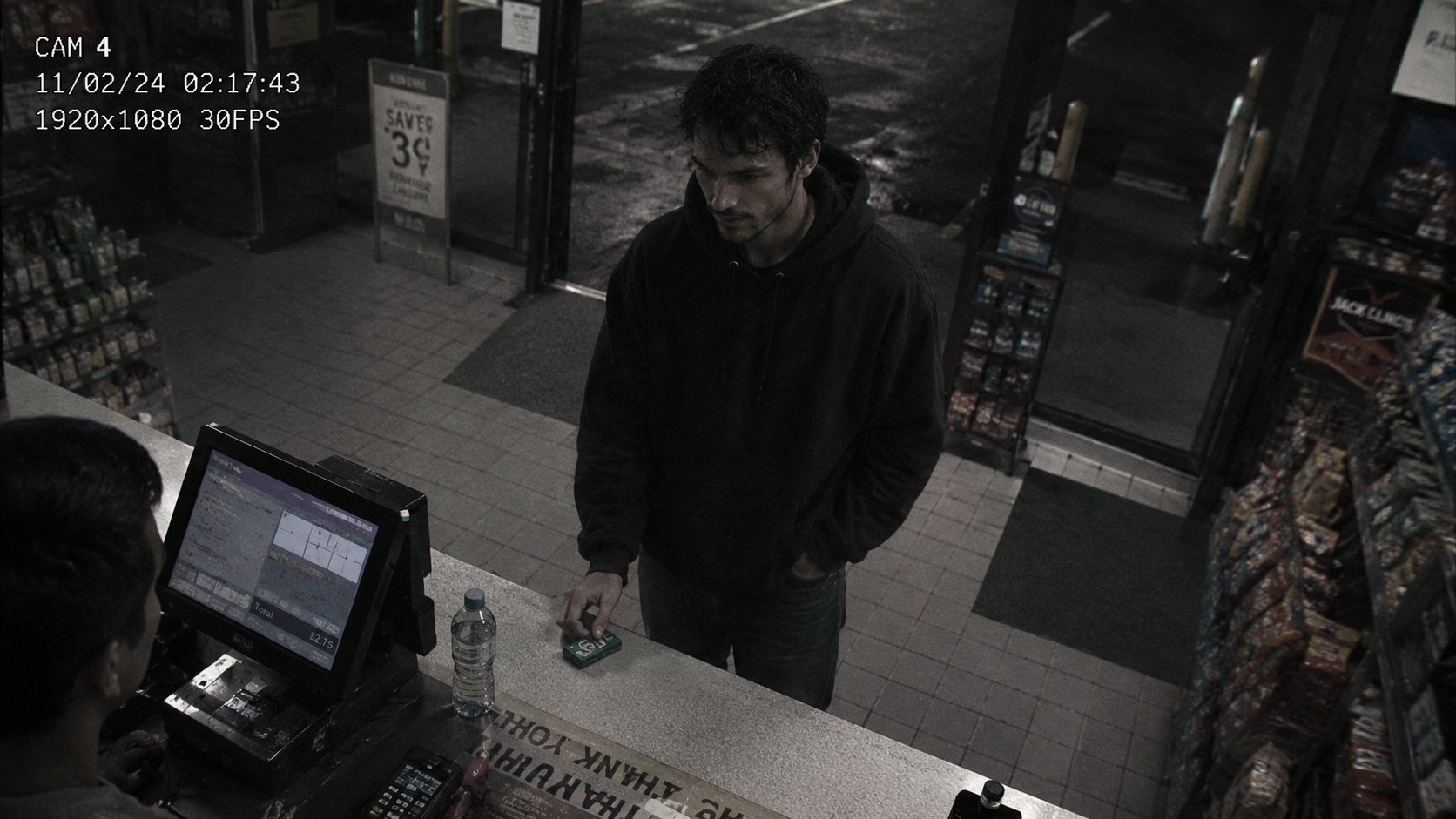
“He paid cash at the gas station,” Cole said. “He had a problem authorizing the transaction. The diner was the only place he used the card successfully. After that, nothing. No transactions. No cell phone pings . . . his phone is still here, as you know. No social media activity. He’s gone completely off grid.”
“Can you track him through the card if he uses it again?”
“Of course. But he hasn’t used it in twenty-seven days. My theory? He’s gone fully analog. No trail.” Cole paused. “Mr. Tucker, I’ve handled dozens of missing person cases. Adults who voluntarily disappear are the hardest to find because they don’t want to be found. And your fiancé isn’t just avoiding you. He may not remember who he is. That’s a different order of problem.”
“You think he’s homeless.”
“I think he’s surviving. He’s resourceful. He’s intelligent. He’s not suicidal. If he were, we’d likely have found him by now.” Cole’s voice was clinical, but not unkind. “A dissociative fugue isn’t a choice, Mr. Tucker. It’s a psychological break. He’s not punishing you. He’s not even thinking about you. He’s operating on instinct, in a mental landscape where you don’t exist.”
I didn’t know which was worse. That Breck might be suffering, or that he might not be thinking about me at all.
The next day, I went looking for him myself.
I drove to the diner on Division Street. It was exactly the kind of place Breck would never have eaten in his old life. Grimy, fluorescent lit, the kind of establishment where the coffee tastes like burnt regret and the waitstaff doesn’t make eye contact. I sat in the same booth Breck had occupied a month earlier and ordered the same thing he’d ordered according to the receipt Cole had pulled. Black coffee. A grilled cheese. The coffee was terrible. The grilled cheese was greasy and perfect. I ate it in silence, staring at the spot where Breck had stared, trying to imagine what he’d been thinking.
Nothing. He’d probably been thinking nothing. That was the point of the fugue. The point was the absence of thought.
I showed Breck’s photo to the waitress. She squinted at it. “Maybe. We get a lot of people through here.” The cook came out, wiping his hands on a towel that had seen better decades. He studied the photograph longer. “Yeah. I remember him. Real quiet. Stared at the rain a lot. Paid with a card, that’s unusual for this place. Most people pay cash.” He handed the photograph back. “Seemed sad. Not like crying sad. Just . . . empty sad. Like someone turned off a light.” I drove back to the townhouse, sat in the driveway, and screamed into my clenched fists until my throat was raw.

Month three, I hired a specialist.
Dr. Amara Okami was exactly what you’d expect from a psychiatrist who consulted on high end missing person cases. Elegant, crisp, and terrifyingly competent. Her office was in a converted brownstone in Lincoln Park, all clean lines and neutral tones, and she moved through it like a woman who’d seen enough human wreckage not to be fazed by it. Cole had recommended her. He’d used her on a previous case involving a Wall Street executive who’d had a psychotic break and wandered into rural Wisconsin. She specialized in dissociative disorders and had a reputation for brutal honesty.
I liked her immediately.
“Dissociative fugue is a protective mechanism,” she said, settling into the chair across from me. “The psyche encounters something it can’t process, usually a combination of traumas, and it walls off the painful material. Not just the memory. The entire identity.”
“Like a circuit breaker.”
“Exactly like a circuit breaker.” She seemed pleased I’d made the analogy. “Your fiancé didn’t choose to disappear. His mind decided, without his conscious input, that being Breck Carson was too painful. So it shut Breck Carson off. The core personality—the temperament, the skills, the emotional instincts—is still online. But the narrative is gone. He doesn’t remember his name, his history, his relationships. He’s improvising a life without context.”
“Is he suffering?”
“Probably not. Not in the way you’re afraid of.” Dr. Okami leaned forward. “A strange calm often characterizes fugue states. The trauma seals off. Anxiety becomes muted. He might be more functional than you expect. Working a simple job. Forming shallow but pleasant relationships. He’s not in agony. He’s in a holding pattern.”
I exhaled for what felt like the first time in months. “So he’s okay.”
“He’s surviving. Whether that’s the same as ‘okay’ is a philosophical question.” She set down her notepad. “Mr. Tucker, most people who hire me want to know two things. How to find their loved one and how to bring them back. I can help with the first one . The second is more complicated.”
“Tell me.”
“Fugue recovery is rarely a single moment of clarity. It’s a process. The psyche lets memory back in when it feels safe enough to process the trauma that caused the break. Safety, in this context, means both physical and emotional. He needs to feel secure enough that his mind decides the threat is over.”
“What triggers that?”
“It depends on the wound.” She studied me with dark, assessing eyes. “You said he lost a caller to suicide the same night he discovered your infidelity. Two betrayals. Two proofs that he couldn’t save the people he loved. His psyche is protecting him from the narrative that he’s a failure. So the trigger would need to rewrite that narrative. He’d need evidence that he’s not a failure. That he’s needed, that he matters, that the people he loves are safe because of him, not despite him.”
I thought about this. “So me showing up and saying ‘I’m sorry’ wouldn’t do it.”
“Probably not. Apologies are verbal. The fugue operates below verbal reasoning. It responds to experience, not arguments. If you found him, the work wouldn’t be about what you said. It would be about what you demonstrated. Consistently. Over time. In a way his body and his instincts could recognize, even if his conscious mind couldn’t.”
I touched my jaw. Unconsciously. Her eyes tracked the gesture.
“You have a tell,” she said.
“I know.”
“Does he?”
“Breck notices everything. But his tell is . . . he touches his ring. Constantly. He’s done it since the day I proposed. It’s like a compass point.” I looked down at my hand, the platinum band still on my finger. “I haven’t taken it off.”
“That’s significant.”
“Is it going to bring him back?”
“No. But it suggests you’re serious about the work.” She stood, signaling the end of the session. “Keep the search going. When they find him, and they will find him, Mr. Tucker, you’ll need to be someone he can trust to get him through this. Not the man who broke him. A man who’s done the work to deserve a second chance. That’s the part money can’t buy.”
I left her office with a recommendation for a therapist of my own and a strange, painful hope blooming in my chest. Breck wasn’t suffering. Breck was out there, functional, calm, living a life he’d improvised from scratch. I’d spent three months imagining him cold and terrified, lost in the city, drowning in a grief he couldn’t name. The reality was almost worse. He was fine without me. He didn’t remember me. Whatever life he’d built, it didn’t include a Trace-shaped hole.
I drove home through a city that felt suddenly, terribly indifferent. The rain had started again, a soft, persistent drizzle, and the windshield wipers beat a steady rhythm against the glass. I turned them off. Let the water blur the streetlights into smears of amber and red. It felt appropriate. My whole life was a blur now, every sharp edge softened by guilt and exhaustion. You can’t pay some debts with money. I’d spent thirty years accumulating a fortune and three months learning it was worth almost nothing.

Month six, I almost became the man I’d always been.
It was a Wednesday. I’d had a session with my therapist that morning. A good one, a hard one, the kind where I’d actually cried in front of another human being without immediately making a joke to deflect. I’d been sober for sixty-seven days. I’d started running again, the same route Breck and I used to do on Sunday mornings, the one that went past the pond with the heron. I was doing everything right. I was doing the work.
And then I was alone in the townhouse on a rainy night and the silence was so loud I couldn’t breathe.
I downloaded the app before I’d consciously decided to. The same app I’d used to meet Rob, the one I’d deleted the night Breck walked out. My fingers moved without permission, muscle memory from a lifetime of looking for exits. I set up a profile. Didn’t use my real name. Used a photograph that was flattering but not identifiable. Swiped right on the first six profiles that appeared.
A match. A message. Hey. You’re gorgeous. What are you looking for?
My thumb hovered over the keyboard. The man in the photograph was handsome. Clean cut, dark haired, a jawline that could cut glass. Exactly my type. The type I’d always used as a distraction, a pressure valve, a way to prove that I still had options, that forever wasn’t a cage.
Just seeing what’s out there, I typed. You?
Same. Want to meet up? I can host.
I looked at the screen. I looked at my left hand, the ring still on my finger. I looked at Breck’s chipped coffee mug still sitting by the espresso machine, because I couldn’t bring myself to move it.
I closed the app.
Opened it.
Closed it.
Opened it.
Went to the bathroom and threw up.
I knelt on the cold tile, the same tile I’d knelt on six months ago, the night Breck disappeared. I pressed my forehead to the porcelain. Eucalyptus still hung dismissively in the air. Breck loved the cleaner because he said the scent cleared his head after a rough shift. I’d been unable to wash it away because it was the last thing in the house that still felt like him.
I deleted the app. Then I deleted my account. Then I went into my phone’s settings and blocked the website, the email domain, everything. I set a password on the restrictions and typed in a random string of characters I wouldn’t remember. I was shaking. My hands, my shoulders, my whole body trembling as if I’d narrowly avoided a car crash.
I called Sloane. It was two in the morning.
“I almost did it again,” I said when she answered. No preamble. No deflection.
Sloane was quiet for a moment. When she spoke, her voice was gentler than I’d ever heard it. “But you didn’t.”
“I was so close. I was typing. I was about to—”
“But you didn’t.” The gentleness was still there, but there was steel underneath it. “That’s the point, Trace. You didn’t. You’ve been that man your whole life, the one who self-destructs when things get real. But tonight, you weren’t. You made a different choice. That’s not nothing.”
“I’m so tired. I’m so tired of being the villain.”
“Then stop auditioning for the role.” Her voice sharpened. “You’re not a villain. You’re a man who did a terrible thing and is trying to become someone who would never do it again. That’s not a redemption arc. That’s just . . . growing up. And growing up hurts like hell.”
I closed my eyes. The bathroom tile was cold against my knees. “When did you get wise?”
“Someone had to. God knows you and I didn’t grow up with paragons of emotional honesty.
I laughed. It was a flimsy, broken sound, but it was a laugh. “Mom would be horrified.”
“Expiration dates horrify Mom. Her opinion doesn’t count.” Sloane paused. “You’re going to be okay, Trace. I don’t know if Breck will ever come back. I don’t know if you’ll get the happy ending. But you’re going to be okay either way. Because you’re finally doing the work.”
“Thank you.”
“Don’t thank me. Go to bed. And if you ever download that app again, I’ll fly to Chicago and break your fingers.”
She hung up. I stayed on the bathroom floor for a long time, the phone loose in my hand, the ring heavy on my finger. Then I stood up, brushed my teeth, and went to bed.
I didn’t sleep. But I didn’t relapse either.
We measure some victories by what you avoid doing.

Month ten, I got the call.
It came from an unexpected source. A woman named Dana Brogan, who’d worked the shift after Breck’s at the Brightline crisis hotline. She’d reached out tentatively at first. An email, then a message through the investigator’s tip line. She’d known Breck for three years and had been thinking about him ever since he disappeared. The hotline had held a small vigil on the anniversary of his last shift, she said. No one had forgotten.
“I think I saw him,” she said when I called her back. Her voice was hesitant, as if she wasn’t sure she should tell me this. “I was at a cafe across town, Cafe Esperanza, near Humboldt Park. I was in the neighborhood for a friend’s birthday and I stopped in for coffee. And the man behind the counter . . . it looked like him.”
“Breck behind a coffee counter?” I’d never seen Breck make an espresso in his life. He could barely operate our machine without supervision.
“I know. It sounds crazy. But Mr. Tucker, I worked with Breck for years. I’d recognize his face anywhere. He’s grown a beard, not a big one, just scruff. And his hair is longer. But it was him.” She paused. “He was smiling. He looked . . . peaceful. I almost didn’t recognize him because I’ve never seen him that relaxed.”
Something twisted in my chest. “Did you talk to him?”
“No. I wasn’t sure it was him, and by the time I decided to go back, he was gone. I’m sorry. I should have said something.”
“It’s okay.” It wasn’t okay. It was the closest thing to a lead I’d had in ten months. “Did you catch his name?”
“He wasn’t wearing a name tag. But the other barista called him something. Michael, maybe? Or Matthew. Definitely an M.”
Michael. My Breck, named Michael. The absurdity of it struck me like a physical blow. He’d chosen the most anonymous name in the English language and slipped into a life I couldn’t have imagined for him. A barista. My fiancé, the crisis counselor, who’d once told me that making coffee was “too much pressure” because he was afraid of messing up someone’s order, was now making lattes for strangers in a neighborhood he’d never visited in his old life.
God, I missed him. I missed him so acutely in that moment that I had to brace myself against the kitchen counter. The missing wasn’t a feeling. It was a physical presence, a weight I’d been carrying so long I’d forgotten it wasn’t part of my body.
I called Marcus Cole immediately after hanging up. “Cafe Esperanza. Humboldt Park. A man matching Breck’s description, going by the name Michael.”
Cole was silent for a beat. “I’ll look into it.”
“Tonight.”
“It’s eleven o’clock, Mr. Tucker. The cafe will be closed.”
“First thing tomorrow, then.”
“Understood.”
The next forty-eight hours were the longest of my life. I didn’t sleep. I didn’t eat. I paced the townhouse like a caged animal, touching Breck’s mug, touching the wedding invitations, touching my ring. The house had become a museum of our former life and I was the only visitor.
Cole’s preliminary report arrived on a Thursday morning. He’d confirmed that a man matching Breck’s description was working at Cafe Esperanza. The cafe owner, Rosa, didn’t ask many questions of her employees. She understood the immigrant neighborhood she served, and she knew some people needed work more than they needed paperwork. The man went by Michael. No surname. He paid the rent in cash for a small apartment above the cafe. He was quiet, reliable, and well liked. He remembered every customer’s order. He was, Rosa said, “the kind of person people tell their problems to.”
Of course he was. Even without his memories, Breck was still Breck. Still the listener. Still the one strangers trusted with their grief.
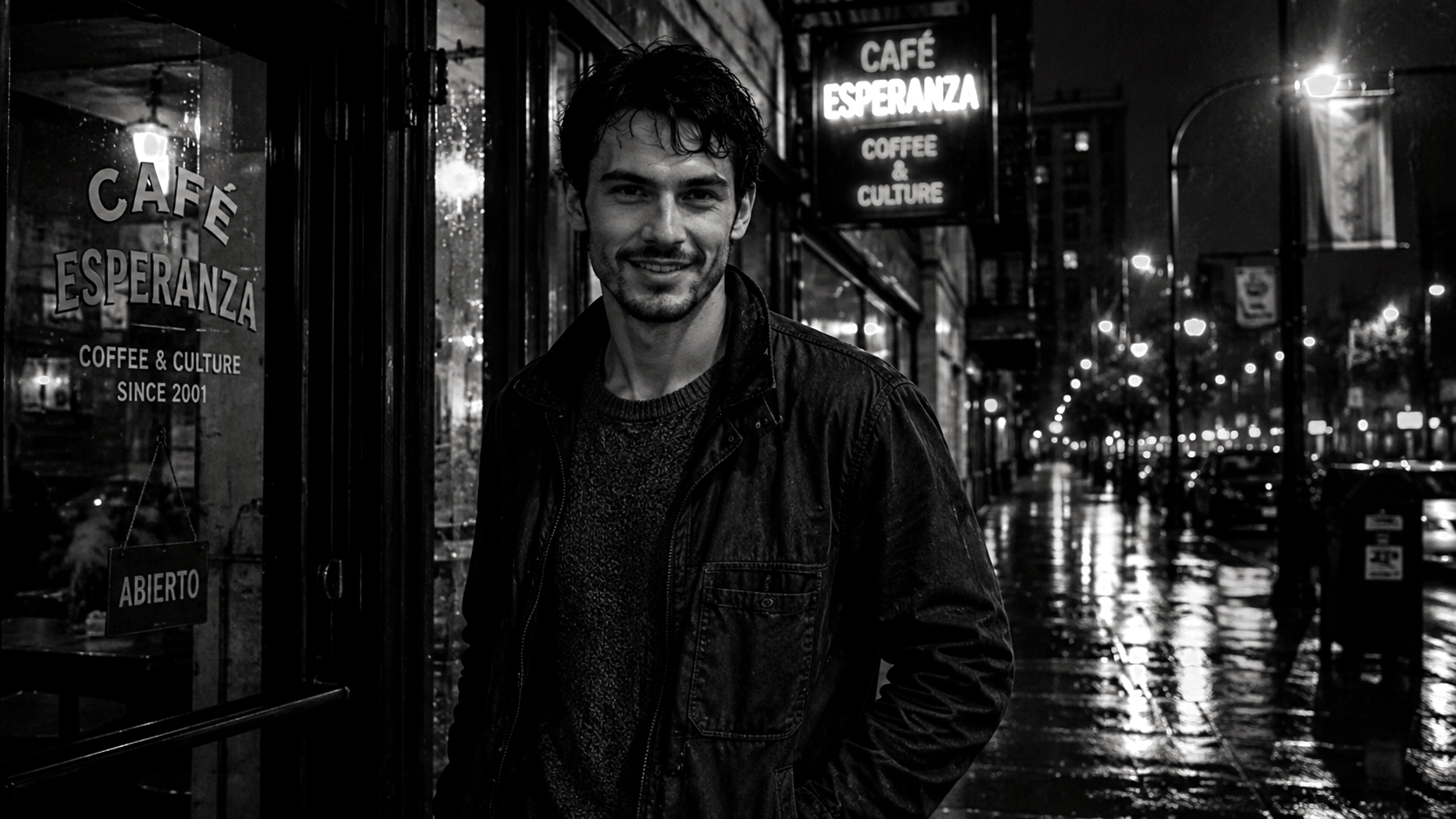
Cole included photographs. Surveillance style, taken from across the street. The first showed a man in a canvas apron, wiping down tables outside the cafe. His hair was longer, his face thinner, a scruff of beard along his jaw. But it was him. The shoulders, the hands, the way he stood with his weight on his left hip. It was him. The second photo was closer, taken through the cafe window. Breck—Michael—was behind the counter, laughing at something a coworker said. His entire face underwent a transformation. Open. Unguarded. The laugh I hadn’t heard in ten months.
I stared at the photos until my eyes blurred. He was alive. He was healthy. He was five miles away. Five miles. A twenty-minute drive. I could be there in the time it took to get into the car. I could walk through the door, say his name, and . . . .
And what?
Dr. Okami’s voice echoed in my head. You’re the trigger, Mr. Tucker. The person who caused the break is often the person who can end it. But you have to do it right.
I didn’t know how to do it right. I didn’t know if there was a right way. All I knew was that Breck was alive and laughing, and I was alone in a house full of ghosts, and I had no idea what to do next.

Month twelve, I found him. But finding him wasn’t the same as bringing him back.
I spent two weeks doing reconnaissance. Not because I was being strategic. Because I was being a coward. I drove to Cafe Esperanza every evening at closing time, parked across the street, and watched Breck lock up. He always did it the same way. Glass door first, then the back entrance that led to the apartment stairs, then a last check of the front door, jiggling the handle twice to make sure it was secure. The same way he’d always checked our front door. Muscle memory. The ghost of a habit from a life he couldn’t remember.
He walked differently now. Slower. Less purpose. The old Breck had moved through the world as if he was exactly where he was supposed to be. This Breck moved like a man who wasn’t sure where he belonged but was making the best of it. He wore thrift-store sweaters and a canvas jacket that had seen better days. He’d stopped shaving regularly. He carried a battered paperback in his back pocket. I couldn’t see the title, but the way he touched it unconsciously reminded me of the way he used to touch his headset during long shifts.
He looked tired. Not exhausted, not the bone deep weariness of someone who was suffering. Just . . . tired. The tiredness of someone who’d been carrying something heavy for a long time without knowing what it was.
I wanted to run to him. I wanted to sprint across the street, grab him by the shoulders, and shake him until he remembered me. I wanted to fall to my knees in the rain and beg him to come home. I wanted to do a hundred things that would have been about my pain, not his healing.
I did none of them.
Instead, I sat in my car with the engine off and the windows fogging up, and I watched the man I loved live a life that didn’t include me. On Tuesdays, he worked the evening shift and walked home under the streetlights, his hands in his pockets, his breath clouding in the cold air. On Thursdays, he closed the cafe with a young woman, a coworker, maybe a friend, and they’d stand on the sidewalk for ten minutes talking and laughing before she caught her bus and he went upstairs to his apartment. On Saturday mornings, he worked the espresso machine and the cafe filled with the hum of conversation, and through the window I could see him moving behind the counter with an ease that looked almost like happiness.
I memorized his schedule. His routes. His habits. It was obsessive and pathetic and I didn’t care. I’d spent a year not knowing if he was alive. Now I knew. Now I could see him. And seeing him, even from a distance, was the only thing that made the hollow year bearable.
I called Avery the night before I planned to approach him. “I found him.”
The silence on the other end was electric. “Where?”
“A cafe. Just five miles away. He’s been there almost the whole time. He’s a barista. He calls himself Michael.”
“Michael.” She made a sound that was half laugh, half sob. “God, that’s so Breck. Just . . . disappearing into the most anonymous name imaginable.”
“He looks good, Avery. He’s okay. He’s been okay this whole time, and I . . . ” My voice cracked. “I’m going to talk to him. Tomorrow. I’m going to go to the cafe and I’m going to tell him everything.”
“Are you sure that’s a good idea?”
“No. But I’ve been sitting outside that cafe for two weeks and I can’t do it anymore. I can’t just watch him. I have to try.”
Avery was quiet. When she spoke, her voice was gentler than it had been all year. “Trace, I’ve spent twelve months hating you. Some of that was fair. Some of it was just . . . easier than admitting I didn’t know how to help my brother either. But you found him. You actually found him.” A pause. “If you go to him, if you actually go, don’t go as the man who broke him. Go as the man who’s spent a year trying to become someone worth coming back to.”
“That’s the plan.”
“Good. And Trace?”
“Yeah?”
“If he doesn’t want to see you, if he tells you to leave, you leave. You respect that. You don’t argue. You don’t negotiate. You let him choose.”
“I will.”
“You’d better.”
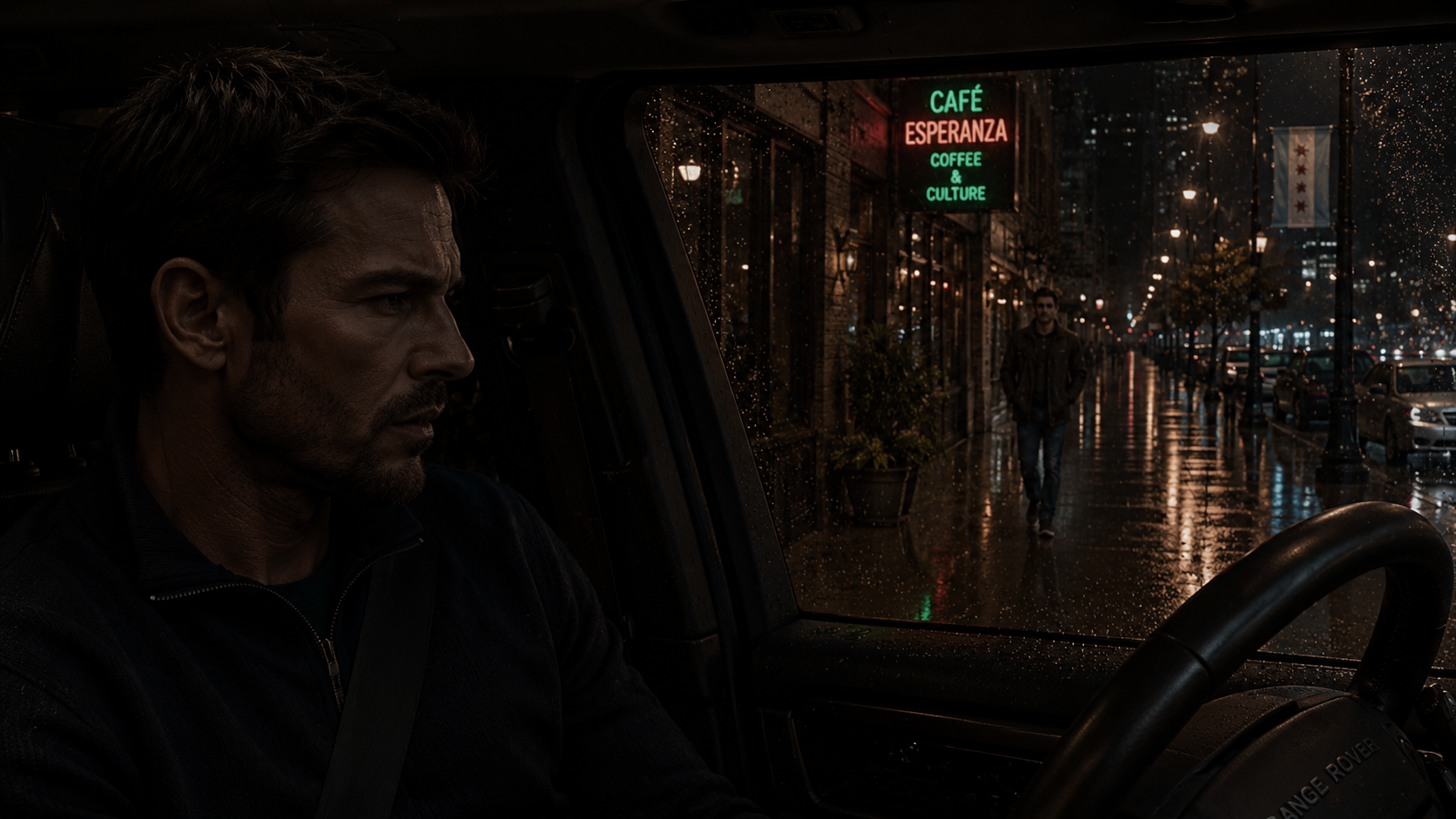
She hung up. I sat in my car outside Cafe Esperanza, watching the rain streak down the windshield. Breck was inside, closing up. I could see him through the window, wiping down the espresso machine, his movements familiar and strange all at once. He looked up once, toward the street, and for a split second I thought he saw me. But his gaze passed over my car without stopping and he went back to his work.
Tomorrow. I’d approach him tomorrow.
Tonight, I was still gathering the courage.

I went home that night and did something I hadn’t done in a year. I opened the hall closet and took out the box of wedding invitations. They were still pristine, still addressed, still waiting to be sent. Breck’s careful handwriting on every envelope. The return address that was supposed to be our first home as a married couple.
I pulled out one envelope and opened it. The invitation was simple. Cream cardstock, gold lettering. Breck Carson & Trace Tucker request the honor of your presence at their wedding . . . . The date had long since passed. The venue had been canceled. Elaine never placed an order for the flowers she had planned.
I traced the letters of Breck’s name with my thumb. Then I put the invitation back in the envelope, sealed the box, and returned it to the closet.
Tomorrow, I’d go to the cafe. I’d tell Breck who he was and who I was and what I’d done. I’d tell him about the search and the specialists and the year I’d spent learning that love was a verb, not a feeling. I’d tell him I was still wearing his ring and that I was sorry and that I understood if he never wanted to see me again.
And then I’d let him choose.
The rain kept falling. The house kept its terrible silence. But somewhere in the city, five miles away, Breck was alive, and laughing, and touching his ring without knowing why. I was going to him. After a year of waiting, a year of becoming, I was finally going to him.
I didn’t know what would happen. I didn’t know if he’d remember me or reject me or something in between. But I knew, with a certainty that felt almost holy, that I’d done the work. I’d sat in the wreckage. I’d let it hurt. I had become someone worthy of a second chance, even if I never received one.
Some debts can’t be paid with money. But they can be paid with patience. With honesty. With a year of showing up even when no one was watching.
I touched my ring. The one I’d never taken off. The one I wouldn’t remove until I’d earned the right to put Breck’s back on his hand.
“Tomorrow,” I said aloud. The word fell into the silence and stayed there, small and bright and terrifying. “Tomorrow.”
The rain answered. Steady. Patient. Unending.
Exactly the way I’d learned to be.

End of Chapter Two