
When a lonely young boxer named Til meets a mysterious stranger named Morfeo at his rundown gym, the immediate chemistry between them feels like something out of a dream. A rain-soaked alley kiss, an invitation home, the terrifying hope of being truly seen. But Morfeo is hiding a devastating secret: he’s an Extractor, a corporate operative trained to seduce, harvest heartbreak as a luxury drug, and vanish without a trace. What begins as a calculated assignment is already threatening to become dangerously real for them both.

Til
The rain started somewhere around three in the morning. I was awake to hear it. Had been awake for an hour, maybe longer, lying on my back under the Ibanez poster with the sheets gone clammy and my shoulder aching from the sparring session I’d pushed too hard the day before. The clock on the nightstand read 3:17 in green digits that hung in the dark like something suspended in water. The ceiling had a stain in the corner shaped like a fist. I’d been looking at it long enough to know its geography by heart.
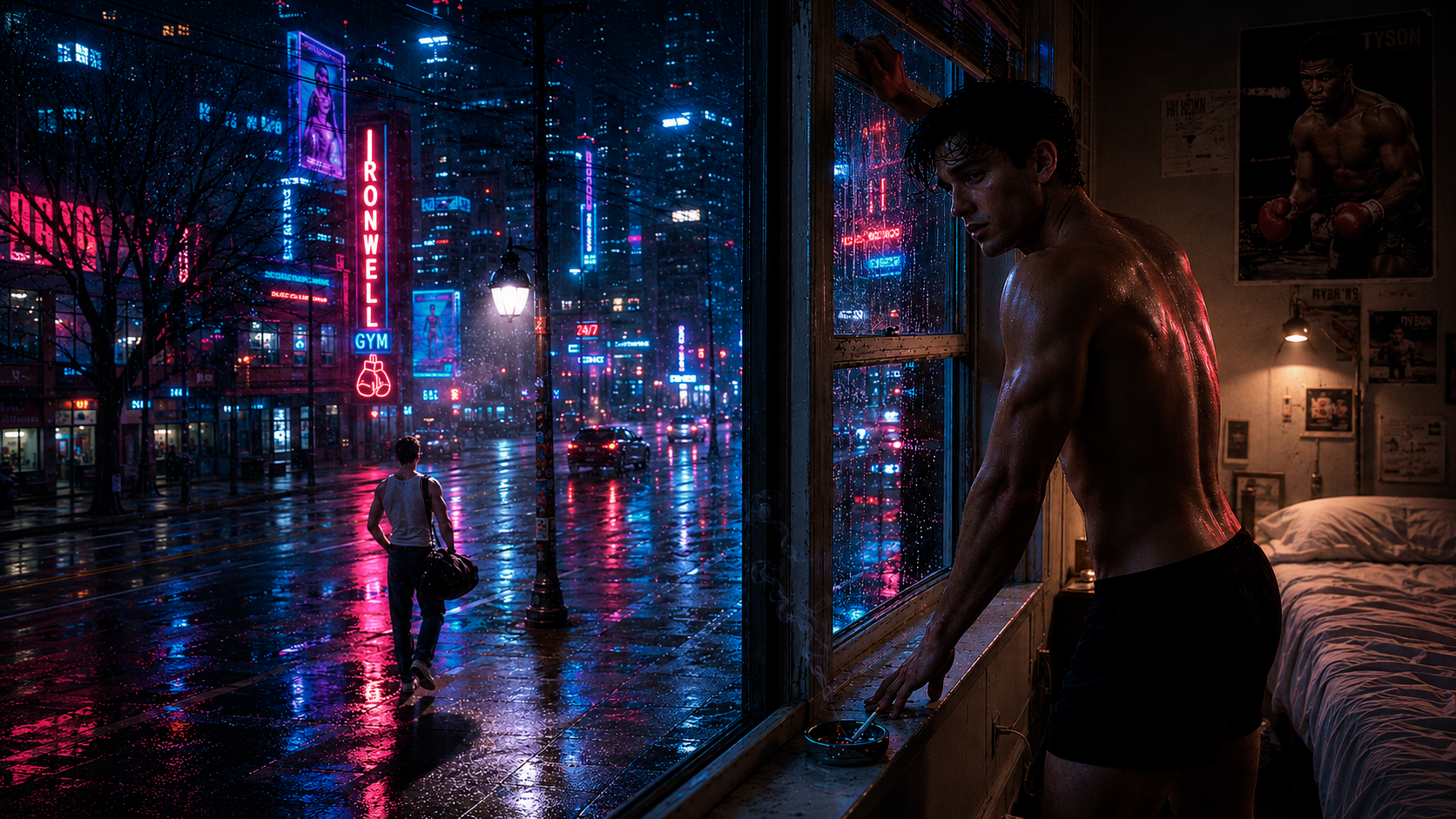
The first drops hit the windowpane with a sound of someone tapping to be let inside. Then more, and more, until the entire street was a blur of water and pink neon.
The Ironwell Gym sign across the street never slept. It buzzed through my curtains at all hours, bleeding hot pink into the apartment, and I’d learned to let the hum of it become a kind of quiet. The way you learn to sleep next to a highway or a lover who snores. The sign was always there. So was I.
I pushed up onto my elbows. The air in the apartment had that stillness that comes with three in the morning. Stale, close, holding the ghost of whatever I’d cooked for dinner and the faint chemical sweetness of the neon. My shoulder rolled with a familiar pull of muscle and tendon, the body’s minor complaint.
The cigarette was in my hand before I made the choice to smoke it.
I did that sometimes. My body goes ahead of my mind, making its own decisions. I cracked the window and the rain smell rushed in all at once. Wet concrete and neon and something green underneath, something alive that the city usually buried. I lit up. The first drag hit the back of my throat with a burn that was almost comforting.
The street below was empty. Naturally. Three in the morning and raining hard enough to keep anyone with sense indoors. The pavement was a dark mirror, and the Ironwell sign floated in it, doubled and broken, pink and shimmering where the water rippled over cracks in the asphalt.
I watched the rain trace paths down the windowpane and tried not to think about her.
My mother. Four years gone. I still bracketed my thoughts around her the way your tongue keeps returning to the space where a tooth used to be. The last thing she said to me was fight. Not boxing—she never cared about boxing, she came to one match and spent the whole time with her hands over her face. She meant fight to stay soft. Fight to keep the part of me that could still cry at movies, still cup a dog’s face in my hands and tell it I loved it, still let people in. She was on her third round of chemo by then, bald and paper-skinned, and she held my jaw in her hand as if she were measuring me for something.
Don’t let the world make you hard, Til. Anyone can be hard. Hard is the easy part.
I took another drag and let the smoke curl out into the rain. My reflection in the glass was a man I half recognized. Square jaw, dark hair sticking up in the back, shoulders that had gotten wider in the last year. The kind of man who looked like he could hurt someone. The kind of man who, in a few hours, would cross the street and hit things until his hands ached and call it training.
The thing was, I didn’t want to be hard.
I wanted to be the kind of person someone came home to. The kind who made coffee for two in the morning instead of standing alone at a window with a cigarette. The kind whose bathroom had someone else’s toothbrush in the cup.
I stubbed out the cigarette. Years ago, I picked up the ashtray at a thrift store. It was chipped on one side and I never replaced it. The smoke rose and vanished. The rain kept falling. The sign kept buzzing.
I went back to bed. Not to sleep. Just to lie there under the poster. Marco Ibanez, the Saint himself, mid-cross, frozen in a moment of perfect violence, and wait for the morning.

The gym smelled as it always did.
Sweat first. Then leather, the finicky musk of old gloves and heavy bags that had absorbed years of impact. Under that, the cleaning solution Marlo used on the mats. Eucalyptus and something sharper, almost medicinal. The tall windows let in a gray, rain-washed light that cut the room into stripes of brightness and shadow. The heavy bags hung in their row like something waiting. Someone had left a jump rope coiled on the floor near the speed bag, and the red vinyl of the ring ropes creaked as two guys I didn’t know sparred light in the far corner.
I was already on the bag when Marlo came over. Jab, cross, hook. Jab, cross, hook. Combinations he’d called out fifteen minutes ago, and I’d been drilling since. My wraps were damp with sweat. The bag shuddered under each impact.
“Your left’s dropping,” Marlo said.
He was sixty-three and built like a fire hydrant with hands so gnarled they told the story without him having to say a word. He’d been in the sport for forty years. He’d forgotten more about boxing than I’d ever know.
“It’s not dropping.”
“Dropped twice. I saw it. Don’t argue with me.”
I reset, threw the combination again, made sure the left came back to guard. Marlo grunted. That was as close to praise as he got before noon.
The gym had maybe six people in it that early. Diego was on the speed bag, a blur of rhythm and concentration, his eyes focused on nothing. A woman with a shaved head worked the heavy bag in the corner, hitting it with a steady, methodical violence. The two guys in the ring moved through their paces, the ropes creaking, their footwork making soft sounds on the canvas.
And near the door, standing with the stillness of someone who’d been watching for a while, was a man I’d never seen before.
He was older than me. Early thirties, maybe. Dark hair, dark eyes, a jaw that could cut glass. He wore a white tank top and dark jeans, and he had the kind of body that said he worked at it but didn’t live in the gym. Lean, defined, not bulky. A duffel bag sat at his feet.
He was looking at me.
Not glancing. Not scanning the room. Looking at me the way you look at something you’ve been searching for and finally found.
I missed a beat on the bag. Caught it, reset, finished the combination. When I looked again, he hadn’t moved.
Marlo followed my gaze. “You know him?”
“No.”
“He’s been standing there for ten minutes. Go see what he wants before I charge him rent.”
I pulled off my gloves. Unwrapped my hands as I walked over, the cotton coming away damp, the skin beneath reddened and warm. The guy straightened up when I got close and I saw his eyes more clearly, deep brown, almost black, with something behind them I couldn’t get a read on.
“Can I help you?”
He smiled. A small smile, almost private, as if he were sharing a joke with himself. “I hope so. I was told this was the place to learn. I’m looking for someone to show me the basics.” He paused, and the smile shifted into something a little self-deprecating. “I’ve never thrown a punch in my life.”
His voice was low and a little rough at the edges. It settled somewhere at the base of my spine. I ignored that.
“That’s what the sign says. Ironwell Gym.” I gestured at the door. “We do walk ins. Marlo handles new members.”
“I saw him.” He glanced toward Marlo, then back. “He looks like he’d yell at me. You’ve got patient written all over you.”
“I’m not.”
“You’re lying.”
Something hung in the way he said it. Not challenging. Just certain. Like he’d already decided what kind of person I was.
“I’m Til,” I said, because I didn’t know what else to say.
“Morfeo.” He offered his hand. His grip was dry and warm and lasted a beat longer than a handshake should. “Just Morfeo. My mother had a thing for Greek mythology.”
“Morfeo.” The name sat strangely in my mouth. “The god of dreams.”
“You know your mythology.”
“I know a few things.”
His eyes moved down my body and back up. Quick, but not so quick that I missed it. “I bet you do.”
There it was. The shift in the air. The unspoken thing becoming spoken. I’d been hit on before. The gym attracted a certain type but this felt different. Deliberate. Like he wasn’t testing the water so much as telling me the water was warm and he knew I wanted to swim.
I should have said something about the rates. About Marlo. About any of the normal things you say when a stranger walks in and asks for help.
Instead, I said, “You want to hit the bag?”
“I want to learn how.” He tilted his head, still smiling. “You offering to teach me?”
I should have said no. I had my own training. Marlo would have opinions.
“Come on,” I said. “I’ll show you a jab.”
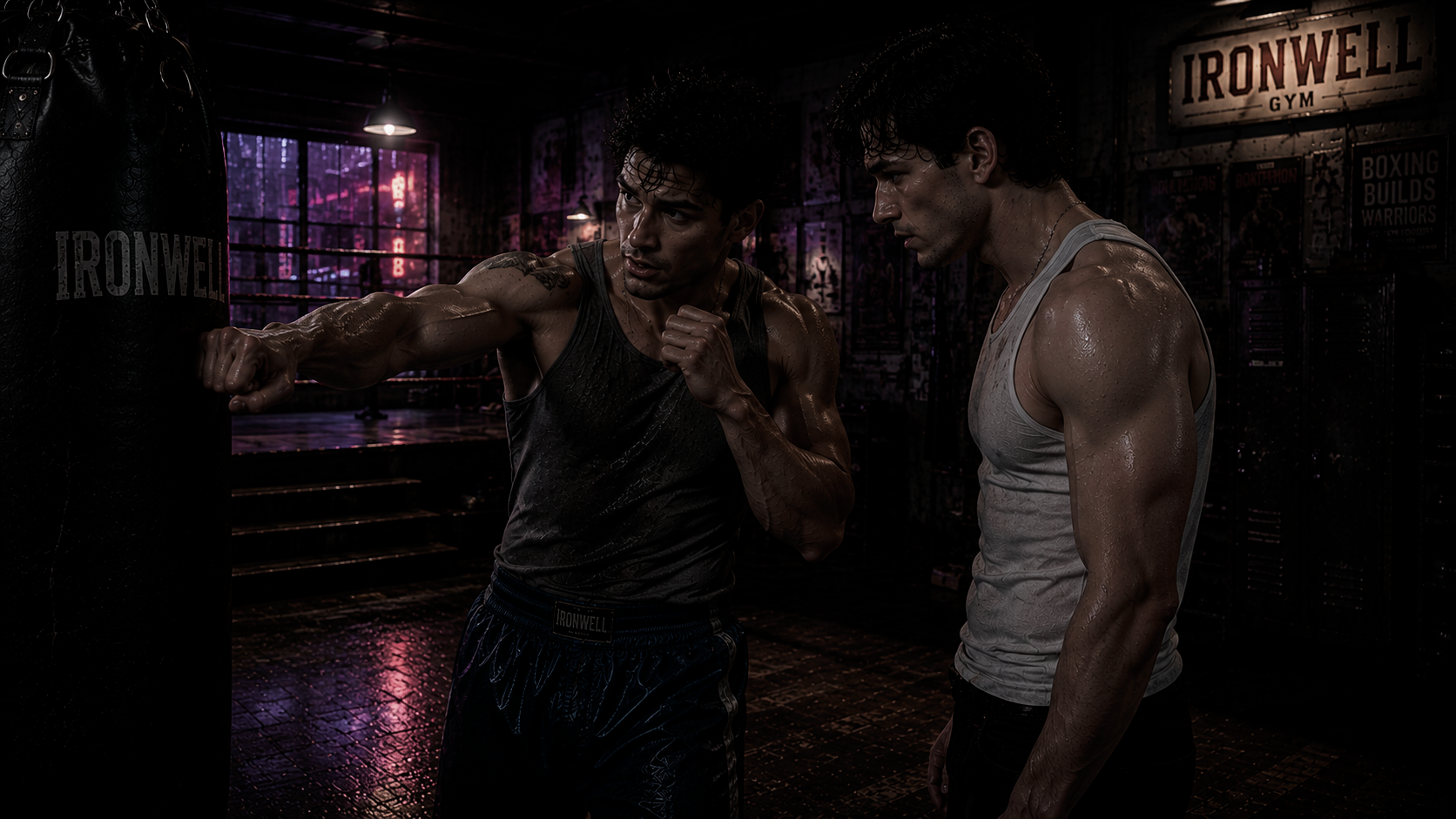
His hands were wrong on the bag.
Not weak. Just placed as if he’d never done this before, like the whole concept of hitting something was foreign to his body. I saw his thumb tucked inside his fist when I glanced over, a classic beginner’s mistake, so I reached out without thinking.
“Thumb outside. You’ll break it if you hit that way.”
His knuckles were warm under my fingers. I adjusted his grip, folded his thumb over his index and middle fingers, and showed him how to keep the wrist straight. He let me move his hand as if it belonged to me. When I looked up, he was watching my face, not the bag.
“Like this?”
“Like that.”
He threw a practice jab. It was terrible, his elbow flaring, shoulder too high, no rotation from the hip. I caught his arm and re-positioned it.
“From here.” I tapped his shoulder. “Not here. You’re throwing with your arm. You want to throw with your body. The arm is just the delivery system.”
“The body.”
“Everything starts in the hips. Boxing’s just a conversation between your feet and your hands. Everything else is translation.”
He tried again. Better. Still wrong, but better.
“You’re a poet,” he said, and he wasn’t mocking me. He sounded genuinely interested.
“I’m a boxer.”
“Same thing. Rhythm. Timing. Knowing when to strike.” He reset, threw another jab, and this time his form was almost right. “How’s that?”
I should have stepped back. Told him to keep drilling and went back to my bag. But I was still standing close enough to breathe in his clean sweat, something spicy hanging underneath, and cedar, a scent that made me want to lean in instead of away.
“Better,” I said. “You’re a fast learner.”
“You’re a good teacher.”
The gym around us faded. The slap of jump ropes, the grunt of someone taking a hit, the buzz of the neon sign that bled through the windows even in daylight. It all went quiet, or maybe I just stopped hearing it. It was just us and the bag and the space between us, which was getting smaller.
“You’re beautiful when you’re focused,” he said. “Has anyone ever told you that?”
The words landed in my chest. Stayed there.
I should have laughed. Deflected. Put the wall back up. But the wall wasn’t there anymore, and I couldn’t remember when it had come down.
“No,” I said. “No one’s told me that.”
“Then they weren’t paying attention.”
I didn’t know what to do with the heat spreading through my ribs, or the way my pulse had picked up, or the fact that I wanted to reach out and touch him again. And not to fix his grip this time.
“What time do you get off?” he asked. Not subtle. Not trying to be.
“Usually around noon.”
“There’s a diner on Fifth. The one with the chrome counter and the neon clock that’s been broken since 1987. Let me buy you lunch.”
It wasn’t a question.
“Yeah,” I heard myself say. “Lunch sounds good.”
His smile widened, just slightly, and it hit me like a hook to the ribs. Sharp and sweet and leaving me breathless.
“Good,” he said. “I’ll be here.”
He picked up his duffel bag and walked to the bench by the wall. Settled in. And I went back to the heavy bag with my hands shaking, my heart beating harder than it had in any fight I’d ever been in.

Morfeo
The diner was exactly as I’d expected.
Chrome counter, red vinyl stools patched with duct tape in places, a neon clock on the wall with its hands frozen at 4:37. The windows were fogged with condensation and outside the rain had settled into a thin drizzle that blurred the city into smears of blue and purple light. The smell of frying onions hung in the air. Coffee. The faint sour note of a rag that needed changing.
He was already there when I arrived.
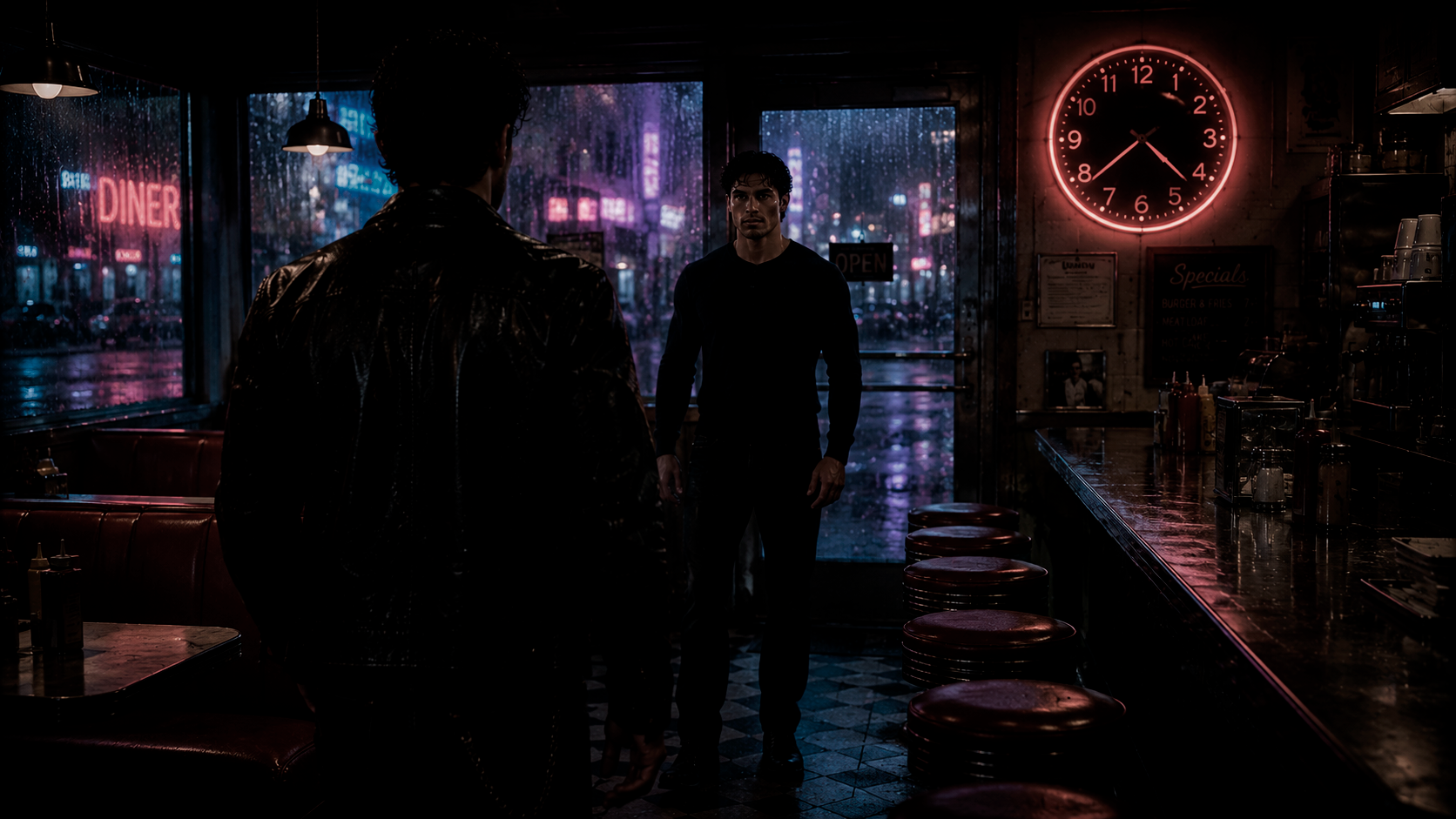
Back booth, facing the door. He’d changed out of his gym clothes into a dark sweater that made his shoulders look even broader. His hair was still damp from the shower, curling a little at the ends. He stood when he saw me. Stood, like I was someone worth standing for.
“Hey,” he said. “I wasn’t sure you’d come.”
“Did I seem uncertain?”
He considered that. “No. But people don’t always do what they seem like they’ll do.”
“And what did I seem like I’d do?”
He looked at me for a long moment. “You seemed like you’d show up.”
He wasn’t wrong. I’d been calibrating this approach for the better part of a week. The gym, the timing, the exact modulation of eye contact and physical proximity. The script was clean. The emotional yield projections were excellent. Subject Til Brogan, 25, orphaned, no significant relational attachments, vulnerability index of 94 on the Hiraeth scale. A rich vein. Deep and unguarded and waiting.
What I hadn’t calibrated for was the way he stood when I walked into a room.
We ordered coffee. The waitress was a woman in her fifties with tired eyes and a name tag that said Dot. She took our orders writing nothing down, burger for him, just coffee and toast for me, and left us alone in the booth with the fogged windows and the ticking of a clock somewhere behind the counter that actually worked.
“So,” I said, wrapping my hands around the warm ceramic of the mug. “Tell me something true about yourself.”
He laughed. A good laugh, unguarded, coming from somewhere low in the chest. “Starting with the hard questions.”
“Life’s too short for small talk.”
“All right.” He leaned back in the booth, considered me. “I’m scared of the dark. Not monster under the bed scared. But I can’t sleep without a light on somewhere. The bathroom, the hall, the neon sign outside my window. I need to know where the door is.”
“That’s two things. The fear and the sign.”
“You asked for true. I gave you true.”
“I appreciate it.”
“What about you?” He leaned forward, forearms on the table. “Something true. You’ve got the look.”
“What look?”
“Like you’re holding a lot of things back. Like you’ve got an entire room inside your head you don’t let anyone into.”
The dampener behind my ear gave a soft hum. Barely perceptible. A reminder. I ignored it.
“I don’t sleep well,” I said. “Never have. I dream too much.”
“That’s the name, right? Morfeo. Dreams.”
“Apparently, it’s ironic.”
“Or accurate in a way you don’t want to think about.”
He was sharper than the dossier had suggested. The profile said emotionally available, physically confident, intellectually average. But there was nothing average about the way he was looking at me, like he was already peeling back layers I hadn’t known I was showing.
“What else?” he asked.
“What else what?”
“Something true. You gave me one. I’m owed at least one more.”
I should have deflected. Turned the focus back where it belonged. But something in me, something the dampener was supposed to be suppressing, wanted to give him this.
“I don’t have anyone,” I said. “No family. No hometown I’d go back to. No one who’d notice if I disappeared.”
I expected him to flinch. They usually did, when you showed them the void that close. But Til just nodded, slow and thoughtful, and reached across the table to touch the back of my hand.
“Now you do,” he said.
Two fingers on my knuckles, brief. I felt it everywhere. The dampener crackled. A warning light pulsed behind my ear—amber, not yet red—and the surge of something I couldn’t afford to name raced through me.
He doesn’t mean it, I told myself. He’s lonely. He’s projecting. This is the job.
But the warmth of his fingers still radiated on my skin.

I planted the first micro-mite when he went to the bathroom.
A casual gesture. I brushed my hand across the collar of his jacket, draped over the back of his chair, and the mite, smaller than a grain of rice and invisible to the naked eye, adhered to the fabric. It would embed itself in his apartment within twenty-four hours. Emotional neural data would begin transmitting back to my drive. The first step in a harvest that would take months to complete, if I did it right.
When he came back, I’d already schooled my face into pleasant neutrality. The dampener was back to full functionality.
“Everything okay?” he asked, sliding into the booth.
“Everything’s fine.” I smiled, the one I’d practiced. Warm, trustworthy. “I was just thinking about what you said earlier. About boxing being a conversation.”
“Yeah?”
“I like that. The idea that violence is just communication. Another way of speaking.”
“Everything’s communication,” he said. “Fighting. Touching. The way someone looks at you across a table.”
He was looking at me across the table, and there was nothing ambiguous about it.
“And what are you communicating?” I asked.
He didn’t answer. He slid out of the booth, dropped a few bills on the table to cover the food, and held out his hand.
“Walk with me,” he said.

The rain had stopped. Wet streets gleamed, mirroring the neon signs that colored every building in this city section. Pink, blue, violet, a vibrant display bleeding into puddles and smearing over windshields. Ozone and wet asphalt saturated the air, with an undercurrent of something fried from a street vendor a block away.
We walked without talking at first. His hands were in his pockets. Mine were at my sides. Our shoulders brushed occasionally. Neither of us moved away.
“I don’t do this,” Til said finally.
“Do what?”
“Meet someone and feel like I’ve known them for years. That’s not a thing that happens to me.”
“Maybe it’s happening now.”
“Maybe.” He stopped walking. We were at the mouth of an alley, a narrow gap between two buildings, dark except for the glow of a distant neon sign that turned the wet brick into a corridor of violet light. “Or maybe I’m just an idiot who’s about to make a mistake.”
“Is that what you think I am? A mistake?”
“No,” he stepped closer. “I think you might be the opposite. And that scares me more.”
The dampener gave a sharp, insistent buzz. I ignored it. I was standing in a rain-soaked alley with a mark who was about to kiss me and I should have been thinking about the harvest yield and the data signature and the protocol for maintaining emotional distance during physical contact.
I wasn’t thinking about any of that.
I was thinking about the way his jaw tightened when he was nervous. The way his breath caught just before he decided. The way his hand came up to cup the side of my face. Callused and warm and so gentle I could have screamed.
“Tell me to stop,” he said.
I said nothing.
He kissed me.
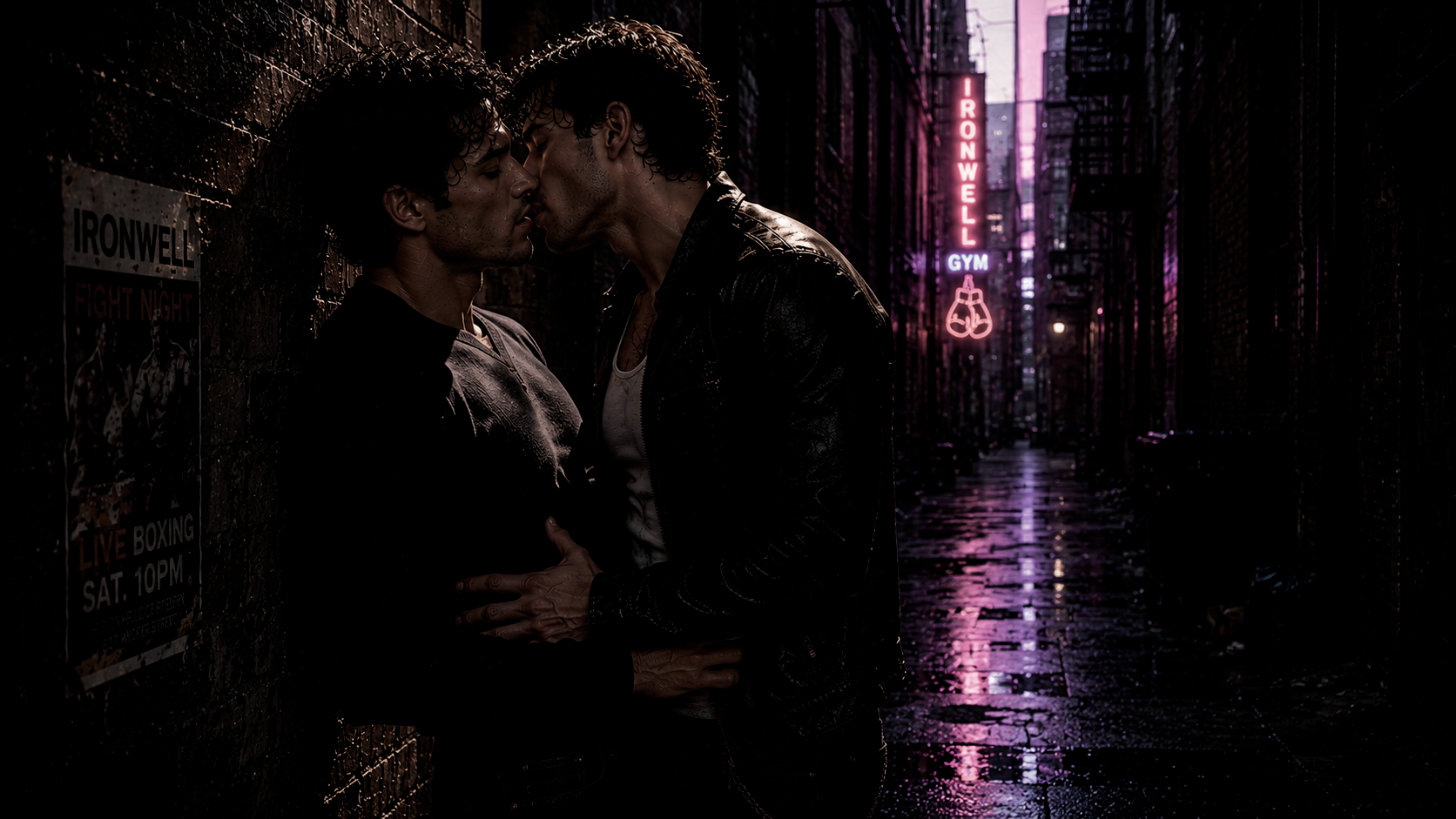
It wasn’t gentle. It wasn’t tentative. It was the kiss that came from someone who’d been holding back a long time and had finally decided to stop. His mouth was hungry. His hands gripped my hips. My back hit the wet brick of the alley wall, and I kissed him back with everything I had.
This is the job, I told myself. This is what you do. This is the protocol.
But the dampener was screaming. Amber light pulsing behind my ear. And I couldn’t tell the difference anymore between what was real and what was supposed to be real. His hands were under my jacket. His mouth was on my throat. The rain had started again, a thin drizzle catching the neon light, and I pulled him closer because I wanted to. Because I needed to. Because for one goddamn second I wanted to feel something that didn’t get logged on a drive and sold to the highest bidder.
We broke apart, breathing hard. His forehead rested against mine. The rain was in his hair, on his eyelashes. He was smiling. A genuine smile, open and wide, like something inside him had come unlatched.
“That was . . . ” He shook his head, laughing a little. “I don’t have words for that.”
“You’re a poet. Find them.”
“Shut up.” He kissed me again, softer this time. A question instead of a demand. “Come home with me.”
I should have said no. The protocol was clear on this point. Maintain control, delay physical intimacy, build the emotional connection gradually so the eventual break yielded maximum harvest. Rushing was a tactical error.
“Okay,” I said.
Because I wasn’t thinking about the protocol anymore. I was thinking about the way his hand fit around mine. The way he led me out of the alley and down the street toward his apartment. The way he kept glancing back, checking that I was still there. That I was real. That I wasn’t something he’d dreamed up in the neon dark.

Later, alone in my rented room with the door locked and the dampener finally silenced, I pulled out the drive and looked at the data spooling across its surface.
The emotional signature was pink. Vivid pink. The color of new love. Of hope. Of someone opening a door they’d kept locked for years.
The yield projections were off the charts.
I should have been pleased. This was why they paid me. What I’d trained for. I was good at this job, and the data would sell high. Heartbreak of this quality didn’t come along often. Some corp would bottle it into a luxury compound and sell it to rich people who wanted to experience something for a few hours without the mess of actually living through it.
But I could still remember his mouth on my throat. I could still hear the way he’d said come home with me. I could still see the way he’d smiled when he kissed me in the alley, like the world had abruptly rearranged itself into something worth living in.
I put the drive away and lay down on the bed. The neon outside the window bled through the thin curtains, some sign I hadn’t bothered to read, and dribbled a stream of blue light across the ceiling. I watched it until it blurred into nothing.
Subject Til Brogan, I thought. Emotional resonance profile: exceptional. Vulnerability index: 94. Heartbreak yield projection: maximum grade.
Initiation phase complete.
I didn’t sleep at all.

My phone buzzed at four in the morning.
A text from an unsaved number. I knew who it was before I opened it.
You’re beautiful when you’re focused. Sweet dreams, champ.
I stared at the screen for a long time. The dampener was on the nightstand, still and silent. I hadn’t put it back on since I got home.
When can I see you again? he’d asked, just before I left his apartment. He was standing in his doorway with his hair a mess and his mouth swollen and his eyes so full of something I didn’t have a name for.
Soon, I’d told him. Very soon.
And the worst part, the part that was going to keep me staring at that ceiling until the gray light of dawn finally seeped through the curtains, was that I meant it.

End of Chapter One.