
After a tense break-up leaves him shaken, weary art student Jesse reluctantly seeks refuge at a late-night pool party, only to find an unexpected sanctuary in the quiet orbit of Wade, an older, grounded host. A chance encounter over a painting sparks an unspoken understanding between two guarded men, offering the promise of connection on a warm Texas night where neither is looking for anything but ready for exactly what they find.

Jesse
The texts started at eight-thirty. I knew this because I checked my phone when I came out of the walk-in cooler at the restaurant, my arms full of prepped mise en place for the dinner rush, and the screen was already lit with the first one.
Thinking about you.
I set the containers down on my station and didn’t answer. That was the right call. Eight-thirty on a Friday and I had four hours of service ahead of me and Luke had already texted me twice that day, once at noon when he knew I was in class and once at three when he knew I was at work, and thinking about you at eight-thirty on a Friday when you know someone is in the weeds was not a thing you sent because you were thinking about them. It was a thing you sent because you wanted them to think about you.
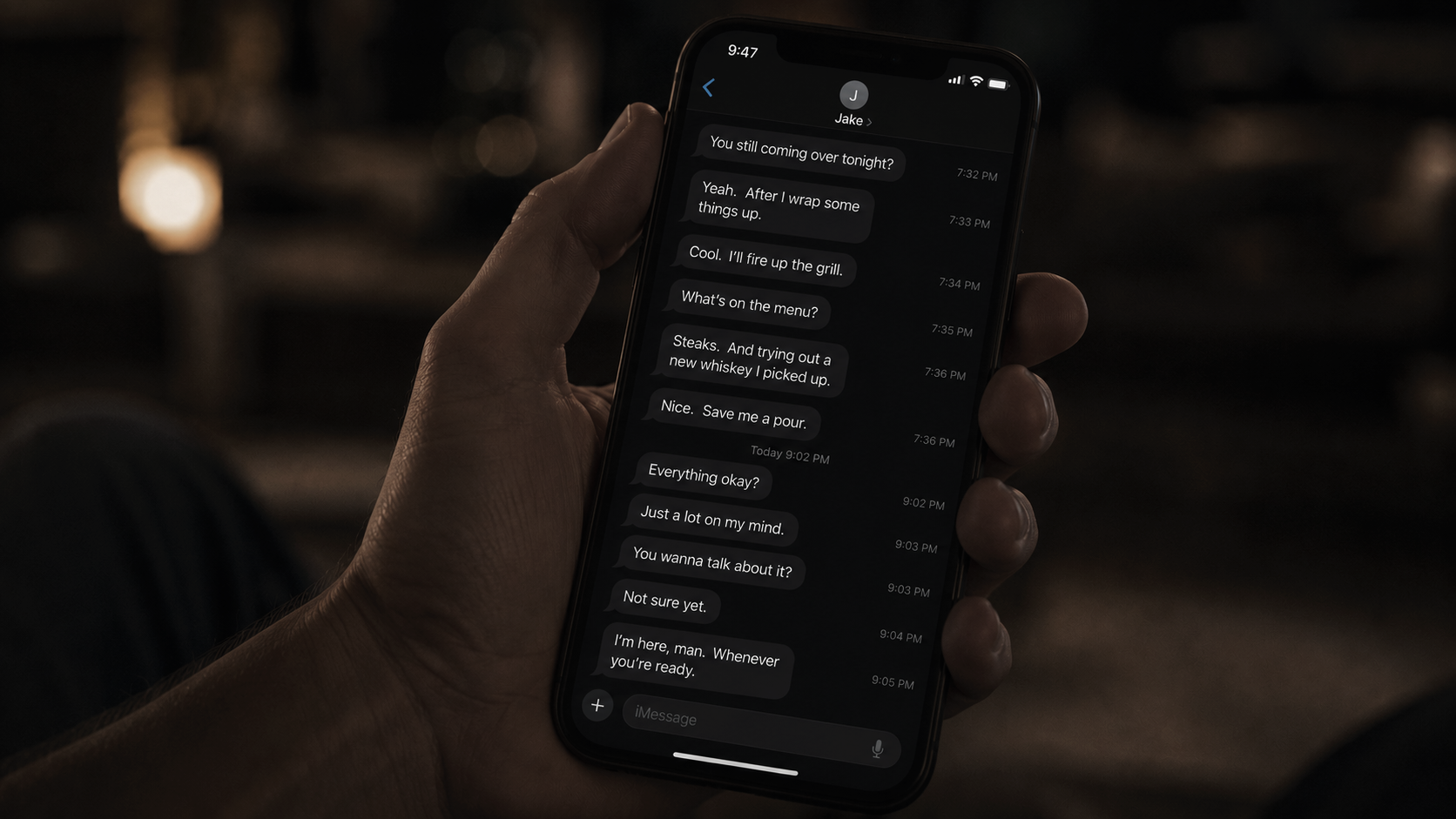
I put my phone face down and worked.
By the time I was walking to my car it was ten forty-seven and the night had that distinctive feel of a June night in North Texas. Not cool, not cooling, the heat of the day still present in the air and in the pavement under my feet, the kind of warm that had no intention of going anywhere just because the sun had. My feet hurt the way they hurt after a double, not just tired but weighted, the joints registering a complaint that started at my heels and worked upward. My lower back had its own separate grievance, a tightness just above my left hip that only made itself known after a long service and that I’d learned to manage by stretching against my car door before I got in. The parking lot was half empty, the sodium lights doing their orange thing overhead, and somewhere across the service road a truck was idling with the low, patient sound of a diesel engine that had been idling for a long time.
I leaned against the driver’s side door and stretched, one hand on the roof, and looked up at the sky. The sky was starless. The light pollution from the strip mall and the highway and the enormous Walmart three blocks south erased everything above a certain brightness threshold, which meant the sky that night was just a flat, ambient orange-gray that pressed down on the parking lot like a lid. The air was thick, not unpleasant, not anymore, just present, the heavy density of a place that had decided humidity was a permanent condition rather than a weather event.
I checked my phone.
Seventeen texts. I stood in the parking lot and read them in order, which took longer than it should have because my eyes kept stopping and backing up, the way you re-read something when your brain refuses to process what it’s telling you.
Thinking about you.
How’s your night going?
You must be busy haha.
Can’t wait to see you tomorrow.
Hey are you okay?
Just checking in.
I was thinking I could come by tonight. Just for a few minutes. To give you a hug.
I know you said you were tired but I’d really like to see you.
I’m like five minutes away.
I can help with your housework haha.
You there?
Jesse?
I’m outside.
Hello??
Please just let me know you’re okay.
I’m worried about you.
I’m going to knock.
I put my phone in my pocket and got into my car.

The drive home took twenty-three minutes at that hour, I35 mostly clear, the Denton exit coming up fast in the dark. I thought about what I wanted to say the whole way, and by the time I was pulling into my apartment complex I still didn’t have it down. I knew what I needed to say. I just didn’t know how to say it in a way that was kind and clear in equal measure, and I’d learned the hard way that those two things were harder to hold together than they sounded, that clarity won when they competed and you were tired enough.
His car was in the visitor lot. A silver Civic with a dent in the rear quarter panel that he’d told me twice he kept meaning to get fixed, the way people mention small things they hadn’t done because naming the intention was easier than addressing the problem.
I sat in my car for a moment. The engine ticked as it cooled. Through my windshield I could see the stairwell light on the second-floor landing and the shadow of someone sitting on the top step, which meant he’d been here long enough to have found somewhere to wait, which meant this was not five minutes, this was however long it took to drive from wherever he was to here and then sit on a concrete step in the June dark and wait. The image of that, of Luke sitting on my stairs in his blue Henley, waiting, because he’d decided to come regardless of what I said, did something complicated in my chest that I couldn’t name and didn’t try to.
I got out of my car.
“Hey.” He was standing when I reached the landing, moving to his feet the moment he heard me on the stairs, the way he always seemed to know exactly where I was. He was smiling an anxious smile that relaxed as he saw me. The blue Henley, sure enough. The sleeves were pushed up. “I was worrying.”
“I told you I’d be late,” I said.
“I know, I know.” He fell into step beside me as I reached the landing, close enough that our arms brushed. “I just . . . I missed you. And I thought even five minutes, just to see you, and I can help with the housework, you mentioned you had stuff to do—”
“Luke.” I stopped at my door and turned to face him. He stopped. He was taller than me by an inch, which was not a common experience, and he was looking at me with an expression I recognized by now, the one that was working hard to seem relaxed. “It’s almost eleven. I’ve been on my feet since one o’clock.”
“I know, I’m sorry, I just—”
“I told you this afternoon I needed a quiet night.”
“I know.” He nodded, quick, agreeable. “You’re right. I know. I just thought . . . I figured I’d be in and out, and you’d feel better seeing me. You always say you feel better—”
“Come inside for a second,” I said.
He followed me in. I set my work bag down by the door and turned on the lamp on the entryway table and didn’t take my jacket off, which I realized after the fact was its own kind of statement. The apartment was small and clean. I kept it clean the way I kept everything in my life, because there was no one else to do it and because the alternative was disorder I didn’t have the bandwidth to manage on top of everything else. Luke stood near the kitchen island with his hands in his pockets and the lamp light caught him warmly. He was a genuinely good-looking person, he had always been that, dark haired and earnest and bright eyed in a way that was part of what made me say yes in the first place.
One week ago. Seven days.
“Luke,” I said. I stayed near the door. There was a version of this conversation I could approach sideways, soften the edges, leave something for him to hold on to, call it a break rather than an ending. I’d considered it the entire drive home. I didn’t think it did either of us any good. “I need to be honest with you about something.”
“Okay,” he said. Already wary, the word landing careful and flat.
“You’ve texted me seventeen times today. You drove over here after I specifically told you I needed to be alone tonight. You’ve been sitting on my stairs.” I kept my voice level. “That’s not something I’m okay with. Not one week in. Not at any point, honestly, but especially not one week in.”
“I was worried about you.”
“You weren’t worried. You wanted to see me and I said no and you came anyway.” I watched him take this in. “Those are different things.”
“I just . . .” He took his hands out of his pockets and put them back in. “I feel you’re always pulling away. Every time I try to get closer you just . . . you put this wall up. And I don’t know what I’m doing wrong.”
“You’re not doing anything wrong,” I said, and I meant it, which was what made this hard. “We just want different things right now. I’m working forty hours a week and going to school full time. I have exactly enough left over for myself by the time I get home, and I’ve been very clear about that from the beginning.”
“But that’s not . . .” He stopped. Started again. “That’s not about the schedule, Jesse. I can work around the schedule. I just want to feel like I matter. Like I’m a priority.”
“You can’t be my priority,” I said. “Not right now. I can’t make that work and keep everything else from falling apart. I told you that.”
“So I’m just supposed to wait around until your schedule opens up?”
“No,” I said. “That’s exactly what I don’t want you to do. That’s actually my point.”
He looked at me. Something in his expression shifted, the careful composure going unsteady at the edges. “So what are you saying?”
The question was not really a question. He knew what I was saying. That he was making me say it told me something about how this was going to go.
“I’m saying this isn’t working,” I said. “I’m sorry.”
His warm-anxious voice didn’t disappear so much as drain, like water going out of a basin, and what was underneath it was rawer and less managed. The voice of someone who didn’t have the composure left to perform composure. He didn’t scream. What he did was cross the space between us in two steps and put his fist against the wall beside my kitchen door frame. Once. A hard, flat, and violent sound that made the framed print on the other side of the wall shift on its nail and then he was talking, words coming in a fast, low torrent about everything he’d given, everything he’d tried, how I couldn’t just, after everything, I couldn’t just do this, he’d been nothing but good to me, nothing but patient, how was this fair, what did he do wrong, I couldn’t just.
I stood near the door and waited.
When it stopped, he was looking at me and his eyes were wet and his hand was still flat against the wall and he looked, suddenly and plainly, very young. Which he was. Twenty-four, which was three years older than me and somehow also younger in ways I didn’t know how to account for. We were both out less than a year. Neither of us had much practice at caring for someone else’s feelings while also caring for our own, and I’d known going in that this was the risk. That the new and not quite ready feeling might be a combination that didn’t hold. I’d said yes anyway because he was kind and bright eyed and because I was lonely in the way you get when you’d been so busy surviving that you’d forgotten to live. I didn’t regret saying yes. I just couldn’t keep saying it.
“I’m sorry,” I said again. Meaning it completely.
He went. I listened to his footsteps on the stairs, the sound of his car starting in the visitor lot, the engine sound moving away down the street and then gone. The apartment was very muted after.
The framed print on the kitchen wall remained slightly crooked. I looked at it for a moment. I didn’t fix it.
I sat down on the edge of my bed and looked at the floor between my feet and breathed. My hands were not steady. I noticed this the way I notice things I’d rather not be true, with a kind of flat, clinical acknowledgment that created a small useful distance between me and the fact.
I’d never had a breakup go like that before. The two before Luke had ended without incident. Gently, in the way of things that were never very serious to begin with, or in one case simply by an unspoken agreement that the thing had run its course and there was nothing left to formalize. This was something else. This was the aftermath of someone pressing his fist against your wall, and it lived in the room even after he left.
I sat there until my hands were steady.
Then I picked up my phone and called David.

He answered on the second ring with the background noise of a gathering at a middle distance. Music, voices, the specific ambient warmth of a small party in full swing. David was always at a party.
“Jesse.” Immediate, no preamble. “What happened?”
This was one of David’s good qualities. He heard the thing behind the thing. He could be self absorbed and relentless and occasionally exhausting in the way of people who operated at high social volume all the time, but when someone he cared about called him at eleven on a Friday, he didn’t start with hello.
I told him. Not everything. Not the specific sound of the fist against the wall, not the specific quality of the voice Luke found underneath his usual one, but enough. The seventeen texts. The Civic in the visitor lot. The conversation, the shape of it ending.
“Oh my god,” David said, and I could hear him moving somewhere quieter, his voice shifting register as the background noise dropped. “Jesse. Okay. Where are you right now?”
“Home.”
“No, okay, no. You cannot sit in that apartment by yourself tonight. Come here.”
“Where are you?”
“Wade’s place, out in Plano. It’s a pool thing, super low key, just a few of us hanging out. Kip’s here, Jake’s here. You know Jake a little, right? Come. The pool is heated, and it’s perfect. You need company right now, not solitude in your apartment staring at whatever he knocked crooked.”
I looked at the framed print. “How did you know something was crooked?”
“I know you,” he said. “Come on. Get in your car.”
“David, I don’t know Wade.”
“You know me. And it’s his house, and I’m telling you it’s fine. He already knows I was going to invite you. I told him about you. Just come. It’s like forty minutes.”
“It’s almost midnight.”
“And? Jesse. Come on. Do you actually want to sit there alone tonight?”
I looked at the framed print. I looked at my hands which were steady now, but only just. Outside my window the June dark was pressing against the glass, the night still warm, the faint smell of cut grass from the complex’s weekly mow drifting up from outside.
“No,” I admitted.
“Then get in your car,” David said. “Text me when you’re close. And Jesse . . .” The warmth in his voice shifted into something more like sincerity, which from David was always a little unexpected, like sun through clouds. “I’m sorry about Luke. He was too much from the jump. You knew that.”
“Yeah,” I said.
“You okay?”
“I will be,” I said. Which was not yes, and David knew me well enough to hear the difference, and was also wise enough . . . or distracted enough, hard to say . . . not to push it.
“Drive safe,” he said. “See you soon.”

Wade
David found me at the outdoor bar off the back patio, refilling my drink with that unhurried attention I had, the thing where I looked like I was enjoying the quiet before the next wave of social effort. The party had thinned to the core group, Jake somewhere near the fire pit, Kip still in the pool, and the night had settled into that comfortable second phase where everyone still present was someone who belonged there.
“He’s on his way,” David said, leaning against the bar.
I looked up. “The friend?”
“Jesse. Yeah.” David gestured with his drink, expansive. “He just broke up with someone tonight. Like, literally an hour ago. The guy was a disaster, way too intense. Jesse’s been trying to figure out how to end it all week.”
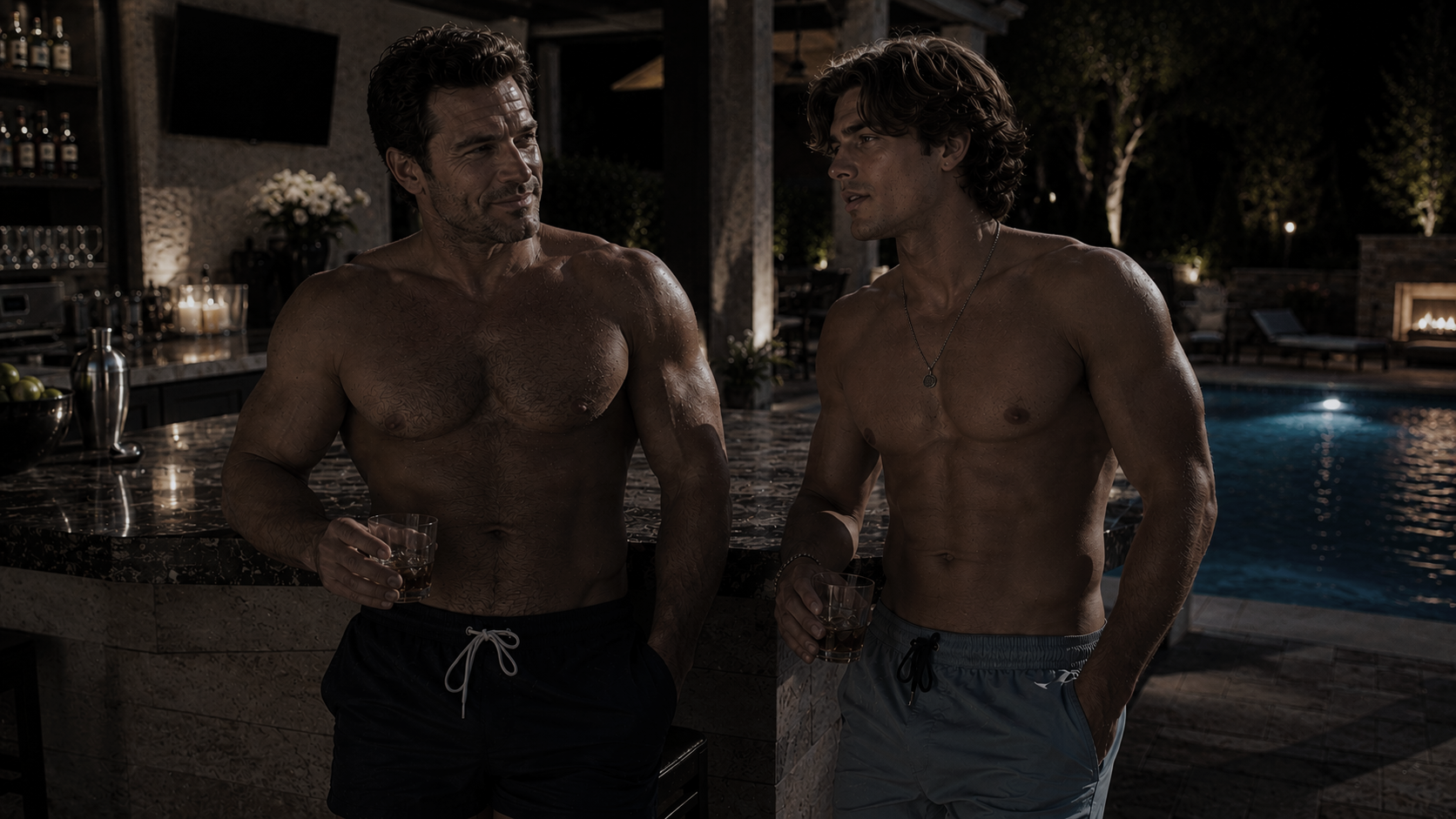
The news landed in a specific place. I’d been in a dry spell. Two weeks, maybe closer to three, which for me was long enough that the body had started keeping its own records. I’d woken up that morning with the restless energy that came from too many nights alone in a bed that had seen considerably more company than it was currently getting, and I’d been half hard before I’d even gotten out from under the sheets, my mind already running through the usual catalogue before I’d fully opened my eyes. The guy from the gym with the shoulders. The bartender at the place in Deep Ellum who always poured heavy and smiled in a way that suggested he’d be up for more than pouring if I ever asked. The back of a stranger’s neck, the specific curve of it, the way a man’s breath changed when you got your mouth on him in the right place.
None of which had happened. None of which was likely to happen tonight either, or so I’d thought, until David appeared at my bar with that expression on his face. The one that meant he was about to deliver something he thought I’d want.
“He’s a little shaken up,” David continued, “but honestly? Total sweetheart when he’s had a couple of drinks. Really opens up.” He made a motion with his hand that I interpreted as somewhere between you’ll see and trust me on this one. “Very cute. You’ll like him.”
I thought about what I would like. The specifics had been circling all day, the way they did when I’d gone too long without. A delicious kind of tightness, the heat of skin under my hands, the sound someone made when they stopped thinking and let their body do what it wanted. I wasn’t picky about the particulars tonight. A tight ass and a willing mouth and someone who wouldn’t make it complicated, someone who’d be gone by morning or maybe stay for coffee if the mood was right but wouldn’t expect anything past that. David’s friend, freshly broken up, shaken and looking for company. The math was not complicated.
I could feel the anticipation settling into my body, a low-grade current that had been building for days and was now, suddenly, pointed at something specific. I’d need to be subtle about it, at least at first. The kid had just ended something, David had said, which meant he’d need a little time, a little warming up. But I’d been doing this for twenty years. I knew how to warm someone up. I knew how to be patient when patience was required and how to recognize when patience stopped being the right approach and something else took over.
Kip drifted over from the pool, a towel around his shoulders, his drink sweating condensation onto the bar top. He stood a few feet away and said nothing. I caught the way his eyes moved between me and David, a look I couldn’t quite read, but I was already thinking about other things. About the guest bedroom, about whether I’d need to change the sheets, about the particular way the night was shaping up to be considerably more interesting than I’d expected when I’d poured my first drink at seven.
David was still talking. Something about what Jesse was like after a couple of drinks, how he could use the distraction, how it had taken some convincing to get him in the car. I was listening with half an ear, the other half already running ahead to the moment when the kid arrived, when I’d pour him something strong and let the evening find its natural shape.
Jake appeared from the direction of the fire pit, his own drink in hand, and his expression was the one he wore when he was about to say something that would complicate whatever easy arrangement I was setting up. I knew that expression. I’d been on the receiving end of it for eight years, and I’d learned that when it appeared, I should probably stop whatever I was doing and listen.
“Hey,” I said, as David drifted back toward the pool with the satisfaction of a completed errand. “Hey, maybe this night’s not a bust after all. David says his friend just got dumped and wants to forget about it. I can help with that. Been so damn long I’m half convinced I’ve forgotten how. I want to bury myself in something tight before the weekend’s out.”
Jake pulled up a stool on the other side of the bar and set his drink down with the particular deliberateness that meant he was choosing his words. “Tell me about this guy coming over.”
“David’s friend. Just broke up with someone tonight, apparently. David says he’s cute.”
“Jesse?” Jake asked.
“You know him?”
“I’ve met him a few times.” Jake looked at me with an expression I couldn’t quite place. Somewhere between concern and warning and the specific patience of someone who was about to deliver information I would not like. “What David actually means when he says Jesse is cute is that Jesse is someone he brings to parties when he wants people to come talk to Jesse so David can meet the people who come to talk to Jesse.”
I considered this. It was, knowing David, entirely plausible. “Okay. So he’s hot. That’s another check in the plus column.”
“He’s twenty-one,” Jake said. “He’s going to UNT full time. Eight to noon every weekday. And he works full time, starts at one, gets off at ten, sometimes later. Every other Saturday on top of that.”
“Okay.”
“Wade.” Jake picked up someone’s abandoned glass and turned it in his hands without drinking from it. “He doesn’t do drugs. Not experimenting, not occasionally, not recreationally. He’s opposed to them pretty firmly, and from what Kip and David say, it’s not a flexible position. He doesn’t like being around them. They think he’s too uptight about it. What David and Kip call uptight, I would call principled.”
I knew what he was doing. It did not annoy me. After eight years he’d earned the right to do it, and he was usually right, and those two things together meant I tried to hear him when he took this kind of tone.
“I’ll keep it put away,” I said.
“I know you will. That’s not . . .” He set the glass down. “Okay, here’s the thing. The guys you usually meet at the lake, or through Andrew’s crowd, or wherever. They’re a certain type. You know the type. They show up, they’re fun, they’re usually up for whatever, the chemistry is easy because the expectations are low. You’re good at that whole thing. You’ve had a lot of practice. Tonight, though, this will not go the way you think it’s going to go. I need you to understand that now, before he gets here.”
I waited.
“He’s not going to bed with you tonight,” Jake said. “And I need you to hear that as information rather than a challenge, because if you treat it like a challenge you’re going to come off as exactly the guy Kip and David’s friends expect you to be, which is a guy who’s forty-one and has a nice house and uses it to sleep with people half his age.”
“That’s a little—”
“Is it?” Jake said.
I drank my bourbon. “What I’m hearing is we’re losing the plus column.”
“He just broke up with someone,” Jake continued. “He drove forty minutes down here because David asked him to and because he didn’t want to be alone. He is going to be polite and he’s going to be guarded and he is almost certainly not going to fall all over you the way you’re used to people falling all over you, and I need you to be okay with that and not make it weird.”
“You make me sound like an animal.”
“I make you sound like a man who is very accustomed to getting what he wants on a timeline he controls,” Jake said, with a precision I couldn’t argue with because it was accurate. “That’s different. And in this case, it’s also not going to work.”
I looked at the pool. The anticipation that had been building all day, that had sharpened into something specific when David mentioned his friend, was still there. My body hadn’t gotten the memo, but something else was seeping in around the edges of it. Curiosity, maybe. Or the curious interest I felt when someone told me a thing would not happen the way I expected it to.
“You said he’s different,” I said. “How different?”
Something changed in Jake’s expression. Just slightly, a quality of care entered it that hadn’t been there before. “I’ve met him twice. Through Kip’s thing. And the honest answer is he’s unlike most of the guys I’ve seen come through here. He reads. He’s got opinions about things, real ones, not just whatever everyone around him thinks. He went to a gallery opening last month because he actually wanted to see the show, not because it was a scene.”
He paused. “If I weren’t with Kip, I’d be making a serious run at him myself. I want you to understand that I mean that sincerely, and I’m telling you so you understand what I think you’re dealing with here.”
This landed differently than the rest of it. Jake didn’t say things like that casually, and he especially didn’t say them about men who were anywhere near his social orbit because Jake was meticulous about those lines. If Jake were saying it, he’d considered it, and he was still saying it.
The anticipation was still there, low in my gut, the body’s stubborn optimism. But it had a different quality now. Less certain. More attentive.
“Okay,” I said. “So maybe a plus column with a time delay.”
“Just be a person tonight,” Jake said. “Not the guy who owns the house and the jetskis. Just a person. See what happens.”
Inside the house I heard the front door chime. The single, pleasant tone that meant someone had come in.
Jake looked at me. “That’s probably him.”
I looked at my glass. I wasn’t someone who got nervous. I had little practice with that sensation. But I noticed something in my chest then that might have been the early stages of it, my attention sharpening, and I looked at the pool instead of the house and took a breath.
“He’s been inside for a while,” Jake said a few minutes later.
“I know.”
“The chime was five minutes ago.”
“I know, Jake.”
He was quiet for a moment. “David didn’t go in.”
“No.” David and Kip were still in the pool, talking over each other the way they did, their voices carrying across the water in the easy overlapping rhythm of two people who communicated mostly in interruption. “He didn’t.”
“So what’s he doing in there?”
“I have no idea,” I said, and I realized as I said it that the not knowing was interesting to me in a way I couldn’t identify. Everyone who came into my house headed for the bar or the television or the back patio. Everyone. My friends, their friends, people I’d never met who’d been brought by people I barely knew. The layout of the house made it obvious where to go. The open plan, the patio doors, the string lights visible through the glass. Everyone found where to be within thirty seconds.
Whoever was in my house right now had not found it.
“I’m going in,” I said.
Jake picked up his drink. “Remember what I said.”
“I remember,” I said, and went inside.

I found him in the gallery hallway, absorbed in a painting.
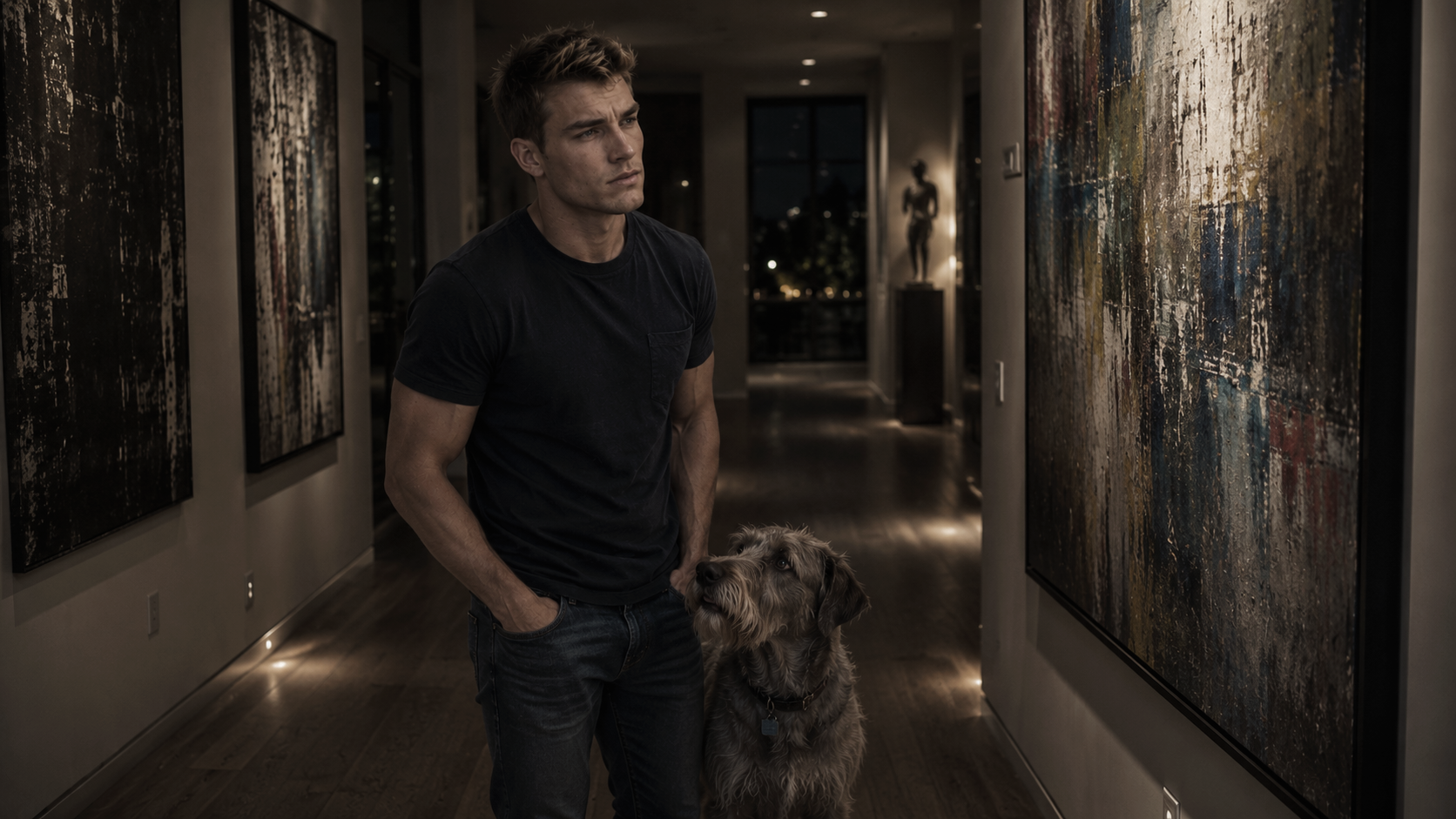
An oil I’d picked up at auction some years before for no particular reason I could have articulated. I’d walked past it twice, turned around, and bought it, which was how I’d bought most of the work in this house. He was standing with both hands in his pockets and his weight slightly forward, the way you stood when something had caught you and you’d stopped thinking about how you looked.
That was the first thing. Not the face, not the build. The pure quality of the looking.
Jake had said unlike anyone you’ve brought through here and I’d nodded along the way I nodded when Jake said things I thought I understood and didn’t yet. I understood it now. From twenty feet away, through an open doorway, watching a man I’d never met stand in my hallway and look at a painting as if it was telling him something he’d been longing to hear.
He was tall, my height or near enough, with the kind of build that came from actual use rather than the vanity of the gym. Broad through the shoulders and narrowing in a way that a fitted navy t-shirt did not conceal. Sun bleaching had lightened his blond hair, revealing darker roots. Though cut close, it had a slightly disheveled quality, suggesting he wasn’t intentionally styling it. The jaw was defined, the expression serious in the way of a face that defaulted to thinking rather than performing, and it gave him the look of someone considerably more formidable than whatever the party context might have suggested.
I was, I noted, looking at him the way he was looking at the painting. The restless, specific hunger I’d been carrying all day was still there. My body hadn’t forgotten what it wanted, but it had gone quiet, or quieter, pushed aside by something that felt less like wanting and more like attention. The kind of attention I rarely had the patience for.
Mercer was at his knee.
This registered separately, and it required a moment to fully process. Mercer did not do this. In eleven years, Mercer had greeted a grand total of two people in this house with anything other than dignified tolerance, and both were people I’d known for over a decade. Yet right now he was standing with his gray muzzle pressed against the knee of a stranger who had been in the building for approximately five minutes. The stranger’s hand had found the back of Mercer’s neck with the easy, unconscious affection of someone for whom animals were just something else in the room worth paying attention to.
I thought about what Jake had said. If I wasn’t with Kip I’d be making a serious run at him myself. At the time I’d taken it as a calibration. Jake’s way of telling me the stakes without putting a number on them. Watching the man in my hallway from the end of the patio, I understood Jake had been precise rather than generous.
He shifted to the next painting without breaking whatever state he was in. A small, unhurried sidestep, Mercer moving with him in the unconscious synchrony of a dog who had decided about where he was spending the evening, and the looking continued. The same quality of it. The same full, unperforming attention.
In fifteen years of gatherings in this house, not one person had done this. Not one. My friends who fancied themselves cultured, the ones who dropped gallery names into conversation the way other people dropped restaurant names, the ones who had strong opinions about things they’d read two paragraphs about. None of them had ever stood in my hallway and looked at what was on my walls as if it was worth looking at. The paintings were furniture to most of them. Pleasant, expensive furniture.
This man was reading them.
Whatever I’d been expecting when I came inside, a lost kid looking for the bathroom, someone on his phone texting David for directions, someone who’d already found the bar and was helping himself, this was not it. This was something else entirely. The anticipation I’d been carrying all day was still there, but it had shifted registers. It wasn’t the simple, physical wanting I’d brought to the bar an hour ago. It was something more complicated, something I didn’t have a name for yet.
I stood in the doorway for longer than I meant to. Then I stepped forward and introduced myself.

Jesse
I didn’t hear anyone come in.
One moment I was alone in the hallway with a friendly dog and the painting and a house that had been lived in carefully and with intention, and the next moment a voice came from behind me and to my right and I turned around.
The man in the hallway was early forties, solidly built, with the kind of physical ease that came from actually using your body rather than performing. He was dressed for a pool party that had been going on for a while. Dark shorts, a linen shirt left open over a plain tee, and he was watching me with an expression I couldn’t gauge. Not suspicious. Not the look people gave when they’d caught you somewhere you weren’t expected to be. Something more like gauging. Taking stock.
“Looking for the bar?” he said.
“Sorry.” I turned to face him. “The door was unlocked. David Reno said—”
“I know. He told me you were coming.” He nodded at the wall where the painting was. “Most people head straight for the bar. Or the TV.” He said it without judgment, as a plain statement of observed fact. “Occasionally the PS5.”
“The painting’s good,” I said. Which was an understatement. Which I kept to myself because I didn’t know this man and wasn’t going to hand him the whole answer in the first thirty seconds.
Something moved in his expression, barely. “Wade Mitchell,” he said, and extended his hand.
“Jesse Tretiak.” I shook it. His hand was dry and warm, and he didn’t do the thing some men did where they made the handshake into a statement.
“Dog’s Mercer,” he said, glancing down at the gray-muzzled dog still stationed serenely at my left side. “He doesn’t usually do that.”
“Do what?”
“Attach himself to people.” He looked at Mercer for a moment, something thoughtful in his face. “He mostly ignores my friends. All of them, actually.” A brief pause. “Come on. Everyone’s out back.”

The back of Wade’s house opened onto a patio that ran the full width of the building, and beyond it a pool lit from beneath, the water that luminous blue-white that pool lights made at night. String lights overhead, looped in generous, warm arcs between the patio posts. An outdoor fire pit off to one side, two chairs angled toward it which struck me as a strange choice for a June night, the air already warm enough without it, but it was burning low and there was something about the warmth of light it added to the yard that I understood without having to think about it. In the pool were David, immediately recognizable by the way he talked with his whole body even when treading water, and Kip, who I knew a little from David’s orbit. The two of them were deep in something animated and overlapping.
The man from the fire pit got up and came toward us as we stepped onto the patio. He was tall, broad shouldered, with the unhurried physical ease of someone who had been trained to move efficiently and had never quite stopped. He extended his hand before Wade introduced him.
“Jake Kowalski,” he said. “We’ve met a couple of times. Good to see you.”
“You too.” We had, once at a thing of Kip’s and once somewhere else I couldn’t place, and both times he’d been straightforward in a way I’d appreciated without registering. “Thanks for having me.”
“Come whenever,” he said, which was an easy thing to say, and which he somehow made sound like he meant it specifically.
“Jesse!” David waved from the pool with both arms, nearly going under. “Get in, it’s perfect.”
“I just got off work,” I called back.
“That’s why you should get in.”
Wade, who had moved to the outdoor bar with surprising familiarity, offered me a drink without asking what I wanted. I looked at it. Bourbon and something, probably ginger given the color, ice already melting at the edges.
“Start there,” David called. “You’ve got some catching up to do.”
I took the drink. Wade took his own back to the fire pit and settled into one of the chairs, and Jake returned to the other, and I stood for a moment on the patio with the warm pool light in front of me and the warm string lights above me and the drink cold in my hand. Something in my chest, the tightness that had been there since the parking lot, since the ugly flat sound of Luke’s fist against my wall, loosened by a degree I hadn’t expected.
I took a sip.
“I’ll get in,” I told David. “Give me five minutes.”
He made a sound of victory that Kip echoed, and I set my drink down on the edge of the pool and pulled my shirt off. The night air hit my skin, warm and close, and for a moment I was aware of the fact that I hadn’t eaten since four and that the bourbon was already doing something pleasant and diffuse at the edges of my awareness. I hadn’t thought to bring a bathing suit so I stripped to my boxer briefs.
I sat on the pool’s edge and lowered myself in, and the water was exactly the temperature David had promised. Heated to the precise point where the distinction between the water and the surrounding air became pleasantly academic, where you stopped being aware of the boundary.
Mercer settled on the deck beside where I’d gone in. I put my hand on his back from the water, and he produced a low, satisfied sound.
“See?” David said, swimming over. “Better than your apartment.”
“It’s warmer than my apartment,” I admitted.
“Everything’s warmer than your apartment. You keep it at sixty-eight degrees like a psychopath.” He folded his arms on the pool’s edge and studied me. “Now. Tell me everything. How bad was it?”
“Medium bad,” I said.
“Did he cry?”
“His eyes were wet.”
“Did he yell?”
“No.”
“Did he . . .” David lowered his voice, which for David was a significant effort. “Did anything get broken or thrown or—”
“Nothing got broken,” I said. “He put his fist on my wall. Against the wall beside the door.” I looked at the water. “He didn’t touch me.”
“Jesse.” David’s voice dropped further, the performing concern version he did that was still actually concerned. “Are you okay?”
“I’m fine,” I said. “It was loud and it was unpleasant and I’m glad it’s over.”
David studied me for a moment, determining whether I was telling the truth or performing telling the truth, a distinction he was better at identifying than most people gave him credit for. Apparently I passed, because he nodded and moved on.
“He was too intense from the beginning,” he said. “I told Kip. I said Jesse will not do well with someone that intense.”
“You didn’t actually tell me that,” I said.
“I thought it,” David said, with the serene confidence of someone who had decided retroactive warning counted. “Drink your drink. You’re going to the lake tomorrow.”
I started to answer, but David was already talking—something about the lake, the jetskis, Wade’s boat—and I caught maybe two words in three. The pool pump was humming behind me, and David was facing away, his voice carrying in directions I couldn’t track. I walked around to his left so I could hear him.
“—every Saturday,” David was saying, “even when it’s stupid hot. You’re coming tomorrow.”
“David, I work on Saturday.”
“Every other Saturday. And this is your off Saturday, I already checked.” He pushed off the wall and floated backward. “Jake has a boat. Wade has jetskis. It’s going to be a whole thing. You’ll love it.”
I drank my drink and tread water and decided not to make any decisions about Saturday at eleven forty-five on a Friday night when I was tired and slightly unsteady and a man I didn’t know was sitting at a fire pit behind me with his gray-muzzled dog pressed against the deck where I’d left him.

The drinks kept coming. David had appointed himself bartender for the pool, which meant every time my glass was half empty he was at my elbow with a refill and a new thing he wanted to tell me about. The lake, the jetskis, the specific and elaborate social architecture of Wade’s friend group, which he explained with the enthusiasm of a sports commentator narrating a replay. I let him talk. It was easier than talking myself, and the bourbon was doing its work, and after a while I stopped thinking about the wall and the sound and the way Luke’s voice had changed when the composure drained out of it.
By midnight I was drunk. Not the careful, managing kind of drunk I usually maintained at parties where I didn’t know people, the kind where you kept one hand on the wall at all times and counted your drinks in your head and left before the third one hit. The other kind. The kind where the edges of things went soft and the pool water felt like it was holding you up in a way that was personal, intentional, and David’s running monologue was the funniest thing you’d ever heard even though you couldn’t have repeated a single word of it.
“This,” David announced to no one in particular, “is the version of Jesse I’ve been telling you about.”
Kip laughed from somewhere near the steps. Even Jake, still at the fire pit with Wade, had turned in his chair to watch. I didn’t care. I tipped backward into the water and came up grinning, pushing the hair out of my eyes, and then, I don’t know why, I took a breath and went under and planted my hands on the pool floor and kicked my legs up.
A handstand. In the middle of a stranger’s pool at midnight on a Friday.
I held it for maybe three seconds. Then I came up laughing, water streaming down my face, and David was applauding and Kip was laughing in the way people laughed when they’d had enough to drink that everything was funny, and even from across the yard I could hear Jake’s low chuckle and see Wade’s face in the firelight. It bore an expression I couldn’t read at this distance, something between amusement and amusement hiding a deeper attention.
“Okay,” David said, swimming over and slinging an arm around my shoulders with the easy affection of someone who had been drinking for several hours and had decided we were all best friends now. “Okay, see, this is what I’m saying. This is what you need. None of that Luke nonsense. Just . . .” He gestured expansively at the pool, the lights, the fire pit. “This. And you know, if you wanted to find someone to take your mind off things, I’m just saying—”
“No,” I said. The word came out easily, without edge, but with the finality that even drunk David recognized as absolute. “Not tonight. Not that.”
“Okay, okay.” He held up both hands in mock surrender, still grinning. “I’m just saying. Options exist.”
“I know options exist.” I leaned back against the pool wall, my arms spread out along the coping, the water lapping at my chest. “I’m not interested in options tonight. Or tomorrow at the lake.”
David made a sound of theatrical disappointment. “You’re no fun.”
“I’m plenty of fun. I just did a handstand.”
Kip had drifted closer during this exchange, and something in his expression shifted briefly. A flicker I caught and then lost, attention that was more assessing than the moment required. Then it was gone, replaced by a smile that was easy and pleasant, and he raised his glass in my direction.
“To handstands,” he said.
“To handstands,” I agreed, and drank.

It was Kip who mentioned Luke.
We were all in the pool by then, David and Kip and me, the drinks count past the point where anyone was tracking carefully. Jake had come over from the fire pit and was sitting at the edge of the pool with his feet in the water, his drink balanced on his knee, and Wade had drifted back from wherever he’d been and was standing near the outdoor bar, close enough to hear but not close enough to be part of the conversation unless he wanted to be.
“So who was this guy, anyway?” Kip asked, and his tone was light, conversational, the tone of someone making small talk at a party. “The one you just broke up with. David said he was a disaster.”
“Luke,” I said. The name came out flat, the way it had been all night, wrapped in the specific exhaustion of something I didn’t want to keep talking about. “Luke Carrillo.”
The silence that followed was not the ordinary silence of a conversation pausing. It was the specific silence of several people processing the same information simultaneously and arriving at the same conclusion. David’s face went through a series of micro-expressions that I was too drunk to catalogue but sober enough to recognize as realization followed by discomfort followed by the attempt to hide both. Kip’s expression, by contrast, didn’t change at all, which was its own kind of tell.
Jake was the one who broke it. “Wade,” he said, and his voice had a certain quality, careful and deliberate, the way you asked a question you already knew the answer to. “Didn’t you date a Luke Carrillo a few weeks ago?”
I looked at Wade.
Wade had gone still. Not dramatically. He hadn’t moved, hadn’t set down his drink, hadn’t done any of the things people did when they were caught off guard. But there was a quality of stillness in him that hadn’t been there a moment before, and I watched him process the name the way you watch someone do math in their head and arrive at a sum they didn’t like.
“Ended it a week ago. We dated three weeks,” Wade said. “Maybe a little less. Introduced by Kip and David, actually.” He said it evenly, without accusation, but the direction of the information was clear. “Ended it because he was too intense.”
“The week you ended it with Luke,” I said, and I was doing the math out loud now, the timeline assembling itself in my head with a clarity that cut through the bourbon. “Kip and David introduced Luke to me.”
I looked at Kip. Kip met my gaze with the pleasant, removed smile I was coming to recognize as his version of a poker face.
“We thought they’d be good together,” Kip said. “You and Luke. It made sense at the time.”
“It made sense,” I said. The words were flat, not really a question. I wasn’t asking him to explain. I was just repeating it back to him, letting the shape of it sit in the air between us.
“It’s not a big deal,” Kip said. “It’s not like anything happened between any of them. It’s just how it went.”
I said nothing. Wade said nothing. The silence stretched out across the pool, warm and close and full of things not being said.
“Yeah,” I said finally. “It’s just how it went.” I reached for my drink, found it on the coping, took a swallow. The bourbon was warm now, the ice long melted, but it still did what it was supposed to do.
The conversation moved on. David, with the particular social agility of someone who had spent years steering parties away from uncomfortable silences, found a new topic and pushed it into the center of the conversation with the enthusiasm of a man launching a lifeboat. Kip followed. The noise returned, the easy overlapping rhythm of people who knew how to fill a gap. But I’d seen Wade’s face in the moment after Jake said the name. The specific stillness. The calculation. The way he’d looked at Kip and David and then at me and then at the water.
He was filing it. Just like I was.
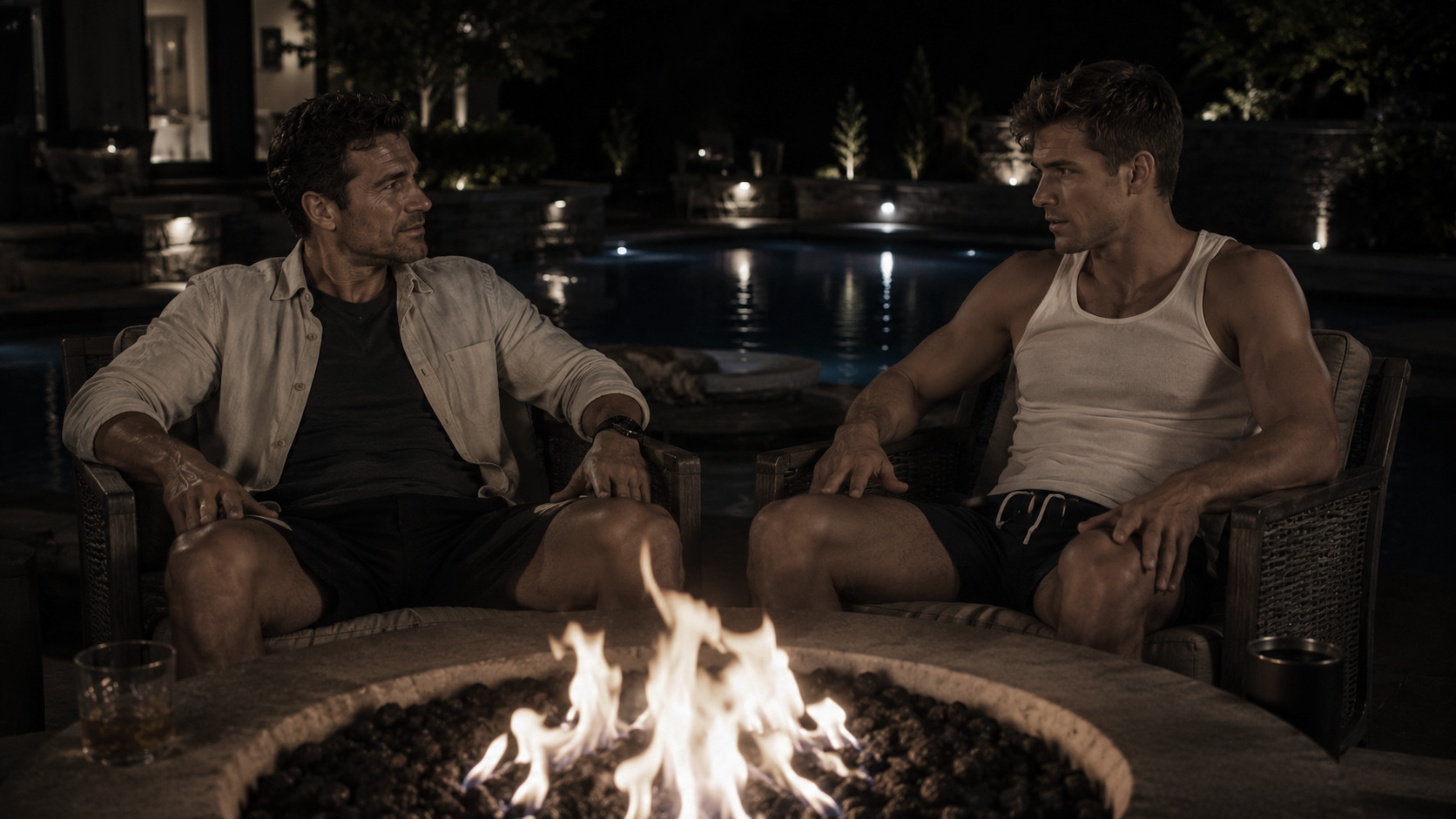
At the fire pit, Jake had turned to Wade and was saying something low, something that didn’t carry across the water. I couldn’t make out the words. I wasn’t trying to. But the quality of the conversation was different now. More serious, more focused, and I understood without hearing it that Jake was saying the same thing I was thinking.
The week Wade ended it with Luke, they handed Luke to me. Like a spare part. Like a thing that hadn’t worked out for one person and might work out for another. Like I was the backup plan. Or worse, the consolation prize after Wade had already passed.
I sat with that for a moment, the pool warm around me, Mercer still at the edge of the deck, David and Kip still performing normalcy at the other end. Then I put it away. There would be time to look at it later. Right now I was drunk and the pool was warm and a dog who didn’t like anyone had decided he liked me, and that was enough to hold on to for one night.

Later, past two in the morning, David and Kip had migrated back into the pool, the drink count had moved past the point where I’d stopped keeping careful track, and Mercer was still beside me on the deck with the settled patience of a dog who had decided this was where he lived now. Wade came to stand at the edge of the pool a few feet away.
He didn’t sit. He stood with his own drink and looked out at the water rather than at me, which I’d noticed he did, this habit of looking-near rather than looking-at. It should have felt evasive. It didn’t. It felt like a form of consideration, as if he were giving me the option of this conversation without making it a requirement.
“You good?” he said.
“Yeah,” I said. “Better than I expected to be, honestly.”
“David said you had a rough night.”
“David says a lot of things.” I looked at the water. “It was fine. It’s done.”
“He also says you drove forty minutes down here at midnight,” Wade said, “which means either David is very convincing or you really didn’t want to be alone.”
“Both,” I said. “Both were true.”
He nodded, a small acknowledgment that wasn’t pushing anything. The pool light shifted as Kip and David moved in the water, the reflection breaking apart and reassembling. Mercer sighed under my hand.
“Your painting,” I said. “The landscape in the hallway.”
Wade was quiet for a moment. “What about it?”
“Who painted it?”
Another pause. Longer. “I don’t know,” he said. “I bought it at an auction, maybe six years ago. There was a lot of work there. I just . . . I walked through and bought the ones I liked.”
“You have good instincts,” I said. “The light in that piece is doing something specific. Most painters working in that scale and with that subject matter flatten it. They get the color right and miss the quality. That one didn’t.”
Silence. The kind that wasn’t empty.
“I never knew what specifically it was,” Wade said. “About that piece. I just knew I wasn’t going to walk out without it.”
“That’s usually how it works,” I said. “You feel the rightness of it before you can say why.”
He looked at me then, briefly, the way someone looks when they’d been given a word for something they’d had for a long time without a name for it. Then he looked back at the water.
“Everyone’s going to the lake tomorrow,” he said. “Jake’s boat, a couple of jetskis. Usually end up at the restaurants out there for dinner. You should come.”
I sat with this for a moment. The pool warm around my feet. Mercer breathing under my hand. The string lights swaying faintly in something too gentle to call a breeze, the heat of the night pressing down around the yard, dense and close.
“I have a long drive back to Denton tonight,” I said. Which wasn’t quite an answer to what he’d asked, but it was what came out.
“You don’t have to drive back to Denton tonight,” he said in the same even tone. “Guest room’s made up. You’d be closer to the lake.”
From across the pool, David made a sound that was probably unrelated but conveniently timed.
“Do you have . . . expectations?” I asked. I didn’t want to offend him, but I didn’t need drama later either if I had to turn him down.
“I’ll behave myself,” Wade said.
I looked up at him. He was looking at the water, not at me, exactly as he had been a moment ago. The pool light caught the side of his face. His expression was easy and unrevealing and he was not pushing anything, not leaning in, not doing the thing I’d expected him to do from the moment David had mentioned I might be someone Wade would be interested in.
He was just standing there. Offering a guest room and a lake day. Not asking for anything in return.
“Okay,” I said.
He nodded once, as if it were settled, and went back to the fire pit with no additional production. I heard the indistinct sound of his and Jake’s voices resuming. I couldn’t make out the words, but there was something in the pacing, unhurried and easy, that landed somewhere I hadn’t braced.
I sat for a while longer with my feet in the warm water, Mercer warm against my hip, David making David sounds across the pool, the string of lights doing their small, patient shimmer overhead. The June night pressed down warm and still around the yard, thick with the specific density of a Texas summer that had settled in for the long haul and wasn’t going anywhere, and somewhere beyond the fence the neighborhood had gone quiet the way late-night suburbia did, all the ordinary lives temporarily still, but the heat itself was awake and present, sitting in the air like something that had made itself comfortable.
I was okay, I thought. Which was more than I’d expected to say earlier, at eleven forty-five, standing in a parking lot with seventeen unread texts and unsteady hands.

The party unwound itself in the way parties did at that hour. Gradually, then all at once. Jake left first, clapping Wade on the shoulder and saying something I didn’t catch before disappearing through the house. David and Kip climbed out of the pool shortly after, towels around their shoulders, David still talking, Kip still quiet in the way he’d been quiet all evening. The patio emptied. The string lights stayed on, their small glow the last thing holding the dark back.
Wade had gone inside at some point. I hadn’t noticed when. I sat at the pool’s edge alone for another few minutes, my feet still in the water, Mercer still beside me. Now that the party had ended, the quiet was different. Not empty, precisely, but expectant, the way a room is expectant after a song ends and before the applause starts. The heat of the night had not diminished. If anything it felt closer, more present, the way things felt when you were the only one awake to notice them.
Mercer shifted and stood. I took this as a signal.
Inside, the house was cool and dark. I found my way through the living room and into the hallway where I’d spent those first five minutes, the painting still on the wall, Mercer still at my heel. The guest room was at the end of the hall. Wade had pointed it out earlier, a brief gesture I’d filed away without thinking I’d need it.
The room was simple and clean. A bed made up with white sheets, a dresser, a window that looked out onto the dark backyard and the pool lights still glowing. A bathroom through a side door, towels folded on the counter. I brushed my teeth with a finger and rinsed my mouth and stood for a moment looking at my reflection in the bathroom mirror. My hair was drying in the strange, stiff way it dried when it had been in chlorinated water. My eyes were tired but not unhappy. I looked, I thought, like someone who had survived something and was still standing, which was true, which had been true for a while, which was maybe the thing I kept forgetting and having to learn again.
I turned off the bathroom light and climbed into the guest bed. The sheets were cool and soft and smelled faintly of something clean that wasn’t detergent. The scent of linens that had been dried outside, or in a house where someone paid attention to things like that. The mattress was firmer than mine and it took my weight differently, the way unfamiliar beds always did, a small adjustment my body would make in its sleep and forget by morning.
Mercer padded in behind me. I hadn’t closed the door all the way, or maybe I had and he’d pushed it open, it was hard to say. After a moment’s consideration, he jumped onto the foot of the bed. Not the floor beside the bed, not the rug by the window. The bed. He turned twice in the peculiar way dogs turn when they are settling into a space that was not theirs but that they had decided, for reasons of their own, to occupy anyway. Then he lay down with his weight across my feet, a warm and living pressure against the comforter.
I looked at the ceiling of a stranger’s house.
The dark was not like the dark in my apartment. It was thicker, somehow. More present, more textured, the way the dark was in a house you didn’t know, where every small sound carried a question mark. Somewhere in the house, a clock ticked. Somewhere else, the air conditioning cycled on with a low, subsurface hum. The pool lights from outside threw a faint, shifting blue against the window glass, and if I listened carefully, I could hear the filter running, a steady mechanical whisper.
I thought about the painting in the hallway. About the quality of the light in it, which I’d been trying to describe to Wade and had only partly succeeded. About the way he’d looked at me when I said you feel the rightness of it before you can say why. Like I’d handed him something he’d been carrying for a long time without knowing he was carrying it.
I thought about David in the pool, arm around my shoulders, making suggestions I’d turned down without having to think. Not tonight. Not that. I’d meant it. I’d been meaning it for a while, I realized, this particular refusal, this clarity about what I did and didn’t want. It was new, or newish. It was the thing you learned by getting it wrong a few times first.
I thought about Luke. About the sound of his fist against the wall. About the way he’d looked at the end. Young and wet eyed and bewildered by his own behavior, like a dog who’d bitten someone and didn’t understand why everyone was upset. I felt something complicated and didn’t name it. It would be there in the morning. It would probably be there for a while. That was fine.
And I thought about the conversation in the pool, the strange, unsettling mathematics of it. Kip and David had introduced Luke to Wade. Three weeks, Wade had said. Ended it because Luke was too intense. And the very week Wade ended it, they handed Luke to me. A spare part. A thing that hadn’t worked out for one person and might work out for another. I’d known, in some abstract way, that I was on the periphery of David’s social world, that I was useful in ways I didn’t always examine too closely. But this was different. This was being treated like a backup plan, a consolation prize, someone you passed along after the person you actually wanted had already passed on it.
I put it away. There would be time to look at it later, to turn it over and decide what it meant. Right now I was tired and the sheets were cool and a dog who didn’t like anyone was warm against my feet.
Mercer sighed in his sleep, one back leg twitching against my ankle.
This is a strange thing to know, I thought, after two hours in a stranger’s house. But it didn’t feel strange. It felt like the first true thing I’d known all night.
I let the night be what it was. The ceiling above me. The dog at my feet. The pool lights shifting blue against the window. Somewhere in the house, a man who had bought a painting without knowing why was asleep in his own bed, and somewhere in Denton, a silver Civic with a dent in the rear quarter panel was parked in a different lot under a different sky, and somewhere overhead, beyond the roof and the string lights and the warm, pressing dark, the stars I hadn’t been able to see from the parking lot were doing what stars did, which was burn steadily and without comment, indifferent to everything happening beneath them.
It was enough. It was more than I’d expected. I closed my eyes.
Mercer shifted once, then stilled.
The house settled around us, and the night went on.

End of Chapter One.