
A Saturday on the lake stretches long under the Texas sun, where dive contests and easy conversation pull Wade and Jesse into unexpected orbit. Jake watches from the periphery, already counting the weeks it’ll take his best friend to realize that the real challenge isn’t catching Jesse—it’s being the kind of man worth waiting for.

Wade
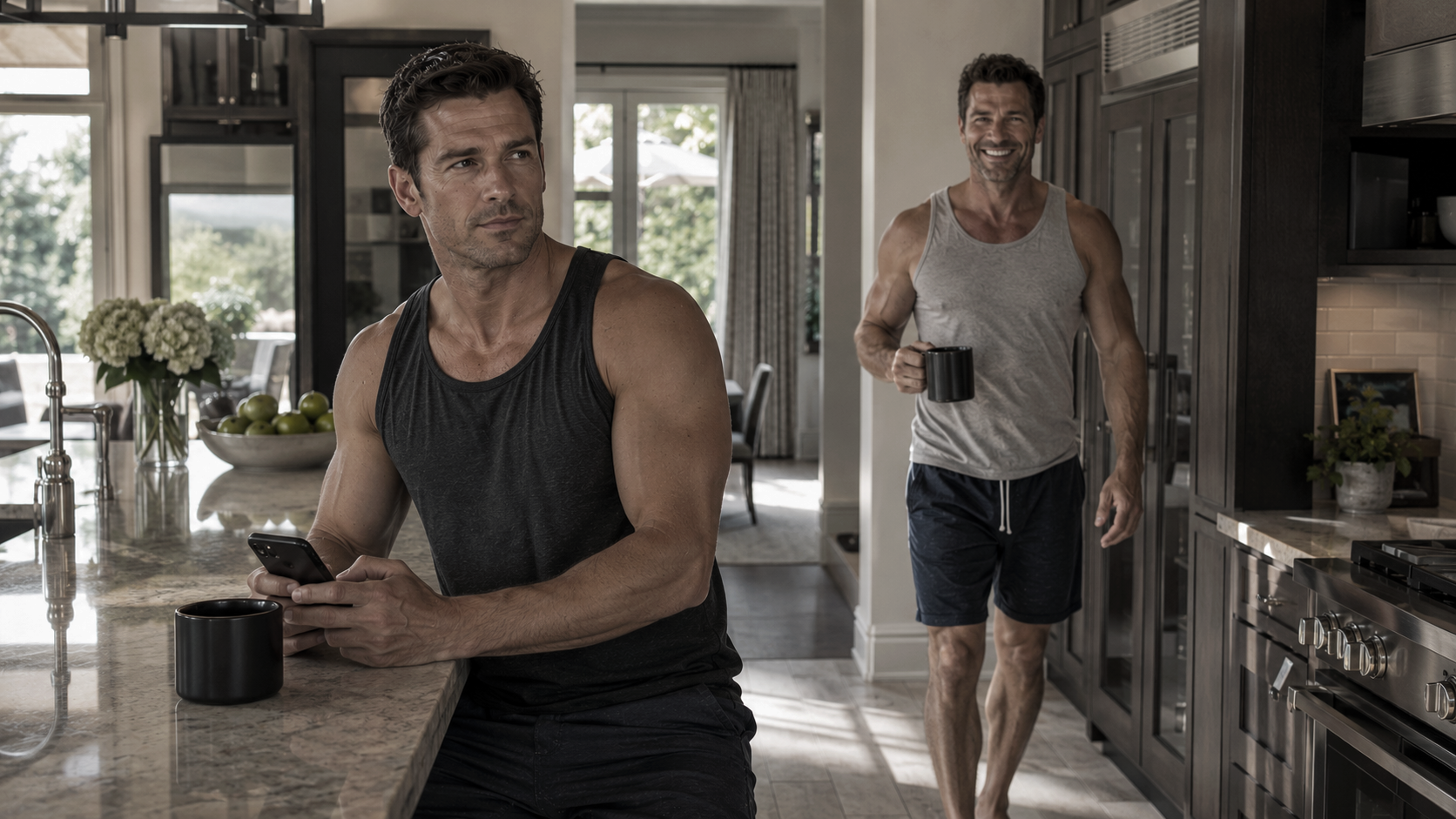
I was up at six-thirty, which was earlier than I needed to be and later than Jake, who I could already hear moving around in the kitchen because Jake had been waking at five-something since he got out of the Marines and had decided this was who he was now. The smell of coffee reached the bedroom before I was fully vertical, threading under the door and into the half-dark of the room, and I sat on the edge of the bed for a moment and looked at the window and listened to the house.
The guest room was at the end of the hall. I couldn’t hear anything from it, which meant either Jesse was still asleep or he woke up as quiet as he did everything else, which based on last night’s evidence seemed possible. He was the stillest person at that pool. David and Kip made noise the way most people breathed, constantly and without apparent awareness of it, and Jake had his own presence, the kind that filled a room through sheer physical solidity rather than volume. Jesse had sat at the edge of the pool with Mercer against his hip and hadn’t seemed to perform quietness. He just was quiet, the way some people were warm or the way some rooms were large.
I pulled on a shirt and went to find the coffee.
Jake was at the kitchen island with his mug and his phone, scrolling through something with the focused, efficient attention he brought to most things. He looked up when I came in, registered me, looked back at his phone.
“He still asleep?” I asked.
“Haven’t heard anything,” Jake said. “You want to know what I actually think?”
“Not especially,” I said, which meant yes, pour me a cup first.
I poured my own cup. Jake never poured for other people, a quirk I’d stopped noticing, and leaned against the counter. “Okay. What do you actually think?”
“I think last night went fine,” Jake said, in a tone that meant and you should know the precise boundaries of what fine means. “He stayed. He was comfortable. He didn’t feel managed, which with someone like him is the main thing.”
“Someone like him,” I said.
“Someone who has built every single thing in his life himself and therefore has very good instincts about when someone is trying to do something to him versus for him.” He set his phone down. “Last night you were just a person. Keep doing that.”
“I’m always just a person,” I said.
Jake picked his phone back up. This was his version of a response.
I drank my coffee and looked out the kitchen window at the backyard, which in the early morning light looked like a different thing than it did at night. Less curated, more like an actual yard, the dew on the lawn catching what sun had made it over the fence line. The pool was still now, the surface flat and slightly silver. Mercer was outside doing his morning circuit of the yard perimeter, the slow, deliberate investigation of a dog who had been doing this long enough to know what he expected to find and checked anyway.
I heard the guest room door.
I did not look down the hallway immediately. I looked at my coffee. There was a version of me that would have looked, that would have leaned out to get an early read, that would have already been working on it this morning, and I was making a deliberate choice not to be that version. Jake had been clear enough last night, and I was clear enough on what Jake meant when he was clear.
Jesse came into the kitchen a few minutes later with the air of someone who had assessed the situation from the hallway before entering it. Which was to say he didn’t look surprised to find us there, he looked like he’d confirmed what he’d already suspected. His hair was doing something that suggested he’d been awake for a while but had done nothing about it yet. He was wearing the same jeans from last night and the gray sweatshirt that lived on the hook by the guest room, mine, left there for guests who underestimated the AC.
He was, in the morning light and without the flattering blur of late night and string lights and bourbon, still striking. I’d registered this the night before—tall, broad shouldered, the kind of blond that photographed well—but the morning made it more specific somehow. The serious face that defaulted to something close to severe. The way he moved through my kitchen with the quiet, deliberate economy of someone accustomed to not taking up more space than necessary. He was a physically beautiful person yet he seemed entirely unaware of this, which was its own category of interesting.
I looked at my coffee.
“Morning,” he said.
“Coffee’s fresh,” I said.
He found a mug with the careful movements of someone making sure not to open the wrong cabinet, filled it, and then looked around for something. Didn’t find it and didn’t ask.
“Creamer’s in the door,” Jake said, without looking up from his phone.
“Thanks,” Jesse said.
He leaned against the counter on the opposite side of the kitchen from me and drank his coffee and looked out the window at the backyard. Mercer had finished his circuit and was now sitting at the back door waiting to be let in with the dignified patience of a dog who considered impatience beneath him. Jesse went and opened the door for him without being asked, with no fuss about it, just saw the dog waiting and opened the door, and Mercer came in and walked directly to Jesse and pressed his head against Jesse’s knee.
Jake looked up from his phone and looked at me.
I looked at my coffee.
Down, I thought, with the specific internal tone I used for things that needed managing. Just down.
“Lake day,” I said. “You still in?”
Jesse looked up. Something in his expression did a small recalibration. “David said something about that last night.”
“David says things,” I said. “I’m asking you.”
He considered this with the particular quality I’d already come to associate with him. Actually thinking before he spoke, processing the question rather than just catching its shape. “What time?”
“We try to be on the water by ten. So leaving here by nine, nine-fifteen. Jake’s trailering the boat.” I paused. “It’s a long day. We usually don’t head back until after dinner.”
“I don’t have anything for the lake,” he said. “I didn’t know when I came down here.”
“I’ve got board shorts that’ll fit you. Sunscreen, towel, whatever you need.” I said it flatly, as information. No production. “It’s your call.”
He looked out the window at the backyard. At the pool, which in the morning light was just a pool. Then down at Mercer, who had not moved from his knee.
“Okay,” he said.
I refilled my coffee. Behind me, I heard Jake set his phone down with the deliberateness of someone who has just decided something and doesn’t need to say it out loud.

Jesse
I showered in the guest bathroom, which was larger than my bathroom at home, with a rainfall showerhead that produced the steady, even pressure you paid extra for and didn’t always get even then. The towels were white and thick and smelled of something clean. The towel I used probably cost more than my monthly electric bill. I held it for a moment after I dried off, feeling the weight of it in my hands, the dense, soft pile that was nothing like the thin, sandpapery ones I’d bought in a six-pack from Walmart when I moved into my apartment and had been using ever since because I didn’t have the money or the bandwidth to replace them. I hung it on the rack and looked at myself in the mirror and thought about the kind of house where the guest towels cost more than my electric bill, and then I stopped thinking about it and got dressed.
The board shorts Wade had lent me were a little large in the waist and I had to knot the drawstring twice to keep them up, which was mildly ridiculous, and I caught myself in the bathroom mirror looking like someone who had accidentally ended up at someone else’s lake day, wearing someone else’s clothes, in someone else’s house, which was accurate, actually, so I let it go and went to find my shoes.

The convoy to the lake assembled in Wade’s driveway by eight fifty-five which, given the number of people and coolers involved, struck me as a minor organizational achievement. Jake hitched his truck to the boat trailer, a center-console fishing boat that was nicer than it sounded, clean and well-maintained with a T-top for shade and seating along both sides. Wade’s truck carried the rest. Two coolers, a bag of gear, David and Kip in the back seat talking over each other about something I stopped tracking around mile two.
I rode in the front with Wade because David and Kip had claimed the back seat with the certainty of people who had gotten there first and considered this a settled matter. Wade drove the way I might have expected from someone who moved through his own house the way he did. Relaxed, one hand on the wheel, the radio on a classic rock station at a volume that allowed for conversation without requiring it. He didn’t feel the need to fill the silence with small talk. This surprised me. He’d struck me last night as someone who filled silence as a matter of instinct, and maybe he did in other contexts, but on the highway that morning he was just driving, his coffee in the cupholder, the truck moving smoothly south and east toward the lake.
I was aware of him the way you were aware of something large and warm in a room. Not preoccupied with it, just conscious of it as a physical fact. He had a certain quality of self-possession that differed from the self-possession I was used to in older men, which tended toward either performance or indifference. Wade’s version had nothing to prove in it. He was just comfortable, the way some people are comfortable, as though whether he belonged in any situation had been settled long ago and he hadn’t thought about it since.
I looked out the window at the highway median going past and told myself I was just observing. Which was true. I had no plans here. I had broken up with someone approximately ten hours ago and I was sitting in a stranger’s truck on the way to a lake I’d been to once on a fourth-grade field trip. Observation was the appropriate mode.
“You been to Lake Lewisville before?” Wade asked, somewhere around Corinth.
“Once,” I said. “A long time ago. Field trip.”
He glanced over. “Field trip.”
“Fourth grade. We were studying Texas ecosystems.” I looked at the highway median. “I remember it was very hot and the bus didn’t have good AC.”
“That’s essentially the complete lake experience,” he said. “You’ve already had it.”
“Does it stay this hot all summer?”
“Until it doesn’t,” he said. “Usually September before it starts to break, and even then you get weeks where it comes back. By November we’ve squeezed the last out of it and it’s done until March.” He looked at the sky through the windshield. It was hard, flat blue, not a cloud anywhere. “June is when it really gets going. We’ve got the whole summer ahead of us still.”
“You do this every weekend?”
“Most. Jake’s got the boat, I’ve got the jetskis. Started as a once a month thing maybe seven or eight years ago and just became what we do on Saturdays.” He paused. “It’s a good way to spend a day.”
From the back seat, David said something about a playlist and Kip argued about the playlist and Wade turned the radio up two notches, which settled both the argument and the question of whether anyone was going to have a quiet ride.

The lake arrived in the way Texas lakes arrived. Gradually, announced first by a change in the air, something looser and more humid, and then by the glint of water visible through the cedar and scrub oak along the shoreline, and then by the marina, which had the cheerful, slightly chaotic atmosphere of a place that existed to facilitate a good time and took that job seriously. Wade backed the trailer down the ramp with the practiced ease of someone who had done it several hundred times, and Jake was in the water guiding the boat off the trailer before I’d finished getting out of the truck.
The morning sun was already high enough to press down on everything, the air thick with the humidity that hung over Texas lakes in June. Not unpleasant yet, but promising a full afternoon of slow, steady heat that would settle into your skin and stay there. The water glittered, a thousand small white points of light moving across the surface with the breeze, and somewhere out on the open water a boat was already running, the low drone of its motor carrying across the marina basin.
Others were meeting us here. I pieced this together as they arrived in the parking lot in ones and twos. People from Wade’s social world, his crowd, a cluster of men in their thirties and forties with the comfortable ease of people who had been doing this exact thing on this exact lake for years. I was, by a significant margin, the youngest person present.
I noticed this without deciding to. It was just information.
Paul Strayer arrived in a white F-250 that was newer than it needed to be, wearing a golf shirt that fit him well and a pair of expensive sunglasses, with a twenty-two-year-old whose name I didn’t catch standing off behind his left shoulder. Paul had the self-possession of a man who had decided he was a character and had been playing that character for so long that the distinction between the performance and the person had become academic. He shook my hand when Wade introduced us and said “well, well” in a tone that conveyed seventeen things at once. His hand lingered on mine a beat longer than it needed to, and the smile he gave me was warm in a way that was technically friendly and also something else.
“David’s friend,” I offered.
“Mm,” Paul said, which was not quite agreement, and took off his sunglasses to look at me with a frankness that I recognized as a technique and didn’t particularly mind because I’d been looked at that way before and had learned not to give it more energy than it was worth. His eyes moved over me with the detached assessment of someone appraising furniture. “You’re a refreshing change,” he added. “Wade’s crowd can get a little predictable.”
Jake, who had been walking past with a cooler, stopped and looked at Paul with an expression that was neutral on the surface and not neutral underneath. He said nothing. He didn’t need to. Paul returned his sunglasses to his face with a small, private smile and moved toward the dock, his companion trailing behind him like someone who had learned not to expect an introduction.
“Jesse,” Jake said, his voice the same easy tone as before but with something firmer beneath it, “come help me with the anchor line.”
I went. As I passed him, Jake’s hand landed briefly on my shoulder. A light touch, there and gone, the kind of gesture that could mean anything and probably meant I saw that and I didn’t like it and you should know I didn’t like it. I filed this away with the other things I was filing away that morning.
Milo and Michael arrived together a few minutes later, navigating the parking lot not quite in tandem. More like two people who were walking in the same direction. Michael was talking as they walked, animated, gesturing toward the water, and Milo was listening with the expression of someone who had heard this category of thing before and was deciding how much energy to give it. Milo noticed me and gave me a warm, easy nod across the hood of a parked truck. Michael didn’t notice me at all.
“Everybody know Jesse?” Wade said to the assembled group, with the casual authority of someone who didn’t actually need to establish authority because it was already there. A general murmur of acknowledgment. David beamed. Kip smiled pleasantly and a degree removed from whatever he was actually thinking, which seemed to be Kip’s default setting. He was standing near the back of the group, quiet, his hands in his pockets, and when David said something about hoping Jesse would be a regular, Kip’s expression didn’t change but his eyes moved to Wade for a fraction of a second before he looked away at the water. It was a small thing you’d miss if you weren’t watching, and I only caught it because I was standing at an angle that gave me a clear view of his face at exactly that moment.
Jake organized us. The boat could take eight comfortably, ten if nobody minded being close. Wade would have one jetski, I’d have the other.
“Can you ride?” Wade asked.
“I’ve never been on one,” I said.
Something moved in his expression that might have been anticipatory. “I’ll show you.”

Wade
The jetski tutorial was an excuse to stand close to him and I wanted to be honest with myself about that even as I maintained the appearance of purely practical instruction. Not that the instruction wasn’t real. I covered everything he needed to know, the throttle response, the kill switch, the lanyard, what to do if he came off. But I was also conscious, in a way I was making myself not act on, of his attention when he listened. He listened in the way he looked at paintings. With his entire focus, no part of it elsewhere.
He was six-one at least, maybe a shade under my height, with the build of someone who did real physical work. He was broader through the shoulders than his clothing suggested at rest, definition that came from actual use. Standing beside him at the dock, I was aware of this in a way I was trying not to be, the way you are aware of something you’d been told to leave alone.
I showed him the throttle. My hand closed over his wrist to guide his thumb to the lever, and I felt the warmth of his skin under my palm, the solid weight of his forearm, the fine blond hairs on the back of his wrist catching the morning light. He didn’t pull away. He didn’t tense up. He stood where he was and listened to what I was saying and didn’t comment on my hand or the proximity or the way my shoulder was against his when I leaned in to point out the kill switch. His breathing didn’t change. His expression didn’t shift.
I noticed this. I noticed he noticed, and that he’d decided not to react, and that his decision not to react was as deliberate as a reaction would have been. He was a careful person, Jesse Tretiak. He was careful even when he was letting things happen.
I finished the tutorial and stepped back and let him take the jetski out in the no-wake zone. He found the throttle with the ease of someone whose body learned things quickly, the machine surging forward, the fine spray catching the morning light, and he opened it up slightly more than strictly necessary and something in the set of his shoulders changed. A release of something, a quality of actual glee that the controlled, careful version of him at the pool last night hadn’t shown.
It was brief. But I filed it away.
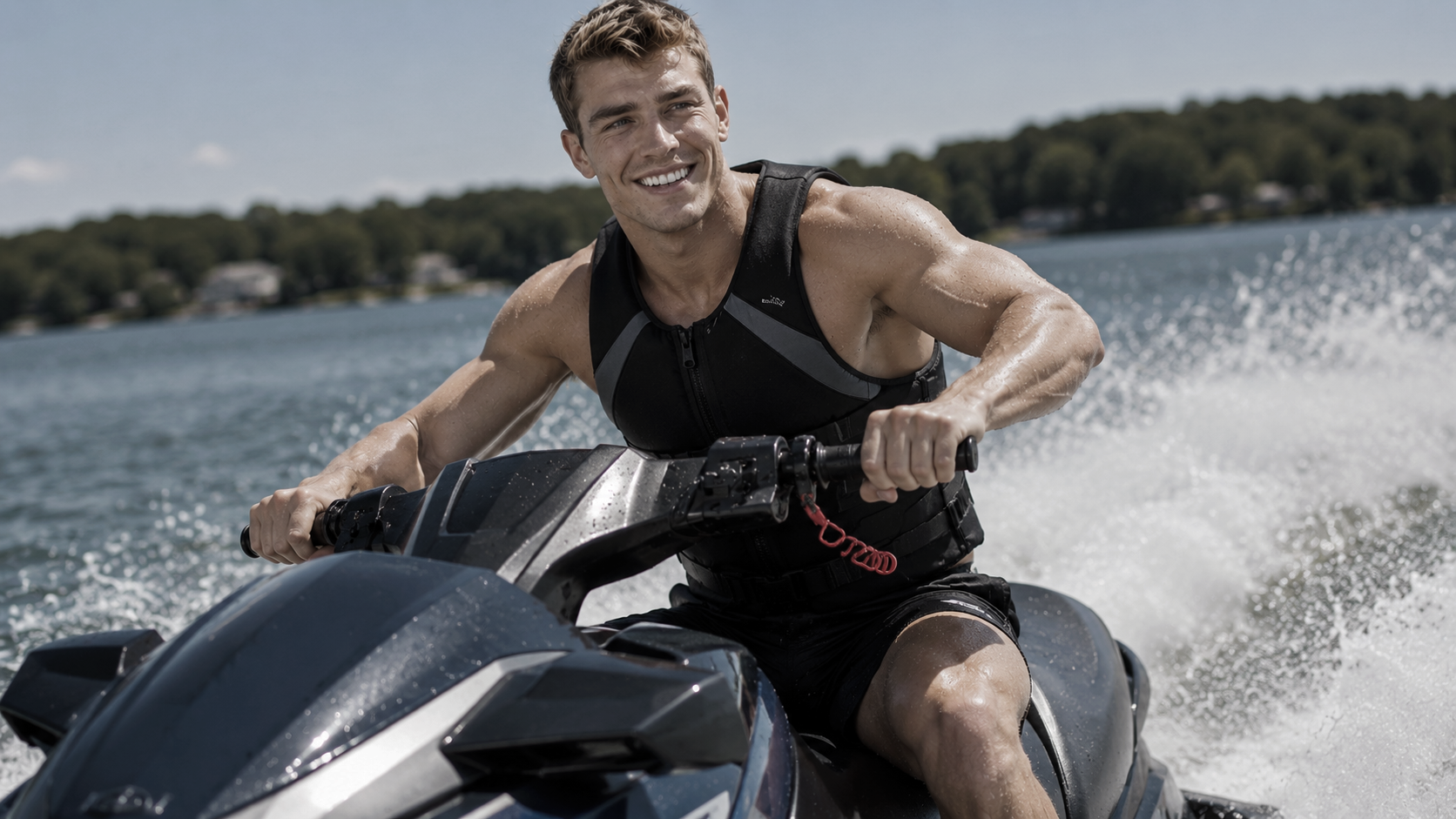
That, I thought, is what he looks like when he’s not managing himself.

Jesse
Wade stood close during the tutorial. Closer than he needed to for the instructions. His hand closed over my wrist when he showed me the throttle, his palm warm and dry against my skin, his fingers wrapping around the bone with an ease that said he touched people this way all the time and thought nothing of it. His shoulder pressed against mine when he leaned in to point out the kill switch, and the weight of him was solid and present, and the smell of him, sunscreen and coffee and something soapy underneath that, was close enough to register as a physical fact. I enjoyed it.
I noticed. His thumb moved slightly on the inside of my wrist, a small, unconscious gesture that might have been nothing, and I felt it travel up my arm in a way that I didn’t want to be feeling at ten in the morning on the day after I’d broken up with someone.
I didn’t comment. I didn’t step back. I stood where I was and listened to the instruction and let my breathing stay even and my expression stay neutral and the awareness of him stay exactly where it was, which was in the category of things I was storing until I could figure out what to do with them. There was a version of this where I would have created distance, and I pondered that version, and then I stayed where I was.

Wade
Jake appeared at my shoulder after Jesse took the jetski out. “You’re watching him.”
“I’m watching my jetski,” I said.
“Your jetski,” Jake said, “is doing fine.”
Jesse came back to the dock and pulled up alongside my machine and said that is excellent in a tone of such unguarded sincerity that I had to look away for a moment toward the marina, and I thought—not for the first time and not for the last—that Jake was right and this was a different problem entirely and I was going to need to be considerably more patient than I was accustomed to being.
“Told you,” I said. “Let’s go.”

The lake in June was full summer. The water was warm all the way down, the coves loud on weekends with boats and sound systems, the heat that sat on everything from nine in the morning until well past dark. The cove Jake anchored in was the one that gave the best shelter from the open-water traffic, cedar-covered bluffs on two sides cutting the noise and the chop, the water stilling down to something cleaner and quieter once you were inside it. You had to know where to find it. We’d found it in the second summer of doing this and it had been ours since.
I watched Jesse in the water for most of the morning from whatever vantage point presented itself, which I managed with the practiced casualness of a man who had learned long ago that watching someone was most effective when it didn’t look like watching. He swam the way he did everything else, with full commitment and no wasted movement. Strong kick, clean stroke, a swimmer who had been swimming seriously for years. The water was clear enough in the cove that I could see him below the surface, the way the light moved across his back and shoulders, and I spent a certain amount of time studying the bluffs on the far shore and thinking about things that were not the light moving across Jesse Tretiak’s back and shoulders. Thinking about myself moving across his back and shoulders.
I was, I noted, doing an extraordinary job of behaving myself. Jake had no idea.
Paul materialized at my elbow at some point, which I’d been expecting. He’d been talking to Jesse earlier at the marina. I’d seen that from across the parking lot, the way Paul had leaned in a fraction too close, the way Jake had inserted himself with the anchor line. I knew Paul well enough to know what that meant. Paul had a type, which was younger and new and hadn’t yet learned to see through him, and Jesse was exactly the kind of person Paul would decide was a refreshing change from the usual rotation.
“David’s friend,” he said.
“Mm,” I said.
“How long have you known him?”
“Since last night.”
Paul was quiet for a moment in the considering way he had. “He’s not your usual type.”
“I don’t have a type,” I said.
Paul looked at me over his sunglasses. He had known me for fifteen years and did not dignify this with a response.
“He’s not here for that,” I said. “He’s a friend of David’s. He had a rough night and needed somewhere to be.”
“Of course,” Paul said pleasantly. “He seems like a serious young man. Quiet. A bit intense for a lake day, maybe.” He said it lightly, but the words had an edge and I recognized the edge as the thing Paul did when he’d been interested in someone and had been deflected. He’d spoken to Jesse earlier, and whatever Jesse had given him hadn’t been what he wanted. “Not very talkative.”
“He’s hungover and he’s been in the sun,” I said, keeping my voice even. “He’ll loosen up.”
Kip, who had been standing on the swim platform and was now sitting on the transom near my feet, said nothing. His presence was quiet and unobtrusive, and I hadn’t noticed him there until just now. When Paul mentioned Jesse’s intensity, Kip’s eyes moved briefly from the water to my face, and then back to the water, and his expression was unreadable.
Paul went back to the bow without pushing it further. I looked at the bluffs and drank my beer.
From across the boat, near the cooler, I heard one of the younger guys, Michael’s friend, someone I’d met twice and whose name I couldn’t keep straight, say to another in a low voice, “He’s kind of cold, isn’t he? The quiet one. Like he’s not sure he wants to be here.”
The other guy shrugged and opened a beer. I didn’t hear a response. I didn’t need one. They were wrong, and I knew they were wrong, and I also knew that Jesse’s default expression read that way to people who didn’t know how to read him. It was the serious face, the one that defaulted to something close to severe, and it had nothing to do with coldness and everything to do with the way he processed the world before he decided what to give back to it.
I looked at Jake, who had heard the same thing and was already looking at me with an expression that said they don’t get it. I nodded once, small. He nodded back.

Jesse
I pulled myself up the swim ladder in the early afternoon and sat on the platform, the sun hot on my shoulders, the water running off me in rivulets. The hangover from last night had receded to a dull, distant pressure at the back of my skull, manageable as long as I stayed hydrated and didn’t move too fast. The cove was quieter now, the boat settled into the rhythm of a long afternoon, people drifting in and out of the water and the shade as the heat dictated.
I sat on the platform and let the sun dry the water on my skin. A few yards away, two of Wade’s friends—Michael’s crowd, I thought—were talking near the cooler. One of them glanced at me, said something I couldn’t make out, and the other shrugged. I caught only the shape of the words, none of the meaning. On a boat, with the water slapping and the T‑top rattling, I missed more than I let on. I’d learned a long time ago not to chase every sentence that got away from me.
Wade was at the helm, looking out at the bluffs. Jake was at the stern, the engine cover open, doing something with a wrench that he seemed to enjoy in the way people enjoyed mechanical work when it was someone else’s boat and there was no urgency to it. David and Kip were still in the water, floating on their backs and talking about something that involved a lot of David’s hands moving above the surface.
Kip climbed out of the water a few minutes later, toweled off, and moved to stand near the helm where Wade was. Not right beside him, but close enough that you noticed, the proximity you maintained with someone you knew well and felt comfortable with. He said something to Wade, his voice too low for me to catch, and Wade nodded and said something back. Kip’s hand rested on the back of the helm seat, inches from Wade’s shoulder, and he stood there for a moment longer than necessary, his posture relaxed and familiar.
Jake was still behind the engine cover, his view blocked by the console. He didn’t see it. Michael was on his phone. Paul was at the bow with his companion, their backs to the helm. David was floating on his back in the water, eyes closed against the sun.
I saw it. Kip close to Wade, the easy familiarity of the body positioning, the way Wade didn’t move away or register it as unusual. The way Kip’s hand stayed on the back of the seat, not touching Wade but close to touching, the near-touch that was nothing or deliberate and I couldn’t tell which. I filed it away with the other things I’d noticed about Kip that morning. His silence at the marina when David had talked about me being a regular, the way his eyes had moved to Wade for a fraction of a second, and I didn’t try to connect any of it. It wasn’t mine to connect. It was just information.
Wade said something and Kip laughed, and then he moved away and sat down on the port side bench and opened the paperback he’d been reading in twenty-minute increments.
The moment passed. The cove was quiet again. The heron on the far bank was still there, motionless, waiting.

I went back into the water. The afternoon heat was full now, the sun directly overhead and pressing down through the water’s surface, and I swam down to where the light broke apart into shifting green columns and stayed there for as long as my breath held. When I came up, Wade was on the swim platform, looking out toward the heron. I pulled myself up and sat beside him, letting the water drip off me onto the deck.
He said nothing at first. He had a beer in his hand and his eyes were on the far shore, and the silence between us was the easy kind, the kind that didn’t need filling.
After a while I said, “Milo told me you built everything yourself. That you didn’t inherit anything.”
“He talks a lot,” Wade said, but there was no edge in it.
“He meant it as a compliment.”
Wade was quiet for a moment. The boat swayed with a passing wake. “I started tending bar when I was twenty-two. Worked my way up to managing, started investing what I could on the side. Got lucky a couple of times, got smart a couple of times, kept reinvesting.” He looked at his beer. “It took a long time and a lot of hours and I don’t miss any of it, but it’s how I got here.”
I said nothing. I was listening in the way I’d discovered worked with him, actually listening, not waiting for a gap.
“So,” he said after a moment. Conversational, nothing on it. “School.”
“What about it?”
“UNT. What are you studying?”
“Art history,” I said. And then, with the practiced efficiency of someone who’d had this conversation before, “and business administration. Double major. The art history because it’s what I actually want to study, the business because it’s what I can actually do something with.”
I felt him turn to look at me. The afternoon sun was warm on my back and the water was cool against my legs where they hung over the transom, and I was aware of his attention in the way I’d been aware of it all day. As a physical fact, a warmth on the side of my face. “Both full time?”
“Fifteen credit hours this semester. And work.” I looked at the water. “It’s a lot on paper. It’s manageable in practice. You figure out the rhythm.”
“And you do this alone?” he asked.
“I do most things alone,” I said. “That’s not a complaint. It’s just how it is.”
He sat with this for a moment. There was something in the flat, unembellished way I’d said it that I was used to people not knowing what to do with, and he didn’t do anything with it. He just received it, the way he’d received the information about the painting last night, without trying to fix it or respond to it or make it into something that made him feel better.
“Why art history?” he said.
I considered the question in the way I considered things. He waited.
“When I was thirteen,” I said, “I found this book at a library sale. A survey of twentieth-century American art, the broad overview kind that covers a lot of ground without going deep. Forty cents.” The water moved against my feet. “I knew nothing. I hadn’t been to a museum, I hadn’t had an art class that was anything beyond coloring exercises, and I sat down with that book on a Saturday afternoon and didn’t put it down until it was dark outside.”
He didn’t say anything. I could feel his attention on me, not waiting for me to finish, just present, fully present.
“It was the first time I’d encountered something where nobody assigned it to me,” I said. “School assigns you things, work assigns you things, family assigns you things. This book, I found it. I paid forty cents for it out of my money. Everything I understood about it I figured out by looking at it and thinking about it. And what I understood was more than I expected. More than I thought I was supposed to understand at thirteen.” I looked at the bluffs. “It felt like finding out there was a language I could already speak that I didn’t know I knew.”
The boat swayed. Somewhere at the bow Paul laughed at something.
“So that’s the reason,” I said.
Wade was quiet for a moment. When he spoke, his voice was slightly different. A register lower, the way someone’s voice got when they’d stopped performing and were just saying something because it was true. “I bought most of what’s in that house at auctions where I didn’t really know what I was looking at. I walked through and if something caught me, I bought it. I didn’t have the vocabulary for why. I still don’t.” He paused. “You’re the first person who’s ever made me feel like I missed something by not knowing.”
I turned my head just enough to see his face in profile. He wasn’t looking at me. He was looking at the bluffs, and his expression was relaxed and easy, but there was something in the set of his jaw that told me he’d said something he hadn’t planned to say.
“You have good instincts,” I said. “The landscape in your hallway. That’s not a painting you buy because you are at an auction. That’s a painting you buy because it speaks to something you don’t have words for.”
He looked at me then, briefly. “The first language thing. That’s what that was.”
“That’s what it always is,” I said.
He looked back at the water. The heron was still there, still motionless, still waiting with patience that made waiting look like its own kind of work. The afternoon light was shifting, the long golden quality that came in the hours before sunset, when the heat eased slightly and the shadows grew longer and the water took on the color that lake water took on at that hour, something between silver and gold and green.
“David said to invite you to these every weekend,” he said after a while. “For whatever that’s worth.”
“David tends to manage people’s social calendars without their input,” I said.
“Yeah, he does.” A pause. “But I’m asking. Not David. Do you want to come back next weekend?”
I looked at the water. The question was simple, and he added nothing to it, no sweetener, no sales job, just the question.
“I work next Saturday,” I said.
“Saturday after.”
“I’d have to check my schedule,” I said, which was not a no, and I knew it wasn’t a no, and I also knew that he knew I knew it wasn’t a no, and neither of us acknowledged any of this.
“Check it,” he said. “Let me know.”
From the bow, Paul said something in a carrying voice about dinner reservations and the group started reassembling with the unhurried efficiency of people used to moving together. The moment closed naturally and I let it close

Wade
I watched Jesse across the table for most of dinner and I did it with the care of someone who knew exactly how much watching he could do without it becoming a thing.
Dinner was at the marina restaurant, the open-air deck overlooking the water, the kind of place that had been exactly the same since 1987 and would still be exactly the same in 2037 and was precisely right for what it was. The group took a long table on the railing side and someone ordered a round and the easy, overlapping conversation of people who had been in the sun and on the water all day settled in around it. The lake beyond the railing was turning silver-pink in the early evening light, the water still now, the boats mostly in by this hour.
Jesse was two drinks in and the shift was visible in the way Jake had described and that I’d watched last night at the pool but hadn’t quite been prepared for in daylight. His severe default expression opening into something warmer and more present, the quality of ease in his posture that the sober version worked for. He was talking to Milo and laughing at something Milo said, an actual laugh, full and unguarded, the kind that changed his entire face. His shoulders were relaxed. His hands were loose around his glass, not the careful, deliberate way he’d held the coffee mug that morning but something easier, the way someone held a drink when they’d stopped thinking about holding it.
He was twenty-one years old. I was forty-one. I want to be clear that I knew this, that it was present in my internal accounting even when other things were also present. It was not a number that particularly bothered me. I’d dated younger before, though not quite this much younger, and the specific distance between twenty-one and forty-one was its own kind of category, but it was a number that Jake clearly thought I should sit with, and so I was sitting with it.
What I was also sitting with was the afternoon on the boat. The painting conversation, which had turned into something I hadn’t expected and which I’d been turning over since it happened. The way he’d listened when I said I bought most of what’s in that house at auctions where I didn’t really know what I was looking at, and the way he’d looked at me after, briefly, and then back at the water. The way he’d said that’s not a painting you buy because you are at an auction like it was just information, like he was telling me something true and obvious that I’d been waiting for someone to tell me.
He’d glanced at me just now across the table and then looked away. I’d caught it and not reacted to it, which took a certain amount of discipline I was privately crediting myself for.
Paul leaned over from his seat on my other side. “You’re quiet tonight.”
“I’m listening,” I said.
“Mm,” Paul said, and refilled his glass. His companion was looking at his phone and hadn’t spoken to anyone in at least twenty minutes. David, from across the table, made some observation about the lake next weekend and whether Jesse was coming back, and Kip, who had been quiet for most of dinner, didn’t look up from his plate. He didn’t smile. His expression stayed carefully where it had been, pleasant and removed, and when David repeated the question to get his attention, Kip said, “I’m sure he will” in a tone that was perfectly neutral and gave nothing away.
What I was thinking, if I was being precise about it, was that Jesse Tretiak was someone I wanted to get to know, and this wanting had a quality I rarely felt, which was patience. I was not a patient person by nature. I did not pursue things over time as a rule because over time things tended to resolve themselves with little effort on my part. The idea of an extended courtship, of weeks of careful, deliberate presence that asked nothing back, was new territory.
But there was something in the conversation at the stern, in the way the afternoon had felt, in the way he’d said you feel the rightness of it before you can say why last night and that’s what it always is today, that made the extended version seem not just possible but correct. Like it would be a shame to do it any other way.
I poured the last of the bottle into my glass and looked at the lake going dark at its edges and let myself want what I wanted without doing anything about it, which was, I was discovering, its own kind of pleasure.

Jesse
The drive back to Denton from Plano took forty-five minutes at that hour, the highways quiet, the sky ahead going dark blue to black as I headed north. Wade had stood at the edge of the driveway while I got in my car and said drive safe and I’d said thanks for the day, and that was the ending of it. Easy, no production, nothing asked for or implied. I had misread his intentions.
My phone had four more texts from Luke. I turned the read receipts off so he couldn’t see I’d seen them and left them unread and drove.
The day sat with me in the way good days did when they’d been better than expected and you hadn’t finished understanding why. The water. The heron. The jetski, which had been better than it had any right to be, that feeling of the throttle opening and the spray hitting my face and the brief, uncomplicated release of it. The afternoon on the boat, which I kept returning to more than the rest of it.
You’re the first person who’s ever made me feel like I missed something by not knowing.
He’d said it like it was just information, the way he said most things, and it landed the way things landed when they were true.
I thought about the dog. Mercer, who had followed me around a stranger’s house all night and appeared at the guest room door and slept at the foot of the bed with settled certainty. The warm weight of him against my ankle. The slow, contented sigh. He had chosen me without being asked, and I had done nothing to earn it, and he’d stayed anyway.
I thought about the man who had come inside to look for me. Not by accident. I’d realized this sometime during the afternoon, with no one having to tell me. The way he’d appeared in the hallway, the way he’d said most people head straight for the bar, the way he’d been watching me the way I was watching the painting. He’d come inside because he’d noticed I’d been standing in his hallway for five minutes and wanted to see why. That was the thing I couldn’t stop thinking about. Not the house, not the pool, not the guest towels that cost more than my electric bill. The fact that he’d come looking.
I was aware that I’d spent a fair portion of the afternoon paying attention to Wade Mitchell in ways that had nothing to do with his taste in art. The way he moved on the water, which was the same way he moved through his house, with the specific ease of someone who had stopped being uncertain about where he belonged. His attention during the conversation at the stern, which had been the same I’d found in the hallway the night before, actually looking rather than appraising. The fact that he’d stood close to me during the jetski tutorial and I hadn’t stepped back.
He was an attractive man. This was just a fact. I noted it with the flat remove I applied to facts I wasn’t planning to act on, filed it in the same category as the painting’s light quality and Milo’s easy warmth and the heron’s improbable patience, and I looked at the highway going past under my headlights.
But the dog. And the man who came inside. Those were harder to file.
I had no intentions. I’d had a relationship end less than twenty-four hours ago. I was twenty-one years old and I was on my way back to an apartment in Denton where a framed print was still slightly crooked on the kitchen wall and I had homework due Thursday and work tomorrow at one. No version of this existed where intentions were appropriate.
I just thought it was worth being accurate, with myself, in the quiet of my own car, about what the afternoon had been. About the dog who had slept at the foot of the guest bed and the man who had come inside to see what I was looking at.
And then I stopped thinking about it and drove.

The apartment was the same when I got back. The print was still crooked, the space that had been empty all day was silent. I straightened the print. I made a cup of tea. I stood at the kitchen counter and drank it and looked at the small rectangle of night visible through my window, the sodium lights from the parking lot doing their orange thing on the underside of the low clouds that had rolled in while I was driving home, the air outside still holding the day’s heat even this late.
I opened Luke’s texts. I read them in order, four of them, each one a degree more uncertain than the last. Then I closed them without answering and set the phone down on the counter.
I thought about the heron. Still in the shallows when we pulled the anchor. Still there when we cleared the cove. Waiting with a patience that suggested it had its own reward.
I washed my mug, dried it, put it away.
I went to bed.

End of Chapter Two.