
When Adrian Hale arrives at Holloway with a devastatingly perfect partner, Marcus and Leo’s reckless bet seems dead on arrival—until Adrian reveals he’s been observing them as closely as they’ve been observing him. As the walls between performance and truth collapse, four years of unspoken longing push past polite reserve, leading to a raw confession and a kiss that changes everything.

Marcus
Accompanying Adrian Hale was a man named Rafael, or possibly Raphael. We never quite settled the spelling, and he was, in every measurable sense, perfect.
Rafael spoke four languages. He drank amaro neat and complimented the glassware. He rested his hand on Adrian’s shoulder with the casual ownership of long intimacy, and Adrian, the unbreachable fortress, leaned into the touch like a cat finding a sunbeam. They had been together, Chloe informed us later via Instagram DM, for over a year. A year. We had never once seen him.
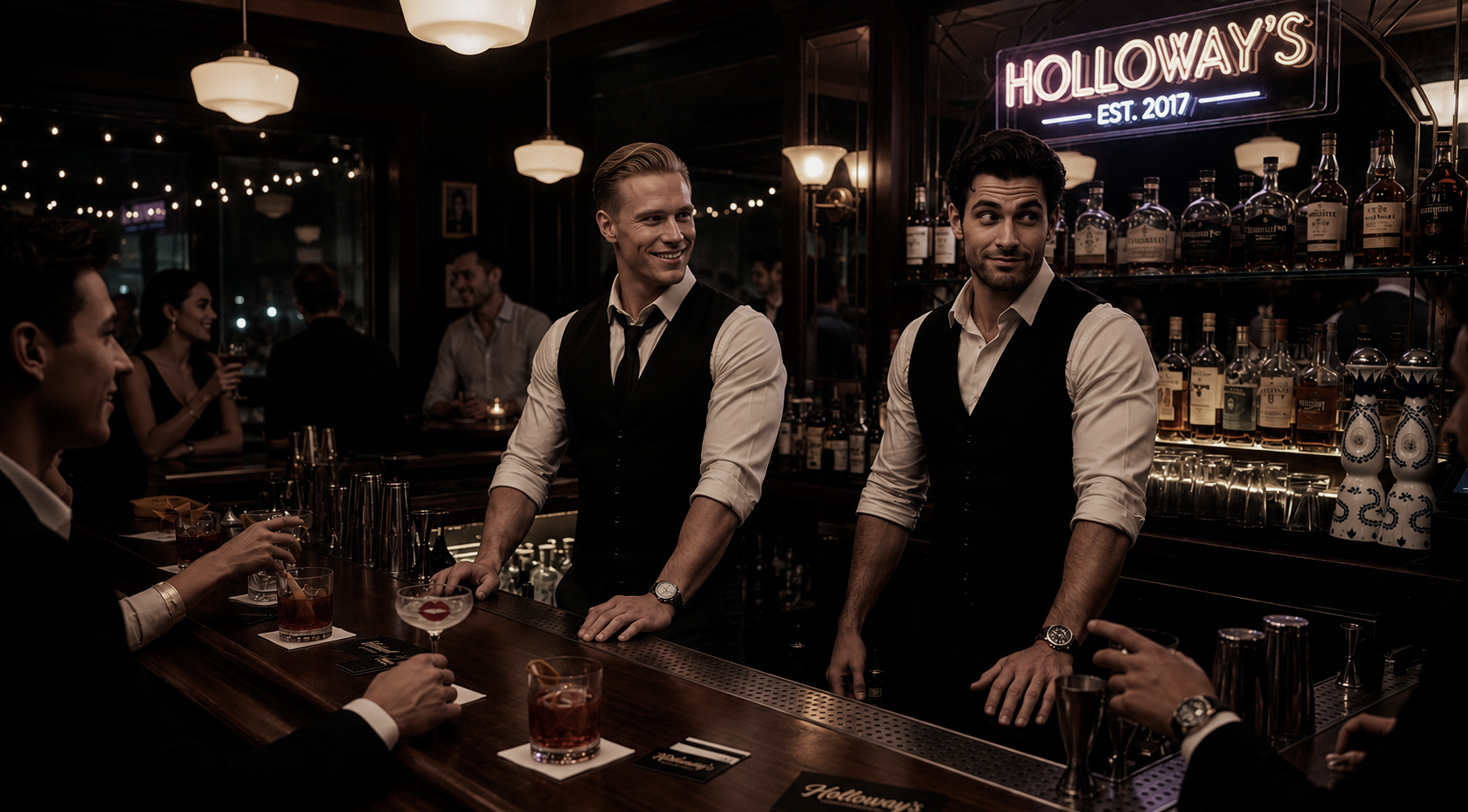
“He’s been hiding him,” Leo said, after the initial shock had settled into something we could speak around. We were crouched behind the bar, ostensibly restocking the low coolers, actually holding a whispered conference that would have looked absurd to anyone paying attention. Leo pressed his knee against mine in the narrow space. I noticed it. I noticed I noticed it. “An entire year. Why?”
“Because he’s private. His personal life is personal. Because we’re not entitled to know anything about him.”
“Okay, but a year.”
“Are you going to keep repeating that?”
“I might.” Leo sat back on his heels, running a hand through his hair. The skin around his eyes was tight, his shoulders were drawn up. He looked genuinely rattled. Not the performed version, the real one. “This changes things.”
I nodded slowly. On the surface, the bet had just become impossible. The target, we’d assumed, was single. Available. The whole premise rested on a fundamental error in our intelligence. But beneath that, in a place I wasn’t quite ready to examine yet, something else had shifted. The bet had been a lens, a way of focusing our attention on Adrian so we didn’t have to focus on . . . other things.
“What do you want to do?” I asked.
Leo looked at me. “What do you want to do?”
“I asked you first.”
“You’re the strategist. Strategize.”
I considered. Rafael was at the bar now ordering a second round. He had a kind of effortless gravity, a charisma that didn’t require an audience. I could see, with sudden and uncomfortable clarity, why Adrian had chosen him. They matched. They were both complete, self-contained, a closed circuit. There was no crack to slip through, no vulnerability to exploit.
Unless.
“We need more information,” I said. “Before we decide. We don’t know the shape of their relationship. We don’t know the rules. And we certainly don’t know . . .” I lowered my voice “ . . . whether Adrian is still interested. In either of us.”
“Interested.” Leo’s tone was flat. “You think he was interested?”
“I think he wasn’t not interested. There’s a difference.”
Leo was quiet for a moment. Behind him, the ice machine kicked on with its low, familiar rattle. Then “What if we just asked him? Directly. ‘Hey, we made this bet, it was stupid, but also are you and Rafael open to third parties and if so, what’s the application process?’”
“Please tell me you’re joking.”
“I’m mostly joking.” He rubbed the back of his neck, a familiar gesture I had catalogued years ago and never quite stopped cataloguing. “I don’t know, Marcus. This whole thing is like a very elaborate trap we built for ourselves.”
He wasn’t wrong. I wasn’t ready to admit it yet.
“Let me do some reconnaissance,” I said. “A few days. We reconvene.”
“Reconvene. You sound like a spy.”
“I’m a bartender. It’s essentially the same job with less international travel.”
Leo snorted, and some of the tension in his shoulders released. That was something I could do. Make him laugh, defuse the tightness. It was a power I’d never catalogued before, and I filed it away now, unsure what category it belonged in.

Leo
The next few days were weird.
Not bad weird, exactly. The weird where you’re going about your normal routine but everything feels slightly tilted, like someone’s moved all the furniture two inches to the left. I poured drinks. I smiled at the customers. I made small talk. Underneath it all, my mind was running in a loop. Marcus touching my wrist in an empty bar. Marcus saying his loss. Marcus looking at me like I was a puzzle he’d just discovered had a second side.
The bet had been my idea. My stupid, impulsive Leo idea. I’d proposed it because it was fun, because it was a game, because it kept us in our familiar dynamic of competition and banter and whatever that unacknowledged thing was that hummed between us. But the game was leaking. Seeping into reality. I couldn’t tell anymore what was strategy and what was truth.
The vulnerability thing, was that a tactic? I’d told myself it was. Novel approach. Adrian responds to genuine. So be genuine. But I hadn’t been talking to Adrian in the empty bar. I’d been talking to Marcus. And the words had come out of me like water from a cracked pipe, things I’d never said to anyone, things I barely admitted to myself. I’ve never been in love. Not the kind that lasts.
Marcus had touched my wrist. His fingers had been cool and dry, exactly the way I’d imagined they’d be. Not that I’d imagined it. Not that I’d spent any time imagining it. For one brief, terrifying second, I’d wanted to turn my hand over and lace my fingers through his and hold on.
I didn’t. Obviously. I made a joke instead because that’s what I do. Good at the start. Useless at the rest.
On Thursday, my day off, I took a run along the East River. Twelve miles, hard pace, the kind that empties your head. It didn’t work. My head wasn’t empty. It was full of Marcus Cole, standing behind a bar in his navy suit, his hands moving with that infuriating precision, his dry little smile flickering at the corner of his mouth.
This is a problem, I thought, for maybe the hundredth time. This is a very specific kind of problem.
I called my sister. She’s a therapist in Portland, which means she’s both professionally obligated and constitutionally incapable of letting me bullshit my way through a conversation.
“Leo,” she said after I’d rambled for five minutes about a fictional version of the problem I’d constructed, “are you calling to ask whether you’re in love with your coworker?”
“I’m not . . . I didn’t say . . . why would you assume . . . ”
“You’re using your deflection voice. The pitch goes up. It’s quite distinctive.”
I closed my eyes. Below me, the East River glittered, indifferent and filthy. “I don’t know what I am.”
“Okay. What does it feel like?”
“Like I’m standing on the edge of something and I can’t see the bottom.”
She was quiet for a moment. The silence on the line was the specific silence of a therapist choosing her next words. “That sounds like fear, not love.”
“Can’t it be both?”
“Often is.” I heard her shift the phone, probably reaching for her coffee. My sister runs on caffeine and professional detachment. “You’ve never been scared of a relationship before. What’s different about this one?”
“He knows me.”
“He knows the surface you.”
“I think he might know the rest, too. Or he’s starting to. And he hasn’t run.”
“And that scares you.”
“It terrifies me. Because if he sees all of it and he still . . . ” I stopped. Swallowed. A barge was moving slowly upriver, its lights low and red against the dark water. “It means I’ve been the problem the whole time. Not them. Me.”
“Leo.” Her voice softened, the professional edge dropping away. “You’ve always known that. You’ve just never had a reason to do anything about it before.”
I didn’t have an answer. We talked for another few minutes about Portland weather and her new cat, and I hung up scraped raw and weirdly hopeful, like a wound that had finally been cleaned.

Marcus
My reconnaissance took me to unexpected places.
It started, as so many things in New York do, with a dinner party. One of our regulars, a gallerist named Soren who spent more on wine than sense, invited me to a Thursday gathering at his Tribeca loft. I usually declined these things. I am not, by nature, a social creature but Soren mentioned, almost as an afterthought, that Adrian Hale might attend. “He’s a collector,” Soren said. “Did you know? Architectural sketches, early drafts. He’s got an eye.”
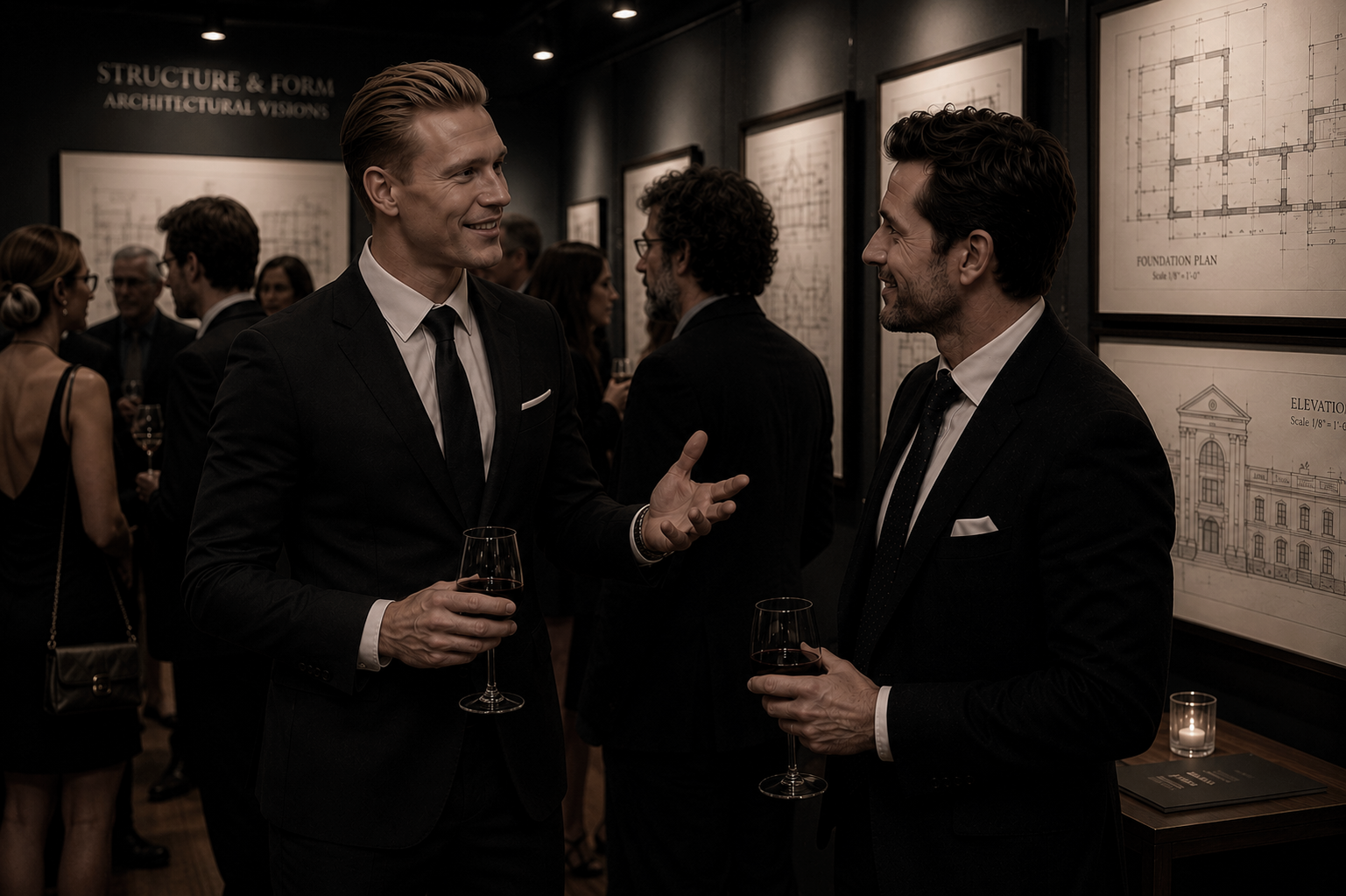
I did not know. I had never considered what Adrian did with his time outside of Holloway. He existed in my mind entirely as a figure in a booth, a problem to be solved, a target in a bet I was already regretting. The idea of him as a person with hobbies and friends and a collection of architectural sketches was disorienting. It made him real in a way I hadn’t prepared for.
But I went. I wore my charcoal suit and my best tie and I went because I am fundamentally unable to leave a question unanswered.
The loft was everything you’d expect. Exposed brick, gallery lighting, chic decor, and a catering staff circulating with tiny plates of something that had been foraged. I found a corner and nursed a gin and tonic and tried to look like I belonged. I’m good at looking like I belong. It’s a skill I developed in graduate school, where every room was full of people who seemed to have received a manual I’d missed.
Adrian arrived at eight-thirty. Alone. No Rafael. He was wearing a dark blazer and a scarf that probably cost more than my rent, and he spotted me before I’d decided whether to approach.
“Marcus.” He smiled, the same quiet, knowing smile he wore at the bar. “This is unexpected.”
“I’m full of surprises,” I said, which was not true but sounded appropriately mysterious.
“Come. Sit.” He gestured to a pair of chairs near the window and I followed him with the sensation of a man walking into a test for which he hadn’t studied.
We talked for an hour. Not about cocktails, not about architecture, not about anything I’d prepared. We talked about his collection. He had a particular fondness for unrealized buildings, structures that existed only in blueprint, “the architecture of possibility,” he called it. We talked about my abandoned dissertation, about the peculiar grief of leaving academia, about the way a well-made drink and a well-made argument require the same bones. He was attentive, thoughtful, generous with his attention, and I found myself, against all expectation, enjoying the conversation for its own sake.
Then he asked about Leo.
“Your partner,” he said, the word landing with deliberate neutrality. “He’s very different from you.”
“In every possible way.”
“Is that why the partnership works?”
I considered the question more seriously than it probably deserved. “Yes. I think so. He’s instinct where I’m analysis. He’s warmth where I’m . . .” I hesitated. “. . . reserve.”
“You say ‘reserve’ like it’s a flaw.”
“I say it like it’s a fact.”
Adrian looked at me for a long moment. The ice shifted in his glass. When he spoke again, his voice was quiet. “Do you know why I come to Holloway, Marcus?”
“Because the cocktails are excellent?”
“Because the two of you are the most interesting things in the room.” He swirled his wine, his gaze drifting toward the window. “You move around each other like a dance. You anticipate, you cover, you support. It’s a kind of architecture, really. A structure of small gestures.” He paused. “I’ve been watching it for two years.”
Two years. The number landed in my stomach like a stone. “You’ve been watching us.”
“Observing. I’m an architect. It’s what I do.”
I didn’t know how to respond. That Adrian, the unbreachable fortress, had been studying us the way we’d been studying him reframed everything. We weren’t hunters. We were specimens.
“Does that make you uncomfortable?” Adrian asked.
“I’m not sure.” I set my glass down. My mind was racing, connections firing in directions I hadn’t expected. “What have you observed?”
“That you’re very careful, Marcus. Very precise. You keep yourself hidden behind a structure of intellect and courtesy, and you only let it trip when you’re looking at Leo.” His gaze was very steady. “And Leo is the opposite. He shows everything except the one thing that matters. And that one thing, I suspect, is the same thing you’re hiding.”
The room was suddenly warm. The gin in my glass was no longer cold. “And what’s that?”
Adrian smiled. It was not an unkind smile. “I think you know.”

Leo
I didn’t know about the dinner party. Not right away. Marcus came in for his Friday shift looking calm and composed as always, but there was a crack in the composure. A hairline fracture I’d learned to spot over four years. His tie was slightly off center. His hands, when he reached for a bottle, were too still. Marcus in deep thought is a Marcus who’s stopped fidgeting entirely, which is how you know something is very wrong.
“You talked to him,” I said, when the dinner rush had died and we had a brief pocket of quiet.
“Last night. A dinner party. He was there.”
“And?”
Marcus was silent for a moment, polishing a glass with unnecessary intensity. The cloth moved in small, tight circles. “I’m no longer certain who’s playing whom.”
That was not the answer I’d expected. “What does that mean?”
“It means Adrian has been observing us for two years. It means he’s not a target or a puzzle or a bet. He’s a . . .” Marcus set the glass down hard enough that I heard the base click against the bar. “He’s a mirror. You said that. You were right. He reflects whatever you give him, but he also sees what you’re not giving. He sees the gaps.”
A chill washed over me that had nothing to do with the air conditioning. The bar was suddenly silent. “What gaps?”
“The things we don’t say to each other.”
We looked at each other across the bar. The EST. 2017 sign hummed above us, steady and indifferent. I became acutely aware of the space between us. Three feet of rubber mat and polished wood, three feet that might as well have been a canyon. The shaker in my hand had grown warm.
“Marcus—”
“Don’t.” His voice was quiet, almost ragged. “Whatever you’re about to say, don’t. Not here. Not now.”
“Then when?”
“I don’t know.” He turned away, reaching for a bottle, and I followed the line of his back, the tension in his shoulders, the way his hands were just slightly unsteady against the glass. “I need to think. I need to . . . I don’t know what I need.”
I wanted to touch him. I wanted to cross the three feet and put my hand on his arm and say something true. But I’d spent thirty-one years being good at the start and useless at the rest and I didn’t trust myself to break the pattern now.
So I didn’t. I let him walk away. And I stood there, alone behind the bar, while the ice melted in my shaker and the hum of the neon filled the silence I should have broken.
Marcus
I spent the weekend in a state of suspended crisis.
Adrian’s words had cracked something open, a door I’d been keeping carefully closed for four years. You only let it slip when you’re looking at Leo. It was true. Of course it was true. I had constructed an entire architecture of detachment around myself—a cool, clean structure of irony and reserve—and Leo Vance had been walking through its walls since the day we met. He wasn’t even aware he was doing it. That was the worst part. He smiled and my scaffolding shook. He laughed and my foundations shifted. He touched my wrist and the entire edifice nearly collapsed.
And I had called it friendship. I had called it partnership. I had called it anything but what it was.
On Sunday evening I walked to Holloway even though it was closed. I had keys. I’d been a manager for three years. The bar was dark and silent, the chairs upturned on the tables, the EST. 2017 sign unlit above the liquor shelves. The air smelled faintly of citrus and cleaning solutions. I sat on my usual stool and stared at the space where Leo usually stood and I tried to have a conversation with myself.
You’re in love with him.
I know.
You’ve been in love with him for years.
I know.
He has no idea.
I know.
What are you going to do about it?
I didn’t have an answer. The bet had been a mistake, not because it was predatory or inappropriate or any of the things I’d half-heartedly accused it of being, but because it had forced us to look at each other. To talk about vulnerability and loneliness and the things we’d never said. And once you’ve started looking, you can’t stop. Once you’ve started talking, the silence is louder than it was before.
My phone buzzed against the bar. Leo. You okay? You’ve been weird.
I stared at the screen. Three words, a question mark, a tiny green bubble that contained more than the letters claimed. You’ve been weird. He’d noticed. Of course he’d noticed. He was Leo. He noticed everything about the people he cared about, even when he pretended he didn’t.
I’m fine, I typed. Then deleted it. Then typed it again. I’m fine. Long weekend. See you Tuesday.
I wasn’t fine. But I didn’t know how to tell the truth yet. I didn’t know if I ever would.

Leo
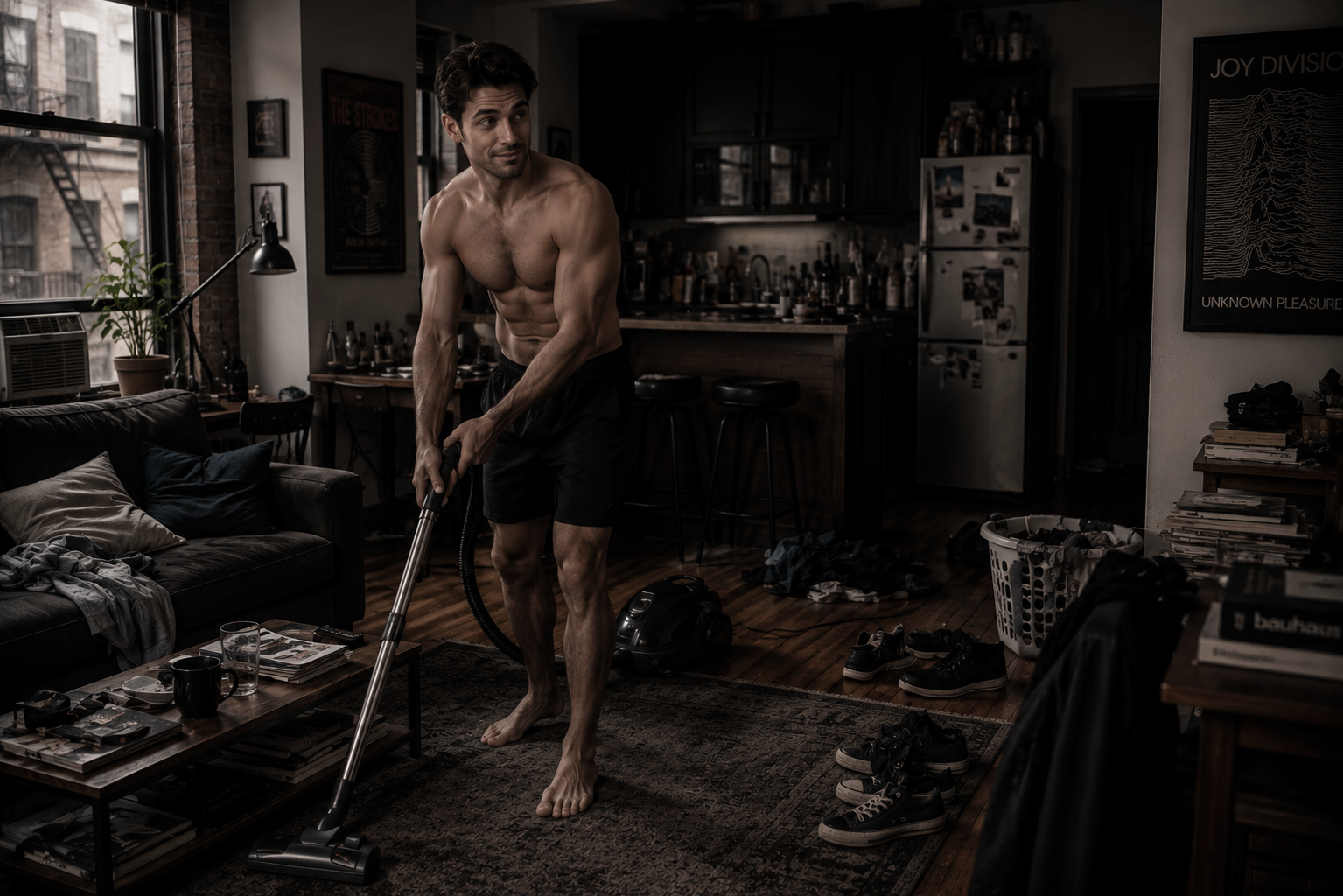
Monday was my day off and I spent it doing something I almost never do. I cleaned my apartment.
Not just tidied. Cleaned. I scrubbed the bathroom until the grout was white, mopped the floors, and organized the closet by color like a person who had his life together. I threw away expired condiments and a dead plant I’d been ignoring for six weeks. It was displacement activity of the most transparent kind, but it worked. By the time I was done, the place looked like an adult lived in it and I was almost functional. The couch cushions were actually on the couch.
I also thought about Marcus. Nonstop. There was no point in pretending otherwise.
My sister’s question kept looping. What’s different about this one? The answer, I was realizing, was everything. Marcus wasn’t a conquest or a flirtation or a fun way to pass the time. He was the person I spent forty hours a week with, the person who knew my coffee order and my stress tells and the exact way I liked the well organized. Marcus was the person who’d covered my shifts without being asked when my dad was in the hospital, who’d stayed late to help me practice latte art for a competition I was too proud to admit I was nervous about. He was the person who’d looked at me in an empty bar and said his loss like he meant it, like it mattered, like I mattered.
And I’d made a bet with him. I’d turned our relationship into a game. I’d done the thing I always do. Deflect, swagger, perform. And I’d done it to the one person who might have seen through it if I’d let him.
I sat on my newly cleaned couch and put my head in my hands. The leather was cool against my forehead.
What do you do when you’re in love with your best friend? What do you do when you’ve spent four years building a perfect, functional partnership and you’re about to blow it up because you can’t stop looking at his hands?
What do you do when he’s looking back?

Marcus
Tuesday night, the black door opened and Adrian walked in. Alone.
He took his usual booth, ordered his usual Old Fashioned, and opened his sketchbook with the same ritual calm he’d always had. Jacket off. Cuffs adjusted. The small, economical signal to the server that said I am here, I am ready. But something was different. A tension in the air, a charge I couldn’t name. When I delivered his drink, he looked up at me with those dark, knowing eyes.
“How is the bet progressing?”
I almost dropped the glass. My hand jerked and the Old Fashioned sloshed against its rim. “I . . . what?”
“The bet.” He said it casually, as if discussing the weather. “The competition. The wager you and Leo made about me. How is it progressing?”
My face flipped between cold, then hot. The blood drained somewhere and rushed back twice as fast. “Who told you—”
“No one.” Adrian lifted his drink, inspected the color against the light. “I’ve been a regular in this bar for two years. I’ve watched the two of you orbit each other. I’ve observed the shift in your dynamic over the past two weeks . . . the private conferences, the whispered arguments, the way you look at each other differently when you think no one is watching.” He took a sip. “And I’m a reasonably intelligent man. It wasn’t difficult to extrapolate.”
I sat down across from him without asking permission. My legs had decided before my brain caught up. “Are you angry?”
“Angry?” He seemed genuinely surprised. “No. I’m flattered. And curious.” He set his glass down and folded his hands on the table. “Tell me, Marcus. Which one of you am I supposed to be seduced by?”
I opened my mouth. Closed it. For once in my life, I had absolutely nothing prepared. The silence stretched and Adrian waited, patient as stone.
“It doesn’t matter,” I said finally. “We predicated the bet on a misunderstanding. We didn’t know about Rafael.”
“Ah, Rafael.” A small, private smile crossed Adrian’s face. “Does his existence invalidate the premise?”
“You’re . . .” I hesitated. The question was forward, possibly offensive, and I was past caring about any of that. “Are you and he exclusive?”
“That’s a very forward question.”
“I’m aware. I’m asking anyway.”
Adrian studied me for a long moment. I had the uncomfortable sense of being read, evaluated, categorized . . . a specimen under glass. “Rafael and I have an agreement,” he said. “We are each other’s primary. But we are not each other’s only. There is room for exploration. If the right circumstances presented themselves.”
My heart was beating quick, in my temples, my wrists, the soles of my feet. “And what would the right circumstances look like?”
“I’m not entirely sure.” He leaned back, his gaze drifting toward the bar, where Leo was pretending badly not to watch us. “But I suspect they would involve the two of you being honest with each other first.”
“Honest about what?”
“I think you know.”
He said it the same way he’d said it at the dinner party. Quiet. Certain. A man who had spent two years observing a structure and had mapped every load-bearing beam.
I stood up. My legs were unreliable, hollowed out. “I need to talk to Leo.”
“Yes,” Adrian said. “You do.”

Leo
Marcus walked back to the bar looking as if he’d seen a ghost. Actually, no. Marcus walks back from bad news looking composed, the way he does everything, his face a careful neutral. That he looked shaken meant it was worse than a ghost. It was personal.
“Adrian knows about the bet,” he said, his voice low and tight.
“What?“
“He figured it out. He’s not angry. He’s . . .” Marcus made a gesture that conveyed nothing and everything. “He’s something else.”
“What does that mean? What did he say?”
Marcus met my eyes. There was something raw in his expression, a door I’d never seen open before, and it stopped my breath. “He told me to be honest with you.”
“About what?”
A long pause. The bar was quiet around us. It was Tuesday, the lull was in full effect, and we were essentially alone. The EST. 2017 sign hummed its steady neon heartbeat. Marcus’s hands were absolutely still on the bar and I realized with a start that he was trembling. Just slightly. A vibration through the wood that traveled to me.
“Leo,” he said. “I’ve been lying to you.”
My stomach dropped. The sensation was physical, a cold, hollow plunge. “About what?”
“Everything. The bet. My motives. The reason I agreed to it.” He took a breath, the kind you take before a dive. “I didn’t care about Adrian. I never did. I cared about . . .” He stopped. Swallowed. His jaw was tight, the muscle working under the skin. “I cared about the fact that you were so willing to chase someone else.”
The words hung in the air between us. My pulse rose again in all of the usual places. The shaker in my hand was freezing against my palm.
“What are you saying?”
“I’m saying I’m in love with you.” He said it flatly, almost angrily, as if he had trapped the words for years and was furious about finally saying them. “I’ve been in love with you since the second year we worked together. I’ve catalogued every smile, every joke, every time you touched my shoulder. I’ve built a whole framework around it, a structure of denial so elaborate I almost convinced myself it was friendship. And then you proposed this bet and I thought . . . I thought maybe if I played along, if I treated it like a game, I could keep pretending. But I can’t.”
I stared at him. Marcus Cole, the most precise person I’d ever met, was shaking. His hands were white-knuckled on the bar, his jaw tight, his eyes dazzling and terrified.
This is the moment, I thought. This is the moment you’ve been avoiding your whole life. The part after the start. The part where it matters.
“Marcus,” I said.
And then I said nothing else. I leaned across the bar, took his face in my hands—his cheeks were cool, his jaw rough with the day’s stubble—and I kissed him.
The shaker clattered onto the mat. I didn’t care.

End of Chapter Two.