
Four men, bound by bloodlines they never knew existed, must navigate a web of ancient secrets, treacherous desire, and a predatory supernatural force that feeds on the fault lines between them. Trust is a weapon, love is a liability, and the only way to stop a king is to crown a new one—or become one themselves. Monogamy is the destination, not the starting point. The erotic charge comes from watching two couples navigate a field of other bodies, other desires, until they finally choose each other. That choice carries far more weight when they've had other options all along.

Kyle
The dead didn’t care about the weather. Fog had eaten the cemetery overnight. Thick and silver. It muffled everything, turning every headstone into a witness standing in the cold. I’d been walking the perimeter for twenty minutes, checking locks on the old mausoleums, marking down which sections needed trimming, trying to ignore the way the silence pressed against my ears. Like water pressure. Three weeks on the job. Three weeks without incident. I should have known it couldn’t last.
My boots crunched on wet gravel. A crow on the east side let out a single cry and then thought better of it. The wrought-iron fence bled rust into the fog, a faint mineral smell that stuck to the back of my throat. I stopped at the north gate, tested the chain, moved on. Routine. Boring. Safe.
I was good at safe.
The clipboard was cold in my bare hand. I’d left my good gloves in the maintenance shed yesterday. The cheap pair I kept in the truck had a hole in the left index finger. Small things. The small things that pile up until you realize you’ve been ignoring them on purpose.
The path curved around the old section. Headstones tilted at angles that said the ground had shifted beneath them. Moss-covered angels, blank eyes, outstretched hands. I liked the old section. The dead there had been dead long enough to stop feeling like people. They were geography now. Landmarks.
I passed the caretaker’s cottage and made myself not look at it.
Harold’s cottage. Harold was the reason I got this job. Three weeks ago, the previous groundskeeper walked into the fog and didn’t walk out. No body. No blood. There were no signs of a struggle. The police searched. The administration wrung its hands. Then they posted the job listing because the grass still needed cutting and the dead still needed tending.
I applied because I needed something that didn’t ask questions. The dead were supposed to be simple.
The cottage windows were dark. The FOR RENT sign on the gate hung crooked, swinging in a breeze I couldn’t feel. A low ache, like the start of a migraine, stirred behind my sternum. I knew what it meant. I’d been ignoring it for years.
Not today, I thought. Not here.
I walked on.

The maintenance shed sat off the main path, half hidden by a yew tree that had needed pruning even before Harold died. Compact building. Corrugated metal roof, a single window, a door that had once been painted green and faded to the color of old bruises.
The door was ajar.
I stopped ten feet away. The clipboard hung at my side. The ache behind my sternum sharpened into something closer to a warning.
Three weeks on the job. Three weeks of routine. And for those three weeks, they kept the shed locked. I knew because I had checked. Every morning. Every evening. I checked because Harold disappeared, and the shed was the last place anyone had seen him. I wasn’t the kind of person who left doors open.
I breathed out. A long, slow exhale that shaped the air into fog.
Walk away, some part of me said. The sensible part. The part that kept me alive through jobs and cities and situations I didn’t like to think about. Lock it tomorrow. Report it to Mrs. Harlow. Go home.
I didn’t walk away.
I approached the shed slowly. Gravel ground under my boots. The door wasn’t just ajar. Someone forced it open. The lock remained intact, but something splintered the surrounding frame. Pale, fresh wood. Someone, or something, pushed through.
I nudged the door open with my clipboard.
Inside, the air was wrong. Not just cold. Hungry cold. The kind that didn’t come from weather. It radiated from the center of the room, from a spot near the desk where the temperature dropped so sharply that my teeth hurt.
The chair lay overturned. Maintenance logs, weather reports, a coffee-stained map of the cemetery with sections circled in red lay scattered across the floor. A ceramic mug had shattered against the far wall. The pieces still lay where they’d fallen.
No body. No blood. Just absence.
I stood in the doorway, letting my eyes adjust. The cold spot pulsed against my skin. My hand drifted to my sternum, pressing hard. The ache flared and settled.
I stepped inside.
Papers crunched under my boots. I knelt and gathered them. Habit. The maintenance logs were meticulous. Harold had been careful, at least until the end. Water damage to the east fence. A cracked headstone in section twelve. A cold spot near the north mausoleum.
I stopped. Read that entry again.
March 14th. Cold spot near the north mausoleum. Unusual. Not weather-related. Will monitor.
The handwriting was steady. Professional. Someone dated the entry two months ago.
I flipped forward. The entries deteriorated. The cold spots spread.
March 20th. Cold spot in section four. Stronger than before. Fence ice despite no precipitation.
March 27th. Heard footsteps on the perimeter path at 2 AM. No one was there.
April 1st. It watches from the fog. It knows I’m alone. I can hear it breathing when I lock the door at night.
Harold disappeared on the date of the last entry.
I closed the notebook and stood. The cold spot was still there. Still hungry. Still waiting. I could feel it watching me, though the cold itself had no eyes. That prickling at the back of the neck. That pressure behind the eyes. The world tilted, then steadied.
I’d had visions since I was seventeen. Flashes, mostly. A woman falling from a bridge. A car crash in the rain. Death, always death. They came without warning and left without explanation. I’d spent a decade learning to ignore them.
But this was different. This was something else. Not a vision, but not not a vision either. A pre-echo. A warning.
I grabbed the notebook and left the shed. I locked the door behind me. Pointless, but satisfying. I added a note to my clipboard.
Shed. Locked. Still missing.
My hand was steady when I wrote it. My mind was not.

The fog thickened as I walked back toward the main gate. The sun had risen somewhere behind the clouds, but the light was thin and watery, barely strong enough to cast shadows. I was almost at the gate when I heard it.
Footsteps.
Not mine. Heavier. Four beats. Pause. Four beats. Pause.
I stopped. The footsteps stopped a half-second later, as if whatever made them had been watching me and adjusted.
Fog hid everything. I couldn’t see ten feet in any direction. Headstones were gray shapes. Angels were looming shadows. The silence deepened, swallowing even the distant traffic noise from the highway.
The footsteps started again. Closer. Circling.
I turned slowly. My body tensed, ready in a way it hadn’t been in years. I’d done some fighting in my twenties. Nothing professional, just the training you pick up when you’re scared all the time and need to do something with it. My body remembered. My body wanted to run.
The footsteps stopped.
The fog parted. Just for a moment. Just enough.
Between the mausoleums, a shape moved. Massive. Too large to be a dog. Too silent to be real. Its outline was wrong. Shoulders too high. Head too low. The proportions of something that had never been human. Or dog. Its coat was the color of old bone.
And its eyes.
Golden. Not yellow. Golden, the way amber is golden, the way fire is golden. They caught the thin morning light and held it. For one suspended second, they pinned me.
Then the fog closed in. The footsteps receded. The silence returned.
I ran.
I didn’t mean to. My body decided. One moment I was standing in the fog, staring at eyes that had no business existing. The next I was sprinting for the gate. My boots slipped on wet gravel. My clipboard went flying. I didn’t stop.
I reached the truck, yanked the door open, and threw myself inside. Slammed the door. Locked it. My hands shook so badly I could barely find the ignition.
I sat there, breathing hard, staring at the fog through the windshield. Nothing moved. Nothing followed. The cemetery was still and silent and empty.
My hand clutched Harold’s notebook. I didn’t remember picking it up. I looked at the last entry again.
It knows I’m alone.
I put the truck into gear and drove.

My apartment was ten minutes from the cemetery, in a building that had been old when I was born and hadn’t improved with age. Thin walls. Temperamental plumbing. The landlord had painted everything the same off-white that turned yellow in the corners after a year. I’d been here three weeks. It looked exactly the way it had when I moved in.
No photographs. No decorations. A single duffel bag in the corner, half packed, ready to go at a moment’s notice. The only thing I’d bothered to arrange was a multi-tool on the nightstand. Stainless steel, well maintained. The kind of thing that costs more than it should and lasts longer than you’d expect.
I sat on the edge of my bed, still in my work clothes. Harold’s notebook on my knee. My breathing had evened out somewhere on the drive home. Four seconds in. Four seconds hold. Four seconds out. A grounding exercise I learned from a therapist whose name I’d forgotten. It worked eventually. It always worked eventually. It ended up taking longer than it used to.
Those golden eyes stayed in my head. The footsteps. The cold spot in the shed. I tried to push them aside, to file them under things I will not think about. They kept sliding back. The notebook was worse. Harold’s handwriting, steady at the start, jagged at the end. I couldn’t unread it. The black ink that documented the slide from observation to fear to terror.
It watches from the fog.
I closed the notebook. Opened it again. Read the earlier entries, the ones from before. Harold had been careful. He noted everything. Weather patterns. Fence repairs. A section of ivy that needed cutting. The supernatural crept in slowly. One cold spot at a time, until it was the only thing he wrote about.
I wondered if he’d had anyone to tell. A wife. A friend. Someone who would have noticed when the entries changed from maintenance logs to last words.
The notebook didn’t say.
I closed it and looked up.
The wall opposite me was bare. Old plaster, off-white, stained in the corners.
Except for the symbol burned into it.
I froze.
The symbol was the size of my palm, glowing faintly with its own heat. That was not paint. It didn’t scorch the surface. It looked as if it had grown there, as if the wall had remembered something that happened centuries ago. Interlocking circles. Lines that suggested binding and containment. A central glyph that hurt to look at directly. The hurt that went straight to the back of the skull.
I reached out. My fingers hovered an inch from the wall.
The air was warm. Not hot. Alive. Like the wall was breathing.
I pulled my hand back. My jaw clenched. The ache behind my sternum answered. A deep hum I’d felt before but never named.
I grabbed the multi-tool from the nightstand. Opened it. Closed it. Opened it again. The movement was automatic, a tic I’d had for years. I didn’t remember where I got it anymore. That bothered me more than I wanted to admit.
I sat on the bed with the multi-tool in one hand and Harold’s notebook in the other, staring at a symbol that shouldn’t exist on a wall I’d been staring at for three weeks seeing nothing at all. The apartment was silent. The fog had followed me home. Or that was the impression it gave.n A gray weight pressing against the windows.
I needed to do something. Call someone. Run. Anything.
I picked up my phone instead.
The hookup app opened with a swipe. I’d been using it for two years, across three cities and five apartments. The faces blurred together. Torsos, jawlines, promises of distraction. I wasn’t looking for connection. I was looking for interruption. Anything that wasn’t the inside of my head.
I scrolled. Stopped on a thumbnail. A man’s body, no face. Just the curve of a shoulder and the suggestion of a collarbone. Local. Available.
I stared at him for ten seconds. Typed Hey. Deleted it. Typed You up? Deleted it.
The phone buzzed. A notification from the app. Someone liked your profile.
I closed the app without looking. Dropped the phone on the bed.
I didn’t want sex. For an hour, I wanted not to be myself. I wanted to be a body instead of a person. Something simple and functional. A machine that touched and was touched and didn’t have to think about golden eyes in the fog or symbols on walls or the way Harold’s handwriting deteriorated at the end.
But even that felt like too much effort. Even that felt like letting someone in.
Pathetic, I thought. The word landed with the weight of long familiarity.
I lay back on the bed and stared at the ceiling. The symbol was still there, peripheral but impossible to ignore. The ache behind my sternum was still there. Harold’s notebook was still there, open on my chest like a hand pressing down.
I didn’t call anyone. Didn’t text. I lay there with the symbol on my wall and a dead man’s last words on my chest.

I showered because I didn’t know what else to do.
The bathroom was small. Barely room to turn around. I braced my hands against the tile and let the water beat down on my shoulders, hot enough to turn my skin pink. Steam rose around me, thick as the fog outside. I closed my eyes and tried to think about nothing.
It didn’t work. It never worked.
The scars on my chest were three parallel lines. Old and silver, crossing my sternum from collarbone to solar plexus. I’d had them as long as I could remember. Or as long as I couldn’t remember. They’d appeared one morning when I was seventeen. I went to bed with an unmarked body. I woke up with blood on my sheets and three lines carved into my skin and no memory of how they got there.
The doctors called it a fugue state. A dissociative episode. A symptom of stress.
They couldn’t explain the precision. The lines were too clean. Too symmetrical. Too deliberate. As if a surgeon or a ritualist had made them. My parents wanted me to see a therapist. I refused. I left home a year later and stayed nowhere long enough to explain them again.
I touched the scars now, tracing the raised edges with my fingertips. They’d healed cleanly. They never stopped aching. A low, persistent hum beneath my skin. A tuning fork struck years ago that never stopped vibrating. The symbol on the bedroom wall hummed with it. The ache flared brighter when I was too close. Softened when I looked away.
Coincidence, I told myself. You’re seeing patterns because you want to see patterns. The mind does that.
The mind did a lot of things. It showed me visions of death without my permission. It let me stand in Harold’s shed and feel something hungry pressing against the edges of reality.
I got out of the shower. Toweled off. Thought about paying attention to my cock. When I stepped back into the bedroom, the symbol was still there. It wasn’t going anywhere.
Neither was I.
I dressed in clean clothes. Sat on the edge of the bed. Opened Harold’s notebook again. The earlier entries were normal. Maintenance logs. Weather observations. Then, a month into his tenure, came the first anomaly. A cold spot near the north mausoleum. The entries deteriorated from there. Observations became fears. Fears became terror. The last entry pressed so hard that the pen nearly tore the paper.
It knows I’m alone.
I closed the notebook. Set it on the nightstand next to the multi-tool.
I could leave. I should leave. Since I started, I had been seeking a reason to quit, and “supernatural predator in the fog” provided an excellent one. I could be ready to leave by nightfall. In another state by morning.
But the symbol on my wall was still there. The ache in my chest was still there. Harold’s last words were still in my head, circling like the footsteps in the fog.
It knows I’m alone.
I looked at the symbol. The symbol didn’t look back. It didn’t need to.

I told myself I was going back because I’d left my good gloves in the maintenance shed.
It was a lie, and I knew it, but I’ve always been better at lying to myself than telling the truth. The symbol was on my wall. The cold spot was in my head. Harold had written It knows I’m alone and I was alone. I’d always been alone. I was starting to think that was the problem.
The truck’s headlights cut weak lines through the fog as I pulled up to the cemetery gate. I’d been here at dawn, but it could have been midnight for all the difference it made. The fog was thicker than it had been all day. Headstones twenty feet away were just suggestions.
I sat in the truck, the engine idling, hands on the wheel. The gate was open. I never left it open.
Someone’s been here, I thought. Or something.
I got out and grabbed the flashlight from the glove compartment. The beam was strong. I replaced the batteries yesterday. It barely made a dent in the fog. The light bounced back at me, silver and blinding. Like a mirror had replaced the world.
I walked the perimeter. The same route I’d walked that morning. My footsteps were the only sound. Too loud. Too obvious. Broadcasting my location to anything that might be listening. I did not try to be quiet. I was too tired.
The shed was where I’d left it. The lock was still in place. I opened it and stepped inside.
The cold spot was still there. Colder now. Sharp enough to ache in my teeth, to make the metal of the flashlight feel like ice in my hand. I stood in the doorway and aimed the beam at the overturned chair, the scattered papers, the shattered mug.
The notebook was still in my pocket. I didn’t need to take it out. I’d memorized the last entry.
“What happened to you, Harold?” I whispered.
The pressure behind my eyes spiked. My vision swam. I staggered and caught myself on the doorframe. The world tilted.
I wasn’t in the shed anymore.

The vision hit me like a fist.
I was in the shed, but not the shed I knew. The shed from three weeks ago, while Harold was still alive. He was there. A stooped man in his fifties, backing away from something I couldn’t see. His mouth was open, screaming. No sound. The air smelled of ozone and rot. A storm brewing inside a corpse.
The walls bled shadows. Not dark. Shadow. Liquid and alive, pooling in the corners and crawling up toward the ceiling. The cold was absolute. It burrowed into my bones, into the spaces between my thoughts. I couldn’t move. I couldn’t look away.
Hands rose from the shadows. Wrong hands. Too long, too many joints, fingers that bent in directions fingers shouldn’t bend. They gripped the back of Harold’s neck and lifted him. Harold’s body went rigid. His eyes rolled back. His mouth was still open, still screaming. No sound. No sound at all.
The hands threw him through the door. Into the fog. And he was gone.
I tried to move. Couldn’t. Tried to look away. Couldn’t. The shadow turned toward me. It didn’t have a face, but I felt it see me. I felt it recognize me. Then it spoke. Not in words. Not in sound. A pressure inside my skull. A voice that bypassed my ears and went straight to the part of my brain that knew what fear was.
You’re not alone.
The words pressed against the inside of my skull like thumbs against eyes.
You’re never alone. That’s the curse, little seer. You see everything. Even this.
Something laughed. The vision ended.

I was on the ground. Gravel, cold and sharp through my jeans. My nose was bleeding. I tasted copper at the back of my throat. The flashlight had rolled away, its beam pointed uselessly at a headstone.
I wiped my nose. Red. The adrenaline was gone. A deep exhaustion settled in. My whole body shook.
I got to my feet. Took two tries. The world was still unsteady, but it was the real world now. Fog. Gravel. The outlines of gravestones. Wet stone, damp earth, the iron of my blood all filled my nostrils.
I breathed. Four seconds in. Four seconds hold. Four seconds out.
It wasn’t enough. It was never enough.
I looked up.
The fog had pulled back around me. Ten feet of clear air. Ahead, the old section stretched toward the property line. The mausoleums stood in a row like granite houses. At the end of the row, half hidden by an overgrown yew, was the one I’d walked past a dozen times without ever really looking.
The name carved above the door was ITURBIDE.
The stone was old. Older than the other mausoleums. Edges softened by centuries of weather. But the carvings were still sharp. They weren’t just decoration. They were geometric. Lines interlocking. Circles within circles. A central glyph that matched the symbol on my apartment wall.
The door was open.
Just a crack. Black space beyond. A sliver of darkness that swallowed the light from my flashlight.
I didn’t approach. I’m not stupid. But I didn’t run. I stood there, flashlight aimed at the crack, heart hammering against my ribs. My nose was still bleeding. My hands were still shaking. But I was standing.
The door didn’t move. The fog shifted. First, the gap widened, then it narrowed. Then the door was closed. Sealed. Like it had never been opened at all.
I walked to the mausoleum anyway. Put my hand on the stone. Cold. Inert. Whatever power had been here had retreated.
But it had been here. And it had left a mark.
The carvings matched the symbol on my wall. Not similar. Identical. The same interlocking circles. The same binding lines. The same glyph that hurt to look at directly. I traced them with my bloody fingers. Left faint smears on the granite.
Harold had been watching this place. He saw something in the fog and wrote about it in a notebook and now he was gone. I was standing where he stood, touching the same stone, marked by the same symbol.
It knows I’m alone, he’d written.
“Me too,” I said. My voice sounded small and human in the fog.

I turned and walked back toward the gate.
The fog was still thick. The pocket of visibility around me had widened a little. Ten feet of clear air, maybe fifteen, before the world dissolved into silver. Gravel crunched under my boots. My nose had stopped bleeding, but dried blood crusted on my upper lip. I’d ruined my shirt. I was tired. Not muscle-tired. Something deeper. It was as if the part of me that cared had fallen silent.
I was halfway to the gate when I saw him.
A shape in the fog. Tall. Broad. Human.
I stopped. My hand tightened on the flashlight.
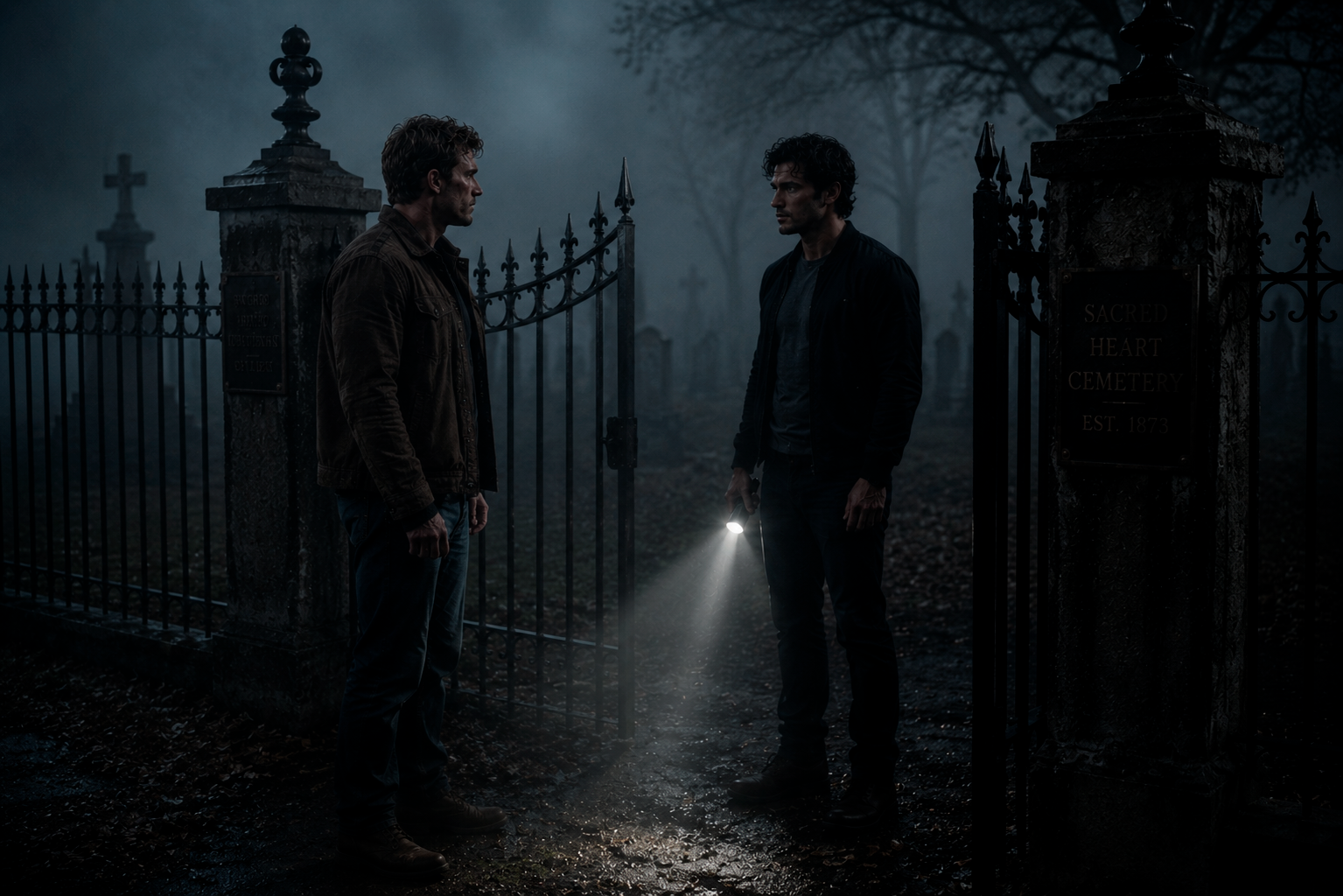
The shape resolved into a man standing just inside the cemetery gate. He faced away from me at first, head turning slowly as he scanned the rows of headstones. Then he turned. The flashlight caught his face. I forgot to breathe for half a second.
He was big. Not tall and lanky like me. Big. Broad shoulders straining the seams of a dark canvas jacket. Thick neck. Hands that looked like they’d been carved from oak and then used to hit things. Square jaw. Someone had broken his nose at least once. His eyes, even in the thin beam of the flashlight, were the color of good whiskey. And the bulge in his denim. God, the bulge in his denim.
He looked at me. Then at the blood on my shirt.
“You hurt?” His voice was a low rumble. A voice that didn’t need to be loud to carry weight. No panic. No drama. Just a question.
I wiped my mouth with the back of my hand. “I fell.”
“Uh-huh.” He didn’t move. Didn’t come closer. Just stood there, hands in his jacket pockets, blocking the gate like someone had planted him there. “You fall often, or just on nights when the fog’s thick enough to hide a body?”
I almost laughed. Almost. It came out as a sharp exhale. “Depends on the night.”
He nodded slowly, eyes still on my shirt. Then his gaze moved to my face. Something shifted in his expression. Recognition, almost. A pause. A recalibration. Like he’d been expecting a groundskeeper and found something else.
The ache behind my sternum flared.
I pressed my palm against it without thinking. His eyes tracked the movement, quick and sharp. His jaw tightened.
“You feel that?” he asked.
“Feel what?”
“That.” He pulled one hand out of his pocket and tapped his own chest, right over the sternum. “Like a tuning fork. Like something’s humming under your ribs.”
I stared at him. The ache was still there, still humming. Now that he’d named it, I couldn’t pretend I wasn’t feeling it. This was the strongest it had been all day. Stronger than in the shed or my apartment. Like being near him turned up the volume on something that had been playing at a low frequency for years.
“I don’t know what you’re talking about,” I said.
“You’re a terrible liar.”
“And you’re trespassing. Cemetery’s closed.”
He smiled. A small smile, barely a curve at the corner of his mouth. It changed his entire face. Took it from hard to something warmer. Something that made my stomach tighten in a way that had nothing to do with fear.
“I’m not trespassing. I’m standing on the right side of the gate. You’re the one who came out here at . . .” He glanced at his watch. “. . . eleven-thirty at night to look at a mausoleum.”
“I left my gloves.”
“You said that already.”
“No, I didn’t.”
“Sure you did. When you said you fell. Same energy.” He pulled his other hand out of his pocket and took a step forward. Just one. It brought him fully into the flashlight’s beam. He was bigger up close. Broader. A body that took up space and didn’t apologize for it.
“Look, I’m not here to cause trouble. I was walking home from the gym and I just . . .” He stopped. Frowned. Looked past me into the fog. “I couldn’t keep walking. I don’t know how to explain it. This place has been pulling at me for weeks. Tonight I couldn’t ignore it.”
The honesty landed harder than a threat. I knew exactly what he meant. I’d felt it too. The pull. The pressure. The sense that something in this cemetery had been waiting for me since before I ever heard of Harold or applied for this job. But I wasn’t about to tell him that.
“There’s nothing here,” I said. “It’s a cemetery. Dead people. Old stones. You want a tour, come back during business hours.”
“There’s something here,” he said. His voice dropped. “You know it. I know it. Don’t pretend you don’t.” He nodded at my shirt. “That’s not from a fall. You’re bleeding from your nose. Your hands are shaking. You’ve got a look on your face like you just saw something you can’t explain. I know that look. I’ve worn that look.”
I said nothing. I couldn’t. He was reading me like a book he’d already finished, and I didn’t know how to close the damn cover. Didn’t know if I wanted to.
He took another step. Six feet away now. Close enough to smell. Clean sweat. Cedar soap. Something underneath that was just warm. Like his body ran hotter than most.
“What’s your name?” he asked.
I should have lied. Should have told him to get lost and walked past him to my truck and never looked back. That was what I did. That was who I was. But the ache in my chest was singing. His eyes were steady on mine. I was too tired to be smart.
“Kyle,” I said. “I’m the groundskeeper.”
“Kyle.” He repeated it like he was testing the weight. “I’m Luke.” He didn’t offer his hand. Didn’t step closer. Just stood there with his name hanging in the air between us. “You’ve got blood on your face, Kyle. You’re still shaking. Whatever you saw in there . . .”
“I saw nothing.”
“Yeah.” He smiled again, a little wider. “You said that already. Same energy.”
I wanted to be annoyed. I should have felt annoyed. Instead, something cracked open in my chest. Something that wasn’t the ache. Or maybe it was. Softer. Warmer. Dangerous. The kind of warmth that made you want to tell the truth after a decade of lying.
“There was something in the fog this morning,” I heard myself say. “An animal. Big. I didn’t get a good look at it.” I wiped my nose again, even though it had stopped bleeding. “My predecessor disappeared three weeks ago. Left his notebook behind. The last entry said something was watching him.”
Luke didn’t laugh. Didn’t tell me I was crazy. He just nodded. Slow and thoughtful. Like I’d confirmed something he already knew.
“What did it look like? The animal?”
“Too big to be a dog. Golden eyes.” I paused. “You think I’m insane.”
“I think you’re scared. I think you’ve felt scared for a long time and you aren’t used to telling anyone about it.” He shrugged. A rolling movement of those massive shoulders. “I think this place is wrong, and you know it’s wrong, and you came back tonight because you’re the person who runs toward the wrong thing instead of away from it. That’s not insane. That’s stupid, maybe. But not insane.”
“You know nothing about me.”
“I know you’re still standing here.” His voice dropped. “You could have walked past me five minutes ago. You didn’t.”
The silence was thick as the fog. I could hear my heartbeat. I could hear him breathing. Calm. Rhythmic. Like he was standing in a grocery checkout instead of a graveyard at midnight. We stood there, six feet apart. I felt something shift in the air between us. A charge. A current. The static electricity that builds before a storm.
Luke felt it too. I saw it in the way his eyes narrowed. His hand moved upward to touch his sternum. The same gesture I’d been making all day. The ache in my chest pulsed hard, then settled into something steadier. A hum. A signal.
“There’s something wrong with your chest,” he said. Not a question.
“There’s something wrong with yours,” I shot back.
He laughed. A genuine laugh, short and surprised. Like he hadn’t expected me to have teeth. “Fair enough.” He dropped his hand. “You should go home, Kyle. Clean yourself up. Get some sleep.”
“Was planning on it.”
“Good.” He stepped aside, clearing the path to the gate. “I’ll walk you to your truck.”
“I don’t need an escort.”
“I didn’t say you did.” He fell into step beside me anyway, matching my pace, his boots heavy on the gravel. “I’m walking this way. My apartment’s about half a mile from here. The old brick building on Cherry Street.”
I knew the building. I’d seen it on my drives to work. A converted warehouse with immense windows and exposed duct work. The kind of place that costs more than my entire monthly salary.
“Nice building,” I said. “You a trust fund kid, or did you actually earn it?”
“Earned it.” No defensiveness. Just a fact. “I train people. Boxing, mostly. Some MMA. Got a gym downtown.”
That explained the shoulders. The hands. The way he moved. Not just big. Controlled. Like he knew exactly how much force he carried and exactly when to use it. I’d known guys like that in my twenties, when I was scrapping my way through nasty jobs and worse neighborhoods. They were the safest people in the room or the most dangerous. It depended on what they wanted from you.
I wasn’t sure which one Luke was yet. I wasn’t sure which one I wanted him to be.
We reached the truck. I unlocked it, pulled the door open, paused with one hand on the frame. Luke stood a few feet away, hands back in his pockets, eyes still on me. The fog was thickening again. It curled around his shoulders as if it were making a claim.
“You felt it too,” I said. “The pull. The thing in the fog.”
“Yeah.”
“And the . . .” I touched my chest. “The hum.”
“Yeah.” His jaw tightened. “I’ve felt it for weeks. Gets worse at night. Gets worse when I’m . . .” He stopped. Shook his head. “Never mind.”
“When you’re what?”
“When I’m near this place.” He met my eyes. “Or when I’m near you.”
The words hung between us. I should have gotten into the truck. Should have driven away. Instead, I stood there with my hand on the door and my heart hammering and the ache in my chest singing like a plucked string.
“I’ll be back tomorrow,” I said. “For work. If you want to—”
“I’ll be here.” His voice was quieter now. “I don’t think I can stay away.”
I nodded. Got into the truck. Started the engine. Luke was still standing by the gate as I pulled out. His shape dissolved into the fog as if he’d never been there at all.
I watched him in the rearview mirror until I couldn’t see him anymore.

The drive home took ten minutes. I don’t remember any of it.
I parked. Climbed the stairs. Unlocked the apartment door. I was still shaking, but it was low grade now. Exhaustion tremor, not shock. My nose had stopped bleeding hours ago. My shirt remained ruined.
I opened the door and stopped.
The symbol had multiplied.
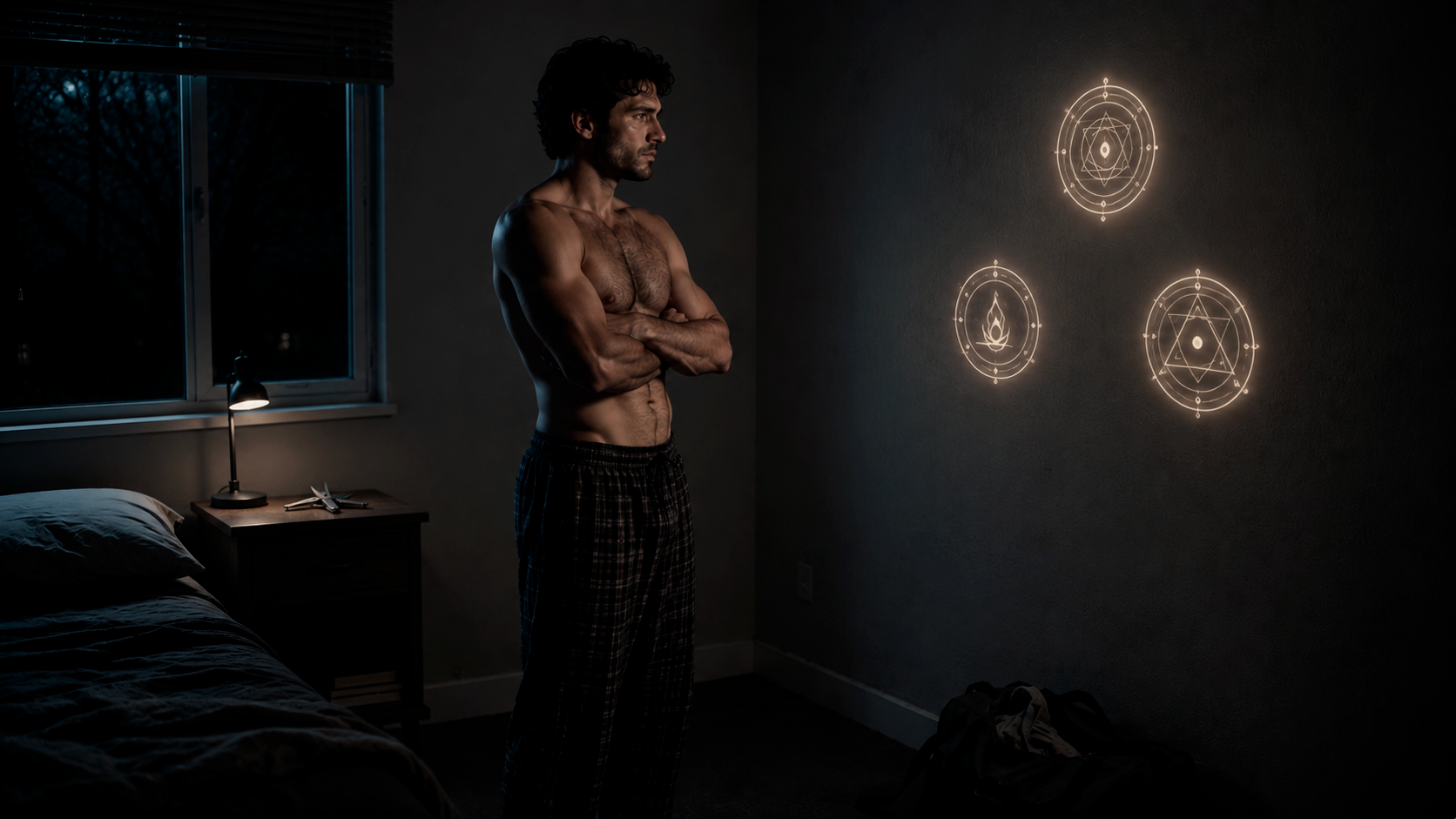
Three of them now, arranged in a triangle on the wall above my bed. The first was still the darkest. Its lines etched deep into the plaster as if they’d always been there. The second was paler, still settling into its final shape. The third was barely visible. A suggestion of light. A ghost of a mark bleeding through the paint.
They were warm. I could feel the heat from across the room.
Pulling the chair from my desk, I sat down facing the wall. I didn’t wash them off. I didn’t pack my duffel bag. I didn’t do any of the things I’d spent a decade training myself to do.
I just sat there. Staring at the symbols. Harold’s notebook on my knee. The multi-tool in my hand. Open. Closed. Open.
I’d been running for years. From the visions. From whatever put these scars on my chest. From the feeling that something had been waiting for me since before I was born. I thought if I kept moving, kept my head down, kept people at a distance, it would lose interest.
I was wrong.
The thing in the fog knew my name. The shadow in my vision had seen me. The symbols were multiplying. And somewhere half a mile away, a man named Luke was probably staring at his own ceiling, feeling the same hum in his chest, trying to make sense of the fact that two strangers met in a cemetery at midnight and neither of them walked away.
I thought about his hands. Scarred. Steady. Strong. The way he’d pressed them against his own chest, mirroring my gesture without knowing what it meant. The way he’d said I don’t think I can stay away like a confession. The way they’d feel wrapped around my . . . .
I thought about the hookup app and the faces I’d scrolled past. None of them made me feel anything. Then I thought about Luke’s smile. Small and crooked and unexpectedly warm. The way my stomach tightened when he stepped closer.
Not now, I told myself. Not him. Not this.
But the ache in my chest was humming. The symbols on the wall were warm. I was too tired to lie to myself anymore.
I reached out. Slowly. Deliberately. I pressed my palm flat against the central symbol before I could think better of it.
It was warm. Alive. And for the first time, it pulsed in response. Just once. Soft and steady as a heartbeat.
I pulled my hand back. Stared at my palm. No mark. But something had shifted. Something had begun.
I didn’t sleep that night. But I didn’t run. I sat in the chair with my back to the wall and my eyes on the symbols, and I waited.
The multi-tool was still in my hand. Open. Closed. Open.
Outside, the fog pressed against the window. Trying to get in. And somewhere in the dark, a man I’d met for five minutes was thinking about me. I knew it. Not a vision. Not a premonition. A certainty as solid as the warmth of the symbol.
You’re never alone, the shadow had said.
For the first time in years, I wondered if that might not be a curse.

End of Chapter One.