

After a devastating trauma fractures his identity, Breck struggles to rebuild a life he can’t remember. Including a future with the fiancé who betrayed him. As fleeting memories of heartbreak and tenderness resurface without warning, he must learn to trust not only the fragments of his past, but also the man who shattered their wedding plans, one sensory flash at a time. This chapter explores the raw edges of amnesia, forgiveness, and the stubborn, inconvenient hope of a second chance at love.

Breck’s Point of View
The memory surfaced at seven-forty on a Thursday morning, halfway through steaming a pitcher of oat milk.
Rosa was at the back burner, tending a cherry reduction she’d been nursing since six. The café smelled of roasting beans and warm pastry and, underneath, the faint sweet-sharp note of the cordial she was developing for the weekend menu. Dark chocolate shavings waited in a prep bowl beside the espresso machine. The whole place hummed with the low-grade industriousness of a coffee shop before the morning rush.
I’d been at Café Esperanza for a year. Long enough that the rhythms had worn grooves in my brain. Steam the milk. Pull the shots. Call out names. The muscle memory of service work, layered over the older muscle memory of a life I could not access. Two sets of instincts running on parallel tracks.
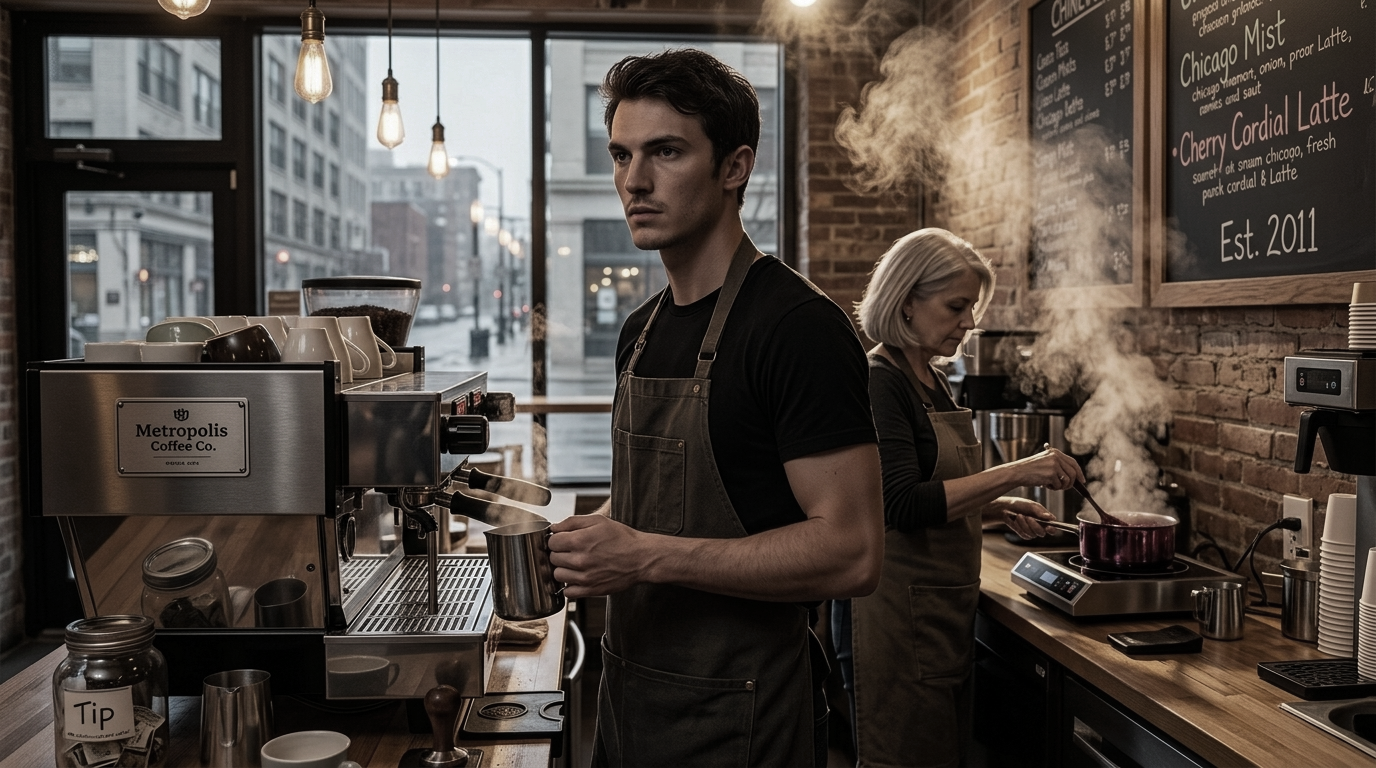
The steam wand hissed against the stainless steel pitcher. A sound I’d heard ten thousand times. I did not hear it at all.
Wine. Not the cheap house red Rosa used for cooking. Something lighter. Sharper. A rosé with grapefruit on the nose and a mineral finish that tasted like . . .
Domaine Tempier Bandol.
The pitcher clanked against the drip tray. Too much air in the milk. I’d have to start over.
Our nightstand. Not my apartment. The townhouse, the one Trace owned, the one with blue tile on the backsplash I’d picked out myself. A wineglass sat on it. Half empty. The wine inside was pale pink, the color of a washed-out sunset, and the glass was beaded with condensation. Beside it, the bottle. Only a third was left.
They’d been drinking it. Our wedding wine.
Trace’s shoulder first. The left one, freckle below the collarbone. Then an arm draped across his back . . . not my arm. Someone else’s. A handsome, sharp-jawed face turning toward the door with the slow-blink confusion of a man who did not know he was destroying something.
But I kept looking at the wine glass. The condensation slipping down the bowl in a single, unhurried bead. The label on the bottle, slightly wrinkled from the chill of the fridge. This one’s special, Trace had said six months ago, on a beach in Oregon, rain soaking through his shirt while he kneeled in the sand. We’ll open it when it counts.
It had counted that night.
But not for me.
“Breck?”
The café snapped back. My hand was shaking. The milk was over-aerated, a foam-capped mess.
Rosa was watching me from the register. Not with concern specifically, Rosa didn’t do concern the way other people did. She catalogued. Filed things away for later. Twenty years in Chicago after fleeing a marriage in San Juan had given her patience and a fine-grained attention to the things people didn’t say.
“You look like you’ve seen a ghost,” she said.
“Something like that.”
“The cherry?” She nodded toward the reduction, still burbling on its low flame. “Smell can do that. Smell is the sense that don’t go through the brain first. Goes straight to the place memories live.”
The place memories live. I didn’t know where that was anymore. My memories had been locked behind a door I couldn’t find for a year. Now they were surfacing in fragments, triggered by the wrong smells, the wrong sounds, the wrong slant of light through a rain-streaked window. I couldn’t control them. Couldn’t verify them. Couldn’t trust that my own mind wasn’t constructing a past out of Trace’s confessions and whatever emotional debris was handy.
“That wasn’t zoning out,” Rosa said. “That was a flash.”
“I’m fine.”
“Did I ask if you were fine?” She wiped her hands on her apron and turned back to the reduction. “Finish your milk.”
I finished my milk.

The lunch crowd cleared out by two o’clock . A few students remained, hunched over laptops in the corner, and an older woman read a paperback by the window. The rain had started up again, a soft, indecisive patter that stopped and started as if it couldn’t commit to anything. I wiped down the counters. Restocked the pastry case. Did the small, necessary tasks that kept the café running while Rosa handled the register.
She let me work. That was one of the things I appreciated about her. She knew when to push and when to make space.
Around three, when the last student had packed up and the woman with the paperback had drifted out into the rain, Rosa came over to where I was reorganizing the sugar station. She leaned against the counter, arms crossed, a few gray wisps escaping from her bun.
“¿Qué pasó?”
A direct question. Rosa’s Spanish came out when she was serious, or tired, or both. I’d learned to read the difference in the year I’d been working for her.
“I remembered something.” I straightened the turbinado packets. The domestic task felt absurd against the weight of what I was carrying. “A wineglass. On the nightstand. And a bottle of rosé. Our wedding wine. The one we were supposed to open on our wedding night. He drank it with the other man.”
Rosa absorbed this. Her face did not change, but something behind her eyes shifted. A recognition. This was a woman who understood betrayal from the inside.
“That’s a hard one.”
“Yeah.”
“Does it feel real?”
“Yes.”
“Then maybe it is.”
I wanted to believe her. But I’d spent a year being Michael Kemp, a widower from Portland who’d arrived in Chicago with nothing but the clothes on his back and a grief he couldn’t locate. I’d believed that too. Belief was just a story. The facts came later, if they came at all.
“Maybe,” I said.
She studied me for a moment longer. Whatever she saw, she decided not to pursue it. “Go home, mijo. You’re no good to me like this.”
I went home.

The apartment was empty.
Trace’s watch was on the nightstand. The one that cost more than I made in a month, which he left there now when he stayed over, which was most nights. The pull-out couch had been folded back into a couch. I’d started leaving it that way since Trace and I had begun sharing my bed again, a decision I still wasn’t sure I’d made consciously or just slid into through exhaustion and the body’s need for warmth beside it in the dark.
His presence was everywhere now. The watch on the nightstand. The spare charger plugged into the outlet by the kitchen counter. A hardcover on the coffee table. Something about architectural theory that he’d been working through slowly, the way he did everything now. Slowly. Deliberately. A man who’d learned that rushing led to wreckage.
I made tea. Chamomile valerian. The blend smelled of hay and honey and something a touch medicinal underneath. I didn’t know why I kept buying it. It just felt right, the way certain things had felt right since the fog started thinning. The body remembering what the mind couldn’t access.
The rain kept up its rhythm on the windows. I sat on the couch and drank my tea and turned the fragment over in my mind like a stone I’d found on the beach. The condensation on the wine glass. The pale pink of the rosé. The label, moisture-wrinkled from the fridge. The way I’d stood in the doorway and catalogued these details while Trace scrambled upright and the stranger reached for the sheet and my entire life collapsed into a single, indelible image. Our wedding wine, half-drunk on the nightstand, an accusation in a bottle.
Trace had told me about it. During one of those long confession sessions on this very couch, his voice raw with tears, he’d told me he’d shared the Domaine Tempier with Rob. I’d watched him cry and felt nothing. Or everything, which looked the same.
What if my mind had taken his confession and built a scene around it? What if the condensation on the glass was invented, the angle of the hallway light a fabrication, the whole thing a construction made of guilt and borrowed details?
I didn’t know. That was the worst part. The creeping suspicion that my own brain was a collaborator in the project of rebuilding a past that might not be mine.
The ring was warm on my finger. I touched it. Turned it. The motion had become automatic. A tic I’d had even before I knew what the ring represented, back when I was Michael and the platinum band was just a mystery I wore on my left hand without understanding why.
Trace came over at seven.
He let himself in with the key I’d given him—a key I’d given my boyfriend, who was also the stranger I was learning to know again—and he was carrying a bag of Thai food and a bottle of red wine. Something modest. The kind of bottle you picked up at the grocery store without asking for help. No grand gestures. No expensive labels. He’d learned to scale down around me.
He set the bag on the counter and looked at my face. Whatever he saw there made him stop midway through hanging his jacket on the hook by the door.
“Hard day?”
“I remembered something.”
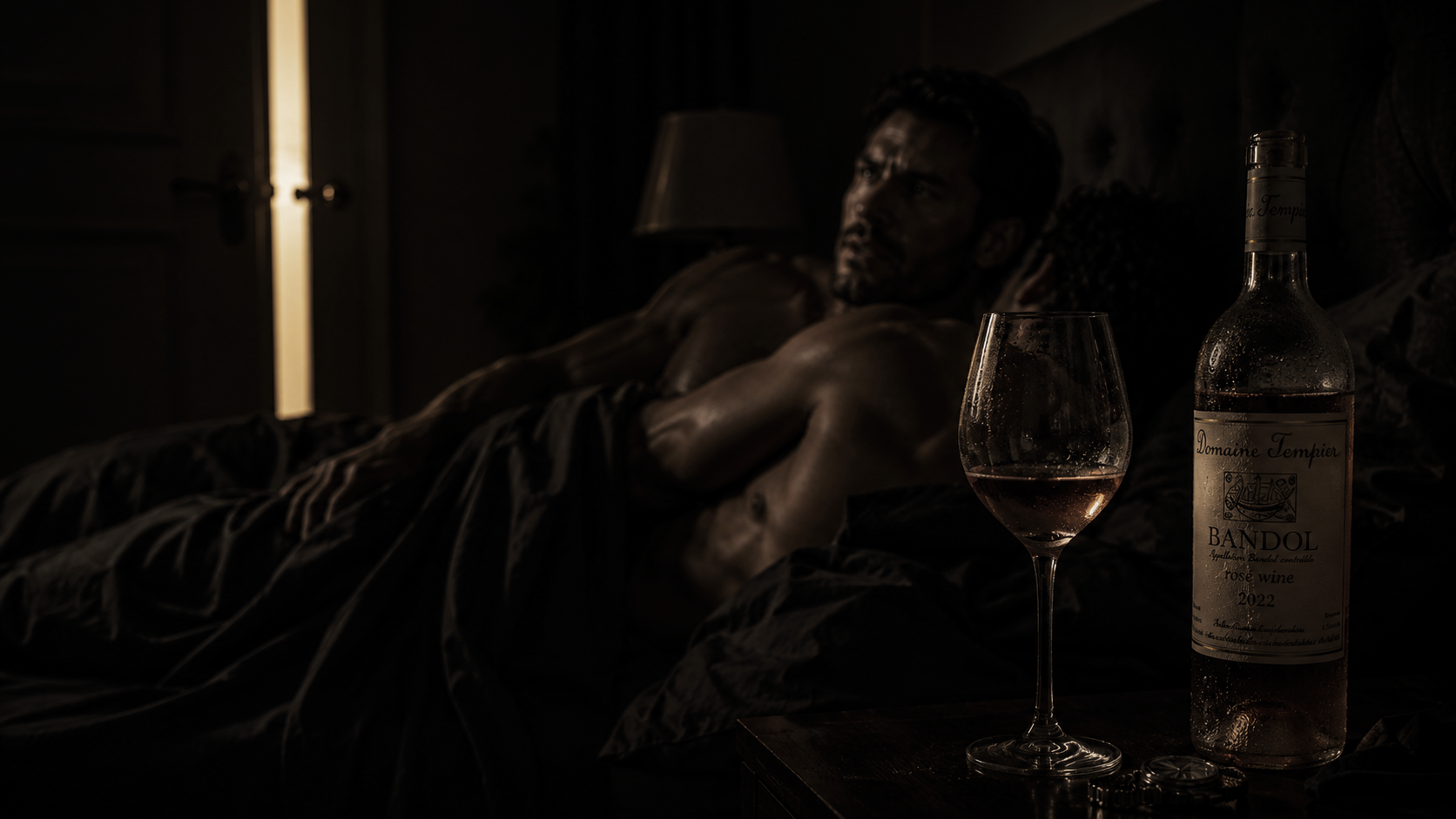
I told him. The wine glass on the nightstand. The rosé. The particular, vicious cruelty of that detail. The bottle he’d cellared, the wine we’d agreed to share on our wedding night, poured for a stranger in our bed while I was at work trying to save a life that would end anyway.
Trace listened. When I finished, he didn’t say anything for a long time. He set the Thai food down on the counter with the exaggerated care of someone handling explosives. Then he looked at his hands.
“It was the Domaine Tempier Bandol Rosé,” he said. His voice was quiet, scraped clean of deflection. “I bought it the night I proposed. On the coast. You remember the rain?”
“I don’t remember any of it.”
“Right,” he swallowed. “Right. I told you it was special. I told you we’d open it on our wedding night. And then I opened it with Rob because I was drunk and terrified, and because some part of me has always needed to destroy the things I want most.” He made a sound that wasn’t quite a laugh. “My therapist has a lot to say about that, by the way.”
“Not an excuse.”
“I know. That’s not what I’m offering. I’m just telling you what happened. You can do whatever you want with it.”
I absorbed this. The fragment was real. Not a construction. Not a story my mind had invented. A genuine piece of my own history, returned to me by the scent of cherry cordial and the body’s stubborn insistence on remembering what the mind had buried.
“Okay.”
He looked up. “Okay?”
“I wanted to know if it was real. Now I know.”
Trace’s jaw tightened. The scar, the one he’d told me about without deflection, the one that had once been a signpost of some old evasion, caught the kitchen light. “Is that better or worse?”
“I don’t know yet.”
We ate the Thai food on the couch. The rain had picked up, drumming harder against the windows, and the apartment got small in the way apartments grow small during storms, not claustrophobic, but close. Contained. A pocket of warmth against the wet October dark.
We talked about lighter things. Rosa’s lavender syrup experiments. The novel Trace was reading. The way the city’s drainage system always backed up on Division Street when the rain got serious. The conversation was easy in a way it hadn’t been easy before. Not effortless—there was still a carefulness to it, a mutual awareness of the fragile ground we stood on—but the carefulness had become less anxious. More like a ritual. Something we did because we both wanted to keep standing here.
We were on the couch when the car backfired.
It was somewhere on the street below. A sedan with a bad muffler or a timing issue or whatever mechanical failure made cars sound like gunshots on wet October nights. I didn’t know what was wrong with it. I only knew the sound. That flat, percussive crack, echoing off the brick buildings, bouncing through the rain.
I was on the floor.
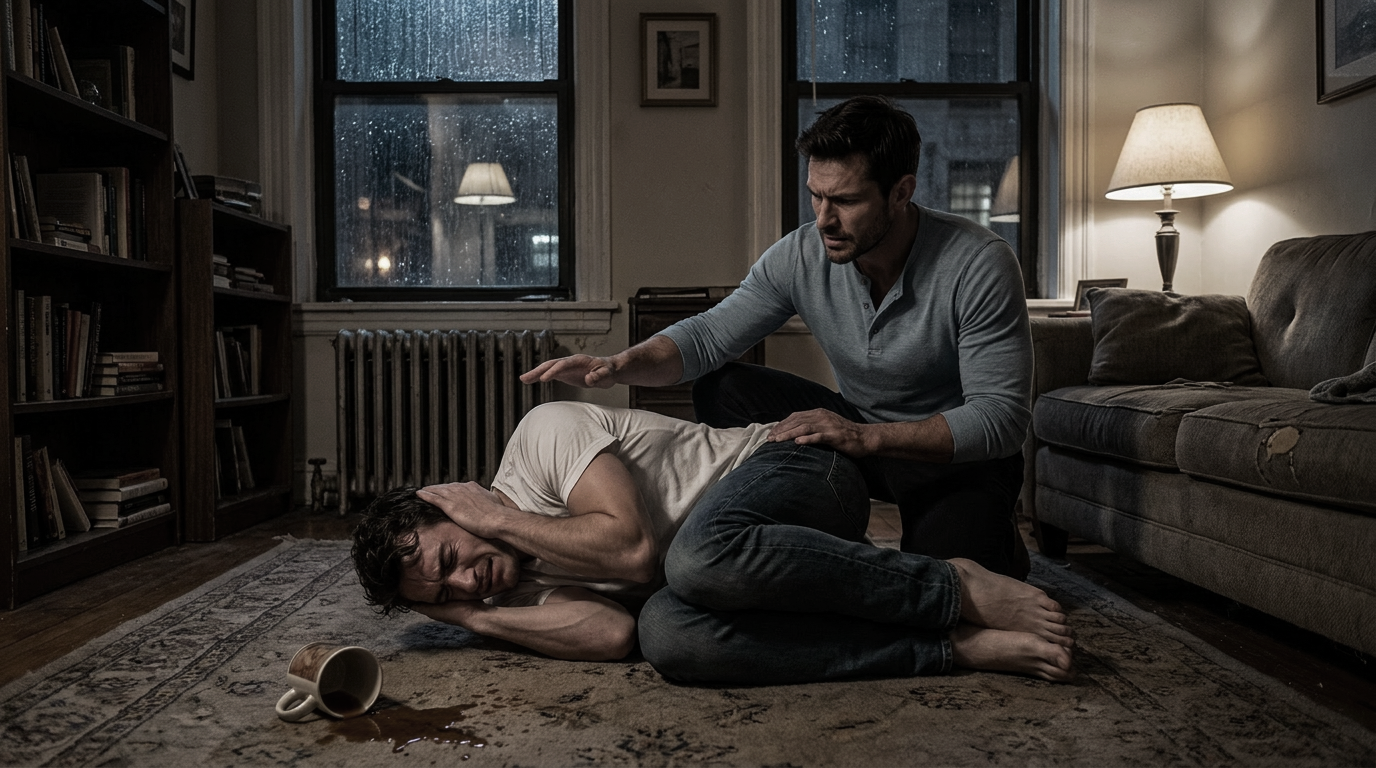
My hands were over my ears. My knees were drawn up to my chest. The tea was a spreading stain on the carpet, the mug on its side, still spinning in slow, lazy circles. I couldn’t hear anything but the shot. Marcus’s shot, the one that had traveled through the headset a year ago and lodged itself behind my chest. The one I’d been carrying ever since without knowing its name.
Henderson had come down to the crisis center floor that night. I remembered his face. The gray pallor, the way he’d pulled me aside near the printer. There was an incident. Oregon. I’m so sorry, Breck. And then the silence afterward, the terrible silence on the other end of the line where Marcus’s voice had been.
A silence that echoed now, in my apartment, under the ringing in my ears.
“Breck.” Trace’s voice reached me from somewhere above. Steady. Calm. The voice of someone who’d learned how to do this properly. He wasn’t touching me. He’d learned that too. “You’re in your apartment. You’re safe. It was a car. Just a car backfiring. Can you hear me?”
I could hear him. The words came through muffled but clear, like a voice on the other end of a crisis line. I’d spent years talking people down from ledges. Now I was the one on the floor, and the person pulling me back was the man who’d shattered everything and then spent a year trying to piece it together.
“Yeah.” My voice didn’t sound like mine. “I can hear you.”
“Do you want me to come closer?”
“Yes.”
He moved deliberately. The way you approach a wounded animal. Sat down on the floor beside me. Still not touching. A warm, solid weight in my peripheral vision.
“Can I put my hand on your back?”
“Yes.”
His palm settled between my shoulder blades. Broad and warm. The weight of it gave me something to orient toward, a fixed point in the echoing dark where Marcus’s voice had gone silent. His thumb moved in small, slow circles against the fabric of my shirt.
“It was a car,” I said. Not a question.
“It was a car.”
“It sounded like—”
“I know.” His voice was rough. “I know what it sounded like.”
I breathed. In through the nose, out through the mouth. Techniques I’d taught a thousand callers during my years on the crisis line. The body first, then the mind. Ground yourself in sensation. Name five things you can see, four things you can touch. I didn’t need to do the exercise. The weight of his hand on my back was enough.
“Marcus,” I said. The name felt strange in my mouth. For a year I hadn’t known he existed. Now he was everywhere. “I was on the phone with him. When it happened.”
“I know.”
“You don’t know. You weren’t there.” The words came out sharper than I intended. I didn’t apologize. “He was talking to me. And then he wasn’t. And I couldn’t do anything. I was on the other side of the country, listening to a man die, and I couldn’t do a goddamn thing.”
Trace didn’t flinch. “You’re right. I wasn’t there. I don’t know what it was like.”
Something in his voice . . . the lack of defense, the simple acceptance of my rage . . . cut through the ringing. I looked at him. His face was drawn, the hazel eyes dark with something that might have been grief or guilt or some cocktail of the two.
“I need you,” I said.
“I’m here.”
“No,” I reached for him. My hand fisted in the front of his shirt. The fabric was soft, worn at the edges, a henley I’d never seen before. “I need you.”
He understood. His eyes searched my face for something. Permission, maybe, or confirmation that this wasn’t just adrenaline seeking an outlet. I couldn’t give him that. I didn’t know if it was true. Maybe I was using him. Maybe this was just another way of outrunning the gunshot. But my body was screaming for contact, for proof that I was alive, for something to hold on to that wasn’t the memory of a dead man’s silence.
“I want to feel something else.” I pulled him toward me. My mouth found the scar on his jaw, the stubble rough against my lips. “I want to remember I’m still here.”
He kissed me. Not careful. Not gentle. The careful Trace was gone, replaced by the man who’d held me through the night after my confession, the one who’d absorbed my rage and my grief and my doubt without flinching. His hands framed my face, thumbs tracing the line of my jaw, and the kiss was deep and desperate and tasted of the wine we’d been drinking and the salt of tears I hadn’t realized I’d shed.
We made it to the bedroom. The sequence of motions blurred. Stumbling steps, hands yanking at clothing, Trace’s mouth never leaving my skin. He kissed my throat. My collarbone. The scar from the childhood surgery, his lips slower there, reverent. A reminder that this body had a history even if my mind couldn’t access all of it.
I shoved him onto the bed. He went willingly, his back hitting the mattress, his eyes dark and fixed on my face. I climbed on top of him, straddling his hips, and pinned his wrists above his head. The position brought our rings next to each other. Platinum on platinum. Twin circles of a promise I’d made in a rainstorm on the Oregon coast and couldn’t remember.
“I want to be in control,” I said. “Can you give me that?”
“Yes.” No hesitation. No negotiation. Just the word offered up.
I held his wrists. I kissed the spot below his ear that made his breath catch. I bit his lower lip. Not hard, just enough to feel the give. He made a sound in his throat, need and surrender tangled together, and the sound went straight through me.
We were still half dressed. My jeans were unbuttoned, shoved down far enough. His were still on, the rough denim pressing against my bare thighs. I ground against him, the friction insufficient and maddening, and he arched up into me with a gasp that was almost a sob.
“Breck.” My name broke open in his mouth. “Breck, please.”
“Please what?”
“Let me touch you. Please.”
I released his wrists. His hands came up immediately, one gripping my hip, the other wrapping around the back of my neck to pull me down into another kiss. His mouth was hot and desperate. His hand on my hip guided our rhythm, the slow roll of our bodies against each other through too many layers.
I reached between us. Unbuttoned his jeans. Worked them down over his hips. When my hand closed around his cock, the sound he made was the most honest thing I’d ever heard from him. No performance, no control, just Trace coming apart under my grip.
“I remember you,” I said against his mouth. “I remember this.”
And I did. Not a specific night, not a particular bed, but the feel of him. The weight and heat of his cock in my hand, the head already slick, the vein on the underside pulsing against my thumb. The way his hips bucked into my grip. The way his breath caught and stuttered when I tightened my hold and twisted.
This was muscle memory. The body’s archive. Knowledge stored in nerve endings and reflex arcs and the electric shimmer of skin on skin. I didn’t remember learning him, but my hands knew the lesson. My mouth knew the taste of him. My hips knew the rhythm that would make him unravel.
I spat into my palm for slickness, worked it over both of us. Then I positioned myself, our cocks aligned, hard and leaking, and wrapped my hand around us both. The friction was impossible . . . velvet heat, the slide of skin on skin, our fluids mingling until I couldn’t tell whose wetness was whose.
Trace’s head fell back. His throat was exposed, the tendons standing out. His hands gripped my thighs hard enough to bruise. I wanted those bruises. Wanted to look at them tomorrow and remember I was here, in this body, feeling this pleasure, surviving this life.
“Look at me,” I said.
He looked. His eyes, hazel and bright with beginnings of tears, locked onto mine. A flush had spread from his cheeks down to his chest. A mottled pink that meant he was close, that meant the pleasure was cresting past the point where he could control it.
“I’m here,” I said. “I’m still here.”
“I know.” His voice cracked. “I see you. I see you, Breck.”
I stroked faster. Not gentle. Not tender. This wasn’t about tenderness. It was about reclaiming my body from the gunshot and the fog and the year of not knowing who I was. The wet sounds of our coupling filled the room. The rhythm of my fist, the slap of skin, his choked breathing and my own harsh exhales.
His hips were moving with me now, his thrusts matching my rhythm. His hands had moved from my thighs to my ass, fingers digging into the muscle, pulling me harder against him.
“I’m gonna come,” he gasped. “Breck—”
“Do it.”
He came apart with a sound that was almost a sob. His cock jerked in my hand, pulsing hot and thick, the first stripe of it landing on his stomach and chest, the rest pooling in the valley of my knuckles. I watched his face, the way his eyes went wide and blind, the way his mouth fell open, the way every muscle in his body seized and released at once.
I followed him over a heartbeat later. The sight of him undone beneath me, the feel of his release slick between our bodies, the raw knowledge that I had made him lose control. It all converged and exploded outward. My orgasm ripped through me in a white-hot surge that left me shaking against him, my cock pulsing against his, my own release joining the mess between us.
I kept stroking through it until the pleasure tipped over into something too sharp to bear. Then I collapsed forward, my face pressed into the curve of his neck, where the sweat was cooling and the scent of him was strongest.
For a long moment there was only breathing. Our hearts hammering against each other. His hands on my back, stroking slow, soothing circles between my shoulder blades. The same motion he’d used to anchor me on the living room floor.
The rain had softened to a whisper against the window. The streetlight painted its yellow stripe across the ceiling.
“You okay?” Trace’s voice was scraped raw.
“Yeah,” I lifted my head. His face was soft in the half light. There was cum drying on his chest, a pearlescent smear catching the streetlight’s glow. I’d done that. The thought was strange and satisfying. “I needed that.”
“I know.” He brushed a strand of hair from my forehead, a gesture so tender it made my chest ache. “Whatever you need. Whenever you need it.”
“Even if it’s just survival sex?”
“Especially then.” No hesitation. No joke to deflect the sincerity. “I’m not just here for the easy stuff, Breck. I know,” his voice caught in his throat and his eyelids overflowed, “I know I have a lot of hard work to deserve you again.”
I kissed him. Softer this time. The desperation had burned off, leaving behind something quieter. Something that might, with time, become trust.
We cleaned up eventually. Trace got a washcloth from the bathroom and rinsed it in warm water, the unscented soap I kept, and he cleaned me off with a care that bordered on ceremonial. I let him. I was learning to do that. Letting myself be taken care of wasn’t weakness. It was just another kind of survival.
We slept. The rain kept falling. The ring caught the streetlight, a glint of platinum in the dark.

The second memory came the next morning.
I was at the café again, during opening shift. The sky was still dark, the streets were still wet from the night’s rain. I was restocking the pastry case when I found it. A stray wedding invitation sample, tucked between the napkins and the sugar packets, forgotten by a customer who’d probably been planning a reception. Cream envelope. Elegant script. The kind of invitation that cost more than it should and less than it looked.
I picked it up.
Turned it over.
And the floor tilted.
I was on the floor of our living room. The townhouse. Blue tile backsplash catching the under-cabinet light. Takeout containers everywhere. Pad Thai, half-eaten, the smell of lime and chili still in the air. A bottle of wine on the coffee table, nearly empty. And invitations. Stacks of them. Cream envelopes and careful handwriting, spread across the coffee table and the rug and the couch cushions.
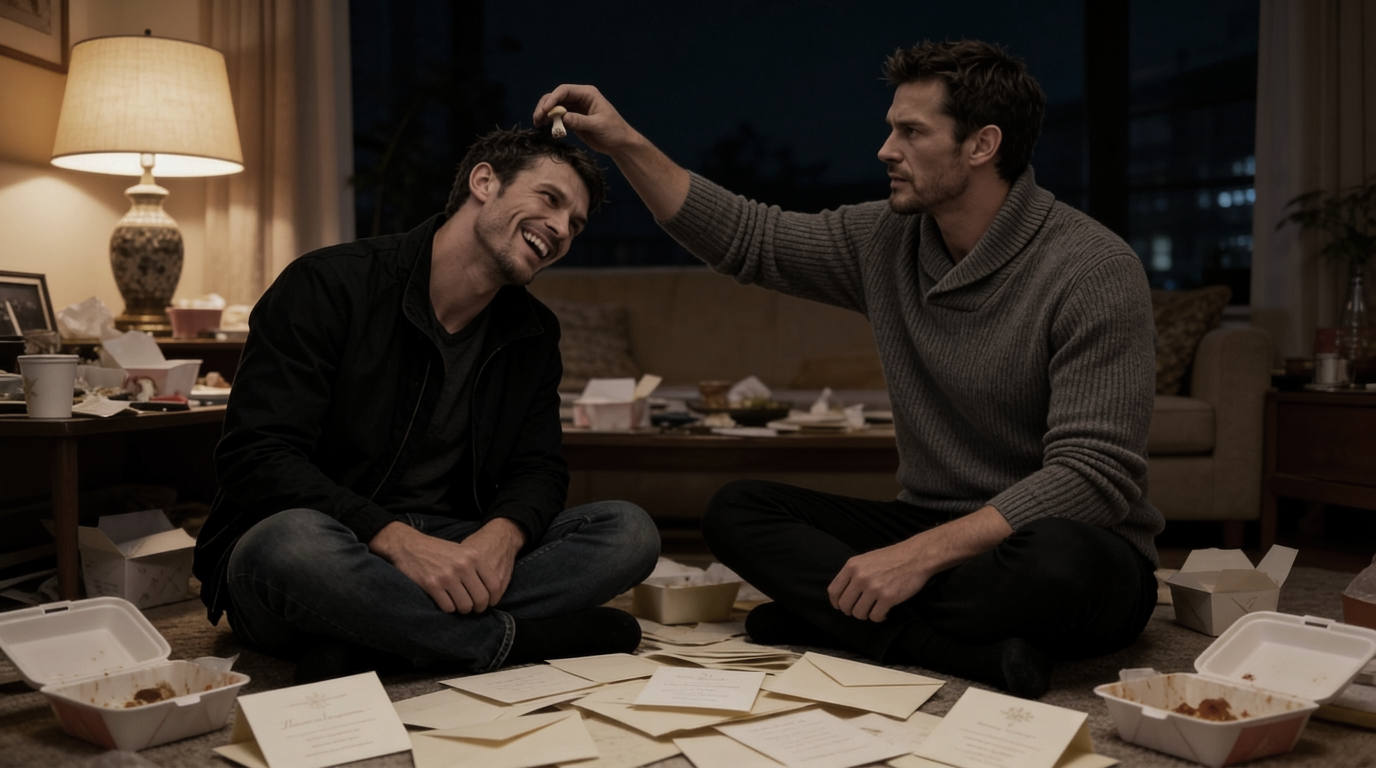
I was laughing. Trace had thrown a mushroom at my head. It had landed in my hair. I could feel the greasy smear of it against my temple and I was laughing so hard I couldn’t breathe. Trace was laughing too. That rare, unguarded laugh that transformed his whole face from guarded to boyish.
“You deserve it,” he said. “You’re taking forever.”
“I’m being careful. These have to be perfect.”
“They’re already perfect. You’re the one writing them.”
He crawled across the floor, actually crawling on hands and knees, through the sea of envelopes, and pulled me into his lap and kissed the spot on my temple where the mushroom had landed.
And I’d been happy. Completely, uncomplicatedly happy. The kind of happy you don’t recognize as fragile until it’s already broken.
“Breck?”
Rosa’s voice. The café came back. The invitation sample was in my hand, its edges crumpled where my grip had tightened. My face was wet.
“I remembered something else,” I said.
Rosa came over. She said nothing. Just stood beside me, her shoulder brushing mine, a solid and steady presence. The cherry reduction was still bubbling on the back burner, filling the café with its dark, sweet scent. The scent that had started all of this.
“It was a good one,” I said. “A good memory.”
“That’s good, mijo.”
I smoothed the invitation out carefully. The way you handle something that might tear if you breathe too hard. The way I wished someone had handled our wedding wine, our wedding plans, the whole careful planning of the life we’d been building before it collapsed.
I finished my shift. I went home. Trace was there, on the couch with his laptop, probably still coordinating with the private investigators he hadn’t quite been able to fire. He looked up when I came in, and whatever was on my face made him close the computer and set it aside.
“What happened?”
“I remembered the last good night.”
I told him. The living room. The Pad Thai. The mushroom in my hair. His laugh, rare and unguarded. The kiss on my temple. The invitations spread across every available surface, proof of a future we’d been too happy to question.
Trace listened. His face did something complicated. Joy and grief, hauled up from somewhere deep and held there, side by side.
“That was the night before,” he said. “The night before the call. Before Rob. Before all of it.”
“I know.”
“You were so happy. We were so happy.” He stopped. Swallowed. “I ruined it. I ruined it all.”
“Yeah,” I sat down on the couch beside him. “You did.”
He flinched, but didn’t deflect. Didn’t argue. Just sat there, absorbing the truth of it. The way he’d been learning to do for months.
“But I’m remembering it,” I said. “That’s not nothing.”
He looked at me. There was hope in his expression. Cautious and fragile hope, a bird that might take flight at any sudden movement. “The fog is thinning?”
“I don’t know.” I leaned back against the couch cushions. The water stain in the corner of the ceiling was still there, a faint brown bloom I’d never asked the landlord about. “I remembered the wineglass yesterday. The rosé. That was real. You confirmed it. And now the invitations. The mushroom. The laughter.” I closed my eyes. “But what if I’m just assembling details you’ve given me? What if I’m building a past out of your confessions instead of my own memories?”
Trace was silent for a moment. When he spoke, his voice was careful, the way it got when he was trying to be the man he aspired to be instead of the man he’d been.
“Do you want me to tell you if you get something wrong?”
“Yes.”
“And if I don’t know?”
I opened my eyes. “Then tell me that, too.”
He nodded. “I can do that.”
We sat there in the gray afternoon light, the rain starting up again outside the window. I thought about the wine glass. The condensation sliding down the bowl. The pale pink of the rosé, catching the hallway light. The bottle that was supposed to christen our forever, poured instead for a stranger while I was trying to save a life that I could not save.
I thought about the invitations. The mushroom in my hair. The laughter I couldn’t remember but could still feel in my body. A warmth that had nothing to do with retrievable memory and everything to do with the man sitting next to me on this couch.
The fragments were coming faster now. The wineglass. The bathroom sink I’d remembered last week. The invitations and the takeout and the laughter. Good and bad, tangled together, a life I’d fled so completely I’d forgotten my own name. I didn’t know which pieces were real and which I’d invented to fill the gaps. I might never know. The fog might lift entirely, or it might leave patches of permanent uncertainty, gray areas where memory and imagination blurred into something that was neither one nor the other.
But I was still here. Still breathing. Still reaching for the man who’d broken me and then worked for a year to earn his way back. Still touching the ring that represented a promise I couldn’t fully recall but could feel in my body as a fact. A truth. A decision I’d made on a rainy beach and kept making, even when I didn’t know my own name.
That night, I lay in bed beside Trace and listened to his breathing slow into sleep. The rain had stopped. The streetlight still burned outside the window, painting a yellow glow across the ceiling.
I catalogued the fragments. The wineglass. The condensation. The silly mushroom in my hair. The invitations. The laughter. The rain on the window and the ring on my finger and the feel of his body under my hands, remembered not in words but in the electric archive of skin and nerve and muscle.
Some of it was real. Some of it might be construction. I didn’t know how to tell the difference yet.
But I was starting to want to.

End of Chapter Six.