

At forty-one, Wade has built a life on wanting things he doesn’t keep until Jesse lasts sixteen weeks and counting, rewriting every rule Wade thought he understood about himself. On an October morning tender with domestic rhythms and quiet hope, Wade throws a party to celebrate the milestone he never thought he’d reach. But when drugs, alcohol, and his own unfiltered history collide in front of everyone they know, Wade will have to reckon with the difference between wanting someone and deserving them—and whether sixteen weeks of learning to love can survive one night of becoming the man he promised he’d never be again.

[As I mentioned in the Content Update earlier this week, things start to get rocky in this story. Have faith.]
Wade’s Point of View
The math arrived before consciousness did.
I woke in the gray October light with the number already sitting there, complete and incontrovertible, the way numbers sometimes are when you haven’t been the one doing the arithmetic. Sixteen weeks. The ceiling was the same ceiling I’d looked at for eleven years, but the weight beside me in the bed was four months new.
Jesse slept on his stomach, face turned toward the window, one arm flung across the space where I’d been before I shifted. The sheets had pulled down past his shoulder blades. The light through the plantation shutters striped his back in pale gold and shadow, and I lay there cataloguing the minor miracle of having sustained genuine interest in another human being for sixteen consecutive weeks. Something I had never done, at forty-one, and had privately assumed I was incapable of doing.
The wanting had changed shape. That was the thing I kept coming back to.

It had started as pursuit. The charged attention of someone new in the house, the particular electricity of watching him study my art while every other person I’d ever brought here had headed straight for the bar or the remote. Then it had become something physical, the long waiting that Jake kept telling me was working, the careful accumulation of small permissions. Then it had become domestic. The Tuesday pho, the two mugs in the drying rack, the exact knowledge of where Jesse kept his keys.
Now it was something else. Something that didn’t have a name I was comfortable using yet, but that I recognized anyway, the way you recognize a place you’ve never been to but somehow know is home.
I wanted to make it last. I wanted to keep it. It was something I didn’t have a word for. Wanting to be the kind of person he’d stay with. Wanting to not be the reason he left.
The problem was that I had never done that before. I had never been the kind of person who kept things. I was the kind of person who managed things, who arranged things, who enjoyed things until they stopped being enjoyable and then moved on to the next thing.
Donovan had lasted almost three months. Andrew, maybe six weeks. Everyone else was measured in days. I’d told myself that was preference. Independence, flexibility, not wanting to be tied down. The truth was simpler and less flattering. I had never met anyone I wanted to keep.
Jesse had already outlasted every reasonable expectation. Jesse had outlasted Donovan, which was the marker I had privately used for years to measure what I wasn’t capable of.
And I was going to have to become someone who deserved him still being here.
Mercer raised his head from the dog bed in the corner , the graying muzzle, the slow movement of a senior dog who still kept watch. I hushed him without a sound, just a hand gesture, and he settled back down with a sigh that sounded almost human.
The house was silent. The pool pump hummed somewhere outside. The October morning looked like any other October morning in Plano. It was pale and cool and slightly gold, the kind of light that makes everything look intentional.
Jesse stirred. His breathing changed rhythm, the small hitch that meant consciousness was pulling at him. His hand moved across the sheet, found my hip, and stayed there.
“You’re awake,” he said without opening his eyes.
“Yeah.”
“How long?”
“I don’t know. A while.”
He turned toward me then with the slow, unguarded movement of someone who hadn’t yet remembered to be careful. His eyes were still mostly closed. His hair was a disaster. The sheet had twisted around one of his ankles.
“You’re staring,” he said.
“Yeah.”
He opened his eyes. Looked at me. Something moved in his face. Not quite a smile, but the thing that comes before a smile, the slight shift of muscle that meant he’d decided to let me see him.
“Sixteen weeks,” I said.
“What about it?”
“That’s how long it’s been. Since the pool party. I did the math.”
Jesse blinked. “You did math. Before coffee. At . . .” he turned his head to look at the clock on the nightstand, “. . . six forty-three in the morning.”
“It came pre-calculated.”
“Pre-calculated.” He said it the way he said things when he was deciding whether they were funny. “That’s either very romantic or very alarming.”
“Could be both.”
“Could be.” He shifted closer, the sheet pulling free of his ankle. His hand was still on my hip, and I was profoundly aware of it. The weight of it, the warmth, the way his thumb had started moving in a small, absent circle against my skin. “You’ve outlasted every expectation, too,” he said. “If we’re keeping score.”
“That’s the most backhanded romantic thing anyone has ever said to me.”
“I learned from the best.”
The kiss started as something sleepy and became something else. Something slower, more deliberate, the kind of kiss that had a destination in mind but wasn’t in a hurry to get there. Jesse’s hand moved from my hip to the back of my neck. The October light moved an inch across the sheets. Mercer, with the instincts of a dog who had learned when to leave the room, heaved himself up and padded out into the hallway.
What I want to say about the sex, because it matters to what comes later, is that it was real.
Not performed, not managed, not two people going through motions that looked like intimacy from a distance. Real. Jesse wasn’t the most experienced person I’d been with. He had told me early on that he’d been with three people before me, and I’d heard it for what it was. Here is who I am. Here is where I’m starting from. But attentive was his factory setting, and sixteen weeks of patient attention had built something between us that had texture and memory, the specific ease of people who’d learned each other’s rhythms.
The sex that followed was unhurried. Domestic. The kind of sex that happens in a bed you’ve been in a hundred times. I’d learned his body the way I’d learned this house. Which floorboards creaked. Where the light fell at what hour. Which doors needed a little extra push to close all the way. I was generous because I wanted to be. I was discovering that generosity in bed was its own kind of pleasure and he tensed less now. Braced less for something to go wrong.
But the anxiety was still there. It still showed up. It still caught him the way it always did, somewhere in the shift from what we’d been doing to what came next. The familiar tightness across his shoulders, the slight catch of breath that wasn’t arousal. I felt it and slowed down . Waited. Let his body catch up to his intention.
“You’re okay,” I said. Not a question.
“I know.” His voice was tight, but he was breathing through it. “Just . . . give me a second.”
I gave him more than a second. Let him find his way back to the place where his body remembered it was safe. Remembered to let me in.
Afterward, he stayed against my shoulder. The silence was the kind that didn’t need filling. Complete, easy, the silence of two people who had learned to be quiet together. I put my arm around him. His breathing slowed to match mine. The ceiling was still the same ceiling, but the room felt different. Fuller, somehow, with the absence of words.
Neither of us spoke. The stillness was the point. I looked at the ceiling and thought don’t screw this up.

Breakfast was easy in the way that breakfast had become easy, which was one of my favorite things about sixteen weeks. The rituals of it, Jesse at the counter making eggs while I managed the coffee, the shorthand of two people who had stopped negotiating the kitchen and started inhabiting it together. He cooked methodically, the way he did most things, and I stayed out of his way because I’d learned that he didn’t want help so much as company. I leaned against the counter and watched him work. The way his hands moved, the precision of his knife work, the small frown of concentration that settled between his eyebrows when he was timing the eggs.
“I want to throw a party,” I said when we were at the table.
Jesse looked up from his eggs. “What kind of party?”
“All of them,” I said. “The entire group. Here, next Saturday.”
He chewed. Considered. The consideration was genuine. Jesse never gave an answer before he’d actually thought about the question. It was one of the things I’d learned to wait for, the pause before the response that most people filled with noise but Jesse let sit. “Reason?”
“Sixteen weeks,” I said. “That’s the reason. You’ve officially outlasted every reasonable expectation anyone had for this, including mine, and I want to make that into something. A statement.”
“A statement.”
“There have been bets,” I said. “Under the table. About when you’d get your walking papers. I want to make it clear that the book is closed.”
Jesse set his fork down. He looked at me with the expression that meant he was deciding whether something was funny or alarming and had settled on both. “That’s the second most backhanded romantic thing anyone has ever said to me.”
“I mean it as a compliment.”
“I know you do,” he said, which was not quite agreement, and picked his fork back up.
I pulled out my phone and opened the contacts list I’d been building in my head since the previous weekend. The list came easily. Jake, of course, Milo and Michael, David, because he was Jesse’s friend and I was trying, Ben and Baker, if Baker showed up, which was never guaranteed, Uncle Paul, because excluding him was more trouble than including him, Andrew, because Andrew was part of the group and had been for years, Jaegen, same reason. I’d invite Kip, too. He came with Jake, and I would not make that weird even if things between Kip and me had been a little off ever since the pool party. Jesse watched me type names and said nothing until I got to Andrew.
Jesse’s fork paused. “Andrew.”
“My former . . . yeah. He’s part of the group. It would be weird not to invite him.”
“You told me, a while back, that he was the best sex of your life,” Jesse said.
He was talking about August. A weeknight. I’d had three whiskeys, and we’d been in bed, and I’d said it without thinking. Probably the best sex of my life, if I’m being honest. Jesse had just nodded, his face giving away absolutely nothing. I’d forgotten I’d said it until this moment. Jesse clearly hadn’t. I looked up. His voice was even, his face was its default, and there was nothing visible in his expression that would have told a casual observer anything was wrong. I had learned to read the stillness beneath the evenness, and the stillness was saying something.
“I didn’t mean it the way it sounded,” I said.
“Wade.” He set the fork down again. “What else does that mean?”
I didn’t have a good answer for this. The honest answer was that I’d said it carelessly, the way I said things when I wasn’t thinking about the weight they carried, the way I’d been saying things for forty-one years before I had someone in my life who made me notice the weight. That it was true in a technical, historical sense. Andrew and I had been physically compatible in a specific and uncomplicated way.
I could see, in the quality of Jesse’s stillness, that the technical historical version was not going to be a satisfying response.
“I meant . . . it was a long time ago. It’s not relevant to—”
“It’s relevant enough that you remember it. Relevant enough that you said it to me.”
“It was a stupid thing to say. I was trying to be open about my past, and I didn’t think about how it would land.”
“You didn’t think about how it would land for me to hear that your ex was better in bed than I am?”
“That’s not what I said.”
“It’s what I heard. Was I wrong?” He put his fork down. “It’s your party. Your list.”
The conversation was over. He’d stated the cost without making a scene, without demanding anything further, and moved on, and I sat with the discomfort of knowing I’d been let off more lightly than I deserved and that he knew it too.
“Jesse—”
“It’s fine,” he said. “Let me know what you need for the setup.”
I didn’t push it. Jesse’s “it’s fine” was like his silence. It carried more weight than most people’s arguments, and it meant precisely what it meant and nothing else. I finished my coffee and let the subject drop and thought, for the first time that day but not the last, about the gap between what I said and what I actually meant, and about how many weeks it had taken me to notice the gap existed at all.
“Jesse.” I looked at him across the breakfast table. “I’m glad you’re here. That’s all I meant,” I said.
“I know,” he said, and picked up his fork. It wasn’t quite agreement, but he said it.

Jake’s Point of View
I arrived early because I always arrived early. It was a habit from the Marines that had never loosened its grip, the bone-deep conviction that being on time meant being fifteen minutes ahead of schedule.
Wade’s house was already in party mode. The patio furniture rearranged, the grill uncovered, the coolers iced. The pool was blue and flat and perfect, the way it had been since Jesse moved in and started noticing things like chemical balance. Wade was in the kitchen, doing something with a platter of meat that looked more like performance than preparation.
I found Jesse in the kitchen slicing lemons.
He was at the island with a cutting board and a knife, moving with the exact, unhesitating economy of someone who knew where everything was. The serving trays were stacked to his left. The extra knives were in the drawer he’d opened without looking.
“You know where the serving trays are,” I said.
Jesse glanced up. “Should I not?”
“It’s either very domestic or very alarming.”
“It’s lemon slicing.” He returned his attention to the cutting board. “Wade’s incapable of slicing lemons. He does wedges, and then everyone complains about seeds.”
I poured myself coffee from the pot on the counter. Wade’s coffee, which was terrible, but the ritual of drinking it was older than my friendship with him, and I wasn’t about to stop now. “You’ve been here four months.”
“Sixteen weeks.” The correction was automatic. “Wade did the math.”
“Wade did math.” I leaned against the counter. “Wade doesn’t do math. Wade calls me to do math.”
Jesse’s mouth did something that wasn’t quite a smile. “It came pre-calculated, apparently.”
“Of course it did.”
Wade appeared in the doorway, looking harassed in the way of a man who had volunteered to host a party and was now remembering why he didn’t do it more often. “Are you two going to stand there talking about me, or is someone going to help me with the grill?”
“The kid knows where your serving trays are,” I said. “This is very domestic or very alarming.”
Wade’s expression flickered with something between pride, and a recognition of being caught. “He also knows where the good napkins are. And the backup bottle opener. He’s organized. It’s useful.”
“It’s useful,” I repeated. “Right.”
Jesse finished the lemons and wiped the knife on a towel. He didn’t look up. “You two do this a lot, don’t you? The banter.”
“Every day for eight years,” Wade said.
“I could tell.” He put the lemons in a bowl and slid them across the island. “The grill needs to be at four hundred. The coals are at three-seventy. You have about fifteen minutes.”
Wade stared at him.
“You said you wanted help,” Jesse said. “That’s help.”
I waited until Jesse had moved to the patio with the screen door sliding shut behind him and the afternoon sunlight catching the blonde in his hair, before I turned to Wade.
“Don’t screw it up,” I said.
“You’ve said that.”
“I keep meaning it.” I put my coffee mug down. “There was a betting pool, you know. When you two started. Michael had four weeks. Paul had three.”
“And you?”
“I didn’t bet.” I met his eyes. “I don’t bet on people.”
Something moved in Wade’s face. “Yeah. I know.”
“Also, because I had a feeling about this one. I was right.”
“What feeling?”
“That he’d last longer than you deserved. Which he has.” He wasn’t smiling. “You’re going to have to start earning it, Wade. The grace period is over.”
I didn’t have an answer for that. I didn’t have an answer for a lot of things Jake had said in the past sixteen weeks, which was why he kept saying them.

Jesse’s Point of View
The party was good in its first half.
I want to say that clearly, because what came later was what it was, and in the aftermath it would be easy to lose sight of the thing that made the disaster a disaster. Which was that there was something real to destroy. The first half of that party was genuinely good. The kind of good that came from a group of people who actually liked each other, the ease of familiar voices in a familiar yard, the early October evening warm enough to be outside without a jacket.
Three drinks in, I felt inside the party.
This was not a small thing. I had spent most of my adult life watching parties from somewhere slightly outside them. A step back, a degree removed, the perpetual observer with the serious face and the good ear turned toward whoever was speaking. Alcohol changed that. Alcohol dissolved the membrane between me and the room, made me loose and warm and able to be present in a way that sobriety never quite permitted.
The afternoon was the right kind of October. Cool enough for a fire pit, warm enough for the pool to still be blue and inviting. People had arrived in waves. Michael and Milo first, then Paul, then a handful of Wade’s other friends whose names I’d learned over the summer and could now produce without hesitation. The fire pit was going. The grill was at temperature. Someone had put music on the outdoor speakers, something with a bass line you could feel through the concrete.
I was laughing at something Michael had said when I noticed Milo watching me with an expression I couldn’t quite read.
“You’re different,” Milo said.
“Different how?”
“Looser. More . . .” he gestured with his beer “. . . here.”
“It’s the alcohol.”
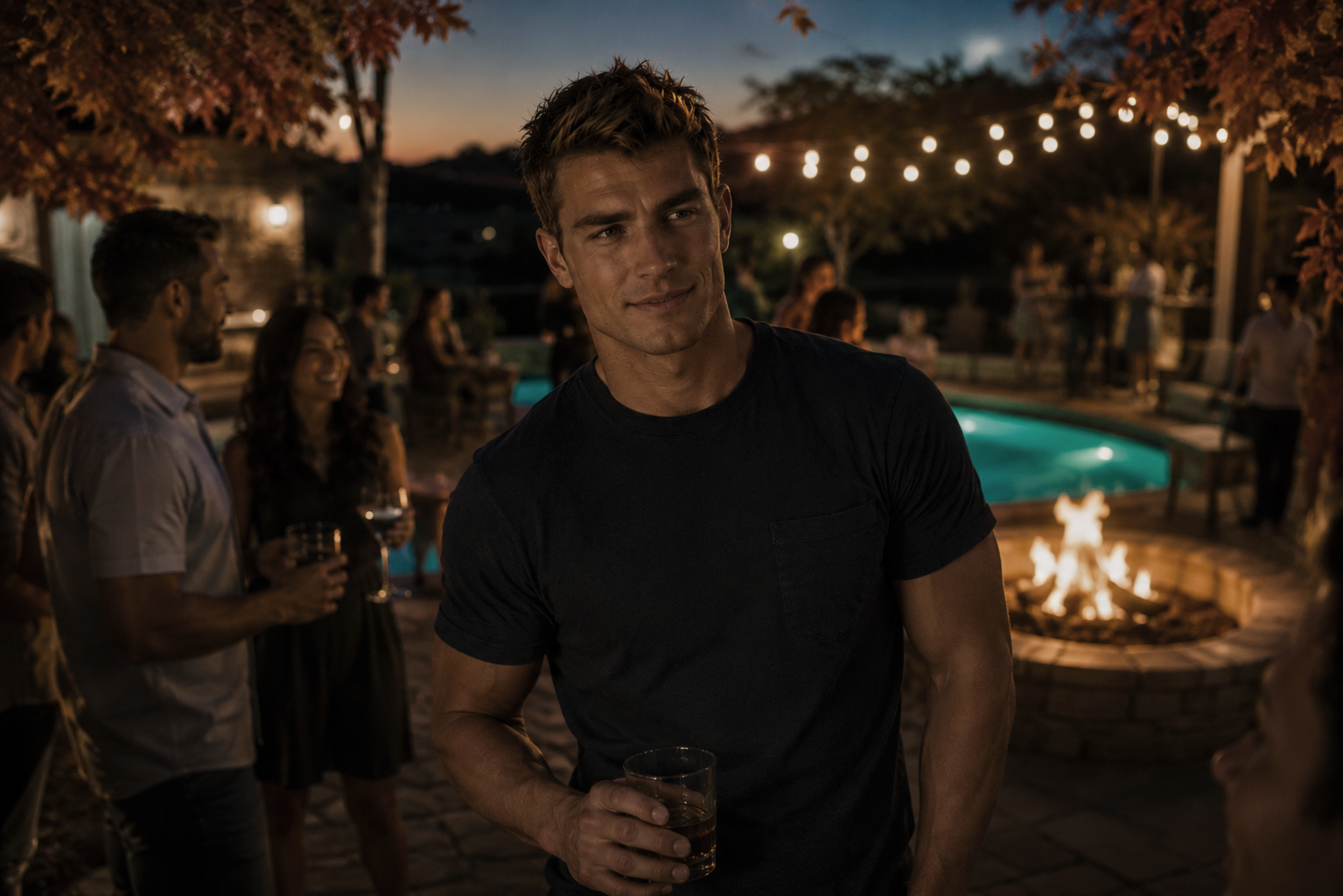
“It’s not just the alcohol.” He said it without judgment, the way Milo said most things. Dry, observational, the tone of someone who had been paying attention for a long time and had learned to keep his conclusions to himself. “You’ve been different since the lake. Since you moved in.”
I didn’t have an answer for that. Or I did, but it wasn’t one I was ready to say out loud.
Michael appeared at Milo’s elbow with a fresh drink and a comment about the fire pit that I didn’t quite catch—my bad ear was toward him, the words dissolving into the ambient noise before they reached me. Milo answered him in a tone that was perfectly friendly and perfectly distant, the particular register of two people who had been together long enough to have developed a private language of micro tensions.
I noticed the distance between them the way I noticed most things. Quietly, without comment, filing it in the category of information that might be useful later.
David arrived at my elbow, drunk and direct, the way David was about everything.
“Are you happy?” he asked.
The question landed with more weight than he probably intended. I turned it over, looking for the catch, the subtext, the thing he was really asking. But David’s drunk face was open and uncomplicated, and the question seemed to be exactly what it was.
“Yeah,” I said. “I think I am.”
David nodded, satisfied in the way of someone who had gotten the answer he wanted and didn’t need to examine it further. “Good,” he said, and wandered off toward the cooler.
Kip was circulating. I caught him watching Wade with an expression I recognized. The hungry, unfulfilled look of someone who wanted something they would not get. It was the same look I’d seen on his face at the lake, the same way he’d positioned himself near Wade every time Wade was in a room. Jake, across the patio, had noticed too. His jaw had tightened, a slight movement that I presumably wasn’t supposed to see.
I filed that too.

Wade’s Point of View
Jaegen arrived at nine with a bottle of Patrón Añejo and the energy of someone who’d been waiting for his entrance.
The party was in full swing by then. Jesse had stopped counting drinks after the third, and I’d stopped counting drinks because I was the host and hosting meant keeping a glass in your hand whether you were drinking from it or not. The fire pit was going. Someone had put music on the outdoor speakers. The pool was lit from within, turquoise and shifting.
Jaegen found me almost immediately, but his attention was on Jesse.
“Where’s the man of the hour?” He was already pouring shots. He’d brought his own shot glasses. They were small crystal ones, deliberate, the thing you carried when you wanted to signal that drinking wasn’t casual but curated.
“He’s around. Pour him something light.”
“I brought the good stuff. Let him have a real drink.” He handed me a shot. “To sixteen weeks.”
The tequila was smooth and expensive, and I drank it faster than I should have. Jaegen refilled my glass without asking.
“Jesse seems relaxed tonight,” he said. “More than usual.”
“He’s had a few.”
“I noticed. It suits him.” He was watching Jesse with an attention that was too specific. Not predatory, specifically, but not not predatory either. “You know, Wade, I’ve been thinking about what you said at the group dinner. About the bedroom situation.”
I had said nothing about the bedroom situation at the group dinner. I’d been careful. But Jaegen had asked questions, and I’d answered some of them, and evidently he’d assembled the answers into a picture I hadn’t meant to give him.
“It’s fine. Things are good.”
“Are they?” He didn’t make it a question. “Because you looked frustrated. At the dinner. Like there was something you wanted to say and couldn’t.”
“Jaegen—”
“I’m just saying. You’ve been patient. You’ve been more patient than anyone expected. But patience has a shelf life.” He smiled, warm and easy, the smile of a man who was just being a good friend. “Tonight’s a celebration. You should enjoy it.”
He found Jesse at the bar and poured him three shots in succession. Jesse drank two. Jaegen’s hand landed on his shoulder, casual, friendly, and I watched it land and told myself I was being paranoid.

Jesse’s Point of View
Jaegen handed me a third shot before I’d finished the second. We were at the bar, the bottle of Patrón between us, his presence so easy it wrapped around to unsettling.
“You know,” he said, leaning an elbow on the counter, “I’ve known Wade a long time. Ten years, maybe more. I’ve never seen him like this.”
“Like what?”
“Invested.” He said the word like it was a compliment, but something in his tone made it feel like an observation. “He’s different with you. More . . . careful. I didn’t think he had it in him.”
“Wade’s full of surprises.”
Jaegen laughed a warm, easy laugh that sounded genuine. “I’m sure he is. How are you finding it? The age difference, the money, the . . .” he gestured vaguely at the house, the pool, the party, “. . . all of this?”
“It’s been fine.”
“Just fine?” He leaned in somewhat, his expression shifting to something more confidential. “You can be honest with me. I know it’s not always easy. Wade’s circle can be . . . a lot. The history, the exes, the expectations. If you ever need someone to talk to who’s not . . .” another gesture, this one encompassing the fire pit, the patio, the whole social apparatus, “. . . involved, I’m around.”
The offer was perfectly pitched. Warm, generous, and concerned. Exactly what someone would say if they were a friend.
“Thanks,” I said. “I’ll keep that in mind.”
Jaegen smiled and poured me another shot.

Wade’s Point of View
I watched Jaegen working Jesse from across the patio, and something struck me I didn’t want to name.
It wasn’t jealousy. Jealousy was simpler than this. Jealousy was the territorial prickle I’d felt when Paul had looked at Jesse too long at the lake, the reflexive mine that flared up and died down. This was something more complicated. A low-grade unease that sat in the back of my throat like the aftertaste of something I shouldn’t have swallowed.
Jaegen was pouring Jesse another shot. Jesse was drinking it. His face was still controlled, but the warmth of the alcohol was starting to show in the slight relaxation of his shoulders, the way his laugh came easier, the particular looseness that three drinks could unlock.
I remembered the way Jaegen had looked at me when he’d said patience has a shelf life. I remembered the way he’d assembled a picture from things I hadn’t meant to give him. And now he was at the bar with Jesse, pouring tequila like it was gasoline and waiting to see if something would catch.
“He’s being friendly in a particular way,” Jake said, appearing at my elbow, “and you don’t like it.”
“I didn’t say that.”
“You didn’t have to.” Jake was holding a beer he hadn’t opened. “You’ve been staring at them for five minutes. Your grill is going to burn.”
I turned back to the grill. The burgers were fine, a little charred on one side, nothing catastrophic. “He’s been pouring him shots since he got here.”
“Jaegen pours everyone shots. It’s his thing.”
“It’s not his thing with Jesse.”
Jake was silent for a moment. When he spoke again, his voice was lower, the particular tone he used when he was about to tell me something I would not want to hear.
“You’re not wrong to notice. But you’re also not in a position to do anything about it without looking like the jealous boyfriend who doesn’t trust his partner to handle himself.” He finally opened his beer. “Jesse can handle himself. You know that.”
“I know.”
“So let him handle himself. And pay attention to your grill.”
I paid attention to my grill. But I kept watching Jaegen out of the corner of my eye, and the unease stayed where it was, undissolved.

Andrew came through the gate at nine-thirty, which was late enough to be an entrance without being late enough to be obnoxiously rude. It was typical. Andrew operated on Andrew’s schedule, and the rest of the world was expected to adjust. He was wearing a jacket that possibly cost more than my grill and moving with the easy, practiced fluidity of someone who had been the most attractive person in every room for long enough that he’d stopped noticing.
He greeted me with a warmth so light it was almost condescending. A hand on my shoulder, a “Good to see you, Wade,” that sounded friendly and meant nothing. Then he moved into the party and mingled with everyone with the same social ease he always did. I watched him do it with the complicated feeling of someone seeing a familiar piece of furniture in a room that had been rearranged.
Jesse was at the fire pit, talking to Milo. Andrew passed near him without stopping, without acknowledging him beyond a brief nod that could have meant anything or nothing. Jesse didn’t react. His face was the same controlled, somewhat serious expression it always was in social situations, but I saw him clock it. Jesse clocked everything.
Milo soon materialized at my elbow. “He’s like that with everyone who’s ever dated someone he used to date,” he said, as if I’d asked. “It’s not personal.”
“It feels personal.”
“It’s Andrew. Everything’s personal and nothing is.”
I didn’t have an answer for that. Milo drifted away, heading back toward the fire pit, and I watched him take the empty seat next to Jesse with the comfortable ease of someone who had decided, quietly and without fanfare, where his allegiances lay.

The pills were on the bar near the ice bucket.
I spotted them half an hour later, when I went inside to get more limes. A small plastic bag with a couple of pale tablets, sitting next to the Patrón like they’d been left there by accident. They hadn’t. Jaegen didn’t leave things by accident.
I knew what they were. I’d known what they were before I picked up the bag, before I held it up to the kitchen light, before I let myself think about what I was doing. Ecstasy. Clean, probably because Jaegen had good connections and his drugs were always what he said they were.
Jesse’s rule sat in the back of my mind like a note. No drugs. Non-negotiable. A condition when we started this and still a condition now.
But Jesse was outside. Jesse didn’t know. And it was a party—our party, the party I’d thrown to tell everyone we were serious—and one little boost wasn’t the same as breaking a promise. It wasn’t chemsex if I was just . . . taking the edge off. Being social. Being the version of myself that was good at parties, the version that didn’t overthink things, the version that everyone expected me to be.
I took one of the pills and washed it down with whiskey.
The effect began quickly. The careful, complicated feeling I’d been carrying since Jaegen arrived dissolved into something simpler, something easier, something that didn’t have edges.
I went back outside.

Forty minutes later, I was a different person.
Not a different person, altogether. A different version of the same person. The version that the drugs unlocked when the alcohol had already taken down the gate. I was warm all over, my skin humming with a pleasant electricity, and the party had become a series of bright, disconnected moments that I moved through without quite tracking the transitions. The music was better. The fire was warmer. The people were more interesting, their faces sharper and their voices more distinct, and I was talking to everyone with an ease that felt transcendent.
I also wanted Jesse.
Not in the abstract, not in the tender way I’d wanted him this morning in bed. I wanted him in the specific, physical, immediate way that the combination of whiskey and whatever Jaegen had left on the table produced. I wanted to get my hands on him. I wanted to get him alone. I wanted to do things to him that we hadn’t done yet, that I’d been patient about, that I was suddenly not feeling patient about at all.
This was the thing about being high. It dissolved the part of my brain that understood patience, that understood the careful framework of what Jesse needed and what I’d promised to give him. It left behind the part that just wanted, and that part was loud and getting louder.
I found him in the living room. He was getting water at the bar sink, the responsible instinct that came in between drinks, and I crossed the room and put my hands on his hips and pulled him toward me with the easy physical confidence that was native to me. He was solid and warm under my hands, and I could feel the muscle of his back through his shirt, and I wanted him so badly it was almost a physical pain.
“There you are,” I said. My voice sounded different to my own ears. Rougher, looser.
“Wade,” Jesse said. “You’re really drunk.”
“I’m celebrating. Sixteen weeks.” I kissed his neck. He smelled like wood smoke and the cologne he always wore, something clean and understated, and I wanted to taste him. “Come here. Come to bed with me.”
“I’m getting water.”
“Get water later.” I pulled him closer, my mouth against his ear. His good ear, the one I’d learned to aim for without thinking about it. “I want you. Right now. I want to take you to bed and take my time with you and not stop until neither of us can remember our own names.”
Jesse’s body was still against mine, not resisting but not yielding. “You’re extremely drunk,” he said again. “And I think you took something.”
“I’m fine. I’m better than fine. I’m celebrating.” I pressed him against the bar counter, my hands moving down his sides, over his hips. “You’re so fucking hot, you know that? I’ve been looking at you all night. I can’t stop looking at you. Your body is . . . Jesus, Jesse. Primo. A-plus. I want to do things to you. I want to do everything to you.”
“Wade.” His voice was level, but there was a note in it I didn’t recognize, or didn’t want to recognize. “People are in the room.”
“Let them hear. I don’t care.” I was steering us toward the couch, my hands still on him, my body humming with the drug and the wanting. “I’ve got the hottest guy at the party, and I want everyone to know it. I want to show you off. I want to . . .”
The living room had a couch. I don’t remember getting there. I just remember that we were there, and I had him against the back of it, and I was kissing him with more teeth than tenderness, and he was kissing me back but not with the same urgency, something held back, something waiting. I didn’t notice that people were watching. I didn’t notice that the room had gone quieter. I didn’t notice anything except the heat of his body and the need to be closer and the conviction that this was romantic, that I was being romantic, that everyone could see how much I wanted him, and that was the point.
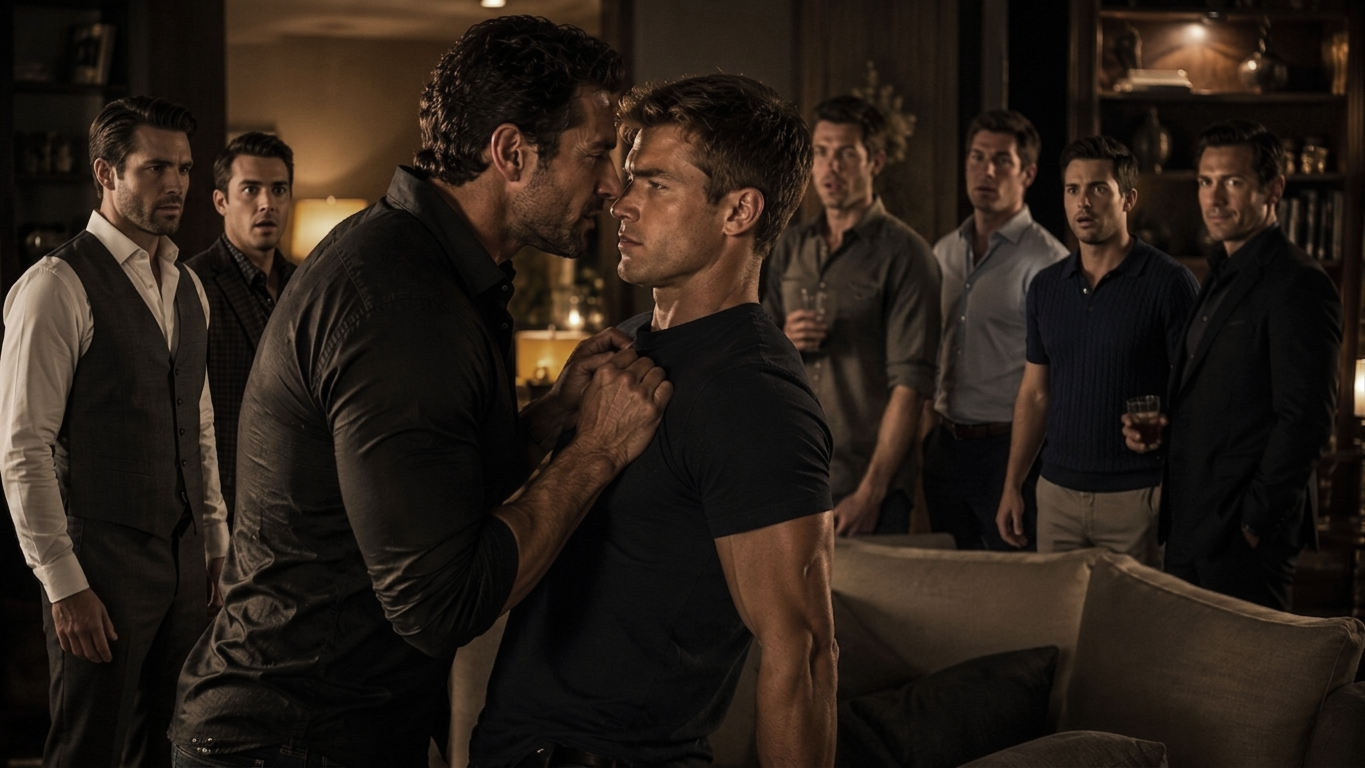
Jesse pulled back and looked at me. His face was unreadable in the low light. His hands were on my chest, not pushing me away but not pulling me closer.
“What?” I said.
“You’re not yourself.”
“I’m exactly myself. This is the best version of myself.” I grinned at him, the big, loose grin that the drugs produced. “You should try it. You’d like it. You’d relax.”
“I’m relaxed,” Jesse said, in a tone that suggested he was not relaxed.
“You’re not.” I put my hands on his face, my thumbs on his jaw, the way I did in the morning when we were alone and the light was gray and the whole world was peaceful. My voice was louder than I had meant it to be. The room felt as if it had gotten brighter, the edges of things sharper. “You know how much I like you. You know how much I want you. Sixteen weeks, Jesse. I’ve been waiting sixteen weeks to wreck that tight little hole of yours and I’m still waiting.”
The room went still.
I felt it happen before I understood it. The way the ambient noise dropped, the way the people who had been filtering through the living room stopped moving, the way the air pressure changed the way it changed before a storm. Jesse was looking at me, and his expression hadn’t shifted, but something behind his eyes had closed.
“I love fucking you,” I said. The words kept coming. The filter between my brain and my mouth was gone. “I do. I really do. You’re great. Your body is amazing. But you’re so . . . you’re so careful about it, you know? You’re so in your head about it. And I need . . . I really need to be inside you. I really need to go hard, with abandon. I need to be able to just demolish you—to cum inside a tight, hot—”
“Wade,” Jesse said with a calmness evoking stone.
“Andrew and I used to . . .” I stopped. I heard myself say Andrew’s name and knew, somewhere in the distant part of my brain that the drugs hadn’t reached, that I should stop. The drugs didn’t care. The drugs wanted to talk. “Andrew and I used to fuck for hours. I’m serious. The sex with Andrew was fucking incredible. He could take anything I gave him. Anything. I’d give it to him as hard and as fast as I wanted and he’d just lie there begging me for more. That tight hole of his just swallowing my cock and he was never . . . he never tensed up, never got in his head about it, just . . . God. No stopping, no . . . we didn’t have to manage it. It was the best sex of my life. It was. Andrew, he was the best sex of my life.”
I looked at Jesse. He hadn’t moved.
“I know you’re not Andrew,” I said quickly, like that would help, like the words could be pulled back if I said enough other words after them. “I know that. That’s not what I’m . . . I’m not comparing you to Andrew. I’m just saying what I need. I’m just being honest about what I need.”
“In front of everyone we know,” Jesse said. “You’re ‘not comparing’ me to Andrew in front of everyone here. We’ve been working on this,” he said. His voice came out even. “We’ve talked about this.”
I looked around. The room was full of people. I hadn’t noticed them gathering. Milo was by the fireplace, his bottle frozen halfway to his mouth. David was in the doorway, eyes wide. Kip was near the hall, watching with an intensity I didn’t understand and didn’t try to. Jake was at the edge of the room, and his jaw was tight, and he was looking at me the way he looked at problems he was trying to decide how to solve.
Andrew was in the room. I knew Andrew was in the room because I had monitored Andrew all evening the way you track someone you have history with. I saw him now, standing near the bookcase, and his expression was not embarrassed or sympathetic. It was something closer to . . . not satisfaction, exactly, but a kind of quiet, knowing assessment, the way you looked at a thing you had been expecting to happen and were not surprised had happened.
Jesse was still looking at me. He hadn’t glanced at the crowd. His face was utterly still.
“I know we’ve talked about it,” I said. “I know. But talking about it isn’t—” I stopped. Tried again. “I just think,” I continued, because the drugs wouldn’t let me stop, because I’d started this thing and I was going to finish it, because some part of me still believed I could make it sound reasonable, “if you’d just try the E . . . just one time, just to see . . . it would make everything easier. It relaxes you. It makes your body stop doing that thing it does. You could just . . . you wouldn’t have to think about it so much. I’ll pay for it. I’ll get the good stuff. No one has to know. Just the two of us, and you’d actually enjoy it, and I’d finally get to—”
“Don’t,” Jesse said.
The word was quiet and very clear, and something in the quality of it stopped me, finally, the specific tone of a person who had reached his limit and was standing at it without moving.
“Look at me,” Jesse said.
I looked at him.
He was composed. That was the thing that stuck with me later, when I was replaying it in my head over and over. He was absolutely composed, his hands flat against his thighs, his voice even, his face giving away nothing except the absolute, unbreakable control that had been holding him upright since the moment I’d said Andrew’s name.
“I will try harder,” he said. “I hear what you’re saying. I hear you. You’ve made my failings abundantly clear.” He paused. Every word was chosen and held. “I will try harder, and I will do better, and I want to give you what you need. But I am not taking drugs. That was a condition when we started this, and it is still a condition now. It is not something I will ever discuss or negotiate. Not for this. Not for anything. Is that clear?”
The room held its breath.
“Yeah,” I said. “Okay. I hear you.”
“Good,” Jesse said.
I squeezed his arm, a gesture that was meant to be reassuring and was probably just the drug’s version of reassurance, and then I turned away. The room was still full of people but I didn’t see them. The conversation was over for me. I was already moving, already following the bright thread of whatever came next, and the weight of what I’d done hadn’t landed yet.
Behind me, Jesse stood at the wall and did not move.

Jesse’s Point of View
I stood at the wall and looked at a fixed point on the far side of the room and breathed.
The room found its noise again by degrees. I heard it happening around me. A voice here, a laugh there, the careful social reassembly of people who had witnessed something and were graciously deciding they hadn’t. It was the sound of a party putting itself back together, a wound being dressed by collective agreement, and I was in the center of it without being part of it, a stone in a stream that the water was learning to flow around.
I was deaf in one ear. I had been my whole life. In noisy environments, in bars, parties, anywhere with ambient sound and competing voices, I lost words constantly. They dissolved into the background, and I compensated and managed, and most of the time it cost me nothing more than the occasional misheard sentence.
In a a silent room, with someone directly in front of me, there was nothing to get lost in.
I had heard every word.
Every word about Andrew. Every word about what they had that we didn’t. Every word about what Wade needed that I hadn’t been able to give him, said in the specific carrying voice of a man who was not thinking about who was listening because the drink and the drugs had dissolved his awareness of the room, and I had heard all of it with the perfect, unsparing clarity of my one good ear in a quiet space, and so had everyone else in the room. I wanted to die.
Andrew was in this room. I knew Andrew was in this room because I had been keeping track of Andrew all evening, and I did not look at him.
Andrew was the best sex of my life.
The sentence sat in my chest like something I’d swallowed wrong. I had known it in the abstract. Wade had told me, months ago, in one of those careless confessions he made without hearing the weight of them, and I’d filed it then. Filed it and moved past it because it was history, because everyone had history, because the past was the past and the present was what mattered. But the past had just walked into the middle of a party in front of everyone we knew and planted itself in the center of the room, and I was standing at the wall looking at the aftermath of it and trying to locate my breathing.
I thought about this morning. I thought about the gray October light and Wade’s hand on my face and the calm after the sex, the way he’d put his arm around me and I’d felt, for the first time in a long time, like I was where I was supposed to be. I thought about the way he’d looked at me across the breakfast table when he said I’m glad you’re here. I thought about the serving trays and the good napkins and the bottle opener, the whole careful map of his house that I’d learned without meaning to, the way I’d let myself believe that all of it meant something permanent.
Then I thought about the words he’d just said, and I thought about the fact that he’d said them in front of everyone, and I thought about what it meant that the version of Wade who existed after a pill and four whiskeys was this version. The version who compared me to his ex in graphic detail, who called my body primo like I was a cut of meat, who offered to drug me so I’d be more convenient for him to fuck.
I didn’t cry. I would not cry. I held onto the wall with my eyes and I breathed in and out and I did not cry.
Milo appeared at my elbow.
He said nothing at first. He just stood there, his presence a quiet, solid thing at the edge of my peripheral vision, and then he picked up the empty glass I’d set on the side table without being aware I’d set it down and went to get me a fresh one. When he came back, he handed it to me and said, “The bluffs at the cove in June were doing something incredible in the afternoon light. I don’t think any of us said that enough at the time.”
I looked at him. Milo’s face was calm, his expression the emotional neutrality of someone who was not going to make you talk about it but was going to stay.
“I thought you should know,” he said.
“Thanks, Milo,” I said.
“Any time.” He moved off, not far, close enough that I could find him if I needed to, and I stood at the wall with my drink and my level face and looked at the party resuming around me and breathed.
I could hear Wade’s laugh from somewhere in the backyard. He had moved on. The conversation was over for him. He was already somewhere else, already lost in the bright, unfiltered present that the drugs had built for him, and the thing he’d done in this room was already behind him, already forgotten. That was the thing about the version of Wade that existed after a pill and a whiskey. He didn’t carry anything. The weight landed on the people around him, and he kept moving, lighter and lighter, until there was nothing left to carry.
I looked at the fixed point on the far wall and thought about the serving trays. The good napkins and the bottle opener. The gray October light, and I didn’t cry.

Jake’s Point of View
I watched Jesse at the wall, and I catalogued the damage.
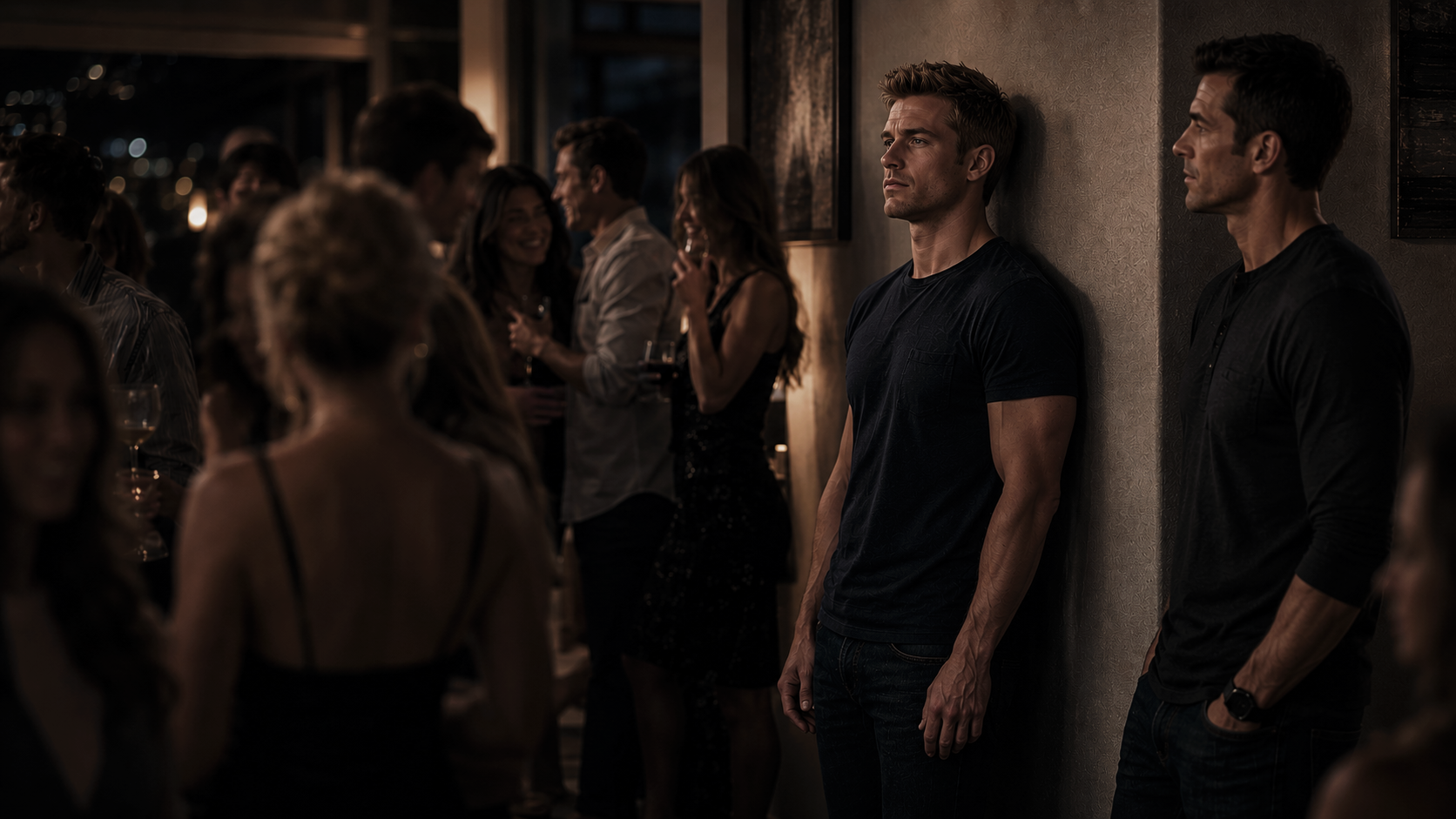
His posture was perfect. Shoulders back, spine straight, the controlled physical presentation of someone who had learned to manage his body because he couldn’t always manage what was happening inside it. His face was unreadable. His hands were steady. If you didn’t know what you were looking at, you’d think he was fine.
I knew what I was looking at.
Kip appeared at my side, drink in hand, expression carefully neutral. “That was . . .”
“I know what it was.” My voice came out harder than I intended. I didn’t soften it.
“I was just going to say—”
“Don’t.”
Kip’s face flickered with something that looked briefly, unflatteringly, like satisfaction, and he retreated toward the bar. I didn’t watch him go. My attention was on Jesse, who had not moved from the wall, who was holding his composure with a precision that was itself a kind of distress signal.
The party was resuming around him, the collective social denial doing what it did. People were laughing again, talking again, the volume of the room gradually returning to normal. Wade was somewhere outside, amplified and oblivious, still celebrating. Andrew was somewhere in the crowd, and I didn’t want to think about what his face had looked like while Wade was talking.
I should go to Jesse. I knew I should go to Jesse. But I also knew that what Jesse needed right now was not someone else’s attention, not another person asking if he was okay, not the weight of anyone else’s concern. What Jesse needed was to be allowed to stand at that wall and hold himself together until he was ready to move.
So I stayed where I was. Watched. Waited. A tear broke loose and streaked down his right cheek. I watched him ignore it.
And I thought about what I was going to say to Wade when I finally got him alone.

End of Chapter Six.