

Alex Bélanger has carved out a quiet life in Montréal’s Little Italy, worlds away from his father’s political empire. But a single glittering gala pulls him back into a web of old loyalties, unspoken desires, and dangerous rivalries. As a tense reunion with a man from his past stirs buried longing, and an investigator begins watching his family from the shadows, Alex must navigate a night where every glance carries a cost. In this atmospheric first chapter, the foundation cracks in ways no one in the room is ready to name.

My chapters run long. If you prefer to read longer material on your Kindle or other device, you can download the EPUB version of this chapter below.
Alex’s Point of View
The sun came through the kitchen window at an angle that made the yellow tile look as though it was holding light instead of reflecting it. I appreciated the warmth it added. I had been up for twenty minutes, standing at the kitchen counter in my bare feet, waiting for the coffee to finish brewing. The machine finally made the sound I was listening for. A kind of wet sigh, as if the effort of producing a single pot of coffee had exhausted its last reserves. Maybe it had. It was an old coffee pot.
I had bought the apartment two years ago against my father’s wishes. He had offered me something larger in a building he owned. A building with a view of the mountain and a concierge who would know my name. I’d chosen a second-floor walk-up on Rue Drolet instead. One where the bathroom door stuck in the humidity and the old woman downstairs played Radio-Canada at a volume that suggested she thought I might want to hear it too. It was mine in a way nothing else quite was. The chip in the living room baseboard from when Gabriel Tremblay had tried to move my bookshelf by himself. The faint scorch mark behind the stove from a dinner party where Michael had insisted on flambéing something. The way the morning light hit the kitchen tiles between seven and seven-thirty in March. It was thin and a little watery, still learning to be spring. I knew the apartment the way you know a person you’ve been paying attention to. It had become an extension of what I knew about myself.
The coffee finished. I poured it into a mug with a hairline crack running from rim to base. One I’d kept from undergrad that I should have thrown out three years ago. I carried it to the window.
The street below was still waking up. The baker at the corner was rolling up his awning with the same jerks he always used, the motion so practiced it looked automatic. A woman in running clothes stretched against the mailbox. Her breath fogged visibly in the morning air. Two doors down, old Signora Rossi was already settled on her balcony with a newspaper and a cigarette, her morning ritual so consistent I could set my watch by it if I wore one. The trees lining the sidewalk were still bare but the buds had swollen with that late-March tension, the city holding its breath between winter and whatever came next.
I loved this street. I loved it in the way you love something you chose, not something you inherited or were expected to want. The love was specific and ordinary and entirely mine.
The coffee was hot and a trace bitter. I’d been buying the same beans for three years from the Italian grocer on Saint-Laurent, partly because they were good and partly because the grocer’s wife always asked me about my sister and remembered the answer the next time.
I had forty minutes before I needed to start the day in any formal sense. Forty minutes that belonged to no one other than me.
I finished the coffee and rinsed the mug in the sink, running cold water over my wrists. The water was chilly enough to be uncomfortable. I dried my hands on a towel hanging from the oven handle. Michael had tried and failed to break me of the habit because it was unhygienic and looked sloppy, he’d said. I caught my reflection in the dark glass of the microwave door.
I looked fine. The thought was automatic, the way it always was. I looked fine.
I dressed in what I liked to think of as my neighborhood clothes. Jeans washed enough times to be soft at the knees, a shirt I’d bought at a thrift store on Mont-Royal that fit better than anything I owned from a department store. Shoes that could handle uneven sidewalks. The clothes were comfortable in the way clothes are when you didn’t think about them.
My first stop was the cheese shop. Not because I needed cheese, but because I always stopped at the cheese shop when I did my morning rounds. It had been my first morning in the apartment almost three years ago when I’d wandered in looking for something to put on bread and found myself in a conversation with the owner about the difficulties of aging cheddar in a Montréal basement. His name was Giancarlo. He was seventy-one years old. He had been running the shop since before I was born. He called me il giovanotto, the young man, which was a small thing I’d told no one about, because telling would have made it smaller.
“Ah, il giovanotto,” he said when I pushed open the door, the bell above it ringing with the particular tinny note I’d memorized. “You’re early today.”
“Ten minutes earlier than last week, maybe.”
“Maybe last week you were late.” He was behind the counter wrapping something in wax paper with the unhurried movements of a man who had been doing this for fifty years and saw no reason to rush now. “You want to try the pecorino? My daughter brought it back from a trip to Tuscany. Tell me what you think.”
I tried the pecorino. It was sharp and slightly nutty and I told him so, and he nodded as if I’d confirmed what he already knew.
“How is she?” I asked. “Your daughter. She was taking the nursing exam.”
Giancarlo’s face changed. The pride was visible before he spoke, a softening around the mouth. “She passed. Ninety-fourth percentile.”
“That’s not passing. That’s announcing yourself.”
“She’s always been the smart one. Don’t tell my son I said that.” He slid the wrapped cheese across the counter towards me. “Take this. It’s too sharp for most of my customers. They want mozzarella, always the mozzarella.”
I took the cheese because refusing would have been unkind. Because Giancarlo had been giving me things I didn’t ask for since the day I’d walked into his shop. Small things, like a wedge of something new or a warning about the landlord’s tendency to ignore plumbing problems until they became crises, things that added up to a kind of inclusion I hadn’t understood I needed until I had it.
The bakery was two doors down and it was wedged between a cobbler whose sign had been promising “next week” for three years and a secondhand bookstore that never seemed to be open. A narrow shop with a blue awning and a window display that changed with the seasons. Pastries arranged in patterns that suggested someone took joy in arranging them.
The bell above the door was different from Giancarlo’s. It rang higher and brighter. The smell inside was warm and yeasty, the unique fragrance of dough proving and sugar caramelizing that settled into your clothes and stayed there for hours.
“Monsieur Bélanger.” Madame Fontaine looked up from the counter with the assessing glance of someone who had been running a bakery for forty years. She could tell from the way a customer opened the door what kind of interaction was about to happen. She was a small woman with flour dusted into the cuffs of her sweater and the steady competence of someone who woke up at four every morning and had made peace with it. “The usual?”
“The usual.”
She was already reaching for the white paper bag, the one she set aside every Tuesday and Friday knowing I’d be in. The palmiers went in first. They were buttery and crisp, their edges caramelized to a delicious deep amber. Then came the small madeleines, still warm from the oven this morning.
“The old men will be waiting,” she said as she folded the top of the bag with a crisp crease. “Enzo was in here yesterday complaining about his knee. You might want to bring an extra madeleine. Flattery helps the medicine go down.”
“Enzo complains about his knee every week. It’s his primary hobby.”
“He complains about his knee because no one will listen to him complain about his wife.” She pushed the bag across the counter. “Two dollars from you. They’re a day old.”
They were not a day old. The madeleines were still releasing warmth through the paper, and I could smell the butter. But Madame Fontaine had been giving me the “day-old” price since the first month I’d started coming in, and I’d learned that arguing with her about it was like arguing with the weather. She’d made up her mind about what my money was worth to her, and nothing I said was going to change it.
“You’re kind,” I said.
“I’m practical. You bring those old men pastries so they stop shouting at each other long enough to enjoy the park. It’s a public service.” She reached under the counter and added a small paper twist of langues de chat to the bag, a gesture so automatic she probably didn’t notice she’d done it. “For later. You’re too thin.”
“Everyone keeps telling me that.”
“We’re all correct.” She wiped her hands on her apron and fixed me with a look that had been withering overconfident bread apprentices forty years ago and had lost none of its effectiveness. “The gala is tonight, yes?”
“Yes.”
“You’ll be the best-dressed person in the room. Don’t let those politicians tell you otherwise.” She paused and something softer flickered in her eyes. “Your mother would be proud, you know. The way you’ve made yourself at home here.”
I didn’t know what to say to that so I thanked her and I took the bag and I stepped back out into the cool morning air. The bakery’s warmth stayed with me for half a block before the March wind found its way through my jacket and reminded me that spring in Montréal was still mostly a rumor.

The park was three blocks east. A narrow rectangle of green wedged between two apartment buildings as though the city forgot to pave something. The old men were already there, gathered around the bocce court with the solemness of people conducting a ritual whose meaning had long since transcended the game itself.
I started bringing them pastries two years ago after a conversation with one of them. A retired tailor named Enzo, who had opinions about everything and who wasn’t shy about sharing them. He had mentioned in passing that the bakery on the corner had stopped making sfogliatelle and the world was going to hell as a result. The next week I came with sfogliatelle from a place three neighborhoods over and something about the gesture had registered with them. Since then, the pastries were expected. I didn’t mind. The expectation was its own kind of welcome.
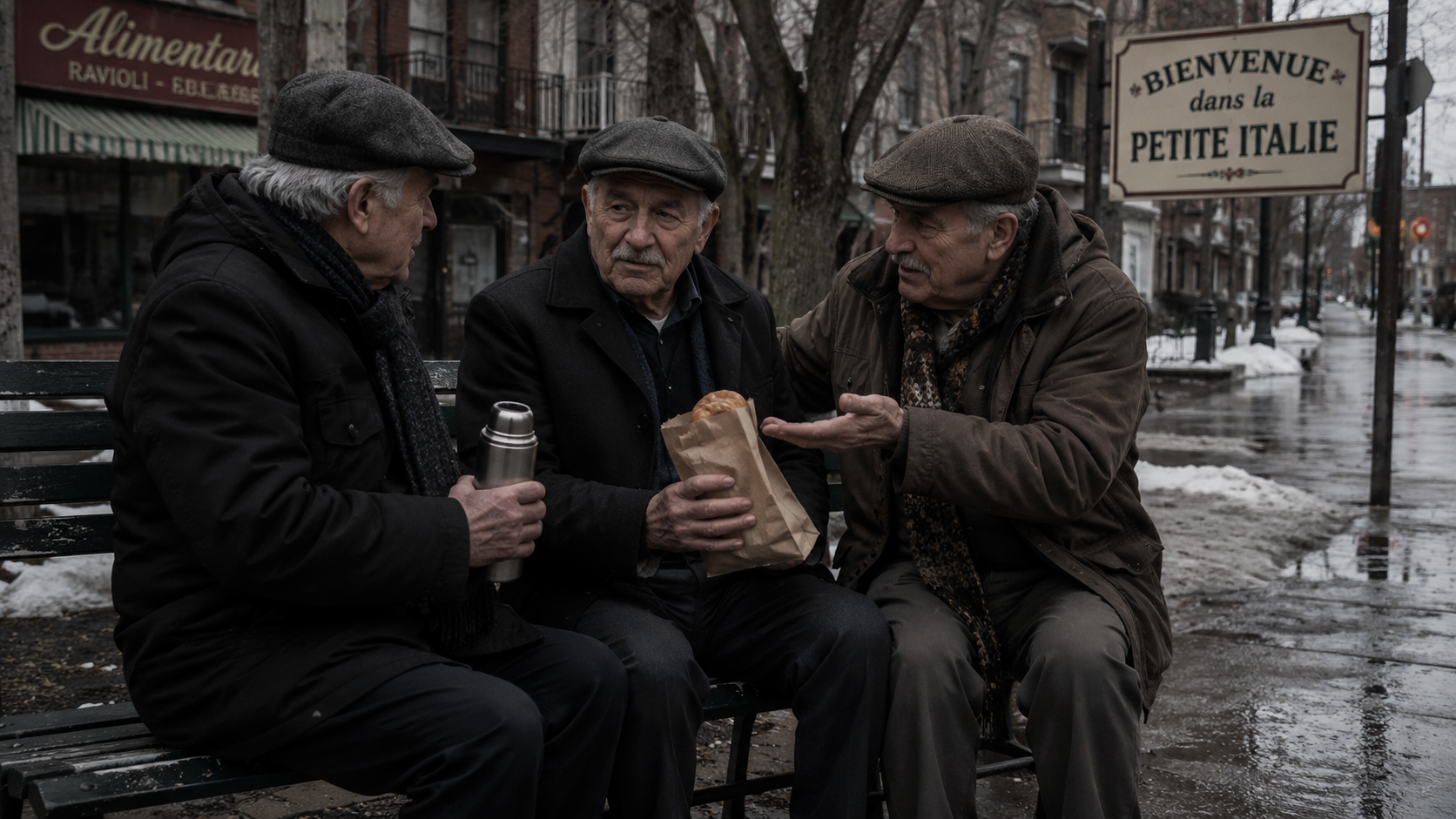
“Too thin,” Enzo said as he took the white paper bag I handed him. He opened it and peered inside with the skepticism of a man who had been receiving pastry deliveries for two years but still felt the need to verify the contents. “The madeleines are fresh?”
“Baked this morning.”
“Madame Fontaine charges you too much.”
“She charges me two dollars.”
“Too much,” he said firmly, and bit into a madeleine with the air of a man delivering a final verdict. “You need a wife to feed you properly.”
“I have a fiancé, Enzo. He feeds me plenty.”
The men around the bocce court exchanged the looks they always exchanged when I mentioned Michael. Not disapproval, precisely. Something more like a collective withholding of judgment, a decision to wait and see.
“The good-looking one?” asked Mario, who was eighty-three and had recently acquired a hearing aid he refused to wear correctly. “With the car?”
“He has a car, yes.”
“Too clean,” Enzo said. “Car like that, you could eat off the wheels. Not natural.” He bit into the pastry again, chewing it slowly. “You haven’t married him yet, so you agree with me.”
I didn’t argue. The old men had decided Michael was wrong for me roughly thirty seconds after meeting him, and nothing I’d said in the intervening eighteen months had shifted that assessment. They’d just been old and Italian and certain about things in the way old Italian men are certain, which is to say without evidence and without doubt.
I stayed for twenty minutes listening to them argue about placing a ball on the court with the same reverence they might have applied to a Supreme Court decision. The morning sun climbed higher, burning off the last of the early chill, and the park was filling with its other regulars. The woman who walked three small dogs on three separate leashes and the young father who pushed a stroller with the shell-shocked expression of someone who hadn’t slept in six months. There was also the teenager who practiced guitar on the bench near the fountain and was getting better in increments I could track week to week. That I knew these things was a small joy in itself.
On my way back, I passed the laundromat where Madame Caron was folding sheets with the mechanical efficiency of someone who had been folding sheets since before I was born. She saw me through the window and raised a hand, and I stopped in the doorway.
“Monsieur Bélanger,” she said. “The gala is tonight.”
“It is.”
“My daughter saw the notice in the paper. Your father’s foundation, yes?”
“Yes.”
She nodded, her hands still moving, folding a pillowcase into precise thirds. “My daughter says he does good work, your father. Important work.”
There was a carefulness in her voice that I’d learned to recognize years ago, the particular distance people maintained when they talked about Philippe Bélanger. Not disrespect. Something more like the caution of people who knew the world had shadows in it and understood that powerful men cast the longest ones. They liked my father. They respected him. But they didn’t talk about him the way they talked about other people, and they didn’t talk to me about him the way they talked to me about anything else.
“He does,” I said. “Important work.”
I had practiced the answer. I’d been giving variations of it since I was old enough to understand that my father’s reputation preceded him in ways that required management. The management had become automatic.
I walked the last block home in the full light of late morning. The street had woken up properly now, traffic on the cross street, a delivery truck idling outside the hardware store, the smell of fresh bread from the bakery drifting through an open door, people starting their lives for the day. I paused on the sidewalk outside my building and looked up at the second floor. My windows. My apartment. The place I’d chosen.
The street felt like mine. The feeling was warm and ordinary and I knew, even as I felt it, that it was something I would need to hold on to.
Upstairs, I found two messages waiting on my phone.
The first was from my father. Car will pick you up at 6. Bring Michael. Don’t be late. The premier’s office confirmed this morning.
I answered immediately I’ll be ready because answering my father’s messages immediately was a habit I’d never broken, one of the few I’d never tried to break.
The second was from Michael. Landed. See you in an hour.
I looked at Michael’s message for a moment longer than I’d looked at my father’s. Not because it required more thought. Because something about seeing his name on my phone, bracketed by the ordinary morning I’d just had, made the world feel a bit off its axis. The feeling was small and I didn’t examine it.
I typed back Door’s open.

Michael arrived from the airport looking like he’d stepped out of a photograph someone had taken for a magazine I’d never read. The flight had not wrinkled the suit he was wearing. The Montréal wind had not disturbed his hair. He was handsome in a curated, deliberate way, and he knew it, and knowing it was part of what made the handsomeness work.
“There he is,” he said, stepping through the door and pulling me into an embrace that was warm and genuine and lasted exactly the right amount of time. “God, you look good. The neighborhood suits you.”
“The neighborhood is the neighborhood. It’s been here.”
“It’s been here, but you’ve gotten . . .” he gestured, a vague wave that somehow communicated approval, “settled. I can see it.”
He moved through the apartment the way he always did, touching things without quite touching them. A hand hovering near the back of a chair. A glance at the bookshelf that felt like an inventory. He stopped at the kitchen window and looked down at the street.
“The old men still playing bocce?”
“Every morning.”
“Charming.” The word was warm and also not. “I booked the hotel. The Ritz-Carlton. Figured we’d want something central after the gala.”
“We could stay here.”
“We could.” He turned from the window and his smile was the practiced smile of someone who had learned to use warmth as a tool. “But the hotel has room service and a bathtub the size of your entire bathroom, and I didn’t fly three hours to share your shower with the mildew.”
“The mildew has character.”
“The mildew has spores.” He crossed the room and kissed me again, lighter this time, a brush of lips that felt like a question he wasn’t quite asking. “Forty minutes before we need to leave. Show me what you’re wearing.”
I showed him. The tuxedo was in the bedroom, hung on the door where I’d put it the night before. It was a good tuxedo. My father had insisted on the tailor, on the fabric, on the careful cut that would read as understated to the people who mattered, and I’d worn it often enough that it felt like mine without feeling like a costume.
Michael looked at it with the assessing gaze of someone who understood the language of clothing the way other people understood French or English. “Perfect. You’ll be the most interesting person in the room.”
It was a compliment and also a positioning statement. The most interesting person in the room was a role Michael liked to assign me, partly because he believed it and partly because being engaged to the most interesting person in the room reflected well on him.
“Thank you,” I said.
In the living room, Michael settled onto the couch with his tablet and began reviewing something, the guest list I realized when I glanced over his shoulder. He was scrolling through names with the mercenary precision of someone calculating value.
“The premier’s chief of staff will be there,” he said. “And the deputy minister from Finance. Your father really pulls them in.”
“He’s been building the guest list for thirty years.”
“Mm.” He tapped on a name. “This one. Landry. What’s his angle?”
“Landry’s been at every gala since I was fifteen. His angle is free champagne and the chance to tell the same story about meeting Trudeau to anyone who’ll listen.”
“Not useful, then.”
“I wouldn’t lead with him at a networking event, no.”
Michael made a note and kept scrolling. I watched him for a moment from the kitchen doorway, feeling the faint disconnect I’d been feeling since he’d arrived. The attention he was giving the guest list was the same attention I’d given Giancarlo in the cheese shop. Focused and present, but the quality of it was different. Giancarlo’s attention was an end in itself. Michael’s was a means to something else.
I didn’t examine the feeling. I had a gift for not examining feelings when doing so would have been inconvenient.
“You’re staring,” Michael said without looking up.
“I’m appreciating.”
“Appreciate faster. We have a schedule.” But he smiled when he said it, and the smile was real, and for a moment he was just the man I’d agreed to marry, warm and handsome and here.
The moment passed. He went back to his tablet. I went to the bathroom to run cold water over my wrists.

Théo’s Point of View
The light came first, as it always did. Not the full white of morning but the gray-amber edge of it, the hour when the city hadn’t decided whether to commit to day. It came through Vincent’s bedroom window at an angle I’d catalogued months ago without meaning to. Late March, east-facing, the glass thick enough to mute the sound of rue Sherbrooke but not thick enough to stop the light. I lay still and let it fall across the duvet in the long parallelogram I’d memorized.
I woke first. That was the pattern. I woke first, and I made the coffee, and Vincent surfaced roughly twenty minutes later with the specific disorientation of someone who sleeps like a stone and claws his way up through layers of it. This morning was no different, except for the gala tonight. He’d mentioned it once, last Tuesday, passing me in the hallway with his phone already at his ear. The fundraiser. Black tie. I’ll send you the details. He hadn’t sent the details. He wouldn’t. That was also part of the pattern.
I didn’t move. My body had learned the discipline of stillness in this bed. It was Vincent’s bed, large and good and chosen for function, the frame a dark wood that matched nothing else in the apartment because he’d bought it to sleep in, not to look at. The room itself was Vincent in summary. Furnished, clean, impersonal in the way of someone who hadn’t decided to make a home personal. A dresser with nothing on top of it. One book on the nightstand, unread for the three months I’d been watching its bookmark not move. The curtains a neutral gray, chosen precisely because they were neutral and gray.
His breathing came from behind me. It was deep and even, the rhythm of someone whose conscience didn’t keep him awake or whose exhaustion had learned to shout louder than his conscience. I’d been studying his breathing for a while now. I hadn’t examined how long. I didn’t.
The city was beginning its day at a distance with a truck grinding gears somewhere on Sherbrooke and the distant hydraulic sigh of a bus kneeling at a stop. The building was old enough that the sounds arrived muffled, secondhand, like news from a country I used to live in. The room was subdued in the way of two people who had been doing this long enough that mornings had gained a rhythm, and the rhythm had gained the weight of something like furniture. Something you stopped noticing was there until you tripped over it.
I got up.
The bathroom floor was cold. Vincent had chosen the tile because it was easy to clean, which I knew because I’d asked him once and he’d looked at me with the faint surprise of someone who had never considered that a floor could be chosen for any other reason. I pissed, rinsed my hands, didn’t look at myself in the mirror. I’d stopped doing that here. The face in Vincent’s bathroom mirror belonged to someone who was still figuring out what he was doing in Vincent’s bathroom in the first place. That wasn’t a conversation I had the energy to have with myself before coffee.
When I came back into the bedroom, Vincent’s eyes were open.
He tracked me across the room with the unfocused attention of someone still moving through the final shallows of sleep. Not assessing, not evaluating, just recognizing. His eyes were the color of the light at this hour, gray-green and not yet sharp. I’d learned to read the difference between the way Vincent looked at me in this bed and the way he looked at me in the office. The difference was why I was still here, and I was very good at not thinking about that.
“You’re up,” he said. His voice was rough with sleep, the words half formed.
“I’m always up.”
“I know.” He didn’t smile, but something moved at the corner of his mouth. “It’s annoying.”
I stood at the side of the bed, and he reached for me.
The reach was familiar. That was the thing I kept coming back to, in the moments when I let myself come back to anything. Vincent’s hand found my hip with the unerring accuracy of someone who had done it a hundred times, two hundred, who knew precisely where my body would be in relation to his because my body had been in relation to his for eighteen months. The familiarity was itself a form of care that Vincent would not have named as care. I’d stopped waiting for him to name it.
I let him pull me down.
What followed was the arrangement’s ordinary warmth. We had roughly twenty minutes before Vincent needed to begin his day. Before the shower and the coffee and the transition into the professional mood that was his real native language. The time was used in the way it was often used. Without preamble. Without negotiation. His mouth found mine and there was no hesitation in it, no question. There never was.
He tasted like sleep, a faint sourness at the back of the tongue, and underneath it the unique taste of Vincent that I’d stopped thinking of as something separate from my body months ago. His hand moved from my hip to the back of my neck, and his fingers combed into my hair, and his grip was firm in a way that meant stay here. I stayed.
He rolled me onto my back, and the weight of him settled against me. We were chest to chest, the familiar pressure, the heat of his skin through the thin cotton of the t-shirt he’d worn to bed. He was already hard. I could feel him through his boxers, pressing against my thigh, and the knowledge of it sent a slow pulse of heat down through my stomach to where my own cock was thickening, trapped against my hip.
Vincent kissed the corner of my mouth, then my jaw, then the place below my ear that he’d found in the third week of the arrangement and never forgotten. His breath was warm and even. He was in no hurry. This was the thing about Vincent in bed, the one place where his habitual remove from the world briefly slackened, where the seriousness he carried like something heavy he’d gotten used to became a different kind of weight. Focused. Generous. Present in a way he almost never was elsewhere.
He pulled my t-shirt up and I lifted my arms so he could take it off. The air was cool on my chest for the two seconds before his mouth was on me again—collarbone, chest, the flat expanse of muscle above my ribs. His tongue traced a path I knew and my back arched into it without my telling it to.
“You good?” he murmured against my skin.
“Yeah.”
It was the only negotiation we ever needed.
He moved lower. His stubble scraped my stomach, and the muscles there tightened, an involuntary flinch that was also not a flinch. He kissed the jut of my hipbone and then his fingers dipped into the waistband of my briefs and pulled. I lifted my hips. The fabric came away and my cock leaped free, fully hard now, the head wet with the first slick of pre-cum. The air touched me there and I sucked in a breath through my teeth.
Vincent settled between my legs. He did it the way he did everything, methodical, unhurried, like he was setting up at a desk to do work that mattered. His hands pressed my thighs apart and he looked at me for a moment, just looked, and the looking was part of it. The one place where Vincent allowed himself to want something without managing the want.
Then his mouth was on me.
The first contact was always a shock. The wet heat of his tongue tracing the underside of my cock from base to tip, the specific pressure he applied just below the head where he knew I was most sensitive. He knew. He had catalogued me too, in his way, even if he didn’t keep his catalogues the way I kept mine. His mouth closed over the head and the suction, the soft give of his lips, the way his tongue worked the frenulum in a slow circle that made my hips jerk up before I could stop them all flooded my senses.
He took me deeper. His jaw relaxed and I slid into the back of his throat and he held me there for a long moment, breathing through his nose, the heat of him enveloping me unconditionally. The sound I made was not a word. It never was at this point.
He pulled back, then down again, finding the rhythm that was ours. Not rushed, not slow, the pace of a body that knew another body. His hand cupped my balls, rolled them gently, and his thumb pressed the patch of skin behind them that made ecstasy spike sharp and electric up through my spine. I gripped the sheets. The cotton was expensive, high thread count, and I’d noticed that the first time I’d been in this bed and I noticed it again now because my brain wouldn’t stop noticing things even when my body was dissolving.
Vincent’s mouth moved on me and the wet sounds of it filled the muted room. The slick slide of lips and tongue, the soft gag when he took me too deep and held it anyway, the hum in the back of his throat that vibrated through my cock and into my pelvis and up into the base of my brain. He was good at this. He was attentive in a way that would have felt like love if I didn’t know better, and I did know better, and I took it anyway.
“Fuck,” I said. Just the one word. It was all I had.
He pulled off me long enough to say, “I’ve got you,” and the tenderness in his voice was the thing I would file away and not examine. Then his mouth was on me again, and the pleasure built in the base of my spine, a tightening thing of heat and pressure that radiated outward through my hips and down my thighs. My breathing became ragged. My hand found the back of his head—not pushing, just resting there, feeling the movement of him as he worked me.
The orgasm came without warning, the way it always did with him. One moment I was climbing toward it and the next it was on me, tearing through my lower back and down through my groin, and I was cumming into his mouth in pulses that shook my teeth. He took it. He took all of it, swallowing around me, his hand still working me through the aftershocks until I was too sensitive and I had to pull his head away.
He came up to me and I tasted myself on his tongue when he kissed me, the salt and bitter and the faint sweetness of his own spit. His cock was still hard against my hip, leaking, the head slick and hot where it pressed into my skin. I reached down and took him in my hand.
The angle was awkward, but I knew his body the way he knew mine. I knew the grip he liked. Firm, the twist at the top, the way his breath caught when my thumb found the ridge of the head. I stroked him and he pressed his forehead to mine and his breathing went shallow and uneven. He was close. I could feel it in the tension of his shoulders, the way his hips moved with my hand instead of just receiving it.
“Come on,” I said. Quiet. Just for him. “I’ve got you.”
He came with a sound that was almost pained, a groan pulled up from somewhere deep in his chest. The heat of his cum spilled over my fingers and onto my stomach in thick pulses. His body went rigid for three long seconds and then collapsed against me, his weight sudden and complete and briefly unguarded.
He lay still. The stillness of someone who had just had something good and was not yet ready to re-enter the day.
I felt the exact moment it ended. It was in the change of his breathing first—the shift from deep and slow to something shallower, more regulated. Then his posture. He rolled off me, and the space between our bodies became a border again. His face re-tensioned, the muscles around his jaw and eyes pulling back into the arrangement that was his public self, and when he spoke his voice had already found its professional register.
“What time is your first call?”
I reached for my phone on the nightstand. “Nine. Dubois.”
“The merger documents?”
“On your desk. I printed them yesterday before I left.”
He nodded, already sitting up, already moving toward the edge of the bed. “Good.”
The ordinariness was part of the structure. I’d stopped resenting it months ago, or told myself I had, which served the same function.
He stood and walked toward the bathroom and I lay there for another thirty seconds, feeling the cooling mess on my stomach, the pleasant ache in my thighs, the particular emptiness of a body that had just been filled with something and was already returning to its default state. Then I got up and went to make the coffee.

I made it the specific way Vincent took it. Black, no sugar, the beans ground fine enough that the espresso machine in his kitchen, an Italian thing he’d researched for three weeks before buying, could extract the full body without turning bitter. I could have made it before the shower. I made it afterward, because Vincent preferred it fresh. The coffee would be ready within ninety seconds of him walking into the kitchen in his suit, and he would take it, and he would not think about the fact that I had timed it that way.
This was a fact about myself that I registered and did not examine.
The kitchen was white and clean and looked like it belonged to someone who cooked for utility rather than fun. The only evidence of regular use was the espresso machine and the single mug Vincent favored which was a heavy ceramic thing with a chip in the handle I’d pointed out once and he’d shrugged at. I pulled the shot, watched the crema bloom dark and golden, and set the mug on the counter.
Vincent emerged dressed in a gray suit, white shirt, no tie yet. He took the coffee, checked his phone, and did not look at my mouth.
“I’ll see you at the office,” he said.
“I’ll be there.”
He didn’t kiss me goodbye. He never did. I left through the side entrance as I always did. The door shut behind me with the sober finality of a period at the end of a sentence no one was reading.

In the car, I sat.
The parking garage was dim and cold and smelled of concrete dust and the faint chemical sweetness of windshield washer fluid. I put my hands on the steering wheel and did not start the engine. The morning condensed on the windows in a thin film of condensation, blurring the fluorescent lights into soft yellow smears.
I catalogued what had just happened. The weight of his hand on my hip. The sound he made when he came. The way his voice changed after. The coffee, cooling now in a mug I hadn’t drunk from.
I catalogued what it meant.
And then I decided, for the thousandth time, that the decision had already been made. I started the car.

Desrosiers’ Point of View
The file on her desk was thick enough to have its own weight, the kind of weight that communicated years of patient investigation before you even opened it. Desrosiers had been looking at versions of this file for the better part of a decade. The names changed. The architecture didn’t.
Her office was in the eastern wing of the building, a corner space she’d claimed fifteen years ago and never relinquished. The window looked out over the parking lot, which wasn’t scenic but was useful. She could see who came and went and she’d learned a long time ago that the people who parked in the far corner and walked the extra distance were usually the ones worth watching.
The junior officer standing in her doorway was young enough to still believe in the clean division between good and evil. His name was Perreault. The assignment to her section happened three months ago, and to date, he had not shown he was unusually competent or unusually stupid.
“The guest list for tonight,” he said, holding out a tablet.
Desrosiers took it without looking up from the file. “Confirmed?”
“As of this morning. The premier’s office sent its final RSVPs at nine.”
She scrolled through the names. It was a list of people who mattered in Quebec, the kind of list that would have made a society columnist salivate. Politicians, business leaders, a scattering of cultural figures whose presence lent legitimacy to the others. The Bélanger Foundation had been hosting this gala for twenty years, and the guest list had grown more powerful with each iteration, the kind of gathering where legitimate power and organized crime occupied the same room with the comfort of people who had long since stopped pretending not to know each other.
She paused at a name. The pause was brief, a fraction of a second, and her face didn’t change.
“Anything unusual?” she asked.
“Nothing that jumps out. The usual security arrangements. Private security firm, licensed and bonded. The venue has hosted this event before.”
“And our surveillance?”
“Current as of noon. No flags.”
Desrosiers closed the file and set it on the corner of her desk, aligning the edges with the desktop the way she aligned everything on her desk. The precision was automatic. A habit from her first posting in a records office where misplaced paper meant missed cases.
“Keep the surveillance current,” she said. “Don’t approach anyone. Don’t let anyone know we’re watching. This is information gathering only.”
Perreault nodded. He was smart enough not to ask why. He was also smart enough to have noticed the pause, she could tell. But he was learning slowly, the way young officers learn, that asking about the things she didn’t explain was not the way to advance in her section.
He left. The door shut behind him with the soft sound of a well-maintained hinge.
Desrosiers sat motionless for a long moment, her hands flat on the desk, her breathing even. Outside the window, a car pulled into the far corner of the parking lot and sat there for thirty seconds before the driver got out.
She opened the file again.

Alex’s Point of View
The car was a black sedan with tinted windows and a driver who knew my name but didn’t use it. Michael sat beside me in the back seat, still on his phone, scrolling through something with the absorption of a man who had never quite learned to be unproductive.
“You’re going to give yourself a headache,” I said.
“I’ll give myself a headache after the gala. Right now I’m confirming that Landry’s story about Trudeau is apocryphal.”
“It’s definitely apocryphal. He’s been telling it for twenty years and the details change every time.”
“But the deputy minister from Finance doesn’t know that.” Michael looked up from his phone and grinned. “Knowledge is power, Alex.”
“Is that what we’re calling gossip now?”
“We’re calling it intelligence. Sounds better.”
The car moved through the evening streets of Montréal, past the restaurants with their terraces filling up despite the March chill, past the joggers along the Lachine Canal in their thermal gear, past the odd quality of light that happens in early spring when the days are finally stretching themselves longer, thin and hopeful against the lingering dark. I watched the city slide by and felt the familiar doubling sensation I always felt when I was on my way to one of my father’s events. The sense that I was both inside my life and just outside it, watching myself perform the role of Philippe Bélanger’s son.
I was good in the role. I’d been playing it long enough that the lines had become automatic. But there was always a moment, usually in the car on the way there, when I felt the gap between the person I was on Rue Drolet and the person I was about to become.
Michael put his phone down. His hand found my knee, a brief squeeze that was affectionate and also, in a way I couldn’t quite name, proprietary.
“You’re quiet,” he said.
“I’m always quiet in cars.”
“You’re quieter than usual.”
“I’m thinking about the cheese shop.”
“The cheese shop?” He laughed, the short, warm laugh of someone who thought I was being charmingly eccentric. “We’re twenty minutes from a gala full of people who can change your life and you’re thinking about cheese.”
“Pecorino specifically. Giancarlo’s daughter brought it back from Tuscany.”
Michael shook his head, still smiling, and turned back to his phone. He didn’t understand and I didn’t explain. The cheese shop wasn’t about cheese. It was about the way Giancarlo had looked when I’d asked about his daughter’s exam. It was about the ordinary kindness of being known in a place, of having people who expected you to show up and noticed when you didn’t.
The car turned onto Sherbrooke Street and the private club where my father held the gala came into view. An old building, limestone and wrought iron, the kind of building designed to communicate permanence and had succeeded.
The driver opened my door. The evening air was cool and carried the smell of the river, sharp and wet, still touched with the memory of ice. I straightened my jacket and then, for the next four hours, assumed the role that was expected of me.

The private club’s ballroom was full in the way my father’s events were always full. Not with the tense, thin crowd of an obligatory appearance, but with the solid, comfortable density of people who understood that attendance at a Bélanger Foundation gala was part of the architecture of their world. You attended because your absence would have drawn attention.
I stood in the doorway for a moment, mapping the room the way I’d learned to do when I was seventeen and attending my first official event. The geography of power was visible if you knew how to read it. Near the bar, the younger politicians, the ones still climbing. Near the windows, the old money, people who’d been coming to this gala since before I was born and saw no reason to work the room now. Near the stage, my father’s inner circle, the men who’d been with him for decades and moved through the crowd with the ease of people who knew they belonged everywhere.
My father was at the center of that cluster, of course. He was always at the center. Even in a room full of powerful people, Philippe Bélanger radiated the particular gravity of someone who had built the room himself.
“There he is,” Michael murmured beside me. “The king in his castle.”
“He’d hate that phrasing.”
“He’d hate it publicly. Privately, I think he’d frame it.”
I didn’t answer. Michael wasn’t wrong. My father had an ego, deliberately managed but massive, but something about hearing it said aloud made me feel disloyal.
We moved into the room. I felt the shift in attention as people noticed me, the subtle recalibration of expressions and postures that accompanied the arrival of the host’s son. Some of it was genuine gladness. Some of it was calculation. Most of it was both.

“Alex.” My father’s voice reached me before he did, cutting through the ambient noise with the clarity of someone who was used to being heard. He emerged from his cluster and embraced me with the firm, brief hug he’d been giving me since I was old enough to shake hands. “Right on time.”
“You told me not to be late.”
“And you listened.” He released me and turned to Michael with a smile that was warm and measured, the smile of a man checking a box. “Michael. Glad you could make the flight.”
“Wouldn’t miss it, sir.” Michael’s charm clicked into place, polished and professional. “The foundation’s work this year has been remarkable. The op-ed in Le Devoir was a masterstroke.”
“The op-ed was Alex’s idea.”
“Was it?” Michael glanced at me, and there was something in the glance I couldn’t quite read. “Of course it was.”
My father’s attention returned to me, and for a moment, the performance dropped away. He looked at me with the particular expression he’d worn since I was a child. Pride mixed with assessment, love mixed with expectation.
“You look good,” he said. “The neighborhood agrees with you.”
“Everyone keeps saying that.”
“Maybe it’s true.” He touched my shoulder, a brief pressure. “I have to deal with something before the speeches. Walk the room. People want to see you.”
He was gone before I could answer, disappearing through a side door with the purposeful stride of a man who had somewhere to be that he wasn’t explaining.
Michael was already moving, his attention fixed on a cluster of political staffers near the bar. “I see three people I need to talk to. Find you in an hour?”
“Find me whenever.”
He kissed my cheek. A gesture that was both affectionate and public, the kind of kiss that signaled belonging to anyone who was watching, and he disappeared into the crowd.
I was alone for the first time since we’d arrived. I stood in the center of my father’s gala, surrounded by people who knew my name, and let the noise of the room wash over me.

I’d been working the legitimate side of the room for almost half an hour when a familiar fatigue began settling into my shoulders.
It wasn’t that I disliked these people. I didn’t. Many of them I cherished. The deputy minister who’d mentored me through my first policy paper, the foundation director who sent me handwritten notes on my birthday, the political science professor from McGill who’d taught my favorite course and still asked after my research interests. They were smart and engaged and doing work that mattered.
But talking to them required a performance. I had to be Alexandre Bélanger, the policy graduate groomed for a political future. I had to reference the right articles, laugh at the right jokes, express the right opinions with the right degree of qualification. The performance wasn’t dishonest. It was just incomplete.
“Bélanger.” Beauchamp materialized at my elbow, holding a glass of something amber and expensive looking. He was in his sixties, silver haired and distinguished, a former cabinet minister who now sat on somewhere around forty boards and had opinions about everything. “I read your piece in Policy Options.”
“Which one?”
“The one about municipal governance reform. Don’t pretend you’ve written so many I’d need to specify.” He took a sip of his drink. “It was good. You actually engaged with the counterarguments instead of setting up straw men to knock down, which puts you ahead of ninety percent of the people publishing in that space.”
“I had an editor.”
“You had a good argument. The implementation timeline was optimistic, though. You’re assuming a level of inter-municipal cooperation that doesn’t exist.”
“That’s not optimism. That’s strategic over-leveraging. If you ask for what’s realistic, you get half of it.”
Beauchamp’s eyebrows went up. “Cynical.”
“Practical.”
We debated the implementation timeline for four minutes, the type of substantive exchange that I enjoyed and almost never got to have at these events. But when we finished and I moved on, I caught Beauchamp watching me with a weight I couldn’t quite parse. The weight was there for a fraction of a second. Calculation, maybe, or something like it, and then it was gone, replaced by the polished affability he showed everyone.
Paul-Antoine greeted me near the windows with a glass of champagne he’d been reserving for me. “You look like you need this.”
“Am I that obvious?”
“You’ve had six conversations in thirty minutes. That’s your limit. I’ve been counting since I was nineteen.” He handed me the glass with the easy warmth of someone I’d known for most of my life. “How’s the neighborhood?”
“It’s still there. The old men asked about you.”
“The bocce mafia? I’m touched.” He grinned, but there was something reserved about the grin, a carefulness I’d noticed more and more over the past year. Paul-Antoine had been one of my best friends since university, but the friendship had always operated within invisible boundaries he’d established and maintained. I didn’t push against them. I had a gift for not pushing.
“They think I need a wife,” I said.
“Enzo’s been saying that since your first boyfriend. He’s consistent, I’ll give him that.” Paul-Antoine’s gaze flicked across the room to where Michael was deep in conversation with a cluster of ministerial staff. “Speaking of. How’s the future husband?”
“Working the room like he was born to it.”
“He was born to it. The question is whether he was born to work it here.” The sentence hung in the air for a moment, too pointed to ignore. Then Paul-Antoine smiled again, and the smile was real and also not quite real, the way it always was. “I’m glad you’re here, Alex. These things are unbearable without you.”
He meant it. He also meant something else he wasn’t saying. I didn’t push.

The old high school contingent clustered near the back of the ballroom, claiming the corner as their territory at every gala since we’d started attending. They were easy to spot. The suits were expensive but worn with a unique quality of confidence, a roughness that came from lives lived in rooms where presence mattered more than presentation.
Vincent saw me first. His face did the thing it always did when I walked into his line of sight. A specific softening, a lightness that I’d been noticing without examining for as long as I could remember. The seriousness he carried like a physical weight shifted, just a tad, and something lighter pushed through.

“Look who finally showed up,” he said, pulling me into a brief, back slapping embrace. “I was starting to think you’d gotten lost in the policy discussions.”
“I was doing my duty.”
“Your duty is to your people first. The politicians can wait.” He released me and stepped back, his hands lingering on my shoulders for a second longer than was necessary. I noticed the extra second without realizing I’d noticed it. “You look good. The neighborhood suits you.”
“You’re the third person tonight who’s told me that.”
“We coordinated. It’s a conspiracy.”
His smile was dry, the particular flat humor that surfaced when he was relaxed. I’d always liked that about Vincent. The way his sense of humor emerged in private, a counterweight to the seriousness he wore in public.
“You walked through the room as if you grew up in it,” he said.
“I did grow up in it.”
“That’s not what I meant.”
He didn’t explain and I didn’t ask. Vincent had a habit of saying things that meant more than they appeared to mean, and I’d learned—over years of friendship, over years of something I’d never quite named—to let the extra meaning sit there without demanding an account.
Two of the others circulated through. Marco Tremblay and Jean-Paul, who everyone called JP and who’d been running his family’s construction business since his father’s stroke. They greeted me with the shorthand warmth of people who’d known me when I was still growing into my limbs.
JP was wholly inside his family’s business, had been since he was old enough to be useful. Marco was the same, running an import-export operation that everyone understood was more than import-export. They were good men, mostly, in the complicated way that men in their world were good. Loyal to their people, generous with their friends, and capable of things I preferred not to think about.
Vincent was the only one trying to get out. His family had been transitioning toward legitimacy for years, and Vincent had become the face of that transition. I admired him for it. I also knew it cost him something he didn’t talk about.
“How’s the transition going?” I asked him when Marco and JP had drifted away to refill their drinks.
“It’s going.” His expression closed. “Some days better than others.”
“You always say that.”
“Because it’s always true.” He looked at me with an attention I’d never examined, an attention that felt like being seen in a way that was subtly more than friendly. “You’re good, Alex? Actually good?”
“I’m good.”
“You know you can tell me if you’re not.”
“I know.”
The moment stretched, and something in his face, something I didn’t have a name for, hovered just beneath the surface. Then he looked away, and the moment passed, and he was Vincent again, dry and serious and carrying his weight like something he’d gotten used to.
“I should let you work the room,” he said.
“You’re part of the room.”
“I’m the part of the room that doesn’t need to be worked.” He touched my arm, a brief pressure that might have been casual and might have been something else. “Come find me later.”
He moved off toward the bar, and I watched him go. The watching lasted a second longer than it should have. Then I turned back toward the legitimate side of the room and became, again, the person I was expected to be.
The disruption entered my awareness as a shift in the room’s ambient noise. A subtle change in the quality of conversation near the main doors, a slight parting of bodies that suggested something had arrived that didn’t quite belong. I felt it before I saw it the way you feel the pressure drop before a storm.
Marc.
He was standing just inside the entrance, his solid frame planted with the stillness of someone who knew his presence was a statement and intended it to be. He was wearing a dark suit that fit him well enough but communicated something different from the surrounding suits. Function rather than fashion, presence rather than presentation. The Riccis did the dirty work that kept cleaner operations running. Enforcement, collections, the type of work that was essential and invisible and never invited to sit at the same table as the people who benefited from it. That he was here, at my father’s gala, meant he’d chosen to be here. Everyone in the room would understand the choice.
I felt the familiar weariness settle into my stomach. Marc and I had been having some version of this strange waltz since junior high, when he’d first started appearing at the edges of my social world with his jaw set and his eyes fixed on me in a way I’d never been able to interpret. He’d been the bully, the antagonist, the one whose presence made rooms feel smaller. The only one to lay hands on me in school, and he’d done so with an intensity that far exceeded the bruises it left behind. I’d learned, over years of navigating his particular intensity, to let it roll off me without letting it in.
The weariness was automatic. So was the stillness that followed it. The decision, made before I acknowledged making it, not to let him see that his presence affected me at all.

Marco and JP were already moving, interposing their bodies between Marc and me with the practiced ease of people who’d been doing this for years. They didn’t make a show of it. They just shifted their positions, creating a buffer that Marc would have to physically push through to reach me.
Marc saw it. His mouth tightened at the corner, a fraction of a movement that I caught only because I was scrutinizing him. But he allowed it. He stood there, held in place by the casual blockade, and his eyes found mine across the room.
The intensity of his gaze was familiar. I’d been on the receiving end of that look for more than a decade. It was angry, possessive, and almost hungry, but there was something underneath it I’d never been able to name. Something that wasn’t contempt. Something that was, in its own twisted way, the opposite of contempt.
I didn’t look away. I’d learned a long time ago that looking away from Marc was surrender and I’d decided, for reasons I’d never understood, that I wouldn’t surrender to him. Not to his anger, not to his intensity, not to whatever unnameable thing lived behind his eyes.
The eye contact held. Five seconds. Ten.
And then Marc looked away first. He moved toward the bar with a controlled, deliberate stride and the room exhaled.
“Jesus,” Michael said, appearing at my elbow. “Was that who I think it was?”
“Marc Ricci.”
“Is he going to be a problem?”
“He’s an old story.”
Michael looked at me with the assessing gaze he used for political calculations, the one that evaluated risk and reward. “You’re sure?”
“I’m sure.” I wasn’t sure. But I’d learned a long time ago that acting sure was sometimes the same thing as being sure, at least in rooms like this.
Michael held my gaze for a beat, then nodded. “I’m going to make another pass at the finance cluster. Come find me if you need extraction.” He squeezed my arm and moved off, already recalibrating his route to avoid the corner of the room Marc had claimed.
I watched him go. And then Vincent was beside me, manifesting without announcement the way he always did when something happened that required acknowledgment.
“He’s been doing this since junior high,” Vincent said. His voice was low, pitched for privacy, and the flatness in it was doing a lot of work. “You’d think he’d grow out of it, eventually.”
“It’s been, what, twelve years? Maybe thirteen.” I kept my eyes on the crowd, not looking at Vincent, not looking at the bar. “You’d think.”
“Some people don’t grow out of things. They just learn to wear them differently.”
I turned then. Vincent’s expression was the same expression he’d been wearing since Marc’s arrival. Controlled, attentive, carrying something personal underneath the composure. He’d been watching the whole exchange. Of course he had. Vincent had been watching Marc watch me since I was thirteen and I’d never asked him why he paid such close attention to a dynamic that didn’t involve him.
“I don’t know what he wants,” I said. “I’ve never known.”
“Yes, you have,” Vincent’s voice was gentle but certain. “You just don’t want to name it.”
The words landed somewhere in my chest, a dull pressure I couldn’t identify. I looked away first this time, not from Marc but from Vincent, from the unnerving precision of his attention. The room was still moving around us, champagne and conversation and the careful choreography of powerful people performing their power. But something in the air between us had shifted.
“I wish I knew why,” I said.
“Why he’s been doing it?”
“Why it still works. Why I still notice. It’s been over a decade and he walks into a room and I feel like I’m seventeen again waiting for the shove or the fist.”
Vincent was silent for a moment. When he spoke again, his voice had lost its flatness. “You notice because you’re paying attention. That’s not the same thing as letting it work.”
“Isn’t it?”
“No,” he said it simply, the way he said things he was sure about. “The shove isn’t the point. The point is that he can’t stop showing up. You’ve been refusing to flinch since we were kids and he still can’t stop showing up. That’s not you losing. That’s him not knowing how to win.”
I looked at Vincent then, honestly looked at him, at the seriousness he carried and the tiredness around his eyes and the way he was looking back at me with an attention that had never been simple. I felt something shift in my chest, a door opening onto a room I hadn’t known was there.
“You’ve been watching this a long time,” I said.
“Someone has to.” He held my gaze for a moment longer, and then his mouth quirked into something that was almost a smile. “Besides, Marco and JP can’t body block him forever. Someone has to provide the strategic analysis.”
“Is that what this is? Strategic analysis?”
“Call it professional curiosity.” He let the joke land, then let it go. “You’re all right, Alex. You’ve always been all right. That’s the thing he doesn’t get.”
“What thing?”
“That you don’t need to flinch. You just need to keep being you. That’s what bothers him most.” He stepped back, putting a small distance between us that felt deliberate. “I’m at the bar if you need me. Don’t let him take up more space in your head than he deserves.”
He moved off before I could answer, and I watched him go the way I’d watched him go earlier. For a second longer than I should have. The door in my chest was still open, a crack of light I hadn’t asked for and didn’t know what to do with.
I returned to the room and resumed being the person they expected. But something had shifted. The performance felt thinner now, more transparent, as if Vincent’s words had worn a hole in the fabric I’d been wearing all night.

My father found me half an hour later, near the windows, where I’d retreated to catch my breath between conversations.
“You’re doing well,” he said. “I’ve had three people tell me you’re wasted in policy analysis.”
“I like policy analysis.”
“You like understanding how things work. That’s different from wanting to spend your career in think tanks.” He stood beside me, close enough that our shoulders almost touched. The proximity was comfortable and also not. My father had always existed at a slight distance, even when he was standing next to me. “Beauchamp was impressed with you.”
“I had a good conversation with him.”
“You had a good argument with him. He likes to be argued with. Most people are too afraid. You’re good tonight. Relaxed. People notice.”
“I’m always relaxed,” I said.
“No. You’re always composed. Relaxed is different.” He looked at me with the specific assessment of a father who had spent twenty-six years learning to read his son’s interior states through the management that concealed them. “Something’s on your mind.”
“Marc Ricci is here.”
“I saw.” His expression didn’t change. “His presence is a message. I’m not sure to whom. Probably not to us. The Riccis have their own reasons for wanting visibility tonight.”
“His family wasn’t on the guest list.”
“No, he came anyway. That’s also a message.” He paused. “You handled it well. The interception was clean. He didn’t get close enough to make a scene.”
“That was Marco and Jean-Paul. Not me.”
“That’s the same thing. You inspire the interception. That’s a form of handling.” He put his hand on my shoulder, a brief, warm pressure. He paused and something in his expression shifted. A tightening around his eyes, a deeper focus that I recognized without naming. “I need to step away for a moment. There’s a private matter. Someone I need to speak with before the evening gets away from me.”
“Is everything all right?”
“Of course.” The answer came too swiftly, the way it always did when everything was not all right. But my father and I had an unspoken arrangement. I didn’t ask follow-up questions and he didn’t offer explanations. The arrangement had been in place since I was old enough to understand that some things my father handled were not things he could tell me about and still keep me insulated from the side of business he didn’t want me involved in.
He turned and walked toward a side door, the one that led to the private meeting rooms. His stride was the same stride he’d always had. Purposeful, unhurried, the gait of a man who expected the world to arrange itself around his passage.
The door opened. My father stepped through. And before the door swung shut, I glimpsed the person waiting for him on the other side.
The glimpse was brief, half a second, maybe less, but something about the figure registered in my body before my mind could process it. A man with an ordinary face and ordinary posture, the kind of face you’d pass on the street without noticing. But the way he stood communicated something I felt in my stomach before I understood it. An authority that went beyond ordinary authority. A presence that was muted and massive and somehow, impossibly, familiar.
The door closed.
The feeling lingered. A cold pressure at the base of my skull, a sense of recognition I couldn’t locate. I stood at the window, staring at the closed door, trying to catch the thought before it dissolved.
“Alex?” Paul-Antoine appeared beside me, holding a fresh glass of champagne. “You look like you’ve seen a ghost.”
“I’m fine.” I took the glass. My hand was steady. My heart was not. “Just tired.”
“When’s the last time you ate?”
“I had breakfast.”
“It’s nine o’clock at night. You need food.” He put a hand on my shoulder and steered me toward the appetizer table with the gentle firmness of someone who’d been managing my eating habits since university. “Come on. The speeches are in twenty minutes. You can’t face your father’s speech on an empty stomach.”
I let him steer me. But as I moved away from the window I glanced back at the closed door one more time.
The feeling was still there. Cold, formless, lodged somewhere behind my ribs. I didn’t know what it meant. I didn’t know why the man’s posture had triggered something in my body that my mind couldn’t reach.
I filed it away. I’d become very good over the years at filing things away.

The hotel suite was Michael’s natural habitat. He moved through it with the ease of someone who had spent a significant portion of his adult life in rooms like this one. Rooms with the same neutral palette on the walls, the same weight of the duvet, the same mini bar stocked with the same small bottles. He ordered from the room service menu with the efficiency of a man who knew what he wanted and expected it to arrive correctly, and it did, because Michael was someone to whom hotel staff responded this way.
I stood at the window and looked down at the street. The city was still moving, even at this hour. Headlights tracing patterns through the old city’s narrow streets, someone’s laughter drifting up from a balcony somewhere below. The room was warm and muted and sealed against the outside world like a glass case.
Michael’s hands found my shoulders from behind. “You were great tonight. Better than great. People noticed.”
“That’s the idea.”
His thumbs worked at the tension in my neck with the practiced assurance of someone who’d learned to read bodies the way he read rooms. “You’re tight. You’ve been tight all evening.”
“Long night.”
“Long good or long bad?”
“Depends on how you feel about tight.”
His hands moved down my back, working across my shoulder blades with a pressure that was firm and skilled and genuine. I closed my eyes and let myself feel it.
“I love tight,” he whispered as his nose approached my ear. He grabbed my waist and threw us onto the bed.
The mattress dipped hard under his weight before I even registered the motion. The world tilted, air rushed past my ears, and I hit the sheets with a thud that knocked the breath right out of me. The headboard groaned against the wall. Michael hovered over me, one hand still braced on the frame, the other raking through my hair. His chest was rising and falling fast, sweat making his shirt cling to his ribs. I laughed, a sharp, sudden sound that bounced off the ceiling.
“Sexy,” I said.
He smirked that slow, crooked thing that always got him into trouble. “Glad I didn’t tear the frame.”
He shifted his weight, rolling off me to straddle my hips. I reached for his shirt hem, fingers catching on the damp cotton. He helped me work it over his head, tossing it aside without breaking eye contact. The air was full of coming rain and cedar and the faint, salty tang of him. I pulled his pants down past his hips, knees scraping my shins. He stepped out of them, dress shoes and socks following in a clumsy pile. We both laughed again, breathless, as his foot caught on his own cuff and he almost went down. I grabbed his waist to steady him, thumbs digging into the soft skin just above his belt line. He leaned down, forehead resting against mine, and kissed me.
I worked to get out of my head as his lips met mine. To shut down the part of me that cataloged and observed and filed life away without experiencing it. During these intimate moments, and only these intimate moments, I let myself exist in the moment. Live in the moment. Sense the moment. Only now would I shut down the detached, clinical observation apparatus my mind had developed as a necessary survival mechanism in the Bélanger household.
It started slow. Soft pressure, lips parting, a tentative brush of tongue that dragged me out of my head. His mouth tasted of peppermint and cocktails. I wrapped my legs around his thighs, ankles locking behind him, pulling him flush against me. The contact was immediate, a wave of heat that traveled straight up my spine. I went still, watching his eyelashes flutter, feeling the steady thump of his heart against my collarbone. My throat tightened.
He shifted his hips, grinding down just enough to make me gasp. I exhaled, slow and deliberate, and let my hands slide up his back, palms pressing into the damp skin beneath his shoulders. His breath hitched. The tightness in my chest relaxed, replaced by something heavier and warmer, a simple hum in my gut. I kissed him back, deeper this time, mouth opening, tongue meeting his. It went on, long and unhurried, while the heater rumbled in the ceiling. His fingers carded through my hair, nails scraping gently against my scalp. I tasted myself on him. I felt every shift of his weight, every adjustment of his thighs. The apprehension dissolved into something steady, grounded, anchored to the rhythm of his breathing.
He slowly broke the kiss, dragging his mouth down my jaw, along the line of my throat, over the hollow of my collarbone. I arched off the mattress, hips lifting instinctively. His hands were everywhere, one splayed across my chest, the other sliding down to grip my hip before unbuttoning my pants. His mouth found my dick through my boxer briefs, hot and wet through the thin fabric. I cursed, hands flying to his hair. He pulled back just enough to work the underwear down, freeing me. The cool air hit my skin, then his mouth immediately replaced it.
A wet, sloppy sound filled the room as he took me in, hand wrapping the base while his tongue swirled around the head. I watched him, eyes wide, as he took me deeper, cheeks hollowing, nose pressing against my pubic bone. His breath was hot against my balls. I felt the stretch of his jaw, the slick friction of his mouth, the tug of his hand syncing with every plunge of his tongue. It was messy and loud and perfect. My fingers tightened in his hair. He hummed, the vibration traveling straight up my shaft, and I groaned, hips bucking off the bed.
“Jesus, Michael,” I managed.
He pulled off with a soft pop, wiping his mouth with the back of his hand. “Take your time.”
He reached between us, sliding two fingers inside his own boxers, then up my leg, palm pressing against my thigh. His middle finger found the heat of me, circling the edge of what I was offering him before pushing in. I gasped, back arching. He pushed deeper, slow and steady, and I felt it instantly. That sharp, sudden bloom of pressure right inside me, a sweet, heavy ache that made my toes curl. He worked his finger in a tight curl, pressing precisely where my nerves crowded together. I writhed, hips thrusting up to meet him, a ragged sound tearing from my throat. He didn’t stop, just kept pressing and rotating, thumb catching my lip while his other hand stroked my cock.
The dual sensation short circuited my brain. I was dripping, slick against his palm, tongue lolling in my mouth. He kissed me again, swallowing my groans, fingers working me open while his mouth claimed mine. I felt him slide a second finger in, stretching me, filling me. I wrapped my legs tighter around his waist, heels digging into the small of his back.
“I want you,” I said, breathless, when he finally pulled his hand away. “In me. Now.”
Michael paused, hovering over me. His eyes dropped to mine, dark and unreadable in the lamplight. A slow grin spread across his face. “Oh? Is that so?”
“Yeah,” I tugged his shoulder. “Don’t you?”
He laughed, low and rough. “Are you begging?”
“I’m telling you.”
He dropped to his knees, popping the cap off the lube bottle on the nightstand. The sharp plastic click echoed in the quiet room. He squeezed a generous amount into his palm, rubbing his hands together until the lube was warm before applying to himself and me. The scent of clean aloe hit the air. He positioned himself between my thighs, lining up with me. I watched his face, the focus tightening around his eyes, the way his jaw set. He pushed in using slow and steady pressure. The stretch was immediate. A firm burn that radiated through my hips and up my spine. I groaned, my fingers digging into the sheets. He kept going, inch by inch, burying himself to the hilt inside me. He paused, resting his forehead against mine, breathing hard.
“Too much?” he murmured.
“No,” I said. “Just perfect.”
He pulled back almost all the way, then slammed forward. The bed shook. I felt the fullness, the heat, the slick slide of his cock moving inside me. His face above me shifted, eyes softening, throat working. A silent, fierce emotion flashing across his features that I hadn’t expected. There was a feeling. Not dramatic, not disruptive, just a flutter of being partially somewhere else. A specific sensation Michael had produced in me. The weight of his hand on my hip, a peculiar kind of pressure that instead of resolving into the present produced a ghost of something different. Rougher hands. Less managed touch. The memory of hands from a different context. Not Michael’s, not anyone from my recent history. Something older and less examined surfaced and then was gone. Then Michael moved again, slow and deep, and the phantom thread melted into something brighter, sharper, wholly in the present again.
He kissed me hard and hungry, mouth crashing into mine as he picked up his pace. The slap of skin, the creak of the frame, the wet slide of his cock inside me . . . they all blurred into one relentless rhythm. I kissed him back, tongues tangling, hands pulling him closer. His pace quickened, thrusts growing longer and harder. I felt every ridge, every sweep, the way he bottomed out and dragged back. My balls drew up tight, a heavy knot forming deep in my gut. I gasped into his mouth, hips meeting his. The room narrowed to just us, just the heat, the sweat slicking our skin, the sound of our breathing. He pulled back just enough to look at me, eyes dark, lips swollen. “Gonna come, babe,” he said, voice rough.
“Do it, Michael,” I breathed. “Let it all out.”
He hit a spot deep inside me and I shattered. My back arched, my cock pulsing, a hot load shooting across my stomach and chest. I felt myself tighten around him, a sharp groan tearing from his throat as he buried himself to the root and held it there. His body went rigid, then relaxed in a long, shuddering exhale. He collapsed against me, heavy and warm, face buried in the crook of my neck. I held him, fingers tracing lazy circles on his back, listening to the liminal nothingness of hotel rooms. His heartbeat was still racing against mine. I pressed a kiss to his shoulder, feeling the damp skin, the tired weight of him. Everything was quiet. Everything was exactly where it should be.
We finished. It was good. Michael was satisfied and said so in his characteristically direct way, which I’d always liked about him. The absence of performed uncertainty about what he wanted and whether he’d gotten it. He kissed my shoulder and rolled onto his side of the bed and was asleep within minutes, his breathing settling into the steady rhythm of someone whose conscience didn’t keep him awake.
I lay awake.

The ceiling was white and anonymous. The city hummed fourteen floors below us, a distant vibration I could feel more than hear. Michael slept beside me, warm and present and still, and I felt not unhappy, exactly. Something adjacent to unhappiness. A quiet wakefulness that had nothing to do with insomnia.
I thought about the morning. The cheese shop. The bakery and Madame Fontaine slipping the extra langues de chat into the bag like a secret. Giancarlo’s face when he talked about his daughter. The old men in the park, their unsolicited advice and their reliable presence. The street, with its particular quality of March light, thin and watery, the trees still bare but beginning to think about spring.
The ordinary warmth of my life. The life I’d chosen.
And then, without deciding to, I thought about Vincent. The way he’d said you just don’t want to name it. The way he’d stood beside me in the aftermath of Marc’s arrival and said things I hadn’t known I needed to hear. The distinct quality of his attention, the weight of it, the way he’d watched me for over a decade and never asked for anything in return.
I thought about the door in my chest, the crack of light I hadn’t asked for.
I filed the thought away. I didn’t examine why I was having it.
Beside me, Michael shifted in his sleep. His phone was on the nightstand, face down, the same way he always placed it with the screen pressed against the wood so no one could see if it lit up.
People had tells. Michael’s was the phone, face down, every night of our relationship. I’d noticed it a hundred times without letting myself think about what it meant.
Tonight, I didn’t think about it either.
I lay awake in the dark, in a hotel room that wasn’t mine, next to a man I’d agreed to marry, thinking about a cheese shop and a bocce court and the way Vincent Lefebvre had looked at me across my father’s ballroom.
The wakefulness stayed with me until the first real light of dawn was beginning to seep through the curtains, gray and tentative, the color of a day that hadn’t decided what it was going to be.
I closed my eyes and waited for morning.

End of Chapter One.