
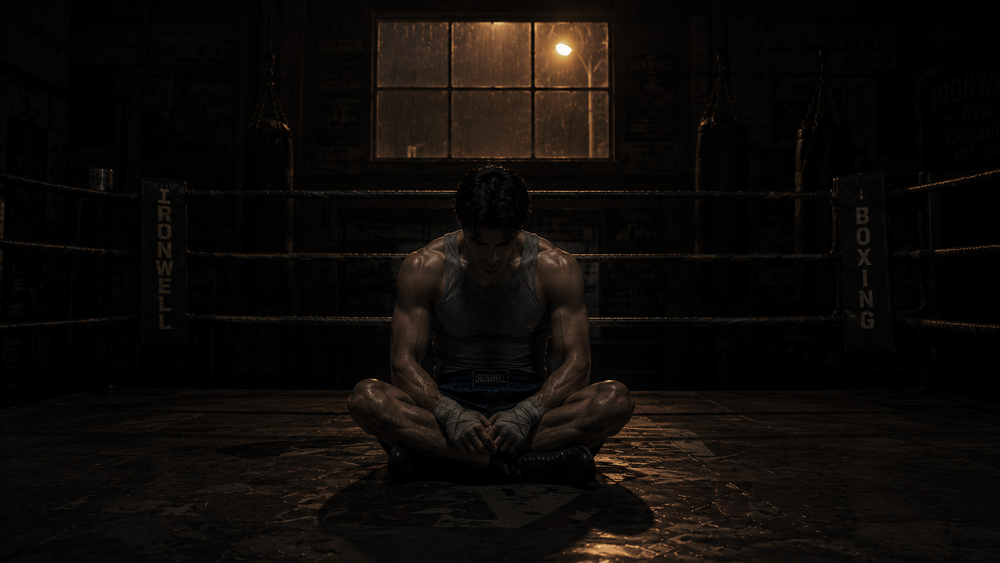
In the aftermath of an unrememberable betrayal, a hollowed-out boxer searches for the shape of a loss he can feel but not name, while the man who destroyed him stalks the rain-slicked streets of a city that has already forgotten them both. Their paths cross one final time in a chrome diner where recognition flickers and fails, leaving each man alone with what remains. For Til, a phantom grief that will never find its object. For Morfeo, the unbearable sound of a love he was too cowardly to keep. This is the price of extraction. Not death, but a haunting that never ends.

Til’s Point of View
The heavy bag didn’t ask questions.
That was the thing I kept coming back to. You hit it, it swung. You hit it harder, it swung harder. The chain creaked. The leather groaned. The impact traveled up your arm and into your shoulder and told you precisely where you stood in the world. There was a kind of math to it. A certain truth. The bag did not lie and it did not leave and it did not look at you with soulless eyes and tell you everything you’d believed was a performance.
It had been four days since the qualifier. Three days since I had woken up in my shitty apartment, battered and bruised, doused in a shittier grief that I could not name.
I was the only here at this hour. No one else came this early, leaving me with just the buzz of the overhead lights and the distant rattle of a space heater struggling against the morning damp to distract my mind. The ropes on the boxing ring hung motionless. The speed bags were silent in their careful rows. The mirrors along the far wall reflected a room full of ghosts. My reflection among them. Shirtless, hands wrapped, the bruise on my ribs faded to a yellowish green. My eye was better. I could open it all the way now, though angry red still marbled through the white.
I hit the bag. Left, left, right. The rhythm came from somewhere underneath thought, some place my body remembered even when my mind didn’t.
My mind hadn’t been remembering much of anything.
I ransacked my apartment last night. I opened every drawer and every cabinet, went through every corner of a life that was supposed to be mine. The hand wraps on the nightstand. The blue mug with the chip in the rim. A toothbrush in the holder that wasn’t mine, or maybe it was, because I could not tell anymore. The boxing poster above my bed, Marco Ibanez staring down with his bloodied face and his impossible heart, and something about him had felt like a promise I couldn’t remember making.
I had stood in the shower and cried. Not the ugly sobbing from that first morning, not the animal howl I still couldn’t explain. Just a silent leaking, tears mixing with the spray, and I couldn’t have told you why. There was no reason. There was nothing wrong. I’d lost a fight, that was all. Fighters lost fights. Fighters got up and trained and fought again. That was the whole point of the Ibanez poster. That was the whole point of everything.
Except the point felt dull now. Like a pencil worn down to the wood.
Left hook. Right cross. The bag shuddered on its chain.
The door at the far end of the gym opened. Morning light streamed through, cutting across the mats, and then it was gone and Marlo was walking toward me with two cups of coffee. Two cups of coffee and a face that meant he wanted to talk.
Marlo was my trainer. Had been for five years, since I was twenty and stupid and trying to punch my way out of a grief I didn’t know how to name. He was sixty-something, built like a fire hydrant, with a gray mustache and hands that had seen more fights than I’d ever fight. He talked little. When he did, it was usually worth hearing.
“You’re here early,” he said. He set one coffee down on the edge of the ring apron. The steam curled up into the cold air.
“Couldn’t sleep.”
“You’ve been saying that for three days.”
I caught the bag on the rebound and held it. My arms were shaking. Not from the workout. From something else. Something that had been living in my muscles since I woke up with that hollow in my chest.
“Something’s wrong with me,” I said.
Marlo didn’t answer. He just leaned against the ring and sipped his coffee and waited. That was Marlo. He’d wait all day if he had to.
“I keep . . .” I let go of the bag and stepped back. My wraps were damp with sweat. The elastic was stretched out, old and gray, and I didn’t know where they had come from. I’d found them on the nightstand the morning after the fight. The morning after . . . something. “I keep forgetting things. Not like normal forgetting. Like there’s a hole where something used to be. And I keep reaching for it, and there’s nothing there.”
“What kind of things?”
“I don’t know.” The words came out harder than I meant them to. “That’s the problem. I don’t know what I’m forgetting. I just know something’s gone.”
Marlo just looked at me for a spell. His eyes were pale blue, almost gray, and they didn’t miss much. “You’ve been fighting strangely since you came back. Not bad. Not off your game. Just . . . strange. Like you’re looking for something in the ring and you can’t find it.”
I picked up the coffee and I stared at the surface, at the little ripple of liquid, at the way the light caught the oil slick on top.
“Did I have someone?” I asked.
“What do you mean?”
“Someone. At the fight. Was there someone there for me?”
Doyle’s mustache twitched. “Your corner was there. I was there. The usual guys from the gym.”
“No, someone else. Someone who . . . .”
I didn’t know how to finish the sentence. Someone who kissed my hands. Someone who washed my hair. Someone who made me believe I was worth loving. The thoughts rose up and dispersed before I could catch them, like wispy shapes in fog.
“Never mind.”
“There was a guy,” Marlo said slowly. “Hung around the gym for a few weeks. Dark hair. Quiet. Watched you a lot.”
My chest tightened. “What was his name?”
“I don’t know. Never talked to him much. You seemed to know him. You were always . . .” He paused, choosing the word. “Brighter. When he was around. You fought brighter too.”
“Where is he now?”
“I figured you’d tell me.”
I set the coffee down. My hands were shaking again, a fine tremor in my fingers, and I wrapped them around my ribs to hold them still. The bruise throbbed under the pressure. Good. Pain was real. Pain was something I understood.
“What did he look like?” I asked.
“Dark hair. Dark eyes. About your height. Had a scar behind his ear, I remember that. Thin little line, like someone had cut him.”
A scar behind his ear.
The words landed somewhere deep, somewhere below the conscious mind, and my body responded before I could understand why. My stomach dropped. My throat closed. Behind my eyes a pressure built, hot and sudden, like tears I hadn’t given permission to fall.
I didn’t remember a scar. I didn’t remember a face. But my body remembered. My body was flooding with something that had no name and no source, a grief so big it didn’t fit inside me.
“I need to go,” I said.
“Til.”
“I’m fine. I just . . . I need to go.”
I grabbed my hoodie from the bench and pulled it over my head in one practiced motion. The fabric was still cold from the walk over. Marlo watched me with his pale eyes and I could feel the questions he wasn’t asking, the concern he was too smart to voice. Marlo had seen me through my mother’s death. Through the years after, when I was a kid trying to punch holes in the universe for taking her. He knew what grief looked like on me.
This was grief. But it was grief without a grave. Mourning without a name.
I was halfway to the door when he called after me.
“The circuit,” he said. “The next qualifier is in six weeks. You going to be ready?”
I stopped. Looked back at the ring. The ropes. The poster of Ibanez taped to the wall behind it. The Saint, beaten and bloodied and still standing. I’d stared at that poster every day for five years and it had always felt like a promise. You show up. You fight. You don’t quit.
Now it just felt like a poster.
“Yeah,” I said. “I’ll be ready.”
I pushed through the door and stepped into the gray morning. The rain had stopped but the streets were still wet, the gutters were still running, the neon signs still dark. The city reeked of wet asphalt and exhaust and something sickly sweet underneath. Something I couldn’t name. I walked without knowing where I was going. Past the bodega, past the laundromat, past an alley between two buildings that made my chest seize up for no apparent reason. I stopped at a diner on the corner, a chrome-and-neon joint with cracked vinyl booths and a jukebox that looked as though it hadn’t worked in years.
I didn’t know why I stopped. I didn’t know why this diner. But the windows were fogged with condensation and the smell of coffee and old grease drifted out through the vent, and something about it pulled at me. A thread I couldn’t see. A memory I couldn’t access.
I went inside.
The waitress nodded at me from behind the counter. I took a booth by the window, the one with the torn vinyl and the view of the street. The table was sticky under my elbows. The menu was the same menu it had probably always been, laminated and coffee stained and missing half its letters. It looked like I felt.
I ordered coffee. Drank it black. Watched the street through the fogged glass.
And felt, for the first time in three days, like I was waiting for something.
I didn’t know what.

Morfeo’s Point of View
The safehouse was a studio in an old warehouse district, four floors up, with one window facing the river. The corporation had rented it for me when I’d first arrived in the city, back when I was still an Extractor with a clean record and a functioning dampener and a career that made sense. I hadn’t been back in weeks. Not since I’d moved into Til’s apartment. Not since I’d started sleeping beside him and waking up to the aroma of freshly brewed coffee and telling myself that this time, somehow, it would be different.
The door stuck in the frame. I shouldered it open and stood on the threshold, looking at what I’d left behind. The bed, made with hospital corners. The kitchenette, spotless, the refrigerator humming to itself in the dark. The single chair at the single table. A room that had never been lived in. A room that had been waiting for me to come back and be the person I used to be.
I wasn’t that person anymore.
I dropped my bag on the floor. I didn’t turn on the lights. The gray morning came through the window somberly and I stood in it with my dampener clutched in my hand and my jaw still throbbing and my shirt still soaked with rain from the alley where I’d collapsed.
The dampener was dry now. I’d been holding it for hours, walking through the city with it clenched in my fist like a talisman, like a rosary, like something I could pray to. The little silver casing was cool against my palm. Smooth. Inert. It had kept me functional for three years. It had let me do the job without drowning in it. It had made me into the best Extractor the corporation had ever produced, and all it had cost me was everything.
I set it on the table. Walked to the window. Looked out at the river.
The water was gray and swollen, still churning with last night’s rain. Debris caught the current and spun away downstream. Branches, a plastic bag, something that might have been a shoe. I watched it all go, and I thought about jumping again. Not seriously. The way you think about throwing your phone off a bridge or driving your car into a wall. An impulse, not a plan. A wish, not a decision.
My phone buzzed in my pocket. I ignored it.
I’d been ignoring Stilo’s messages for three days. The first had come an hour after the extraction. Excellent work, Extractor. Report to the office for debrief. The second, six hours later. Your dampener logs show a full disconnection. Explain. The third, the next morning. Morfeo. Respond.
The fourth had come an hour ago. Your reassignment is ready. The target profile is attached. Acknowledge receipt.
A new target. A new person to destroy. Another human being with hopes and fears and a heart that could be broken, and I was supposed to do it all over again. Slide into their life. Learn their wounds. Make them love me. Then take everything they’d given me and turn it into data, into product, into a little violet file on a drive that would buy me another promotion and another bonus and another sterile room in another city where I could sit alone and listen to my victims sob on a loop until I couldn’t feel anything anymore.
Except I could feel everything now. That was the problem. The dampener was off, and I wasn’t putting it back on, and the full weight of what I’d done to Til was sitting on my chest like a boulder.
I left the window. Sat on the edge of the bed. The sheets were cold and stiff and they had no scent. Not coffee, not cedar, not the cheap shampoo we’d shared because we’d stopped keeping track of whose was whose. Just nothing. Just the absence of everything that had made the last three months the only real thing I’d ever had.
The harvest drive was in my bag. I hadn’t looked at it since the alley. I’d been afraid to. Afraid of what I’d hear. Afraid of what it would do to me. But the drive was still there, still pulsing with its little amber light, still holding the record of the worst thing I’d ever done.
I pulled it out. Set it on the table next to the dampener. The two objects sat side by side like a pair of choices and I stared at them for a long time, not moving, not breathing, just staring.
The dampener—I could put it back in. I could go back to being the Extractor. I could take the new assignment and seduce the new target and forget, eventually, the sound of Til’s voice when he’d said You made me believe I was worth loving. The dampener would make it possible. It would sand down the edges of this grief until it was smooth enough to swallow.
The harvest drive—I could destroy it. I could throw it into the river, smash it under my heel, shove it into the disposal and listen to it grind. But destroying the drive wouldn’t destroy the data. The data was already streaming to Stilo. The erasure was already complete. Til was already gone.
And I was still here.
I picked up the drive. The casing was warm from being in my pocket, the little amber light pulsing like a heartbeat. I turned it over in my hands, feeling the weight of it, the smoothness, the terrible ordinariness of the thing that held the record of Til’s destruction.
There was a portable player in my bag. I hadn’t used it in months. It was a small black device, the size of a deck of cards, designed to render neural-emotional data as sound. Most Extractors didn’t use them. Most Extractors didn’t want to hear what they’d done. But I’d always been different. I’d always been the one who needed to know. Who needed to witness. Who needed to carry the weight of every extraction I’d ever performed, even when it was crushing me.
I slotted the drive into the player. Put the earpiece in. Pressed play.
Silence at first. The recording started at the moment I had pulled the dampener out. The clean feed, the raw neural data, the emotional signature of a man having his heart ripped out in real time. Then the sound came, and it was worse than anything I’d imagined.
It wasn’t words. The player didn’t render thoughts as words. It rendered emotion as tone, as frequency, as a soundscape of the interior. And what I heard was . . . .
A high, keening note. Love. Pure, undiluted, unreserved love. The love Til had felt for me, still there, still burning, even as I told him it meant nothing. Underneath it, a lower frequency, a rumble of confusion and fear. The moment he realized something was wrong. The moment he started to believe what I was saying. The moment the ground opened up beneath him.
Then the break.
It came as a jagged spike. A tear in the soundscape. A dissonance so sharp it made me flinch. That was the moment I had said I was practicing. That was the moment his heart had broken. I could hear it. I could hear the exact millisecond when Til’s love for me turned into a wound that would never heal.
And then, underneath everything, so soft I almost missed it, sang a single recurring note. It pulsed through the whole recording like a bass line under a melody. It said I love him. I love him. I love him.
Even at the end. Even after I’d told him it was all a lie. Even after I’d looked into his eyes and told him he was just a job. Through the shock and the grief and the devastation, his brain was still screaming that he loved me.
I tore the earpiece out.
I sat on the edge of the bed in the morning light, the player still humming in my hand, and I couldn’t breathe. My chest locked up. My throat closed. My eyes burned, but the tears wouldn’t come. I’d cried myself empty in that alley. There was nothing left to cry with. Just this dry, heaving grief that wouldn’t stop.
I love him. I love him. I love him.
The note looped in my head. It would loop forever. It would be the last thing I heard before I fell asleep and the first thing I heard when I woke up. It would be the soundtrack to the rest of my life.
I set the player down. Stood up. Walked to the window.
The river was still there. The gray water, the debris, the city beyond it. All of it indifferent, all of it going on exactly as it had before. The world didn’t care what I’d done. The world didn’t care that Til Brogan was walking around with a hole in his memory where I used to be. The world just kept turning, and the rain kept falling, and the neon signs kept flickering, and somewhere across town, Til was probably at the gym, hitting the heavy bag, trying to understand why he felt like he’d lost something he couldn’t name.
I pressed my forehead against the cold glass. Closed my eyes.
I was practicing. You were a lay, not a life.
The words came out of me in a whisper, barely audible and swallowed by the hum of the refrigerator. The words I destroyed him with. They weren’t enough. They would never be enough. But they were the only prayer I had.

Three days later, I went to find him.
I told myself I wasn’t going to. I told myself I’d stay in the safehouse. I’d wait for the corporation to send someone to collect me, take my reassignment and disappear into the next city and the next target and the next life I was going to ruin. I told myself that seeing Til again would only make it worse. For both of us. He didn’t remember me. He didn’t remember us. Showing up in his life again would be cruelty for no purpose, a wound re-opened for no reason.
But I couldn’t stay away.
The corporation had stopped calling. That was worse than the calls. The silence meant they’d escalated. It meant Stilo had flagged me as noncompliant. It meant there was probably a retrieval team on its way, a pair of corporate enforcers with dampeners of their own and orders to bring me in or put me down. I didn’t care. Let them come. Let them do whatever they wanted. There was nothing they could take from me that I had not already given away.
I found myself outside the diner on a Thursday morning six days after the extraction. The chrome was dull under the overcast sky, the neon sign dark, the windows fogged with their usual condensation. I stood across the street for a long time with my hands in my jacket pockets, my dampener still sitting on the safehouse table where I’d left it. I hadn’t put it back in. I wasn’t going to. Whatever happened now, I was going to feel all of it.
He was inside.
I could see him through the foggy window. He sat in a booth by the glass, the same booth we’d sat in on our first date, when he’d told me he’d never been taken out like this. I had filed that information away as a vulnerability to exploit. He was wearing a gray hoodie with the sleeves pushed up, and his hands were wrapped around a coffee cup, and he was staring out the window with an expression I couldn’t read.
He looked thinner. Or maybe I was imagining it. His jaw was still bruised, yellowish green at the edges. His left eye was still a little swollen but he was beautiful. He was the most beautiful thing I’d ever seen, and he didn’t know me. He would never know me. I had made sure of that.
I crossed the street.
The bell above the door jingled when I pushed through. The diner smelled like coffee and the faint, sweet undertone of pancake batter. The waitress behind the counter glanced up at me, then went back to wiping down the grill. The jukebox in the corner was dark and silent, the way it had been since before I’d ever set foot in this city.
Til didn’t look up.
I walked to the counter. Ordered coffee I didn’t want. Sat on a stool where I could see his reflection in the chrome trim of the pie case. His hands around the cup. The way his thumb moved back and forth over the rim. The way he kept glancing at the door, then back at the window, then down at his coffee. Waiting. He was waiting for something. He just didn’t know what.
I knew. I knew what he was waiting for. He was waiting for me. Not the me who’d destroyed him. The me who’d loved him. The me who’d kissed his split knuckles and washed his hair and whispered I’m yours in the dark. Some part of him, some deep animal part that the micro-mites couldn’t reach was still waiting for me to come back.
The coffee arrived. I wrapped my hands around the cup and the heat bleed into my palms. The same heat he was feeling ten feet away, in a booth by the window.
I love him. I love him. I love him.
I should leave. I should finish my coffee and walk out and never come back. Let him forget. Let him heal. Let him become whoever he was going to become without me. That would be the kind thing. The decent thing. The only thing I could still do for him that wouldn’t cause more pain.
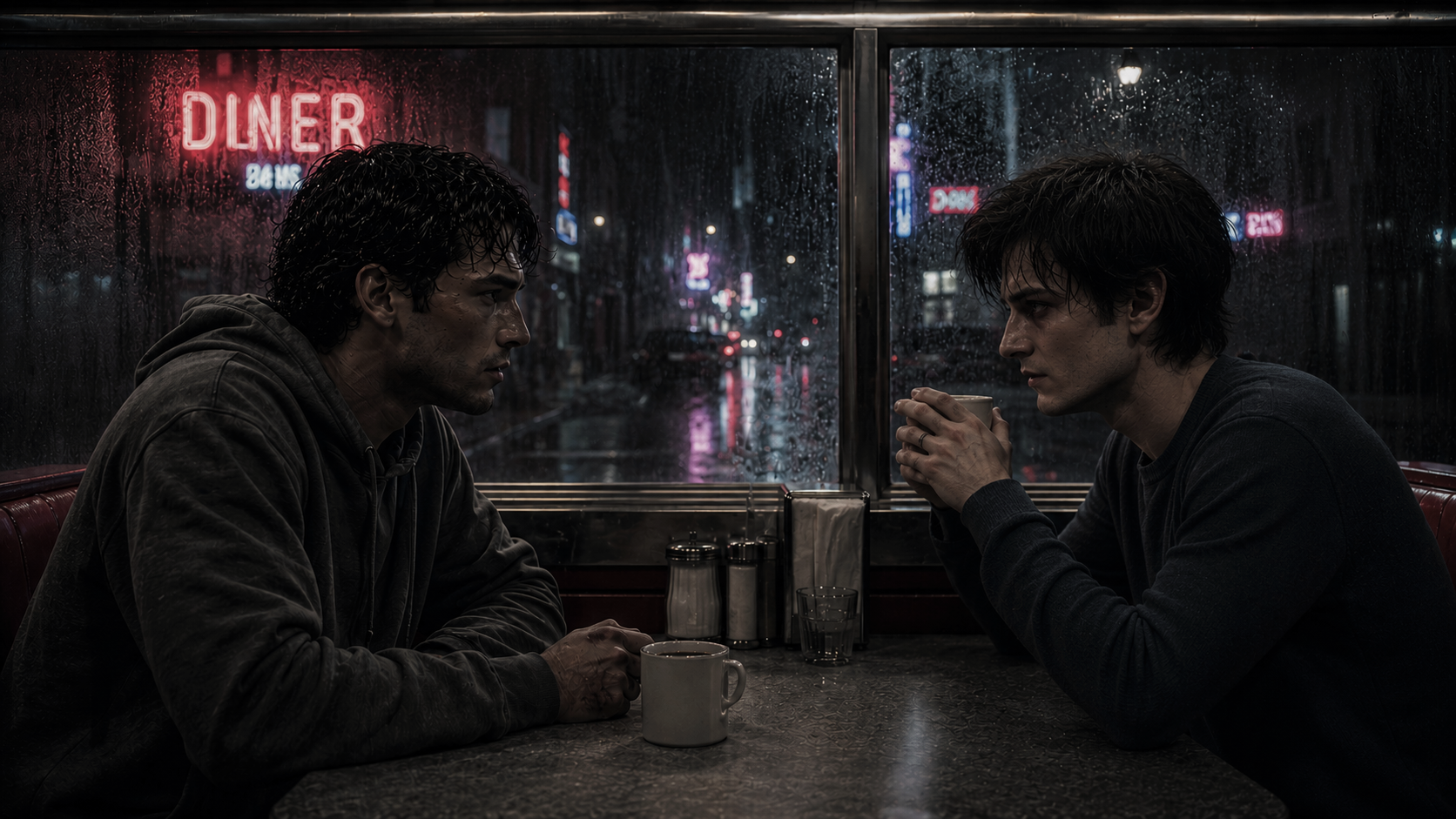
But I was a selfish man. I’d always been a selfish man. That was why I’d become an Extractor in the first place. Because it was easier to steal love than to risk feeling it. Because it was safer to break other people than to let myself be broken.
I picked up my coffee. Walked to his booth.
He looked up.
His eyes. God, his eyes. The same eyes that had looked at me in the gym that first day, curious and open and so full of hope. The same eyes that had closed when I’d kissed him in the alley. The same eyes that had filled with tears when I’d told him he was just a job.
Now they looked at me with nothing. With friendly, polite, total blankness. The eyes of a stranger.
“Hey,” I said. “This seat taken?”
He blinked. Looked around the empty diner, the rows of empty booths, the counter with no one at it. A small, puzzled smile crossed his face. “Uh, no. Go ahead.”
I sat down across from him. The vinyl creaked beneath me. The table was sticky, the same sticky it had been the first time we’d sat here, and I put my coffee down on the same ring of old condensation where I’d put it that night.
“I’m Morfeo,” I said.
The name meant nothing to him. I watched it land and fade, watched his eyes stay empty, watched his mouth stay curved in that small, polite smile.
“Til,” he said. “Nice to meet you.”
Nice to meet you. Like we were strangers. Like I hadn’t held him while he cried. Like I hadn’t traced every scar on his body with my mouth. Like I hadn’t destroyed him six days ago and left him standing at a window, crying for reasons he couldn’t remember.
I wrapped my hands around my coffee cup to keep them from shaking. “You come here often?”
“Not really. I don’t know why I’m here today, honestly.” He laughed. It was a forlorn and confused laugh. “I just . . . felt like I was supposed to be somewhere. This was the closest thing I could think of.”
“Yeah,” I said. “I know the feeling.”
He looked at me then. Really looked. His head tilted and something flickered in his eyes. Not recognition. Not memory. Just . . . curiosity. The way you look at someone who reminds you of someone else, but you can’t figure out who.
“You kind of remind me of someone,” he said.
My heart stopped. “Yeah?”
“Yeah. I don’t know who. It’s been a weird week.” He rubbed the back of his neck, a gesture I’d seen a hundred times, and my chest ached with the familiarity of it. “I keep having these . . . I don’t know. Feelings. Like I’m forgetting something important. Does that ever happen to you?”
“Sometimes,” I said.
“It’s driving me crazy. I’ll be fine and then something will hit me out of nowhere. A smell. A sound. The way the light comes through the window in the morning. And I’ll feel . . .” He stopped, searching for the words. “I’ll feel like I just lost something. Something I can’t get back.”
The coffee was burning my hands through the ceramic. I loosened my grip. Made myself breathe. Made myself stay in the booth instead of running for the door.
“Maybe you did,” I said.
“What do you mean?”
“Lose something.”
He stared at me. The flicker in his eyes was back, stronger this time. For a moment, just a moment, I thought I saw something struggling to surface. A memory. A name. A face. But then it vanished, and he shook his head, and the polite smile came back.
“Maybe,” he said. “I don’t know. It’s like . . . do you ever wake up from a dream and you can’t remember what it was about, but you remember how it made you feel? And the feeling stays with you all day, even though the dream is gone?”
“Yes,” I said. “I know exactly what that’s like.”
“That’s what this week has been. Just . . . a feeling. A really sad feeling. And I don’t know where it came from.” He laughed again, but it was a hollow sound, a sound that hurt to hear. “That’s stupid, right? Being sad for no reason?”
“It’s not stupid.”
“You’re just being nice.”
“No,” I said. “I’m not.”
He looked at me for a long moment. His hands still cocooned his coffee cup and I could see the scabs on his knuckles. The splits from the fight, the places where my mouth had been. I hadn’t re-opened them when he’d hit me. I was grateful for that. I didn’t want to see his blood on my skin. I didn’t want any more of him on me than I already carried.
“You’re a strange guy,” he said.
“I’ve been told that.”
“You just . . . sat down and started talking to me like you know me.”
“I don’t,” I said. “I just thought you looked like you could use some company.”
He considered this. Then he nodded slowly, the way he nodded when he was making up his mind about something. “Yeah. Yeah, maybe I could.”
We drank our coffee. The waitress came by and refilled our cups. The gray light through the window shifted, brightened a bit, and the diner filled with the low hum of the refrigerator and the distant clatter of dishes from the kitchen. We didn’t talk much. But we didn’t need to. I just sat across from him and memorized him. The way he held his jaw when he was thinking. The sound he made when he was about to say something and then changed his mind. The exact shade of his eyes in the morning.
The same things I’d memorized the day before I destroyed him.
“You know,” he said eventually, “this is going to sound weird, but . . . I feel like I’ve done this before. Sat here. With someone. Like this.”
My heart seized. “Maybe you have.”
“I can’t remember who it would have been.” He frowned down at his coffee. “I don’t . . . I haven’t really been seeing anyone. I think. I mean, I would remember if I were seeing someone, right?”
“You’d think so.”
“Right.” He laughed, but it was strained now, and the confusion in his eyes was turning into something else. Something closer to fear. “I don’t know. I’ve been really messed up this week. Ever since I woke up after the fight. I just . . . I feel like I lost something. Something crucial. And I can’t figure out what it was.”
“Maybe you didn’t lose it,” I said.
“What do you mean?”
“Maybe it was taken from you.”
He looked at me. His eyes were sharp now, sharp and searching, and I saw the fighter in him surface. The part of him that didn’t quit. The part of him that kept swinging even when he was bleeding. He was looking at me like I was a puzzle he was trying to solve. Like I was an opponent he was trying to read.
“What do you know?” he asked.
“Nothing,” I said. “I’m just a guy who sat down at your table.”
“That’s not true. You know something. I can see it.”
“I know nothing you’d want to hear.”
The words hung in the air between us. He stared at me, and I stared back, and I could feel the truth pressing up against the inside of my skin, desperate to get out. I could tell him. I could tell him everything. What I was. What I’d done. Who he’d been to me, and who I’d been to him, and how I’d traded his memory for a promotion and a bonus and a cold, sterile approval from a corporation that had turned me into a weapon.
But what would that do? What would it change? The memory was gone. The erasure was permanent. Telling him the truth wouldn’t bring it back. It would only give him a new grief to carry, a fresh wound to heal, a new person to hate. And he already had enough of those.
So I didn’t tell him.
“I should go,” I said. I pulled out my wallet and dropped a few bills on the table. Enough for both our coffees. Enough for a tip. I didn’t know why. It didn’t matter.
“Wait.” His hand shot out and caught my wrist. Not hard, not aggressive. Just a touch. Just a hand on my arm. But it was the first time he’d touched me since the morning of the breakup and the shock of it went through me like electricity.
I looked down at his hand. His split knuckles, his bony wrist, the fine dark hairs on his forearm. The last time he’d touched me, he’d been hitting me. And before that, he’d been holding me. And before that, he’d been tracing the scar behind my ear and asking what it was really from.
“Thank you,” he said. “For sitting with me. I know that’s a weird thing to thank someone for. But I’ve been . . . I’ve been really alone this week. I don’t know why. I just have been.”
“You’re not alone,” I said. The words came out before I could stop them, rough and raw and more honest than anything else I’d said to him since I’d sat down. “You’re not alone, Til. You never were.”
He let go of my wrist. His hand dropped back to the table and he looked at me with that same searching expression, that same fighter’s intensity, and for a moment, just a moment, the emptiness in his eyes flickered.
“I feel like I know you,” he said.
“You don’t,” I said. “You just know the person I remind you of.”
I left before he could answer.
I left the diner and walked three blocks and found an alley and pressed my forehead against the wet brick and breathed. In and out. In and out. The brick was cold and harsh and real. The rain was starting again, a fine drizzle that misted my hair and soaked through my jacket. A garbage truck ground past on the street behind me and the city went on being the city, indifferent and eternal and utterly unchanged.
I’d sat across from him. I’d talked to him. I’d listened to him describe the hole I’d left in his life, the grief he couldn’t name, the loss he couldn’t remember. And I’d done nothing. I’d said nothing. I’d left him sitting alone in a diner with his cold coffee and his confusion, and I’d walked away like the coward I’d always been.
But what else was I supposed to do?
I pushed off the wall. Kept walking. The rain picked up, a steady downpour now that filled the gutters and drummed on the awnings. I walked through it without caring, without feeling it, without knowing where I was going. I just walked, block after block, past the gym and the bodega and the alley where he’d first kissed me, pushing deeper into the city until I reached the riverfront where I’d stood six days ago and thought about jumping.
The water was still gray. Still churning. Still carrying debris downstream. I stood on the embankment and looked down at it, and I thought about Til. About the way he’d looked at me in the diner. About the way he’d said I feel like I know you. About the way some part of him, some part the erasure couldn’t touch, was still reaching for me across the void I’d created.
In the end, the Extractor extracted his own soul and left it inside a man who would never remember him.
I didn’t know where the thought came from. It surfaced from somewhere deep, somewhere I hadn’t accessed in years, a place the dampener had kept walled off. I stood in the rain on the edge of the river and let it roll through me, let the truth of it settle into my bones.
I had spent three years extracting other people’s emotions. Three years harvesting heartbreak and packaging it as a luxury drug for people too numb to feel their own pain. And in all that time, I’d never understood what I was really doing. I’d never understood that every extraction was also an extraction of myself. That every person I destroyed took a piece of me with them into the dark.
But Til had taken all of me. Every piece. Every scrap. Every shred of the man I might have been if I’d never become an Extractor. And now he was walking around with my soul inside him and he didn’t even know it. He would never know it. For the remainder of his life, he would just feel a grief he couldn’t explain. A loss he couldn’t name. A love that had nowhere to go.
The rain stopped. The clouds broke. A sliver of pale afternoon sun cut through the gray and lit the river in bands of silver. I stood there until I couldn’t feel my hands anymore, until the cold had seeped through my jacket and into my skin, until the only thing I could feel was the weight of the harvest drive still in my pocket and the echo of Til’s voice in my head.
I feel like I know you.
You don’t, I’d said.
But that was a lie. He did know me. Some part of him, some deep, unreachable part, still knew me. And that was the worst thing of all. That was the mark I’d left on him. Not a memory, but a scar. Not a story, but a wound. Not a name, but a feeling.
A feeling that would never go away.

Til’s Point of View
The gym at night was a different place.
During the day, it was all grunts and sweat and the percussion of fists on leather. But at night, after everyone had gone home and Marlo had locked up and the last of the fluorescent lights had flickered off, it was something else. A cathedral. A confessional. A place where you could stand in the dark and hear your own thoughts for the first time all day.
I’d come back after the diner. I don’t know why. I’d been halfway home, walking through the gray drizzle with my hood up and my hands in my pockets, when my feet turned toward the gym instead. The lights were off. The door was locked. I had a key, though. Marlo had given it to me years ago, when I’d told him the only place I felt safe was the ring.
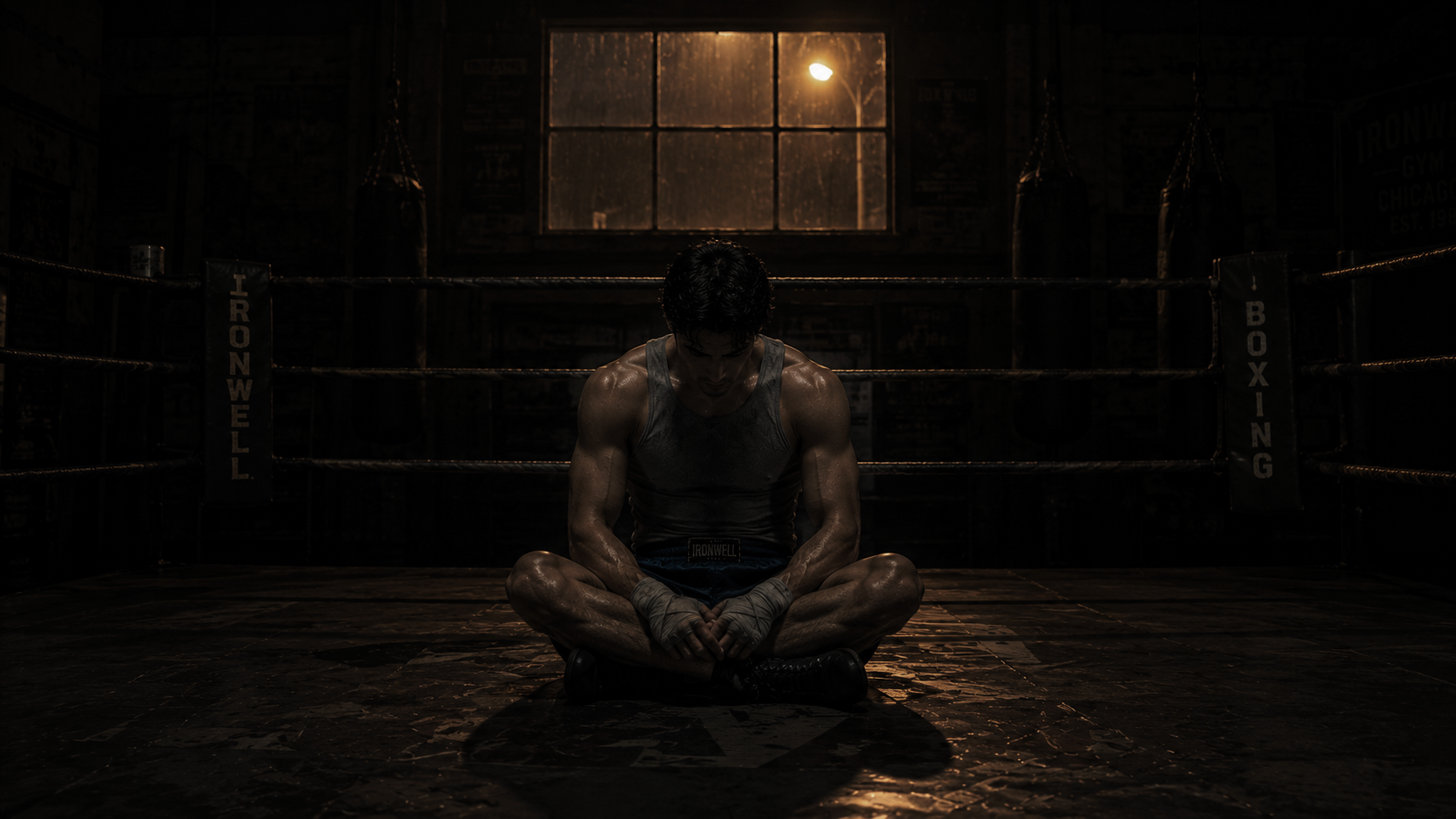
I let myself in. Didn’t bother with the lights. Just stood in the dark, breathing in the smell of sweat and leather and old floor wax, and let the silence settle around me.
The man in the diner. Morfeo.
I didn’t know him. I kept telling myself that. I didn’t know him. I’d never seen him before. He was just a stranger who’d sat down at my table and talked to me like we were old friends. It happened. People were strange sometimes. The city was full of strange people.
But I couldn’t stop thinking about him.
The way he’d looked at me. The way his hands had shaken around his coffee cup. The way he’d said You’re not alone like it was the truest thing he’d ever spoken. Like it was a promise he was making with his whole body. And the way I’d felt when he’d said it. Like a lock turning in my chest. Like a door opening onto a room I’d forgotten was there.
I walked to the ring. Climbed through the ropes. Stood in the center of the canvas, looking out at the empty gym, the silent bags, the dark mirrors reflecting nothing but shadows.
I’d fought in this ring two weeks ago. The qualifier. I’d lost by split decision, and Marlo had told me I’d fought well, and I’d gone home and . . . .
And something.
I’d gone home and something had happened. Something I couldn’t remember. Something that had left me standing at the window in the morning with tears on my face and a cigarette in my hand and a grief so big I couldn’t breathe.
The man in the diner had known something. I’d seen it in his eyes. He had looked at me as if he were looking at a ghost. Like he was seeing someone he’d lost. Like I was the one who’d done something terrible to him, and not the other way around.
You know something, I’d said. I can see it.
I know nothing you’d want to hear.
Why had he said that? What didn’t I want to hear? What was so terrible that a stranger would cross a diner and sit down at my table and look at me with those haunted eyes and tell me I wasn’t alone?
I didn’t have answers. I didn’t have anything. Just the dark gym and the silent bags and the ghost of a feeling I couldn’t name.
I sat down in the center of the ring. Crossed my legs. Put my hands on my knees. The canvas was cool and rough under my palms. The same canvas I’d bled on a dozen times. The same canvas where I’d kneeled after the fight, bruised and shaking, and someone had . . . .
Someone had been there. Someone had helped me up. Someone had taken me home and washed my hair and kissed my split knuckles and wept beside my bed.
The memory rose up out of the darkness like a fish breaking the surface of a lake. There and then gone. But I’d seen it. For one second, I’d seen it. A face above me in the darkness. Dark eyes. Dark hair. A mouth that had pressed against my wounded hands with a reverence that had nothing to do with pity.
Morfeo.
The name came out of nowhere. I didn’t know where I’d heard it. He’d introduced himself in the diner, yes, but that wasn’t the source. The source was older. Deeper. I’d known that name before today. I’d said that name before today. I’d screamed it, maybe, into a pillow, into the steam of the shower, into the hollow of my own hands.
Morfeo.
I pressed my palms against my eyes and tried to hold the memory. But it was already slipping, already dissolving, already fading back into the fog from where it had come. The face blurred. The name went silent. And I was left with nothing but the feeling. The same feeling I’d had all week. The feeling of having lost something I couldn’t get back.
I stayed in the ring for a long time. Long enough for the rain to stop and then start again, drumming on the roof, running down the windows. Long enough for the streetlights to come on and throw their orange glow through the high windows. Long enough for the Ibanez poster on the wall to fade into shadow until I couldn’t see his face anymore.
When I finally got up, my legs were stiff and my hands were chilled and my chest was still full of that nameless grief. I climbed through the ropes and walked to the door and looked back one last time at the dark gym, at the silent ring, at the ghost of whatever had happened here.
Then I locked the door behind me and went home.
The apartment was dark when I got there. I didn’t turn on the lights. I just stood in the doorway, dripping on the mat, looking at the space where something used to be. The blue mug was still on the counter. The hand wraps were still on the nightstand. The Ibanez poster was still on the wall, and it still felt like a promise I couldn’t remember making.
I went to the bedroom. Sat on the edge of the bed. Picked up the hand wraps and turned them over in my hands. The elastic was stretched out, the white fabric gone gray with use. They smelled like coffee and cedar and something else. Something sweet. Something that made my chest ache.
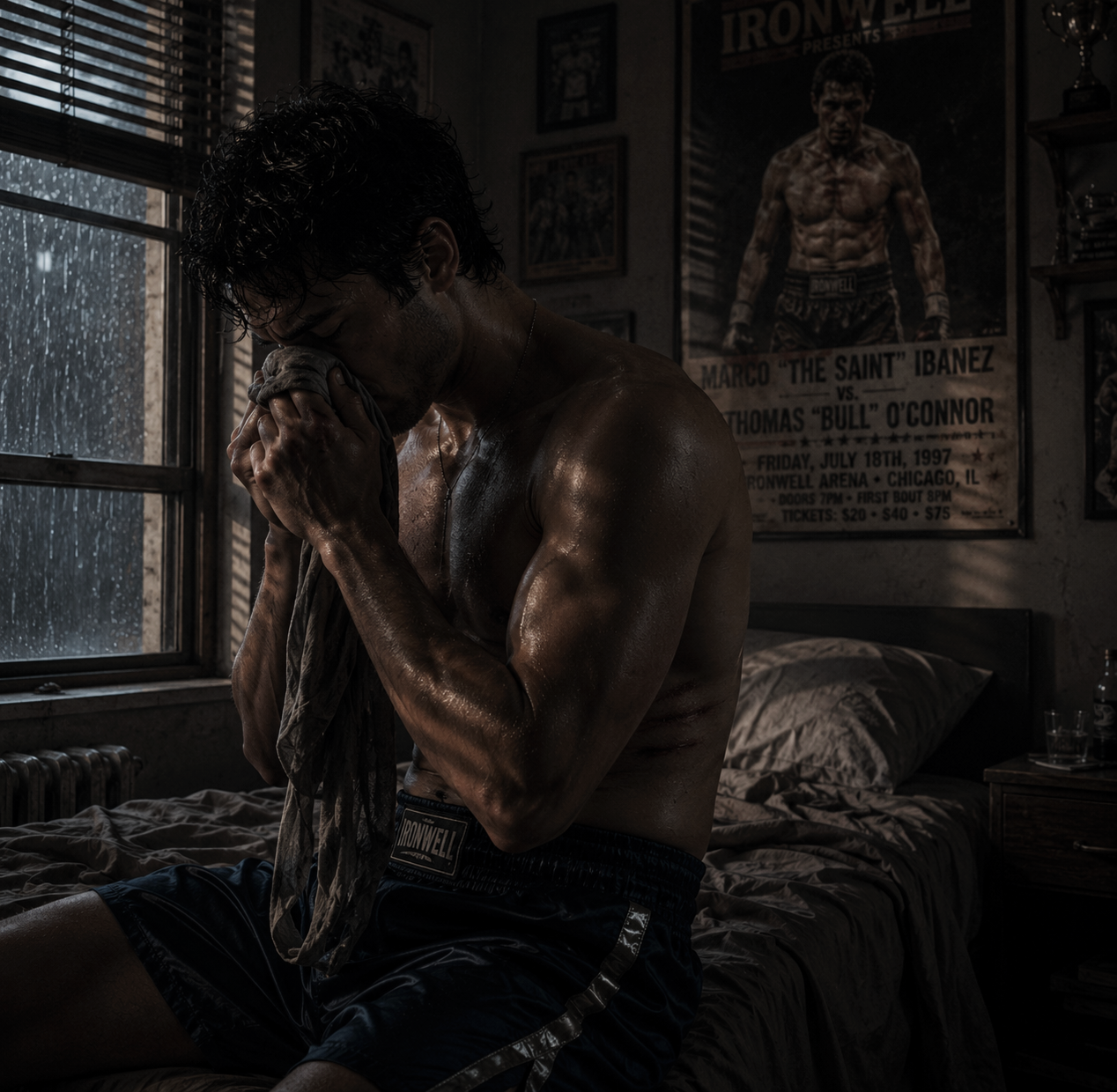
I pressed them to my face and breathed in.
And for a moment, just a moment, I remembered.
A face above me in the dark. A voice in my ear. I’m here. I’m yours. A pair of hands washing my hair in the shower, gentle and careful and full of something I’d never let myself believe I deserved.
Then it was gone. The memory dissolved and I was alone again, sitting on the edge of my bed, holding a pair of hand wraps that had come from nowhere.
I lay back on the bed. Stared up at the ceiling. The water stain was still there, a map of an island I’d never visit. The Ibanez poster watched from the wall. The rain drummed on the windows.
And in the dark, in the silence, I whispered a name I didn’t remember learning.
“Morfeo.”
The name hung in the air. It meant nothing. It meant everything. It was just a sound and yet it was the only sound that mattered.
I closed my eyes.
And I waited.
For what, I didn’t know. For the feeling to go away. For the memory to come back. For the man in the diner to walk through my door and tell me the truth, whatever it was, however terrible.
I waited.
The rain kept falling.
The city kept humming.
And somewhere out there, in the wet neon dark, a ghost was walking the streets with my name on his lips and a harvest drive in his pocket and the full, unbearable weight of what he’d destroyed pressing down on his soul.
I didn’t know that.
I didn’t know anything.
But I felt it. In my chest, in my bones, in the hollow place where something used to be. I felt him out there. Walking. Waiting. Haunting the scene of his own crime.
And I couldn’t remember why.

Morfeo’s Point of View
The alley behind the gym was dark and wet. It smelled like old garbage and wet brick and the acrid ghost of cigarettes. I’d been standing there for an hour, my back against the wall where Til had pushed me that first night, the night of the diner, the night he’d kissed me with a desperate hope I’d never deserved.
The harvest drive was in my hand. The portable player was in my pocket. The dampener was still on the table in the safehouse, five miles away, where it would stay until the corporation came to collect it. Or me. Whichever they found first.
I wasn’t running anymore. I’d spent the afternoon walking the city, retracing every step of the last three months. The diner. The gym where Til had fought and lost. The apartment building where I’d stood on the stoop and watched him sleep through the window. Every place we’d been together, every place I’d poisoned with my presence, every place that would never know what had happened there.
Now I was back where it started. The alley. The wet brick. The moment before everything went wrong.
I slotted the drive into the player. Put the earpiece in. Pressed play.
The recording started again. The high, keening note of Til’s love. The jagged spike of his heartbreak. The bass line underneath: I love him. I love him. I love him. I let it wash over me. I let it fill me up. I let it destroy me, the way it had destroyed me every time I’d listened to it, and I didn’t look away, and I didn’t turn it off, and I didn’t run.
Because this was what I deserved. This was the price. Not death, not prison, not the cold corporate justice of a retrieval team. This. The sound of what I had killed. The sound of a love I’d been too cowardly to keep. The sound of Til’s heart breaking in real time, over and over, forever.
I was practicing. You were a lay, not a life.
I’d said that. I’d stood in his kitchen and said that to his face while he cried, while he begged, while he hit me with the hand I’d kissed the night before. I’d said it on purpose. I’d said it because I had to. I’d said it because the corporation had scripted every word, and I was just the mouthpiece, just the weapon, just the tool they’d shaped me into.
But I was also the man who’d said it. I was the man who’d chosen to say it. I could have stopped. I could have walked away. I could have thrown the dampener into the river and told Stilo to go to hell and stayed with Til in that cramped apartment with the boxing poster and the broken coffee machine and the life we might have had.
I didn’t. And that was the sin I would carry for the rest of my life.
The recording ended. The player went silent. I pulled the earpiece out and stood in the dark alley, the rain dripping down the back of my neck, the harvest drive still warm in my hand.
On the street beyond the alley, the Ironwell sign flickered. The gym was dark. The fighter inside was gone. The man I loved was somewhere in this city. He was walking around with a void in his mind where I used to be. He would never know what he’d lost. He would never know what I’d taken. He would just feel, for the rest of his life, an aching grief that he could not name and a love that he could not find.
I pressed the drive to my chest. Held it there. Felt the pulse of it against my chest, the little amber light blinking through my fingers.
“I’m sorry,” I said. The words were a whisper, swallowed by the rain and the dark and the indifferent hum of the city. “I’m sorry. I loved you. I loved you.”
No one heard. The neon sign flickered. The rain kept falling.
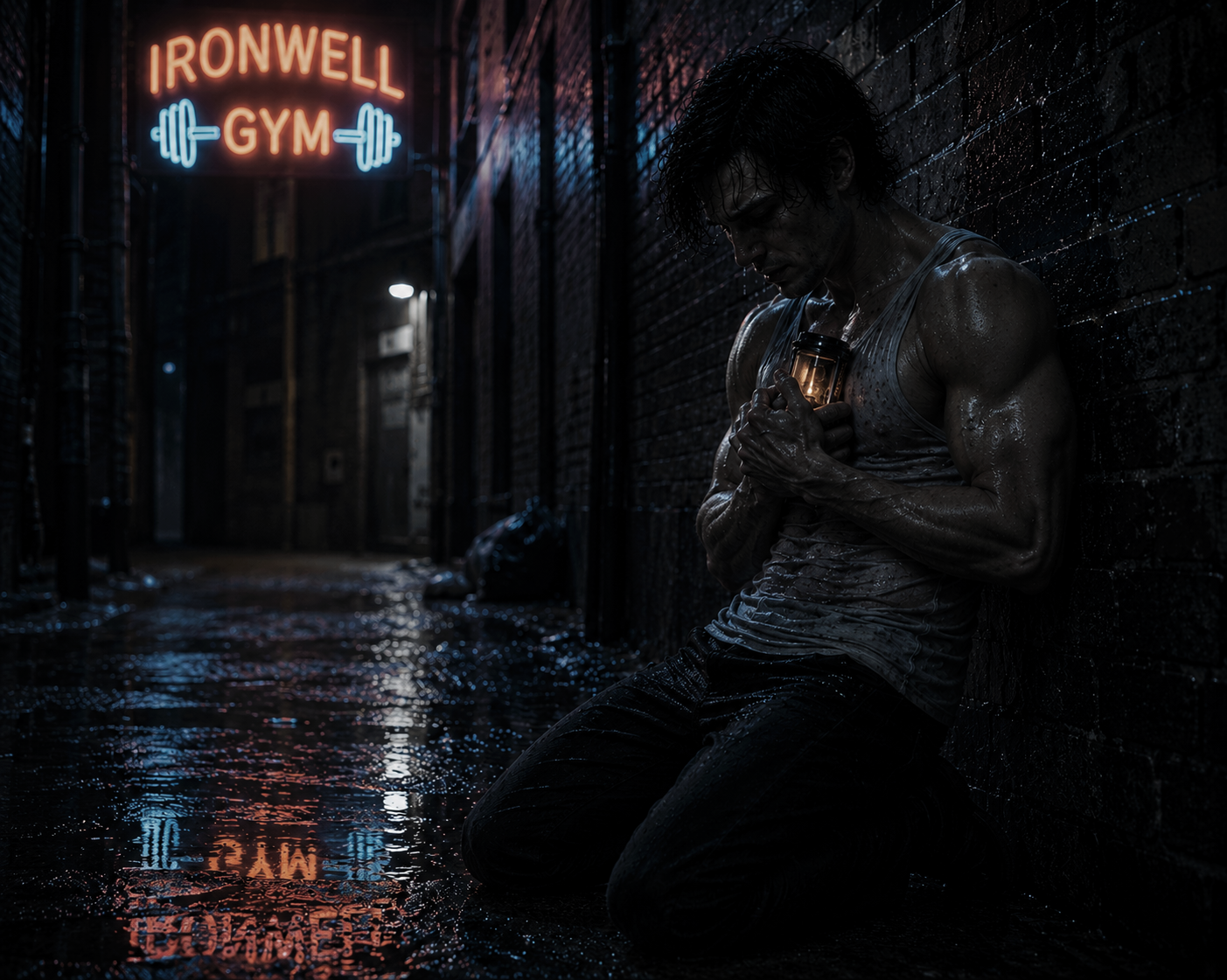
And I stayed there, on my knees in the alley where we’d first kissed, holding the record of his destruction against my heart, until the gray light of dawn began to seep through the clouds and the city started to wake up and the world went on being the world. Indifferent and eternal and altogether unchanged.
The Extractor had extracted his own soul.
And left it inside a man who would never remember him.

End of Chapter 5.
End of Ironwell.
I am so sorry.