
In the quiet aftermath of a soaking October rain, Breck wakes to find Trace fighting with more than just a broken espresso machine. He’s struggling to earn a place in a life Breck cannot remember. As a fragile morning shifts into an evening of Thai takeout and tentative trust, a single desperate kiss on a worn pull-out couch tests the boundary between devastating loss and the terrifying possibility of beginning again.

Breck’s Point of View
The rain had stopped before dawn.
I woke to a peace that felt borrowed. The kind of quiet that settles over a city after a long soaking, when the clouds have spent themselves and left behind a gray hush. My radiator was knocking in its old, familiar rhythm. A car passed on the wet street below, tires making that low, ripping sound that water brings out of rubber and asphalt. I stared at the ceiling for a while, counting the cracks in the plaster near the light fixture, the same cracks I’d mapped a hundred times since moving in. My body felt warm under the thin comforter. Warm and still, as if it had finally exhaled something it had been holding for a year.
I could smell coffee.
Not the sharp, clean pull of a proper espresso. Something wounded. Something burning.
I got up. The floorboards were cold against my soles, the worn varnish smooth in spots where feet had polished it over decades. I pulled on the sweatpants I’d dropped beside the bed and walked to the doorway, pausing there the way I always paused in doorways now, one hand on the frame, gathering the room before stepping into it.
Trace was in the kitchenette.
He stood with his back to me, allowing me a moment to study him the way you look at a stranger when you believe you won’t be caught. The cashmere sweater from last night, dark gray, sleeves shoved up to the elbows. His shoulders were tight, that athletic frame bunched with concentration. He was fighting with my espresso machine.
The machine was winning.
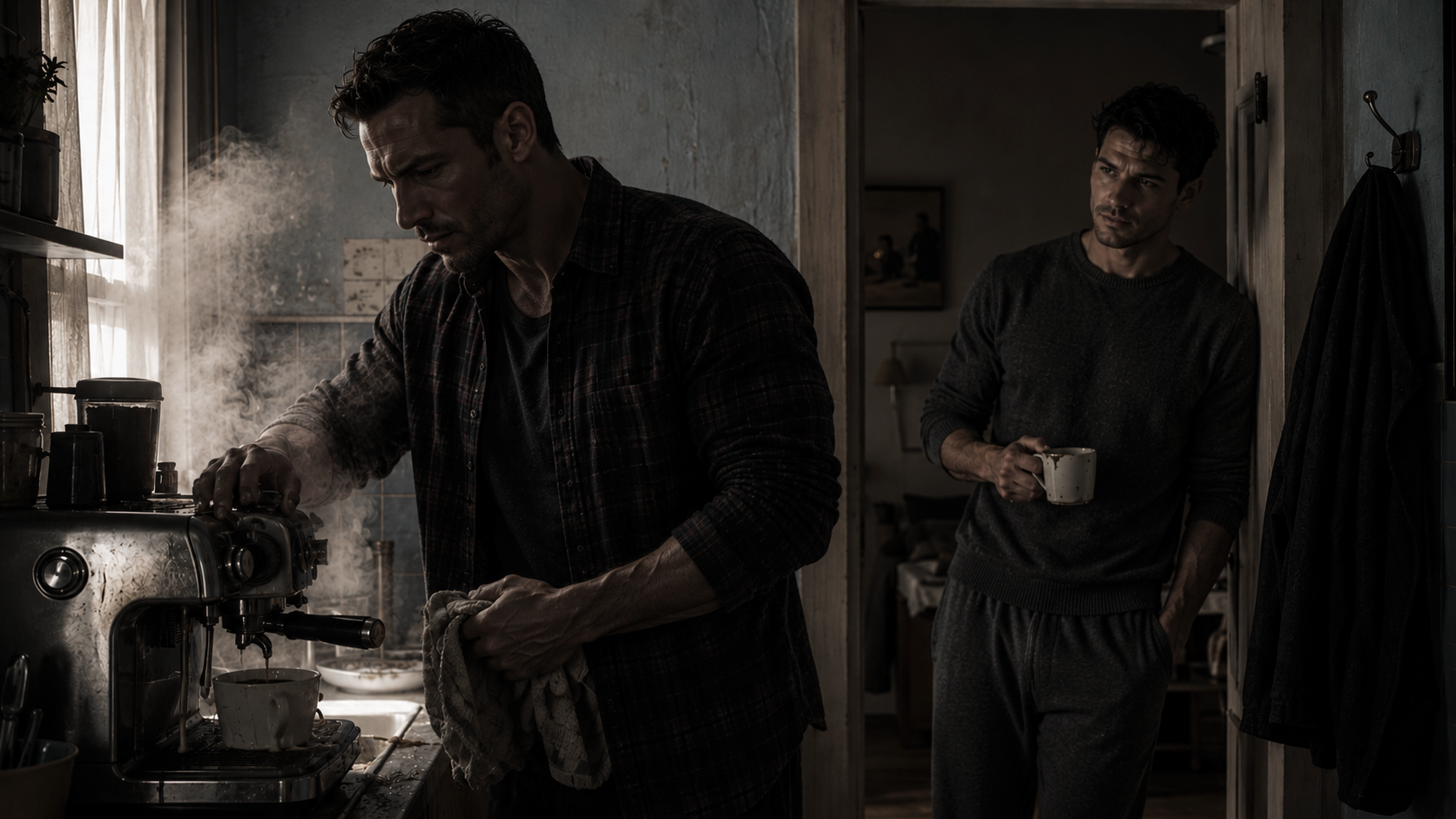
Steam hissed out sideways instead of through the portafilter, spitting dark water onto the counter. Trace muttered something, grabbed a dish towel, and tried to wrestle the handle into place. His hands were graceful even when they were failing. Long fingers, a neat square nail on the thumb. The platinum ring caught the weak morning light coming through the window.
I watched him mis-align the basket for a second longer than I needed to. Something in my chest did a slow rotation, not quite painful, not quite pleasant. A door in a draft, pivoting on its hinge.
“You’re supposed to tamp it first,” I said.
Trace went still. Then he turned his head, and I saw the exhaustion on him. Sleeplessness sat purple in the hollows beneath his eyes, and his hair, swept back, had lost its precision sometime around three in the morning. A man who had been dismantled and was only now figuring out which parts still worked.
“I watched you do this a dozen times,” he said. “Through the window. You made it look easy.”
“It’s not easy. You just have to talk to it.”
“I don’t think it likes me.”
I crossed the small room. The linoleum was tacky with yesterday’s humidity. I stood next to him at the narrow counter, close enough to smell the cedar and bergamot on his skin, the rain scent still trapped in his hair. He stepped aside without being asked, making room for me in the tight space. His hip brushed the table’s edge. Mine brushed the oven handle. We were both doing that careful dance, pretending we had more room than we did.
I knocked the old grounds into the compost bin I kept under the sink. The bin smelled of coffee and onion skins. I filled the basket, tamped it with the heel of my palm, twisted the handle into place with a push and a pull that my hand knew without my mind bothering to supervise. Trace watched. I could feel his eyes on my forearms, on my hands.
“You were watching me through the window?” I asked.
“Mostly I watched you hand people cups.” His voice was rough, morning rough, but gentle. “The way you leaned in to hear the old man with the hearing aid. The way you gave that kid an extra napkin without him asking. You make it look like a language.”
“It’s just coffee.”
“It’s not.”
I pressed the button. The machine found its rhythm, a low purr, and the espresso began to come, dark and stippled with cream. I didn’t look at him. My face felt warm, and I didn’t know what to do with the warmth, so I watched the coffee instead.
Trace had slept on the pull-out couch. I could see the evidence. The blanket was folded imperfectly, a hospital corner on one side and a loose drape on the other. The pillow sat at an angle that suggested he’d readjusted it multiple times in the night. He’d hung his coat on the back of the door, and it dripped last night’s rain onto the linoleum in a small, dark constellation.
My face went warm. The man in the expensive sweater was failing at my appliances, trying anyway. The radiator clicked. I watched the steam die on the counter.
“You don’t have to make coffee,” I said. “You’re a guest.”
“I’m not a guest.” He said it simply. No deflection. “I’m whatever you need me to be. Even if that’s just a man who stays out of your way.”
I found a second mug, one of the chipped ones I used for myself. I poured the espresso into his and mine, added oat milk to one without thinking. My hand knew which mug was his. The realization landed like a stone at the bottom of a pond, heavy but distant.
I handed him the cup with oat milk. He took it, and his fingers paused around the ceramic. He looked at the milk, then at me.
“You remembered again,” he said.
“I didn’t. I just . . . did it?”
“That’s what I mean.”
We stood in the small kitchenette and drank our coffee. The light coming through the window was the color of old pewter, flat and diffuse. October pressed its thumb against the glass. I could see my breath when I exhaled near the window, just a faint mist. Trace’s shoulder almost touched mine. Neither of us moved to close the gap or widen it.
“Do you work this morning?” he asked.
“Seven to three.”
“I’ll stay close. If that’s okay.”
I looked at him. At the jawline I’d traced in the dark, at the scar I’d touched. At the way he held the mug, as if it were something precious he didn’t deserve.
“You can stay,” I said. “But I don’t know what I’m doing here. With you. I need you to know that.”
“I know.”
“I might never know.”
He nodded. His eyes were hazel in the gray light, shifting between green and amber, and for a second I saw understanding move across them. Not the shallow kind. The kind he had earned.
We finished our coffee in a silence that wasn’t uncomfortable. It had too much texture to be uncomfortable. The scrape of the mug against the counter. The drip from his coat onto the linoleum. The radiator clicking like a clock with a lazy second hand.
I showered. I dressed for the shift, pulling on the soft flannel shirt I favored and the worn jeans that fit like a habit. Trace sat on the couch while I moved around the apartment, and I was aware of him watching me dress in the way you’re aware of sunlight moving across a wall. Present. Warm. Not demanding anything.
At the door, I stopped. Trace was still sitting there, his hands folded around the empty mug, his posture impeccable even when he was exhausted.
“Breck,” he said.
I turned. The name was still a coat that was too large, but I was growing into it.
“The espresso,” he said. “I’ll get better at it. If you let me practice.”
I almost smiled. The expression surprised me. It had been a long time since a smile arrived without being invited.
“Yeah,” I said. “Okay.”
I went down the narrow stairs to the cafe, my hand sliding along the banister that was sticky with humidity, my ring tapping a slow rhythm against the wood.

The morning shift at Cafe Esperanza belonged to a different species than the nights.
The morning regulars were faster, chattier, their hands wrapped around paper cups with a desperation born of caffeine and commerce. The commuter crowd wanted lattes in a hurry. The retirees wanted to talk about the weather. The students wanted the wifi password and the corner table near the outlet. I moved through them with my body on autopilot, steaming milk, pulling shots, wiping the counter with a rag that smelled of bleach and cinnamon.
Distraction claimed me.
It showed in small ways. I gave Mrs. Venable almond milk instead of oat and she had to correct me twice, laughing while she did it. I forgot to ring up a croissant and had to chase the customer to the door. I wiped the steam wand and left it running, the hiss startling me so badly I dropped the towel.
Rosa was in the back office doing the books, but I felt her attention on me the way you feel barometric pressure before a storm. She said nothing. She just looked up from her ledger when the steam wand hissed, then looked back down. It was more painful than her asking.
I kept touching my ring.
It was unconscious. My thumb would find the band, the smooth platinum, the faint wear where another thumb had rubbed against it. I’d catch myself doing it while taking an order, while counting change, while staring out the window at the gray street. Each time I made myself stop. Each time my hand forgot within minutes.
Around ten, a man came in I didn’t recognize. He was maybe sixty, with a face like a used paperback and hands that trembled as he peeled off his gloves. He ordered a plain coffee, black, and sat at the counter while I poured it.
“That’s a distinctive mark,” he said.
I looked up from the cup. “What?”
“On your hand. There.”
He pointed with his chin. I looked down at my left palm. The crescent-shaped scar sat there, pale and curved like a thumbnail pressed into wax. I knew it was there. I’d seen it every day for a year. But his pointing at it made it strange to me, foreign, as if I were seeing it for the first time through someone else’s curiosity.
The world narrowed.
For a split second, I was somewhere else. Hardwood floor beneath my knees. Warm afternoon light slanting through a window I didn’t recognize. And a dog, golden, tail thumping against the floor, moving toward me with a tag jingling on its collar. The image had color, sound, and weight. It was real enough to touch.
Then it was gone.
I blinked. The cafe came back in pieces. The espresso machine, the chalkboard menu, the man’s patient face. My hand was shaking.
“I don’t remember,” I said.
The man’s expression softened into an apology. “I’m sorry. Didn’t mean to pry. Occupational hazard. I used to be a doctor. We notice skin.”
“It’s okay.”
But it wasn’t okay. The words were dirt in my mouth. He took his coffee and retreated to a table near the window, and I stayed at the counter with my palm turned up, staring at the scar as if it might open and tell me what lay beneath it.
Nothing did.
The scar was just a scar. A crescent. A moon on my hand. But my heart was hammering against my ribs in a way that didn’t match the moment, and the smell of coffee was too sharp now, too insistent.
Rosa came out of the back. She stood at the counter and looked at me, then at the man, then at my hand still hovering in the air.
“You all right, Michael?”
I closed my fist. The ridges of the scar pressed into my fingers.
“Yeah,” I said. “Just tired.”
She nodded. She didn’t believe me. She went back to the office, but she left the door open a crack.
The rest of the shift passed in a blur. I moved through it, but I was somewhere else. I kept seeing hardwood floors. I kept hearing a dog’s tags. I kept touching the scar when I thought no one was looking, and each time I touched it, the ridges pressed into my fingertips, insistent, like a splinter working its way to the surface. Each time I touched it, my heart knocked harder against my ribs.
By the time three o’clock came, I was raw. My feet ached. Knots tightened my shoulders. The gray feeling was pressing at the edges of my vision, not yet arriving, but making its travel plans known.
Rosa emerged from the back wearing her green parka. She had her keys in one hand and her phone in the other. She stopped at the door.
“You sure you’re okay closing up?” she asked.
“I’m sure.”
“Trace is outside.”
I looked up from the register. “What?”
“Leaning against the brick. Has been for an hour.” She paused. “I’m going out the back. You lock up proper.”
She left before I could ask what she meant or what she was going to do.

Trace’s Point of View
The brick was cold against my back, even through the coat.
I had been standing there for the better part of an hour, shifting my weight from foot to foot, watching the light change inside Cafe Esperanza. Watching Breck move behind the counter, his shoulders bent in concentration, his hands busy with the choreography I’d observed for two weeks but still couldn’t replicate.
I felt like a debt collector. Standing in the street, waiting to collect on a ruin I’d caused.
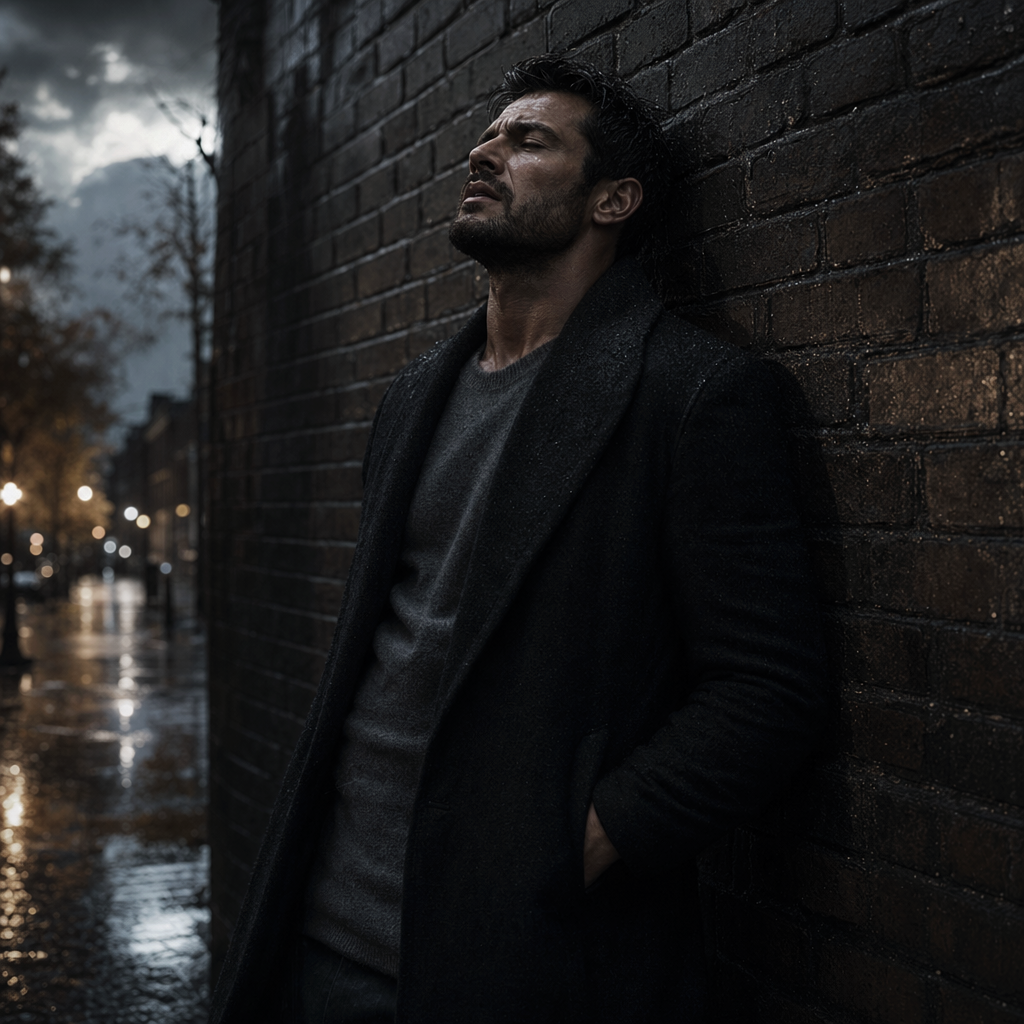
My feet were freezing. I’d walked the neighborhood for hours after he’d gone inside, too restless to sit in a coffee shop, too afraid to go back to his apartment without permission. I’d looked at the storefronts, the nail salons and dry cleaners and bodegas that made up the geography of his new life. None of them had anything to do with me. None of them knew my name. It was exactly what I deserved, standing there with my hands in my pockets, waiting for a door to open through which I had no right to walk.
The door opened.
I expected Breck. What I got was Rosa.
She stepped out and pulled the door shut behind her with a solid click that said she knew precisely how to handle locks. Then she turned and looked at me. Her eyes were the color of strong tea, and they carried the same flat assessment I’d seen her give the milk delivery guy when he tried to short her a crate.
“You,” she said.
I straightened off the wall. “Ma’am.”
“Don’t ma’am me.” She stepped into my path. She was a full head shorter than I was with a fire hydrant’s build, but her presence occupied the sidewalk in a way that made me want to step back. “I don’t know you. But I know him. He came in here a year ago with nothing. No wallet, no name, no past. He was soaked and he was shaking and he looked at me as if I might be a hallucination. I gave him a job because he needed one, and I gave him an apartment because I had one, and I watched him build himself back from air. You don’t get to undo that because you’re sorry.”
My jaw ached with the effort of keeping my mouth shut, of not explaining, not negotiating, not buying my way to a better position.
“You’re right,” I said. “I don’t get to.”
She blinked. I think she’d expected a fight. A deflection. The Tucker charm, rising to the occasion. I’d expected it too, and I was glad, fiercely glad, that it didn’t come.
Rosa’s eyes narrowed. “You think that’s enough? Saying I’m right?”
“No. It’s not enough. Nothing I say is ever going to be enough.”
I looked past her at the cafe window. Breck was wiping off a table, his back to the street, his thumb worrying at his ring. The sight of him made my chest tighten. I put my hands in my coat pockets so no one would see them shake. He was still here. I was still trying to reverse something that might not move.
“I’m not here to undo anything,” I said. “I’m here to see if he’ll let me stand next to him while he figures out what he wants to build next.”
Rosa crossed her arms. The clipboard she’d been holding was now tucked under her elbow, a weapon she’d decided not to use yet.
“He built himself back without you,” she said. “He can keep doing it.”
“I know.”
“I’m watching you. He’s my family now, too.”
“Good,” I said. “He needs that.”
She studied me. The wind had picked up, carrying the smell of wet leaves and exhaust, and it pressed her gray curls against her cheek. I could see her deciding. Weighing whatever she saw in my face against whatever she knew, or thought she knew, about men like me. Men with expensive coats and hands that had never done manual labor.
Whatever she found, she didn’t appear satisfied with it. But she stepped aside.
“You hurt him again,” she said, “and you’ll find out what a sixty-three-year-old Mexican woman can do with a cast-iron skillet.”
“I believe you,” I said. Paused. Spoke again. “I spent a year hunting him down to do right by him, Rosa. That’s all I can say.”
She snorted. It might have been almost respect. Then she walked away down the sidewalk, her parka swelling in the wind like a sail.
I leaned back against the brick and watched the cafe door. My hands were trembling. I put them in my coat pockets so no one would see.

Breck’s Point of View
I found him there when I was locking up.
He was leaning against the brick wall with his head tipped back, looking at the sky. The clouds were breaking up into strips of pale silver and charcoal, the October afternoon sliding toward evening. The street was slick and black, puddles catching the neon from the cafe sign in trembling pink reflections.
“You waited,” I said.
Trace straightened. He’d been in his head, and it took him a second to surface. “Did Rosa talk to you?”
“She left out the back. She say something to you?”
He hesitated. The tell was hardly visible. A twitch in his jaw, a moment where his eyes went somewhere else. Then he shook his head. “Just letting me know the lay of the land.”
That wasn’t all of it. I could tell by the way he held his shoulders, stiff and careful. But I was too tired to push. The scar on my palm was itching, a phantom sensation I couldn’t scratch.
We climbed the narrow stairs to the apartment. The door stuck, and I had to lean my shoulder into it the way I always did. Trace stood behind me on the landing, close enough that I could feel the warmth of him, but not touching. The door gave with a groan.
Inside, the apartment was cold. Trace hung his coat on the hook by the door. He took off his shoes and lined them up neatly, a small act of domesticity that made something in my chest hitch.
“You don’t have to do that,” I said.
“I want to.”
We stood in the small space. The silence differed from the morning’s. Denser, carrying the weight of the day.
“I could make us something,” I said. “But I mostly have eggs and old bread.”
“I brought dinner.”
He reached for a bag I hadn’t noticed by the door. Paper, grease stained at the bottom. Thai food from the place over two blocks.
“You left?”
“For twenty minutes. I wanted to contribute.” He paused. “I didn’t know if I should ask first.”
My chest did that slow rotation again. The carefulness of him. The effort.
“Yeah,” I said. “You can contribute.”
We ate at the small table, the one with the two mismatched chairs. Trace had ordered carefully, pad Thai with tofu, green curry, rice. He didn’t know what I liked anymore, so he ordered everything. The gesture was so broad and so uncertain that I felt something loosen behind my chest.
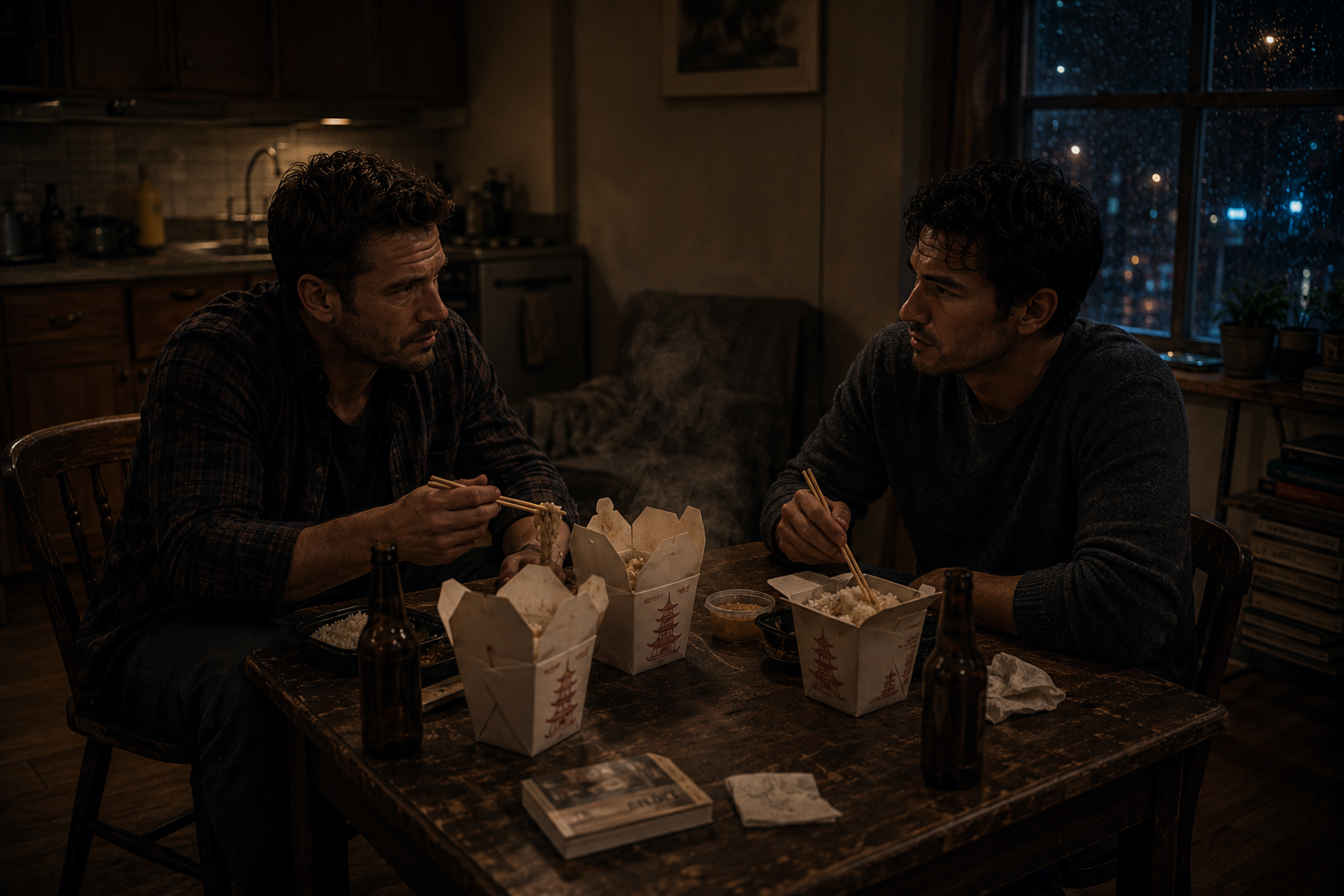
We ate with our hands from the cartons, the steam rising between us. The conversation remained light. He told me about his undergraduate years at Yale, a story about trying to make ramen in his dorm room and setting off the fire alarm. I told him about the used bookstore down the street, the one where I’d bought most of the paperbacks stacked on my floor. We talked about the blue tile in the kitchenette, how Rosa said it was original to the building, probably from the seventies.
“It’s ugly,” I said.
“It’s specific,” Trace replied. “That’s better than beautiful, sometimes.”
“I don’t know if I believe that.”
“I’m learning to.”
He looked at me then. The expression I’d been catching all evening surfaced well. It was complicated, dense as a cloud bank. Grief in it, and hope, and something darker that might have been shame. I couldn’t name it. I only knew it made my breath come shallow.
We finished eating. Trace stacked the cartons and carried them to the trash. I stayed at the table, watching him move in my kitchenette. He was too large for the space, too refined, too expensive. He resembled a piece of furniture delivered to the wrong address. But he moved with care, mindful of the low cabinets, the hanging plant, the stack of books teetering near the counter.
He stood at the sink for a moment, his hands braced on the edge, his profile to me. Then he turned.
“I should clear these,” he said, gesturing to the plates.
I nodded.
He walked back to the table. He picked up my plate, then paused. His hand came down on my shoulder, light and steady, the weight of it settling through the flannel like a bri. He didn’t squeeze. He didn’t rub. He just let it rest there, warm and present, before he picked up his own plate and moved toward the kitchen.
Something in me tipped.
It wasn’t a decision. It was physics. A lever, a fulcrum, a weight finally finding its balance.
He told me the very worst things about himself. Things he’d done to me. Things it broke him to say aloud. He’d slept on that miserable pull-out couch with its broken springs and its thin blanket. He’d made terrible espresso and owned it. He had spent a year looking for a person who didn’t know he needed to be found, and he was still here, standing in my kitchen, washing plates like they were the only thing in the room he knew how to get right.
I didn’t remember our life. The wall in my mind was as solid as ever, silent and unmoving. I knew, because he’d told me, that it had been messy. That he’d broken me. That there were debts between us that might never be paid.
But there was this. The warmth of his hand still on my shoulder. The way he looked at me when he thought I wasn’t watching. The unbearable, patient mapping of my absence.
He was worth finding out about.
I heard the water stop running. He reached for the kettle, filled it, set it on the stove. The ritual from the night before. He was making tea.
My hands were steady on my thighs. My heart was not.
When he came back, he had two mugs. Chamomile, by the smell. The steam curled up between us. He set one mug on the table, close enough that I could wrap my hand around it.
I didn’t.
I stood up. The chair scraped against the linoleum.
I took the mug from his hand and set it on the table.
Then I reached up and touched his face. The stubble was rough under my palm. The scar on his jawline was a faint ridge, white and smooth. His eyes widened, just slightly, and I felt the intake of his breath, the way his chest stilled beneath the cashmere.
I kissed him.
It was not gentle. I don’t think it could have been gentle, not with everything roaring in my blood. But it wasn’t angry either. It was recognition. My body found his jaw, the heat of his skin grounding me in the moment, my breath catching.
His mouth was warm. He tasted like the curry we’d eaten, like mint he’d picked up somewhere. For a fraction of a second he went still, surprised or cautious, and then his hand came up to cradle the back of my head, and he was kissing me back.
We stumbled against the pull-out couch. My knee hit the frame. His elbow knocked against the bookshelf and sent a paperback sliding to the floor with a soft slap. Neither of us stopped to pick it up.
The kisses deepened. Urgency built between us, reckless and searching. My hands were under his sweater, finding the heat of his skin, the map of his ribs, the scar on his jawline I traced with my nose. He made a sound against my mouth, broken and low, and the sound vibrated through my chest.
I pushed him onto the couch. He went, pulling me with him, and I landed between his thighs, the denim rough against my jeans, the friction sudden and shocking and right. We ground against each other with a kind of desperation, clothed and urgent. The couch springs groaned. My shirt rode up. His hands were on my hips, gripping hard enough to bruise, and I wanted the bruises. I wanted proof that I’d been here.
I felt him, the rigid shaft of him through his jeans, pressing against my thigh. Our hips found a rhythm that was messy and imperfect and completely what we needed. The apartment was too hot now. The radiator hissed. My breath came in harsh bursts, and I could hear his, ragged and open, the controlled man coming apart at the seams.
He turned his head, gasping, and I followed the line of his throat with my mouth. Salt and skin and the faint trace of bergamot. I bit down, not hard, just enough to mark. He shuddered.
My hand slid between us. I found the button on his jeans, then hesitated. Not because I didn’t want to. Because I did, and it was too much, too fast, a door swinging open that I wasn’t ready to walk through.
“Wait,” I breathed.
He froze. Every muscle in his body went rigid with restraint.
I pulled back enough to see his face. His eyes were wide, pupils dilated, his mouth swollen. He looked wrecked. He looked beautiful.
“Are you okay?” he asked. His voice was hardly there.
“Yeah,” I was panting. “But I can’t . . . not yet. I don’t know enough. About myself. About us. I can’t go all the way into something I might not be able to handle.”
He nodded. He didn’t argue. He didn’t try to talk me into anything. He just nodded, his jaw tight with control, and let his head fall back against the arm of the couch.
I shifted, grinding down against him one more time, and we both groaned. It was too much and not enough. The edge was right there, bright and sharp, but we weren’t going over it.
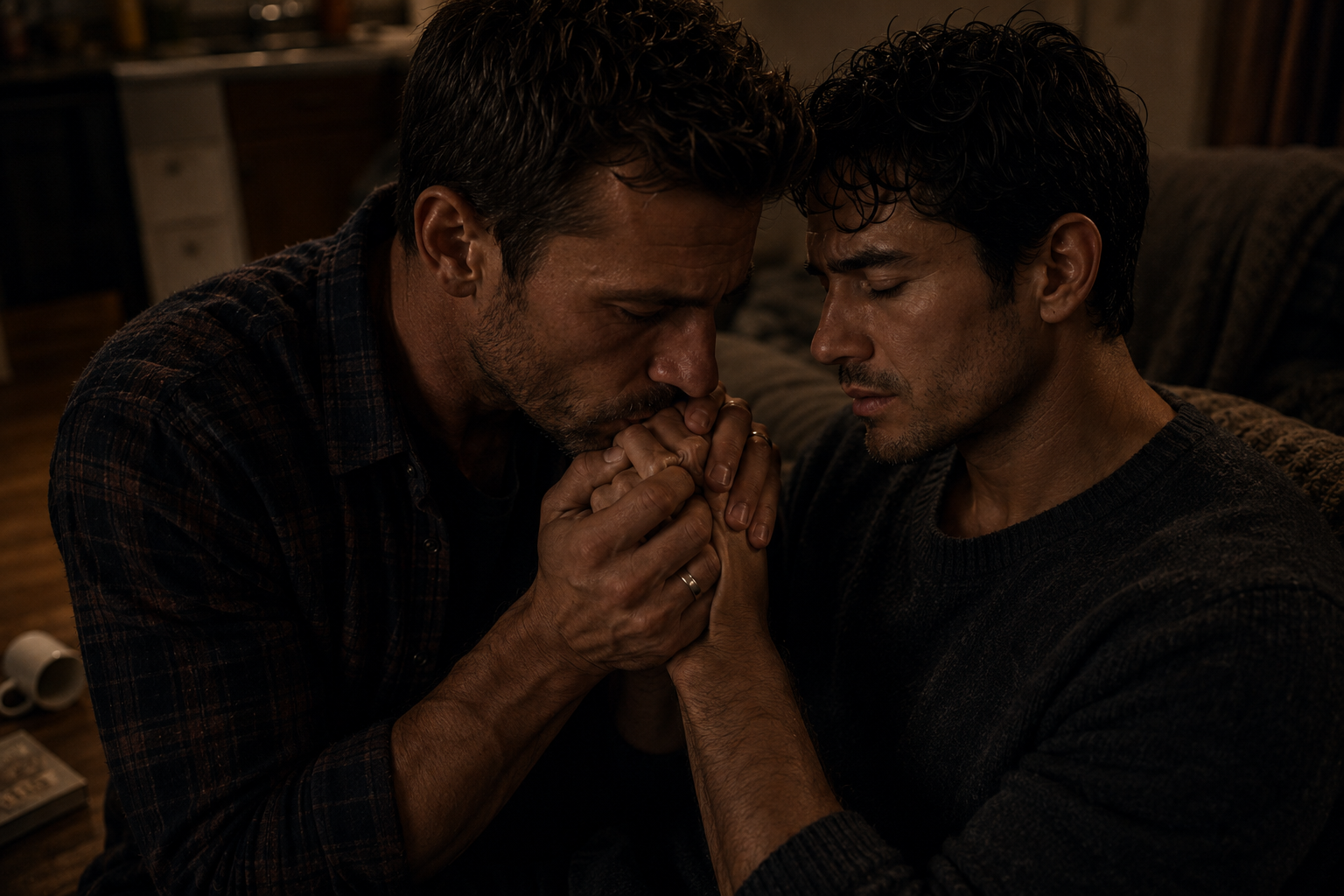
I found his hand. Interlaced our fingers. The rings clicked together. I brought our hands to his mouth, and without thinking, without planning, I pressed a kiss to the scar on my palm, using his lips against my skin.
He made a sound. His eyes closed.
I held our hands there for a moment, feeling his breath warm against the crescent mark. Then I let go and pulled back, sitting up on the couch, my legs tangled with his.
He sat up gradually, running a hand through his hair, disheveled and dazed. We were both fully clothed, technically, though my shirt was twisted and his sweater was rucked up beneath his arms. The air smelled like sweat and tea and the Thai food we’d eaten.
Trace looked at me. His eyes were wet, his brow furrowed just, but the corners of his lips had turned up just enough to signal a change.
“Whatever you need,” he whispered. “Whatever you want.”
I touched his knee. My hand was steady.
“Just this,” I said. “Just this for now.”
He covered my hand with his. We sat there, breathing hard, the couch creaking beneath us, the streetlight coming on outside the window.
“Can I stay?” he asked. “One more night. On the couch. I won’t . . . I won’t assume anything.”
I looked at him. At this man who had shattered my life and spent a year trying to find the pieces. At the careful set of his shoulders, the exhaustion in his eyes, the want he was holding back so hard I could feel it thrumming in the air.
“Yeah,” I said. “Okay.”

The townhouse came up later.
We had separated, tidied ourselves in the bathroom one at a time like roommates or teenagers. I had folded the pull-out couch back into a couch, and Trace had helped me straighten the blanket. I watched the hospital corner meet the loose drape, and something in my throat caught.
We sat on the couch with fresh mugs of tea that had gone lukewarm. The television was on, some nature documentary with the sound muted, whales moving silently across a blue screen. Trace’s shoulder was inches from mine, not touching, but close enough that I could feel the heat rising from his skin.
“I need to go back eventually,” he said softly. “To check on things. I have a place. In Lincoln Park.”
“A place.”
“Brick. Three stories.” He paused. “We bought it together two years ago. I thought about selling it this year. After everything. But I couldn’t.”
I tried to picture it. Red brick, probably. Black door. A foyer with a chandelier that cost more than my monthly rent. A kitchen larger than my entire apartment. The image was sharp and empty, like a real estate listing for a life I couldn’t imagine inhabiting.
“Probably worth more than this entire block,” I said. It came out flatter than I meant.
Trace looked at me. “That’s not why I mentioned it.”
“I know. I just don’t know what to do with the information yet.”
“You don’t have to do anything with it.”
I nodded. I stared at the whales on the screen, moving through water that looked too blue to be real.
“Breck,” he said.
“Yeah?”
“The place is yours too. If you want it. If you ever want it. There’s no pressure. There’s no timeline. I just . . . I want you to know there’s space. For you. However much of you there is.”
I didn’t answer. The whales dove, and the screen went dark blue, and the radiator clicked in the corner.
After a while, I went to bed.

I lay in the dark and touched the scar on my palm.
Trace was on the couch in the next room, close enough that I could hear the shift of his weight as he settled, the soft huff of his breath evening out. He had kissed this scar. I had held my hand to his mouth and pressed his lips to the exact center of the crescent, and his eyes had closed as if he were touching something sacred.
I wanted to know where it came from.
My thumb found the scar and circled it. For a year it had been nothing. A shape on my hand, a moon without a tide. Tonight it itched. A small, solid pull, like a string tied somewhere I couldn’t see. Tonight it demanded a story. A bicycle, maybe. A kitchen knife. A piece of glass in the ocean. My mind offered possibilities like a dealer fanning cards, and I didn’t know which one was true.
I closed my eyes and the hardwood floor came back. The dog. The tail against the floor, the jingle of the tag. It felt kind. It felt like something that might have loved me.
But it was gone as fast as it came, and I was lying in my narrow bed with the October wind rattling the window, touching a scar I didn’t understand and listening to a man breathe on my couch.
I wondered if the dog was real. I wondered if my mind was already building memories out of scraps, filling the empty rooms with furniture I wanted to be there.
I didn’t know.
But I wanted to know.
The wanting was small, but it was solid. A seed in dark soil. I held it in my chest along with the ache and the uncertainty, and for the first time since Trace Tucker had appeared in the rain, the gray feeling didn’t come for me.
I fell asleep with my thumb on the scar, listening to the city settle outside, and the last thing I thought, before the dark took me, was that my body was trying to tell me something. I just had to learn how to listen.

End of Chapter Four.