
Six weeks of mounting tension reach a breaking point on an August Saturday when Wade swims out to Jess in the middle of a sun-scorched Texas cove. What begins with a touch in the warm lake water deepens into an intimacy of whispered confessions about loyalty, inexperience, and the terror of being truly seen. As night falls over North Texas, two men who have never made it past the first few weeks must decide if being scared together is enough to build something real.

Wade’s Point of View
By week six, I had stopped counting the Saturdays and started counting other things. The number of times Jesse had slept in my guest room. Four, before tonight, which would make five. The number of dinners I’d paid for without comment. Seven, and he’d stopped ordering the second-cheapest thing on the menu around dinner four. The number of times I’d caught him looking at me with an expression that wasn’t the careful, assessing one he used for paintings and people he hadn’t decided about yet, rather one with something less managed underneath. Enough that I’d stopped being surprised and started being something else. Expectant. Jesse Tretiak had settled under my ribs the same way Friday did, or the first cold morning in October. A low, steady hum of something coming that no amount of wanting could hurry.
The lake in August differed from the lake in June. The water was warmer, for starters. Bathwater warm, the kind of warm that stopped being refreshing and simply became the element you were in. The sky was a harder blue and the atmosphere had the bleached-out quality of a summer that had been going long enough to forget we had other seasons. The cove was the same cove. The same cedar bluffs, the heron on the far bank the same heron or close enough. But the character of the light had changed. August light was heavier than June light. Less golden and more white, the sun directly overhead instead of at the angle that made things look more like a painting.
Jake’s boat was anchored in our usual spot, the group doing what the group always did on Saturdays. David and Kip in the water with their drinks, Paul Strayer on the bow with whatever young man he was currently not quite dating, Michael on the port bench with his phone, Milo at the stern reading a paperback that had been in his bag since June and was still only half finished. Jake at the console, doing nothing in particular, which with Jake always meant he was doing something specific in his head.
Jesse was in the water.
He had been in the water most of the morning, the same strong, efficient stroke I’d watched every Saturday since the first one. He swam the way he did everything. With full commitment and no wasted motion, the water parting around him cleanly, his body moving through it with the ease of someone who had been doing this seriously for years. I had been watching him from the boat with an attention I applied to Jesse Tretiak and nothing else, which was a thing I’d noticed around week three and had stopped being surprised by around week four and had stopped trying to manage around week five.
What I wanted, if I was being honest in the way I was trying to be honest about him, was to close the distance. Not just the physical distance, the forty yards of open water between the boat and where he was swimming, but the other distance, the careful one he maintained even when he was letting me pay for his dinner and sleep in my guest room and watch him from across the cove. He’d given me something weeks ago in my studio, on his knees, with that serious and deliberate expression, and he’d done it as a gift rather than a transaction, and since then he’d been . . . not distant, exactly, but holding. Waiting. Watching me watch him and not moving toward me any faster than he was ready to move.
I was ready. My hands had been stupid with it for weeks. Reaching for him before the rest of me caught up. It began around the time I’d started thinking about him in my kitchen instead of just in my bed. I was standing at the rail of Jake’s boat on an August Saturday with the heat pressing down and the water glittering and Jesse Tretiak swimming laps across the cove and I was done waiting.
Jake turned his beer in his hands, watching the label peel. “You know.”
“Probably,” I said.
“Six weeks,” Jake said. “Long time for you.”
I looked at him.
“He’s not coming to you. Today, I mean. If something happens. It’s you or nothing.”
Jake looked at me.
“Okay,” I said. “Six weeks is a long time.”
He went back to his beer. I went back to watching Jesse in the water and thinking about patience and its limits. I’d told Jake six weeks ago in this same cove that I was going to wait. I’d meant it then. I still meant it. By August the waiting had a location. Under my ribs, in the wrists, a thrumming that started whenever he was near and didn’t stop when he left. I wanted my hands on him. I wanted to hear what he sounded like when the careful went out of him. I wanted him to stop carrying that second spine. I’d been wanting it for six weeks and I’d been good about it and I was done being good.
“I’m going in,” I said.
“Mmm,” Jake said, which meant he’d filed this under Not His Problem around ten o’clock this morning.
I went in.

The water was warm. August warm. Bathwater warm, the kind of warm where the boundary between your skin and the lake took a moment to locate. I swam out toward the middle of the cove where Jesse was, my stroke less efficient than his because I wasn’t a swimmer, not really, just a man who spent a lot of time on the water and had learned to move through it when necessary. He saw me coming and didn’t stop, just adjusted course the way you did when another swimmer entered your space.
I pulled alongside him.
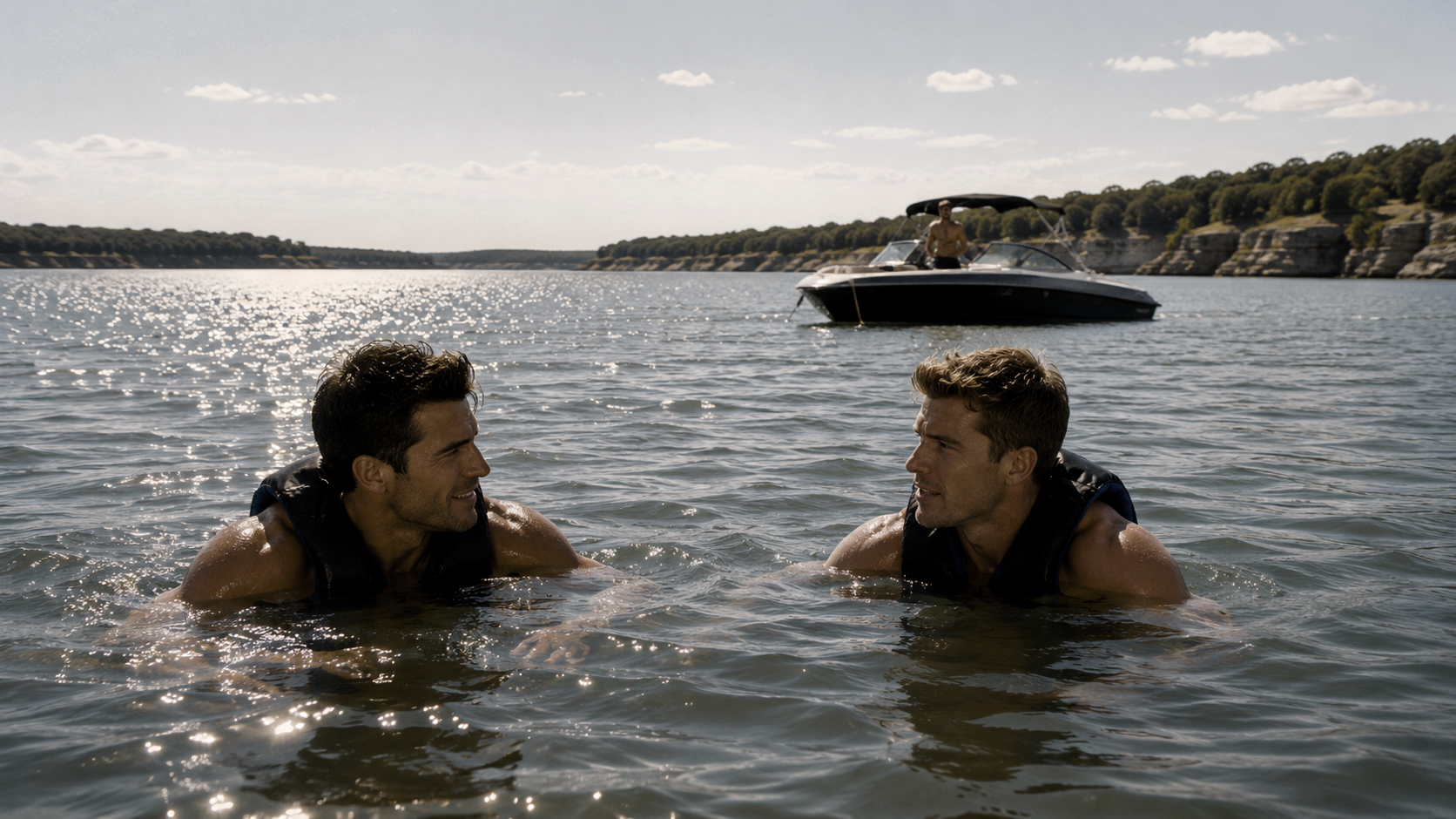
He stopped swimming. Tread water. Looked at me with his default expression, which in the bright August light with the water moving around it had an element I hadn’t seen from the shore. One less severe, the relaxation of a face that had stopped being watched.
“Hi,” I said.
“Hi,” he said.
We tread water while the lake flowed around us. The boat was maybe forty yards back. From here I could see Jake at the console and the shapes of the others in the water closer to shore, David’s laugh carrying across the cove in the way sounds carried over open water, clear but reduced to something that didn’t require attention.
I had been thinking about this moment for six weeks. Or not this exact moment, but the moment when I finally stopped waiting and started moving. I’d imagined versions of it. The version where I was smooth, the version where I was direct, the version where I said something clever that made him smile that small, private smile he did when something landed. None of those versions came out.
“Come here,” I said.
It wasn’t a question. It wasn’t a line. It was just what I wanted. Him. Closer. Now. And I said it the way I said things when I’d stopped performing, flat and unadorned, the noise gone from my voice.
He looked at me with the expression of someone who was deciding. I watched him make it, the small shift in his face and the way his shoulders settled, and then he moved toward me.
I caught him when he was close enough. One arm around his back, the life jacket buoyant between us, his weight and mine balanced in the water. He didn’t resist. He put his hands on my arms, not holding on exactly, just present, and we floated together in the middle of the cove with the August sun overhead and the cedar bluffs throwing their shadow across a third of the water and the rest of the group distant enough to be irrelevant.
“I can’t figure you out,” I said. Not a complaint. Just the honest accounting of six weeks. “I’ve been trying for six weeks and I can’t figure you out and I keep trying anyway.”
A swell lifted us, then let us go. “I know,” he said.
“I’m not going to stop,” I said. “I want you to know that. I will not stop trying.”
“I know that too,” he said.
There was an aspect to this conversation, to the specific flatness of how he was receiving what I was saying, neither pushing back nor closing off, just receiving it with the calm acknowledgment of someone who had known both things already and was not surprised to hear them said aloud. His knowing was not the knowing of someone who had filed the information and moved on. It was the knowing of someone who had been carrying it.
I thought about the studio six weeks ago. The way he’d dropped to his knees with that same deliberateness, the way he’d looked up at me while he worked my cock, and the way he’d said it was for being patient, like I’d earned something. He’d been carrying a weight then, too. He’d been carrying it since the night we met, maybe, or since the first lake day, or since some moment I hadn’t identified yet. He pocketed information the way some men pocketed stones, then he turned it over in private, smoothed it with his thumb, only showed you the side he’d decided was ready.
My hands moved. Found the drawstring of his board shorts under the water in the dark privacy of the lake, and he froze. The small wakes his body had been cutting went flat.
I wanted to see him come apart. I’d been imagining it for weeks, in my kitchen, in my bed, in the shower with the water running and my hand on myself and his name somewhere in the back of my throat. The imagining had been detailed. The reality, I suspected, would be better. The reality of Jesse Tretiak letting go of the careful, deliberate control he carried everywhere was something I’d been working toward since the night I’d found him in my hallway, and I was close enough now to feel his breath and the warmth of his skin through the life jacket and the small, telling tension in his shoulders that meant he was deciding something.
“Wade,” he said.
“Yeah,” I said.
“We’re in the middle of the lake.”
“Yeah,” I said.
A moment. The water moved around us. The sun was warm on his shoulders and on mine.
“Okay,” Jesse said. Very quietly. And then, after a pause, “Okay.”

Jesse’s Point of View
What I want to say about it is that it was unhurried.
This is the detail I hold on to afterward—in the truck on the drive back, in the weeks that follow when I turn it over in the compulsive way I turn things over that matter—not what happened, exactly, but the quality of it. The way it wasn’t rushed, wasn’t aggressive, wasn’t anything like the thing I’d been quietly bracing for in the abstract, the inevitable conclusion of six weeks of Wade Mitchell’s attention, which I’d always assumed would feel like being caught rather than like being asked.
It didn’t feel like being caught.
The water was warm around us and the August light was overhead and the boat was far enough back that the people on it were shapes and not faces. Wade’s arm was around my back through the life jacket and his hands found me with a patience that had nothing performative in it, that was simply what it was, and I let my head fall back slightly and looked at the August sky and felt what I felt.
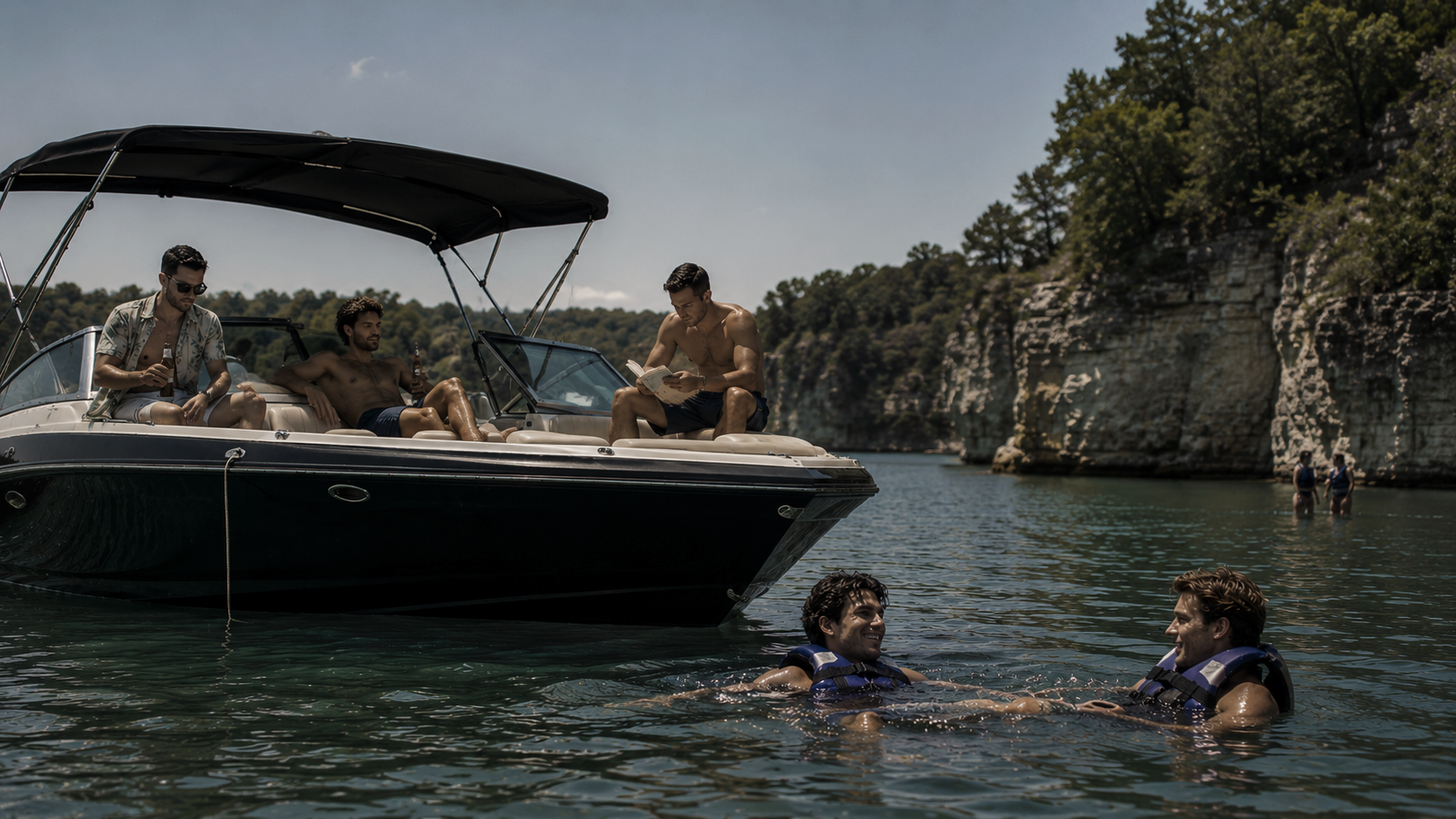
What I felt was present. In the specific sense of a person entirely inside an experience rather than watching it from a slight remove, which was where I usually was in experiences of this type. Not managing. Not monitoring. Just there, in the warm water, in the August light, with his hands on me.
His mouth was warm even in the warm water. He found a rhythm and then varied it, keeping track of my breathing, pausing when my shoulders tightened, starting again when they dropped. The rock was rough under my palms. The water lapped at my chest. I stopped managing and started feeling.
I was aware of his body against mine in the water, the solid warmth of his chest, the width of his shoulders blocking the sun when I opened my eyes, the way his arm around my back was both supporting and claiming. I’d noticed his body before, in the way I noticed things I wasn’t planning to act on. The shape of him in the water, the way his back moved when he pulled himself up the swim ladder, the specific structure of his forearms when he was driving with one hand on the wheel. Noticing was different from feeling. Feeling was his chest against my life jacket and his hand working below the waterline and the heat of him even in the August warm lake, and the noticing had become something else altogether, something I wasn’t managing anymore.
I made a sound. It escaped before I could catch it.
Wade’s arm tightened around my back.
I thought, briefly and without attachment, about the group on the boat. David’s voice carrying across the water, Kip’s laugh, the ordinary sounds of a Saturday afternoon continuing uninterrupted. They didn’t know. Or they knew and were pretending not to. Either way, the distance held, and the privacy held, and I was in the middle of the lake with Wade Mitchell’s hands on me and the August sky overhead, and it was good, it was genuinely and specifically good, and I let it be good without examining why.
Afterward, in the suspended stillness of the water, both of us floating, my breathing slower than it had been and not quite back to normal, I noticed the August heat on the top of my head, and the way the water lapped at the edges of the life jacket, and the small, patient sound of the lake moving around us.
Wade’s hand was on my back. Flat, still, not doing anything. Just there.
His other arm was still around me, and I was still leaning into him, and the floating had a different quality now, looser, the ease of a body that had released something it had been holding.
“Jesse,” he said.
“Yeah,” I said.
He said nothing else immediately. We floated. The boat was still where the boat had been, the shapes of the others visible and not paying us any attention.
“Jesse,” he said again. His voice had an inflection I recognized. The stripped-down one, the one that came out when the performance had been set aside and what was left was the thing itself. “There’s something I should tell you. About Jake.”
“Jake,” I said.
“I told him.” He paused. “About six weeks ago. In the studio. What you did.”
I was quiet. The water moved around us.
“I tell Jake things,” Wade said. “Always have. He’s my best friend. I didn’t think. I just told him. It didn’t occur to me that you might not want him to know.” Another pause. “Jake pointed that out. That you might not appreciate me sharing details like that. And he was right. I should’ve asked you first. So I’m telling you now, and I’m apologizing.”
I considered this. The water lapped at the edges of the life jacket. Somewhere on the far bank the heron was either there or not there. I couldn’t see it from this angle.
I thought about Jake and the steady, watchful quality of him. The way he’d intercepted Paul at the marina without making a production of it, the way he’d looked at me the first night at the pool party and seen something other people hadn’t. I thought about what Jake knew about me now, and what that knowing meant, and whether it bothered me that Wade had told him.
It didn’t. I found it surprising that it didn’t.
“I trust Jake,” I said. “If you need someone to talk to, I’m glad you have him and not . . .” I stopped.
“Not Paul,” Wade said.
“Not Paul,” I agreed.
Wade’s arm tightened around my back. “I don’t want you to think I’m . . . that I talk about you the way I’ve talked about other people. I don’t. What you did was different. What you are is different. Jake knows that. I just wanted you to know he knows.”
“Okay,” I said.
“Okay,” he said.
We floated for another moment. Then Wade’s voice dropped lower, the tone it took when he was saying something he meant.
“While we’re being honest,” he said, “I should tell you something else.”
“What?” I asked.
“That was extraordinary. What you did in the studio. I’ve been thinking about it for six weeks. I’ve been thinking about your mouth and your hands and the way you looked at me and the fact that you did it as a gift. No one’s ever given me something like that before.”
I felt my face go warm in a way that had nothing to do with the August sun.
“The way you swallowed,” Wade said, his voice still low, still stripped, “without flinching. The way you cleaned me after. The way you tucked me back in like you were closing a book you’d finished reading. I’ve had a lot of blowjobs in my life and none of them felt like that. You made me feel like I’d earned something. Like I’d been patient and decent and you’d noticed, and you wanted me to know you’d noticed.” His hand moved on my back, a small, slow circle. “I noticed you noticing. And I’ve been wanting to return the favor ever since.”
His other hand moved under the water, not reaching for anything, just moving, finding my hip, settling there with a gentle, proprietary weight.
“I’ve been thinking about what you’d sound like,” he said. “If I got my mouth on you. If I took my time the way you did. You made this sound, up against the wall, my name in it somewhere. I’ve been replaying that. I want to hear it again. I want to hear what you sound like when I’m the one on my knees.”
My breathing had changed. I was aware of it changing. I was aware of his hand on my hip and his arm around my back and the water moving around us, and I was aware that forty yards away a boat full of people was going about its Saturday afternoon with no idea what was happening in the middle of the cove.
“Wade,” I said.
“Yeah,” he said.
“You’re not on your knees,” I said. “You’re treading water.”
His mouth curved against my temple. “Technicality. I’m making a point.”
“What’s the point?” I said.
“The point is I want you to know what you are to me. What you’ve been since the first night. And the point is I want to show you, not just tell you.” He pulled back enough to look at my face. “Can I show you? Here?”
My pulse was doing something in my throat. The August sun was hot on my shoulders and the water was warm around my legs and Wade Mitchell was asking me, with the same stripped-down sincerity he’d used to apologize about Jake, if he could put his mouth on me in the middle of the lake.
“Jesse,” he said again.
“I’m not doing this,” I said, “if you’re doing it with anyone else.”
A pause. The water moved.
“I’m not,” he said.
“I mean it,” I said. I kept my voice level and I meant every syllable of it. “I don’t do this kind of thing casually. If we’re . . . if this is something . . . then it’s only this. Only us. That’s not negotiable.”
“I know you mean it,” he said. He said it with the voice I’d been learning to recognize as Wade at his most stripped, the voice that came out when what was left was just the thing itself. “I’m not doing it with anyone else. I haven’t been. I won’t.”
I looked at the sky.
I had come to the lake six weeks ago to not think about Luke and had ended up thinking about this, which was its own kind of answer to a question I hadn’t asked yet.
“Okay,” I said. “Then I need to know something else.”
“Anything,” Wade said.
“This thing between you and Kip.” I said it plainly, without accusation, the way I said things that needed to be said. “I’ve been watching it for six weeks. The way he positions himself near you. The way he looks at me when he thinks I’m not looking. I don’t know what’s going on there and I don’t want to get in the middle of something.”
Wade was silent. The water moved around us in small, patient swells.
“There’s nothing going on,” he said. “Not on my end. There never has been.”
“He’s Jake’s boyfriend,” I said.
“I know.” He shifted in the water, his arm still around me, his voice still stripped. “Kip’s been in love with me for about two years. That’s what Jake thinks, and Jake’s usually right about these things. But I’ve never touched him. I’ve never led him on. He’s with Jake, and I’m not . . . I’ve never been interested in Kip that way. I don’t know how to be clearer about it than that.”
“And he knows that,” I said. “That you’re not interested.”
“I’ve never said it out loud. Maybe I should have. But I’ve never given him a reason to think otherwise.” He paused. “Jake knows. Jake’s known for a while. They’re working through it, or not. That’s between them.”
I turned this over. It fit with what I’d observed. Kip’s watchful silences, the way his pleasant surface never quite reached his eyes when he looked at me, the territorial nature of his attention around Wade. It fit with what Jake had told me the first night at the pool party, though he’d said it differently, meant it differently. It fit with the quiet, unhappy shape of something I’d been noticing without wanting to name.
“So there’s nothing on your side?” I said.
“Nothing,” Wade said. “There’s only one person I’ve been interested in for the past six weeks, and he’s currently floating in a life jacket with my arm around him.”
I looked at him. In the August light his expression was open in a way it rarely was on shore. No performance, no deflection, just the honest fact of him.
“Okay,” I said.
“Okay?” he said.
“I believe you.” I meant it. “Then show me. Here.”
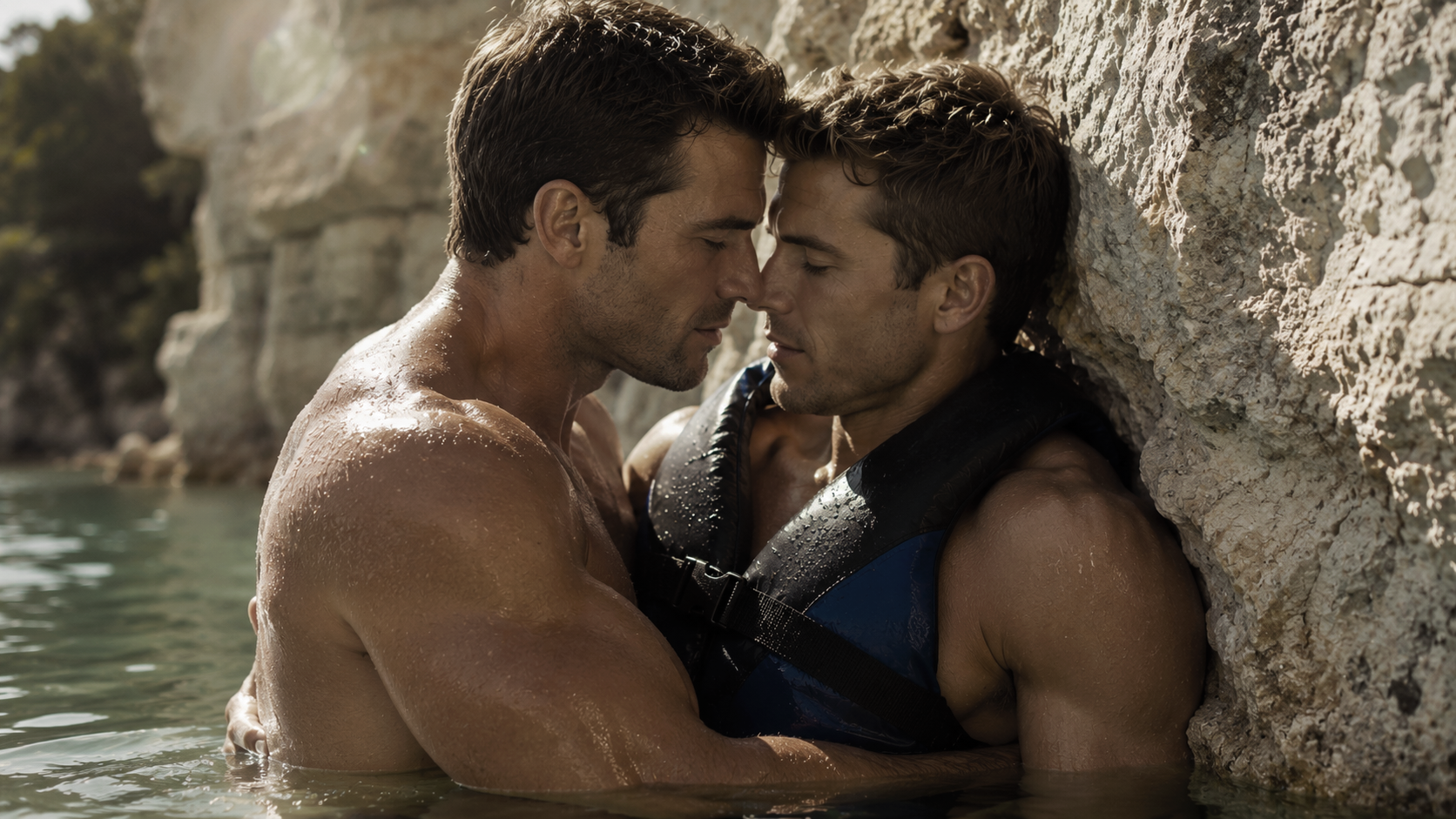
He kissed me once. It was brief, almost chaste, a reassurance rather than a demand. He guided me back until my shoulder blades met the rock. The water was waist-deep here, warm as a bath. He dropped to his knees in front of me, the life jacket pressing against my thighs, his face level with my stomach. “Hold on,” he said. I gripped the stone above my head.
“And try to stay quiet.”
I held onto the rock.
What followed was deliberate. I had no other word for it. He approached it the way he approached everything that mattered to him, with focused attention and no hurry and the specific skill of someone who had been doing this for three decades and had learned, somewhere along the way, that patience was the difference between a transaction and a gift. His mouth was warm even in the warm water, and he took his time, and when I made a sound I couldn’t swallow he paused and looked up at me with an expression that was both satisfied and tender.
“Good?” he said.
“Don’t stop,” I said.
He didn’t stop.
There was something to being on the receiving end of Wade Mitchell’s attention that I hadn’t fully understood until this moment. I’d seen it directed at other things—the lake, the jetskis, the painting in his hallway, me across the dinner table—but being the direct object of it, being the thing he was focused on with that complete, unwavering presence, was something else entirely. He paid attention to what I responded to. He adjusted when my breathing changed. He found a rhythm and then varied it, keeping me off balance in a way that made the balance, when it came, feel earned.
The rock was rough against my palms. The water lapped at my chest. The August sky was unchanged overhead, the same hard blue, the same white sun. Somewhere on the boat David was laughing and Kip was probably watching us not watch each other, and Jake was probably aware of exactly what was happening and Paul was probably making some comment I was glad I couldn’t hear.
None of it mattered. What mattered was Wade’s mouth and Wade’s hands and the specific, building pressure at the base of my spine, and when I came it was with my head back against the rock and my eyes closed against the August sun and his name tangled somewhere in the noise I couldn’t suppress.
He held me through it. His hand steady on my hip, his mouth gentle through the last aftershocks, his arm around my back when my knees threatened to give. I was breathing like I’d sprinted and my heart was going too fast and the rock was still rough under my palms, and Wade Mitchell was looking up at me from the water with an expression of such unguarded satisfaction that I had to close my eyes against it.
“So that’s what that feels like,” I said, and my voice came out rougher than I intended.
“No,” Wade said. He pulled himself up, still close, his chest against mine, his mouth near my ear. My good ear, the left one, and I didn’t know yet if he’d noticed or if it was accident, but it landed like intention. “That’s what you feel like. What you feel like when someone’s been wanting to do that for six weeks and finally gets to.”
We stayed there against the rock, the water moving around us, the boat still where the boat had been. Then Wade kissed me once, softly, on the mouth this time and pulled back.
“Come on,” he said. “Before they send a search party.”
I pushed off the rock. We swam back to the boat together, not touching, the distance between us charged with the private knowledge of what had just happened. I pulled myself up the swim ladder and sat on the stern bench and I felt . . . loose. My shoulders wouldn’t tighten back down. The August air dried the lake water on my arms and I let the bench take my weight, something in my spine unkinking itself without permission. Unmoored, maybe, but not unpleasant.

Wade’s Point of View
Coming back to the boat had its own texture.
Jake, at the console, said nothing when we swam back. He registered our arrival with the focused non-reaction of someone who had expected this and had decided in advance not to make it a thing. Michael and Paul were occupied with their own conversations and either didn’t notice or chose not to. David, in the water with Kip, noticed immediately. David always noticed, it was his primary social skill and his primary liability depending on the context, and I watched him nudge Kip and watched Kip register it and watched Kip’s face do the unique thing Kip’s face did, the pleasant surface with the thing behind it that wasn’t quite pleasant.
Jesse pulled himself up the swim ladder and I followed, and we sat on the stern bench with the August heat drying us fast and the sounds of the lake afternoon resuming around us, and nobody said anything directly. Kip was on the port bench, his back to us, his phone in his hand. He didn’t turn around. His shoulders were very still. The temperature of the boat had changed in the way they did when something had been acknowledged even without words.
David swam to the ladder and pulled himself up, dripping, and sat on the bench beside Jesse. “So,” he said.
“So,” Jesse said.
“Nothing,” David said, with the tone of someone who meant the opposite, and reached for a towel, and let it go because he was David and David knew when to push and when to wait, and this was a wait.
I looked at Kip, who was still in the water, looking up at the stern with an expression I registered and then let go because there was a limit to what I could manage in a single afternoon and I had reached it. Jesse had asked about him, in the water before I’d put my mouth on him, and I’d told him the truth. There was nothing on my side, there never had been. Kip’s feelings were Kip’s to manage and whatever he’d been doing on the boat all afternoon, watching us with that careful, unhappy attention, was between him and Jake. I had other things to think about.
“Lunch,” Jake said from the console. “We should go to the restaurant.”
This was Jake redirecting the afternoon, which was both practical and considerate and wholly characteristic, and I was grateful for it.
“Yeah,” I said. “Let’s go.”

Jesse’s Point of View
In the truck on the way back from the lake, somewhere on Interstate 35 between Corinth and Carrollton with the August evening coming on and the sky going the deep blue of a Texas summer dusk, the radio on low and the truck smelling of sunscreen and lake water, I told Wade he was the fourth person I’d been with. He was driving. He was silent. The truck drifted slightly left, he corrected. The dashboard light caught the ridge of his knuckles. His thumb moved on the wheel, back and forth, back and forth, and then he glanced at me.
“The fourth?” he said.
“Yes,” I said.
I said it without apology because I wasn’t apologizing for it. It was just a fact about me, like the double major or the hardware store shifts. But I was aware of what it meant to hand it to him. The cost of giving someone a piece of information that told them something true about who you were and waiting to see what they did with it. I’d been lugging this as a private thing for six weeks, aware it had implications, aware it would need to be said eventually and that eventually was now.
He drove another mile without speaking.
“I’m honored,” he said and his voice had gone strange, smaller than I’d ever heard it. “I want you to know that. I don’t take that lightly. Not even a little.”
I looked at him. He was still watching the road, his profile in the evening light, and the expression on his face was not the one he wore when he was performing sincerity. I’d learned the difference over six weeks, the slightly elevated quality of performed sincerity versus the quieter, less composed version of the real thing. This was the real thing.
“Okay,” I said. The stickiness of the seatbelt pulled at my sunburned skin as I leaned back.
“I mean it,” he said.
“I know you mean it,” I said. The cab smelled of lake water and warm vinyl. My throat felt narrow. The number four sat in my mouth like a stone and I couldn’t swallow it back down. I looked at the passenger door handle instead of him.
“Wade,” I said. My voice came out level, which was the only way I knew how to say things that cost me something. “I’m scared.”
He looked at me. A quick glance, then back to the road. “Scared of what?”
“Scared I don’t know as much as the other guys you’ve been with.” I kept my voice level, which was the only way I knew how to say things that cost me something. “I’m scared I can’t compete. In the bedroom. You’ve been with . . . I don’t know how many people. Hundreds. And I’ve been with four. I know there are things I don’t know how to do. Things you expect. Things you’re used to. And I’m scared that when you figure out I can’t . . .” I stopped. Looked out the window. “That I won’t be enough.”
The highway hummed beneath the tires. Wade said nothing and we missed our exit.
“Jesse,” he said finally, and his voice was different now. Not the stripped-down sincerity he’d used in the water, not the warm charm he used on everyone else. Something quieter than either. “Can you look at me?”
I turned away from the window. He glanced at me, then back at the road, and his jaw was doing the thing it did when he was working something out.
“Everything I’m used to,” he said, “is not what I want. Everything I’m used to is transactional. Everything I’m used to is people who want something from me and will trade something to get it. I’ve had plenty of sex and most of it was forgettable. Not because the people weren’t good at it but because they weren’t . . .”
He stopped. Regrouped. “Because I didn’t care about them and they didn’t care about me. That’s what I’m used to. You asked me in the water if I was doing this with anyone else and I said no and I meant no. But I also mean this. I am not comparing you to anyone. I’m not measuring you against some standard of experience you haven’t had yet. Whatever things you don’t know how to do we’ll figure them out together. Or we won’t do them. It doesn’t matter.”
He paused. Took one hand off the wheel and rested it on the center console, palm up, an invitation.
“You’re not competing with anyone,” he said. “There’s no competition. There’s just you and me and whatever we figure out between us. You will not be not enough. That’s not possible. Do you understand what I’m saying?”
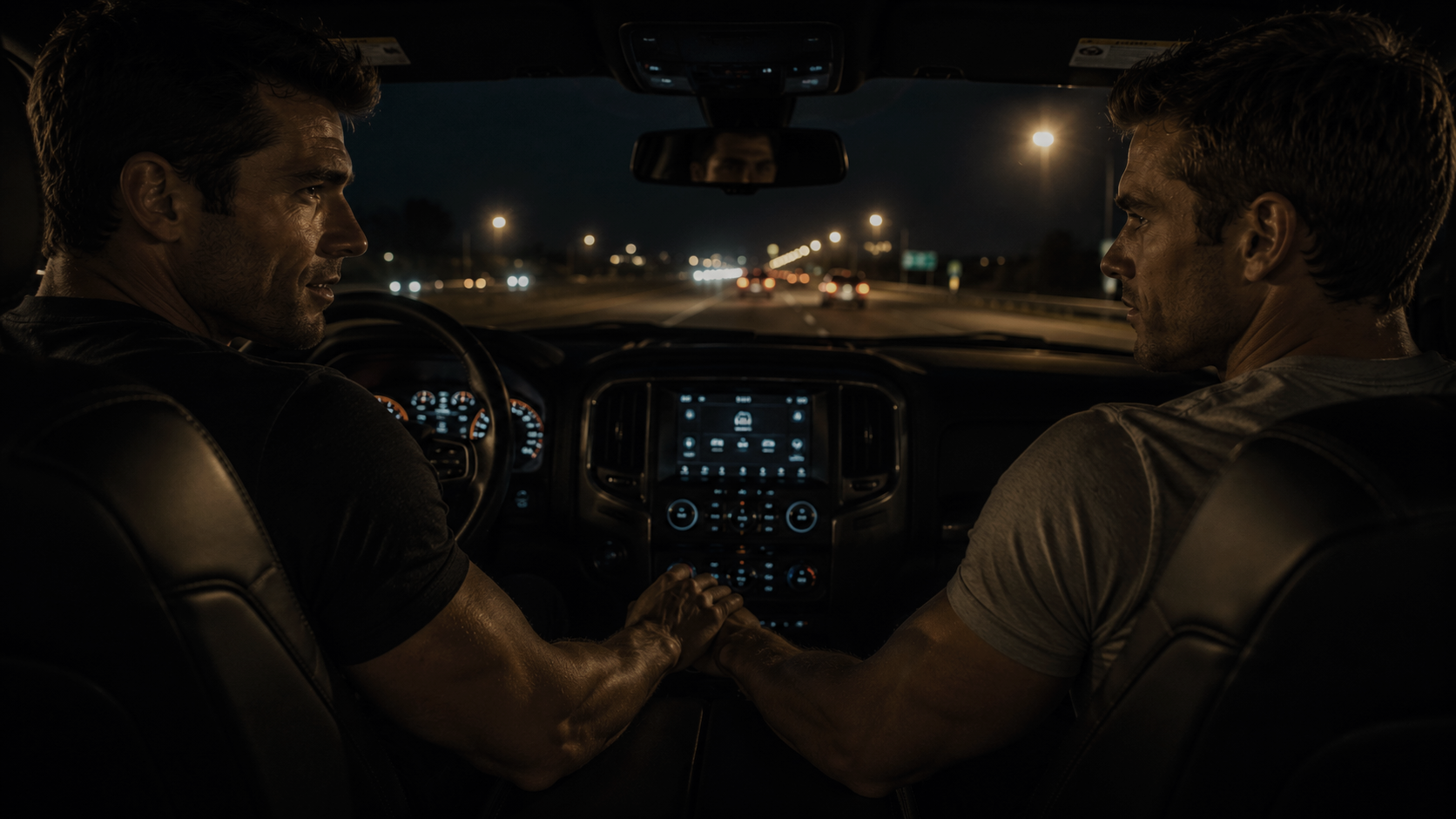
I put my hand in his. His fingers closed around mine, warm and steady, his palm slightly rough from the jetski grips.
“I think so,” I said.
“I’m not saying it to make you feel better. I’m saying it because it’s true.” He squeezed my hand once and then returned his to the wheel, because he was driving, because we were on a highway at seventy miles an hour and the practical reality of the situation didn’t allow for grand gestures. But the squeeze had been enough. “I’ve been with many people, Jesse, and most of them have bored me. You are the least boring person I have ever met. You’re also the most deliberate, the most principled, and the most unexpectedly bold. You dropped to your knees in my studio and gave me one of the best blowjobs of my life because I didn’t kiss you when I could have. You did that. Not someone with more experience. You. So whatever you think you’re missing . . .” He shook his head. “You’re not missing it. You’re just new at some things. There’s a difference.”
I looked at my hands in my lap. The highway stretched ahead of us, the taillights of the cars going south a steady red current on the other side of the median. The August night was full dark now, the last of the dusk faded from the sky, and the truck cab was a small, warm container of dashboard light and quiet and the unfamiliar feeling of having said something true and been met with something true in return.
“I don’t know how to do this,” I said. “The relationship thing. I’ve never done it for more than a few weeks. I don’t know the rules.”
“There aren’t rules,” Wade said. “There’s just what works for us and what doesn’t. That’s the whole secret. That’s all I’ve figured out in forty-one years.”
“That’s not very reassuring.”
“It’s not supposed to be reassuring. It’s supposed to be honest.” He looked at me again and in the dashboard light his expression was the open one, the one he’d had in the water when he’d told me about Kip. “I don’t know what I’m doing either. I’ve never done this. I told you . . . I’ve never made it past a few weeks. Everything past this point is new for me too. So if we’re going to be scared, we can be scared together. That seems fair.”
I thought about that. Wade Mitchell, forty-one years old and experienced in every way I wasn’t, admitting he didn’t know what came next either. It should have made me more nervous. It didn’t. It landed as something else. Relief, maybe. Or the comfort of realizing you weren’t the only one in unfamiliar territory.
“Okay,” I said.
“Okay,” he said.
We drove. The highway moved beneath us. His hand was back on the wheel and my hands were in my lap and the silence between us was the comfortable kind, the kind that didn’t need filling.
“I’m still scared,” I said, after a while. “But less.”
“That’s all I’m asking for,” Wade said. “Less scared. The rest we’ll figure out as we go.”
I looked out the window at the dark Texas suburbs going past. The shopping centers, the apartment complexes, the endless repetition of a landscape I’d been driving through for six weeks and still didn’t know. That was the thing about Dallas. It was endless and it sprawled forever.
Wade would be patient. He’d said it in the water and he’d said it in the truck and he was saying it now with his silence and his hand on the wheel and his willingness to hear the things I was afraid of and not make me feel small for being afraid.
I thought this is what it’s supposed to feel like. Not the fear, the being met in the fear. The not being alone in it.
We backtracked and got off the highway at Plano and the familiar streets replaced the highway, and Wade drove us home.

Wade’s Point of View
I drove and I thought about what he’d said. I’m scared I can’t compete. The phrase sat in my chest like something I’d swallowed wrong, a small, sharp weight I couldn’t shift. He’d been carrying that for weeks, probably. The fear that he wasn’t enough, that his inexperience was a liability, that the arithmetic of my history versus his history meant something about his worth. And he’d said it to me in the truck’s dark with his voice level and his hands in his lap, the way he said everything that cost him something. Straight on and without asking for reassurance he didn’t think he’d earned.
I meant what I’d told him. Every word. The people I’d been with before him were not a standard he had to meet. They were a collection of transactions I’d largely forgotten. He was the first person in years who’d made me want to be better than I was, and the irony was that he thought he was the one who needed to measure up.
I thought about four. Four people, including me. I thought about how brave he’d been in the studio six weeks ago, getting on his knees for a man he hardly knew, trusting that his inexperience wouldn’t be held against him. I thought about how brave he’d been in the water today, letting me put my mouth on him in broad daylight with a boat full of people forty yards away, letting go of the control he carried everywhere. I thought about how brave he was being right now, telling me he was scared and not knowing how I’d respond.
He was the bravest person I’d ever met and he didn’t know it. That was maybe the thing that undid me most about him. The way he carried his courage like it was ordinary, like everyone faced down their fears with a level voice and a straight spine. I wondered how long he’d had to support himself on his own.
When we got off the highway, I said “I’ll be patient.”
Jesse looked at me. In the light of the streetlamps his expression had the look I’d been learning to read. The one that meant something had landed and was being held carefully.
He didn’t say anything.
He looked out the passenger window.
I didn’t need him to say anything. The silence told me what I needed to know.

Jake and I sat at the outdoor firepit after the lake group had dispersed, the August night pressing down around the yard, the pool dark and still. The fire was low. Neither of us needed it for warmth and neither of us mentioned this.
“Well,” Jake said eventually.
“Yeah,” I said.
“How do you feel?” he said.
I looked at the fire. “Like something shifted,” I said. “Today. In the water.”
“Something did shift,” Jake said.
I thought about the rock, the cedar bluff, Jesse’s hands gripping the stone. The sounds he’d made that he couldn’t quite swallow. “I put my mouth on him,” I said. “Against the bluff. While everyone was on the boat.”
Jake’s eyebrows rose. “In the lake.”
“In waist-deep water. He held onto the rock.” I looked at the fire. “Before that, he laid down the law. Said he wasn’t doing this if I was doing it with anyone else. Asked me about Kip.”
Jake’s expression didn’t change. “What did you tell him?”
“The truth. That there’s nothing on my side and never has been. That Kip’s feelings are his own, and you know about them, and it’s between the two of you.” I paused. “He believed me. Just like that. Didn’t press, didn’t interrogate. Just said okay and let me put my mouth on him.”
“That sounds like Jesse,” Jake said.
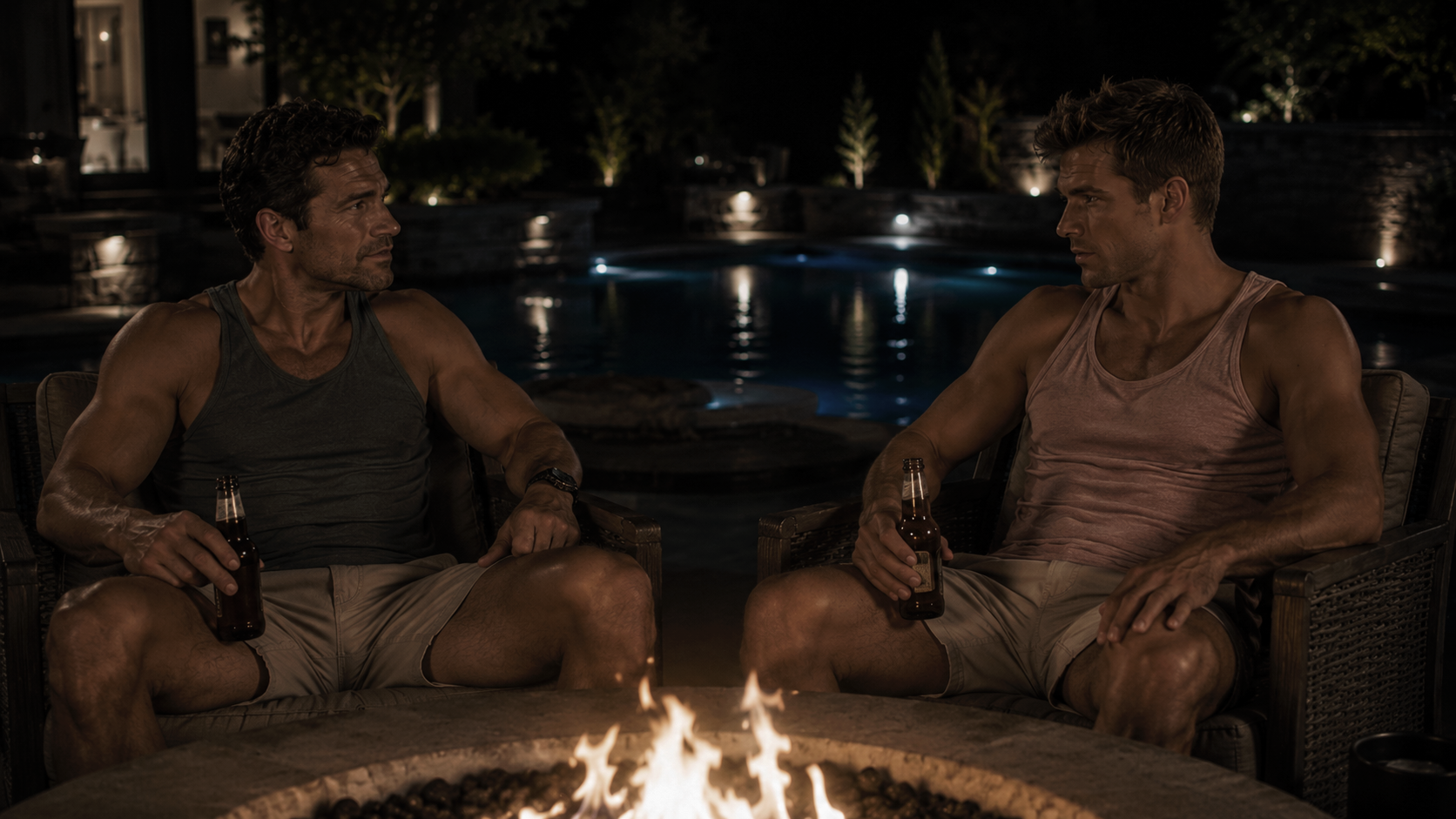
“Yeah.” I turned the beer in my hands. “Then, in the truck on the way back, he told me I was the fourth person he’d been with. And then he told me he was scared.”
“Of what?”
“That he couldn’t compete. In the bedroom. That he didn’t know enough, wasn’t experienced enough, that I’d get bored.” I looked at the fire. “He said it like it was just a fact he’d been carrying. Like he thought I’d eventually figure out he wasn’t enough and move on.”
A piece of wood shifted in the fire. “Perceptive for twenty-one. What did you say?”
“I told him there was no competition. That everything I was used to wasn’t what I wanted. That whatever he didn’t know, we’d figure out together.” I paused. “I told him I was scared too. That I’d never done this either. That we could be scared together.”
Jake looked at his beer. “Yeah,” he mumbled. “I think that’s probably right.”
“That’s new for me,” I said. “Admitting I’m scared. I’ve never done that with anyone.”
“I know it is,” Jake said.
We sat by the fire for a while. Then Jake said, “Kip registered it. On the boat. What you two were doing.”
“I saw.”
“He’s not going to get easier about this.”
“I know.” I looked at Jake across the fire. “Jesse asked me and I told him the truth. Which means he’s going to be watching now, and he’s going to notice if Kip keeps positioning himself the way he has been.”
“Good,” Jake said. “He should know what he’s walking into. Kip’s been managing his own feelings for two years. That’s not on you and it’s not on Jesse.” He paused. “I’m still deciding what to do about it. On my end. But that’s my marriage, not yours.”
We sat with that. The fire moved in its low, steady way. The August night pressed close and warm around the yard.
“What are you going to do now?” Jake said.
I looked at the fire. Thought about Jesse in the truck, his voice level, saying I’m scared I can’t compete. Thought about his hand in mine on the center console. Thought about the way he’d said okay when I told him we could be scared together.
“I’m going to be patient,” I said. “And I’m going to be careful. And I’m going to keep showing up until he believes me.”
Jake raised his beer.
“There you go,” he said. “Fuck this up and I’ll kill you myself.”
I looked at the fire. Thought about four people, and being the fourth, and what it meant to be given something that someone had held onto for twenty-one years before deciding you were worth the risk. Thought about courage that looked like stillness, and fear that looked like honesty, and a twenty-one-year-old with serious eyes who had told me the truth in the dark of my truck and then let me drive him home.
The fire crackled. Jake finished his beer. The August night held its heat around us, and I sat with what I’d been given and let it be enough.

End of Chapter Four.