

Four strangers, each haunted by an inexplicable pull, converge before an ancient mausoleum under a fog-choked night only to be dragged inside by a force none of them can resist. When the iron door seals behind them, trapping them in the dark with a chilling warning carved in cold blue light, they discover a fifth bloodline violently erased from history. With something ancient stirring beneath their feet and their only exit sealed by the very bloodline magic that binds them, the four men must find a way to work together. Or the mausoleum will become their tomb.

Adrian’s Point of View
The footsteps stopped being a question and became an answer.
I had been standing in the fog for what struck me as hours. My canvas propped against a headstone and my hands gone numb around the edges of the stretcher bars. The blue light from the mausoleum door beat like a heart. It went slow, then faster, then slow again. Each pulse made the carved symbols on the stone flare with an element that wasn’t fire. Cold light. The kind that whispered of deep water and things moving beneath it.
The footsteps came through the fog from the east. They fell heavy and deliberate. Not trying to hide. Not trying to announce themselves either. Just . . . walking. The walk of a man who had stopped being surprised where his feet took him.
My breath caught in my throat as I shifted my weight. The painting under my arm was still damp in places. I had only finished it less than an hour ago, waking at my easel with my fingers covered in burnt umber and that eerie shade of blue I’d started mixing in my sleep. The shade that matched the light pulsing from the mausoleum door. Four figures in the fog. One of them stood apart from the others, tall and lean and wrapped in shadows I could never quite capture.
The footsteps resolved into a shape.
He was big. Broad through the shoulders and chest. He had a build that must have come from years of using his body as a tool, or a weapon. He moved in the way of a fighter, with his weight balanced and his hands loose at his sides but he was ready to close. He had a handsome but serious face and his eyes, even in the fog-dimmed darkness, were the color of fine whiskey.
But it wasn’t his size that made me go still. It was the way his gaze cut past me and searched the clearing. He cataloged every shadow and headstone and patch of shifting fog. He wasn’t looking at me. He was looking for someone.
I’d painted that look three days ago on a face I hadn’t recognized yet.
“You’re not the groundskeeper,” he said.
His voice was gravel and low tones. It didn’t need to be loud to fill a space. Tension lurked in it. Not anger yet, but close.
“I’m not. I’m Adrian. Adrian Vale.”
I turned the painting around to face him. The fog gave the colors a weird and ghostly glow. The scene was still pretty sharp. Four people stood in a dark blue space. A mausoleum door was cracked open behind them. One figure looked tough, standing with his feet apart in a fighter’s stance. Another was thin and hurting, holding his chest. A third person loomed in the shadows. He was tall and distant. The fourth person was me. I had painted my back to the viewer, holding a canvas, as if I were meant to be looking at the others, not myself.
His stare moved to the canvas and his expression shifted. His eyes narrowed and his face tightened. He didn’t focus on the figure that represented him. Instead he looked at the wounded one, the small one, the figure with its hand pressed to its chest as if it were carefully holding something precious inside.
“You know him,” I said. Not a question.
He didn’t answer. His gaze had already shifted back to the fog, and he was scanning the treeline with a desperate intensity.
There was a pause. “Luke. Callahan.”
The name Callahan hit me hard and I didn’t know why. My fingers twitched on the canvas frame. Somewhere in the back of my mind, a shape started to form. A sigil, a word, a piece of a puzzle I hadn’t known I was assembling, like fragments secretly coming together.
“Adrian Vale,” I repeated. “I’m not . . . I don’t work here. I just . . . I couldn’t stop painting this place. The mausoleum. The door. The people. The whole place, really.”
Luke’s face clenched. “People.”
“Four of them,” I said. “I’ve been painting them for weeks. I didn’t know who they were until tonight.”
His eyes went back to the canvas and I saw that spark of recognition again. Not for himself, but rather for the wounded figure. He clenched his hands, exposing thick and scarred knuckles.
“What’s wrong with him?” he asked. His voice had gone rougher, the pressure behind it pushing at the edges.
“I don’t know,” I said. “Maybe he’s hurt. Or he’s been hurt. Possibly afraid of being hurt again. It changes in the paintings. Sometimes he’s holding his chest. Other times he’s reaching for someone. Sometimes he’s running.”
“I’m not running.”
The voice came from behind me. It was sharp and defensive and it carried the edge of someone who’d been listening longer than they wanted to admit.

Kyle’s Point of View
The clearing was wrong.
I had walked this part of the cemetery a hundred times in the three weeks since I’d been hired. It had never looked like this. The fog was too thick at the edges, and the blue light from the mausoleum door made the gravestones look like teeth. Two strangers stood in the middle of it all as if they’d been invited to a party I hadn’t known I was hosting.
One of them was holding a painting. Artsy-looking guy in a soft sweater, paint on his fingers, a face that invited confidences even when you knew better. He looked at me with open curiosity, as though I was a puzzle he was already solving, and I wanted to be somewhere else.
The other one was Luke.
Luke.
My chest ached. The scar across my chest, the three parallel lines I’d woken up with at seventeen and never gotten an explanation for, flared hot. Nothing to do with infection. Everything to do with the man standing twenty feet away. He was bigger than I remembered. Broader. The fog clung to his shoulders like it was trying to pull him back. When his eyes met mine, my stomach dropped and my pulse kicked against my ribs.
I’d been avoiding him since the night at the gate. Since the blood and the notebook and the way he’d looked at me like I was an answer he hadn’t known he’d been searching for. I had told myself I was being smart. Practical. The hum in my chest that was growing louder every night and dragging me toward the mausoleum like a fish on a line was just another supernatural hazard to be managed. Luke Callahan was the epicenter of it.
Seeing him now, with the blue light catching his knuckle scars and the set of his jaw, I couldn’t remember why avoiding him had seemed possible.
“I said I’m not running,” I repeated. My mouth needed work to do while my brain caught up. “I work here. This is my job. You two are the ones who don’t belong.”
The artist—Adrian, he’d said—didn’t seem offended. He tilted his head and studied me with those warm, perceptive eyes, and I was abruptly, uncomfortably seen in a way I’d spent years dodging.
“You’re Kyle,” he said. “Kyle Mercer.”
“How do you . . .” I stopped. Looked at the painting. Looked at the figure with the hand pressed to its chest, the one Luke had been staring at, the one rendered in shadow and blue light and technique that looked an awful lot like fear.
“Right. The painting. Of course.” My voice was flat.
“You’ve been having dreams too,” Adrian said. Not a question. “About the door. About the light. About . . .” He glanced at Luke, then back at me. “About people you’ve never met.”
I didn’t answer. The ache in my chest was answer enough, and from the way Luke’s expression trembled raw and hungry and desperately controlled, he felt it too.
“This is insane.” My voice was weak, armor already cracking.
“Probably,” Adrian agreed. His voice was so gentle, so impossibly kind, that I wanted to hit him and thank him in equal measure. “But you’re here. We’re all here. I don’t think it’s an accident.”
Luke still hadn’t spoken. He was looking at me. His body angled toward me like a compass needle finding north, his hands opening and closing at his sides. The wanting hummed between us, in my scar, in the thickened air, in the way the space between our bodies felt electric.
I looked away first. I always did.
“The door’s been opening on its own,” I said, jerking my chin toward the mausoleum. “Blue light. Symbols glowing. And now there’s a painting of me and a guy who looks like he could bench press a car, and neither of you seems surprised.”
“I’m surprised,” Adrian said. “I’ve been surprised for weeks. I just stopped expecting it to make sense.”
“That makes one of us.”
Luke shifted his weight. The movement was small, but it grabbed my attention like a flare in the night. His eyes were still on me, and there was emotion in them now. Frustration, possibly, or hope, or some impossible combination of both that made my chest ache harder.
“You’re hurt,” he said.
The blood I’d wiped off my face an hour ago. After the vision hit. After I saw Harold lifted into the fog by hands with too many joints. After I woke up on the ground with my nose bleeding and the symbols on my apartment wall burning cold.
“It’s nothing. Happens sometimes.”
“Liar.”
The word landed blunt and unapologetic. My spine went rigid.
“Excuse me?”
“You heard me.” Luke took one step forward. Just one. The air pressure changed. My pulse jumped and my palms turned clammy. “Something’s wrong with you. With this place. With all of us. You’re standing there pretending it’s nothing.”
“I’m not pretending—”
“You’re bleeding.” His voice dropped, rough at the edges. “You’ve been bleeding. I can feel it.”
I opened my mouth to fire back something sharp, something defensive, something that would put distance between us, but the words died in my throat.
He could feel it, he was right. I could feel him feeling it. The hum between us was a living thing now. It existed as a taut sensation vibrating with each of our heartbeats. My scar was burning. His hands were shaking. And somewhere in the fog behind us, a third set of footsteps was approaching. They were quieter than Luke’s had been, more careful, but no less deliberate.
Adrian heard it too. He turned his head toward the treeline and his eyes unfocused the way they did when he was seeing something not quite there. The canvas shook in his hands.
“There’s someone else,” he said.
Luke’s posture changed. A subtle change. Just a shift in his center of gravity, a widening of his stance, but he was no longer a big man standing in a graveyard. He was a fighter. A protector. A shield.
The footsteps stopped.
And then Gabriel Iturbide stepped out of the fog, and the universe silenced itself.

Gabriel’s Point of View
The artist’s eyes locked onto mine.
I’d spent about an hour watching the clearing from the shadows of a worn headstone. Others started showing up one by one. The shield, Callahan, the name supplied by the humming resonance in my wards. He had come first, drawn by the same pull that had been dragging me to this mausoleum every night for a week. He was powerful and uncontrolled. His signature had a chaotic pressure that set my carefully constructed wards vibrating with alarm.
Then the seer. Mercer. His arrival had sent a chilled spike through the symbols on the door, and it beat in my chest like a second heartbeat. He was wounded, defensive, and radiating a pain that was both physical and psychic. His aura flickered with suppressed potential, like a fluorescent light buzzing at the edge of perception.
And now the artist. Vale. The one whose signature hummed with a creative chaos that was, impossibly, compatible with my own rigid architecture. His presence warmed my wards. Their heat flowed under my skin. Unsettling. Unacceptable.
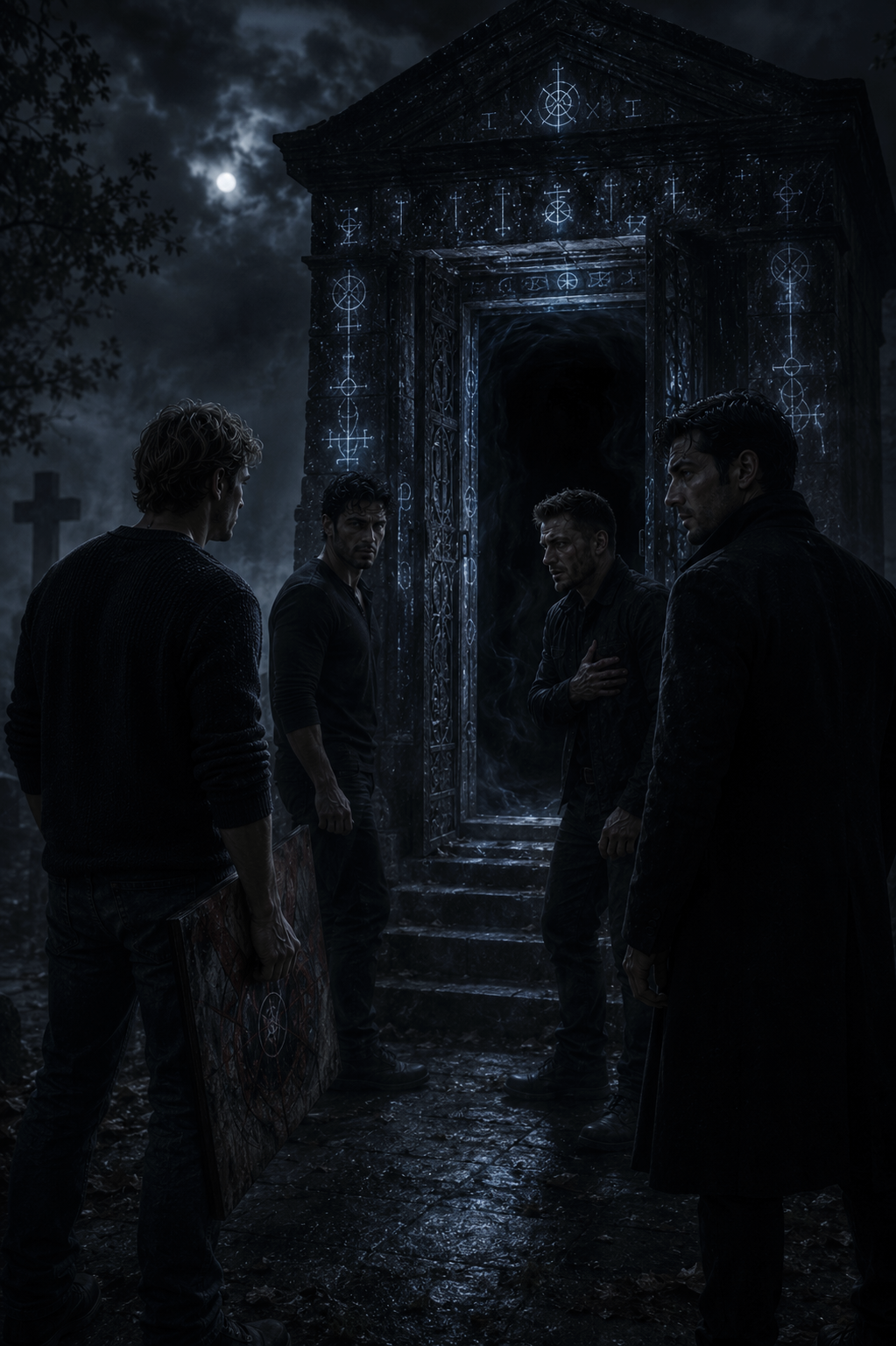
He was still staring at me.
His eyes were warm and steady. Disconcertingly perceptive as well, and they were looking at me as if I were a door he’d been waiting to open. As if he’d seen me before. As if he knew me, in a way that had nothing to do with the careful distance I maintained between myself and everyone else.
I looked away. Forced my attention to the symbols on the mausoleum door. Cold. Geometric. Comprehensible. Unlike the man watching me with that expression of patient, unshakeable curiosity.
“Gabriel Iturbide,” I said. My voice came out formal, controlled, revealing nothing. “Independent occult researcher. I’ve been studying this site.”
The name landed with weight. It registered on their faces. Vale’s silent recognition, Callahan’s narrowed suspicion, Mercer’s sharp scrutiny. Iturbide. The same name carved into the mausoleum. The same name that had followed me all my life like a shadow.
“You’re one of them,” Mercer spoke in a clipped, sarcastic tone. “One of us. Whatever ‘us’ is.”
“I am a researcher,” I repeated, as if saying it again would make it true. “I have no affiliation with—”
“Bullshit,” Callahan said. My jaw tightened.
“I beg your pardon?”
“You heard me.” The shield’s voice was a low growl. The pressure of his signature pushed against my wards and tested their boundaries. “You feel the same hum we do. The same pull. You’re not here because you’re curious. You’re here because you can’t stay away.”
I opened my mouth to deny it. The words were there. Words I had prepared and rehearsed . . . careful evasions I had spent a lifetime perfecting. But before I could speak, Mercer shifted his weight, and the movement drew my attention to the door.
The symbols flared up brighter now. The blue light was pulsing faster, synchronizing with a resonance in my chest. It was a four-note chord that resonated through the fog like a tuning fork struck against stone.
And then the surge. The four of us were standing in the clearing together for the first time, our bloodline signatures overlapping. They were amplifying and harmonizing in a way that made my meticulously constructed wards sing with notes that weren’t alarm.
Mercer flinched and clutched his chest. Callahan’s power surged, a concussive wave that rattled the mausoleum door, before he wrestled it back under control. The artist’s breath caught, his canvas trembling in his hands.
And I . . . .
My mask slipped. Just for a moment. Just long enough for a raw and terrified and desperately hopeful expression to show through.
The artist saw it. Of course he did. He was still looking at me.
And then he turned the painting toward me. Four figures in the fog, one standing apart, wrapped in shadows. Me. He had been painting me. For weeks, he’d said. Before we’d ever met. Before any of this had begun.
The air left my lungs.
“I don’t know what’s happening, but I think we’re supposed to be here. All of us. I think we’ve been moving toward this moment for a long time.” Adrian’s voice was so gentle, so present, that I couldn’t look away.
The hum peaked in a chord of four notes and rang through the clearing like a bell before settling into a quieter sound. Expectant. Waiting.
The mausoleum door pulsed twice before the symbols on its surface shifted and began rearranging themselves into patterns I didn’t recognize.
“Alright,” Mercer said in a ragged voice. “Anyone have a manual? A pamphlet? An interpretive dance that explains what just happened?”

Adrian’s Point of View
Gabriel moved toward the mausoleum like a man walking into a familiar room and finding all the furniture rearranged.
His posture changed as his gloved fingers traced the symbols on the stone. His rigid control softened by degrees as he fell into the rhythm of expertise. This was a language he understood. The glyphs and sigils and interlocking circles were a grammar he’d been trained to read. For the first time since he’d stepped out of the fog, he was a man who’d found his footing, not one bracing for impact.
“These are binding marks. Iturbide family sigils. They’re designed to contain, to create a seal between what’s inside and what’s outside.” Gabriel said.
Kyle cut in, testy. “What’s inside? What prison? What’s behind that door?” His eyes scanned the clearing with the hypervigilance of someone who’d learned young that exits were more important than entrances.
Gabriel hesitated only half a second but we all saw it.
“You don’t know,” Kyle said. It was not a question.
“I have theories.” The careful precision of that single word was a door slammed shut. He was holding back. Maybe to protect us. Maybe to protect himself. Maybe the truth was a reality he hadn’t let himself look at yet.
“Great,” Kyle muttered. “Theories. Love that for us.”
But Gabriel had stopped listening. His hand had stopped on the stone and his fingers pressed on a section of the wall near the base, where the moss grew thickest. His expression had gone somber. Not the composed stillness of his usual camouflage, but a fragile thing.
“There’s something here,” he said.
I moved closer drawn by the shift in his voice. The symbols were pulsing faster now and their blue light cast strange shadows across his face. When he brushed the moss away from the stone, I saw what had made him freeze.
Letters. Crude, weathered, letters carved into the granite decades ago by a hand that had pressed hard enough to leave grooves.
G.I.
“Gabriel Iturbide, those are your initials.” I said. The air was thick and charged with an energy I couldn’t name.
“They can’t be. I’ve never been here. I’ve never seen this mausoleum until—”
“Until a week ago. When the pull started.”
He didn’t answer. His gloved hand still pressed to the stone, his fingers traced the grooves of the carved letters, and the conflict played out in the muscles of his face and in the way his shoulders drew up toward his ears.
“Someone carved your initials into this mausoleum decades before you were born,” I said, keeping my voice gentle.
“My family has been preparing for this site for generations. The Iturbide line has always known that the prison would require a Warden. That one of us would be called to—”
“To what?” Kyle’s voice cut in. He was sharp and demanding. “To seal themselves inside? To become the lock?”
Gabriel didn’t answer but his silence was answer enough.
“Jesus. That’s why you’re here. You’re not researching. You’re planning to—”
“I am here to do what is necessary,” Gabriel said. The words came out cold and precise. “Whatever that may be.”
“No.” The word came out of my mouth before I could stop it. Gabriel turned to look at me, his dark eyes unreadable, and the weight of his attention landed on me like a physical thing. “Whatever’s happening here . . . whatever’s behind that door . . . we face it together. All of us. You’re not going to—”
“You don’t understand. This is what I was trained for. The Warden must stand alone. Any attachment is a vulnerability that the Hollow can exploit.” His mask cracked again as he spoke, that flicker of raw, exhausted, and desperately lonely.
“That’s a lie,” Luke said.
“I beg your pardon?” Gabriel blinked.
“You heard me.” Luke’s voice was a low rumble, but there was gentleness in it. The same gentleness I’d seen him fighting to express when he looked at Kyle.
“You’re not standing alone. You’re standing in a graveyard with three other people who’ve been dragged into the same nightmare. Whatever this thing is, it’s coming for all of us. You think shutting us out makes you stronger?”
“It is not about strength. It is about minimizing risk. If I allow myself to . . . to care—”
“Too late,” Kyle’s voice was flat, but his eyes flicked to Luke for a fraction of a second. “We’re already here. We’re already connected. Whatever the bloodlines did to us, it’s done. So maybe stop pretending you’re the only one with something to lose.”
Gabriel looked at him for a long moment. Then at Luke. Then at me.
The exhaustion, the fear, the desperate, hopeless longing that he’d been holding back since the moment he stepped into the clearing showed plainly. He was drowning in it. He’d been drowning in it for years, alone in the dark, with no one to throw him a line.
“You’re not alone,” I said. I stepped closer, close enough to see the way his hands were trembling inside his gloves, close enough to catch the faint scent of old paper and candle wax that clung to his coat. “Gabriel. You’re not alone in this anymore. None of us are.”
He didn’t respond. But he didn’t pull away, either. And for a moment his shield slipped, and I saw the man underneath, exhausted, terrified, and so achingly beautiful that my chest hurt just looking at him.
The symbols on the door flared white. The hum built to a shriek.
And then the world tumbled sideways.

Kyle’s Point of View
The light hit like a concussion grenade.
Blue-white fire erupted from the carvings. My scar blazed—the three parallel lines that had been a mystery since I was seventeen—and my knees gave out. Gravel bit through my jeans. Blood dripped from my nose. None of it mattered because the door was open, a gaping throat of shadow behind the iron, and the pull that had been dragging me here every night became a shove.
Something inside wanted us. Something inside was hungry.
Luke’s power detonated.
The concussive wave hit before I saw it, rattling my teeth, turning the air sharp with ozone. He wedged his kinetic force between us and whatever was pulling from inside, holding the line. His face twisted with effort. The pressure of his signature was a physical weight pressing against the darkness flowing out of the door like cold honey.
Gabriel’s wards shattered. The sound was ice breaking under too much weight. He staggered, hand flying to his chest. The symbols on the doorframe were rewriting themselves too fast to follow, and the blue light pulsed in time with my heartbeat, with Luke’s heartbeat, with all our heartbeats locked into one terrible rhythm.
Adrian clutched his canvas, his eyes wide, his mouth moving, words lost to the roaring in my ears.
And then the darkness pulled.
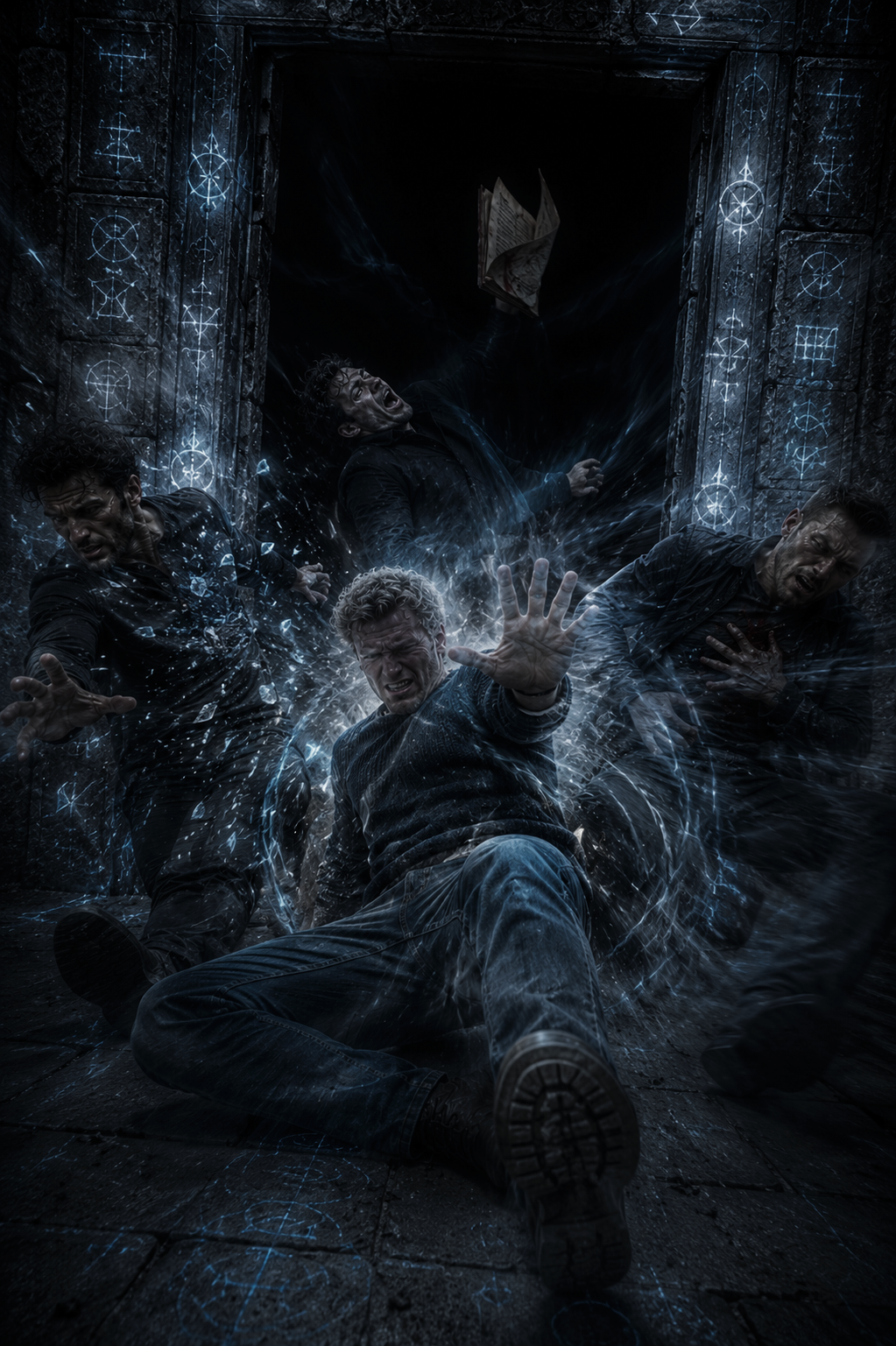
It wasn’t a physical force, not exactly. Like gravity reversing. Like the world tilting. Like every step I’d taken toward this mausoleum had been leading to this single moment. My feet moved without permission. Luke staggered forward, still fighting. Gabriel’s wards flared and died. Adrian’s canvas tore from his hands and spun into the dark ahead of us.
We crossed the threshold together.
The iron door slammed behind us. The sound of a guillotine falling.
The blue light cut off.
The silence pressed down on my eardrums. The darkness was so complete I couldn’t see my own hands. Couldn’t see Luke. But his body heat was there, his breathing ragged. His power surged and crashed against the walls of whatever space had swallowed us.
“Everyone alive?” My voice came out steadier than my hands.
“Here,” Adrian said, somewhere to my left. His voice was shaky but intact.
“I am unharmed,” Gabriel said. The formality was back like a shield, but a tremor ran underneath. “Physically, at least.”
“Luke?”
A pause. “Yeah.”
One word, but I could hear the effort behind it. The struggle to leash his power, to keep the concussive force from hurting someone. Hurting me.
Trapped.
The word surfaced before I could stop it. My chest tightened. My breath went shallow and fast. My hands were shaking. My scar still burned, but the pain was distant now, muffled by the panic crashing through my skull.
I pressed my palm flat against the iron door behind me. Cold. Immovable. No latch, no handle, no seam I could find with my fingers. The door had sealed itself as completely as if it had never existed at all.
I’d been locked in places before. A closet in a foster home I couldn’t remember the name of. A basement I’d learned to pick the lock on with a bent paperclip. The body remembers even when the mind doesn’t. My lungs were pulling shallow now, my fingers gone cold at the tips. Luke was two feet away. I could feel the heat of him, the weight of his attention, but I couldn’t look at him. Couldn’t let him see me like this. My face was wet. Blood or sweat. I wasn’t going to check which.
“We’re inside,” I said. “The door . . . it’s sealed. I can’t find a way to open it.”
The words came out flat, which was something. My palm was still pressed to the iron, and the cold of it was grounding. Stone. Metal. Real things. I counted them. The ache in my chest was not real in the same way. It was older than this door, older than the mausoleum, older than whatever had just swallowed us.
The darkness pressed closer. Somewhere deeper, something shifted. Stone grinding against stone. Or something heavier. Something that breathed.
“Gabriel,” Adrian said, his voice cutting through the panic like a lantern in the dark. “You said the seal responds to our presence. Can you—”
“Perhaps. The symbols on the exterior were Iturbide work. The binding language is familiar. But this . . .” He paused. His gloved fingers whispered against the stone. “This interior is older. The wards are not responding. It’s as if—”
“As if they’re waiting for something,” Adrian finished.
A cold blue light flickered to life on the wall. Not the violent flare from before, but a deliberate illumination. It wanted to be seen.
THEY MUST NEVER MEET.
The words pulsed and stabilized, glowing with a cold fire that matched the hum in my chest. A scar of light on the stone. A warning waiting for centuries.
I pressed my palm to the words. The stone was cold, but the light was warm. Not physically warm, but in some frequency that resonated with the scar on my chest and the pull toward Luke and the symbols that had been appearing on my apartment wall. The same frequency. The same origin. The same warning we had just violated.
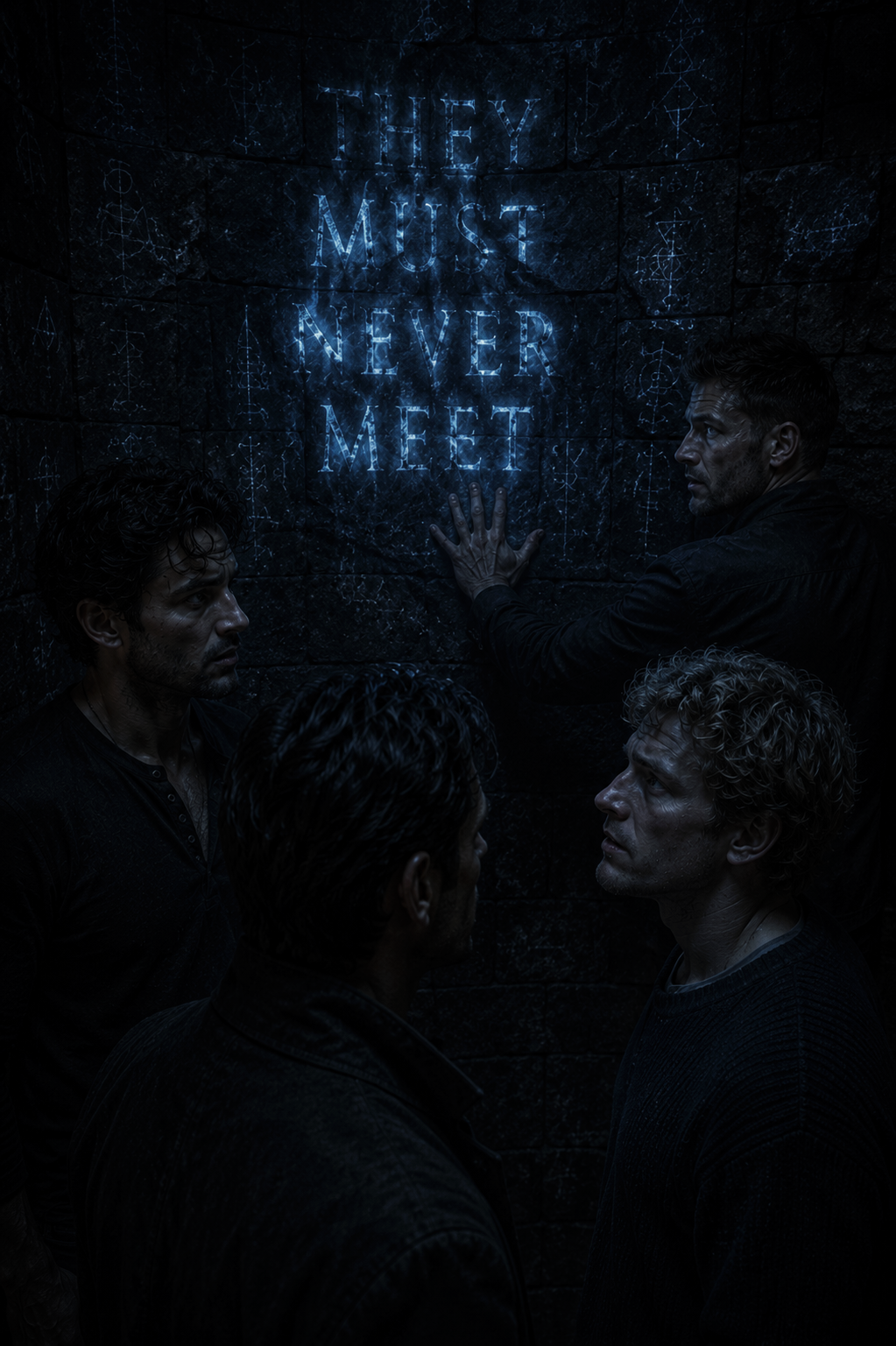
My hand was still there when the light changed. The warning didn’t fade, it shifted, the cold blue deepening at the edges, and I felt something inside the stone push back against my palm. Not hostile. Testing. Like the door was reading me. The scar on my chest answered with a pulse of its own, and for half a second the light flared bright enough to throw our shadows against the far wall.
Then it settled. Waiting.
I pulled my hand away. The warmth stayed in my fingers.
They must never meet.
Too late. We were already here. The four of us, sealed inside a mausoleum that had been waiting for us, bound together by something that predated all of us. The prohibition had been broken the moment we stepped into the same clearing, and whatever was supposed to happen next was already in motion.
“They were afraid,” Adrian said.
I turned to look at him. His face was pale in the blue glow, strained but steady. His canvas was gone, torn from his hands when the darkness pulled us in, but his eyes were still sharp.
“Someone didn’t want us to find each other,” he continued. “They carved a warning into the wall and scattered the bloodlines and made sure we’d never be in the same place at the same time. They were afraid of what we could do together.”
“The warning is explicit,” Gabriel said. His voice had lost some of its certainty. “The pact was clear. The four bloodlines were meant to stay separate. To converge is to—”
“To what? Break the seal we didn’t know existed until five minutes ago? The seal that was already weakening before we got here?”
Gabriel didn’t answer.
Then the pressure shifted.
Subtle at first, it was just a change in the air, a softening of the oppressive weight. The hum in my chest, which had been a shrieking discord since the symbols flared, began to settle. To harmonize. The four-note chord resolved into almost peaceful tones.
My scar cooled. The ache in my chest faded to a warmth that was almost pleasant. The absence of it was like taking off a heavy pack after miles of walking. My shoulders wanted to sag, my knees wanted to buckle, and I had to lock them just to stay upright.
Luke’s power steadied. The chaotic pressure of his signature smoothed into a solid and grounded energy. It became a shield at rest rather than a weapon straining for release. I could feel the difference in the air between us. The weight of him was still there, still immense, but it wasn’t pressing anymore. It was just . . . present. Solid. Something you could lean against if you wanted to.
I wasn’t going to. But I noticed it.
Gabriel’s wards, flickering and unstable since the door closed, began to glow with soft, steady light. He looked down at his gloved hands as if he didn’t recognize them.
“There,” Adrian whispered. “That’s what it’s supposed to feel like.”
I didn’t know what he meant. But standing there in the dark, with the blue light flickering on the walls and the hum singing quietly in my chest, maybe I did. The four of us, sealed in, and for the first time since I’d woken up with three scars on my chest and no memory of how they got there, the noise in my head was quiet. Not gone. But quiet. Like something that had been screaming for years had finally stopped to take a breath.

Adrian’s Point of View
The second message appeared while we were still catching our breath.
The blue light from THEY MUST NEVER MEET was fading, but as it dimmed, a new glow built on the opposite wall. Faint at first. Then stronger, carving letters into the granite.
The light moved like water finding cracks in stone. It spread sideways, pooling in the indentations, then hardening into something legible. I watched it happen and thought of paint bleeding into gesso, the way the canvas drinks it in and gives back something permanent. The stone was giving us something it had been holding for centuries.
Names.
MERCER
CALLAHAN
VALE
ITURBIDE
Four bloodline names in clean, deliberate strokes. Each one had a different weight to it. A different hand, different century, different person who had stood in this dark and left their mark. Mercer was carved deep and steady, the grooves worn smooth by time. Callahan was rougher, the letters angular, almost gouged. Vale had a gentler hand, the curves of the letters still visible. Iturbide was precise, measured, each stroke placed with the care of someone who understood that a symbol was a promise.
Below them, a fifth name, scored so deeply into the stone that the letters looked like wounds.
THORNE
A jagged line through it. Carved again and again. Whoever had put it there had been trying to obliterate it wholly.
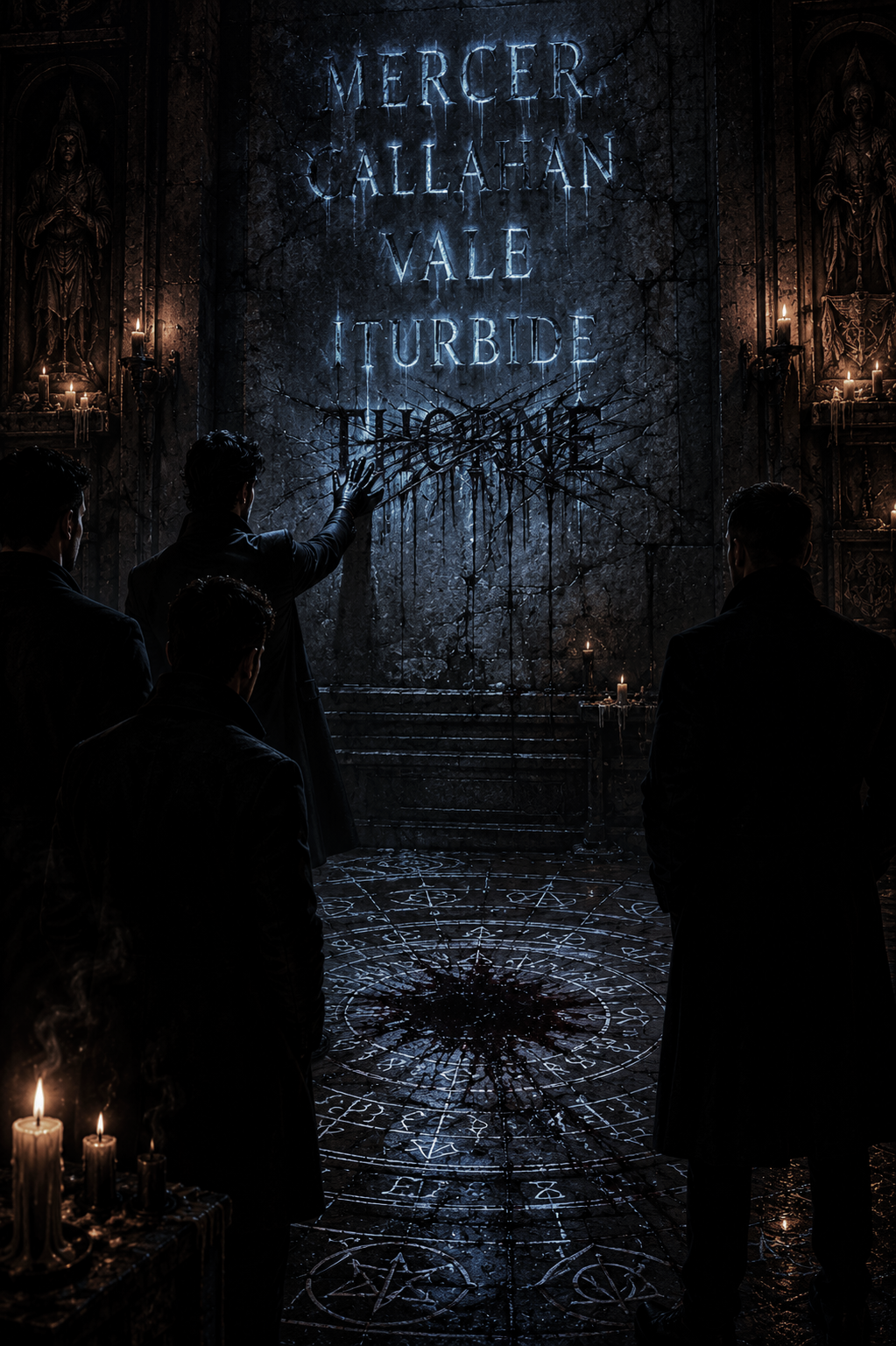
The stone around the name was paler than the rest. Scraped raw. Someone hadn’t just crossed it out. They had dug into the granite, over and over, as if the name itself was a contagion that had to be excised.
Gabriel made a sound. It wasn’t a word, just a breath, a catch in his throat, a fracture in his composure. His gloved fingers were trembling as they traced the obliterated name.
He didn’t touch the name itself. His hand hovered over the gouged-out hollow where the letters had been, and I watched his throat move as he swallowed. The mask was still up, but barely. I could see the architecture of him straining—the careful lattice of control, the wards he’d built around everything including his own grief—and I wanted to reach for him. I stayed where I was. He wasn’t ready. He might never be ready. But I was there, and he knew it.
“That’s been erased from all the family records,” he said in a hush. “Every mention of a fifth bloodline. Every reference to Thorne. My family’s archives go back four hundred years, and there’s not a single . . .” He stopped. Swallowed. “Whoever they were, someone made sure they were forgotten.”
“But not here,” I said. “Not inside the prison.”
“No.” Gabriel’s hand dropped to his side. “Not inside.”
The blue light pulsed, illuminating the chamber around us. Stone walls, ancient and damp, curving upward into darkness that swallowed the light before it could reach the ceiling. The space was small, maybe fifteen feet square, with no visible exit beyond the sealed door. In the center of the floor, a spiral of symbols radiated outward from a dark stain that looked centuries old and still wet.
Somewhere deeper in the mausoleum . . . below us, maybe, or behind the walls . . . something ancient stirred. The hum shifted. The blue light flickered in response.
“Gabriel,” I said.
He turned to look at me. His eyes were dark and guarded and so exhausted that my chest ached.
“The Thornes weren’t victims, were they? They’re the reason the pact forbade us from meeting. They’re the reason someone tried to erase their name.”
He didn’t answer. But he didn’t disagree, either.
“We’re going to find out what happened. Together.” I looked at the sealed door, at the spiral on the floor, at the three men standing with me in the dark. Luke’s power, steadied into an energy almost calm. Kyle’s scar, still glowing faintly beneath his shirt. Gabriel’s wards, flickering with light that matched the symbols on the walls. “But first we need to figure out how to get out.”
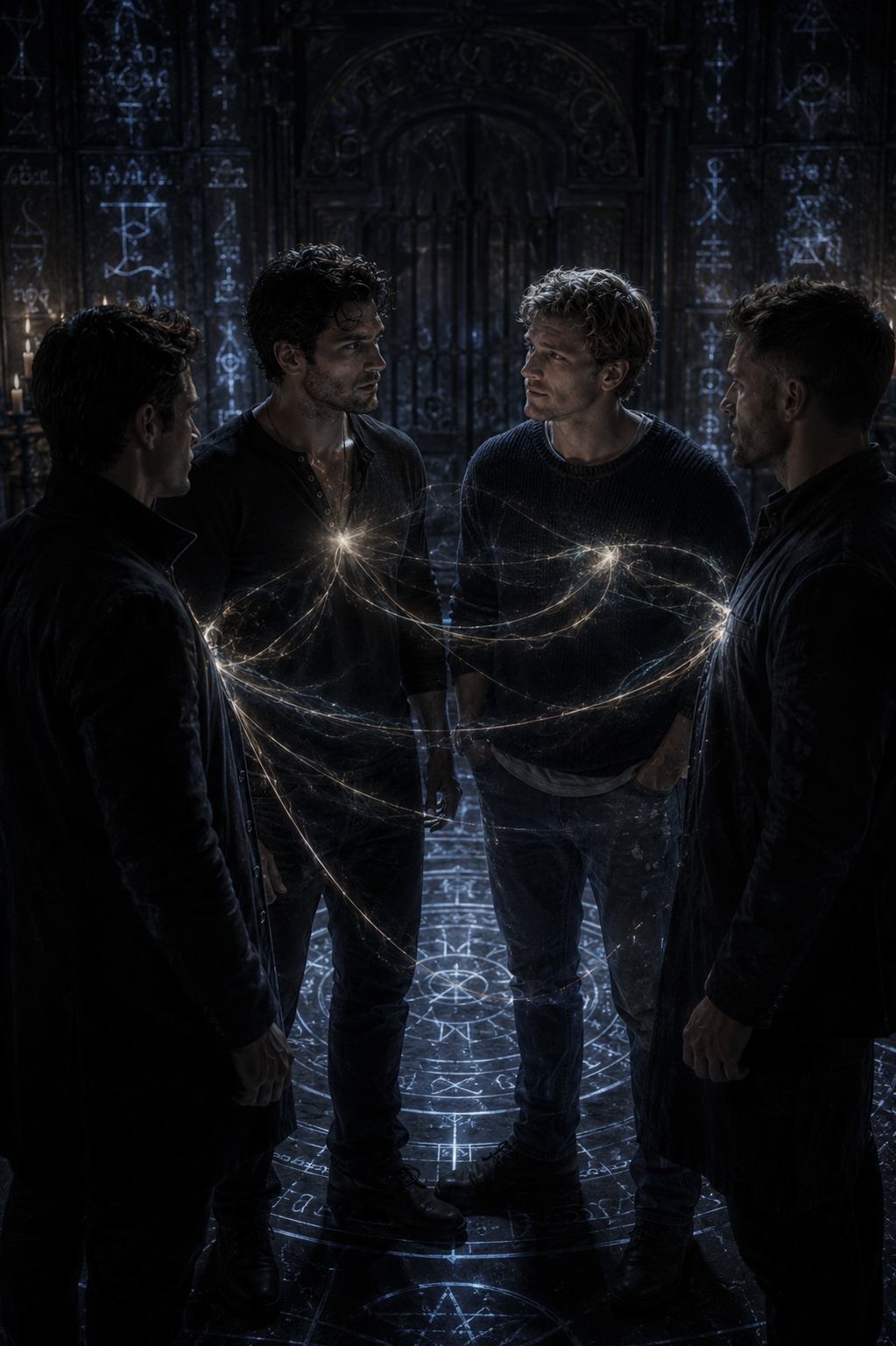
“The resonance,” I said. “Outside, it was chaos. In here, it’s settling. Harmonizing. What if that’s the key? They must never meet . . . unless they want to wake something up.”
Gabriel’s eyes widened. “The prison. The bindings. If the four bloodlines converging is what sealed us inside—”
“Then the four bloodlines working together might be what gets us out,” I finished.
The cold blue light flickered. The thing beneath us stirred again, closer this time. And in the dark, the name THORNE waited to be remembered.

End of Chapter 4.