

In the heart-wrenching climax of the heist, Morfeo delivers a script of calculated cruelty that shatters Til’s world, triggering the memory erasure that will strip him of every trace of their love. As Til dissolves into a blank, tear-streaked shell, Morfeo removes his dampener and is obliterated by the full weight of the love he stole. And the monster he’s become.

Morfeo’s Point of View
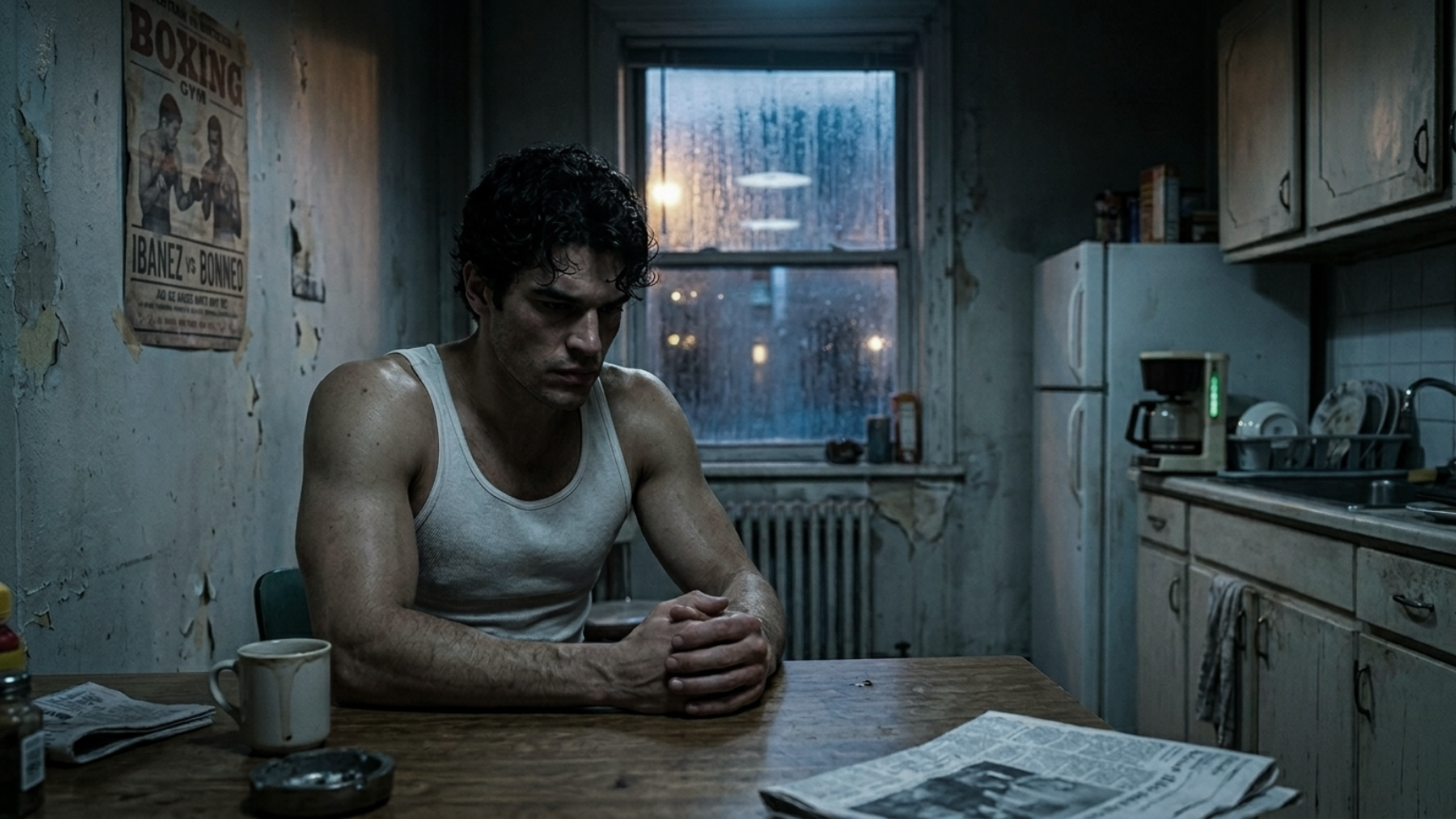
The coffee machine blinked its green eye at me from the kitchen counter.
I’d been standing in front of it for three minutes, watching the light pulse on and off, on and off, a small, faithful heartbeat in the pre-dawn dark. The mug in my hand had gone cold. I couldn’t remember pouring it. I couldn’t remember walking to the kitchen. I’d been doing that all night. Surfacing in rooms without knowing how I’d gotten there, finding myself at windows with no memory of crossing the floor.
The sun wasn’t up yet. The sky through the blinds was the color of a healing bruise, that yellowish gray that comes before the first actual light. The street below was peaceful in the way streets were just before the city woke. A garbage truck grinding somewhere distant, a car hissing past on wet pavement. Rain from the night before was still dripping down the windows, an irregular percussion against the glass.
I poured the cold coffee down the sink and made a fresh cup. My hands were steady. That surprised me. Every other part of me had been coming apart all night. The dry heaves on the front stoop, the shaking in my fingers when I’d crawled back into bed, the way my chest kept seizing up like a fist around my heart. My hands, though, when I needed them they were steady. The body’s betrayal of the mind, or maybe the mind’s betrayal of the body. I couldn’t decide which direction the knife was pointing.
I sat at his kitchen table. The surface was tacky with old coffee rings, a scatter of takeout menus, the boxing magazine he’d been thumbing through last week. A pair of his hand wraps hung over the back of the chair, still damp from where he’d washed them in the sink and hung them to dry. I touched the fabric. It was cool and slightly rough under my fingers, the elastic still stretched out from where his hands had been.
The neural display flickered in my peripheral vision. I’d been ignoring it for hours, but it was patient. It was always patient. A soft amber glow, pulsing in the corner of my eye, waiting for me to open the file.
I opened it.
The breakup script scrolled across my field of vision, white text on a black field, each line burning into my retina like a brand. I’d written this file six weeks ago, in a sterile rented room across town, before I’d ever kissed him. Before I’d washed his hair in the shower and traced the ladder of his spine with soap-slicked hands. Before I’d kneeled beside his bed and kissed his split knuckles. Before I knew he made a small sound in his sleep when he turned over, a little exhale like a question no one was meant to answer. Before any of it.
The words hadn’t changed. They were the same words I’d typed with clinical precision, the kind of language you use when you’re assembling a machine and not dismantling a human being.
You’re suffocating me. You’re too needy. Your love is a weight I don’t want to carry.
I was practicing. You were a lay, not a life.
It meant nothing.
I closed the file. Opened it again. The words were still there, patient and terrible, waiting to be spoken.
The coffee had gone cold again. I drank it anyway. It tasted like the dregs of something already finished, bitter and thin, and I let it sit on my tongue until I couldn’t stand it anymore.
From the bedroom, the rustle of sheets. A small sound. His small sound, the exhale question. Then silence. He was still asleep. I had maybe an hour before he woke, before the morning light reached his face and pulled him up out of whatever dream he was having. An hour to become the person who could do this.

I’d put the dampener back in at four in the morning.
Not because I wanted to. Because I had to. Because I’d spent the entire night without it, feeling everything, and everything was too big to carry into the room where I was going to destroy him. The dampener didn’t make me feel nothing. I had set it low, to the lowest setting, a whisper instead of a wall. It took the sharpest edges off. It made the guilt into something I could hold at arm’s length and examine instead of drowning in. It let me breathe.
I hated it. I hated what it allowed me to do. I hated I needed it.
But I needed it.
The dampener hummed behind my ear, a faint vibration I could feel in my teeth if I paid attention. The scar where it connected was still tender from having it out all night, the skin around it pink and raised. Til had kissed that scar last night. He’d traced it with his thumb and asked what it was really from, and I’d . . . I’d said nothing. I’d closed my eyes and let the silence answer for me. And he’d let it go, because he was Til, because he never pushed, because he trusted me to tell him when I was ready.
I would never be ready.
I pulled up the neural display again and scrolled past the breakup script to the harvest protocols. Stilo had sent them yesterday, a terse little packet of instructions bundled in corporate boilerplate. Final consummation sequence: Deliver script. Initiate emotional freefall. Trigger harvest when readings peak. Activate memory erosion within sixty seconds of peak. Do not deviate. Do not delay. Confirm completion within one hour of extraction.
I’d read it a dozen times. I’d memorized every word, every step, every precisely calibrated cruelty. And I still didn’t know if I could do it.
But that was the lie, wasn’t it? The comfortable, cowardly lie I’d been telling myself for weeks. I don’t know if I can do it. I don’t know if I can go through with it. I knew. I’d always known. From the moment I sat down across from him in that diner, both of us rain soaked and pretending we hadn’t already fallen into something we couldn’t name, I’d known exactly how this was going to end. I was an Extractor. This is what Extractors did. The dampener, the harvest, the erasure . . . they were just tools. The betrayal was the job.
I’d just never understood, until now, that the job would extract something from me too.
I finished the cold coffee. Put the mug in the sink. Watched the first proper light of dawn seep through the blinds and stripe the floor in bands of pale gold. The Ibanez poster caught the light. Marco “The Saint” Ibanez, beaten and bloodied and still standing, staring down through the years at a kid who believed that heart was enough. Til believed that too. He believed that showing up was enough. He believed that loving someone hard enough could make them stay.
The light reached the bedroom doorway. The sheets rustled again.
Showtime.

Til’s Point of View
I woke up to coffee in the air and the sound of rain.
No, the rain had stopped. What I was hearing was the drip down the windows, the last of the night’s storm working its way down the sides of the building, and for a moment I just lay there with my eyes closed, tracking the sound. Drip. Drip. Drip. Steady as a heartbeat. Softer than it should have been. The world still muffled by the thin membrane of sleep.
My body announced itself in stages. First the ribs, a dull throb that flared when I breathed too deep. Then the shoulder, stiff and hot and angry at having been asked to throw punches for twelve rounds and then left in one position all night. Then the eye. The left one, still swollen, still a hot, pulsing weight under the lid. I tried to open it and managed a slit, a narrow wedge of blurry light. Good enough. I’d fought with worse.
The bed beside me was empty.
I reached for him anyway. My hand slid across the sheet where his body had been, and the fabric was still warm, still holding the shape of him. He hadn’t been gone long. The pillow smelled like his hair. Coffee and cedar and something sweeter underneath, the shampoo we shared now because we’d stopped keeping track of whose was whose. I pressed my face into it and breathed, and for a moment I was still in the night before, still wrapped around him, still feeling him inside me, still hearing his voice in my ear: I’m here. I’m yours.
Then I opened my eyes.
Something was different. Not in the room, the room was the same as always. The same bare walls and dirty laundry and boxing posters, the same Ibanez print above my bed, the same water stain on the ceiling that looked like a map of an island I’d never visit. The difference was in the air. A wrongness. A charge, like the eerie calm before a storm, like the moment before the bell rings and you know you’re about to get hit.
I sat up. My ribs screamed. I ignored them.
The bedroom door was open. Through it, I could see the living room and the kitchen beyond. The coffee machine was on, I could smell it, and someone was standing at the counter. Morfeo. He was dressed. Fully dressed. Jeans, a white tank top, his jacket already on his shoulders. A bag at his feet. The black duffel he’d brought over weeks ago, the one he’d been living out of, the one that had started to feel like a permanent fixture in the corner by the door.
It wasn’t in the corner anymore. It was at his feet. Packed.
I didn’t think the thought. Somewhere low in my stomach a cold drop spread outward through my gut. My hands tightened on the sheets. The fabric was still damp with sweat. Mine, or his, or both, the shared humidity of two bodies sleeping tangled.
I got up. Pulled on the boxers from last night, the ones he’d peeled off me with such patience, such excruciating care. They were still inside out. I didn’t fix them.
“Hey,” I said, stepping into the kitchen.
He didn’t turn around.
“Morfeo.”
He turned.
His face. His face was . . . .
I’d seen him careful. I’d seen him guarded. I’d seen the mask he wore when he was managing his presentation, the screen behind which he kept whatever he wasn’t ready to show. Months of watching him, of cataloguing his expressions, of learning the difference between his genuine smile and the one he used for strangers and I’d thought I’d seen every version of him there was. I was mistaken. This face was unfamiliar. This face was a locked door where there had never been a door before. This face was a stranger wearing the skin of the man I loved.
“Sit down,” he said.
His voice matched his face. Flat. Calibrated. The voice of a man reading lines off a screen.
My legs were stiff. The floor was cold. Everything was cold, and I didn’t know why, and the drop in my stomach was spreading now, turning into something with weight and teeth.
“What’s going on?” I asked.
“Sit down, Til.”
I sat. The kitchen chair creaked under me. The table was between us, a narrow battlefield of old coffee rings and takeout menus. I put my hands on the table to steady them. The knuckles were still raw, still split. He’d kissed those splits last night. He’d kneeled beside my bed and pressed his mouth to every wound and wept, and now he was standing on the other side of the kitchen with a bag packed and a face I didn’t recognize.
He stayed standing. Didn’t come closer. Didn’t sit. Didn’t touch me.
Somewhere in the back of my mind, a piece of last night came loose and fell. Don’t leave me, I’d said. And he’d paused. A fraction of a second too long. I’m here. I’m yours. But he hadn’t promised. I’d asked him to promise, and he’d said something else, something close but not the same, and I’d been too tired and too hurt and too in love to notice.
My throat closed.
“Til,” he said, and the sound of my name in that flat, bitter voice made my stomach lurch. “We need to talk.”
“No,” I said. The word came out before I could stop it, small and stupid and desperate. “No, whatever this is . . . whatever’s happening . . . no. Not after last night. Please. Not after last night.”
Something flickered across his face. A crack in the door, there and then gone. Then the mask came down again, harder this time, and he was the stranger again.
“Last night was a mistake,” he said.
The words landed like a hook to the ribs. They pelted my chest, my gut, the place behind my ribs that had been full of him for months and was now, suddenly, empty.
“What are you talking about?” My voice was rising. I could hear it, the shake in it, the crack, and I couldn’t control it. “You were . . . you were there. You were with me. You held me. You . . . you said you were mine.”
“I said a lot of things.”
“You meant them.”
“I didn’t.”
“You cried. I saw you crying. You kneeled beside my bed and kissed my hands and cried, and you’re telling me you didn’t mean it?”
His jaw tightened. The muscle at the corner of his mouth jumped once, twice. “I was practicing.”
The words didn’t make sense. I heard it. I heard the sounds, the syllables, the shape of them, but they didn’t fit together into anything I understood. “Practicing?”
“I’m an Extractor.”
Still didn’t make sense. The word was new, alien, a piece of jargon from a world I didn’t know existed. “An extractor of what?”
“Emotions. I harvest emotional data. That’s what I do. That’s my job.”
The cold thing in my stomach was spreading faster now, reaching up into my chest, my throat. “That’s not . . . that doesn’t . . . what does that even mean?”
“It means everything between us was a performance. The first time we met. The gym. The diner. I scripted every conversation, every touch, and every word I said to you. Designed. Calibrated to make you fall in love with me as hard and as fast as possible.” His eyes were flat as stones. “It worked.”
I shook my head. The room was tilting, or maybe I was. “No. No, that’s not . . . I don’t believe you. You’re lying. You’re lying to me right now. I don’t know why, but you’re lying.”
“I’m not.”
“You are. I know you. I know you, Morfeo. I know the way you hold your jaw when you’re thinking. I know the sound you make when you’re falling asleep. I know the exact shade of your eyes in the morning. You can’t fake that. You can’t perform for three months straight and never break. I’ve seen you break. You broke last night.”
“That was the point.” His voice was cold, so cold, so controlled. “The more you believed it, the higher the yield. Your heartbreak . . . that’s the product. That’s what I’m here to collect. And last night got me everything I needed.”
I couldn’t breathe. My chest was too tight, the air too thin, the room too bright. “You’re telling me you felt nothing?”
“I’m telling you it meant nothing.”
The words landed in my chest and spread outward like a bruise, blooming under the skin, dark and hot and spreading. I’d heard those words before. Not in his voice, not in this kitchen, but in the voice of every person who’d ever left, every person who’d ever decided I wasn’t worth staying for. My mother, when she got sick and I couldn’t save her. My father, who’d walked out before I was old enough to remember his face. Every trainer who’d said I didn’t have what it takes. Every opponent who’d looked down at me from the winner’s corner.
Not enough. Never enough. Good for a fight, not for a life.
I stood up. The chair scraped back, loud in the quiet kitchen. “Why are you doing this?”
“Because it’s my job.”
“No.” I was shaking now, my whole body trembling, my hands clenched at my sides. “No, there’s something else. Something you’re not telling me. The scar behind your ear. You never told me what it was. That wasn’t a performance. That was real. You were protecting something. You were . . . you were scared.”
“It’s a dampener,” he said. His hand went to the scar, a gesture I’d seen a hundred times, a tic, a tell. “It regulates my emotional responses. Keeps me from feeling too much. So I can do the job without getting attached.” His mouth twisted into something that was almost a smile. “It’s been malfunctioning. That’s what you saw. Glitches. Noise in the system. Not feelings. Never feelings.”
The floor was dropping out from under me. Everything I’d believed, every touch, every whispered word, every moment I’d let myself think was real. It was being rewired into something else. A lie. A scheme. A con. And the worst part, the part that made me want to double over and empty my stomach onto the floor, was that I could feel myself starting to believe it.
Because people had left me before. People had always left me before. And maybe, maybe this was just the universe proving, once again, that anyone I loved would eventually find a reason to go.
“You’re a monster,” I said.
“I’m an employee.”
“You’re a monster. You came into my life. You came into my gym, my bed, my body and you made me believe . . .” My voice broke. I couldn’t hold it. I couldn’t hold any of it. “You made me believe I was worth loving. You made me believe someone could see me. All of me, every scar, every broken piece, and not run. And it was all a lie.”
He didn’t answer. He just stood there, his bag at his feet, his face a mask, and the silence was worse than anything he could have said.
“Say something,” I spat. “Say anything. You owe me that much. You owe me something real after everything you stole.”
A long pause. “I owe you nothing.”
I hit him.
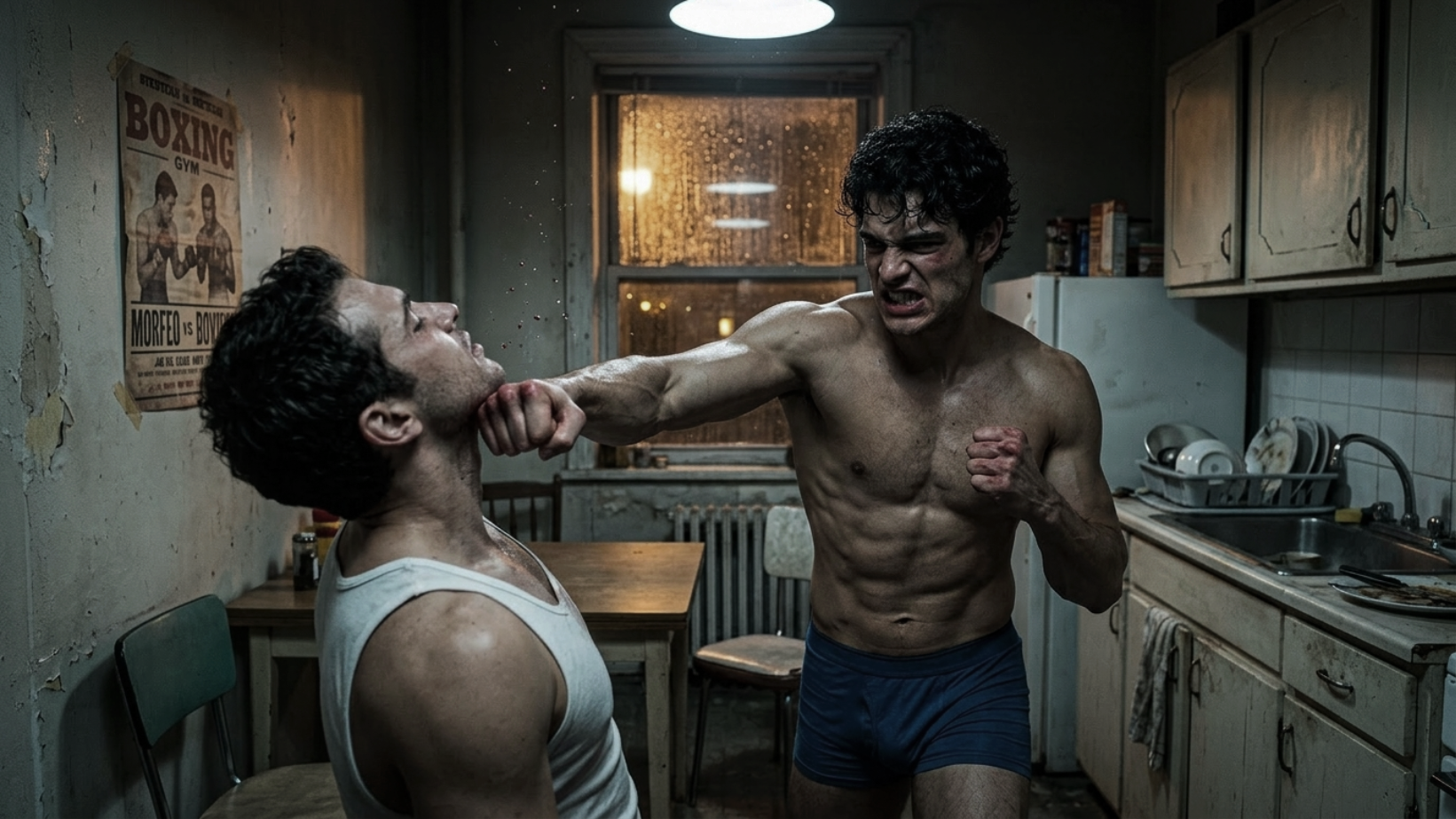
My right hand, the swollen one with the split knuckles, the hand he’d kissed last night. It connected with his jaw before I knew I’d thrown it. The impact jolted up my arm, a bright shard of pain that woke every bruise and every torn muscle. His head snapped back. He stumbled and caught himself on the counter. His hand went to his mouth and came away red.
I stood there, breathing hard, my fist still raised, my whole body screaming. His blood on my knuckles. His blood mixed with the scabs he’d kissed last night.
He looked at the blood on his fingers. Then at me. His eyes were still flat, still cold, but there was something underneath now. Something that looked almost like relief. Like he’d been waiting for me to hit him. Like he’d needed me to prove that he deserved what was coming.
“Feel better?” he asked.
“No.”
“Good,” he wiped his mouth on the back of his hand. A smear of red across his knuckles. “That’s the first honest thing you’ve given me in weeks. Hold on to that feeling. It’ll be gone soon.”
I didn’t understand what he meant. Not yet.
He picked up his bag. Walked past me close enough that I could smell him. The coffee and cedar and sweat, the smell of the bed we’d shared hours ago, and he paused at the door. His hand was on the knob. His back to me.
“You want to know the worst part?” he said.
I couldn’t answer. My throat was closed. My eyes were furious and blurring.
“You’re not going to remember any of this.” He turned his head, just slightly, and I saw the edge of his profile. The scar behind his ear, the line of his jaw, the mouth I’d kissed a hundred times. “In about three minutes, you won’t remember me at all.”
The door closed.
He was gone.

I stood in the middle of the kitchen for what felt like a long time. The coffee machine was still blinking its green light. Takeout menus still scattered on the table. The mug he always used, the blue one with the chip in the rim, was still by the sink, half full and cold.
I picked it up. Held it in both hands. My knuckles left a smear of blood on the ceramic, and I stared at that smear for a long time, thinking about the way his mouth had looked when my fist connected, the way his head had snapped back, the way he’d looked at his own blood on his fingers like it belonged to someone else.
You’re not going to remember any of this.
My legs gave out. I don’t remember deciding to sit down, but I was on the floor, my back against the cabinets, the cold linoleum under my thighs. The mug was still in my hands. I couldn’t put it down. If I put it down, something was going to end, something I didn’t know how to name.
The tears came. Not the clean, cathartic tears of a good cry. These were ugly, tearing things, ripped out of my chest like something being extracted. I bent over the mug and sobbed, and the sound was an animal sound, a howl that hurt my throat, and I couldn’t stop, couldn’t slow down, couldn’t breathe. Everything I’d held back in front of him—the pleading, the screaming, the begging—came out now, in the empty kitchen, with no one to hear.
“Please,” I said. The word came out wet and broken, addressed to no one. “Please, please, please.”
I don’t know who I was asking. Morfeo, to come back. God, to undo the last twenty minutes. The universe, to give me back the person I’d been this morning, when I’d woken up to the smell of coffee and believed I was loved.
The room was getting fuzzy. At first, I thought it was the tears. My good eye was swimming, the swollen one still a slit of blurry light, but this was different. This wasn’t crying. This was something else. A hum, low and distant, vibrated at the base of my skull. A warmth spreading behind my ears, down my neck, into the space between my thoughts.
I tried to stand up. My legs didn’t work.
You’re not going to remember any of this.
The hum grew louder. The warmth grew warmer. And the thoughts . . . the thoughts were slipping. I’d reach for one and it would slide out of my grip like a wet fish, there and then gone, leaving behind only the impression of where it had been.
His face. I could still see his face. Dark eyes. Dark hair. The scar behind his ear . . . .
No.
The scar was fading. The details were blurring. I could remember . . . I could remember that there was something to remember, but I couldn’t . . . .
The gym. The diner. The way he’d called me beautiful. The way he’d washed my hair.
No.
No, no, no . . . .
I was on my feet. I didn’t remember standing up, but I was standing, and the mug was on the floor, and my hands were empty, and I was walking, staggering, toward the window. The window. The window he’d . . . the window where I’d . . . where someone had . . . .
I reached the glass and pressed my forehead against it, the cold a jolt in the spreading warmth of the hum. Outside, the street was gray with morning, the neon signs dark, the wet pavement reflecting the sky. A figure in a white tank top was walking away. His shoulders were hunched. He was carrying a black duffel bag. He was . . . he was . . . .
Who was he?
I knew him. I knew I knew him. The shape of his walk, the set of his shoulders, the way he held his head. These things were familiar, bone familiar, as familiar as my own hands. But when I tried to put a name to the shape, when I tried to pull up a memory of his face, there was nothing there. Just a hollow. Just a space where something used to be.
I was crying. I could feel the tears on my face, hot and wet, but I didn’t know why. I was standing at the window, shirtless, my ribs bruised, my eye swollen, watching a man I didn’t know walk into a city I didn’t recognize. And I was crying, and I didn’t know why.
The figure reached the corner. Paused. Looked back, just for a moment, just a turn of the head, and then kept walking. The neon signs flickered. The street was empty.
I looked down at my hands. They were shaking. The knuckles were split, the skin puffy and pink, two of the splits crusted with dried blood. Someone had kissed these splits. Someone had kneeled beside a bed and pressed their mouth to every wound and wept. I could feel the ghost of that kiss on my skin. But I couldn’t remember the mouth. I couldn’t remember the face.
“What was I . . . ?”
The question died in my throat. I didn’t know how to finish it. I didn’t know what I’d been about to say.
On the nightstand was a pair of hand wraps. Old ones, the elastic stretched out, the white fabric gone gray with use. I didn’t know where they’d come from. I didn’t know why they were there. But when I picked them up, when I turned them over in my hands, my chest seized with something. With a grief so big and so sourceless that I was drowning on dry land.
I held the wraps to my face. Pressed them against my mouth. Breathed in. Coffee and cedar and eucalyptus, a smell that meant something, a smell that meant everything, a smell that meant . . . .
Nothing.
The smell was just a smell.
I dropped the wraps on the bed and went to the bathroom. The mirror showed me a face I didn’t recognize. Swollen eye. Split lip. Bruised jaw. The face of a fighter who’d lost. The face of a man who’d run out of things to believe in.
I turned on the shower. Stood under the spray and let the heat beat down on my back, my shoulders, my head. The water ran pink at first, then clear. I washed my hair with the shampoo on the ledge. It was cheap stuff, coffee and cedar, and I didn’t know why I owned it, didn’t remember buying it, didn’t remember choosing that particular brand. It was just there. It was just the shampoo I used.
When I got out, the apartment was silent. The coffee machine was still on. The blue mug was still on the floor. The hand wraps were still on the bed.
The Ibanez poster watched from the wall. I stared at him for a long time, waiting for the feeling he usually gave me. For the hope, the resolve, the reminder that showing up was enough. But the feeling didn’t come. The feeling wasn’t there. Something was missing, and I didn’t know what, and I didn’t know why, and I didn’t know how to get it back.
I lit a cigarette. Sat on the edge of the bed. Smoked in the gray morning light, watching the street through the blinds. The rain was starting again, a fine drizzle that blurred the neon signs and slicked the pavement. A woman walked past with a dog. A car hissed by, tires on wet asphalt. The city was waking up, and I was sitting in the ruin of a life I couldn’t remember building, holding a cigarette that tasted like ash, feeling a grief so deep it had no name.
I finished the cigarette. Stubbed it out in the ashtray on the nightstand.
Got dressed.
Went to the gym.

Morfeo’s Point of View
The harvest drive vibrated in my pocket as I hit the street.
A single pulse, followed by a steady hum. The data was streaming deep violet, the color of peak resonance, the purest heartbreak I’d ever collected. The readings on my neural display were spiking so high they flickered, threatening to overload. Heartbreak yield: exceptional. Emotional resonance: maximum grade. Memory erosion: initiated.
I kept walking.
My jaw throbbed where he’d hit me. The taste of copper was thick on my tongue, slick and warm, and when I probed the inside of my cheek with my tongue, I found a split where the tooth had cut. My blood, this time. Not his. Mine. He’d hit me with the hand I’d kissed last night. The split knuckles, the swollen joints, the skin I’d pressed my mouth to with a reverence that had nothing to do with the script. He’d hit me, and I’d felt it, and I’d been grateful.
Because it was something real. The only real thing in the whole performance. The only honest exchange we’d had in that kitchen.
I reached the corner and stopped. The dampener was humming behind my ear, a low, steady vibration I could feel in my molars. It was doing its job. I was functional. I was calm. I was the Extractor they’d made me, holding the harvest from the most successful extraction in company history, walking away from the wreckage like I’d been trained to do.
But I was also . . . .
I turned around.
He was at the window. Shirtless, his face wet, a cigarette smoldering in his hand. He was staring down at the street with the blank, empty expression of someone who had forgotten what he was looking for. The micro-mites were working. The erosion was almost complete. In another minute, he wouldn’t remember my face. In another hour, he wouldn’t remember that there had been something to forget.
I watched him. I couldn’t not watch him. The last time. The last sight of him, before he became a stranger and before I became a ghost.
His expression shifted. The grief was still there in the tears, in the trembling, but something behind it was going dark. The light that had been there, the light I’d fallen in love with, was flickering out. His mouth moved. I couldn’t hear the words, but I could read them on his lips: What was I . . . ?
He didn’t finish. He couldn’t finish. There was nothing left to finish.
I turned away.
The harvest drive pulsed in my pocket. Ninety-eight percent. Ninety-nine. Full.
The extraction was complete.
My phone buzzed. Stilo. I didn’t answer. I kept walking, my feet carrying me down the wet street, past the bodega, past the laundromat where a woman sat alone in the harsh white light, past the corner where Til and I had walked that first night, the night of the fight, the night he’d let me take him home. The rain was starting again. Another thin drizzle that plastered my hair to my forehead and soaked through my shirt. I didn’t care. I didn’t feel it. The dampener was good. The dampener was very, very good.
But it couldn’t block everything.
Because even through the hum, even through the rigorously calibrated suppression of every emotion I’d ever felt, I could still hear the sound he’d made. That animal howl, that wounded thing ripped out of his chest. I’d heard it through the door. I’d heard it all the way down the stairs. I was hearing it now, in my head, a loop that wouldn’t stop, a recording that had burned itself into my neurons.
You’re a monster.
I’m an employee.
You’re a monster.
He was right. He’d been right about everything. And I’d stood there with my bag packed and my face cold and my voice flat as a blade, and I’d delivered every line of that script like I was reading off a screen. Because I was. Because I had to. Because if I’d let myself feel a single second of it, I would have dropped to my knees and told him everything, and then the corporation would have come for both of us.
I reached the end of the street. Turned into the alley. Not the one where we’d first kissed, not the one behind the venue where I’d led him out into the rain, just a narrow passage between two buildings, dumpsters and fire escapes and the reek of old garbage. It was empty. I was alone.
I reached behind my ear. Found the dampener. Pulled it out.
The world hit me like a freight train.
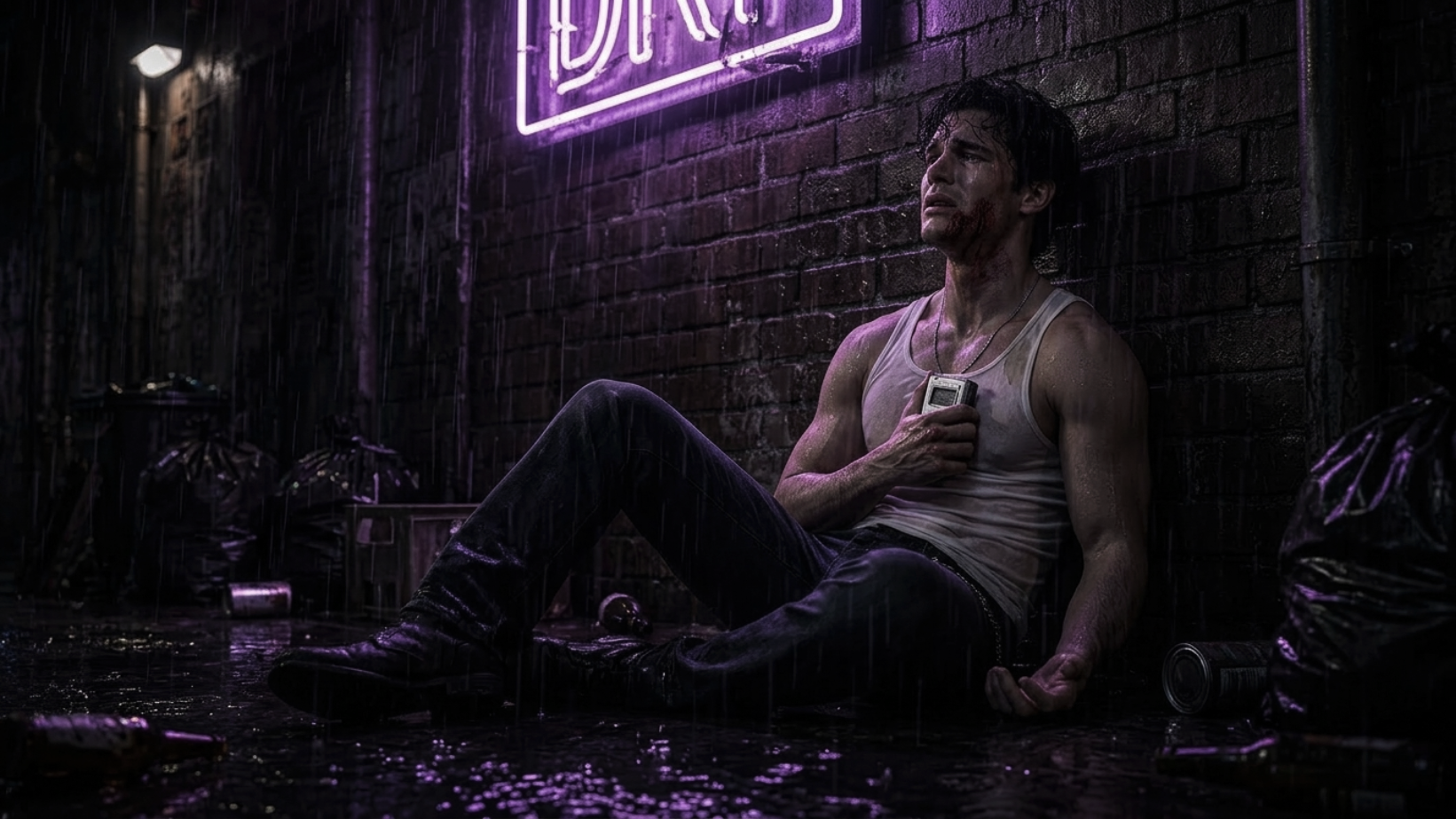
Everything the dampener had been suppressing, every feeling, every memory, every shred of the love and guilt and horror I’d been holding at bay flooded back in a single, obliterating wave. My knees buckled. The brick wall scraped my back as I slid down it. The full, undiluted force of what I’d just done, what I’d just said, what I’d just destroyed took up residence in my soul.
You were a lay, not a life.
It meant nothing.
I owe you nothing.
The words I’d spoken. The lies I’d told. The face I’d worn while I told them.
I bent over my knees and sobbed. The sound that came out of me was nothing like the controlled, calibrated Extractor I’d been trained to be. It was raw and ragged and ugly, a keening wail that scraped my throat raw, and it went on and on and on until I had nothing left to expel. I’d dry heaved on that stoop last night, and now I was dry heaving again, my stomach clenching around an emptiness that had no bottom.
“I’m sorry,” I said. The words were a whisper, cracked and broken, swallowed by the rain. “I’m sorry. I’m sorry. I loved you. I loved you.”
No one heard. The neon signs flickered indifferently. The rain kept falling, cold and steady, washing the blood from my mouth and the tears from my face and leaving nothing behind but the hollowed-out shell of a man who had extracted his own heart and left it in the chest of someone who would never remember him.
I stayed in that alley for a long time. Long enough for the rain to soak through my jacket, my shirt, my skin. Long enough for the dampener to dry out in my palm, its little silver casing slick with rainwater. Long enough to understand that what I’d done was permanent. Irreversible. Done.
The harvest drive was in my pocket. Full. Complete. The best extraction I’d ever performed, the data that would make my career, the yield that would buy me a promotion and a bonus and the cold, sterile approval of a corporation that had turned me into a weapon.
I wanted to destroy it. I wanted to throw it into the river, or smash it under my heel, or shove it into the nearest dumpster and watch the garbage truck take it away. But it wouldn’t matter. The data was already streaming to Stilo. The erasure was already complete. Til was already gone. The Til who loved me, the Til who’d let me wash his hair, the Til who’d whispered You’re the only thing that’s real. That Til was dead. I had killed him.
And I was still here.
I got to my feet. My legs were shaking. My jaw was throbbing. My hand, when I looked at it, was streaked with blood from my split lip. I wiped it on my jeans and started walking.
I didn’t know where I was going. I didn’t have a destination. I just walked block after block through the gray rain and the indifferent city, a ghost haunting the scene of his own crime. I walked past the diner where Til had told me he’d never been taken out like this. Past the gym where I’d watched him hit the heavy bag with that ferocious, hungry grace. Past the alley where he’d pushed me against wet brick and kissed me with the kind of desperate hope that only people who’d never been hurt could muster.
At some point, my phone buzzed again. Stilo. I pulled it out of my pocket, stared at the screen.
Extraction confirmed. Data received. Excellent work, Extractor. Report to the office for debrief and reassignment.
Reassignment. A new target. A new person to seduce, to destroy, to erase. The thought made me want to vomit, but there was nothing left in my stomach. Just acid and guilt and the endless, looping memory of Til’s face when I’d told him it meant nothing.
I typed a reply. Understood.
Sent it.
Turned off the phone.
The rain was heavier now, a steady downpour that filled the gutters and drummed on the awnings. I found myself at the riverfront, at the edge of the old warehouse district, standing on the concrete embankment and staring down at the water. It was gray and churning, swollen with rain, carrying debris downstream. Branches, plastic bags, the unidentifiable detritus of a city that never stopped shedding its skin. I thought about jumping. Not seriously. I wasn’t going to jump, but the thought was there, a dark shape at the edge of my mind, and I let it sit there for a while, letting the weight of it press down on me.
Then I turned away from the water and walked back into the city.
I didn’t have a home anymore. The apartment across town was just a room, a sterile box I’d rented for cover. The only place that had ever felt like home was the cramped one bedroom with the boxing poster and the broken coffee machine and the man who’d looked at me like I was worth loving.
And that was gone.
I was gone.
He was gone.

End of Chapter Four.