
Leo and Marcus have spent four years building an unspoken language behind the bar, but a single dinner invitation from two sophisticated regulars forces them to name what they’ve been afraid to claim. As curiosity, love, and long-buried insecurities surface over candlelight and city views, they make a fragile pact to explore another couple together, only to face their first real test when a handsome stranger slides his number across the polished wood during the very next shift.

Leo’s Point of View
The email arrived during the slow hour between the after-work crowd and the late-night regulars. I was restocking the speed rail, the necks of the bottles cold against my fingers, when my phone buzzed against the wood. The screen lit up in the dimness. Adrian’s name. I wiped my hands on a bar towel and opened it.
Marcus was at the other end of the bar, polishing glassware that didn’t need polishing. He’d been doing that all week—finding small, repetitive tasks that kept his hands busy while his mind chewed on something. I watched him hold a tumbler up to the neon, checking for smudges that weren’t there.
“Marcus.”
He looked up. Something in my voice must have carried, because he set the glass down without a sound and walked over. I turned the phone toward him. He read it once. Then again. His lips moved slightly on the second pass, as if he were translating it into a language he could trust.
He said nothing. He just looked at me, and in his eyes was the same thing I felt in my chest: a door swinging open onto a room we hadn’t known was there.
“We don’t have to decide tonight,” I said.
“No,” he agreed. “We don’t.”
We didn’t decide that night or the next. The email sat in my inbox, unread and re-read a dozen times, its weight shifting from invitation to provocation to something that hummed like a live wire every time I thought about it. I didn’t delete it. I didn’t answer it. I just let it sit, and I let it hum.
The avoidance became its own ritual. During prep, when the bar was empty and the ice machine was the only sound, one of us would start to say something—a half-formed question that died in the throat—and the other would find a reason to move away. I need to check the vermouth. Did we rotate the citrus? The words we didn’t say filled the space between us like a third presence, patient and heavy.
The first real crack came on the third night. We were in my apartment, the streetlight painted its familiar stripes across the floor, and Marcus was lying on his back with his head turned toward the window. I had my hand on his chest, feeling the steady rise and fall of his breathing, and the question I’d been swallowing all week finally pushed its way out.
“What are you afraid of?”
He didn’t answer right away. His hand found mine, fingers interlocking. “I’m afraid of miscalculating,” he said finally. “I’ve spent years building a framework for us. Every variable accounted for. And now there’s a variable I can’t solve for.”
“Maybe it’s not a variable. Maybe it’s just a dinner.”
He turned his head. His eyes were dark and steady in the dimness. “You know it’s not just a dinner.”
I knew. That was the problem. We both knew, and we both let the silence stretch again, and we both fell asleep with the question still hanging between us, unanswered and alive.
The next night, after closing, we sat on the edge of my mattress. He was leaning against the wall. I was leaning on him. The silence had changed. It wasn’t heavy anymore. It was full, like a glass of water at the exact point before it spills.
My voice came out rough when I finally spoke. “What if you want someone more . . . sophisticated?” I gestured vaguely toward the ceiling, toward the city, toward the world outside. “I’m a former swimmer who barely finished college. You’re a PhD candidate who quotes dead poets during sex.”
He turned his head. He looked at me. His eyes were cool. Steady. “Former PhD candidate. And I’ve never quoted a poet in bed. That would be absurd.”
I laughed. A short, rough sound. “You totally would.”
He sighed. A quiet exhale. “Fine. I might. But I’m choosing you. Actively. Every day. This isn’t a consolation prize. You’re the thing I’ve been terrified to want for four years.”
The words hit me in the chest. A heavy, solid weight. I let them sit. I reached out. I touched his jaw. His skin was warm. He leaned into my hand. I felt his breath against my palm.
“Okay,” I said.
He nodded. “Okay.”
I sent the reply the next morning, standing at the kitchen counter while the coffee maker hissed and dripped. Marcus was still in bed, one arm stretched across the empty space where I’d been. I typed the words carefully, as if they were made of glass. We’d love to. Friday works. Leo. Then I set the phone down and watched the coffee finish brewing, my heart beating steady and slow against my ribs.
We fell asleep like that. Leaning against each other. Breathing in sync. The city hummed outside. The rain kept falling. We didn’t need to fill the quiet. We just held on.

The penthouse rose above the city like a promise made of glass and shadow. The building itself was unassuming from street level—a converted industrial facade of weathered brick and black iron—but the elevator, once we stepped inside and the doors whispered shut, told a different story. It ascended in a smooth, silent rush, the floors ticking past in increments of polished brass, and when it opened again, we were somewhere else entirely. Somewhere the city didn’t press against the windows so much as bow before them.
The elevator opened straight into the living room. No foyer. No transitional space. Just the sudden, vertiginous sweep of floor-to-ceiling glass and the city lights spread out below us like a second sky. The floors were polished concrete, cool and seamless, their gray surface caught the ambient glow and threw it back in soft, diffused pools. The walls were bare except for a single, massive canvas. An abstract in deep blues and charcoal that seemed to shift as you looked at it, resolving into something almost architectural before dissolving again into pure color. The furniture was low and sleek, uncluttered, arranged with a precision that felt less like decoration and more like a statement of intent. Nothing here was accidental. Nothing here was without purpose.
It felt like a sanctuary. It felt like a fortress. It felt, I realized, altogether like Adrian.
Rafael greeted us at the threshold. He was tall and lean, his dark hair swept back from a face that seemed to carry warmth as a default setting. His eyes were deep brown, lively, the kind of eyes that found you and held you without ever making you feel trapped. He was wearing a linen shirt, the sleeves rolled to the elbow, and when he moved forward to embrace us, there was no hesitation in his body. He hugged me first, a full, easy embrace that carried the scent of cedar and citrus, and then Marcus, with the same effortless warmth.
“Welcome,” he said, stepping back and letting his gaze move between us. “Come in. Make yourselves comfortable. Can I get you something to drink? We have a Sancerre open, or I can make something stronger if you prefer.”
His voice was as warm as his eyes, with the faintest trace of an accent I couldn’t quite place. Spanish, maybe, or Brazilian. Something that rounded the edges of his consonants and made every word feel like an invitation.
Adrian stood behind him, near the low sofa that faced the windows. He was more reserved, his posture straight and composed, his hands clasped in front of him. He was wearing charcoal trousers and a dark shirt, no tie, and the simplicity of the outfit only emphasized the precision of his bearing. His eyes, when they met mine, were calm and steady. Assessing, but not cold. Never cold.
“Good evening,” he said, and the faint shift at the corners of his mouth was the closest he came to a smile. “Thank you for coming. I know the invitation was . . . somewhat cryptic. I appreciate your willingness to trust it.”
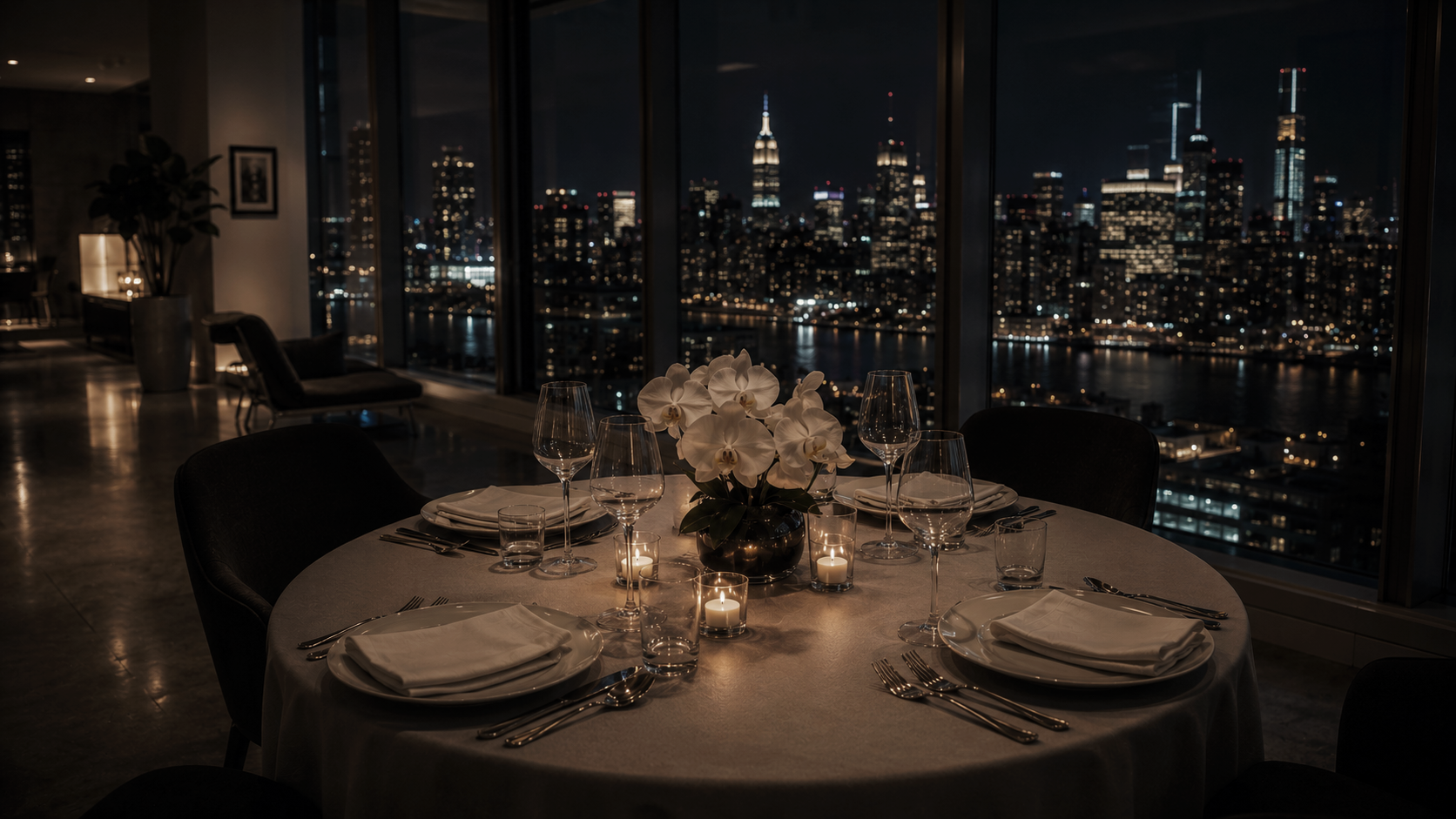
The table was set near the windows, four places arranged with a care that bordered on ceremonial. The plates were simple white porcelain, heavy and cool to the touch. The silverware was old. Real silver, faintly tarnished at the edges, the kind of pieces that had been passed through generations and acquired a patina of use. The wine glasses were thin stemmed, catching the candlelight and throwing small arcs of gold across the tablecloth. A single austere and elegant arrangement of white orchids sat at the center.
Rafael poured the Sancerre. The wine was pale and crisp, cold enough to bead condensation on the glass. We sat, and for a moment the four of us simply existed in the space together, the city lights flickering below us like a field of slow-burning embers. A record was playing somewhere. Jazz, something slow and piano driven, the kind of music that seemed to breathe rather than play.
“So,” Rafael said, leaning forward with his elbows on the table, his eyes finding mine with an interest that felt entirely genuine. “Adrian tells me you were a swimmer. People who spend that much time in the water have always fascinated me. What’s it like? The silence, I mean. When you’re under.”
I turned the glass in my hand, feeling the condensation slick against my fingers. “It’s the only time my brain shuts up,” I said. “Everything else falls away. There’s just the rhythm of your body and the sound of the water moving past you. The silence isn’t empty. It’s full. Like the water is holding you.”
Rafael nodded slowly, his eyes never leaving my face. “That sounds like meditation. Or prayer.”
“Maybe it is. I never thought of it that way.”
Across the table, Marcus and Adrian had fallen into their own conversation. I caught fragments. Something about narrative structure, about the way a well-made story held tension the same way a well-designed building held weight. Adrian was leaning forward, his hands still, his voice soft and precise. Marcus was matching him, sentence for sentence, his eyes bright with the particular focus he got when he was talking to someone who actually understood his frame of reference.
I caught Rafael’s eye. He raised an eyebrow, a tiny gesture, and tilted his head toward our partners. The look on his face was unmistakable. Fond, amused, a little bit in awe. I found myself returning it. The couples were mirroring each other, and neither Marcus nor Adrian seemed to notice.
The food arrived in unhurried courses. Roasted vegetables, their edges caramelized and sweet. Grilled fish, flaking apart at the touch of a fork, dressed with lemon and herbs. The wine was replenished without ceremony. The conversation flowed, ebbed, found new channels. Rafael asked about the bar, about the regulars, about the strange taxonomy of human behavior you developed when you watched people drink for a living. Adrian and Marcus drifted from architecture into film, then into the psychology of space, then into a friendly argument about whether a story’s ending was more like a destination or a collapse. Through it all, the city pulsed below us, silent and indifferent, and the candles burned lower in their holders.

After dinner, we moved to the living room. Rafael poured small glasses of something darker. A port, thick and ruby red, that coated the inside of the glass and smelled of figs and tobacco. Adrian sat in the armchair by the window, his posture as composed as ever, but I noticed the way his fingers rested on the armrest, the faint tension in his knuckles. He was about to say something that mattered.
The record had changed. Something slower now. A saxophone, mournful and low.
“I’ll be direct,” Adrian said. His voice was restrained, measured, the voice of a man who chose his words the way he chose his furniture, with precision and intent. “Rafael and I have an agreement. We are primary partners. Deeply committed. But our relationship has always had room for meaningful connections with others. Not casual sex. Curated intimacy.”
He paused. The word hung in the air. Curated. It was such an Adrian word. Precise. Deliberate. It implied care, selection, attention to detail. It implied something far more unsettling than simple desire.
“We’ve both been aware of you two for a long time,” he continued. “Not just as bartenders. As a fascinating dyad. The way you move around each other behind the bar . . . the economy of it, the care. I don’t use the word lightly.”
Rafael leaned forward, his elbows on his knees, his glass cradled in both hands. When he spoke, his voice was softer than Adrian’s, warmer, but no less certain. “We watched you orbit each other for two years. The way you move together. The care you take. Adrian said it was like watching a building being designed in slow motion. All tension and balance. We never said anything because it wasn’t our place. But we noticed.”
Adrian nodded, a single, precise motion. “We are interested. Consensually. Transparently. With no pressure whatsoever. If you’re not interested, we remain friends and devoted patrons. If you are . . . we’d like to explore that. Together. The four of us.”
The room became very quiet. The saxophone curled through the silence, a long, aching note that seemed to hang in the air like smoke. The city hummed below us, its million lights flickering and steady. Rafael had reached over and taken my hand. His grip was warm and dry, his thumb resting against the back of my knuckles with an ease that felt less like presumption and more like an offer. Marcus’s hand tightened on mine, his fingers cool.
I could feel my pulse in my throat. I could feel the port settling warmly in my stomach. I could feel the weight of Adrian’s calm, steady gaze and the gentle pressure of Rafael’s hand and the way Marcus’s breathing had slowed, deepened, his body shifting almost imperceptibly closer to mine.
“Can we talk?” I asked. My voice came out quieter than I intended, but steady.
Adrian inclined his head. “Of course. The study is down the hall. Take as long as you need.”

The study was smaller than the living room, more enclosed, with walls that were not bare but lined with books. They rose from floor to ceiling on all three interior walls. Hundreds of volumes, their spines a muted mosaic of burgundy and navy and dark green, the gold lettering catching the light from a single brass lamp on the desk. The desk itself was solid oak, unadorned, bearing only a laptop closed to sleep and a fountain pen resting on a blotter. The fourth wall was glass, looking out onto a different angle of the city, and beyond it the lights stretched away to the dark horizon where the sky met the water.
Marcus walked to the window first. His back was to me. His shoulders were tense, the line of them rigid under his jacket, and I could see the faint tremor in his hands where they hung at his sides. I closed the door behind us. The click of the latch was soft, final.
I walked over and stood beside him. I didn’t touch him. I just let the silence stretch, the way we’d learned to do over the past week. The city sprawled below us, indifferent and beautiful, its lights bleeding into the dark like water spreading across silk.
“What if you get lost in the physical and forget the emotional?” he asked. His voice was quiet, careful, each word placed like a foot on uncertain ground. “What if this is just . . . more for you? An extension of your old patterns?”
The words tied a knot beneath my collarbone and left me breathing around it. They were the words of a man who had spent four years watching me, cataloguing me, learning the shape of my habits and my evasions. Who knew that I had patterns. Who knew that I had spent a long time using bodies to avoid conversations.
I let them sit. I felt them in my chest, sharp and cold. I reached out and touched his shoulder. His jacket was smooth beneath my fingers. He didn’t pull away. He didn’t lean in. He just stood there, breathing.
“What if you realize you want someone more intellectually matched?” I asked, and my voice was rougher than I meant it to be, scraped raw at the edges. “Adrian can talk to you about Tadao Ando without you having to explain who that is. I’m just . . .”
He turned. The movement was sudden, sharp, cutting off the end of my sentence before it could leave my mouth. His eyes were dark and blazing in the dim light, and his hands came up to grip my shoulders with a force that surprised us both.
“You’re just the man I love,” he said. “Stop doing that.”
I wasn’t braced for it. Naked, honest words that walked in and sat down in the center of my chest. I felt them in my throat. I felt them in the backs of my eyes. I felt them in the sudden, shaking exhale that left my body like something that had been trapped there for years.
He loved me. He had said it. In Adrian’s study, with the books watching and the city sprawling below, Marcus had said the thing we had both been building toward for four years and one week.
I reached up and covered his hands with mine. His knuckles were cold. I could feel the fine bones of his fingers, the slight tremor still running through them.
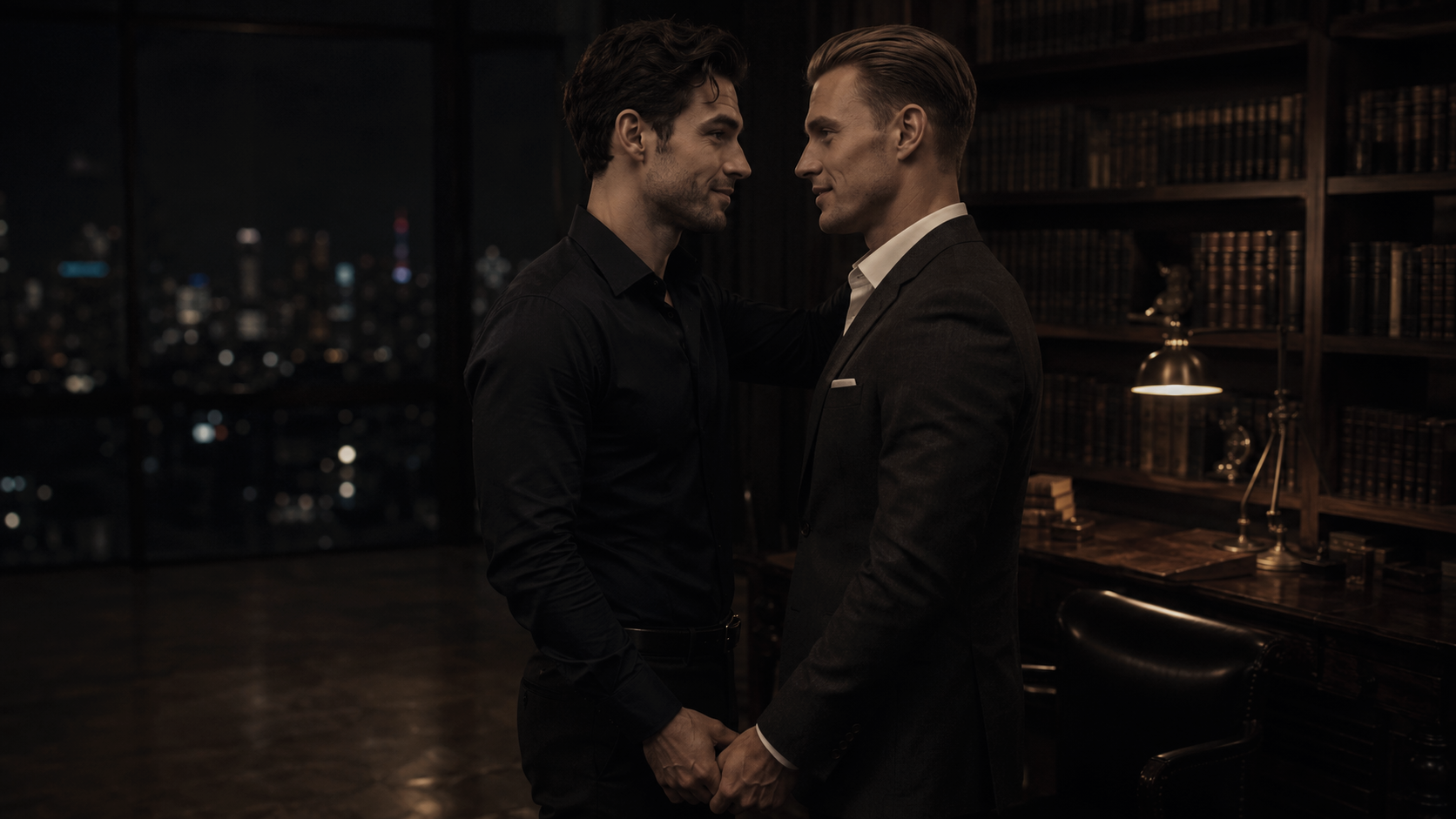
“I love you too,” I said. “I should have said it first. I should have said it a year ago.”
He shook his head, a tiny motion, his eyes never leaving mine. “You’re saying it now.”
We stood there for a long moment, our hands tangled between us, the city breathing at our backs. The silence wasn’t heavy anymore. It wasn’t full. It was something else entirely. Something new, something still taking shape.
“We’re both curious,” I said finally, my voice steadier now. “We’re both a little aroused. And facing this together, with full communication, might actually strengthen what we’ve just started. Because it forces us to talk about desire instead of performing it.”
He nodded. His grip on my hands relaxed, fraction by fraction. “Yes. That’s . . . yes. That’s exactly what I was trying to articulate.”
“That’s why I’m here. To articulate things for you.”
He laughed. A short, surprised sound that was half exhale and half something warmer. “You’re an ass.”
“Your ass,” I said. “Specifically and exclusively. At least at first.”
He was still laughing when I leaned in and kissed him, soft and brief. It was a kiss that was less about passion and more about punctuation. When I pulled back, his eyes were steadier. His shoulders had dropped an inch. I watched the muscle below his ear stop twitching.
“We need to go slow,” I said. “And everything happens together, at least at first. We’re a unit.”
He nodded. “Together.”
We opened the door. The hallway stretched before us, cool and dim, the floor smooth beneath our feet. We didn’t speak. We didn’t need to. Our shoulders aligned, our hands brushed, and by the time we reached the living room, we were moving in the old, familiar rhythm. The one we’d built over four years behind the bar, the one that had carried us through rush after rush, crisis after crisis. It was the same rhythm. It was just moving to a new stage.
Adrian and Rafael were waiting. They had not moved from their positions. Adrian in the armchair, Rafael on the sofa, but something in the set of their bodies suggested they had been talking while we were gone. They looked up when we entered, their expressions carefully neutral, but I saw Rafael’s hand tighten on his glass.
“We’re interested,” I said. My voice was steady. “But we need to go slow. And everything happens together, at least at first. We’re a unit.”
Adrian smiled. It was a faint thing as always, just a shift at the corners of his mouth, but it reached his eyes. “That’s precisely what we wanted to hear.”

We went home in a taxi that smelled of leather and stale air freshener. The city slid past the windows in streaks of neon and shadow, and Marcus’s hand rested on my thigh, his thumb tracing absent circles through the fabric of my trousers. Neither of us spoke. The silence between us had changed again. It was charged now, electric, humming with the afterimage of Adrian’s steady eyes and Rafael’s warm hands and the words that still echoed in my chest. Curated intimacy. The four of us.
In the apartment the silence finally broke. We fell through the door together, hands fumbling with buttons and belts and the familiar geography of each other’s clothes. The shirt I’d chosen carefully for the dinner, a dark blue button down that Marcus had once told me brought out my eyes ended up on the floor beside the shoes I’d polished that afternoon. His jacket, the charcoal one he’d been adjusting all night, slid off his shoulders and pooled on the carpet. We didn’t bother with the bedroom. We barely bothered with the lights.
The sheets were cool against my back, and then Marcus was above me, his weight settling onto my hips, his mouth finding my throat as his hands worked at the last of our clothes. The city hummed outside the window. The streetlight through the blinds silhouetted stripes across his shoulders.
“What did you think about?” I asked, my subdued voice rough between breaths. “When they said they’d watched us?”
He turned his head. The flush that climbed his throat was visible even in the dimness. “I thought about Adrian’s hands. And Rafael’s mouth. But I also thought about you watching me. I’d want to see your face the whole time.”
The words hit me in the chest. I groaned, low and involuntary, and reached up to touch his jaw. His skin was warm, damp with the first sheen of sweat. “God, yes. I’d want you to tell me if it was good. If I was still . . . yours.”
He nodded, a single slow motion, his eyes never leaving mine. “You are.”

Marcus’s Point of View
We lay tangled in the sheets, the room still thick with the smell of us, when the invitation hit like a spark on dry tinder. Leo’s hand rested on my chest, his thumb tracing slow circles over my nipple, and the heat rose again between us. My cock twitched against his thigh, already half hard from the thought of Adrian’s steady eyes and Rafael’s warm hands and the way Leo had said ours like it was the simplest word in the language.
“I keep thinking about them watching us,” Leo murmured, his voice low and rough against my neck. “Adrian sitting there in that chair, telling us exactly how to touch each other.”
I rolled on top of him, straddling his hips, feeling his thick cock press up against my ass. The cum from earlier was still there, slick and warm, and I reached back to guide him, feeling the head slide between my cheeks. “Tell me what you want them to see,” I said, grinding down slow. “Tell me while I ride you. Talk dirty to me, Leo. Filthy.”
Leo’s eyebrow shot up. “Why Marcus, I thought you were a snobbish literary high brow type and you want me to . . . talk ‘filthy’ to you?”
“I’ll lecture you on the literary ties to smut some other time,” I gasped as I started lowering myself down on him. “Right now I want you to share every filthy thought going through that beautiful head of yours.”
Leo’s hands gripped my hips as I sank down, the stretch burning sweet and deep. “Fuck, Marcus,” he groaned, watching his cock disappear inch by inch into my ass. “I want Adrian to see how tight you are. How your hole grips me like it never wants to let go.”
I hit bottom with a wet sound, my balls resting on his pelvis. I rolled my hips in slow circles, feeling every vein drag along my inner walls. The stretch was perfect, the fullness of him grounding me in my body. “And Rafael?” I asked, breath hitching as I rode him, lifting until just the head remained inside me before slamming back down. The loud and shameless slap of skin filled the room. “What would he do?”
Leo thrust up to meet me, his cock punching deep, hitting that spot that made my dick leak precum onto his stomach. “He’d get on his knees beside us. He’d lick my balls while I fuck you. Then he’d suck your cock while Adrian watched.”
I moaned, riding harder, the wet squelch of his cum-slick cock filling my hole loud and filthy. My hands braced on his chest, nails digging in. “I’d want you to watch me suck Rafael’s cock,” I panted. “Watch his thick head stretch my lips while Adrian tells me to take it deeper.”
Leo’s hands slid up to my chest, thumbs brushing my nipples. “Yeah? You’d let him fuck your throat while I’m buried in your ass?”
“Fuck yes,” I gasped, bouncing faster, the bed creaking under us. Sweat dripped down my back, my hips working fast and desperate. I reached down and stroked my cock in time with my thrusts, precum slicking my fist. “I’d want Adrian to see you come inside me. Watch it leak out around your cock.”
Leo groaned, hips bucking up hard. “Keep talking. Tell me what you’d let them do.”

Leo’s Point of View
Marcus rode me like he was starving for it, his hole clenching tight around my cock with every downward slam. The sight of his ass swallowing me, the way his hole stretched and gripped still shiny with the cum I’d already pumped into him earlier, made my head spin. I thrust up to meet him, watching my shaft disappear into that hot, feathered heat, feeling his body open and take me deeper each time.
“I’d let Adrian finger you while I face fuck you,” Marcus said, his voice breaking on a moan. “Two thick fingers in your ass while my cock’s in your mouth.”
I flipped us suddenly, rolling him onto his back and hooking his legs over my shoulders. I drove back into him in one smooth thrust, the new angle letting me go deeper than before. The wet sound of my cock sliding through my own cum was obscene, a slick, sucking noise that filled the room. “Fuck, Marcus. Keep going.”
He reached up, fingers tangling in my hair as I pounded into him. “Rafael would eat my ass while you fuck me. Tongue fucking my hole around your cock.”
I groaned, pace turning urgent, the slap of my balls against his ass its own percussion accompaniment. I leaned down and kissed him hard, tasting the salt on his lips. “I’d want to watch you come on his tongue. Watch your cock shoot while I’m still buried in you.”
Marcus’s hand flew to his own cock, stroking fast and desperate. “Leo . . . fuck . . . I’m close. Tell me you’d let them both fuck me.”
“I would,” I growled, hips snapping hard and fast. “I’d hold you open and let them take turns stretching your hole. Then I’d fuck you after, feel how loose and wet they left you.”
Marcus’s back arched, his hole clamping down hard around me. “Coming . . . fuck, Leo . . .” Bold ropes of cum leaped from his cock, draping his chest and stomach in hot pulses. His ass milked me, pulsing tight, and I followed right after, burying myself to the hilt as I unloaded another load deep inside him. Stab after stab, hot and dense, filling him until it leaked out around my shaft with every shallow thrust.
We stayed locked together, breathing hard, sweat slicked and shaking. I rested my forehead against his, my cock still twitching inside his cum-filled hole, feeling the aftershocks ripple through both of us.

Marcus’s Point of View
“We can stop this anytime,” I whispered, my voice rough and shaky, my hands still trembling on his shoulders. “If either of us wants to. We just say the word.”
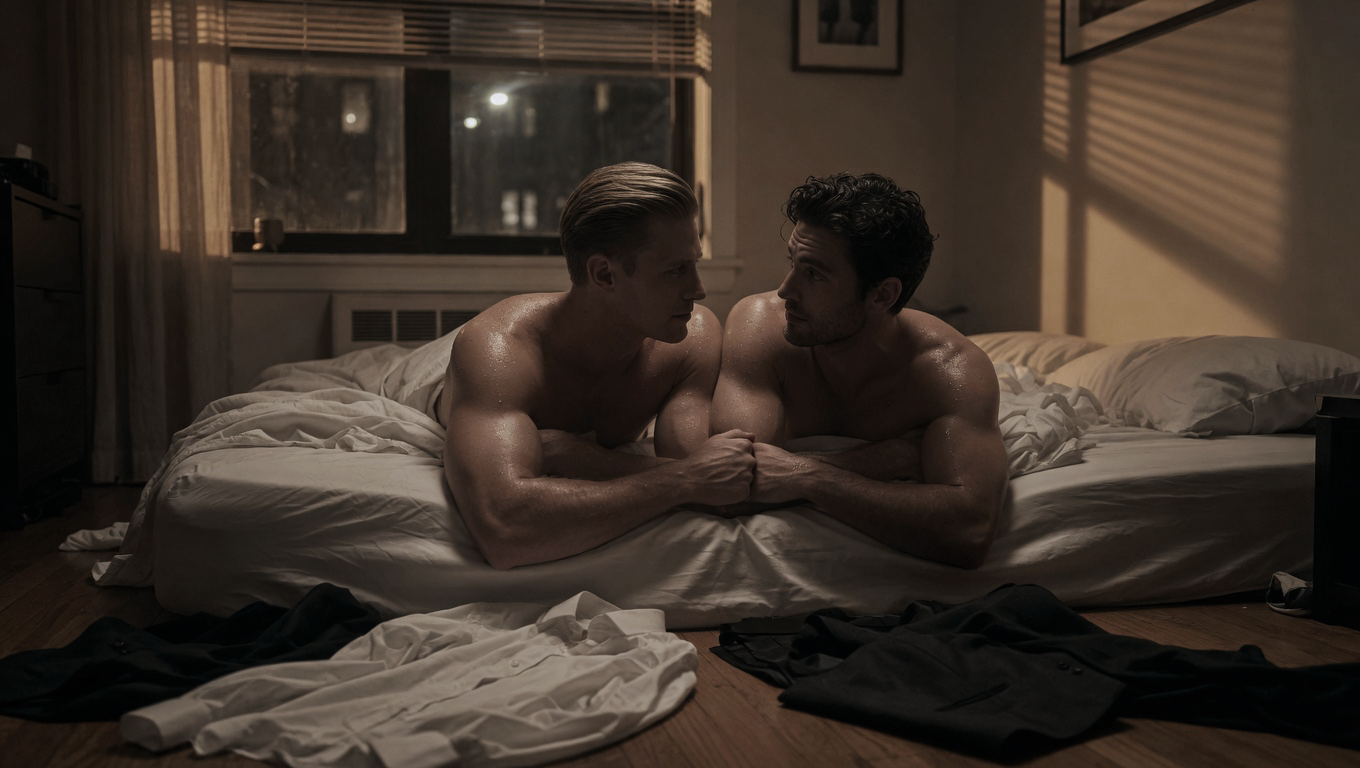
Leo kissed my jaw, soft and tender. “I know. That’s why I’m not scared.” He pulled out with care and I felt the thick mix of our cum drip from my stretched hole onto the sheets. He watched it for a moment, then looked back at me. “We’re in this together. Always.”
I pulled him down beside me, our bodies still pressed close, the mess between us warm and sticky. The room smelled of sex and sweat and the faint traces of his laundry. Outside, the city hummed its endless, indifferent song. “Together,” I echoed, feeling the steady beat of his heart against my chest.
I kissed his jaw. “I know. That’s why I’m not scared.”
He smiled. He closed his eyes. I felt his breathing slow, felt the weight of his arm across my stomach, felt the warmth of his skin against mine. My own eyes grew heavy. I fell asleep with his body pressed to mine and his name on my lips.

Leo’s Point of View
The next shift at Holloway felt different. The city was the same—the damp pavement, the distant sirens, the neon signs bleeding into the puddles—but the space between us was gone. We walked shoulder to shoulder. Our hands brushed. We didn’t hold hands. Not yet. But the space between us didn’t vibrate anymore. It just felt right.
We pushed through the black door. The neon sign hummed above us. The bar was quiet. The prep crew was already at work. Glasses clinking, ice bins being filled, the espresso machine hissing its morning calibration. We went to the back. We changed. I pulled on my shirt and rolled my sleeves. I didn’t bother with a tie. I never did. He adjusted his waistcoat in the small mirror, straightened his collar, checked his reflection with the same care he’d always brought to it. I watched him and felt the familiar pull in my chest, that low-grade ache behind the chest, but it was different now. It wasn’t hunger. It was certainty.
We took our places behind the bar. The first regulars trickled in. Chloe arrived early, as she always did, and took her corner seat. Her coat was damp from the drizzle outside, and she shook her hair out like a dog shedding rain. She ordered a gin and tonic. I made it, the ritual of ice and pour settling my hands into their old rhythm. I slid the glass across the wood.
She took a sip and looked at me. Then she looked at Marcus. Then she looked back at me. Her eyes narrowed, the corners of her mouth twitching.
“Did something happen?” she asked. Her voice was light, teasing, but there was real curiosity underneath. “You two are glowing.”
I wiped down the bar, the cloth moving in slow circles. “New skincare routine.”
She snorted. “Mmm.”
I didn’t answer. I just smiled. I felt Marcus’s hand brush my lower back as he passed behind me. It was a quick touch, barely there, but it sent a jolt through my whole body. My shoulders relaxed. My breathing slowed.
The night moved as it always did. Ice cracking. Bottles pouring. Glasses clinking. Regulars talking. Strangers watching. But everything felt different. The space behind the bar felt smaller and warmer, the rhythm of our movements synced without effort. It was the language we’d built over four years. It wasn’t dying. It was just moving to a new stage.
And then the door opened and he walked in.
He was young, mid-twenties maybe, and handsome in a way that felt manufactured. The sharp cheekbones. The dark hair swept back from a high forehead. The clothes that fit too well, cut to emphasize a body that he clearly worked on. He moved through the room with the casual confidence of someone who had never been turned down, sliding onto the stool directly in front of me and leaning forward with his elbows on the wood.
“Vodka martini,” he said. His voice was smooth, practiced. “Dry. Twist.”
He didn’t look at Marcus. He didn’t look at the menu. He didn’t look at anything but me.
I made the drink. I stirred it, strained it, twisted the lemon peel over the surface and dropped it in. I set it on a coaster. His fingers brushed mine when he reached for it. A deliberate contact, his fingertips lingering against my knuckles for just a beat too long.
“Thanks,” he said, and his smile was a slow, knowing thing. “I’m Alex.”
I nodded. I didn’t offer my name. I just moved down the bar to check on another customer, feeling his eyes on my back the whole way. The familiar pull in my chest had shifted. Not hunger, not discomfort, but something in between. Something that felt like a test I hadn’t studied for.
When I came back, he was still there. Still watching. He asked about the bar, about how long I’d worked there, about the neighborhood. His questions were casual but his focus was not. Every time he leaned forward, his knee brushed the bar. Every time he laughed his hand moved closer to mine on the wood.
Marcus was at the other end of the bar, serving a couple who had been nursing the same glasses of wine for an hour. I could feel his attention shift. I could feel the exact moment his eyes found the man in front of me and stayed there.
The man didn’t notice. Or if he noticed, he didn’t care. He finished his martini and asked for another. When I set it down, his hand closed over mine. Not a brush this time. A hold. His palm was warm, his grip just firm enough to register as intentional.
“Listen,” he said, his voice dropping to something more private. “I rarely do this, but you’re gorgeous. I’d love to buy you a drink sometime. Off the clock.”
I pulled my hand back. Not sharply. Not quickly. Just deliberately, the way you pull your hand away from something you’re not sure is hot. The smile I gave him was polite, automatic, the smile I gave difficult customers when I didn’t want a confrontation.
“I’m flattered,” I said. “But I’m not available.”
He tilted his head, his smile never wavering. “The way I see it, nobody’s really available until they are.” He pulled a napkin from the stack on the bar, produced a pen from his jacket, and wrote his number in a quick, confident scrawl. He pushed it toward me. “In case you change your mind.”
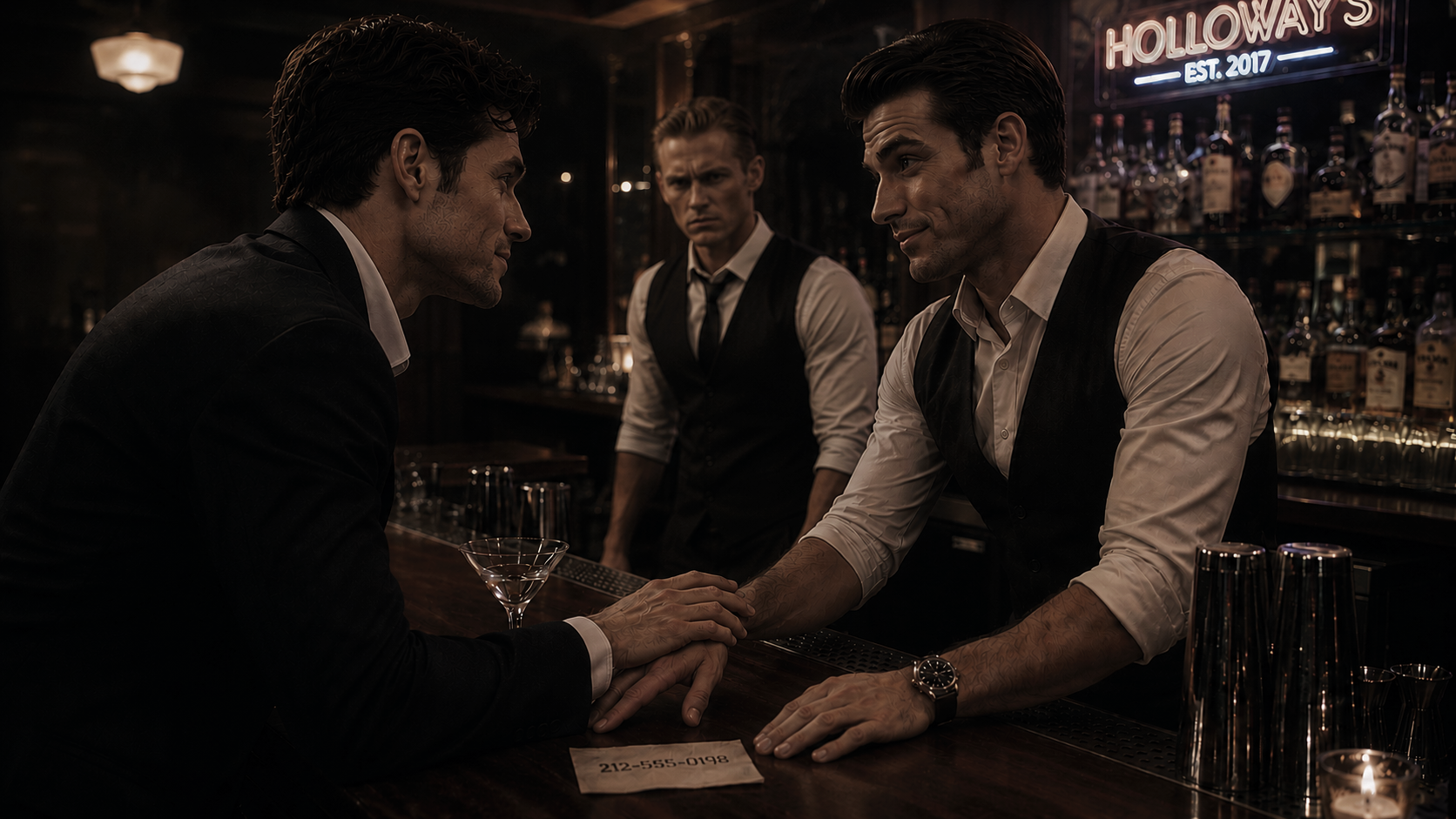
He left a twenty on the bar and walked out. The door swung shut behind him. The napkin sat on the wood between me and the empty glass.
I pocketed it. I didn’t know why. I just did. I felt the paper crumple against the lining of my trousers and I didn’t look at Marcus. I didn’t look at anything. I just turned to the speed rail and started restocking bottles that didn’t need restocking, my hands moving through the motions while my mind spun uselessly.

Marcus’s Point of View
I watched him pocket the napkin. I watched the paper disappear into his pocket and I felt something cold settle in my chest. Something unfamiliar and sharp and utterly without precedent. It wasn’t jealousy, exactly. Jealousy was hot and reactive, something that flared and burned. This was different. This was a slow, creeping cold that spread through my chest and into my hands, making my fingers tighten on the glass I was holding until I thought it might crack.
He hadn’t shut it down. He had said he wasn’t available, that was something, but he hadn’t shut it down. The man had touched his hand, had held it, and Leo had not pulled away. The man had written his number on a napkin and Leo had taken it. Had put it in his pocket. Had not thrown it away.
I catalogued these facts the way I catalogued everything. Dispassionately, clinically, assembling them into a pattern that I recognized even as I wished I didn’t. The pattern was plain. Leo had been propositioned, and Leo had not said no loudly enough to be heard.
The cold thing in my chest tightened. I finished pouring a glass of wine for the couple down the bar, my hands steady in a way that felt almost obscene. My face, I knew, was composed. My posture was correct. Anyone looking at me would see a bartender in the middle of his shift, calm and capable and entirely untroubled.
Anyone looking closely would see something else. But nobody was looking closely. Nobody except Leo, and Leo wasn’t looking at me.
This is the test, I thought. It’s barely been a week and we’re already being tested.
I set the wine glass on the bar and picked up another tumbler that needed polishing. The neon sign hummed overhead, steady and indifferent. The ice machine chugged in the back. The city breathed outside, its million lights flickering in the rain. The bar moved around me, oblivious and ordinary, while the cold thing in my chest settled deeper and made itself at home.

End of Chapter Four.