
A playful afternoon with his casual lover Jules leaves Adrian Vale warm, satisfied, and quietly aware of the hollowness that lingers after every uncomplicated goodbye. But when a sudden trance seizes him in his studio, his hands paint a place he has never truly seen. The Iturbide mausoleum, rendered in impossible detail, with four shadowed figures waiting before an open door. Compelled by a pull he cannot name, Adrian carries the still-wet canvas through a cemetery drowned in supernatural fog, arriving at the very stone his brush foretold only to realize he is not alone in the dark.

Adrian
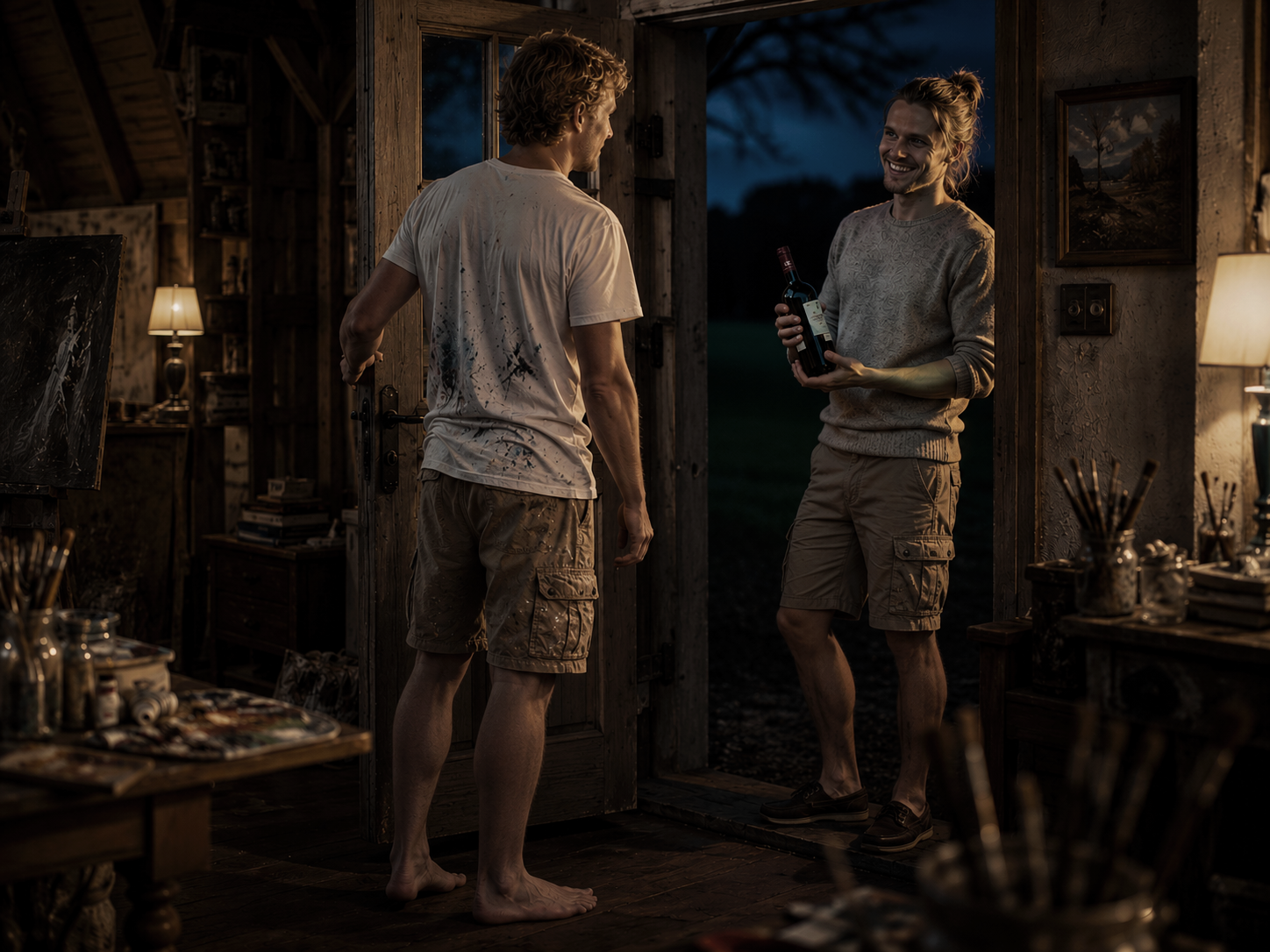
Jules arrived at six o’clock with a bottle of wine and a smudge of rosin on his jaw. I knew it was rosin because he came straight from rehearsal more often than not, still vibrating with whatever they’d been working on, his fingers smelling of steel strings and cedar. He handed me the bottle and kissed my cheek and said, “I’ve been thinking about you all day,” which was true and also not true. Jules thought about everyone all day. He was a composer. It was what he did. People were melodies to him, themes to be developed, variations to explore. I was a theme he enjoyed returning to, and that was fine. That was what we were.
“You’ve been thinking about that cello line in the second movement,” I said, taking the wine to the kitchen. “But I appreciate the sentiment.”
He laughed. He had a bright laugh, easy and percussive, like a cymbal tapped with a fingertip. “The cello line is giving me trouble. It keeps wanting to resolve into something major, and I keep telling it no, stay minor, stay minor, there’s tension we haven’t earned yet.”
He followed me into the kitchen, leaning against the counter while I opened the wine. He was wearing a soft gray sweater that made his eyes look darker than they were, and his hair was tied back in a loose knot that was already coming undone. “But I thought about you. Specifically, about your hands.”
“My hands?”
“Mm.” He reached out and took my wrist, turning my palm up. Ultramarine and burnt umber stained my fingers, and the paint worked into the creases of my knuckles in a way that never quite washed out. “I was trying to describe a color in rehearsal. That blue, the one you use for shadows. Tourmaline, you called it? No, ultramarine. We needed something that sounded like ultramarine.”
“Did you find it?”
“We ended up with bassoon. It’s not the same thing at all.”
I poured two glasses and handed him one. The wine was a red he’d picked up from some small vineyard he’d discovered on tour. He was always discovering small vineyards, small restaurants, small towns with surprisingly good orchestras. Jules collected experiences the way I collected pigments, voraciously and with little discrimination, because everything was interesting if you looked at it the right way.
We took the wine to the bedroom. Or rather, Jules took my hand and led me to the bedroom, which was how these evenings usually went. He was the initiator, I was the director, and between us we built something that was satisfying without being significant. A composition in a minor key, full of tension we hadn’t earned.
The bedroom was warm. The last of the afternoon sun came through the windows, catching the dust motes in the air and making them look like flecks of gold leaf. I’d made the bed that morning on a rare impulse and the sheets were still crisp, the pillows still plump. The quilt my mother sent me last Christmas, a riot of color, was folded at the foot of the bed.
Jules set his wine on the nightstand and pulled his sweater over his head in one fluid motion. His body was lean and well-muscled, a musician’s body, shoulders broad from the cello work he’d done before switching to composition full time. The rosin dust on his jaw had smeared into a faint silver streak that caught the light.
“You’re staring,” he said.
“I’m looking. There’s a difference.”
“Is there?”
“Staring is passive. Looking is active. When I look at you, I’m studying.”
He grinned. “Studying what?”
“Light. Shadow. The way your collarbone catches the sun.” I stepped closer, setting my wine aside and touched the hollow of his throat with one paint-stained finger. “The contrast between warm skin and cool blue. It’s a great subject.”
“I’m a subject now?”
“You’ve always been a subject.”
He kissed me, still grinning, and the wine was on his breath and the rosin was on his skin and his hands found my hips with the easy familiarity of someone who’d done this many times before. I let him lead for a moment before I shifted my weight and took control, walking him backward toward the bed, my hands on his shoulders, my mouth still on his.
Jules liked this. He enjoyed being directed, being positioned, being told without words what I wanted him to do. It wasn’t submission exactly. It was more like improvisation, the way a jazz musician takes a melody and runs with it, making it their own while still following the structure. I pushed and he yielded and then he pushed back just enough to keep it interesting and between us we found a rhythm that felt like music.
The sheets were cool against my skin when we finally tumbled onto the bed. Jules’s mouth was on my throat, my chest, the soft place below my ribs where I was ticklish and he knew it and he exploited it mercilessly until I was laughing and breathless and swatting at him with one hand.
“You’re terrible,” I managed.
“I’m inspired. There’s a difference.” He lifted his head, his eyes bright with mischief. “Tell me what you want.”
The question was genuine. Jules always asked, and I always answered, and that was one thing I appreciated about him. The clarity he brought, the absence of guessing games. He didn’t assume. He didn’t project. He asked, and he listened, and then he did what I’d told him to do.
“Stay there,” I said, and rolled us both so that I was above him, my weight pinning him to the mattress. “And stop talking.”
“Make me.”
I did.
I kept him pinned with my weight and watched the light move across his face. His eyes were half lidded, his mouth still curved with that easy grin. Jules never performed anticipation. He just waited, loose and trusting, a musician between measures waiting for the downbeat.
“Let go,” he murmured, and I did.
I lowered my mouth to his throat. Not his lips but his throat, the place where his pulse beat close to the surface, where the skin was thin and tasted faintly of salt and the metallic residue of rosin. I let my tongue drag slowly across the tendon, following it from the hollow above his collarbone up toward his jaw. The vibration of his swallow traveled through my mouth. His skin was warm and gave slightly under the pressure, and I could feel the individual ridges of his tracheal cartilage, the architecture of his voice box, the instrument that produced all that uninhibited laughter. I traced it with the flat of my tongue and then with just the tip, spelling nothing, just feeling.
He exhaled. A release, the breath a musician takes before the first note. His hands came up to my ribs, not gripping, just resting, his fingertips finding the spaces between my bones.
I moved lower. The hollow of his throat gave way to the flatness of his chest bone, the skin smoother here, less salt, more the clean neutral taste of soap and living flesh. I pressed my mouth to the bone and held it there, feeling his heartbeat through my lips. A steady, unhurried thump that hadn’t yet quickened. That was the challenge. That was always the challenge with Jules, the part I enjoyed most. Finding the exact sequence of touches that would break his musician’s composure and turn that steady tempo into something ragged.
His chest was roughly hairless, just a sparse trail of fine dark blond running down the center of his stomach, and I followed it with my tongue. The muscle beneath his skin jumped when I reached just below his ribs where he was ticklish. He knew I knew, and his hands tightened on my sides in warning, but I lingered there anyway, tracing the border between sensitivity and pleasure until his stomach hollowed and his hips shifted beneath me.
“Adrian,” he said, and his voice was still steady but the breath behind it was thinner now, stretched across a frame of tension it hadn’t had before.
I didn’t answer. My mouth was busy with the soft place where his stomach sloped into his hip, the ridge of bone that emerged just beneath the skin, the faint trail of hair that thickened and roughened as I moved lower. The light had shifted again. The sun was truly setting now, the gold gone copper, the shadows long and blue and Jules’s body was a landscape of warm tones against the white sheets. I could see the faint tan line at his waist, the pale band of skin that rarely saw light, the darker trail that led downward from his navel.
His cock was already hard. Not fully though he was getting there, thickening against his thigh, the head beginning to emerge from the foreskin the way a musician’s head emerges from a curtain before a performance. Still half shy. Still waiting for the overture to finish.
I bypassed it altogether.
My mouth found the crease of his thigh, the tender junction where leg met groin, and I licked a broad stripe along the fold. The skin here was different. It was thinner, more sensitive, carrying the musk that was uniquely Jules, a scent that reminded me of vanilla and clean sweat and the odd bit of citrus. I buried my nose in the coarse hair at the base of his shaft and breathed him in, letting the smell fill my sinuses, letting my tongue dart out to taste the salt gathered in the creases of his skin.
Jules’s hands moved from my ribs to my shoulders. His thumbs pressed into the muscle on either side of my spine, and I felt the tension there. The first actual sign that his composure was developing hairline cracks. His breathing had changed too, no longer the deep draughts of a man at rest but something shallower, caught in the upper part of his chest.
I trailed my tongue along the base of his shaft, moving from the root to the tip in one long, slow pass. The skin was hot and velvety, loose enough to move under my tongue, and I could feel the pulse of blood beneath it, the throb that matched the heartbeat I’d felt in his chest. When I reached the head I stopped, my lips just brushing the ridge of the glans, my breath warming the wet skin I’d left behind.
Then I took him into my mouth.
Not all at once, that wasn’t the point. I took the head first. Just the head, sealing my lips around the ridge and letting my tongue work the sensitive underside where the foreskin attached. The taste was salt and skin and something faintly bitter, the precum already beading at the tip, and I gathered it on my tongue and spread it across the soft tissue of his glans.
Jules made a sound. Low, guttural, a note from the bottom of his range that vibrated through his diaphragm and into my hands where they rested on his stomach. His fingers curled against my shoulder blades, nails pressing crescents into the skin, and his hips canted upward just a hitch. An involuntary movement that he checked almost immediately. He was still trying to let me lead.
I took him deeper.
My lips slid down his shaft following the path my tongue had blazed and I felt him fill my mouth by degrees. The head pressed against my soft palate, then slipped past it into the tighter channel of my throat. I breathed through my nose—slow, controlled, the way I’d taught myself over the years—and I held him there for a count of three before pulling back, my tongue pressed flat against the underside of his cock, dragging friction along the swollen vein that ran from base to tip.
“God,” he breathed. Not a moan. A prayer.
I did it again. And again. Each time I took him a little deeper, held him a little longer, pulled back a little slower. My saliva was coating him now, slicking the passage, and the wet sounds of my mouth working his shaft filled the tranquil room. The fan overhead stirred the air in lazy circles. Outside, the first crickets were beginning their evening chorus. The cottage creaked, settling into the cooling night. And here, on the bed, Jules was losing his battle with composure one breath at a time.
His hips were moving now in small, aborted thrusts. Not enough to choke me but just enough to tell me he wanted more. His hands had left my shoulders and tangled in the sheets. He threw his head back, exposing the long column of his throat, and his hair completely came undone, spilling across the pillow in a dark gold fan.
I pulled off him with a wet, obscene pop that left a strand of saliva connecting my lower lip to the head of his cock. It stretched, thinned, broke. I wiped my mouth with the back of my hand and looked up at him.
“Still with me?”
His laugh was a ragged exhale, nothing like his usual easy percussion. “Barely.”
“Good.”
I lowered my head again, but this time I bypassed his shaft and moved lower, to the tight sac drawn up beneath it. His balls were heavy and warm, the skin loose and lightly furred with dark blond hair, and I took one into my mouth and rolled it gently on my tongue. The taste was muskier here, denser, the salt of his sweat more concentrated in the folds and creases. I lapped the left one, then the right, bathing each in turn while my hand wrapped around his shaft and stroked him in long, lazy pulls.
Jules’s moan was unmistakable now. A real moan, drawn from somewhere deep in his chest, vibrating through his whole body. His thighs fell open wider, an offering, an invitation, and I felt the shift in him, when he stopped trying to maintain any kind of control and surrendered to what was happening.
“Please,” he said, and the word was barely a word, more breath than voice, more need than language.
I released his balls and moved back up his body, my mouth trailing wet kisses across his stomach, his chest, his throat, until I was hovering over him again, my face inches from his, my weight braced on my forearms on either side of his head.
“Please what?”
He opened his eyes. They were darker than they’d been an hour ago, the pupils wide, the warm brown of his irises reduced to a thin ring. “You know what.”
“Say it anyway.”
“Fuck me.” He swallowed. “Please. I want all of you inside me.”
I kissed him then, not gently, my tongue pushing past his lips, and he tasted his own salt on my mouth and moaned into the kiss. His hands came up to my face, cupping my jaw, pulling me closer, and we stayed like that for a long moment. Two mouths moving together, breath mingling, the heat between us building like a chord held too long and demanding resolution.
I broke the kiss and reached for the nightstand. The lube was in the drawer, a small glass bottle with a pump top, the oil inside pale gold and slick. I’d bought it months ago, a gift from some artisan market I’d wandered through on a Sunday afternoon when I was supposed to be painting. It smelled faintly of almonds and something else, something green and alive.
“Sit up,” I said.
He did, moving with that fluid grace that musicians often have, and I positioned him against the headboard, pillows piled behind his back. I wanted to see his face. Jules was beautiful when he was undone, and I wanted to watch every moment.
I poured a generous amount of oil into my palm and warmed it between my hands before reaching between his legs. His cock bobbed against his stomach, slick with my saliva, the head dark and swollen. Lower down, between the cheeks of his ass, I found the tight ring of muscle and pressed my oiled fingers against it.
“Breathe,” I said.
He did. His eyes stayed on mine and I saw the inhale, the deliberate relaxation, the way his body opened for me even before I pushed inside. That was Jules. Always ready to collaborate, always willing to meet me halfway.
My first finger slid in to the knuckle. He was hot and tight and breathtakingly smooth inside, the muscle clenching once around me before yielding. I held still, letting him adjust, watching his face. His lips were parted. His eyes had gone unfocused, looking at something beyond the ceiling, beyond the room.
“You’re thinking about the cello line again,” I said.
His laugh was breathless. “I’m really not.”
I added a second finger, working them in gradually, scissoring gently to stretch him open. His body resisted at first, then accepted, the muscle softening around my knuckles, pulling me deeper. I found the small, firm swell of his prostate and pressed against it.
The sound he made was beautiful. A note I’d never heard from him before, something half plucky, half grunt, wholly involuntary. His cock jumped, a fresh bead of precum welling at the tip and sliding down the shaft. His hands fisted in the sheets again and his thighs were trembling.
“There,” I said. “Right there. Let me look after you.”
“Yes. Right there. Don’t stop.”
I didn’t. I worked him open with patient, deliberate strokes, my fingers twisting and curling inside him, my thumb pressing against the sensitive skin just behind his balls. The oil was everywhere now, slicking his thighs and my hand and the sheets beneath us, and the smell of almonds mixed with the salt of his sweat.
When I had three fingers inside him and he was rocking against my hand with small, desperate movements, I withdrew. He made a sound of protest. A whimper, really, though Jules would never have called it that, and his eyes snapped open.
“Shh,” I said. “I’ve got you. Look at you,” I said, unsure if I meant to say it out loud, “So good for me.”
I pulled my fingers free and climbed up his body, my hands finding his wrists, pinning them above his head. He looked up at me, his pupils dilated, his lips parted, and I held his gaze as I brought my hips down, my semi-rigid cock brushing against his mouth.
“Open,” I said, and he did.
I pushed in slowly, just the head at first, and his tongue worked the underside, wet and warm and perfect. I went deeper, felt the tight clutch of his throat, and he took it, his eyes watering but never leaving mine. I held there for a moment, then pulled back, gave him air as my cock turned to steel.
I thrust again, deeper, faster, and his throat closed around me, a reflexive swallow that nigh undid me. I fucked his mouth in slow, deliberate strokes, watching his face, watching the way he struggled to take it and took it anyway, watching the tears leak from the corners of his eyes.
I pulled out before I lost control, my cock slick and aching, and Jules gasped for air, his chest heaving.
I slid down and positioned myself between his legs, my knees spreading his thighs wider. My cock was aching now, the head slick with my precum, and I took a moment to coat myself with oil, stroking from base to tip until I was glistening. Jules watched my hand move, his tongue wetting his lower lip, his breath coming in quick, shallow pants.
I lined myself up. The head of my cock pressed against his opening. Hot, tight, still slightly resistant despite my preparation. I pushed forward just enough to breach him, just the first inch, and held there.
“Look at me,” I said.
He did. His eyes were dark and wet, and the look in them was something between gratitude and desperation. “Adrian.”
“Breathe in.”
He inhaled.
I pushed deeper. His body swallowed me inch by inch, the tight heat of him sliding down the length of my shaft. The sensation was overwhelming, pressure and friction and the silken grip of his inner walls, and I had to close my eyes for a moment, had to breathe through my own rising pleasure. When I opened them again, I was fully seated inside him, my hips flush against his ass, my balls pressed against his skin.
“There,” I breathed. “There. You feel so amazing, you know that?”
He was trembling. His whole body was trembling, from his shoulders to his thighs, and his hands had found my arms and were gripping them so hard I’d have bruises tomorrow. His mouth was open but no sound was coming out. He was beyond sound, beyond words, beyond anything but the physical fact of me inside him.
I held still. Let him feel it. Let the stretch become familiar, let the fullness become something his body could accept.
“It’s . . .” He swallowed hard. “It’s so . . . you’re so deep.”
“I know. You’re taking me perfectly, Jules. So good.”
I moved. Slow, deliberate thrusts, little more than a rocking of my hips, never pulling out more than an inch before sinking back in. I wanted him to feel every ridge and vein of my cock as it slid inside him, wanted the friction to build like a crescendo, layer on layer, until there was nowhere left to go but over the edge.
His hand found his own cock and began stroking in time with my thrusts. The sight of it, his long musician’s fingers wrapped around his shaft, the head appearing and disappearing through his fist, the slick sound of precum and oil. It all sent a jolt of pure heat through my groin. I was leaking inside him, I could feel it, my own fluids mixing with the oil and easing the passage.
“You feel incredible,” I said, and my voice was rougher than I’d intended, scraped raw by the exquisite pleasure building at the base of my spine. “So tight. So hot. You’re perfect.”
He answered with his body. His hips rose to meet my thrusts, finding my rhythm and matching it, making it his own. That was Jules, even now, even utterly undone he was a collaborator. Our bodies moved together like counterpoint, two melodies weaving around each other, and the wet slap of desperate skin on skin filled the room like percussion.
I increased the pace. Not because he’d asked for it. He was still beyond words. But because I could feel him approaching the edge, could read it in the tension of his thighs and the way his breath hitched on every exhale. His hand was moving faster on his cock now, the strokes becoming erratic, losing their rhythm.
“Adrian,” he whispered. “Please don’t look away.”
The words hit me somewhere unexpected. Below the ribs, behind the chest, in a place I rarely let casual partners reach. But I didn’t look away. I held his gaze as I drove into him, my thrusts deepening, my pace quickening, the pressure coiling tighter and tighter at the base of my spine.
“I’m here,” I said. “I’m right here. Let go, Jules.”
He did.
His orgasm hit him like a wave and I watched it travel through his body, starting somewhere deep in his gut and radiating outward. His back arched. His head fell back against the pillows. His mouth opened in a silent cry. His cock convulsed in his hand and then he was coming, thick white ropes spilling across his stomach and chest, painting his skin in long, glistening pearlescent streaks.
The sight of it—Jules undone, Jules beyond composure, Jules with his eyes squeezed shut and his body wracked with pleasure—was what pushed me over. My orgasm slammed into me like a fist, sudden and overwhelming. My hips thrust forward of their own accord, driving my cock as deep into him as it would go and I felt my balls draw up tight against his ass and then release, pumping my aching load into the hot clutch of his body in long, shuddering pulses.
“Oh, fuck,” I gasped. “Oh, fuck. Fuck.”
The words came out strangled and barely recognizable. My whole body was trembling, my arms threatening to give out, and I lowered myself onto him, my chest pressing against the mess on his stomach, my face buried in the curve of his neck. I could feel him still pulsing around me, the aftershocks rippling through his body in diminishing waves, and I held still and let him milk the last of my cum from me.

We lay there, tangled and sweaty and breathing hard. The fan overhead stirred the cool air. The crickets outside had reached a steady, rhythmic chorus. The cottage creaked its evening creak. And Jules’s hand came up to rest on the back of my head, his fingers threading through my hair, his touch gentle in a way that felt like an exhale after a long piece of music when the final chord is still resonating in the air.
After a time, I couldn’t say how long, I stirred. My muscles protested. My skin was sticky with cooling sweat and Jules’s spunk and the almond oil that had spread everywhere. But I pushed myself up onto my elbows anyway and looked down at him.
His eyes were open now, still dark, still soft. He looked wrung out in the best way, his limbs loose and his expression peaceful. The streak of rosin was still there, smeared now with sweat.
I withdrew from him tenderly, and the sensation of it, the slow slide of my softening cock leaving the warmth of his body, made us both shiver. He let out something between a sigh and a murmur and I watched the trickle of my cum follow me out, white against the flushed pink of his skin.
He felt hollowed out, I knew. Full of me in more ways than one. I could see it in the way he lay there, boneless and sated, his chest rising and falling in the slow rhythm of recovery.
“God,” he said after a while. “You’re very good at that.”
“You’re not so bad yourself.”
“I know. I’m excellent.” He stretched, long and languid, a cat in human form. “But you . . . you’re something else. You’ve got a gift.”
“It’s just paying attention.”
“It’s more than that. It’s like you see what I’m feeling before I feel it.” He turned his head to look at me, his expression thoughtful. “Does that make sense?”
It made more sense than he knew. “Sure,” I said, and didn’t elaborate.
We lay there for a while, the sweat cooling on our skin, the fan overhead stirring the air in lazy circles. Somewhere in the distance a dog barked twice and fell quiet as our bodies recalibrated.
“You’re distracted,” Jules said again.
“You said that already.”
“Because you still are. You went somewhere just now. I could feel it.”
I sighed. “I’ve just got something on my mind.”
“Something, or someone?”
“Something. There’s no someone.”
Jules was quiet for a moment. Then he said, carefully, “You know I don’t mind, right? If there were someone? We’re not . . .” He gestured vaguely, encompassing the bed, the room, the arrangement we’d maintained for the better part of a year. “This isn’t exclusive. It’s never been exclusive. If you met someone, you’d tell me.”
“I know. There’s no someone. Just work. Restlessness. The usual artist angst.”
“Ah, angst. I know that one well.” He sat up, reaching for his wine glass. “It’s usually a sign that you’re about to make something interesting. The cello line that keeps trying to resolve major. Tension you haven’t earned yet.”
“Maybe.”
“No maybe about it. I’ve seen your process, Adrian. You get quiet and distant and then suddenly there’s a new canvas on the easel and it’s the best thing you’ve ever done.” He took a sip of wine. “Trust the restlessness. It’s trying to tell you something.”
I wanted to tell him that the restlessness had a name, that it had been pulling at me for weeks, that I’d been having dreams about stone and fog and a door I couldn’t open. I wanted to tell him about the sketches on my desk. The arches, the carvings, the word Iturbide that my hand kept writing even when my mind didn’t know what it meant. I wanted to tell him that I was scared, a little or maybe a lot, and that I didn’t know what was happening to me.
But Jules and I didn’t have that kind of relationship. We had wine and sex and easy laughter, and that was enough, and I would not ruin it by asking for more than he could give.
“Same time next week?” He asked, setting his empty glass on the nightstand.
“Sure. If my angst doesn’t eat me first.”
“If the angst eats you, call me. I’ll bring a shovel.” He kissed me once, brief and warm, and then rolled out of bed and began gathering his clothes. “Rehearsal at nine. The bassoonist is threatening to quit. I have to go mediate.”
“The perils of being a genius.”
“Genius is mostly just mediating between people who think they’re geniuses.” He pulled on his jeans, his sweater, ran a hand through his hair. At the door he paused, as he always did, and looked back at me. “Adrian.”
“Yeah?”
“Whatever you’re painting in your head—finish it. You’re not going to sleep until you do.”
He left. The door clicked shut behind him and the cottage settled into silence.
I lay there for a long time, watching the light die. The gold had faded to gray, and then to blue, the color of a bruise, the color of twilight in winter. The sheets chilled against my skin. The wine glass on the nightstand caught the last of the light and held it, a tiny star in the growing dark.
It had been a good night. Jules was precisely what he was. Talented and easy and undemanding, a friend who occasionally shared my bed, a collaborator in bliss who never asked for more than I was willing to give. Being with him was fun. Being with him was simple.
But he was right. I was distracted. I’d been distracted for weeks, my mind pulled toward something I couldn’t name, my hands itching to paint something I couldn’t see. The dreams had started subtly, the way my trances always did. Just fragments at first, the sense of a place I’d never been but somehow recognized, the feel of cold stone under my palms, the sound of footsteps on gravel in heavy fog. Then the sketches started appearing on my desk, rough charcoal studies of an archway, a carved door, symbols I didn’t recognize but somehow understood.

Iturbide.
I didn’t know what it meant. I didn’t know why my hands kept shaping the letters. But I knew, with the certainty of someone who’d learned to trust his unconscious brush, that it meant something. That it was important. That whatever was pulling at me was getting stronger, and it wasn’t going to let me go until I’d done whatever it wanted me to do.
The cottage felt different when I was alone. Not empty, exactly. It was too full of my things for that. Canvases stacked against every wall, some finished and some abandoned, their surfaces a riot of color and form. Jars of brushes soaking in cloudy water on every available surface. Tubes of paint scattered across the floor, their caps mismatched, their labels smeared beyond recognition. The small altar in the corner with its rose quartz and its white candle and the photograph of my family. Everyone smiling, everyone alive, a snapshot of a life that had been largely undamaged before the visions started.
This was my space. I’d made it deliberately, filling it with things that grounded me. The soft blankets, the plants in every window. When I was here, surrounded by my work and my objects, I could almost forget the other thing. The empty space. The silence that Jules’s presence filled without me noticing until he left and the hollow shape of it became visible again.
I wasn’t lonely. I’d made peace with solitude a long time ago, back when the trances first started and I realized that most people couldn’t handle being close to someone whose hands moved without their consent. I’d had friends, lovers, people who tried to understand, but in the end they all drifted away, uncomfortable with the way I’d stop mid sentence to stare at a blank wall, the way I’d wake up with paint on my fingers and a face on the canvas I’d never seen before. My family loved me unconditionally, but they lived across the country, and our calls were warm but brief.
So I’d learned to be alone. I’d learned to fill the silence with work, with music, with the occasional casual connection that asked nothing of me beyond a few hours of warmth. Jules was part of that. Jules was good at it. But sometimes, in the quiet moments between one thing and the next, I remembered that being good at being alone wasn’t the same thing as wanting it.
I got up. The floor was cool under my bare feet, the old wood smooth with age. I pulled on a pair of loose pants, paint stained and soft from too many washes, and padded into the kitchen. I poured myself a glass of water and stood at the sink, watching the last of the twilight drain out of the sky.
The cottage sat on the edge of the cemetery grounds. I could see the iron fence from my bedroom window, black against the darkening trees. During the day, the cemetery was almost peaceful. Old headstones tilted at gentle angles, moss softening the edges of the names, the mausoleums rising out of the grass like weathered ships at anchor. I’d wandered through it a handful of times, sketchbook in hand, looking for interesting angles and interesting shadows. It was a good place to think. A good place to be alone.
At night, it was different. At night, the fog rolled in from somewhere. I’d never figured out where, exactly, since we were miles from the coast, and the familiar paths became unfamiliar and the silence took on a quality that felt almost like listening. I’d tried to paint it once, the night fog, but I’d never quite captured the way it moved. Like it had intentions. Like it was going somewhere.
Tonight, the fog was already gathering. I could see it through the window, thin tendrils of white curling around the base of the fence, thickening in the hollows between the headstones. The air felt different, too. Charged with something, a pressure like the moment before a thunderstorm.
I finished my water and set the glass in the sink. My hands were restless, the way they always were before a trance, my fingers curling and uncurling at my sides. I could feel the image waiting somewhere in the back of my mind, a shape I couldn’t quite see, a door I couldn’t quite open. The restlessness Jules had noticed was building toward something. I could feel it.
The studio was calling me.
I crossed the cottage in the gathering dark, not bothering with the lights. I knew the way by heart. Past the couch with its pile of art magazines, past the bookshelf sagging under the weight of monographs and theory texts, past the small altar with its rose quartz catching the faint glow from the window. The studio door stood open at the end of the hall, and beyond it, the room was full of shadows.
The studio was the largest room in the cottage which was the only reason I’d rented the place. It had been a sunroom once, all windows and light, and I’d converted it into a workspace the day I moved in. Easels stood in a loose semicircle near the windows, their surfaces cluttered with palettes and rags and half-squeezed tubes of paint. Canvases in various stages of completion leaned against every wall—landscapes, portraits, abstract compositions that I’d started in trance states and never quite finished. The air smelled of turpentine and linseed oil and the clean, green scent of the eucalyptus I kept in a vase on the windowsill.
On the small table near the door, my grandmother’s sable brush rested on a clean cloth. I touched it as I passed, a brief brush of fingertips against the worn handle. It was my talisman, my anchor, the one tool I treated with something approaching reverence. Everything else in the studio was chaos. The brush was order.
I crossed to the easel by the window. A fresh canvas waited there, primed and ready, the white surface glowing faintly in the twilight. I’d stretched it three days ago and hadn’t touched it since. I’d been waiting, I realized. Waiting for whatever was coming.
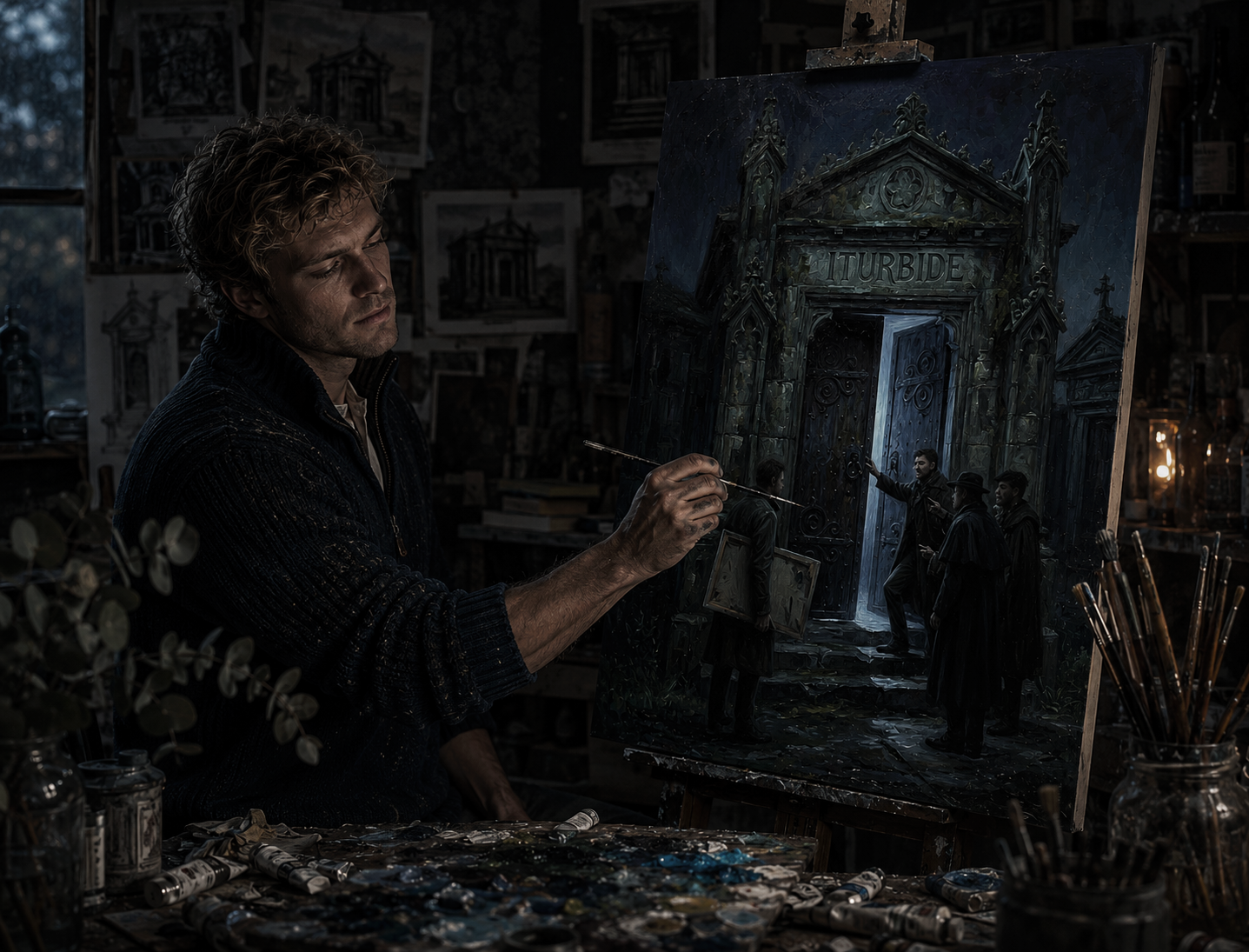
I picked up a brush. Not the sable, something cheaper, a synthetic flat that I used for blocking in. I squeezed paint onto the palette without looking. Ultramarine, ivory black, titanium white, a touch of burnt umber for warmth. The colors of night. The colors of stone. The colors my hands had been reaching for in my sleep.
The breeze through the window shifted. Just slightly. A change in direction, a drop in temperature. The hair on my arms stood up. And then . . . .
I wasn’t there anymore.
I know how that sounds. I know it sounds like an exaggeration, or a metaphor, or the kind of thing artists say to make themselves sound more interesting than they are. But it’s not. One moment I was standing in my studio, brush in hand, the evening light soft against the windows. The next, I was somewhere else altogether.
Not completely. My body was still in the room. I could feel it distantly, the way you can feel your feet on the ground when you’re dreaming, the way you know your hands are under the pillow even when you’re not conscious of moving them. My lungs still drew breath. My heart still beat. But my mind—the part of me that was me, that made decisions and had opinions and remembered my own name—had gone somewhere deeper. Somewhere quieter. A place where time moved differently and the only thing that existed was the canvas and the brush and the image trying to birth itself through my hands.
I’ve tried to describe the trance state to people. I’ve never gotten it right. It’s not like sleep, though it shares sleep’s passivity. It’s not like meditation, though it has meditation’s stillness. It’s not like drugs, though I’ve heard people compare it to psychedelics and I can see why, the way the boundaries between self and world dissolve, the way time becomes elastic, the way images rise out of nowhere with the force of revelation.
It’s more like being a conduit. Like something vast and incomprehensible is pouring through me and I’m just the pipe it’s using to get where it needs to go. I don’t decide what to paint. I don’t compose the image or choose the colors or make any of the thousand small decisions that normally go into a painting. My hands move and the painting happens and I am somewhere else, watching from a great distance, unable to intervene.
Sometimes I remember fragments. The smell of a place I’ve never been. The texture of a surface my conscious mind doesn’t recognize. The sense of someone standing just behind me, breathing softly, waiting to be seen.
This time, I remembered bleak stone.
I remembered the feel of it under my palms, rough and chill, the kind of stone that’s been underground for centuries and carries the memory of damp in its pores. I remembered the weight of a door. Massive, iron bound, reluctant to move. I remembered the sound of my own footsteps echoing in a space that felt too large and too small, the walls pressing in and falling away.
I remembered light. Blue light, cold and pulsing, the color of a vein seen through pale skin, the color of the hour just before dawn when the world is suspended between night and day. It moved like something alive, like something breathing, and it cast shadows that didn’t match the objects that made them.
I remembered four figures.
They stood before a door, the same door, the massive one with its iron bindings, carved with symbols I didn’t recognize but somehow understood. Their faces were indistinct, their bodies rendered in quick strokes, but I could feel their presence like heat from a fire. One of them was tall and broad, his shoulders set in a way that suggested protectiveness, or maybe aggression. One of them was smaller, slighter, his posture somehow wounded even in outline. One of them stood very straight, very still, radiating a formality that was almost defensive.
And one of them, the fourth figure, was holding a canvas.
It was me. I was in the vision. I was in the vision, and I was standing before the door, and the other three figures were there, and the door behind us all was opening, and something was reaching through from the other side.
Then I was back.
The brush clattered to the floor. I was standing in front of the easel, breathing hard, my heart hammering against my ribs as if I’d just sprinted up a flight of stairs. Paint, black and gray and a deep, cold blue that I didn’t remember squeezing onto the palette covered my hands. The studio was dark. The windows showed only night, the glass reflecting my pale face back at me. Hours had passed. The last light was gone. The moon had risen somewhere, but the fog had swallowed it, and the world outside was black and thick and silent.
I’d been painting for hours.
I looked at the canvas.
It was the mausoleum.
I knew it immediately, even though I’d never seen it this clearly before. It had appeared in fragments in my earlier sketches. An archway here, a carved symbol there, the shape of it looming out of fog in my dreams. But this was different. This was complete. I rendered every detail with a precision I couldn’t have achieved consciously, from the weathered texture of the stone to the way the shadows pooled in the corners of the doorway. The carving above the entrance was precise, every line and curve in its proper place, the chisel marks still visible in the stone.
The name chiseled into the lintel was ITURBIDE.
I’d written that name before. I’d found it on scraps of paper, in the margins of my sketchbooks, scrawled across the back of an old receipt I’d left on the kitchen counter. My hands had been trying to tell me something for weeks, and I’d been too distracted to listen.
But it was the figures that made my breath stop.
There were four of them, standing before the mausoleum door. They were more detailed than they’d been in the vision. Still impressionistic, still rendered in quick, confident strokes, but with enough specificity that I could see differences in their postures, their heights, the way they held themselves. The tall one stood slightly apart, his weight shifted forward as if he were about to move. The small one was turned slightly away, his head bowed, his shoulders hunched against something unseen. The formal one stood at the very edge of the group, his back straight as a ruler, his hands clasped behind him.
And the fourth figure—me—stood facing the door, a canvas clutched to my chest, my face the only one that was fully visible. My expression, rendered in a few deft strokes, was one of recognition. Of arrival. Of something that might have been fear or might have been hope.
The door behind us was open.
Not wide. Just a crack. Just enough that I could see the darkness beyond it. A darkness I’d painted with such depth that it seemed to recede into the canvas, a tunnel of shadow leading somewhere I couldn’t follow with my eyes.
The blue light was there too. Faint threads of it woven through the darkness, pulsing with a rhythm I could almost hear. Like a heartbeat. Like a breath.
The paint was still wet. It glistened in the low light of the studio lamps, the pigments catching the glow and holding it. I reached out and touched the surface with one finger, smearing the edge of a shadow. The paint was cool against my skin. Real. There.
I’d painted this. I’d painted it without knowing I was painting it, the same way I’d painted the wolf with the human heart, the same way I’d painted the sad man’s house when I was a child, the same way I’d painted every truth my conscious mind wasn’t ready to face. My hands had known what to do. They’d known this place. They’d known these figures.
I knew them too. Not rationally, I couldn’t have told you their names or where they came from or what they wanted. But somewhere deeper, somewhere my waking mind couldn’t reach, I recognized them. They were part of whatever had been pulling at me for weeks. The restlessness I couldn’t shake, the dreams I couldn’t remember when I woke. We were connected in a way I didn’t understand but couldn’t deny.
The mausoleum was in the cemetery. I’d passed it during the day, a handful of times, drawn by the architecture and the carvings and the sense of age that clung to it like moss. It was one of the oldest structures on the grounds, built in a style I didn’t recognize. Not quite Gothic, not quite classical, with symbols worked into the stone that didn’t match any tradition I’d studied in art school. I’d meant to sketch it properly, to spend an afternoon with my charcoal and my portable easel, but something had always stopped me. A sense of being unwelcome. A feeling that the mausoleum was watching me, and that it didn’t wish to be drawn.
Until now.
I stepped back from the easel. My legs were shaky, the way they always were after a trance, as if I’d been standing for hours without moving. My mouth was dry. My hands were trembling. I looked down at them and saw the paint under my nails, the blue worked deep into the creases of my knuckles, the black staining the pads of my fingers. The colors of night. The colors of stone.
I should have been afraid. A normal person would have been afraid. But what I felt, standing there in the dark studio with the painting glowing softly on the easel, was something closer to certainty. This was what I’d been waiting for. This was where I was supposed to go.
The cemetery. The mausoleum. The door.
Now. Tonight.
I looked down at myself, bare chest, paint-stained pants, bare feet. I was in no condition to go anywhere. I crossed to the bathroom and washed my hands at the sink, watching the paint swirl down the drain in ribbons of gray and blue, blue and gray. The colors of whatever was waiting for me in the dark.
I dressed quickly, pulling on a clean shirt and jeans, finding my shoes by the door. I grabbed a jacket, the fog would be thick, I could feel it, and a flashlight from the kitchen drawer. The batteries were low. The beam flickered when I tested it, weak and yellow. I found fresh batteries in the junk drawer and swapped them out, the light steadied, brightening, cutting a clean path through the dark kitchen.
The painting waited on the easel. I could feel it watching me, the way my paintings sometimes did when they weren’t finished with me yet. The figures seemed to shift in the low light, their postures changing, their faces turning toward me.
“Fine,” I said aloud. My voice was strange in the empty cottage, too loud and too small simultaneously. “I’m going.”
I lifted the canvas gently from the easel. It was larger than I usually worked, maybe two feet by three, and the frame was still tacky with wet paint. I carried it to the door, balancing it against my hip, and paused with my hand on the latch.
The cottage was silent behind me. The kitchen, the bedroom, the studio, all the spaces I’d filled with my things, my work, my small rituals of comfort. The plants on the windowsills. The quartz on its altar. The photograph of my family. All of it waiting for me to come back.
If I came back.
I pushed the thought away and opened the door.
The fog swallowed me whole.
It was thick, thicker than I’d ever seen it this far from the coast. It clung to the ground and coiled around the trees and pressed against my skin with a cold, damp deliberate weight. The air tasted of wet stone and old earth, the smell of a cellar that hadn’t been opened in decades. I pulled my jacket tighter and clutched the painting to my chest.
The path from my cottage to the cemetery gate was short, maybe a hundred yards of gravel that wound through a stand of old oaks before opening onto the fence line. During the day it was a pleasant walk, the trees shading the path, the cemetery visible through the iron bars like a city of the dead waiting to be explored. Night was something else.
The fog blurred everything. The oaks were dark shapes against a darker sky, their branches reaching through the mist like arms. The gravel crunched under my feet, but the sound was muffled, swallowed by the fog before it left the ground. My flashlight beam cut a narrow path through the murk, illuminating swirls of mist that danced like something alive.
I’d walked this path a hundred times. I knew every twist, every root, every patch of uneven gravel. But tonight nothing looked familiar. The fog had transformed the ordinary into the alien, the known into the unknown. I could have been anywhere. I could have been nowhere.
I kept walking.
The gate loomed out of the fog sooner than I expected. A sudden black shape against the gray, its iron bars dark with moisture. My flashlight played over the scrollwork, the finials, the heavy chain that should have been wrapped around the latch.
The chain was gone.
I stopped. The gate was open. Not wide. Just a few inches, just enough for a person to slip through, but it was open. The chain lay coiled on the ground like a sleeping snake, its padlock still attached, still closed. The gate hadn’t been unlocked. It had been unfastened some other way. Some way that didn’t involve keys.
I’d tried to come here after dark once before. The gate had been locked then, the chain heavy and cold against my fingers. I’d stood at the fence for a long time, looking through the bars at the dark cemetery beyond, feeling something pull at me with a pressure in my chest, a hum in my blood. I’d gone home eventually and I’d painted the gate from memory and the painting had shown the chain broken and the gate swinging wide.
My hands had known. They’d always known.
The fog was thinner at the gate. Not by much, but enough that I could see the path ahead more clearly than the path behind. It was as if the mist was parting for me, opening a corridor through the cemetery, leading me somewhere specific. The effect was subtle, just a slight thinning, just a slight brightening, but it was unmistakable. The fog wanted me to go this way.
I thought about turning back. I thought about going inside my warm cottage and making tea and pretending I had painted nothing at all. I thought about calling Jules and asking him to come back, filling the silence with his easy laughter and his undemanding hands. I thought about getting in my car and driving and not stopping until I was somewhere the fog couldn’t follow.
But the painting was heavy in my arms, and my chest was humming with something that felt like anticipation, and I knew . . . I knew, with the bone-deep certainty that had guided my brush through every trance I’d ever had, that whatever was waiting for me in the fog would not let me go until I’d seen it.
I stepped through the gate.
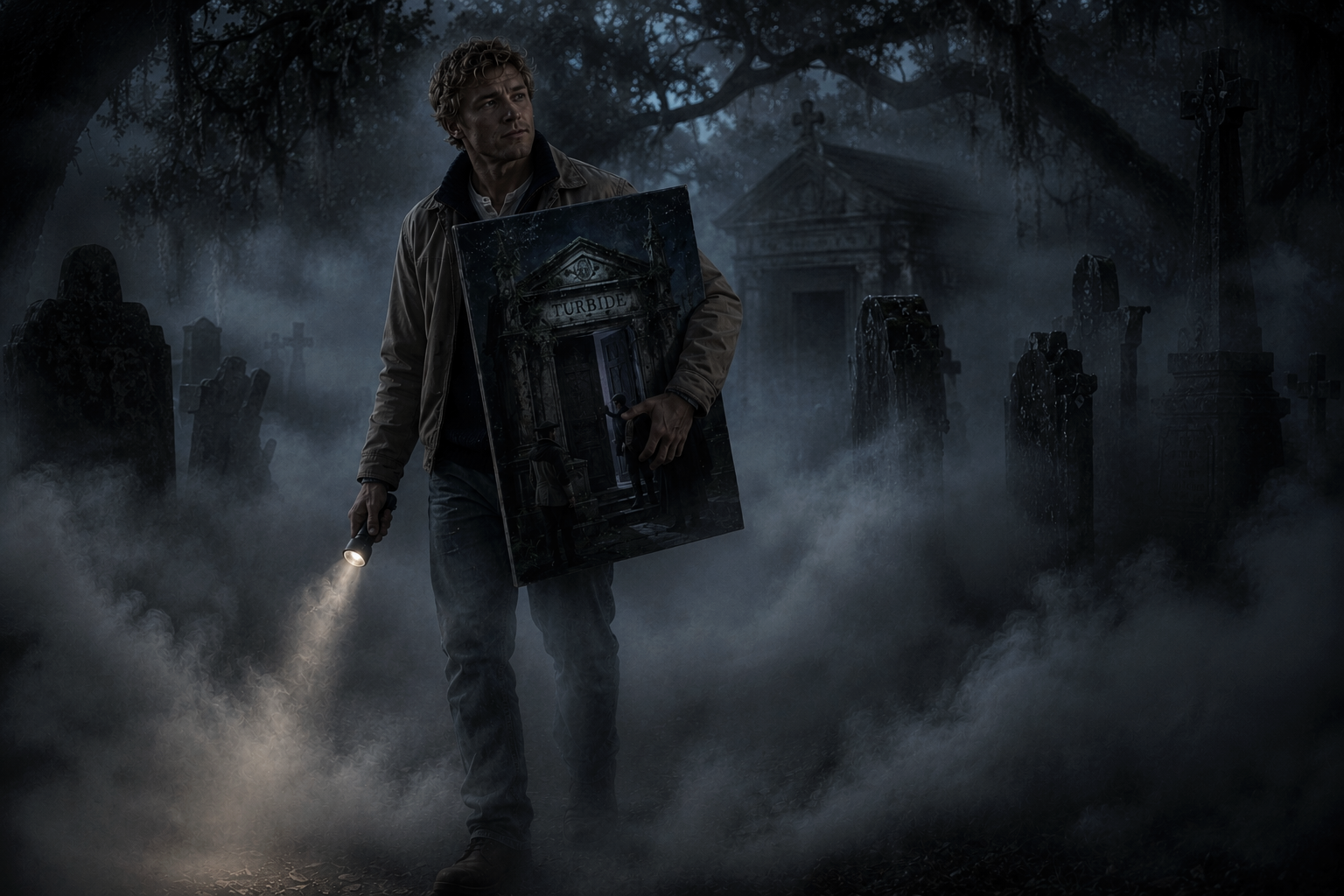
The cemetery swallowed me. The fog closed around me like a door shutting, and I couldn’t see the gate behind me anymore. Couldn’t see the cottage. Couldn’t see anything except the path ahead, winding between the headstones, leading me deeper into the dark.
The headstones loomed up out of the mist like frozen figures, their inscriptions worn smooth by time. I passed a mausoleum with a broken angel on its roof, one wing chipped away, the other reaching toward a sky it couldn’t see. I passed a row of graves so old that the names had vanished utterly, leaving nothing but blank stone and the memory of grief. I passed a crypt with its door hanging open, the darkness inside thick and absolute, the smell of old stone drifting out like breath.
The fog thickened and thinned, thickened and thinned. The path ahead was always clearer than the path behind. The hum in my chest had become a pull, a physical sensation like a hand at the small of my back, guiding me forward with gentle, inexorable pressure. I wasn’t walking so much as being led.
The painting grew warmer against my chest. When I looked down the blue light in the painting was brighter, the figures more distinct. The fourth figure, the one holding the canvas, seemed to have moved. I couldn’t have said how. It was still just paint, still just impressionistic strokes on a stretched cloth. But it looked different. Closer. More real. The face, my face, had turned as if looking toward something I couldn’t see.
The path curved. The fog parted.
And there it was.
The Iturbide mausoleum rose out of the mist like something that had been waiting for me. It was exactly as I’d painted it—the weathered stone, the carved symbols above the door, the heavy iron hinges. Every detail was precise. Every shadow was where I’d placed it. The name ITURBIDE was chiseled into the lintel in letters that seemed to absorb the light of my flashlight rather than reflect it, drinking the beam down into the dark stone.
But it was the door that made my breath stop.
The door was open.
The painting showed the door closed. I was sure of it. I’d painted it closed, the iron solid and dark, the figures standing before it like supplicants waiting to be let in. But the real door, the physical door in front of me, was open a crack. Just a few inches. Just enough that I could see the darkness beyond it, thick and absolute, a darkness that seemed to breathe. A darkness that had texture, depth, a quality of waiting that made the hair on the back of my neck stand up.
The symbols above the door were moving. No . . . not moving. Glowing. A faint blue light, the same blue I’d painted, pulsing with a slow, steady rhythm. Like a heartbeat. Like a breath.
I stood there, clutching the painting, my flashlight trembling in my hand. The mist swirled around my ankles. The hum in my chest had become a roar. The mausoleum waited, its open door a mouth full of darkness, its symbols pulsing with cold light.
I had painted this. I had painted this exactly. And now I was here, and the door was open, and the figures from my painting were real, and I was one of them.
And then I heard it.
Footsteps on gravel. Behind me. Slow and deliberate, the crunch of shoes on stone, coming closer through the fog.
I turned. The flashlight beam cut through the mist but found nothing. Only swirling gray, the vague shapes of headstones, the suggestion of movement that might have been wind or might have been something else. The footsteps stopped.
The silence that followed was worse than the sound.
“Hello?” My voice came out steadier than I felt. “Is someone there?”
No answer. The fog pressed in, cold and damp, smelling of something that made me think of closed rooms and locked doors and secrets buried so deep they’d forgotten the light. The mausoleum waited at my back, its open door a mouth full of darkness. Hot against my chest the painted pulsed blue light like a heartbeat.
I was not alone. I didn’t know who was out there in the fog, or what they wanted, or whether they were friend or enemy or something in between. But I knew, with the same deep knowing that had guided my brush, that the figures in my painting were real. That they were here, somewhere, drawn by the same pull that had drawn me. That whatever had been reaching for me through my dreams and my trances and my unconscious brush had finally brought me where it wanted me to go.
The fog swirled. The footsteps started again. Closer now, more deliberate, the measured tread of someone who knew exactly where they were going.
I held my ground. The painting was heavy in my arms. The blue light pulsed against my chest. The mausoleum breathed at my back.
And I waited, my flashlight cutting a trembling path through the fog, for whatever was coming toward me in the dark.

End of Chapter Three.