

In the aftermath of a crushing loss, Til seeks shelter in Morfeo’s arms, begging to be held, seen, and never let go. What passes between them is not just sex but a slow, desperate act of worship. Each touch a confession, each whispered promise a lie Morfeo can no longer bear to tell. As dawn approaches, Morfeo faces an impossible choice: complete the harvest that will erase Til’s memory of this night, or defy the corporation and risk destroying them both.

Til

The bell rang and I knew I’d lost. Not because I was down. I was still standing, still breathing, still trying to figure out which of the three referees bobbing in my vision was the real one. But I’d felt the fight drain out of me somewhere in the seventh round, siphoned off by the kid from Stilton who hit like a freight train and moved like one too. All forward momentum and no brakes. My legs were sandbags. My left eye had swollen to a slit, a hot throbbing weight I could feel with every heartbeat. My mouthpiece had gone missing in the eighth. I’d spit it into the ropes or the canvas or wherever mouthpieces go when your jaw is rattling too hard to care. The taste of copper was thick on my tongue, slick and warm, and when I swallowed I could feel the split in my lip reopen.
The noise of the crowd rolled over me in a tide that belonged to someone else. I’d heard that roar before, but it had always been pointing in my direction. Tonight it angled toward the corner across the ring, where the Stilton kid was getting his hand raised and his hair ruffled and his future rewritten in real time. I tried to lift my arm to acknowledge the loss, the ritual of good sportsmanship they drill into you from day one, but my shoulder barked and I let it hang. The ref glanced at me with the particular blankness of a man who has already moved on to the next fight.
My trainer, Gus, materialized at the ropes. He was saying things. Words that probably meant you fought hard and you’ll get the next one and all the other husks of comfort that fill the space between a loss and the locker room. I saw his mouth move but I heard almost nothing. The ringing in my ears had set up a steady whine, and under it my own thoughts were too loud. You lost. You lost the qualifier. You lost your shot.
I nodded at Gus because nodding was easier than speaking, and then I was walking, my legs carrying me down the aisle between folding chairs that scraped the concrete, past faces I didn’t recognize, past the heavy canvas smell of the ring and into the bright, buzzing corridor that led to the lockers.
The hallway was cinderblock painted a green so pale it flirted with gray. The fluorescents overhead flickered with a tremor I could feel in my teeth. I put one hand on the wall to steady myself. The paint was tacky under my palm and I could feel the grit of years of dust caught in the texture. My fingers left four damp streaks. I didn’t remember sweating that much.
The locker room smelled of bleach and sweat and the fungal sweetness of old shower drains. A bench ran down the middle, scarred with initials and gouges. Someone had left a roll of athletic tape on the floor, half unspooled, dirty. I sat down and stared at it for a while. My hands were resting on my thighs, palm up, knuckles swollen and raw. Two splits across the right hand, one on the left. The surrounding skin was puffy and pink and beginning to tighten as the blood dried. I flexed my fingers and felt the pull of fresh scabs threatening to crack.
Gus appeared again, sat down next to me. He pressed a water bottle into my hand. I held it without drinking.
“You got clipped in the fifth,” he said. “Messed up your timing.”
I nodded.
“He was beatable. You had him in the fourth. You saw that hook coming, and you didn’t step in.”
I nodded again. He was right. I’d seen the hook. I’d seen it and my body had decided, without consulting me, that it had taken enough for one night. That was the thing about boxing. It wasn’t the muscle that gave out first. It was the will. The will was a thin, fragile membrane, and once it tore, no amount of training could patch it.
“I’m going to talk to the judges,” Gus said, standing. “See if there’s anything we can contest. Take your time.”
He left. The door swung shut and I was alone with the buzzing light, the dirty tape, the water bottle still unopened in my lap, and the weight of my failure.
I don’t know how long I sat there. Long enough for the sweat to cool on my skin and the chill to creep in from the vents. Long enough to replay the fifth round in my head three times, each time finding a different place where I might have turned it. Stepped right instead of left, thrown the uppercut instead of the cross, been faster, been smarter, been someone else. The old familiar spiral. I was still spinning in it when the door opened again and Morfeo was there.
He stood in the doorway, haloed by the dimmer light of the corridor. He was wearing the white button down I’d told him I liked, the one that made his shoulders look broader and his waist narrower, the one he’d rolled up at the sleeves like he was preparing for serious work. His face was careful. That was his word, not mine, but it fit. A kind of poised neutrality, the expression of someone who had learned to hold his emotions behind a screen and present only what was needed. I’d seen that carefulness in a hundred small moments. When he answered a question he didn’t want to answer, when he watched me from across the gym, when he talked about his past in loose, vague shapes that never quite became a story. Tonight there was a flicker in it, a hairline crack I didn’t know how to read.
“Hey,” he said.
“Hey.”
“You want to get out of here?”
I looked at him. The buzz of the light above me seemed to soften. Something in my chest—that tight, hot knot I’d been refusing to name—loosened by a single thread.
“Yeah,” I said. “I do.”
He said nothing else. He just came over, put his hand on my elbow, and guided me up. His grip was firm but gentle, calibrated. He’d done this before, I realized. Handled damaged things. The thought flickered and was gone before I could examine it.
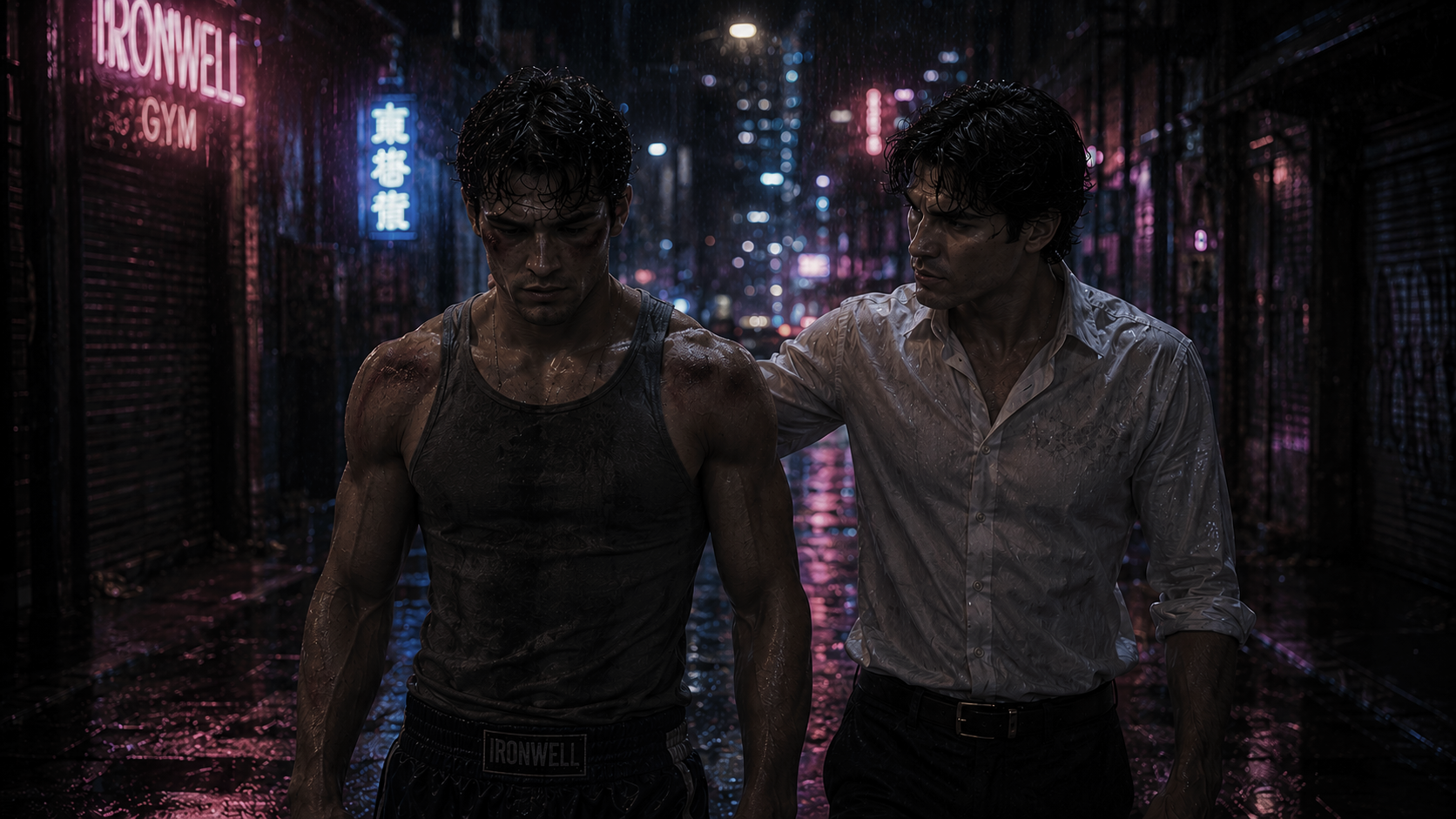
We went out the back door, the one that opened onto the alley behind the venue. The night air hit my face like a wet cloth. Rain had started while I was inside, a fine, steady drizzle that blurred the streetlights and slicked the pavement with oily rainbows. I tilted my head back and let it fall on my face, the cold prickling the gash over my eyebrow, washing the salt out of my eyes. My body was still humming with the aftermath of the fight. Fading adrenaline, endorphins retreating, leaving behind the raw, hollowed-out ache of muscles that had been asked for everything and given it.
Morfeo stood next to me, not speaking. The rain darkened the shoulders of his shirt, plastered a strand of dark hair to his forehead. He looked up at the sky, then back at me.
“Long way home?” he asked.
“Long way.”
We walked.

The route home from the venue was a rambling thing that cut through the old warehouse district and the edge of the riverfront and then doubled back toward my neighborhood, the kind of walk you take when you need more time than the direct route allows. The rain came down steady and soft, filling the gutters with a mild rush, and our footsteps echoed off brick walls and corrugated metal doors. We passed the bodega with its neon beer signs buzzing behind locked grates. We passed the laundromat where a woman sat alone in the harsh white light, watching her clothes tumble in a dryer, her face blank with the exhaustion of two in the morning. She didn’t look up as we went by.
My shoulder was stiffening. I rolled it once, twice, felt the joint grind in a way I didn’t like. Morfeo’s hand found the small of my back. Just a light pressure, there and then gone, but it steadied me. He’d been doing that more and more. Small touches. Anchors. I’d started to lean into them without thinking, the way a plant leans toward a window.
“You’re quiet,” he said.
“I’m tired.”
“I know.” A pause. “Do you want to talk about it?”
I didn’t. I wanted to crawl inside his chest and pull his ribs shut around me and not come out until the world had rearranged itself into something less cruel. I wanted to sleep for a hundred years. I wanted to go back to the fifth round and throw the uppercut instead of the cross and watch the whole night unspool differently.
But I said, “Not yet.”
He nodded and didn’t push. That was another thing he did. He let me come to him. He never pried. He waited, patient as stone, until I was ready to hand him whatever broken thing I was carrying. I’d met no one who could do that. I’d met no one who made me feel like my silence was acceptable, like I didn’t have to perform okay-ness for the sake of the person next to me.
We turned onto my street. The rain had picked up, fat drops splatting on the pavement, and by the time we reached my building I was soaked through. My shirt clung to my chest, cold and heavy. My hands were shaking from the cold, I told myself, from the adrenaline dump, not from the thing that was swelling behind my chest, that hot, tight grief I still refused to name.
Morfeo unlocked my door. I didn’t remember giving him a key, but he had one. He’d had one for two weeks now. The first time he’d used it, I’d come home from a run to find him in my kitchen, making coffee, wearing one of my shirts. He’d looked up and smiled and said, “You left the door unlocked,” which was a lie, and we’d both known it, and neither of us had mentioned it. I’d given him a copy of my key the next day. He’d given me one of his. I kept it on my ring next to the gym fob and the bottle opener my mom had brought back from a trip to somewhere I couldn’t remember. She’d been dead eight years next month, and I still used the bottle opener every day. A stupid thing to get sentimental about. I felt its shape through the wet fabric of my shorts and my throat closed.
The apartment was dark. The streetlight through the blinds striped the floor in bands of desaturated orange and shadow. My boxing gloves were in the corner where I’d dropped them after the last training session, hunched and misshapen. The kitchen counter was cluttered with dirty mugs and a half-empty bottle of the coffee syrup Morfeo liked because he refused to drink it black. The Ibanez poster watched from the wall. Marco “The Saint” Ibanez, who never won a title but fought with impossible heart. I’d bought that poster when I was sixteen, the year my mom died. I’d taped it up above my bed and stared at it every night since, telling myself that heart was enough, that showing up was enough, that you didn’t need to win to matter.
Tonight I couldn’t look at him.
I stopped in the middle of the living room, dripping on the floor. My reflection in the dark window was a smeared silhouette, a ghost against the neon blur of the street. I looked like a fighter who’d lost. I looked like a man who’d run out of things to believe in.
From the bathroom, the sound of water began to run. The old pipes groaned in the walls, a familiar complaint, and steam curled under the door, carrying the faint green scent of eucalyptus. Morfeo moved somewhere in there, his footsteps soft on the tile. Then his voice, quiet and steady.
“Til, come here.”

Morfeo
I tested the water on my palm before I let him step into it.
It was a small thing. A nothing thing. But I saw him notice. His good eye tracked my hand from the tap to my skin, and his breath caught and released in a rhythm I knew by heart. I was learning all his tells. The slight downturn of his mouth when he was trying not to cry, the way he held his jaw when he was thinking, the precise pressure of his fingers when he was holding on. The dampener was still off. It had been off since last night, when I’d pulled it from behind my ear with shaking hands and felt the whole unbearable flood of what I’d been suppressing for weeks. I hadn’t put it back. I needed to feel this. Every second. Later I would understand that I was stockpiling my grief like a miser, hoarding every sensation before I had to destroy its source.
The bathroom was too small for both of us. His shoulders brushed the shower curtain when he shifted his weight and my hip kept knocking against the sink. Steam clouded the mirror until the room became a soft, silver cocoon, sealed off from the rest of the world. The air thickened and warmed and smelled faintly of the eucalyptus soap his mother had apparently liked. He’d told me that once, holding the bottle up to the light, his voice gone soft and distant. She bought this kind. Same brand, same smell. I can’t use anything else. I’d filed it away. I filed everything away. It was my job. It was also, now, my punishment.
“Can you . . .” He gestured at his own shirt, a defeated little wave, his shoulders hunching with the effort of the movement.
He couldn’t lift his arms. His shoulders were seized. The deltoids, the trapezius, the whole complex architecture of muscle that lets a man throw a punch or wrap his arms around someone he loved. Twelve rounds of guarding, of absorbing, of keeping his hands high when every instinct screamed to drop them. I stepped forward and took the hem of his shirt in my fingers, then worked it up and over his head with a slowness that was ceremonial. He winced when the fabric caught on his ear, and I murmured something. I don’t remember what, some low, meaningless sound of comfort and he exhaled, the tension in his jaw loosening by a fraction.
His shorts were next. I kneeled. I was kneeling a lot around this man. I’d kneeled to lace his gloves once, and he’d looked at me with something like awe, like no one had ever done him that particular, pointless kindness. Now I kneeled to push the wet nylon down his legs, and he steadied himself with a hand on my shoulder. His weight settled into me, warm and trusting, and I felt the shape of my chest rearrange itself around the fact of it. The dampener, had it been on, would have shut that feeling down in an instant. Without it, I was defenseless.
He stepped into the shower and I followed. The spray was hot enough to sting, the way he liked it. He turned to let it hit his back, and I watched the water trace the geography of his body. The slope of his shoulders, the ladder of his spine, the narrow channel between his shoulder blades. He had a fighter’s body—dense and compact and scarred in the hundred small ways that added up to a lifetime of violence. I knew every scar now. The thin white line on his left eyebrow from a sparring accident when he was seventeen. The knob of scar tissue on his right knuckle from a street fight he wouldn’t talk about. The faint, faded stretch marks on his hips from a growth spurt in his teens. I had catalogued them all with the meticulousness of my profession, and somewhere along the way the catalogue had become a liturgy.
The water ran pink at first. Blood from the cut over his eye, from the abrasion on his shoulder where a glove had scraped, from the split knuckles he held cupped against his chest like a wounded bird. I watched the pink spiral toward the drain and thought of the harvest drive, sitting in my bag, nearly full. Heartbreak yield projection: maximum grade. Stilo’s voice, or my own, they’d started to blur. I pushed the thought down. I was good at pushing things down.
“Come here,” I said.
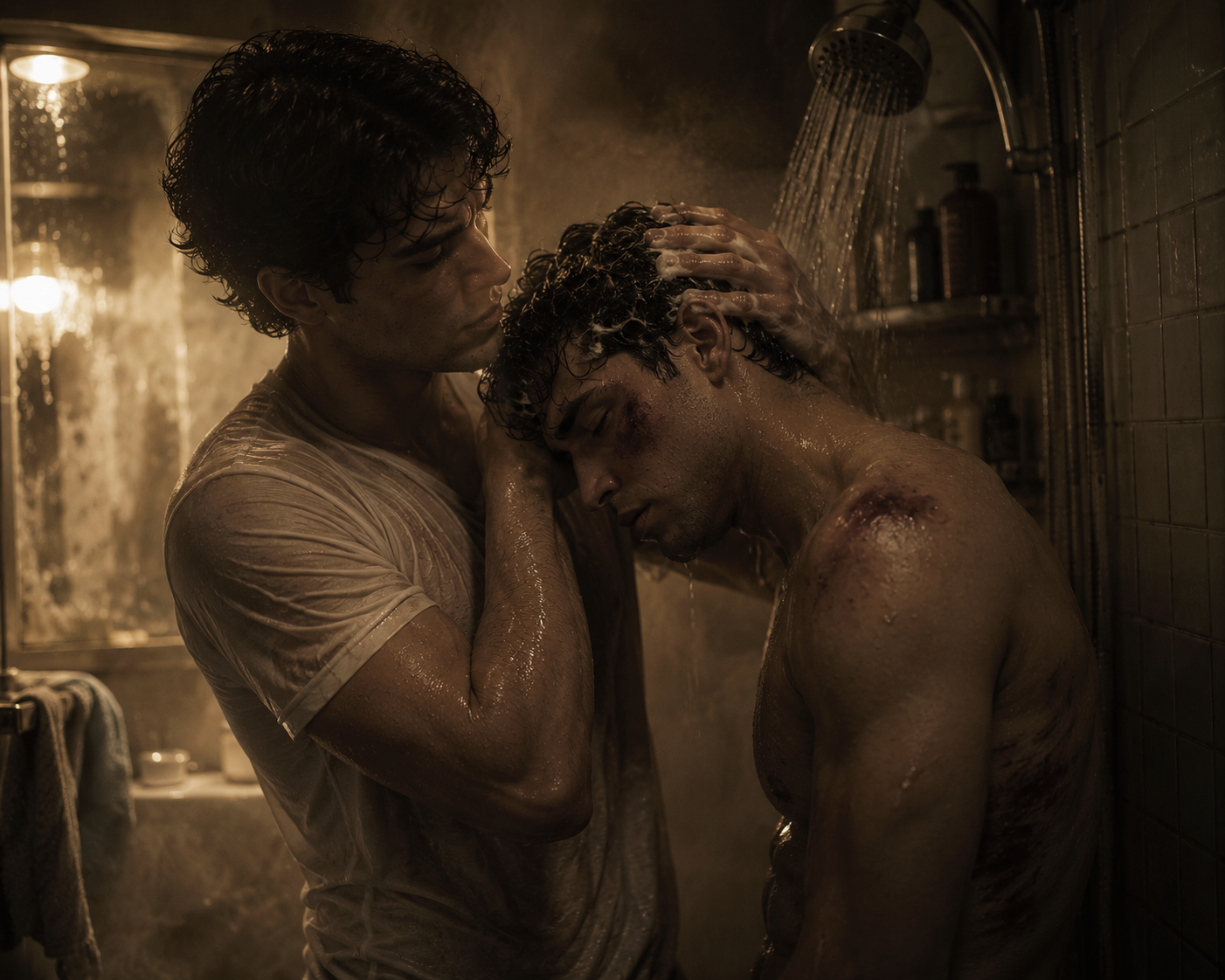
He turned and leaned into me, his forehead coming to rest against my sternum. I wrapped my arms around him gently, carefully avoiding the bruised ribs I’d watched the Stilton kid hammer in the seventh round. The water beat down on both of us, drumming against my back, dripping from my hair into his. I felt his breath slow. I felt the tremors in his back ease. I felt the exact moment when the last of the fighter drained out of him and left only the man. The man I was going to destroy tomorrow.
“Don’t move,” he said, his voice muffled against my chest. “Just . . . don’t move yet.”
I didn’t.
My hands moved on their own, tracing the composition of his spine one vertebra at a time, up to the ridge of his shoulder blades, down to the dip above his tailbone where the shorts had chafed. He shuddered under my palms, a full-body ripple that had nothing to do with the cold. His hands, still cupped protectively against his chest, slowly opened and pressed flat against my stomach. I could feel the heat of them, the rough texture of his knuckles, the slight tremor in his fingers.
“Your hands hurt,” I said.
“Yeah.”
“I’m going to wash your hair.”
He let out a sound that was almost a laugh. “That’s not how you’re supposed to do it.”
“How would you know?”
“Fair point.”
I reached for the bottle on the ledge, the cheap stuff he’d bought in bulk from the grocery store because it smelled like coffee and cedar and he’d said that it made him feel like himself. I squeezed a palmful and worked it between my hands to warm it. The thing you do for a child, or for someone you love more than you meant to. The scent rose in the steam, dark and woody, faintly sweet, the smell I’d associated with waking up and drifting off and all the quiet hours in between.
I ran my fingers through his hair. He had thick hair, dark and unruly, and I’d spent enough nights with my hands in it to know its weight and texture, the way it curled at the nape of his neck when it was wet. I worked the shampoo in casually, my fingertips pressing circles against his scalp, tracing the line of his occipital bone, the soft hollows behind his ears. He made a sound I’d never heard him make before and his hands on my stomach tightened, his fingers curling against my skin.
“That feels good,” he said.
“I know.”
“You’re smug.”
“I’m thorough.”
He laughed. I felt it in my chest.
I rinsed his hair with the same methodical care, cupping water in my palms and pouring it over his head, keeping the soap out of his good eye. Then I reached for the soap—his soap, the eucalyptus bar his mother had used—and worked it into a lather between my hands.
“Turn around,” I said.
He did. I started at his shoulders, working the soap into the dense muscle with both thumbs, feeling the knots and the tension and the places where the punches had landed. He flinched when I hit a tender spot near his right shoulder blade, and I gentled my touch, waiting until his breath evened out before I kept going. Down his spine. Across the expanse of his lower back. The dip just above the swell of his ass. He leaned forward and braced his hands against the tile, his head dropping between his arms.
“You’re too good at this,” he said.
“I’ve had practice.”
“On who?”
“No one.” I paused. “No one else.”
It was the truth. I’d never done this before. I’d taken people to bed, performed whatever intimacy was required to get close enough to harvest, but I’d never washed someone’s hair or soaped their back or kneeled in front of them while they leaned their weight into my shoulder. Those things belonged to a different category of human interaction, the category marked real, and I’d never let myself cross that line until Til.
I moved around to his front and he straightened up. His face was wet, his eye still swollen, his lip still split. He looked exhausted and battered and so impossibly vulnerable that I had to stop for a moment and just breathe through the weight of it. Then I worked the soap into his chest, across his collarbones, down the ridges of his ribs. Eight blows I’d counted tonight and I traced the path of each one with my palm. There, a bloom of heat and swelling under his left pec. There, a darker bruise forming on his flank. There, a raised welt on his sternum where a straight right had landed square. I touched each one as if I were cataloguing damage I didn’t have the right to catalog.
His hand came up to my face. His thumb traced the scar behind my ear. The dampener scar, the pale silver line I’d told him was an old injury. I’d told him a lot of things that weren’t true. This was the one that always made me feel the worst, because it was the one he seemed to sense was a lie and he never pushed.
“What’s this really from?” he asked.
I didn’t answer. My throat had closed around the words, all of them . . . it’s a dampener, it’s a corporate implant, it lets me feel nothing while I steal everything from people like you . . . and none of them would come out.
He looked at me with his one good eye and something in his expression said he knew. Not the specifics. Not the corporation or the harvest or the countdown ticking on my phone. But he knew there was a broken thing inside me, a thing I hadn’t told him, a thing shaped like a scar and a lie. And he was choosing, in this moment, not to push.
“That’s okay,” he said. “You don’t have to tell me.”
I closed my eyes. You have to tell him, something screamed inside me. You have to tell him everything, now, before it’s too late, before you do the unforgivable thing.
I didn’t.
I finished washing him in silence. His arms. His hands. I was careful around the split knuckles, dabbing the soap around the broken skin rather than on it. The swell of his bicep. The soft inside of his elbow. The narrow wrists I’d kissed a dozen times without thinking. When I was done, I pulled him under the spray one more time and held him while the water rinsed us both clean.
“Let’s go to bed,” I said.
He nodded against my chest.
I wrapped him in the least ragged of my towels. I’d brought it over last week, a quiet annexation of his bathroom, and I dried him with the same slow, deliberate care, patting the bruised places dry instead of rubbing. He let me. He stood there with his eyes half closed and his body surrendered, and I understood, with a clarity that felt like a blade slipping between my ribs, that he had let no one do this before. Til Brogan, who had built an entire identity around being the one who could take a hit, had given me something he had never given another human being.
I stored it. I stored it with all the rest of the data, the files I’d been building for months, the memories I was going to have to carry alone when this was over.

Til
The bed was cold when I lay down, but the sheets smelled like him.
He’d been staying over more and more. His toothbrush was in the cup by the sink, the blue one with the worn bristles. His white tank tops were in my drawer, folded in the precise way he folded everything. Sharp creases and perfect squares like his hands had been trained to impose order on fabric. He had a whole apartment across town. I’d never seen it. He’d never invited me and I’d never asked. It didn’t matter. He was here every night now, and my bed had stopped feeling like mine. It felt like ours.
I lay on my back and stared at the ceiling. The streetlight through the blinds sent more orange and shadow lines across the wall, and the Ibanez poster was a dark rectangle above me, a saint I couldn’t bring myself to look at. My body was a map of aches. But under the physical pain was something else. A hollow, scraped out feeling like someone had scooped out my insides and left the cavity empty.
Morfeo came out of the bathroom with a towel around his waist and stood in the doorway, looking at me. The light behind him made a silhouette of his body. The broad shoulders, the narrow hips, the way he held himself with that smooth, controlled stillness. His hair was wet and pushed back from his forehead. His chest was bare, and I could see the scar behind his ear now, the pale silver line I’d traced in the shower, the one he wouldn’t explain. His eyes found mine in the half dark, and something passed between us. Something heavy and unspoken and then he crossed the room.
He didn’t get on the bed. He kneeled beside it.
My breath caught. I propped myself up on my elbows, looking down at him. He was kneeling on the floor like a man approaching an altar, and his face was unreadable in the striped darkness.
“What are you doing?” I asked.
“Looking at you.”
“You’ve seen me.”
“Not like this.” His voice was barely above a whisper. “Not after tonight.”
I didn’t know what to say. I didn’t know what this was. This sudden, fierce tenderness that radiated from him like heat from a stone. He’d been tender before, in the gym, in the shower, in a hundred small moments I’d tucked away. But this was different. This was deliberate. This was a man who was doing something on purpose, and I couldn’t figure out what.
He took my right hand. Lifted it gently, cradling it in both of his own. My knuckles were raw and swollen, two of them split open from where I’d caught the Stilton kid’s jaw, the skin around them puffy and pink. He turned my hand over, studying it as if it were a text he needed to memorize, and then he raised it to his mouth.
The first kiss landed on the unbroken skin between the splits. A soft, dry pressure, his lips warm against the ache. Then another kiss, higher, on my palm. Then another, on the inside of my wrist where the pulse beat close to the surface. He worked his way across my hand with a patience that undid me, kissing every knuckle, the web of skin between my thumb and forefinger, the calloused pads at the base of each finger. By the time he reached my pinky, my whole arm was shaking.
“Morfeo . . .”
He looked up at me. His eyes were dark and steady and full of something I was afraid to name.
“Let me,” he said.
I let him.
He took my left hand and started again. Same slowness. Same reverence. Kisses on the bruised knuckles, the split skin, the tender palm where I’d caught a jab and felt the impact all the way up my forearm. I watched him and felt something crack open inside my chest. The wall I’d spent years building, a fortress I’d thought was impenetrable. He was walking through it as if it were tissue paper.
No one had ever done this. No one had ever looked at my hands, these hands that had been breaking things since I was old enough to make a fist, these hands I’d used to hurt people and defend myself and push the world away and treated them like something worth handling gently. My mother had kissed my scrapes when I was small, but that was different. That was a mother’s love, fierce and automatic. He chose this. This was a man kneeling at my bedside, pressing his mouth to the instruments of my violence as if they were holy objects.
When he was done with my hands, he looked up at me again, and I saw his eyes were wet.
“You’re crying,” I said.
He didn’t deny it. He just reached up and touched my face, the uninjured side, his fingers light on my cheekbone, and then he stood and let the towel fall.
“Move over,” he said.
I did.

He climbed onto the bed and settled himself over me, his knees bracketing my hips, his hands braced on either side of my head. He was still damp from the shower, his skin cool where the air had touched it, warm where our bodies pressed together. I reached up and put my hands on his chest, feeling his heartbeat under my palm. It was fast, too fast, faster than it should have been for a man moving this slowly.
“You’re nervous,” I said.
“I’m not nervous. I’m careful.”
“You’re always careful.”
“Someone should be.” He stooped and kissed my forehead, right where the bruise from a stray elbow was beginning to purple. “You’re not careful with yourself.”
“That’s what I have you for.”
Something flickered in his expression. A shadow, gone too fast to read, and then he kissed me. On the mouth this time, gentle and mindful of the split in my lip. His lips tasted like the mint of my toothpaste and something else, something sharper, like salt. I opened my mouth under his and he deepened the kiss, his tongue sliding against mine, and the familiar heat of him flooded through me, chasing away the cold that had settled into my bones.
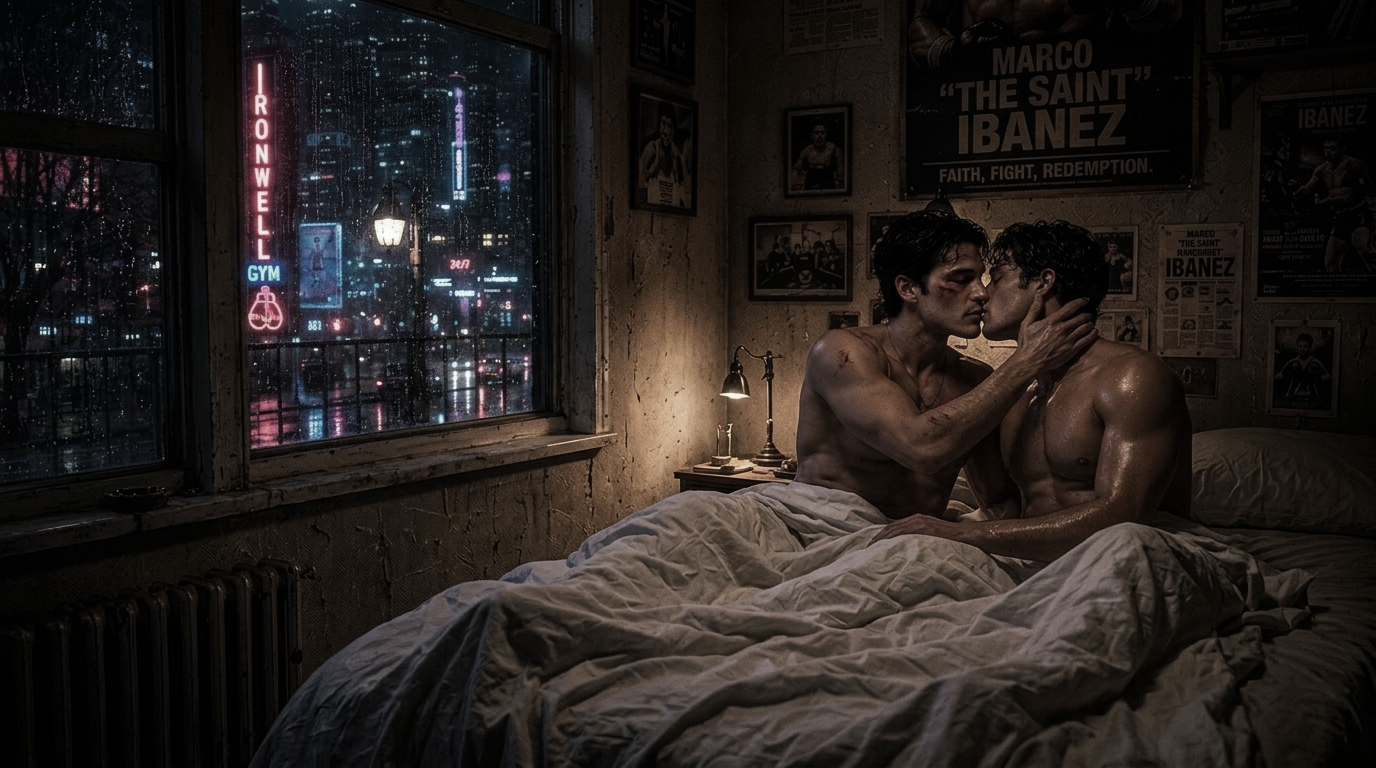
I wrapped my arms around his back and pulled him down against me. The weight of him was grounding. He was a solid, breathing anchor in a night that had felt unmoored. I ran my hands up his spine, feeling the shift of muscle under skin, the sharp jut of his shoulder blades, the dip at the base of his neck where I liked to press my face when I was falling asleep. His throat made a noise and he kissed along my jaw, down the side of my neck, pausing to mouth at the hollow of my throat.
“I love when you do that,” I said.
“I know.” His voice was muffled against my skin. “You told me. The third night.”
“You remember.”
“I remember everything.”
He moved down my body with the same deliberate slowness, his mouth charting a course across my collarbones, my sternum, the rise of my chest. He paused at each of the bruises the Stilton kid had left, kissing them with a tenderness that made my eyes sting. The one on my ribs. The one on my flank. The one on my breastbone that still ached when I breathed too deeply. He kissed them all, one by one, as if he were taking an inventory of my pain.
“You counted,” I said.
“I always count.”
He reached the waistband of the boxers I’d pulled on, and he hooked his fingers into the fabric and drew them down with an excruciating patience. I lifted my hips to help him, and then I was naked under him, utterly bare, and I felt the last of my defenses crumble.
“You’re beautiful,” he said.
“I’m beat to hell.”
“You’re beautiful.” He said it again with more force, as if he needed me to believe him. “Every part of you. Every scar. Every bruise. All of it.”
I didn’t have words. I reached for him instead, pulling him back up to me, and he came freely. Our bodies aligned, chest to chest and hip to hip, and I could feel him, hard against my thigh, but he didn’t rush. He just held himself there, suspended above me, his forehead pressed to mine.
“What do you need?” he asked.
“You.”
“You have me.”
“I need . . .” I swallowed. My throat was tight, the words sticking. “I need you to not let go. I need you to hold me and not let go and not stop touching me. Not for a second. I need . . . I need to feel like I’m still here. Like I’m solid. Like I’m not just going to float away.”
He closed his eyes. Something passed across his face . . . anguish, maybe, or grief. Then he opened them again and looked at me with an intensity that pinned me to the bed.
“I’m not going anywhere,” he said. “I’ve got you.”
He reached for the nightstand drawer, where we kept the lube and a few other things I never would have bought on my own. His fingers moved with the same precision he used for everything, and then he was kneeling between my legs, one slick hand working me open with a perseverance that bordered on torture.
“Breathe,” he murmured.
I breathed. In and out, slow and deep, trying to relax into the intrusion. He added a second finger, then a third, stretching me with a gentleness that was almost unbearable. My hands fisted in the sheets, my head thrown back, my breath coming in ragged gasps. He watched my face the whole time, reading my body like it was a language he’d spent years learning, adjusting his pace, his angle, the pressure of his touch. I’d never had a lover who paid this much attention. I’d never had a lover who made me feel like my pleasure was the most important thing in the world.
“Okay,” I said. “Okay. Now. Please.”
He withdrew his fingers and settled between my legs. I felt him at my entrance, the blunt pressure that always made my breath catch, and then he pushed inside. Slow, so slow, a fraction of an inch at a time. I wrapped my legs around him and locked my ankles at the small of his back.
“Don’t stop,” I said. “Don’t pull out. Stay. Just stay there.”
He stayed. He held himself still while my body adjusted to the fullness, his breathing ragged, his forehead slick with sweat. I could feel every inch of him, the heat and the weight and the solid, undeniable presence. I tightened my legs around him and pulled him deeper.
“Til . . .”
“Stay.”
“I’m here.”
He began to move. Slow, deep thrusts that pushed the air from my lungs in small, helpless sounds. I kept my eyes open, watching his face. The furrow between his brows, the way his mouth parted, the darkness of his eyes that never left mine. I’d closed my eyes before, during sex. I’d hidden my face in pillows and shoulders, afraid of being seen in the moment when I was most unguarded. But tonight I couldn’t look away. I needed to see him. I needed to know he was still here, still present, still looking back at me.
“You feel so good,” he whispered. “You feel like home.”
Something hot and tight unspooled in my chest. I reached up and pulled his face down to mine, kissing him hard, the split in my lip stinging. He kissed me back with equal urgency, his hips never stopping their slow, relentless rhythm.
“Don’t leave me,” I said, the words breaking against his mouth. “You’re the only thing that’s real. You’re the only thing that’s ever been real. Don’t leave. Don’t.”
“I won’t.”
“Promise me.”
A pause. A fraction of a second too long. Then, “I’m here. I’m yours.”
I believed him. God help me, I believed him.
I tightened my legs around him and pulled him even deeper still, and he groaned and dropped his head to my shoulder, his hips picking up speed. The slow, reverent rhythm began to fray into something more desperate, more urgent. I felt the heat roiling low in my belly, the pressure building, the world narrowing to the point where our bodies joined.
“I’m close,” I gasped.
“Let go. I’ve got you.”
He reached between us and wrapped his hand around me, and the double sensation of him inside me, of his hand on me sent me over the edge. I came with his name in my mouth, not shouted but whispered, a prayer, my body arching up into his. I felt him follow, the shudder that ran through his entire frame, the low, broken sound he made against my throat, and then he collapsed on top of me, his full weight pressing me into the mattress.
We lay there, tangled and sweating, neither of us willing to be the first to let go. The rain had stopped outside. The only sound was our breathing, slowly steadying, and the distant hum of the city through the window glass. The Ibanez poster was a dark blur above us, a silent witness to something I didn’t yet understand was already ending.
I still wrapped my arms around his back. I still locked my legs around his waist. I let the grip loosen, but I didn’t let go. Couldn’t. The thought of him pulling away, of the cool air rushing in where his body had been, was unbearable.
“Don’t leave me,” I said again. My voice came out small, smaller than I’d ever let it in front of another person. “You’re the only real thing. You’re the only thing that makes sense.”
He lifted his head and looked at me. His eyes were wet again, and his face was a landscape of emotions I couldn’t parse. Grief, love, fear, something that looked almost like guilt. He opened his mouth, closed it, opened it again.
“I’m here,” he said. “I’m yours.”
I fell asleep still holding on.

Morfeo
He slept like someone who’d been punished and forgiven in the same breath.
I watched him for a long time. The rise and fall of his chest. The flutter of his eyelids while dreaming. The way his hand, even in sleep, stayed curled around my forearm, as if he were afraid I’d vanish if he let go. His face was slack and peaceful, the swollen eye made him look younger, more fragile. In the kitchen, the green light of the coffee machine blinked steadily, a small, faithful heartbeat.
I counted the bruises again. Eight on his ribs. One on his jaw. The abrasion on his shoulder. The split knuckles I’d kissed. I catalogued them the way I’d catalogued everything else over the past two months. His laugh, his coffee order, the way he touched his jaw when he was thinking, the exact shade of his eyes in the morning light. Data. It was all data. It had always been data.
Except it wasn’t anymore.
The harvest drive remote display was on my phone. Ninety-four percent capacity. I’d been dragging it out, milking the connection I’d told Stilo, building the emotional resonance for maximum yield. But the truth was simpler and more damning. I couldn’t make myself end it. Every day I found an excuse. Every night I told myself tomorrow. And now the drive was almost full, and Stilo was calling me every twelve hours, and I was lying in this bed with this man who had just given me his whole heart, and I was going to destroy him.
I slipped out from under his arm. He stirred, murmured something, but didn’t wake.
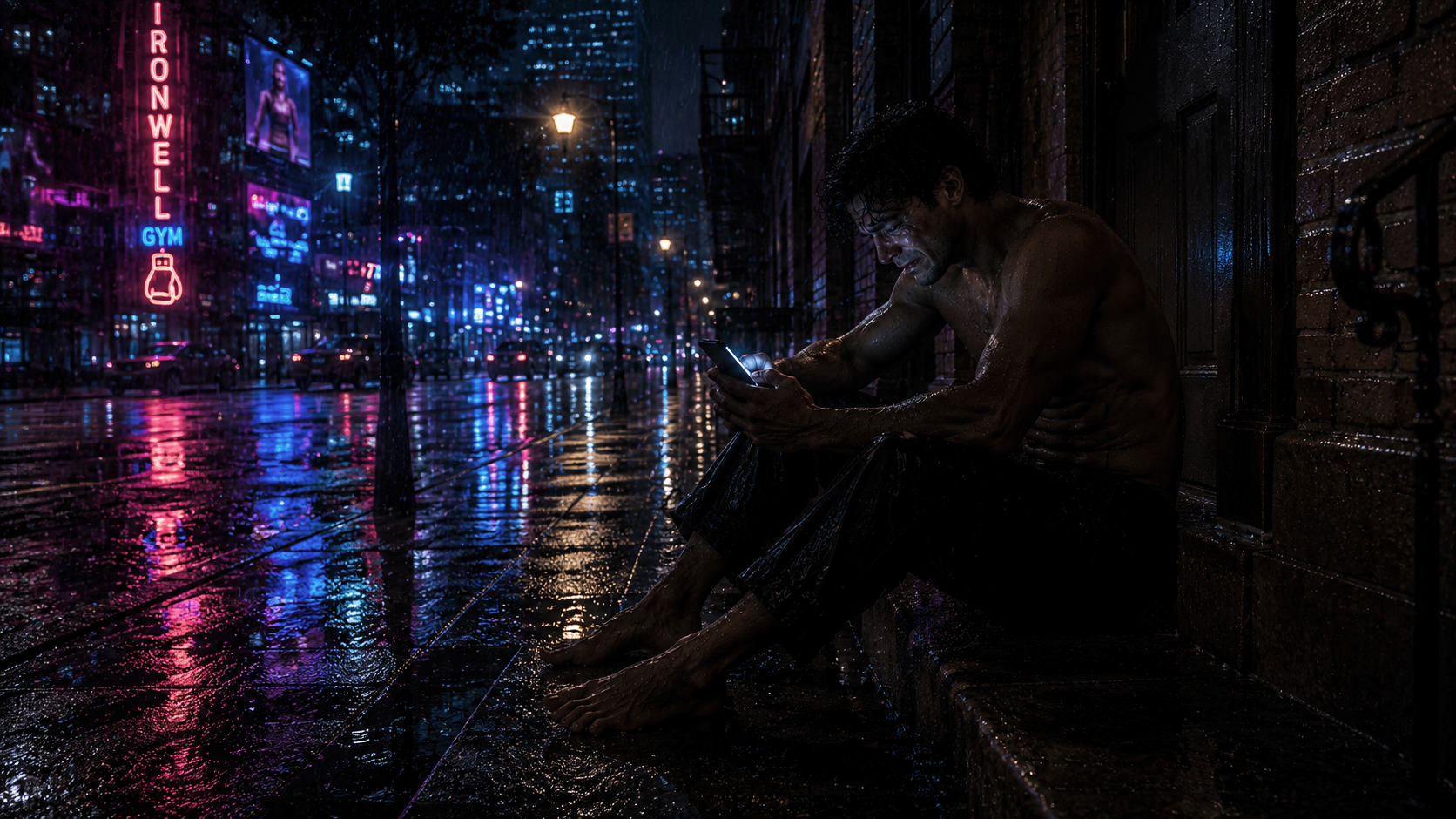
The stoop outside his apartment was cold under my bare feet. The rain had stopped, but the air was still wet, heavy with the smell of wet iron and garbage and somewhere in the distance the river. I sat on the top step and pulled the dampener out of my pocket. I’d been carrying it like a talisman, or maybe a threat. The little silver pill that could shut all this off. One press behind my ear, and I’d be functional again. Efficient. The Extractor they’d made me.
I didn’t press it.
Instead, I let it all in. Everything the dampener had been filtering for the past week—the love, the terror, the guilt, the impossible knowledge of what I had to do. It hit me like a wave and I bent over the railing and dry-heaved into the rain-slicked alley below. Nothing came up. There was nothing inside me to expel. Just the feelings, vast and formless and unbearable.
Stilo’s last message was still on my phone. Final consummation needed. Target the core wound. His fear of abandonment. Break him over it. Then abort.
I knew the script. I’d studied it. I’d written half of it myself in the early days, before I met him. Before I knew what his face looked like when he laughed. Before I knew he cried in his sleep sometimes, and that he’d never told anyone, and that I only knew because I’d been awake, watching him, storing up memories I wasn’t supposed to keep.
The breakup dialogue was loaded onto my neural display. You were a lay, not a life. I’d written that line six weeks ago, in a sterile rented room, before I’d ever felt his hands on my skin. Now it sat in my head like a loaded gun, waiting for tomorrow.
I couldn’t do it. I couldn’t not do it. The corporation had its hooks in me deeper than any dampener. They knew things about me, held things over me, owned things I’d signed away when I was young and desperate and didn’t understand what I was becoming. If I didn’t finish the harvest, they’d come for me. Maybe for him. I didn’t know what they were capable of but I’d heard stories. Extractor failures didn’t get severance packages.
I stood and moved down the sidewalk to look through his window. He was still asleep, his face slack and peaceful, the Ibanez poster above him like a saint in a cathedral. The hand wraps I’d left on the nightstand caught the streetlight. A ghost gift I’d placed there without knowing why. I knew now. I knew he’d wake up tomorrow, after the erasure, and hold them and not remember. I knew he’d feel a sourceless grief, a phantom limb where his love used to be. I knew all of this, and I was going to do it anyway, because I was a coward and a thief and the worst kind of monster. One who understood precisely what he was destroying.
When I went back inside, I crawled into bed and wrapped myself around him with a desperation that matched his own. He stirred. His hand found my arm, gripped, held.
“You okay?” he murmured.
“I’m scared of losing you.”
He was already half asleep again. His voice came out thick, dreamy, the way it did when he was on the edge of dreams. “Never. You’re stuck with me.”
I held him until the sky began to lighten. I watched the streetlight fade and the first gray pallor of dawn creep through the blinds. I memorized the way his hair curled at the nape of his neck, the smell of his skin, the sound of his breathing. I memorized everything, as if I could keep it, as if the harvest would store it for me instead of taking it from him.
And then I decided.
I reached for my phone. Pulled up Stilo’s message thread. Typed three words.
Tomorrow. I’ll finish.
I didn’t sleep. I didn’t move. I just lay there, holding him, waiting for the morning that would end everything.
On the nightstand, the hand wraps glowed somewhat in the rising light, already waiting to become a mystery Til wouldn’t remember how to solve.

End of Chapter 3.