MM Fiction, Infidelity, Angst, Hurt/Comfort, Second Chance Romance
Breck faces his family for the first time in a year, rebuilding the scaffolding of a past he can't fully trust, while Trace earns an unexpected ally in the woman who had every reason to hate him. In the golden quiet of a Sunday afternoon, they make love without grief or anger for the first time. Two men relearning each other's bodies as if for the first time. Between therapy sessions, kitchen-table negotiations about money, and the hard, quiet work of telling the truth even when it's awkward, they begin to build a new normal from the wreckage of the old one.

Breck’s Point of View
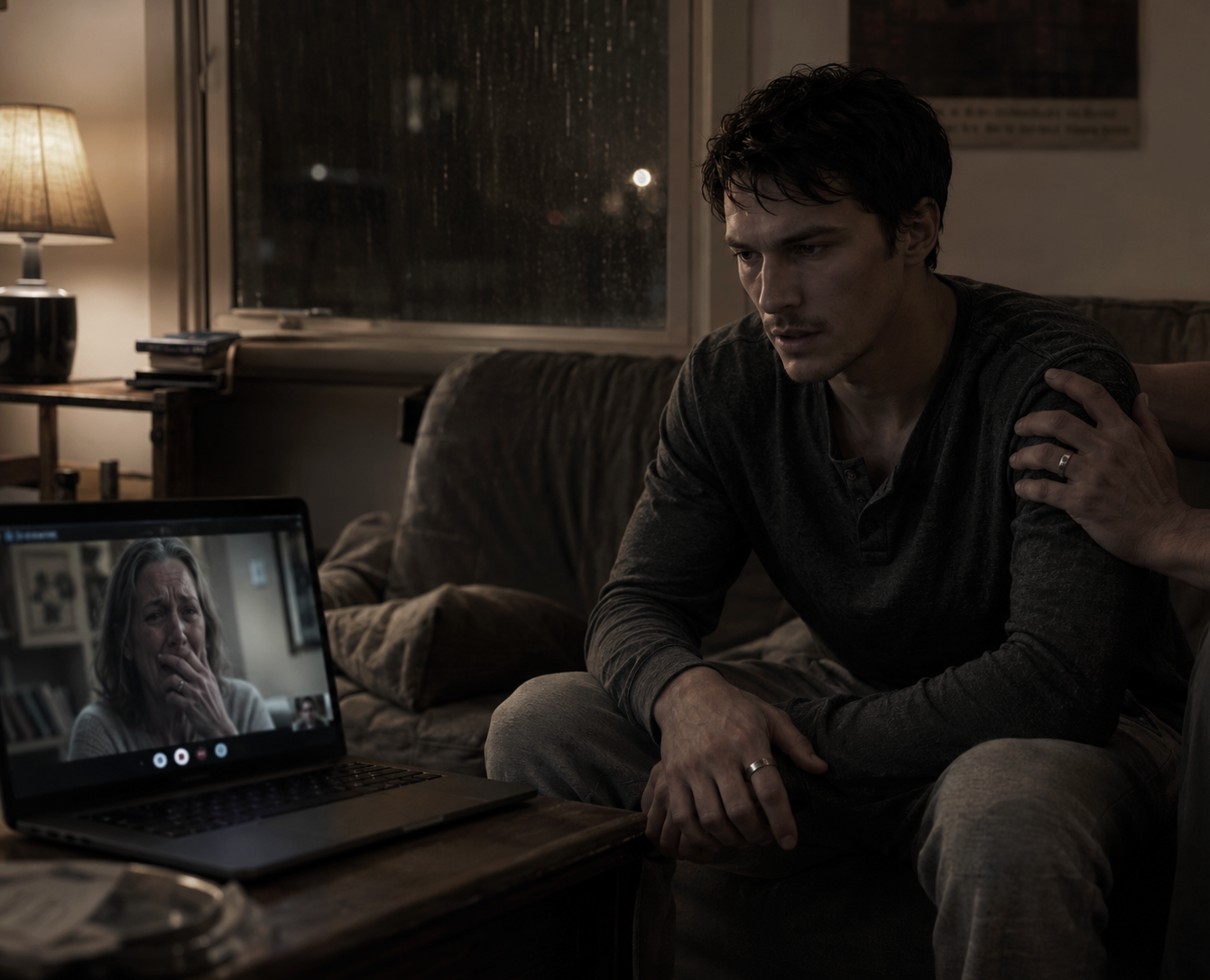
The video call connected at eleven in the morning on a Thursday, and my mother’s face filled the screen like a weather system moving in.
She was in the kitchen of the house I had grown up in. I knew that kitchen. The yellow wallpaper with the faded sunflowers. The window over the sink that looked out on the backyard where my father had taught me to throw a baseball and I’d missed every single one. I knew the way the light came in at this hour, slanting across the counter where she’d rolled out pie dough and iced cupcakes and written my name in frosting on a hundred birthday cakes. I knew it, and I didn’t know how I knew it, and that uncertainty was a cold finger at the back of my neck.
“Breck.” Her voice came out strangled. She was already crying. “Oh, sweetheart. Oh, baby.”
“Hi, Mom.”
I was sitting on the pull-out couch in my apartment. Trace was beside me, close enough that our shoulders touched but not close enough to be in the frame. His presence was a steady warmth against my left side, grounding me in a way I hadn’t asked for and could not have articulated. The ring on my finger felt heavy. The ring on his was somewhere just out of sight.
My father appeared behind her. David Carson, sixty-four, a retired civil engineer, a man who communicated emotion through the angle of his shoulders and the set of his jaw. He put his hand on my mother’s shoulder, and the gesture was so familiar that something cracked open in my chest.
“Son,” he said. His voice was rough. “You look good.”
“I look like I haven’t slept in a week.”
“That too.”
Avery pushed into the frame from the left. My sister, three years younger, sharp-edged and sharp-eyed, the one who’d never quite trusted Trace and had evidently been right not to. Her face was pale, her mouth a thin line. She didn’t cry. She’d never been a crier. She just looked at me like she was memorizing my face in case it disappeared again.
“You asshole,” she said. “You complete and utter asshole.”
“Hi, Ave.”
“Don’t ‘hi Ave’ me. Do you have any idea . . . do you have any idea what the last year has been like? Mom didn’t sleep for a week. A week, Breck. Dad drove around Portland every night looking for you. Every night. I had to . . .” Her voice cracked and she swallowed hard. “I had to call morgues. Do you know what that’s like? Calling morgues and hoping your brother isn’t there?”
“I’m sorry.”
“You don’t get to be sorry. You get to be sorry when you borrow someone’s car and dent the bumper. You don’t get to be sorry for disappearing for a year and making everyone think you were dead.”
“Avery.” My mother’s voice was quiet but firm. “Let him breathe.”
“He doesn’t deserve to breathe. He deserves to—”
“Avery.”
My sister’s jaw clenched. She looked away from the camera, and I saw the tears she’d been holding back finally spill over. She wiped them with the back of her hand, furious at herself for letting them show.
“I thought you were dead,” she said, quieter now. “I thought he killed you and buried you somewhere and we’d never find you.”
The he landed in the room like a stone.
Trace didn’t move. His shoulder stayed pressed against mine, but I felt the tension ripple through him, a tightening of muscle, a held breath. He didn’t speak. He’d promised he wouldn’t speak unless I asked him to.
“He didn’t,” I said. “Trace didn’t hurt me. He’s the reason I’m here. He found me.”
“I know what he did.” Avery’s eyes flicked to the edge of the frame, where she knew Trace was sitting. “I know what he did before that. And I’m not . . . I can’t just—”
“You don’t have to forgive him. That’s not why we’re calling.”
“Then why are we calling?”
I looked at my mother, still crying silently, her hand pressed to her mouth. At my father, whose jaw was working like he was chewing on words he couldn’t spit out. At my sister, who had called morgues for me, who had been sharpening her anger for a year and didn’t know where to point it.
“Because I needed to hear your voices,” I said. “Because I don’t know what I remember and what I’m making up, and I needed . . . I needed to know you were real.”
My mother made a sound I’d never heard before. Something between a sob and a laugh. “We’re real, baby. We’ve always been real. We never stopped being real.”
“Tell me something,” I said. “Something from when I was a kid. Something I couldn’t have made up.”
She blinked, confused. “What do you mean?”
“I don’t . . . some of my memories are real. Some of them might be constructed. Things I want to be true. I can’t always tell the difference. So tell me something true. Something only you would know.”
My mother looked at my father. He looked back at her. Something passed between them, a marriage’s worth of shorthand.
“When you were seven,” my mother said, “you found a bird in the backyard. A sparrow. It had fallen out of the nest, and its wing was broken. You wrapped it in your favorite t-shirt, the one with the dinosaur on it, and you carried it around in a shoebox for three days. You fed it water from an eyedropper. You named it Harold.”
“Harold the sparrow.”
“You were determined to save it. You told me . . . you said, ‘Mom, I’m going to be a doctor for birds.’ And I said, ‘I thought you wanted to be a fireman.’ And you said, ‘Firemen only save people. I want to save the things no one else thinks are important.’”
I couldn’t breathe. The memory wasn’t there, not exactly, but something was. The feeling of small feathers against my palm. The weight of a shoebox. The fierce, impossible certainty that I could fix something broken.
“Harold died,” my mother said. “On the third day. You cried for an hour. And then you asked your dad to help you bury him under the apple tree, and you made a little cross out of popsicle sticks, and you wrote ‘Harold the Brave’ on it in green crayon. And I remember thinking . . . I remember thinking, This is who he is. This is who he’s going to be. A boy who fights for the small things.”
I was crying. I hadn’t noticed when it started. Trace’s hand found mine, our rings clicking together, and I held on.
“That’s real,” I said. “I didn’t remember the shoebox. But the feeling, the wanting to save something, that’s been there my whole life.”
“It’s who you are,” my mother said. “It’s who you’ve always been.”
My father cleared his throat. “You want another one? I’ve got one.”
“Okay.”
“You were twelve. I was teaching you to ride a bike. The two-wheeler, the one with the red paint that was too big for you. You fell off about fifty times. Scraped your knees to hell. Your mother wanted me to stop, but you wouldn’t let me. You kept getting back on. Every single time. And finally I asked you. I said, ‘Breck, why don’t we take a break?’ And you looked at me with this . . . this fierce little face, all determination, and you said, ‘Dad, if I stop now, I’ll never know if I could have done it.’”
He paused. His voice had gone rough.
“You made it to the end of the block before you fell again. But you got back up. You always got back up.”
The tears were coming faster now. I didn’t try to stop them.
“Thank you,” I said. “Both of you. For the memories. For being real.”
“We’re always going to be real,” my mother said. “No matter what you remember or don’t remember. We’re your family. That doesn’t go away.”
Avery had been silent through both stories. When she spoke, her voice was different. Not soft. She was never soft, but something adjacent to it.
“I don’t have a story,” she said. “I just have . . . I’m glad you’re not dead. And I’m really, really angry that you disappeared. But I’m glad you’re not dead.”
“That’s fair.”
“And I still don’t trust him.” Her eyes flicked to the edge of the frame again. “But you found him. Or he found you. Whatever. You’re back. That counts for something.”
“It counts for a lot.”
“Don’t do it again. Don’t disappear. Don’t . . .” Her voice broke again. “Don’t make me call morgues. Okay?”
“Okay.”
“I mean it, Breck.”
“I know you do.”
She nodded once. Wiped her eyes. Looked away.
My mother leaned closer to the camera. “We love you. We’ve always loved you. And we’re going to be here. Whatever you need. Okay?”
“Okay.”
“We should let you go. You look exhausted.”
“I am. But it was good. Hearing you. It was really good.”
“Call us again. Soon. When you’re ready.”
“I will.”
“Promise me.”
“I promise.”
The call ended. The screen went dark. I sat there on the pull-out couch, Trace’s hand still in mine, and let the tears fall without trying to stop them.
After a long moment, Trace spoke. “You okay?”
“No. Yes. I don’t know.” I wiped my face with my sleeve. “Both. Neither.”
“That’s fair.”
“My sister hates you.”
“She has every right to.”
“She’s going to give you hell when you finally meet her.”
“I know. I’m prepared.”
“Are you?”
He was quiet for a moment. “No. Probably not. But I’ll take it. Whatever she needs to say to me, I’ll take it.”
I turned to look at him. He was still in the same position he’d been in when the call started. His shoulder against mine, hand in mine, presence steady and undemanding. He’d sat through my mother’s memories and my father’s story and my sister’s fury without saying a word, without trying to defend himself, without making any of it about him.
“You’re different,” I said.
“What do you mean?”
“The man who cheated on me. The man who lied for four years. He would have found a way to be the center of that conversation. He would have apologized to my mother. He would have tried to explain himself to my father. He would have told Avery she was right not to trust him, and somehow made it about his own guilt.”
Trace didn’t flinch. “I wanted to. Every instinct I had was screaming at me to say something. To make it better. To manage the narrative.”
“But you didn’t.”
“Sloane’s coaching. And my therapist. They both said the same thing. When it’s not about you, don’t make it about you. Sit there. Be present. Let them feel what they need to feel.”
“That must have been hard for you.”
“It was excruciating.” A ghost of his old smirk, there and gone. “I’m not good at being a supporting character.”
“You’re learning.”
“I’m trying.”
I leaned into him, letting my head rest against his shoulder. The fabric of his shirt was soft and expensive. He’d probably paid more for it than I made in a shift at the café. Underneath it was the steady thump of his heart. Alive. Present. Here.
“I need to sleep,” I said. “For about a year.”
“Then sleep. I’ll be here.”
“You don’t have to stay.”
“I know. I want to.”
I closed my eyes. The tears had dried on my cheeks, leaving that tight, salty residue that always followed a good cry. My mother’s voice was still in my head, a boy who fights for the small things and my father’s you always got back upand Avery’s fierce, broken don’t make me call morgues. They were real. They had always been real. And I was real, too, even if some of the pieces were still missing.
Trace’s hand was warm around mine. The rings clicked together, a small metallic heartbeat.
I slept.

Trace’s Point of View
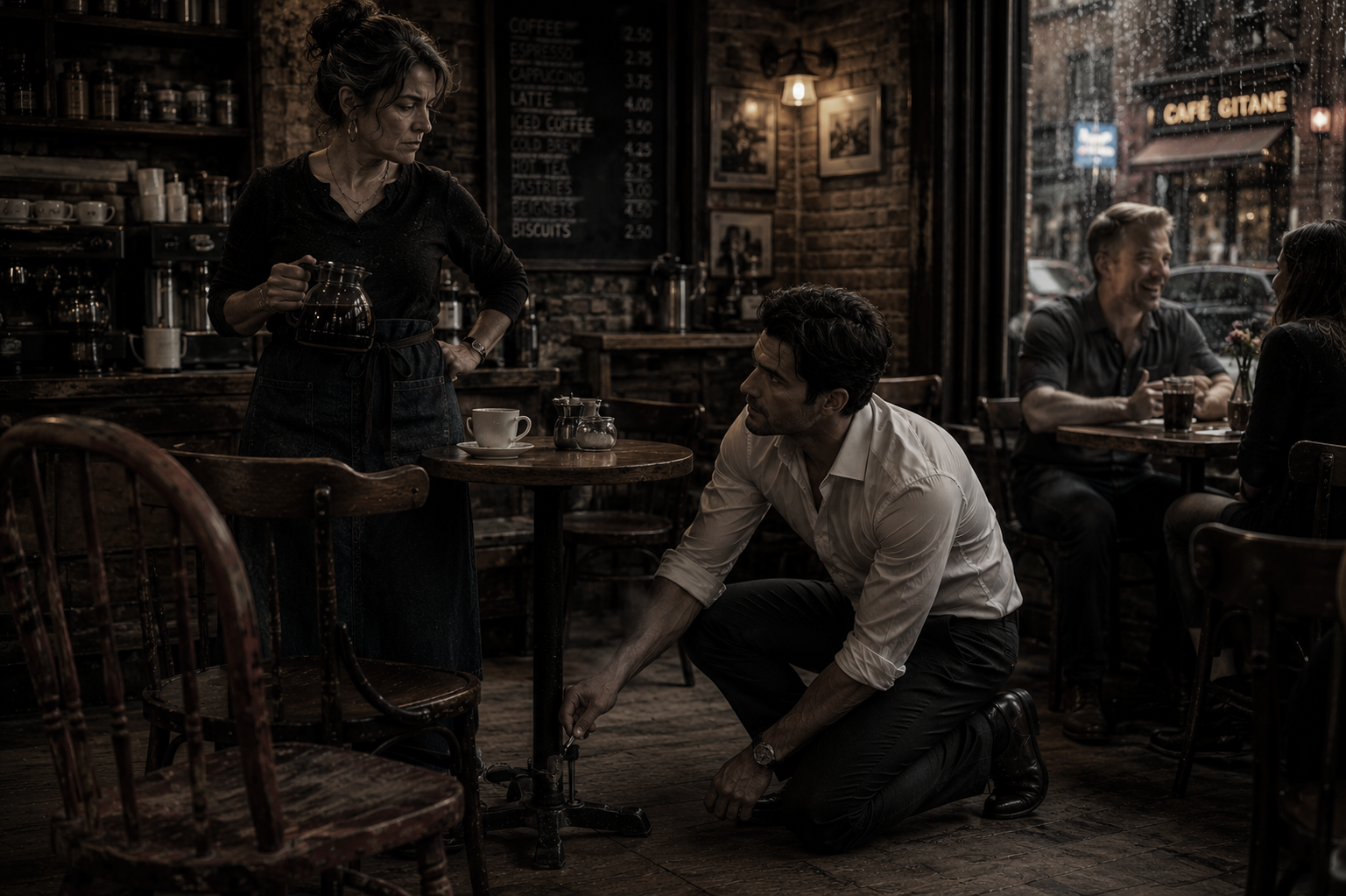
A few days later, I was at Café Esperanza, and Rosa was watching me fix a wobbly table leg.
She hadn’t asked me to fix it. I’d noticed it rocking when I sat down with my espresso. Breck was working the counter, his back to me, the faint spearmint of his gum drifting across the café, and I’d gotten down on one knee to check the hardware without really thinking about it. The bolt was loose. I’d fished a dime out of my pocket and tightened it, the way my father had taught me when I was ten and he was still trying to figure out how to have a son who didn’t care about quarterly reports.
“You’re going to scratch your trousers,” Rosa said. She was standing over me with a coffee pot in one hand and an expression that hovered somewhere between suspicion and amusement. “Those are four-hundred-dollar trousers.”
“Three-fifty. They were on sale.”
“I don’t think you’ve ever bought anything on sale in your life.”
“I’m trying new things.”
She didn’t say anything else. Just stood there while I finished tightening the bolt and wiped my hands on a napkin. When I stood up, the table was solid.
“You’ve been doing that a lot,” she said.
“Doing what?”
“Showing up. Not pushing. Letting him set the pace.” She nodded toward Breck, who was laughing at something a customer had said, his whole face lit up in a way I hadn’t seen since before he’d disappeared. “I’ve been watching you.”
“I know.”
“You’re not who I thought you were.”
I met her eyes. She was a small woman, compact and fierce, with a brand of stillness that made you feel like you were being X-rayed. She’d hated me on sight. I couldn’t blame her.
“I wasn’t,” I said. “Before.”
“I know. He told me some of it.” She paused. “The cheating. The lies. The way you were when he first knew you.”
“That was me. That’s still me. I’m just . . . trying to be less of that person.”
“Are you succeeding?”
“Some days. Some days I’m still an asshole.” I folded the napkin and set it on the table. “But I’m trying. That’s new. The trying part.”
Rosa studied me for a long moment. The coffee pot was still in her hand, steam curling from the spout. Behind her, the espresso machine hissed and a spoon clinked against ceramic, the café’s usual morning noise filling the spaces where neither of us was speaking.
“He came in here a year ago with nothing,” she said. “No wallet. No name. No past. He couldn’t remember what he liked in his coffee. He had to ask me what he ordered. Can you imagine that? Not knowing what you like. Having to be told.”
“No,” I said. “I can’t.”
“He built himself back from air. It took months. He was quiet and careful and he never asked for help, but he’d listen to anyone who needed to talk. Customers would tell him their whole life stories and he’d just nod. Listen. Say the right thing. Even when he didn’t know his own name.”
“That sounds like him.”
“It is him. It’s the core of him. The part that couldn’t be erased.” She set the coffee pot down on the table. “When you showed up, I thought you were going to break him again. I watched you walk in here with your expensive watch and your desperate eyes, and I thought, Here comes the man who shattered him, come to finish the job.”
“I thought the same thing. About myself.”
“But you didn’t.”
“No.”
“You stayed. You let him yell at you. You slept on his pull-out couch. You learned how to make espresso.” Her mouth twitched. “Badly, at first.”
“Very badly.”
“You’re doing the work.”
“Trying.” I met her eyes. “That’s all I can do. Try. And hope it’s enough.”
Rosa picked up her coffee pot. She didn’t smile. I wasn’t sure she knew how to smile at me yet. But something in her face shifted. A verdict, silently delivered.
“Okay, then,” she said. And walked back to the counter.
I stood there for a moment, feeling something I couldn’t quite name. It wasn’t forgiveness. It wasn’t approval. It was something closer to acknowledgment. A door that had been closed was opening a crack.
Breck caught my eye from behind the counter. He raised an eyebrow—what was that about?—and I shrugged. He shook his head, but he was smiling.
The table stayed solid for the rest of the morning.

Breck’s Point of View
The sex was different in the daylight.
We’d been back in each other’s bodies for weeks now, but always with something else underneath. The desperation of the pull-out couch, the raw survival of the car backfire night, the angry, bruising kiss against the kitchen counter. Even the slow, sacred re-consecration in my bed had been freighted with grief and memory and the weight of everything we’d lost.
This was Sunday afternoon, and the sun was coming through the window of Trace’s townhouse, our townhouse he called it, and neither of us was angry or scared or trying to prove anything.
We were just here.
Trace’s bed was bigger than mine, a king with sheets that probably cost more than my entire bedroom set, and the light fell across it in long golden rectangles. I’d been here before, before the fugue, but I didn’t remember it. This was the first time in my memory that I’d been in his bed, and that should have felt heavy, but it didn’t. It felt like a beginning.
He propped himself against the headboard, shirtless, and watched me with an expression I couldn’t quite read. Grief and hope, still tangled. But the hope was winning today.
“You’re staring,” I said.
“I’m always staring.”
“That’s creepy.”
“It’s romantic. There’s a difference.”
“You say that about everything.”
“Because it’s usually true.”
I laughed. The sound surprised me. Bright and unguarded, a laugh I hadn’t heard from myself in longer than I could remember. Trace’s face changed when he heard it. Something in his eyes went soft and almost wounded, like the laugh had hit him in a place he’d forgotten he had.
“That’s the one,” he said.
“What one?”
“Your real laugh. The one that sounds like you’re surprised by it. You used to do it all the time. When I’d say something stupid, or when the cat did something ridiculous, or when you were half asleep and I’d whisper something in your ear.” He reached out and touched my face, his thumb brushing the corner of my mouth. “I haven’t heard that laugh in a year.”
“I think it’s new,” I said. “I think I get to keep it.”
“Good. Keep it. It’s my favorite sound.”
I leaned into his hand. His palm was warm and dry and familiar in a way that went deeper than memory. My body knew him. Even if my mind couldn’t always sort the past from the present, my body knew absolutely who he was.
“Kiss me,” I said.
He did.
It started slow. Not desperate, not hungry, not the fight-kiss of the kitchen counter. His mouth on mine, soft and searching, like he was learning me again. His hand slid from my jaw to the back of my neck, and I let my weight settle against him, and for a long time we just kissed in the golden afternoon light. Nothing urgent, nothing to prove.
Then his hand moved lower. The small of my back. The curve of my hip. His fingers hooked into the waistband of my jeans.
“This okay?” he asked.
“Yeah.”
“You sure?”
“I’m sure. I want this. I want you.”
He undressed me slowly. There was no rush. The sunlight moved across the bed in increments, and his hands followed the light down my shoulders, my chest, the faint surgical scar along my collarbone that he touched with the pad of his thumb like it was something precious. He kissed the scar. He kissed the freckles on my nose. He kissed the crescent-shaped mark on my palm, the one from the bike accident when I was eight, the one my mother had kissed better and told me was proof I was brave.
“I remember this one,” I said. “My dad told me the story. On the call. I couldn’t remember it before, but now I can.”
“Does it feel real?”
“I don’t know. But it feels like mine.”
He kissed it again. His mouth was gentle and almost reverent. Then he pulled back and looked at me with an expression that was so open, so unguarded, that my chest tightened.
“I want to make love to you,” he said. “Not because I’m trying to earn something. Not because I’m proving I’ve changed. Just because I love you, and it’s Sunday, and the light is perfect, and I want to make you feel good.”
My throat was too tight to speak. I nodded.
“Words,” he said. “I need words.”
“Yes. Yeah. I want that too.”
He reached for the nightstand. His hand found the lube and a glass of water that was sweating condensation onto the wood. The ordinary details of an ordinary afternoon. But nothing about this felt ordinary. It felt like the first real thing we’d done since he’d found me.
He prepped me slowly, one finger at a time, checking in with his eyes and his voice and the gentle pressure of his free hand on my hip. My body opened for him the way it always had. Muscle memory went deeper than mind. When he finally positioned himself between my legs, the sturdy head of his cock pressing against me, I reached up and put my hand flat on his chest.
“Wait,” I said.
He stopped immediately. “What’s wrong?”
“Nothing. I just . . .” I looked at him. At the sun in his hair, the faint scar on his jaw, the ring on his finger that matched mine. “I want to remember this. I want to remember it for real. Not as a story someone told me later. Not as a maybe. I want to know this happened.”
“It’s happening,” he said. “Right now. You and me. Sunday afternoon. The light through the window. The neighbors arguing about something. Can you hear them? They’re always arguing. It’s the one constant in this building.”
I listened. Through the window, faint and far away, a man’s voice rose in irritation, and a woman’s answered. I laughed again in that same surprised, delighted sound.
“The neighbors are fighting.”
“They’ve been fighting since 2019. It’s practically a landmark.”
“Kiss me,” I said. “And don’t stop.”
He pushed inside me and I gasped and the stretch was familiar and new all at once. My body remembered even when my mind didn’t. The fullness. The heat. The way he always paused just inside, letting me adjust, his forehead pressed to mine, his breath warm on my lips.

“Okay?” he asked.
“More than okay. You can move. Please.”
He moved.
Easy at first. Deep, rolling strokes that built like a tide coming in. The slide of him, the weight of him, the magical friction that only he had ever known how to find. His breath went ragged against my throat. I could smell him, the faint salt of sweat starting at his temples, something brawnier and muskier that was uniquely him. The bed creaked softly. The neighbors were still going at it through the wall, a muffled counterpoint I barely registered.
“There,” I said. “Right there. Don’t stop.”
“I’m not stopping.”
“Harder. A little harder.”
He obliged. The headboard tapped the wall once. Then twice, and I thought about the neighbors and laughed again, a breathless, broken sound that turned into a moan as he shifted the angle and found the spot that made my vision blur. The sound of our bodies was slick and rhythmic, an undertone to the creak of the bedframe and the distant argument next door and the rush of blood in my ears.
“There,” I said. “There. Yes.”
He was watching my face. His eyes were deep and his mouth slightly open, the tendons in his neck standing out with the effort of holding back just enough. I catalogued him the way he always catalogued me. The flush spreading down his chest, the sweat beading at his hairline, the way his teeth clenched when he was close. His free hand came up to cup my jaw and he ran his thumb across my bottom lip.
“I love you,” he said. “I love you so much it terrifies me.”
“I love you too. I’m . . . close. I’m really close.”
“Let go. I’ve got you.”
His hand wrapped around my cock with just the right pressure, just the right rhythm, and I came with a noise that was his name and a chuckle and an honest to god shout, my body clenching around his hardness inside me, the orgasm rolling through me in waves. My vision took a vacation, and not a short one, either. I felt every pulse of it, the way my muscles seized and released, the hot spill of my own sticky cum across his fingers and my stomach. The scent of it hit my nostrils almost immediately.
Trace was still inside me, still hard, still moving. His rhythm broke and stuttered and I watched his face change as it hit him. The way his eyes squeezed shut. The way his mouth fell open around a sound that started low in his chest and rose into something almost wounded. He buried himself deep, once, twice, three more strokes, each one harder than the last, and then he was coming too, a groan tearing out of him so low that I felt it in my chest. The pulse of him inside me, slick and hot, flooding me deep. His whole body shuddered, and he collapsed against me, his weight pinning me to the mattress, his breath ragged and wet against my throat.
For a long moment there was only the sound of us breathing, and the neighbors finally falling silent on the other side of the wall, and the sun inching its way toward the edge of the bed.
We lay there afterward, tangled and sticky, the sun pooling on the sheets around us. His weight was warm on top of me. His breath was slowing against my throat. His heartbeat came through his chest, a steady, percussive rhythm that my body knew like its own.
“That’s the laugh I missed,” he said again, muffled against my skin.
“I think I’m going to keep it. The laugh. The ring. The job. The apartment.” I turned my head and kissed his temple. “I think I get to keep all of it.”
“You do. It’s yours.”
“Mine.”
“Yours.”
We stayed like that until the sun moved off the bed and the room grew cool and the neighbors finally stopped arguing. Then we showered together. More laughter, more touching, nothing urgent, just the easy intimacy of two people who’d finally found their way back to something simple. And then I made coffee in Trace’s kitchen while he ordered takeout from a Thai place he swore was the best in the city.
It was. He was right about a lot of things.

Two weeks after that Sunday afternoon, I was sitting on Dr. Okami’s couch. The new normal had settled in around us between then and now, quiet and unannounced, like sediment finding the bottom of a glass.
I kept my apartment. Trace kept the townhouse. We dated. Real dates, the kind we’d never really had the first time around, when we’d fallen into each other’s lives so fast we’d skipped the getting-to-know-you part. Now we went to movies and argued about the endings. We tried new restaurants. We walked along the river in the rain, Trace’s umbrella tilted toward me, our shoulders brushing.
Some nights I stayed at his place. Some nights he stayed at mine. The pull-out couch stayed folded up because my bed was ours now, and his bed was ours, and the geography of our relationship was a thing we were drawing together, one night at a time.
I was still working at Café Esperanza. He was slowly returning to his firm, picking up clients he had abandoned during the year he’d spent searching for me. Soon, I would start volunteering at a different hotline. A smaller one with better boundaries, where nobody knew me as the guy who’d heard a caller die. Rosa had already put in a word. We didn’t talk about the money at first. It was there, a fact of our lives, but it was a fact we’d both been carefully stepping around.
Until I brought it up.

Trace’s Point of View
We were at Breck’s apartment. His apartment, I reminded myself, the one with the pull-out couch and the thrift-store espresso machine and the café schedule pinned to the fridge and he was making dinner. Pasta with mushrooms. Breck loved them. I’d spent years picking them out of my plate, but somewhere along the way I’d stopped minding them and started liking them, which was either love or Stockholm syndrome, and either way I wasn’t complaining.
“I don’t want you paying for everything,” he said.
He was at the stove, his back to me, stirring sauce. The sentence was casual, almost thrown away, but I’d learned to recognize the weight underneath his casual sentences. This one was heavy.
“Okay,” I said. “You set the terms.”
“I don’t know what’s fair.” He turned around, a wooden spoon in hand. “You make . . . I don’t even know what you make. A lot. More than me. A lot more than me. And part of me wants to say we split everything fifty-fifty, but that would mean you eating ramen three nights a week, and I don’t want to eat ramen three nights a week.”
“I like ramen.”
“You like the forty-dollar ramen at the place in the Pearl District. That’s not real ramen.”
“It’s real. It’s just expensive.”
Breck pointed the wooden spoon at me. A droplet of tomato sauce flew off and landed on the counter. “I pay for dinner on my nights. You pay on yours. Rent is separate. For now.”
“Done.”
“There’s no argument?”
“Do you want an argument?”
“No. I just . . .” He frowned at me. “I expected you to push back. ‘Let me take care of you.’ ‘Money doesn’t matter.’ All the things rich people say when they’re trying not to be weird about being rich.”
“The money matters. Pretending it doesn’t would be insulting to both of us.” I leaned back in my chair. “You need to feel like an equal. I understand that. If the way you feel equal is by paying for dinner on your nights, then that’s what we’ll do. If you change your mind later, we’ll adjust.”
“That’s it?”
“That’s it.”
He stared at me for a long moment. Then he turned back to the stove, but not before I caught the expression on his face. It wasn’t relief, exactly. It was something closer to surprise. Like he’d been bracing for a fight and found none.
“You passed,” he said quietly.
“Passed what?”
“A test. You didn’t know you were taking it.” He stirred the sauce. “I needed to know you’d let me set the terms. That you wouldn’t try to manage me into accepting your money because it made you feel better about your guilt.”
“I don’t want to manage you. I want to be with you. However that looks. Whatever terms you set.”
“Okay.” He scraped the pasta into a colander, steam billowing up around his face. “My nights. Your nights. Separate rent. For now.”
“For now.”
Later, after dinner, after the dishes, after we’d curled up on the pull-out couch with a movie neither of us was really watching, I thought about all the ways I’d used money in the past. The gifts I’d given to avoid conversations. The vacations I’d planned to paper over cracks. The life I’d built for Breck, for us, without ever asking if it was the life he wanted. I’d thought generosity meant spending. I’d been wrong. Generosity meant letting go of the check.
I hadn’t told him what the search had cost me. The clients I’d lost. The partnership track I’d stepped off. A year of billable hours I’d never get back, not that I wanted them. I’d drained my savings on private investigators and digital forensics and a specialist in dissociative disorders who’d finally been the one to suggest looking at homeless shelters. It was the best money I’d ever spent. I’d burn it all again without blinking. But he should know. At some point, I needed to tell him, not because it made me noble. It didn’t, there was nothing noble about cleaning up a mess you’d made, but because hiding the cost was another kind of lie. Another way of managing the narrative. Another thing I was trying not to do anymore.
His head was on my shoulder. His breathing was slow and even. He wasn’t asleep, but he was close, his body heavy and warm against mine.
“Thank you,” I said.
“For what?”
“For telling me what you need. Instead of letting me guess.”
“You’re bad at guessing.”
“Catastrophically bad.”
“I know.” He shifted, tucking his feet under my thigh. “That’s why I’m telling you. The deal, remember? Truth, even when it’s awkward.”
“Even when it’s awkward.”
“Especially when it’s awkward.”

Breck’s Point of View
Dr. Okami’s office was on the twelfth floor of a building downtown, with windows that looked out over the river and a waiting room that smelled like eucalyptus and candle wax. Trace had been seeing her for six months. When I’d asked him for a recommendation, he’d given me her name without hesitation, then immediately added, “She knows the whole story, which means you don’t have to explain everything from zero. But I can get a referral if you’d rather have someone who doesn’t know me.”
I’d thought about it. A therapist who knew Trace’s side of things, one who had heard his version of the betrayal and the search and the slow, painful reconstruction might be biased. Might see me as the victim and him as the perpetrator and treat us like a problem to be solved rather than two people trying to heal.
But she’d also seen him through the worst of it. She’d helped him build the structured apology he’d delivered at three in the morning while I raged at him. She’d coached him on how to be a supporting character. If she was good enough that he was still going, still learning, still trying, she was good enough for me.
“No,” I’d said. “If she’s good enough for you, she’s good enough for me.”
Now I was sitting on a couch that was too soft, my feet sinking into a rug that probably cost more than my monthly rent, telling a stranger about the worst night of my life.
“The gunshot,” I said. “That’s the part I can’t get past. I hear it at night. When it’s too quiet. When the rain stops. It’s like the silence triggers it.”
Dr. Okami nodded. She was a small woman in her fifties, with gray-streaked hair and glasses that hung from a chain around her neck. Her face was kind but not soft. She had the same way of listening I’d learned on the hotline. Fully present, no impatience, no hurry to fill the silence.
“You were on the phone with him when it happened.”
“Seven calls over three months. He was . . . Marcus. His name was Marcus. He had a rescue greyhound named Lucy. He called when he felt himself slipping.” My voice was steady, but I could hear the effort in it. The way I was skimming the surface of the words, not letting them sink. “On the last call, he said he was tired. I told him he didn’t have to do it. I told him to stay on the phone with me.”
“And you heard it.”
“I heard the gun go off. I heard . . .” I stopped. Swallowed. The word body stuck in my throat. I’d said it a thousand times in debriefs, in supervision, in the clinical language that kept everything at arm’s length. But in this room, on this couch, with this woman who was watching me with her steady, patient eyes, the word wouldn’t come. “I heard him fall. I heard Lucy start barking.” I pressed my palms together and felt the rings click. “I sat there for twelve minutes waiting for emergency services. Protocol says you stay on the line. I stayed on the line. And the whole time I could hear the dog losing her mind, and Marcus wasn’t making any sound.”
Dr. Okami didn’t say anything for a moment. “You know it wasn’t your fault.”
“I know it intellectually.”
“But you don’t feel it.”
“I feel like I failed him. I feel like if I’d said the right thing . . .” I stopped. She’d caught the filtering language. I’d said I feel like twice, the crisis worker’s dodge, the way you make emotion manageable by wrapping it in a simile. I dropped the scaffolding. “I failed him. That’s the story my body tells me every time it gets too quiet. Doesn’t matter what I know. The body doesn’t care about logic.”
Dr. Okami nodded slowly. “That’s where we start. Not with what you know. With what your body believes.”
“I don’t like needing saving.”
“I know. That’s what we’re going to work on.”
I looked out the window. The river was gray and flat, a mirror of the sky. Rain was coming. The air had that density, a pressure changing behind my eyes.
“How often?” I asked. “How often do I need to come?”
“Twice a week to start. We’re dealing with complicated grief. Marcus, yes, but also the loss of your own identity for a year. The man you were before the fugue is gone. The man you were during it, Michael, is gone too. You’re building a new self from pieces of both. That’s not simple. It takes time.”
“Twice a week.”
“For now. We’ll reassess in a few months.”
I nodded. The rain started in a soft patter against the window. I watched it streak down the glass.
“There’s something else,” I said. “Something I haven’t told Trace.”
“Okay.”
“Sometimes I miss being Michael.”
The words hung in the air. I’d never said them out loud. I’d barely let myself think them.
“Michael didn’t know about the gunshot. Michael didn’t know about the betrayal. Michael was just a guy who worked at a café and made friends with Rosa and didn’t have a past. He was simpler. Lighter. He didn’t carry all this . . .” I gestured at myself, at the couch, at the rain outside. “All this weight.”
“That makes sense,” Dr. Okami said. “Michael was a shelter. He kept you safe when you couldn’t be Breck. It’s natural to miss the shelter, even when you know you can’t live there forever.”
“But I can’t tell Trace that. He’d think . . . I don’t know what he’d think. That I wished he’d never found me.”
“Do you wish that?”
“No. Yes. Sometimes.” I pressed the heels of my hands into my eyes. “I’m glad he found me. I’m glad I know who I am. But knowing who I am means knowing what happened. It means carrying the gunshot and the wine and the sheets and the ring. Michael didn’t have to carry any of that. Michael was free.”
Dr. Okami waited. I dropped my hands.
“But Michael wasn’t real,” I said. “He was a lifeboat. You can’t live in a lifeboat.”
“You can for a while.”
“I lived in it for a year.”
“And now you’re back on dry land. It’s going to feel heavy for a while. The gravity. The weight of everything you couldn’t feel when you were floating.” She leaned forward. “But you’re here. You’re doing the work. That’s what matters.”
We talked for another twenty minutes. About Trace. About the deal we’d made for truth, even when it was awkward. About the phone call with my family and how my mother’s story about Harold the sparrow had unlocked something I didn’t know was locked. About the new normal, the separate apartments, the dinner rotation.
At the end of the session, Dr. Okami handed me a card with my next appointment time.
“Twice a week,” she said. “We’ll start with the gunshot. Then the fugue. Then the relationship. One thing at a time.”
“One thing at a time.”
“It’s going to be hard.”
“I know.”
“But you’ve survived harder.”
I thought about that. The gunshot. The rain. The year of not knowing my own name. She was right. I had survived harder. I just hadn’t done it while knowing who I was.
“Yeah,” I said. “I guess I have.”

Two days later, I was at Trace’s townhouse and we were cooking dinner together for the first time since before the fugue.
Pasta again. Mushrooms again. The kitchen was bigger than mine, all marble and stainless steel, and I kept opening the wrong drawers looking for utensils. Trace stood at the counter, chopping garlic with the careful precision of someone who’d only recently learned how.
“You’re doing it wrong,” I said.
“I’m doing it the way the YouTube video showed me.”
“The YouTube video was wrong. You’re supposed to smash it first. With the flat of the knife.”
“That seems unnecessarily violent.”
“It’s garlic. Garlic deserves violence.”
He handed me the knife. I smashed the clove, peeled it, and chopped it in thirty seconds flat. He gave me a look that was half admiration and half exasperation.
“You’re just mad I’m faster with a knife than you are,” I said.
“Among other things.”
I scraped the garlic into the pan and watched it sizzle in the oil. The kitchen filled with the smell of it. Sharp and warm and so familiar it made my chest ache. We’d done this before. We’d done this a hundred times, in a different kitchen, in a different life. I couldn’t remember it, but my body could. My hands knew the weight of the knife, the hiss of the oil, the exact moment the garlic would turn golden.
“I think we had a fight once,” I said. “About dishes. You did something with the sponge that drove me insane.”
Trace paused. He was grating parmesan, the cheap kind that came in a green can because he refused to buy the real stuff even though he could afford a wheel of it. “We had a lot of fights about dishes. But the sponge thing, I don’t remember that one. It might be a composite.”
“Composite.”
“Your brain taking a bunch of different memories and smashing them together into one that didn’t happen exactly that way.”
“Oh,” I stirred the garlic. “So the sponge wasn’t real.”
“The sponge might have been real. But the fight about the sponge, I don’t remember it. It could be a real fight I’ve forgotten, or it could be your brain combining the dish fights with something else.”
“Something else?”
“I don’t know. A movie. A conversation. A dream.”
I thought about that. The uncertainty that had been gnawing at me for weeks, the fear that my memories were fabrications, that I was building a past from scraps of story and hope, had settled a little. Not disappeared. Just settled.
“Okay,” I said. “That helps. Knowing you’ll tell me.”
“That’s the deal.”
“Yeah.” I turned away from the stove, looked at him across the kitchen island. “The deal.”
He was wearing an apron. It was a ridiculous apron with blue and white stripes, a Father’s Day gift from his sister that said World’s Okayest Brother and he had flour on his nose from the pasta dough. He looked nothing like the man I’d met at the fundraising gala, the one who’d walked up to me with his expensive suit and his easy arrogance and his eyes that said I’m going to charm you and there’s nothing you can do about it. He looked like a man who was trying. Who was failing at some things and succeeding at others. Who had driven around Chicago for a year looking for me and was now standing in his kitchen wearing a stupid apron, telling me the truth about a sponge.
“Do you remember the proposal?” I asked.
Trace set down the grater. “Every detail.”
“Tell me.”
“You sure?”
“I want to know how close I am. What I’ve got right and what I’m filling in.”
He wiped his hands on the apron. “You took me to the coast. A house we rented the first year we were together. It was raining—not hard, just a drizzle, the kind that makes everything look like a photograph. We walked on the beach for an hour, and you kept stopping to look at shells, and I kept thinking he’s going to find the perfect shell and give it to me and that’s going to be the moment, but you didn’t. You just kept walking.”
“What did I do?”
“When we got back to the house, you poured two glasses of wine. That Oregon Pinot Noir we picked out together. And you said . . . you said, ‘I don’t have a speech. I’ve been trying to write one for weeks and everything I come up with sounds like a Hallmark card. So I’m just going to say it.’ And then you got down on one knee, right there in the kitchen, and you opened the box, and you said, ‘Trace Tucker, will you marry me?’ And I said yes before you finished the question.”
I was crying. I didn’t know when I’d started. “That’s what I remember. The rain. The wine. The kitchen.”
“It’s real. All of it.”
“I didn’t have a speech.”
“You didn’t need one.”
I wiped my eyes with the back of my hand. “You got down on one knee in the rain. In my memory, you got down on one knee. But you said it was me.”
“Your memory’s right. I’m the one who proposed. You said yes before I finished.” Trace smiled, a little crooked, a little sad. “I’d been carrying the ring around for two months. I was terrified you’d say no.”
“Why would I say no?”
“Because I didn’t think I deserved you. I was right, as it turns out.”
I crossed the kitchen. Put my hands on his chest. The stupid apron bunched under my fingers.
“You made terrible choices,” I said. “You hurt me in ways I’m still figuring out how to survive. But you also found me. You stayed. You’re learning. You’re trying.” I looked up at him. “You deserve to be here. In this kitchen. Wearing that apron. With me.”
His eyes were wet. He didn’t try to hide it.
“Thank you,” he said.
“For what?”
“For letting me be here. For giving me a chance I didn’t earn.”
“You’re earning it now. Every day. With the espresso. With the couch. With the truth about the sponge.” I kissed him, soft and quickly. “Now finish the pasta. I’m hungry.”

Trace’s Point of View
The dinner was good. The conversation was easy. We talked about nothing important and everything important, like people do when they’re not trying to fix anything, just being together in the same room.
Afterward, Breck kissed me at the door. He was leaving for the night, back to his apartment, his bed, his shift at the café in the morning. I watched him go with a feeling I couldn’t quite name. My throat was tight. My hands were still at my sides. The quiet in the entryway was different from the quiet I’d lived in for a year. Not hollow, but full. Like a room waiting for someone to come back.
“Thank you,” he said.
“For what?”
“For finding me.”
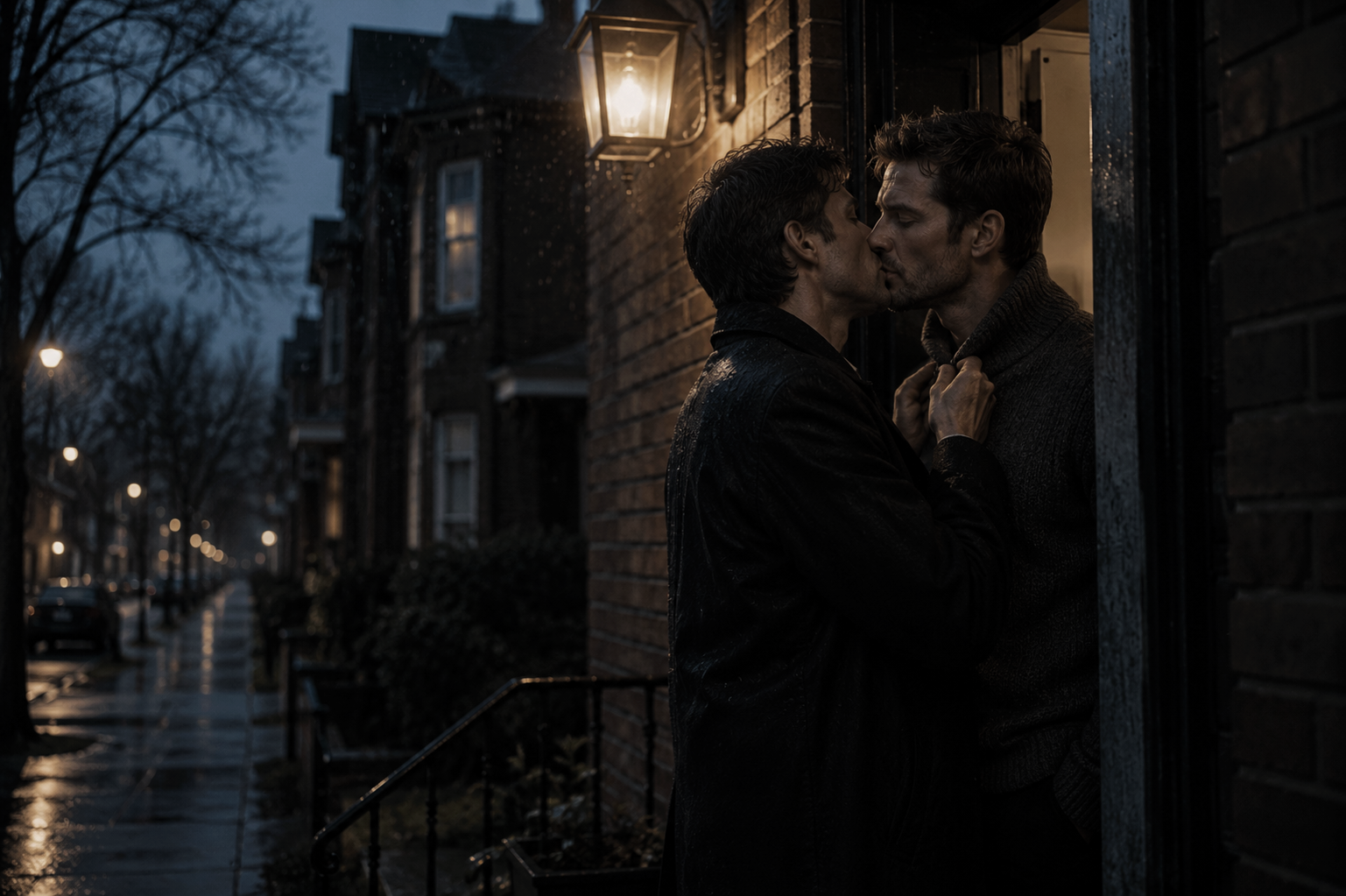
I reached out and straightened his collar. The gesture was automatic. A habit I’d developed in the early days of our relationship, when his collar was always crooked and I was always fixing it. He’d accused me of being controlling. He’d been right.
“I’d find you in any life,” I said.
“Prove it next Tuesday. Dinner. My place.”
“It’s a date.”
He kissed me once more, then turned and walked down the hallway toward the stairs. His footsteps faded. The door clicked shut.
I stood there for a long time, alone in the entryway of our townhouse, surrounded by the quiet and the marble and the expensive art on the walls that I’d bought because I thought it would make me feel like I’d arrived somewhere. None of it mattered. The only thing that mattered was the man who’d just walked out the door, and the ring on my finger, and the knowledge that I’d spend the rest of my life trying to be worthy of him.
The rain started again. Soft. Steady.
I left the porch light on. Just in case.

End of Chapter 8.