In the sultry, waterlogged streets of New Orleans, Cairo, a young journalist fleeing a fractured family and a ghosting ex, collides with Pete, a retired adult film star who’s rebuilt himself as the owner of a historic guesthouse. Their electric first date unravels into a nightmare when Pete’s past follows them into a notorious Quarter club, where Cairo is drugged by a promoter hoping to exploit him for a live sex show. What follows is a raw, unflinching test of trust, consent, and the courage it takes to let someone see the parts of yourself you swore you’d keep hidden. A story about whether two men shaped by shame and silence can build something honest from the wreckage.

The story to date in EPUB format can be downloaded HERE if you prefer to read longer material on your Kindle or other device.

Cairo’s Point of View
The Louisiana sun had teeth. By nine in the morning, the air was already thick enough to chew. I’d been in New Orleans for three weeks and my body still hadn’t learned how to breathe here. Seattle air was polite. It stayed in your lungs and left when you asked it to. This air colonized you. It pressed against your skin like a second shirt, heavy with river water and something floral gone a shade too sweet. This was only March. I shuddered to think what August would bring.
My notebook was already damp at the corners.
I’d wedged it under my arm while I walked, thumb marking the page with today’s interview questions. I had a sit-down with a Gulf Coast angel investor who’d agreed to let Bayou Beat profile him after six emails and one voicemail I’d delivered in what I hoped was a charmingly persistent tone and not a vaguely threatening one. The notes were in my usual shorthand, a hybrid of actual English and squiggles that only made sense for about forty-eight hours after I wrote them. After that, they became archaeological artifacts. What did I mean by “expansion vectors + shrimp”? I didn’t know then. I don’t know now.
My phone buzzed in my pocket. Then again. Three short, insistent pulses.
I fished it out, squinting against the glare. Julian.
Good luck today! Let me know if you need anything. Coffee’s on me next time you’re in the office.
I read it twice. There was nothing unusual about it. Julian was a hands-on boss, the kind who remembered staff birthdays and sent follow-up emails with subject lines like “Just checking in!” He’d hired me after a single video call where I’d rambled about community journalism and he’d nodded along with this attentive, mildly unnerving stillness, like I was saying something profound instead of simply quoting my old ethics professor.
But the messages had been coming more often now. Little things. A text about a restaurant I might like. A forwarded article with “thought of you” in the subject line. The coffee offer. A GIF of a cat typing at a keyboard, captioned “us on deadline.”
I was probably imagining the weight behind them. That’s what I told myself. Julian was just being welcoming. I was the new hire, the Seattle transplant who didn’t know anyone yet, and he was filling the gap. A good boss. Attentive.
I typed back a quick Thanks! Fingers crossed and slid the phone into my back pocket without breaking stride.
Ahead of me, a couple was arguing on the corner of Chartres and Mandeville. They were close to my age, in their late twenties, possibly thirties, and dressed in coordinated vacation outfits that suggested either deep affection or a truly weaponized Instagram presence. The woman had her arms crossed. The man was gesturing at a parked car with the helpless, flapping motion of someone who’d run out of rational arguments and was now just hoping physics would intervene.
“I told you to fill the tank,” she said.
“I didn’t know we were driving to Slidell.”
“You didn’t know we were driving to see my mother? The same mother we’ve been talking about visiting for three days.”
“We talk about a lot of things.”
“Oh, my God.”
I passed them and the argument trailed behind me like exhaust. They’d make up or they wouldn’t. In three weeks, they’d be back in whatever city they came from, and this fight would be a story they told at parties, or it wouldn’t. That was the thing about New Orleans. It was full of people colliding with each other and then spinning off in new directions. A city-sized particle accelerator.
My father had called me two nights ago to tell me he was seeing someone. Someone not my mother. They had separated last March, almost a year ago. It was a quiet thing, coming after thirty-one years of what I had assumed was contentment and what had apparently been a very long, very patient negotiation with the truth. He was living in a one-bedroom in Tacoma now, and the someone he was seeing was a man named Doug who taught community college history and kept bees.
“I’m still figuring it out,” my father had said. His voice on the phone had been the same as always. Steady, a little dry, the verbal equivalent of a flannel shirt. “The labels and all that. But I wanted you to know.”
I had told him I was happy for him, and I was. I meant it. But afterward, lying on my mattress in the Bywater shotgun apartment that still smelled like the previous tenant’s cats, I had stared at the ceiling and something chilled settled into my stomach. My father had waited three decades to tell the truth about himself. Three decades of silent suppression, of building a family on a foundation he must have known was cracked. And what did that leave me with? A genetic inheritance of self-erasure? A blueprint for how to love someone without ever letting them see the whole room?
Ryan had ghosted me after four months of what I’d thought was something real. You’re overthinking it, he’d said once, when I’d asked him where he saw this going. I was overthinking it. He wasn’t thinking about it at all. One day his texts just stopped and I spent two weeks checking my phone every six minutes until Leo finally said, “Baby, he’s not dead, he’s just an asshole.” Which was true. But also true was I had been so easy to discard that he hadn’t even bothered to type it’s not you, it’s me.
The semicolon on my wrist was warm under the cuff of my sleeve.
Leo had done it on a rainy afternoon of our junior year in his parents’ basement with a sewing needle and a bottle of India ink we’d stolen from the art room. It had hurt more than I’d expected. Leo kept saying “don’t flinch, don’t flinch” in this high, nervous voice, and I’d bitten my lip so hard I tasted copper. But when it was done, I looked at the small, imperfect mark, the dot, the curve, and felt something lock into place.
A semicolon. A pause, not an ending. My story isn’t over.
I touched it now, running my thumb over the faint ridge of scar tissue. A grounding ritual. A reminder that the voice in my head that whispered you’re not enough, you’re never going to be enough was a liar with excellent credentials and terrible evidence.
The city had to work. I had to make it work.
My apartment still had boxes I hadn’t unpacked. The Bayou Beat office was a single floor of a converted warehouse near the railroad tracks, and the elevator smelled like damp sheetrock and ambition. I was the youngest staff writer by six years and the only one who’d never covered a hurricane. My editor, Renata Boudreaux, had looked at my first draft of a piece on coastal restoration and said, “This is good, but you write like someone who’s never been wet.” I’d spent the next three days reading about flood mitigation until my eyes blurred.
But I was here. I’d crossed the country with two suitcases and a Moleskine, and a conviction that the stories I wanted to tell were waiting for me in this impossible, waterlogged city. And I was going to find them.
The angel investor’s office was in a converted Creole townhouse on Esplanade, four blocks from where I was walking. I could see the ironwork balcony from here, its shadow a dark filigree against the pale stucco. My stomach did the thing it always did before interviews. A slow, liquid roll, like a fish turning over in deep water.
I touched my wrist again. Breathed.
The story wasn’t over. I was just getting to the good part.

Pete’s Point of View
The shutter on the third-floor window had been squeaking for two weeks. It made a noise that dug into your back teeth. A high, metallic whine that came and went with the breeze, like a ghost trying to remember a tune. I had been meaning to fix it since Tuesday. But Tuesday had wound up being the air conditioner condenser in Room 4. Wednesday had been a backed-up drain in the courtyard fountain. Thursday had been the health department inspection that I had passed, but only because Bea had given me a twelve-minute briefing on everything I’d forgotten to check.
Friday morning, I finally had an hour.
The courtyard of Maison de Fer was still cool. The flagstones held onto the night’s damp. Near the fountain, I had set up my workbench on an old door that rested on two sawhorses. Tools and one cold, half-empty mug of coffee lay scattered across it. I was crouched beside it, working oil into the hinge with a cloth, when I heard the gate creak open.
Miss Delphine.
She moved through the courtyard like the morning light itself. She was slow, deliberate, and impossible to hurry. Eighty years old, Creole, with a spine straight as a plumb line and hair wrapped in a purple tignon. She carried a paper bag in one hand and a walking stick in the other, though I’d never seen her lean on it.
“You feedin’ that hinge or courtin’ it?” she said.
“Little of both.”
She set the paper bag on my workbench to the left of the cold coffee. Inside, I could smell dried lavender, something sharp and green, a curl of smoke from an incense I couldn’t name.
“For the threshold,” she said. “Front gate. Put it under the mat.”
“What’s it do?”
“Keeps away what needs keeping away.”
I wiped my hands on my jeans and picked up the bag. The herbs were tied with a red string, the bundle dense and fragrant. “I thought we already did the threshold last month.”
“That was for the house. This is for you.” She tapped her temple with one finger. “Something’s coming. I can feel it in my knees.”
Miss Delphine’s knees were more reliable than the National Weather Service. I’d learned to take them seriously.
“Good something or bad something?”
She smiled, and her teeth were very white against her brown skin. “Something that’s been waiting. Now stop asking questions and finish your hinge. A man who can’t silence his own house can’t hear what it’s trying to tell him.”
She was gone before I had a chance to answer, her stick tapping against the flagstones in a rhythm that faded into the street noise beyond the gate.
I finished oiling the hinge and I carried the shutter up the narrow back staircase to the third floor. The guest rooms were quiet. Bea had handled checkout that morning and the new arrivals weren’t due until three. The hallway smelled of wood polish and lingering southern dampness. Everything in its place. Everything calm.
My old framed photograph hung in the back corridor, between the linen closet and the door to the attic stairs.
I had put it there deliberately. Not hidden exactly, any guest who wandered far enough would find it, but not on display. The front hall had vintage maps of New Orleans, framed botanical prints, a watercolor of Jackson Square that Ellis had given me when we were still something. This corridor was private. This was mine.
The photo was black and white, taken eight years ago by a photographer whose name I’d long since forgotten. I was twenty-four. My body was a thing I’d built in the gym six days a week, every muscle group cycled through with the precision of a machine. No ink at the time, except the gear on my lower back, fresh and dark. My jaw was sharper, my eyes harder, my mouth curved into a half smile that I’d practiced in the mirror until it looked effortless.
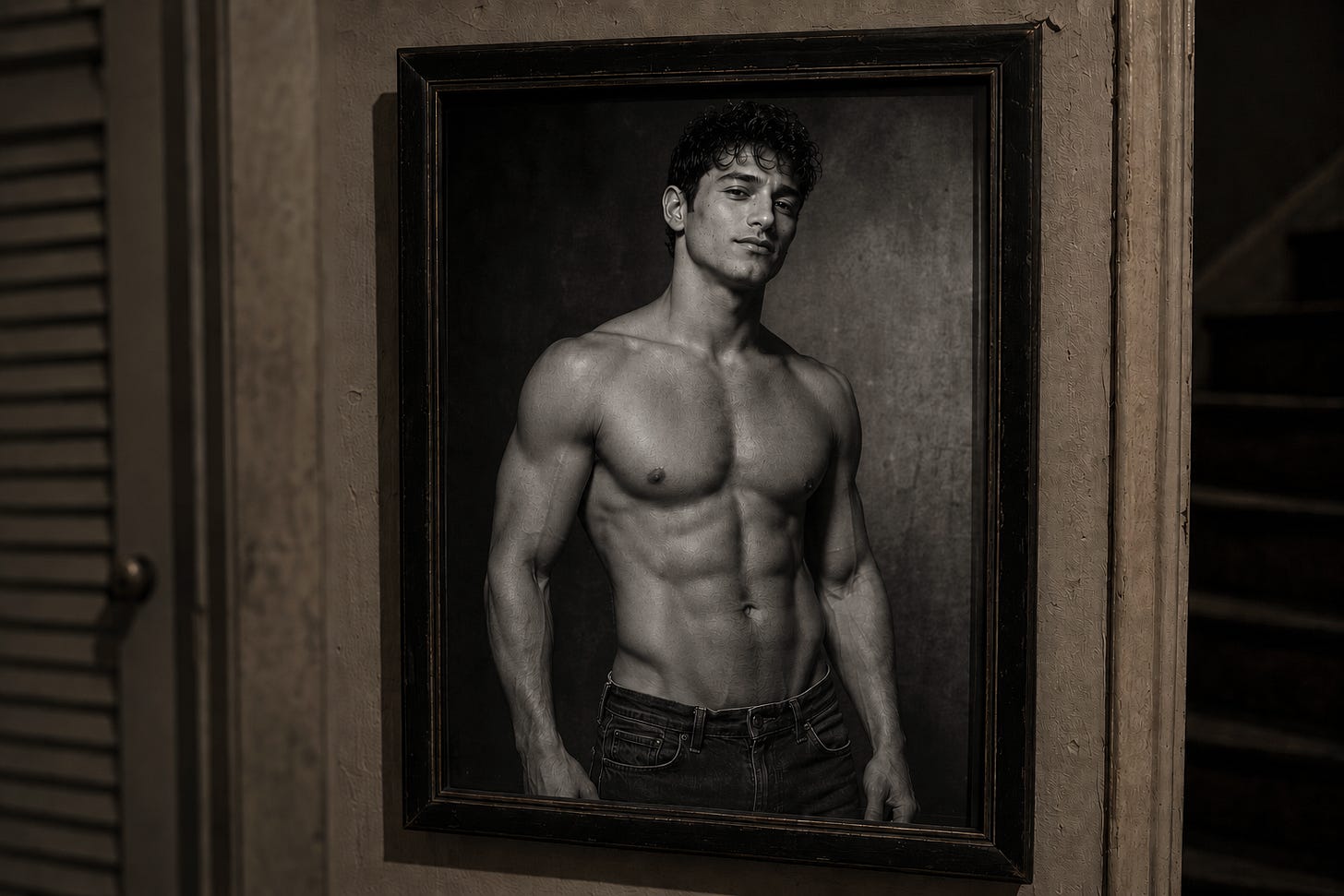
Piston Pete. The brand. The empire.
I had been magnificent once. The thought arrived without vanity and more like acknowledging a fact about the weather. I’d built a career on being looked at, on making desire into a product, on fucking on camera with a stamina that seemed almost inhuman because I’d trained my body to be a machine. Millions of views. Enough money to buy this crumbling townhouse and remake it into something beautiful. A life funded by performance.
I had also been lost. So completely and thoroughly lost that I had stopped recognizing myself in the mirror. The man in this photograph was a stranger who happened to wear my face. He had been lonely in a room full of people who wanted him. He’d been tired in a body that never showed fatigue. He’d been terrified that if he stopped performing for even one second the whole thing would collapse and there would be nothing underneath.
I touched the scar on my left thumb. A diagonal line of paleness against my tan. Devin had been teaching me to make étouffée in his cramped apartment kitchen near Tulane. I had grabbed the cast-iron skillet handle without a towel, and the burn had blistered before I could even swear. Devin had wrapped my hand in a cold dishcloth and kissed my forehead and said, “You’re a menace to cookware.” We’d been twenty. I’d thought we’d last forever.
The relationship ended, but the scar stayed. That was the thing about the past. It marked you whether you wanted it to or not.
Through my shirt, I rubbed the spot on my lower back where the gear tattoo used to be. The laser removal had taken six sessions. The ghost of it still lurked there, a faint outline only visible if you were looking. The dermatologist had offered me a cream that might fade it further but I’d never filled the prescription.
I didn’t want to forget. I wanted to make peace.
The shutter hinge was fixed now, silent and smooth, the oil worked deep into the metal where it needed to go. I tested it twice, listening to the quiet, before I headed back downstairs to prep the guest rooms for check in.
The guesthouse was beautiful. I’d built it with my own hands, sanding floors and re-plastering walls and choosing every light fixture like I was furnishing a life instead of a business. The courtyard was lush with ferns and jasmine, the fountain trickling into a copper basin, the wrought-iron balconies casting their lacework shadows on the brick. I’d made a home that welcomed people. A place of safety and comfort and calm, deliberate care.
But at night, when the guests were asleep and the courtyard was still, I’d sit in the kitchen with a glass of whiskey and ponder the hollowness of it. The shape of a person who wasn’t there. The absence where a partner should be.
Keisha called it my “monk phase.” Miss Delphine called it my “waiting season.” I called it something I didn’t have a word for yet. A sense that I’d built the container but hadn’t filled it. The guesthouse was ready. I was ready. The universe, apparently, was still deciding. Sometimes I wondered if I hadn’t passed my partner by in the hundreds of men I had torn through in my career.
I had finished the shutter, so I put away my tools and headed inside to check the reservation book. Outside, the morning was heating up, the air thickening toward the afternoon’s inevitable thunderstorm. The city hummed its rumbling, constant note, and I moved through my silent house, waiting for something I couldn’t name.

Cairo’s Point of View
The ghost tour was supposed to be research. That’s what I had told myself when I’d signed up online, clicking through the booking page while eating cold lo mein over my laptop. A human-interest piece. Bayou Beat covered business and tech, but Ren had hinted that she wanted more local color, more texture. The kind of writing that made readers imagine they were walking the streets themselves. A ghost tour was perfect. Atmosphere. History. A cast of colorful characters. Mayhap some interesting quotes about the economics of the paranormal tourism industry.
What I got instead was seventeen drunk bachelorettes and a goth chick with a megaphone.
The rain started at dusk. It wasn’t a downpour so much as a fine, persistent drizzle that beaded on my jacket and made the cobblestones slick. Our guide was a woman in her early twenties wearing a crushed velvet top hat. She carried an electric lantern that flickered unconvincingly. She’d introduced herself as Raven, which I strongly suspected was not the name on her birth certificate, and she’d launched into a script about the LaLaurie mansion that sounded like she’d memorized it from a Wikipedia article.
The bachelorettes were wearing matching T-shirts that said Bride Squad: NOLA or Never. They kept shrieking every time Raven paused for dramatic effect, which she did roughly every forty-five seconds.
I had wedged myself at the back of the group with my notebook in hand, trying to take notes that weren’t just WHY ARE THEY SCREAMING. The rain had smeared the ink across the page. My shoes were soaked. A woman in front of me was vaping something that smelled like birthday cake.
This is fine, I thought. This is atmosphere.
We’d reached the corner of St. Ann and Royal when the second tour collided with us.
They came from the opposite direction. A group twice our size, led by a man in a Confederate soldier costume who was apparently committed to the bit because he was speaking in a drawl that made Raven’s megaphone seem like a model of restraint. The two groups merged at the intersection like oil and water, bachelorettes swirling around Confederate re-enactors, umbrellas tangling, everyone trying to hear their own guide while drowning out the other.
I stepped backward to avoid being elbowed by a woman in a sequined cowboy hat, and my heel caught on the curb, and I was falling . . .
. . . and suddenly I wasn’t.
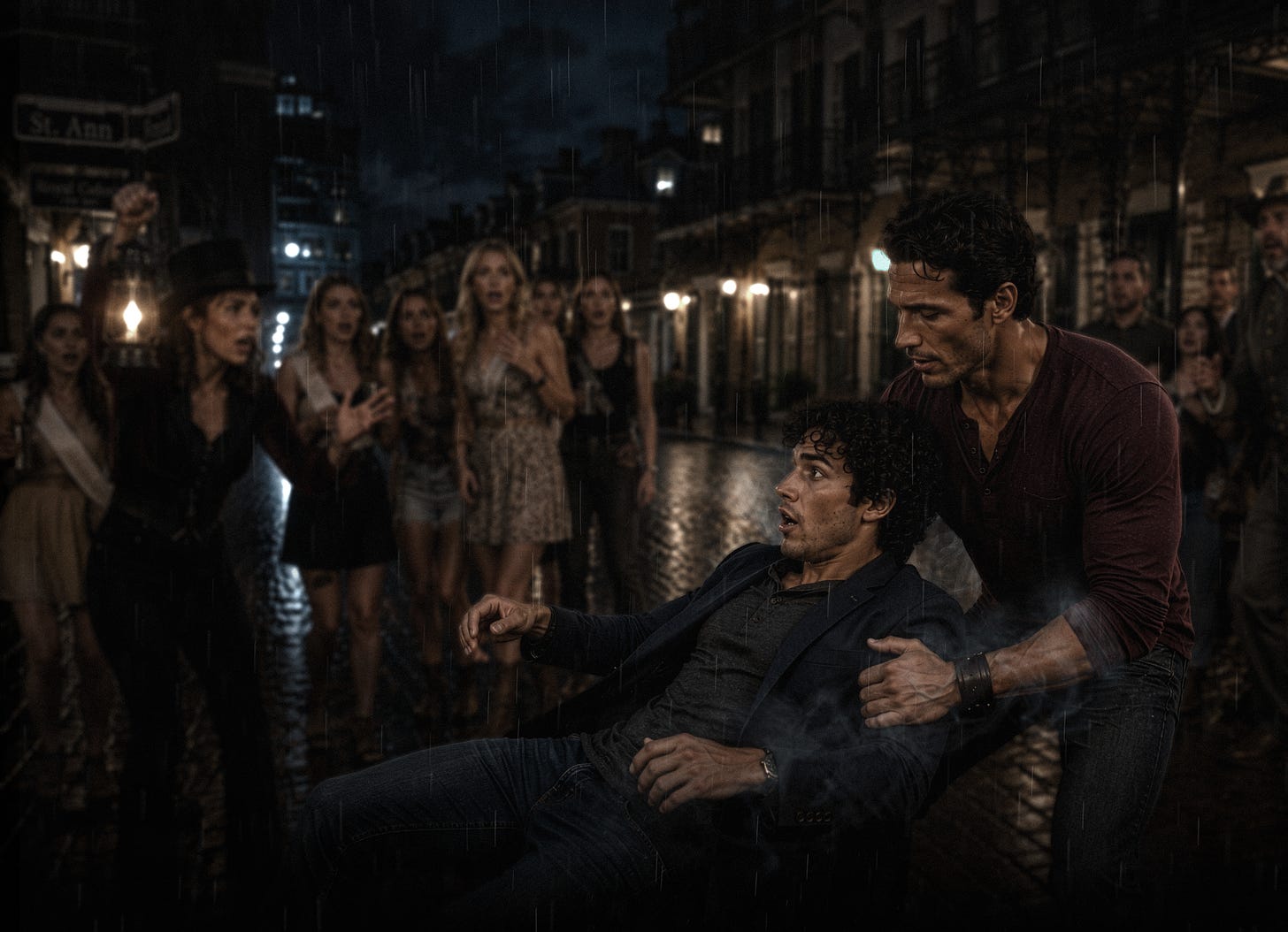
Hands caught me. Two hands, big and warm, one on each of my elbows. I was steadied, pulled upright, my shoulder blades brushing against a broad chest. The rain was still falling. The tourists were still swirling. But for a suspended moment, I was standing in a pocket of stillness, held by a stranger who smelled like sandalwood and coffee and clean sweat. God, he smelled good.
“Easy there, ghost hunter.”
The voice was low and warm, with the faintest drawl, the vowels rounded and unhurried. It came from just above my ear. I turned, still half caught, and found myself looking up at a man who made the noise of the crowd drop away like a radio losing signal.
Tall and athletic, he had broad shoulders that filled out his shirt. A firm jaw framed his face, with his nose a tad off-center. His eyes beckoned with a deep and complicated shade of sage that seemed to hold the light and refused to let it go. Drizzle had beaded in his dark hair and glistened there, while a calm hung on his face that seemed almost gravitational. Unavoidable. As though the world had thrown chaos at him and he had simply decided not to engage.
“Fuck, you’re handsome,” I blurted out.
The words came before I could stop them. My face got hot with a blush that started at my collarbones and worked its way up. The man’s eyebrows rose a quarter inch, and then his mouth curved into a smile. Not the practiced half smirk I’d braced for, but something genuine and a little startled, like I’d surprised a laugh out of him.
“Thank you,” he said. “You okay? That curb’s a menace.”
“I’m fine. I’m great. I’m . . . God, I can’t believe I said that out loud. I’m sorry.”
“Don’t be. I’m glad you did.”
He still hadn’t let go of my elbows. I still hadn’t stepped back.
The ghost tour was moving on without me. Raven’s megaphone was fading up the street, the Bride Squad trailing behind her in a cloud of birthday cake vapor. I should have been catching up, taking notes, doing my job. Instead, I was standing in the rain looking at a man whose hands were still warm on my arms.
“You’re not with the tour?” I asked.
“Just passing through.” He nodded toward the cafe behind me, a tiny place with steamed-up windows and a green awning. “Was getting beignets. Heard the screaming.”
“It’s a ghost tour. Screaming’s kind of the point.”
“Is it?”
I laughed, a little breathless. “No. It’s terrible. The guide’s name is Raven, and she’s been mispronouncing ‘LaLaurie’ for six blocks.”
“You want the real hauntings,” he said, “talk to my neighbor, Miss Delphine. Eighty years old, she knows every ghost in the Quarter by first name. And you need better coffee than they serve at the tour stops.”
“I haven’t found decent coffee since I moved here.”
“Then you haven’t been looking in the right places.”
He let go of my elbows then, but he didn’t step back. The space between us was still small enough that the warmth coming off his body still reached my skin, a contrast to the cool drizzle. My reporter’s instinct flickered with a quick, automatic thought. This man is a story. Look at him. The calm. The presence. The way he’d caught me as if it were the most natural thing in the world. Like his hands had been waiting for precisely that purpose.
I filed the thought away and felt immediately guilty about it.
The rain picked up, shifting from drizzle to something with intent. I pulled up my hood but it was a lost cause. My jacket was already soaked through at the shoulders.
“Come on,” the man said. “There’s a coffee shop on Decatur. I’ll walk you.”
“You don’t have to—”
“I know I don’t. But I’m handsome, remember?”
He said it simply and without weight, but something in the way he looked at me made the rest of my protest die in my throat. We started walking, falling into step as if we’d done it a hundred times. The rain tapped against the awnings above us. The street was emptying as tourists scattered into bars and restaurants. The Quarter seemed different in the rain. Quieter and older, like the city was letting down its guard.
“So,” I said, “you promised me real ghost stories.”
“I did.”
“I’m a reporter. I’ll know if you’re making it up.”
He made a small sound, almost a chuckle. “You’re a reporter?”
“Staff writer at Bayou Beat. Just moved here from Seattle.”
“And you’re already doing ghost tours.”
“Research.”
“Right. Research.” He said it with the same gentle teasing I was already beginning to recognize, a humor that didn’t sting. “Okay, reporter. You want a real New Orleans ghost story?”
“I absolutely do.”
He was silent for a moment, navigating us around a puddle that had formed in a dip in the sidewalk. When he spoke again, his voice had shifted. It was still warm, but now lower and more deliberate. A storyteller’s voice.
“Jackson Square, a hundred and fifty years ago. There was a duel between two Creole gentlemen, both in love with the same woman. She wasn’t interested in either of them, but that didn’t matter. They fought at dawn under the oaks. One of them took a sword through the lung. He bled out on the flagstones before the doctor arrived.”
“His ghost haunts Jackson Square?”
“No.” He glanced at me, and his eyes caught the streetlamp. “The ghost is the one who survived. He spent the rest of his life walking the square at dawn, waiting for his rival to come back so he could apologize. He’d won, but he’d also lost. The woman never spoke to him again, the city turned its back, and he died alone, still walking, still waiting. They say you can see him sometimes, just before sunrise, pacing the flagstones where the other man fell.”
The rain had quieted to a hush. I realized I’d stopped taking mental notes. I’d just been listening.
“That’s not a ghost story,” I said. “That’s a love story.”
“Same thing sometimes.”
We walked a few more paces in silence and then the air changed. I hit a sudden cold pocket, sharp as stepping into a walk-in freezer. I shivered, my shoulders drawing up against the unexpected chill.
Pete glanced at me. “You felt that?”
“Hard not to.”
He nodded toward the building on our left, an old Creole townhouse with shuttered windows and a balcony draped in dead wisteria. “That one’s actually haunted. Cherie, the madam who ran my guesthouse back in the twenties, she knew the woman who died there. The stories overlap in this city.”
He said it lightly, the way you’d mention a historical footnote. But the cold was still clinging to my skin, and it wasn’t just the weather. I filed the name away without knowing why. Cherie.
We’d reached the coffee shop. An antique brass plaque announced it as 214 Decatur St. It was small and warm, the windows fogged, the air inside thick with the smell of espresso and old wood. He held the door for me, a gesture so automatic I almost didn’t notice it, and then we were inside, shaking off the rain, claiming a small table near the window.
He asked about my work and I told him. The startup, the chaos, the thrill of covering a region I barely understood. He listened like I was the only person in the room, his attention a steady, peaceful thing that made me want to keep talking.
“What about you?” I asked. “Where did you learn all this ghost lore?”
He reached across the table and refilled my cup from the carafe the barista had left. The movement was smooth and unthinking, a tiny act of service that somehow felt more intimate than the question I’d asked.
“I run a guesthouse,” he said. “Maison de Fer, in the Marigny. Old building. Lots of stories in the walls.”
“A guesthouse. That’s . . . that sounds nice.”
“It is.” He smiled. Something complicated floated in it, something I couldn’t read. “What about you? You said you just moved here. How’s that going?”
And just like that, he redirected the question. I didn’t notice it at the time. I was too charmed, too warmed by the coffee and the rain and the way he was looking at me. I launched into my story about the apartment, the boxes, the loneliness I tried to make sound funny. He listened, and he laughed in the right places, and by the time we’d finished our coffee, I still didn’t know much about him. But I knew his name was Pete, and I knew the way his eyes crinkled when he smiled, and I knew he’d caught me in the rain and hadn’t let go until he was sure I was steady.
We exchanged numbers outside the coffee shop. The rain had stopped. The street was glossy with reflected light.
“Let me take you out sometime,” he said. “A proper night. No ghosts.”
“I don’t know,” I said. “The ghosts were a pretty good opener.”
He smiled. And I smiled back. And the air between us sat with the moment before a storm breaks. All charged and expectant, full of something I didn’t have words for yet.

Pete’s Point of View
I dressed for the dinner date with more care than I’d given my appearance in months. Not that I was trying to impress him. That’s what I told myself as I stood in front of the wardrobe, rejecting a third shirt for reasons I couldn’t articulate. Not that I cared how I looked. Not that I’d been thinking about him since the moment we’d parted on that rain-slick street, the way he’d laughed at himself, the way his eyes had widened when he’d blurted fuck, you’re handsome like it had escaped without his permission.
The linen shirt was a pale blue-gray, soft from years of washing. The jeans were dark and well-fitted, the kind I wore when I wanted to feel like myself and not like the version of me that existed in other people’s expectations. I stood in front of the mirror and tried to see myself the way he might. A man in his thirties, a few threads of gray at the temples, with a face that had settled into something calmer than it used to be. Not the boy in the photograph. Someone different. Someone real.
The flutter in my chest was unfamiliar. I had to think back to remember the last time I’d felt it. Some early date with Ellis, maybe, before we’d figured out that our rhythms didn’t match. Before I’d learned to guard myself.
I arrived at the restaurant first.
It occupied a small place on Esplanade, brick walls and candlelight, the kind of spot that didn’t advertise because it didn’t need to. The owner, a stout Frenchman named Gerard, greeted me with a handshake and a knowing look. “A guest tonight?”
“A date.”
His eyebrows rose. “The first in how long?”
“Long enough that you’re making it weird.”
He laughed and led me to a table near the window, tucked into an alcove where a candle cast a single, steady flame. I ordered a wine that was good without being pretentious, and I waited.
Cairo arrived five minutes late, slightly out of breath, his hair damp at the ends like he’d just showered and run out the door. He was wearing a navy blazer over a henley, the blazer slightly rumpled, the sleeves a half-inch too long. He’d tried. The effort was endearing in a way that lodged somewhere beneath my chest.
“Sorry,” he said, sliding into the chair across from me. “I couldn’t find parking. I circled the block four times. I think I accidentally drove through a pedestrian zone. It’s possible there are warrants.”
“I’ll post bail.”
He grinned, and the candlelight caught the warmth in his brown eyes, the scatter of freckles across his nose that the Louisiana sun was already darkening. The flutter came again. Stronger this time.
The conversation started easy and stayed that way. He told me about his work, about the startup’s precarious funding, his editor Renata’s brutal feedback, the piece he was writing about a Gulf Coast investor that he was worried would be “too boring to print and too important to kill.” He talked with his hands, painting shapes in the air, and when he got excited, his voice sped up, tripping over itself in its eagerness to get the thought out.
“It’s just . . . okay, so this guy, right? He’s sitting on millions from some app he sold in 2016, and now he’s investing in coastal resilience startups, which is genuinely good work, but he also has this whole thing about vertical farming that sounds like a cult, and I’m trying to figure out if I’m writing a profile or an exposé—”
“Both, maybe.”
“Right? But how do you write both without sounding like you’re ambushing the guy?”
“You tell the truth and let him read it before it goes to print. If he’s honest, he won’t ask you to change anything.”
He blinked at me. “That’s surprisingly good advice.”
“I’ve been around.”
“Doing what?”
The question was casual, but it landed in my chest with unexpected weight. I reached for my wine, giving myself a beat. “I renovate old buildings. Run a guesthouse. Nothing as exciting as investigative journalism.”
“I don’t know. Buildings have stories too.”
“Some more than others.”
He tilted his head, and I saw the reporter in him . . . that flicker of curiosity, the instinct to dig. But he let it go. Instead, he leaned forward, elbows on the table, and said, “Can I ask you something?”
“Sure.”
“When you caught me on the street that night, you didn’t have to stay. You didn’t have to walk me to coffee. That was just . . . kind. I’m still not used to that.”
The words landed somewhere soft and undefended. I held his gaze and didn’t know what to say. The silence stretched between us. Not awkward, but full, the way a room fills with light before you realize the sun’s come out.
I had been praised for my body a thousand times. For my stamina, my performance, the way I looked on camera. But kindness? I was Piston Pete. The man famous for fucking men into unconsciousness. No one had used the word kind with my name in a sentence for a decade or more. That was something I’d almost forgotten how to receive. It had nothing to do with what I’d built my career on. It had everything to do with who I was trying to become.
“It wasn’t . . .” I started, then stopped. “It wasn’t anything. It was just what you do.”
“Not everyone does.”
The waiter arrived with our entrées and the moment shifted. But it had planted something. I could feel it taking root, a small green thing pushing up through the cracked pavement of my caution.
We ate. We talked more. He told me about Seattle and its grayness, the coffee, the way the mountains held the city like a cupped hand. I told him about Baton Rouge, my father’s auto shop, the way the Mississippi smelled different in Louisiana than it did anywhere else. He asked about the guesthouse, and I told him about the renovations, the courtyard, the ghost of the brothel madam who might or might not haunt the third floor.
“You’re deflecting,” he said at one point, and I nearly choked on my wine.
“What?”
“Every time I ask you something personal, you ask me a question instead. You’re good at it . . . I didn’t notice for the first half hour. But you’ve done it four times now.”
I stared at him. He was smiling, but his eyes were serious, curious.
“Most people don’t catch that,” I said.
“I’m a reporter. It’s my job to notice.”
“What do you want to know?”
He considered the question. The candle flickered between us. “When you’re not fixing hinges and telling ghost stories, what do you want? For yourself. Not for the guesthouse or the guests or anyone else.”
I didn’t have a quick answer. The truth was too big and too fragile to hand over all at once. But I owed him something.
“I want to build something that lasts,” I said slowly. “Not a performance. Not something people watch and forget. Something real. A home that feels like a home, not a set. And perhaps . . . someone to share it with. Eventually.”
He didn’t look away at all. He was utterly unintimidated by the implications. “That’s not a small thing.”
“No, it’s not.”
At some point, our fingers brushed. I was reaching for the wine bottle, and he was gesturing with his hand, and our knuckles touched, a brief, magnetic contact that neither of us acknowledged. But I saw the way his breath caught. It echoed in my own chest. There was a warmth growing there that I had not felt in nearly a decade. A warmth I’d been scared I would never experience again.
Outside the restaurant, the street was quiet. The rain had held off, and the air was warm, thick with the fragrance of jasmine from somewhere nearby. We stood under the streetlamp, and the light pooled around us like we were the only two people in the world.
I leaned in.
The kiss was slow. Deliberate. I cupped his jaw with one hand, the slight rasp of stubble against my skin, the warmth of his skin. His lips were soft and a little parted, and when I kissed him, he made a small sound in the back of his throat . . . surprised, wanting, utterly unguarded.
We parted. His eyes were wide and his breath was coming fast. I’d been shaken in a way that had nothing to do with the wine.
I’m in trouble, I thought. The realization hit me like a wave. It was cold and bracing and impossible to ignore. He sees me. He actually sees me. And if he keeps looking, he’ll see everything.
The part of me that had spent ten years performing intimacy had no idea what to do with the real thing. The part of me that wanted it was terrified.
“Wow,” Cairo said softly.
“Yeah.”
“That was . . .” He trailed off, laughed at himself. “I don’t have a word for it.”
“Me neither.”
We stood there for a moment longer, the streetlamp humming above us, the city breathing around us. Then he smiled, and I smiled back, and everything that was going to happen had already begun.

The Velvet Gator was Cairo’s idea.
“There’s this club in the Quarter, a few blocks away from here,” he said as we stood outside the restaurant. “Supposed to be legendary. Live shows, music, the whole thing. You’ve probably been, right?”
I had been. Many times. Years ago, in the Piston Pete era, I was first invited by a collaborator who had thought it would be good for my brand. The owner had paid us $2,500 to fuck on stage. I’d taken it because rent was due and my truck was dying. I stayed for forty-five minutes afterwards, nursed a drink, and left with a crawling sensation under my skin that had taken days to shake.
The place was notorious not for the music or the dancing, but for the live sex shows. The Midnight Madness specials. The blurry line between performance and exploitation that the club’s owner, a man named Stassi, had turned into a business model. I had performed many times there because the recordings streamed better than anything filmed in a studio. It was there on stage where I railed my first twink unconscious, something that would later become my signature move. A lanky kid named Marc who needed the money worse than I did. He wasn’t a bottom, and that was his first time, but he told me to go all out because it would beat being homeless.
I should have told Cairo the truth right at that moment. I used to work in that world, and that place is the ugly underside of it, and I don’t want you anywhere near it. Or I should have told him no. Taken him somewhere else.
But I’d been a coward.
Or not a coward, exactly. I had been a man who’d spent the week and this one night falling into something that tasted impossibly fragile. Something I was terrified of breaking but desperately wanted. Every conversation with Cairo had peeled back another layer of my caution. The way he laughed. The way he asked questions and actually listened to the answers. The way he’d looked at me after that kiss under the streetlamp like I was something precious instead of something used up. The way my chest was warm.
I wanted to tell him about Piston Pete. I realized I had to at some point. But the thought of saying those words—I was a porn star for a decade, and millions of people have seen me fuck, and I built my life on being a fantasy—made my stomach clench into a fist. What if he looked at me differently? What if the warmth in his eyes cooled into something else? Curiosity, maybe. Journalistic interest. Distance. It wouldn’t be the first time. It just wasn’t first-date conversation material.
It’s been months, I told myself. Almost a year. No one will recognize me. The beard’s different, the hair’s different. I’ll keep him close, buy him a drink, and if anything feels wrong, we’ll leave. Simple.
Willful self deception. I can see it now, looking back. The story I told myself was so neat, so reasonable. But underneath it was the truth I wouldn’t admit. I was ashamed of my past, and my shame had made me reckless.
The Velvet Gator was a converted warehouse on a side street off Bourbon, marked only by a single red light above an unmarked door. The bouncer was a mountain of a man with a shaved head and a line of piercings up one ear. He recognized me before I even handed him my ID.
“Piston Pete,” he said, and his face split into a grin. “Haven’t seen you in a minute. Stassi’s gonna be thrilled.”
The name hit like a cup of flour dropped on a stone hearth. A soft thump first, then a spreading cloud of unease. “Just here for drinks. Off the clock.”
“Sure, sure.” He waved us through without checking Cairo’s ID, his eyes sliding over my date with an appraisal that made the skin on the back of my neck tighten. “Cute one. Have fun with him tonight. Crowd will love it.”
Inside, the bass was a physical presence, thumping up through the floor and into my chest. The lighting was red and low, the air thick with sweat and something sweet that might have been spilled cocktails or might have been the fog machines. A stage dominated the far wall, empty for now, but lined with equipment that left little to the imagination. The VIP area was roped off to the left, elevated on a platform with leather couches and its own bar.
I steered Cairo toward the main room, a hand at the small of his back. He was looking around with wide eyes, taking it all in. The crowd, the décor, the couple in the corner who were already a few degrees past public decency.
“This is . . . a lot,” he said, leaning close so I could hear him.
“You wanted legendary.”
“I didn’t know legendary meant . . . is that guy wearing a harness?”
“Probably.”
I ordered at the bar. Scotch neat for me, a Cape Cod for Cairo. Vodka, cranberry, lime. The bartender, a slim twink with eyeliner, made the drinks efficiently but I caught the flicker of recognition in his expression before he turned away.
I found us a table in the VIP area, elevated on its platform with a view of the stage and enough distance from the main floor to breathe. For a few minutes, it was almost normal. Cairo leaned into me, his shoulder warm against mine, asking questions about the club with the curiosity of a reporter who couldn’t turn it off even on a date. I answered in half truths.
“It’s been around a while, the owner’s a character, the shows are . . . theatrical.”
I watched his face in the red light, the way his eyes glowed when he smiled, the way he kept looking at me like I was the most interesting thing in the room. I let myself forget, for a moment, where we were. I let myself just be a man on a date with someone who made the world feel less heavy.
Then I saw Stassi.
He was on the far side of the club, near the stage, talking to a drag queen in a jeweled catsuit. He hadn’t seen us yet. His attention was on whatever deal he was working. But I knew that posture. The easy lean, the calculated smile, the way his eyes never stopped moving even when his mouth did. He’d been running this place for years, and every inch of it was his. The stage. The VIP platform. The bartenders. The fog. Stassi didn’t own a club. He owned an ecosystem, and everyone inside it was either a product or a consumer.
I’d watched him work before, years ago, from the safer distance of a performer who was valuable enough to be treated well. Tonight, I was not a performer. Tonight, I was a disruption. A retired legend walking through his venue with a date who was obviously not in the life. Stassi would notice. He always noticed. And when he did, he’d want to know what I was doing here, who the new face was, whether there was an angle he could work.
I should have gotten us out right then. Before he turned around. Before anyone else recognized me.
But Cairo was laughing at something I’d said. I don’t even remember what, and his hand had found my knee under the table, and I was a coward who wanted ten more minutes of being just a man on a date.
Stassi’s gaze swept the room and landed on our table. His smile didn’t change. But something behind his eyes sharpened. The focus of a producer who’d just spotted his next project.
I put my hand over Cairo’s on my knee. “We should probably—”
And then the first comment landed.
“Ooh, this is a cute one, Pete!”
The voice came from a man I vaguely recognized. A former scene regular, someone I’d crossed paths with at parties years ago. He was lean, shirtless under a leather vest, his smile sharp with knowing.
“Can’t wait to see you rail him unconscious on stream later if I miss it live tonight,” he added, and the group around him laughed.
Cairo looked at me, confusion flickering across his face. He hadn’t caught all the words over the music, but he’d caught enough. “What did he say?”
“Nothing. Just some guy. Let’s go.”
I started guiding him out but the comments kept coming. The drag queen in the jeweled catsuit touched my arm as I passed. “Oh hell no, Piston Pete with a brand new pocket prince! Honey, you better not take that show private. We deserve to see you split him like dry wood.”
A man towards the stage, shirtless and oiled, raised his glass in a mock toast. “Piston Pete’s back, baby. Retirement didn’t stick.”
Each word landed like a small, surgical cut. Cairo’s body tensed beside me, his steps faltering. He kept looking from the faces around us to mine, trying to read something I wasn’t giving him. He gulped half his Cape Cod and his nose wrinkled.
“This is kind of salty,” he said.
I wasn’t paying attention. I should have been paying attention. But I was preoccupied with something else. Something selfish.
This is the one person I didn’t want to see this, I thought. The words were a cold pressure behind my eyes. This is my worst fear, and it’s happening right in front of him, and I brought him here. I did this.
Before I could get us to a quieter corner, before I could explain or apologize or just get him out, the DJ’s voice boomed over the speakers.
“Midnight Madness in twenty minutes, y’all! Looks like Piston Pete is in the building tonight and he brought fresh meat. Get your drinks, get comfortable, and let’s see if this one lasts longer than his last collaborator. Drink specials all night, and you know what that means . . . Stassi’s got something special cooked up. Get your drinks now and get ready to party.”
Cairo’s hand found my arm. “Pete, what’s going on? Why does everyone know you? What’s Midnight Madness?”
I opened my mouth to answer, to tell him everything, to say we need to leave right now. But before the words formed, another couple pushed through the crowd toward us.
I knew them both. The top was Kodiak Carl, a mountain of hairy muscle who’d built his brand on throat-fucking partners until they choked out on camera. The twink beside him was his partner, a doe-eyed kid named Pretty Paul who’d been one of my protegés years ago. Paul’s face lit up when he saw me.
“Pete! Oh my God, I didn’t know you were coming tonight.” He turned to Cairo, beaming. “You’re the new one? You gotta let us collab tonight! You’ll love the feeling of blacking out with Kodiak’s cock down your throat. It’s transcendent.”
The blood drained from Cairo’s face.
“We’re leaving,” I said. My voice came out harder than I intended. I grabbed Cairo’s hand, but the crowd was thick, and someone was already shouting my name again. Cairo looked at his drink, the Cape Cod was half empty, and then he looked at the stage, and then he looked at me, and something in his expression cracked.
He downed the rest of the glass in one gulp.
“Let’s just go,” he said, but his voice was strange, tight. “Please. Let’s go.”
I pushed through the crowd, his hand still in mine. We’d made it roughly twenty feet toward the door when Cairo stumbled. I caught him, my arm going around his waist, and the sudden looseness in his limbs, the way his head lolled before he jerked it upright, was not lost on me.
“I’m fine,” he said, but his tongue was thick. “I’m fine. Just . . . dizzy for some reason.”
And I understood. The salty aftertaste he’d mentioned, the way the drink had been slightly off. The bartender who’d recognized me. Stassi, who’d always been too interested in my collaborators, who’d once offered me five figures to bring a “fresh one” to one of his private shows.
GHB.

Cairo’s Point of View
The drink went down wrong.
I realized it the second it hit my stomach. It had a faint chemical saltiness under the cranberry, the way my tongue tingled like I’d licked a battery. But I was already swallowing, already trying to get out of this nightmare of a club, and by the time my brain registered the warning, it was too late.
I tried to reach for my phone. My fingers fumbled at my pocket, clumsy as a stranger’s, and then the phone slipped and hit the floor, and I couldn’t see where it landed because the floor was tilting. The floor was tilting. That wasn’t right. Floors didn’t tilt.
The music blurred into a single low throb. The red lights smeared across my vision like wet paint. I was hot . . . too hot, a flush crawling up my neck and into my face. My legs acted like they belonged to someone else, and that someone else had forgotten how to use them.
I looked at Pete.
His face was shifting. I couldn’t read it. His mouth was moving, but the words reached me a half second after his lips formed them, like a badly dubbed movie. He looked scared, I thought. Or maybe he looked angry. I couldn’t tell. The colors were wrong.
“Did you put something in this?”
The question came out of me before I had a chance to stop it. I didn’t mean it as an accusation. I meant it as a plea, a desperate grasping for sense. Tell me what’s happening. Tell me you didn’t. Tell me I’m wrong.
I saw the way his face changed. Something flinched in his eyes. Was that guilt? Surprise? The room was spinning, and I was trying to read a face that kept fragmenting into pieces, and I couldn’t. I couldn’t.
This isn’t right. This isn’t me. Why can’t I stand? Why is Pete just staring?
He grabbed my wrist. His hand was big and warm, and I focused on it like it was the only real thing left. He was pulling me toward the door, but the crowd was pressing in, bodies everywhere, and then the club owner was in front of us.
Stassi. I’d seen his face on the club’s website, but in person he was smaller than I’d imagined, with a goatee and a smile that never reached his eyes. A bartender the size of a refrigerator and a twunk in a mesh shirt who was bouncing on his heels like he couldn’t wait for something wonderful to happen flanked him on either side.
“Pete, baby, where you going?” Stassi’s voice cut through the noise, slick and too friendly. “The show’s about to start. I’ve got a slot for you. Five grand cash for twenty minutes, tag-team with Carl, or my friends here, the crowd will eat it up. We haven’t had a live sex show in a hot minute.”
I heard the words in fragments. Live sex show. Cash. Tag-team. They didn’t make sense. They wouldn’t resolve into meaning. My brain was cotton wool, and the cotton wool was catching fire.
And then the bartender’s hands were on me. He was handsome, I’ll give him that, but I’d never met him before.
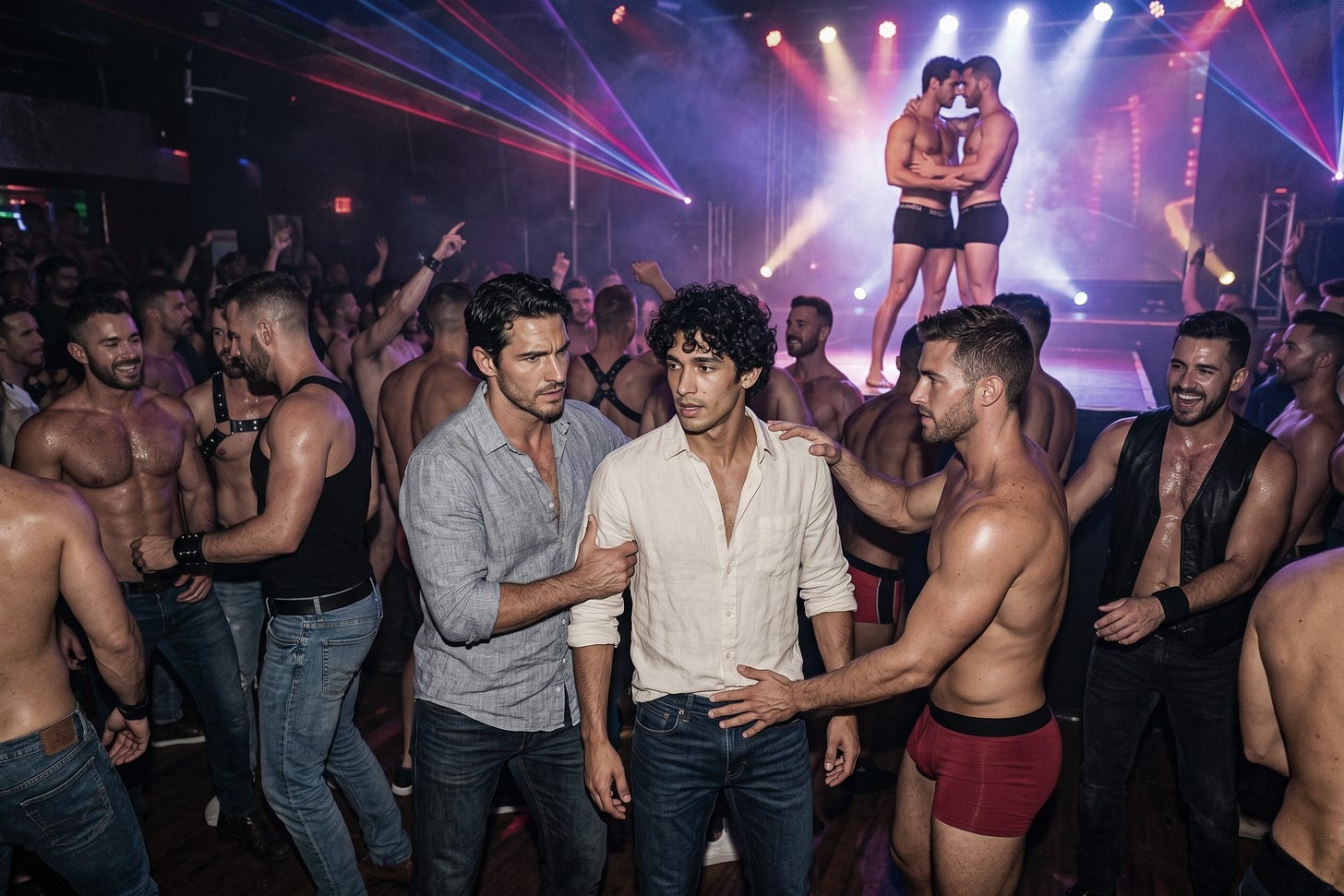
He grabbed my waist from behind, thick fingers digging into my hipbones, and his other hand started fumbling with the button of my jeans. “Pete’s always got the best bottoms,” he said. His breath was hot and wet and greedy against my ear. “I can’t wait to bust inside you tonight.”
Inside you.
The words hit like a physical punch. My vision tunneled. The red lights shrank to pinpricks. I was going to pass out. I was going to pass out in this horrible place with this man’s hands on my body, and no one knew where I was, and Sam was three thousand miles away, and Leo didn’t even know I was here, and my phone was on the floor somewhere, and . . . .
The darkness took me.
I dreamed of a courtyard I didn’t recognize. Gas lamps instead of string lights. Flame-lit torches and candles. Stone flagstones slick with recent rain. Women in silk dresses moving through the space, their laughter low and easy, their French accented in a way I’ve never heard before. Creole, old New Orleans perhaps. One of them, older than the others, turned to look at me. Her expression wasn’t hostile. It was curious. Appraising. As if she were trying to decide whether I belonged here. She seemed about to speak and then the dream dissolved, and there was only the dark.

Pete’s Point of View
The next few minutes existed as fragments. The kind of memory that comes back in flashes. Still images, sounds, the feel of my own voice tearing out of my throat.
I remember shoving the bartender.
The sound that came out of my throat wasn’t a word. It was something older than language. A roar, a snarl, the kind of noise a body makes when thought shuts down and instinct takes over. Cairo was collapsing, his knees buckling, his eyes rolling back, and the bartender’s thick fingers were still digging into his hipbones like he had a right to be there, like Cairo’s body was public property, like everything I’d built in the year since I’d left this world meant nothing the moment I walked back through its doors.
I drove my shoulder into the bartender’s chest and shoved. Not a push. A full-body expulsion. He let go of Cairo finally and stumbled backward into the crowd behind him, arms flailing, crashing into a knot of patrons who scattered like startled birds. A drink flew. Someone yelped. The bartender hit the floor hard, his back connecting with the concrete with a wet thump that cut through the bass.
“Get your hands off him.” My voice was shaking. No. I was shaking. Every muscle in my body was wired tight, vibrating at a frequency I hadn’t felt in years. The protective fury of a man who’d spent too long performing passivity and had forgotten what it felt like to be dangerous. “Don’t you ever . . . don’t you ever touch him again.”
Stassi was already yelling, but not at me. At the twunk in the mesh shirt, who was shrinking back toward the stage. “I told you not to put too much in his drink, dammit. Just enough to loosen him up for a show!”
Then Stassi turned to me, his hands coming up in that practiced, placating gesture, and I cut him off before he could start.
“That was my date. Not a performer. My date.” I was still holding Cairo’s weight, his body slumped against mine, and I could feel how light he was, how breakable. The bartender was groaning on the floor. The crowd had gone quiet. “What did you put in his drink?”
Stassi’s hands stayed up. “Hey, man, I didn’t . . . how was I supposed to know? He was with you. I figured he was a new collaborator. The kid at the bar always adds a little something to loosen up the fresh ones. Nobody’s ever complained before.”
“A little something.” My voice was flat. Deadly. “You dosed my date with GHB. Without his knowledge. Without his consent. Do you understand what that is? That’s not a party favor. That’s a felony.”
Stassi’s expression flickered, the first crack in the performance. “Pete, come on. You’ve been in this world. You know how it works. A little chemical assistance, everybody has a better time—”
“I’ve been in this world,” I cut him off, “and I know exactly how it works. I also know that Bayou Beat would love a story about a club owner who drugs patrons to coerce them into live sex shows. I know the city licensing board would love to know about your Midnight Madness specials. And I know the NOPD vice squad has been looking for a reason to shut this place down since before you bought it.”
The crowd around us had gone completely still. Stassi’s smile had frozen into something that wasn’t a smile anymore. Behind him, I could see the bouncer from the door shifting his weight, waiting for a signal.
“You don’t want to do that,” Stassi said quietly. “You and I both know there’s things about your past that wouldn’t look so good in the papers either.”
“Try me.” I adjusted Cairo’s weight against my shoulder. “Publish whatever you want. My past is already out there. But if I ever see you near him again, if I ever hear about you drugging another person in this club, I will burn this place to the ground. Not figuratively. I know people who owe me favors, Stassi. I know people who would love to own a club in the Quarter and wouldn’t ask questions about how the previous owner lost it.”
I didn’t wait for his response. Cairo was heavy in my arms, his breathing shallow, and every second I spent in this place was a second I wasn’t getting him to safety. I pushed past Stassi, past the bouncer, past the frozen crowd. The bass was still thumping. The red lights were still spinning. The club hadn’t stopped. It couldn’t stop. It was a machine and it would keep running long after we were gone.
But Stassi didn’t follow. And the look on his face as I carried Cairo through the door was not the look of a man who’d been scared off. It was the look of a man who’d just been publicly humiliated in his own club, in front of his own people, and was already calculating what it would cost to make me regret it.
I don’t remember what else I said. I remember the weight of Cairo’s body against mine, his head lolling, his breathing shallow but steady. I remember pushing through the crowd with one arm wrapped around his waist and the other clearing a path. I remember the door, the street, the sudden coolness of the outside air.
The rideshare took four minutes to arrive. I spent every second checking his breathing, my hand pressed flat against his chest, gauging the rise and fall. His face was slack, peaceful in a way that was wrong because it wasn’t sleep. It was absence. The emptiness of someone who had been chemically erased from his own body. I’d seen that look before, in the industry, on collaborators who’d partied too hard before a shoot. I’d always found it unsettling. On Cairo, it was devastating. His face in the streetlamp light was young and open and utterly defenseless, and some part of me registered, with a clarity that felt like a knife, that this was what innocence looked like when it had been stolen rather than given. He hadn’t chosen this. He’d chosen a date with a man he trusted, and that trust had delivered him into the hands of people who saw him as a product.
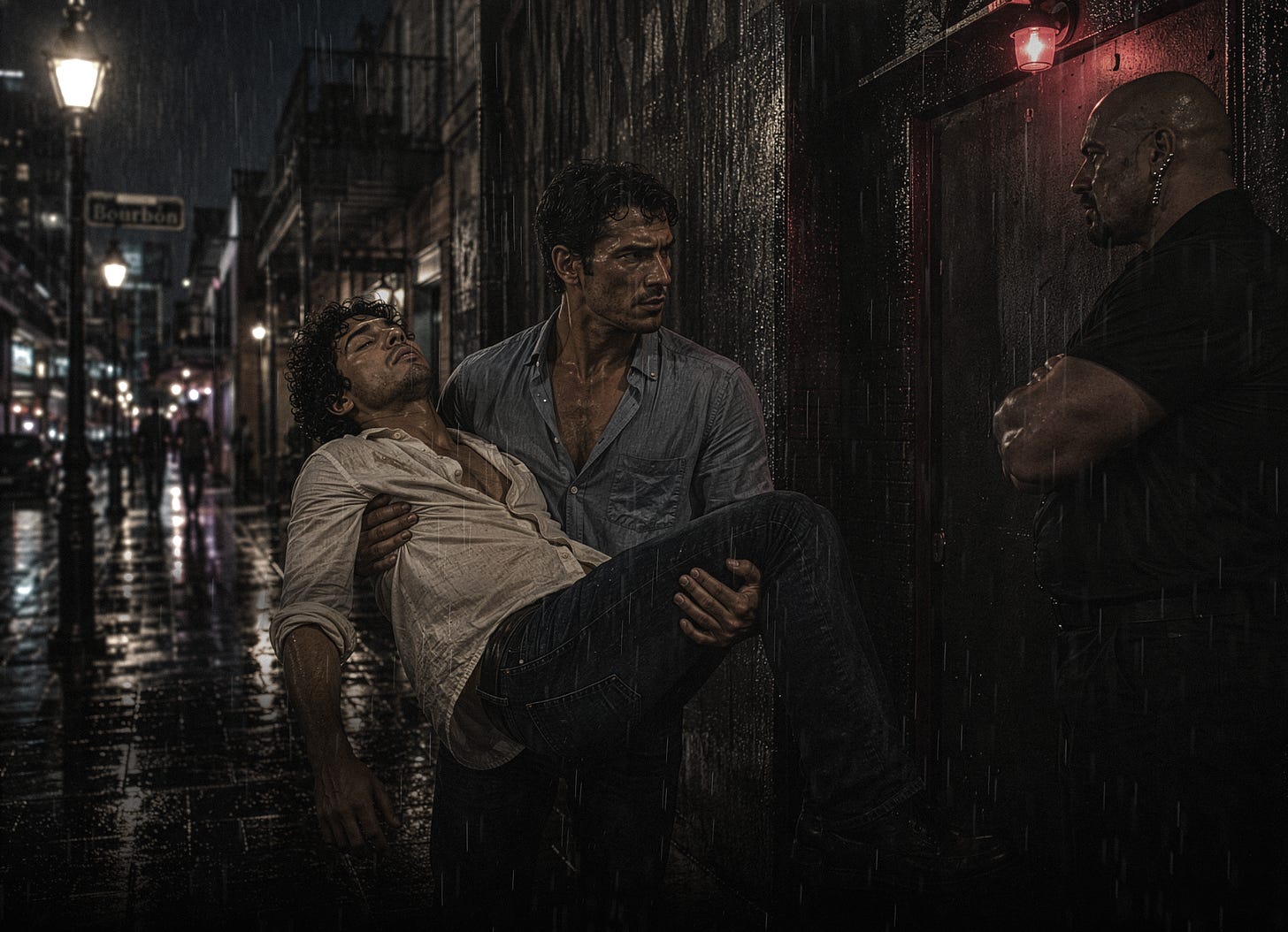
The Uber driver didn’t ask questions. I gave him the address for Maison de Fer and I sat in the back seat with Cairo’s head in my lap, my hand resting on his shoulder, my thumb moving in small, useless circles. The city lights slid over his face, red and gold and red again, and I watched them the way you watch a monitor in a hospital room, looking for any change, any sign.
I should have known better. The thought circled like a carrion bird. I knew what that place was. I knew Stassi. I knew the risks. And I went anyway because I didn’t want the night to end. Because for an hour at dinner, I was just a man falling for someone, and I wasn’t ready to be Piston Pete again, and my selfishness put him in danger. My shame did this. My fucking shame.
I looked for his phone to call one of his friends. I didn’t know where he lived. I couldn’t find it in his pockets and nothing stood out when I patted him down. I couldn’t call anyone he knew. I couldn’t tell anyone where he was. I was all he had, and I had failed him spectacularly.
I whispered into the dark of the car, not expecting him to hear. “I’ve got you. I’m not letting go.”
He didn’t stir. And the city lights slid over his face again, red and gold and red again.

Maison de Fer was dark when we arrived. The guests were asleep. The courtyard was still, the fountain silent, the jasmine heavy with its own scent. I carried Cairo through the gate and stopped in the center of the flagstones.
The courtyard wasn’t empty. In the far corner, near the back hallway where her portrait hung, a woman stood watching. Older, composed, draped in pale silk that caught the light in a way that didn’t make sense. As if it were lit from within, not reflecting anything external. Her expression as she looked at Cairo was neither pity nor alarm. It assessed. The way someone looks at a new arrival and decides whether they belong.
I had seen her before. Glimpses. The way candles had flared. The stories Miss Delphine told. I had always dismissed it. Tonight, I didn’t. I looked at her—really looked—and she looked back. Her gaze dropped to Cairo’s face. Softened. She raised one hand and motioned toward the door.
Bring him in.
I felt the words more than heard them.
Then she was gone. But the air was different now. Warmer. As if the house itself had decided to welcome him.
I carried Cairo up the front steps and through the door. And somewhere beneath the guilt, a quieter thought surfaced. She approves. He belongs here.
I laid him on the bed in my room. Not a guest room, my room. The sheets were clean, the pillows stacked, the window cracked open to let in the night air. I didn’t undress him. I didn’t want to touch him in any way that might seem like a violation, even if the intention was practical. I just pulled the blanket up to his chin and stood there, looking down at his face.
Then I sank to the floor beside the bed, put my head in my hands, and I broke.
The tears came silently, the way they always did. I’d trained myself out of making noise a long time ago. In my line of work, crying was a liability. A sign of weakness, or worse, a sign that you’d forgotten the performance. So I wept into my palms, shoulders shaking, the sobs trapped somewhere in my chest where they couldn’t escape.
Cairo is different. He was my chance. He saw me. And I let my world eat him alive.
I don’t know how long I sat there. Long enough for the tears to stop. Long enough for the shaking to subside.
“I knew better,” I muttered into the dark. “I knew what it was. I knew the risks. I went regardless because I didn’t want to end the night so soon. Because you looked at me like I was worth something and I wasn’t ready to give that up. That was selfish. That was . . .” My voice cracked. “I promise you. I will never, ever put you in that position again. I will tell you the truth. All of it. Even the parts that scare me. Even the parts that might make you leave. You deserve better than what I gave you tonight.”
He didn’t stir. He hadn’t heard a word. But I’d said them. And somewhere in the saying, something shifted. I’d spent a decade performing intimacy for audiences who’d never spot the difference. Tonight, alone on the floor with a sleeping man who couldn’t hear me, I’d been more honest than I’d ever been on camera.
I climbed onto the mattress and rested my head against his, one hand reaching up to rest on the blanket where it covered his arm. Just to feel the warmth of him. Just to know that he was still there. Still breathing.
I fell asleep like that. A guardian who’d already failed but who’d just made a promise he intended to keep.

I woke up to see the alarm clock. The numbers glowed blue in the dark. 2:14 a.m. The room was silent. The window had let in the smell of rain, and somewhere outside, a night bird was calling in short, insistent bursts.
Cairo had shifted in his sleep. He’d curled toward the edge of the bed, toward me, his head tucked under my arm like it belonged there. His hand rested loosely on my chest, and the warmth of it bled through my shirt. His breathing was slow and even. His face was peaceful, truly peaceful now, not the terrible emptiness of before.
Something broke open in my chest.
I want this forever.
The thought was so clear, so complete, that it arrived like something I had always known and only just remembered. I want to marry him. Not a performance. Not a fling. A life. Morning coffee and courtyard breakfasts and the sound of his voice asking me questions I don’t know how to answer. I want to build him a home and watch him fill it with his notebooks and his curiosity and his terrible parking.
The guesthouse. The garden. The quiet mornings I’d spent alone drinking coffee and checking the reservation book and trying not to notice the hollowness beside me. I had built all of it for a moment like this. For a person like this. For a future I hadn’t let myself imagine.
I reached up very gently and touched his hair. Just once. Just the lightest brush of my fingertips against the dark, unruly curls.
Then I let my hand fall, and I closed my eyes, and I let sleep take me.

The second time I woke, a hand was fumbling with my belt.
The clock read 4:26. Cairo pressed against me, his mouth on my neck, his hips grinding slow and clumsy against my thigh. His fingers were working at my buckle with the uncoordinated determination of someone who wasn’t fully awake.
I caught his wrists. “Cairo.”
“Want you,” he mumbled. His eyes were open but glassy. “Been wanting you. Since the rain. Since you caught me.”
“Cairo, stop.”
“Don’t you want me?” He pulled back, and I saw the hurt flash across his face. Genuine hurt, the kind that comes from somewhere deep and vulnerable. “Is it because I’m not . . . because I’m not experienced enough? Because I know you’ve been with . . . with people who know what they’re doing. I can learn. Just tell me what you like.”
GHB rebound. I knew the signs. The drug lowered inhibitions and stripped away all the filters. He was “unlocked,” but not sober. The things he was saying might be true, but the person saying them wasn’t in a state to understand what he was offering.
“We can’t,” I said. I kept my voice as gentle as possible. “You’re not in a place where you can consent right now. I won’t take advantage of you.”
“I’m fine. I want this,” he protested.
“You’re not fine. You were roofied. You need to rest.”
He stared at me for a long moment, and then his expression shuttered. “Fine,” he said, and the word was cold. “If you won’t help me, I’ll do it myself.”
He pulled off his clothes. Shirt first, then his jeans, kicking them off the bed with sharp, angry movements. He was naked in the low light, his body lean and soft edged, a tiny semicolon tattoo on his wrist. He looked at me the whole time, a challenge in his eyes, and then he lay back against the pillows and touched himself.
I froze.
He was beautiful. I couldn’t pretend I didn’t see it. His head tipped back, the column of his throat exposed. His hand moving with increasing urgency, his hips lifting to meet each stroke. And he was looking at me, staring me down with an intensity that was equal parts defiance and desperation.
My body responded. I couldn’t stop it. The ache in my groin, the pull of desire, the part of me that demanded to climb onto that bed and give him exactly what he was asking for.
But my mind was screaming.
This isn’t consent. He might not remember this. I’m complicit if I even stay and watch.
Ten seconds. Fifteen. I couldn’t break eye contact. I was caught in the pull of it—the wrongness, the nausea, the grinding awareness that I’d already failed him tonight and now I was failing him again by not leaving the room immediately.
God, I prayed, and the words came from somewhere I’d thought I had long buried. God, why are you testing me like this? I’m trying to do right. Is this punishment for my past?
And then, with a wrenching effort that seemed physical, I turned away.
I walked to the door. I closed it behind me. I slid down the wall in the hallway and put my head in my hands and shook.
I did not touch myself. I didn’t seek release despite a cock that was hammering inside my pants of its own accord. I sat in the dark and listened because I couldn’t not listen, because I needed to know he was still breathing, hadn’t fallen, and I let the shame wash over me in waves.
Through the door, I heard him. Narrating every step of his fantasy encounter until he approached the end, giving me a roadmap of his desires.
“Pete,” he gasped. “Pete. Please. Cum inside me, Pete. Fuck. I wanna feel your body shudder in me as you cum . . .”
The words were graphic and unguarded, things he would never say sober. And I heard them. Every syllable. The flattery of it, the arousal I didn’t want, the deep embarrassment of eavesdropping on someone’s private self. And underneath it all, a fierce, protective tenderness that made my throat ache.
He would never say this sober. I shouldn’t be hearing this.
When the sounds stopped, I waited. The silence was heavy. I counted to a hundred, then to a hundred again. Then again, once more for good measure.
I stood up and walked back in. Cairo had passed out on the bed naked, his stomach streaked with giant ropes of pearlescent cum that reached his chin. His face was slack and peaceful again, oblivious to everything that had happened.
I fetched a washcloth from the bathroom. Ran it under cool water. I cleaned him with brisk, efficient movements, keeping my eyes averted from his body as much as I could. This wasn’t intimacy. This was a task. Erasing evidence of a violation he hadn’t been able to consent to. I did not want him waking up sticky and gross and scared about what may have happened.
I pulled the blanket back up to his chin. I checked his breathing one more time. It was steady, deep, and normal.
Then I retreated to the chair across the room, sat down, and watched the window until the light began to change.
I fell asleep sitting up. The posture of a guardian. The exhaustion of a man who’d been tested and wasn’t sure he’d passed.

The morning came soft and tender, the light filtering through the curtains like milk strained through cheesecloth.
I was awake before Cairo stirred. I had made coffee, a cup for each of us, and I set his on the nightstand with a glass of water and two aspirin. Then I’d retreated to the chair again, waiting.
He woke gradually. I watched his eyelids flutter, his fingers twitch against the sheets. The moment when awareness returned was visible, marked by a sharp inhale, the way his body tensed, the confusion that creased his brow as he took in the unfamiliar room.
“You’re at my guesthouse,” I said softly. “Maison de Fer. You’re safe.”
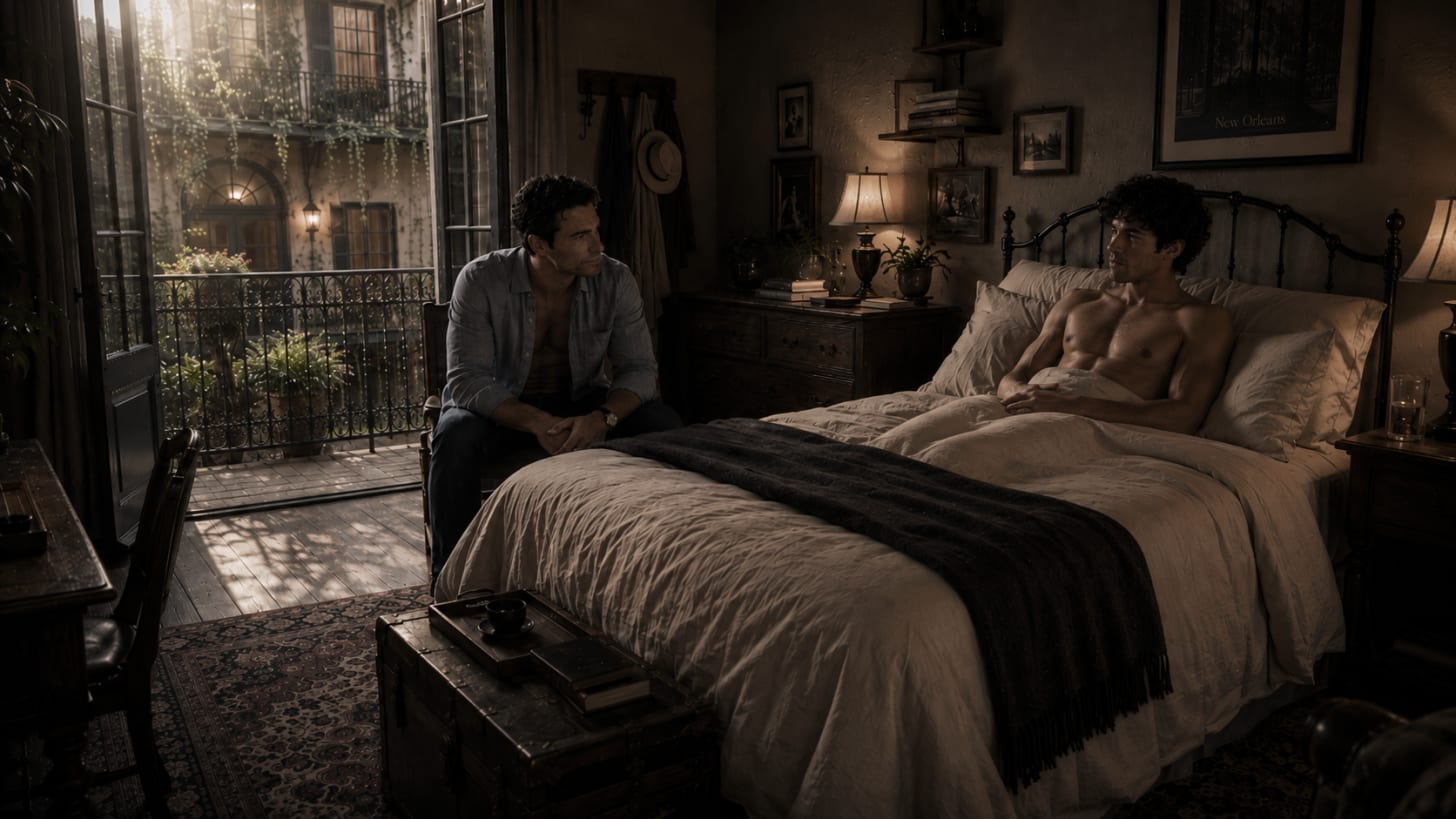
He turned his head toward my voice. His eyes were bloodshot, his hair a disaster, his expression raw with the vulnerability of someone who’s just surfaced from a dreadful dream and isn’t sure the waking world is any better.
“What happened?”
“You got roofied at the club last night. GHB, I think. I brought you here because I couldn’t find your phone or your address. You’ve been asleep for about six hours now.”
He processed this in silence. I watched the information move through him in a flicker of horror, the way his hand touched his stomach, the slow dawning comprehension that he was naked.
“Roofied,” he repeated.
“Yes.”
“Did anyone . . . ?” I hated that he even had to ask the question.
“No. I got you out before anything happened. One of the bartenders touched you. He started to unbutton your jeans, but I stopped him. Nothing else happened.”
He closed his eyes. “Inside you,” he mumbled. His breath wound out in a long, shaky exhale. When he opened his eyes again, they were wet.
Of all the things for him to remember, that had to be one of the worst.
“Thank you,” he said. “For getting me out.”
“You don’t have to thank me.” The words came out rougher than I intended. “It was my fault. I brought you there. I knew what The Gator was and I didn’t warn you.”
“Why didn’t you?”
The question was simple. The answer wasn’t.
I set down my coffee. I rubbed the scar on my thumb in an old habit, a grounding ritual. And then I told him.
“Before I ran the guesthouse, I had a very different career. For about a decade, I was an adult performer. OnlyFans, mostly. My stage name was Piston Pete. Endurance streams, live shows, collaborations with other performers. I was . . . successful. I made a lot of money. I used it to buy this place.”
I forced myself to look at him. His expression was unreadable. Not angry, not horrified, just . . . absorbing. The reporter’s look. The one that said I’m listening, I’m cataloging, I’ll process this later.
“The Velvet Gator is part of that world,” I continued. “The owner, Stassi, he recognized me. He assumed you were a collaborator—a new performer I was working with. He spiked your drink to, as he put it, ‘loosen you up’ for a live show. I didn’t know he would do that. But I should have foreseen it. I should have told you. But I was . . .” I stopped. The word tasted like copper. “I was ashamed, Cairo. And I was afraid that if you knew the truth about me, you wouldn’t want to see me anymore.”
The silence that followed was long and thick.
“I’m sorry,” I said. “For not telling you sooner. For taking you there. For everything that happened.”
Cairo was quiet for a long moment. Then he said, “I don’t know what to say.”
“You don’t owe me anything.”
“No, I . . .” He rubbed his face with both hands, the heels of his palms pressing into his eyes. “I’m trying to process. Piston Pete. You were . . . how many . . . I mean, how long did you . . . ?”
“Ten years. Hundreds of scenes. Millions of views.”
The numbers hung in the air between us. I watched him do the math. How many partners, how beautiful, how much more experienced than him. I saw the insecurity flicker behind his eyes.
“That’s a lot,” he said finally.
“Yes.”
“And you’re . . . retired now?”
“Almost two years now. I went to therapy. I bought this place and rebuilt it. I’m trying to be someone different. Someone who doesn’t perform his life for other people’s consumption.”
He nodded slowly. The coffee I’d made him sat untouched on the nightstand. Outside, the morning birds were starting their chorus.
“I need to tell you the rest,” I said. “The full night. Everything that happened after you passed out. It’s not all good. Some of it is going to be embarrassing for you, Cairo. And for me as well.”
“Tell me,” he said quietly. He looked braced for misery.
I did.
I told him about carrying him out of the club. About the Uber ride, my panic, the way I’d checked his breathing every thirty seconds. I told him about laying him on the bed, about falling asleep beside him, about waking to the alarm clock at 2:14 and the epiphany I’d had—I want this, I want him, I want a life—that I didn’t try to explain because I wasn’t sure I had the words yet.
Then I told him about 4:26.
“You woke up,” I said. “The GHB rebound. You were disinhibited, not sober. You tried to start sex with me. I told you no. You got upset. You . . . touched yourself. And I . . .”
I forced myself to meet his eyes.
“I watched. For maybe fifteen seconds. Before I got out of the room. That was wrong. I’m sorry.”
Cairo’s expression flickered as something complicated moved across his features too fast to name.
“I heard everything through the door,” I said. “I didn’t want to leave you completely alone in case something went wrong. But I heard you. Your climax. The things you said. That violated your privacy, and I apologize for it.”
The silence stretched. Cairo’s face was flushed now, a deep red creeping up from his neck.
“I remember some of it,” he said quietly. “The climax, I mean. It’s . . .” He let out a shaky breath, almost a laugh. “It’s one of my top five ever, I think. I remember cumming buckets. And I remember calling out your name.”
He looked at me, and there was embarrassment in his eyes, but also something else. Something braver.
“I am embarrassed that you heard all that, Pete. But I’m not mad at you about it. Everything I said . . . it was true.” His lips hung for a moment. “Is still true.”
The words cracked through me like a bolt of lightning tearing across a cloudless sky. I had no idea what to do with them. I had no clue what to do with the sensation that rose in my chest. An emotion that was gratitude and terror and hope all tangled together in a knot I couldn’t unpick.
“I don’t know what this is yet,” he said. “Us. Whatever’s happening. And I still have questions about your past, about the club, about all of it. My reporter brain isn’t going to let this go. But I wanted you to know that. What I said in the dark . . . it wasn’t just the drug talking.”
The distance between us was thick with things unsaid. But something had shifted. Trust had been planted. It was fragile and new and might not survive the next storm, but it was there.

Cairo’s Point of View
The French toast arrived at nine, delivered by a member of Pete’s staff. A young man named Jules who had perfect cheekbones and a theatrical energy that suggested he had already decided I was the most interesting thing that had happened all week. He set the tray down on the nightstand, gave me a look that contained multitudes, and vanished.
I ate mechanically, my mind racing.
How many partners? How handsome? How much more experienced than me? The questions circled like sharks. Every insecurity I’d carried from Seattle—that I was too inexperienced, too soft, too little—was suddenly roaring in my ears. Pete had been with hundreds of men. Had built a career on being desired. Had fucked people so beautifully that millions of people had paid to watch. Against the sea of that, I was one very average dot.
What could I possibly offer someone like him?
But underneath the noise, a quieter awareness grew. He told me. He didn’t have to. He’s choosing to be honest. Very honest.
That awareness settled somewhere deep, like a sudden gust scattering a pile of leaves.

Pete’s Point of View
After breakfast, Cairo couldn’t find his phone.
He patted down his pockets, checked the nightstand, and looked under the bed. I watched the panic creep into his movements. The quickening of his breath, the way his hands started to shake.
“It’s got everything,” he said. “My notes for the interview next week. My contacts. The only photos I have of the apartment. Leo and Sam’s numbers. I just financed it. I can’t get another one. I can’t—”
“I’ll take you to get a new phone after breakfast.”
He stopped. Looked at me. “You don’t have to do that.”
“Consider it part of my apology.”
The phone store was a sleek, brightly lit box in a strip mall on the edge of the Quarter. We bickered over models. He was an Android fan, and I was Apple all the way, and somehow the argument felt like the most normal thing in the world. The first truly light exchange we’d had since the disaster.
“The camera on this one is objectively better,” I said, holding up my choice.
“The operating system on yours is a walled garden of corporate control.”
“And yet you’re the one without a phone.”
He laughed. It was a real laugh, surprised out of him, and something relaxed in my chest.
I paid for the replacement without making a big deal of it. He protested, but I insisted quietly, and after a moment, he let me.

We grabbed coffee afterward. The mood was almost normal. Easy, real, the embryonic shape of something we were both still learning to name.
At one point, my hand brushed his as I passed him his cup. Our eyes met.
The question hung between us, unspoken. What are we?
I didn’t know the answer. But I gave him a small, quiet smile, and he returned it. Fragile. Hopeful. Haunted by the night before, but alive.
Outside, the city was waking up. The rain had stopped. The sun was breaking through the clouds, and somewhere in the Quarter, a street musician was playing a trumpet, the notes drifting through the morning air like something that had been waiting.
“Can I see you again?” It had taken me most of the morning to work up the nerve to ask him.
He thought for a moment before he spoke. “I would like that,” he said, “but I have one condition.”
“Name it.”
He leaned over the table to be closer to my ear. “The next time I want to climb you like a tree, you let me climb you like a tree.”
Then he sat back down as if he’d just told me the weather.

End of Chapter One.