In a desperate bid to secure his sister’s future, Alex Bélanger sells himself at an elite underground auction where the city’s most powerful figures gather to bid on human contracts. But when both Vincent Lefebvre, the man who’s loved him from a distance for years, and Marc Ricci, the childhood tormentor who’s waited more than a decade to possess him, enter the bidding, the auction becomes a reckoning that none of them can walk away from unchanged.

The story to date in EPUB format can be downloaded HERE if you prefer to read longer material on your Kindle or other device.

Alex’s Point of View
The holding room had a window that looked onto nothing. A light well, maybe, or an air shaft. The glass was frosted, the kind you couldn’t see through, and the light that came through it was gray and directionless, the way light gets when it’s bounced between too many surfaces before finding a place to land. I’d been in the room for forty minutes. Long enough to memorize the pattern of cracks in the baseboard. Long enough to count the books on the single shelf. There were nineteen, mostly legal texts, one worn copy of The English Patient that someone had left and no one had retrieved. Long enough to drink two glasses of water from the carafe on the side table and watch the condensation reform on the crystal after each pour.
The chair I sat in was comfortable without being inviting. The kind of chair that told you it was fine to wait here, but not fine to settle in. I’d positioned it so I could see the door without turning my head. Old habit. My father had taught me that when I was twelve, at my first political fundraiser, his hand on my shoulder guiding me toward a corner of the room with clear sightlines. “Always know who’s coming in and who’s going out,” he’d said. “The room tells you everything if you let it.” I’d let it ever since.
The door opened without a knock.
Mat Deschamps entered with the economy of movement I associated with this building. Nothing wasted. Nothing performed. He carried a leather portfolio under his arm and closed the door behind him with a soft click, the same sound every door in the Chalice made. I wondered if they’d chosen the latches deliberately or if the building had simply aged into consistency.
“Mr. Bélanger.” He didn’t offer his hand. I’d noticed that about him during the intake process. He avoided physical contact in a way that suggested it was a professional choice rather than a personal discomfort. “Thank you for your patience. I know the waiting is the worst part.”
“I’ve had practice.”
He acknowledged this with a slight movement of his head. Not quite a nod. Something more economical. He sat in the chair across from me, the portfolio flat on his knees, unopened.
“I wanted to review a few things before this evening’s proceedings. The order of events, what you’ll be expected to do, the format of the auction itself. Most of this you’ve already been told, but I find it helpful to go through it again. The evening moves quickly once it begins, and there isn’t time for questions.”
I nodded. The gray light from the frosted window caught the edge of his collar, the clean line where fabric met skin. He was wearing the same dark suit he’d worn for my intake interview. I wondered if he owned several identical versions or if this was the same one, cleaned and pressed between then and now.
“The presentation will begin at eight,” he said. “You’ll be brought to the anteroom at seven-forty-five. From there, you’ll be able to hear the bidders arriving, but you won’t see them until you’re presented. The Coordinator will brief you on the specific sequence, but broadly speaking, you’ll enter, you’ll walk the room, you’ll be available for individual examination by bidders with genuine interest. The auction follows immediately after. Once the gavel falls, the transfer is immediate. You’ll leave with the winning bidder tonight.”
“I understand.”
He opened the portfolio. Not to read from it, his eyes stayed on my face, but as though the gesture itself were part of the procedure. A formal acknowledgment that what he was about to say was documented, binding, real.
“I want to review what the contract guarantees. Some of this will feel repetitive. I’m going to say it, anyway.”
“All right.”
“Item one. Your sister’s tuition is covered through the completion of her degree. Every semester, every fee, every ancillary cost the university can conceivably attach to a student’s account. The Chalice pays the university directly. There is no mechanism by which a third party can intercept or delay those payments.”
I felt the words land in my chest. Not relief, relief was too soft a word for what this was. Relief implied a loosening, a release of tension, and what I felt was more like structural reinforcement. A beam sliding into place where there had been only the expectation of collapse.
“Item two,” Deschamps continued. “A separate account, seeded at the time of auction completion, in the amount specified in your contract and based on the winning bid. This account is held in a trust structure that neither the Chalice nor the contract holder nor any external creditor can access. It is irrevocable. It will be released to your designated beneficiary at the contract’s conclusion, regardless of how that conclusion occurs. If the contract is terminated early, the trust remains intact. If the contract holder defaults, the trust remains intact. If the contract holder dies, the trust remains intact.”
“I understand.”
“Item three.” He paused. The pause was deliberate, a fractional beat of emphasis that told me this item mattered more than the others. “The Chalice provides institutional protection for both your name and your sister’s. This means, in practical terms, that anyone who attempts to use your contract status against her—legally, professionally, socially—will encounter the Chalice’s legal resources. We’ve been doing this for forty years. Our legal resources are considerable. Our alternative resources are considerable. No one interferes with us twice.”
I thought of Margaux in her dorm room, five hundred miles away, pulling twenty hours a week at the university library on top of a full course load. The carefully bright voice on the phone. The thin note of strain she couldn’t quite hide. I thought about what it would mean for her to finish her degree without that strain. Without the library job. Without the fear underneath every conversation she had about money.
“That’s the contract,” Deschamps said. “The protections I just described are non-negotiable and binding. The Chalice has never failed to honor them. We don’t intend to start with you.”
“You’ve answered the two questions I was going to ask.”
The corner of his mouth moved. Not quite a smile. “I assumed you’d have them.”
He closed the portfolio. The leather made a soft sound against itself, the whisper of one surface meeting another. Outside the frosted window, the gray light hadn’t changed. The light well was indifferent to what happened in the room. I liked that about it. The building’s indifference felt, in its own strange way, like a form of respect. It didn’t pretend to care. It didn’t pretend not to care. It simply was, and I was in it, and the contract was what it was.
“One more thing,” Deschamps said. He’d risen from the chair and was standing near the door, his hand on the latch. “The bidding field tonight will include parties with prior knowledge of you. I can’t tell you who they are. I can tell you that you should be prepared to be recognized.”
I’d assumed this already. The political world was small, and the criminal world was smaller, and the overlap between them was where my father had spent his life. Of course there would be people in that room who knew my face. Who’d shaken my hand at fundraisers. Who’d watched my father’s career and my own with the kind of attention that wasn’t quite professional and wasn’t quite personal, something in between that I’d learned to recognize without learning to name.
“I’ll be prepared,” I said.
Deschamps looked at me for a moment longer than the conversation required. I’d learned, in the intake process, that his silences were communicative. He used them the way other people used words, as a form of punctuation, of emphasis, of meaning. What this particular silence meant, I couldn’t read. I noted it and moved on.
“The Coordinator will come for you at seven-forty tonight,” he said. “If you need anything before then, there’s a call button by the door.”
Then he was gone. The door clicked shut behind him with the same soft, final sound. I sat in the comfortable chair with my back to the gray window and reviewed what I knew.
Margaux’s tuition. The separate account. The Chalice’s protection. The contract guarantees were real, binding, and irrevocable. I’d read the documents three times since signing them. I’d had Gabriel’s lawyer friend review them. The language was as solid as language could be. The institution had been doing this for forty years and had never failed to honor its obligations. The obligations were the one thing in all of this that weren’t in question.
What was in question was everything else.
The parties with prior knowledge. The representative I’d identified at the intake, the one who’d come on behalf of an absent party. The proxy client who’d flagged my profile before the auction’s formal announcement. The person who’d been watching the channel, waiting for me to appear in it, the way you wait for a door you know will eventually open.
I stood and walked to the small bathroom off the holding room. The mirror was clean and unframed. I looked at my reflection without flinching. The person looking back was me. Not a version of me. Not a performance. I was wearing the dark gray suit I’d worn to the intake, the last good suit I owned. I’d shaved that morning in Gabriel’s bathroom while he made coffee in the kitchen, Proust winding between my ankles. I’d dressed with the same care I’d brought to every part of this process. The care was itself a form of dignity. Maybe the only form available here.
I turned on the cold water. Ran it over my wrists. The shock of it was small and specific, a reset that started at my pulse points and worked inward. I’d done this since I was a teen. Before exams, before speeches, before conversations I didn’t want to have. The cold water was a signal my body had learned to recognize. Pay attention. This matters. You can do this.
I looked at myself in the mirror again. The composure was intact. The face in the glass was steady, the eyes clear, the shoulders level. I looked fine. I looked like someone who had made a decision and was prepared to live with it.
The bathroom smelled of lavender soap and something else, something institutional and clean. The towels were white and thick, stacked on a shelf beside the sink. I dried my hands and left them folded the way I’d found them. The small rituals of inhabiting a borrowed space.

Théo’s Point of View
The morning light in Vincent’s office came through the windows at an angle that made everything look sharper than it was. I’d been in the room for twenty minutes, and I’d watched him work through three separate items on his agenda before I said anything that mattered.
This was deliberate. Vincent processed information best when he’d already been working. The transition from the manageable to the unmanageable was easier if you gave him somewhere to land.
“There’s an auction tonight,” I said. “At the Chalice.”
“There are always auctions at the Chalice.” He didn’t look up from the spreadsheet.
“The name on the contract is Alexandre Bélanger.”
The cursor on his screen stopped moving. That was all. His right hand went still, the mouse abandoned, the spreadsheet still glowing with its columns of clean numbers. Then he lifted his head, and his face did something I’d never seen it do before.
It didn’t move.
That was the thing. Vincent’s face was expressive in predictable ways. The slight softening when something pleased him, the particular compression of his mouth when he was calculating, the way his eyebrows drew together when he was about to ask a question he already knew the answer to. This was different. This was a face being held in place by conscious effort, every muscle employed in the project of not revealing anything.
“How long have you known?” he asked.
“The name? Two and a half years.” I kept my voice level. “The auction? About forty minutes.”
He absorbed this without nodding. His eyes moved to the window, and I watched him look at the city without seeing it. The glass towers, the mountain behind them, the particular gray of Montréal in early spring. His hands were flat on the desk now, not gripping, just resting there with the kind of deliberate stillness that was itself a tell.
“When?”
“Tonight. Eight o’clock. The bidding field is invitation only, but I can get you in.”
He didn’t ask why I was offering. Second point logged. The first had been the face.
His phone rang.
He picked it up, listened for maybe a minute, and set it back down. When he spoke again, his voice had the flatness it got when he was absorbing something he couldn’t afford to react to.
“Marc Ricci has been liquidating assets all week. He must intend to bid. This is . . .”
The window held his attention for approximately four seconds. I counted. I was good at counting things like that, the duration of pauses, the spacing of breaths, the specific weight of a silence. It was what made me good at my job.
“I’ll be there,” he said.
Not a question. Not a request.
“I’ll arrange the invitation.”
I left him at his desk with the spreadsheet still open and the city still gray behind him. The door closed with its usual softness, and I walked down the corridor to the elevator, and I pressed the button for the underground parking, and I didn’t think about any of it until I was sitting in my car with the engine off and my hands on the wheel.
Twenty-two minutes.
That was how long I sat there. I didn’t plan it. I just sat there with the engine off and the fluorescent light buzzing and thought about what I’d just seen on Vincent Lefebvre’s face.
Not the name. He’d known the name since childhood. He’d known the name and he’d done nothing with it, which was itself a kind of information.
What I’d seen this morning was different. It was the arrival of a specific cost. The recognition that whatever he’d been maintaining—whatever equilibrium he’d built around that name, whatever story he’d told himself about distance and discretion and waiting for the right moment—was about to become impossible to maintain.
He was going to bid on someone he’d lose. He knew that. The moment he heard Marc’s name he’d known. Marc would go to a number Vincent couldn’t match, and Vincent would bid anyway, and the bidding itself would be the thing. A public declaration of a private failure, performed for an audience that would include the person he was failing.
I catalogued it all in those twenty-two minutes. The stillness on his face. The way his hands had rested on the desk. The four seconds at the window. The I’ll be there not I’ll try, not Can you get me in, just the fact of it, stated flatly, as if presence were an action rather than an absence of departure.
What I understood, sitting in my car with the engine off and the parking garage’s smell of exhaust and cold concrete settling around me, was that I was watching a grief event in advance of itself. Vincent was mourning something he hadn’t lost yet, and he was doing it in the only way he knew how. By showing up, by being present, by performing the motions of someone who still had agency while knowing, with absolute clarity, that the outcome was already written.
I started the car eventually. Twenty-two minutes after I’d sat down, because at some point processing becomes stalling, and I wasn’t interested in stalling.
But I didn’t pull out of the space. Not yet.
I sat with my hands on the wheel.
Vincent Lefebvre.
I didn’t finish the thought. I never finished that thought.
The way he looked at Alex was different. I’d noticed years ago at a reception, Alex walking in, Vincent’s face doing something it had never done for me. I’d put that away. I was good at putting things away.
But the work tonight was getting Vincent into a room where he’d watch the man he wanted be sold. And I was arranging it. I was always arranging it. The invitations, the logistics, the careful management of Vincent’s exposure. Every arrangement brought him closer to Alex or further from me, and I wasn’t sure anymore which direction I was facing.
I didn’t know what I expected. Vincent had never looked at me that way. He probably never would. I was still here, still arranging, still counting the seconds of his silences. I told myself it was professional. I had been telling myself that for years.
It wasn’t professional.
I pulled out of the space and drove up the ramp into the flat gray light of the afternoon. I made the necessary arrangements. I went back to the office and scheduled three meetings as if nothing had happened.
Two of them were legitimate.
The third was a placeholder I’d cancel later, once I knew what shape the rest of the day would take.

Alex’s Point of View
The preparation room was on the third floor, at the end of a corridor that smelled of floor polish and something floral that had faded hours ago. Two staff members were waiting when I arrived. There was a woman in her fifties with the posture that came from decades of standing, and a younger man whose face was professionally neutral in a way that suggested he’d been doing this long enough to have stopped counting.
They didn’t introduce themselves. That wasn’t part of the protocol. I wasn’t sure if that made it better or worse.
I was told to undress. I did.
The room was warm. Warmer than the holding room, warmer than the corridor, and the air had the dryness of a space where humidity was controlled for reasons that had nothing to do with comfort. My clothes were folded and placed in a cabinet whose door closed with a soft pneumatic hiss. The floor under my bare feet was heated tile, smooth and faintly textured in a pattern I could feel but not see.
The woman began with my hair. Her fingers were quick and impersonal, working something through it that smelled faintly of bergamot. The man attended to my skin with the same efficiency, a series of applications that were neither clinical nor intimate, occupying the specific territory between those things that the Chalice had perfected. Warm cloths. Cool lotions. The light pressure of hands that knew my body as a surface to be prepared, not a person to be acknowledged.
I closed my eyes and let them work. This was not passivity. This was allocation. The deliberate choice to save my resistance for moments when resistance would matter.
The collar came last.
It was gold, or something that looked like gold, and it was heavier than I’d expected. The woman lifted it from a case lined with dark velvet, and the man stood behind me while she fitted it around my throat. The metal was cool against my skin, then warm, then simply present. A band of weight that sat at the base of my neck like a question I’d already answered.
“There’s a bathroom down the hall,” the woman said. “You have ten minutes.”
I found it without asking which door. It was small, tiled in white, lit by a single bulb above the mirror that cast everything in the drab flatness of institutional light. The faucet was one of those modern ones you turned on by touching, and the water came out cold enough to make my fingers ache.
I ran it over my wrists.
The gesture was automatic now, my body responding to a signal it had learned years ago, before exams, before speeches, before the raid. Cold water, both wrists, held under the stream until the skin went numb. A reset. A way of telling my body the threshold had been crossed and what came next was something I’d chosen to survive.
I looked at myself in the mirror.
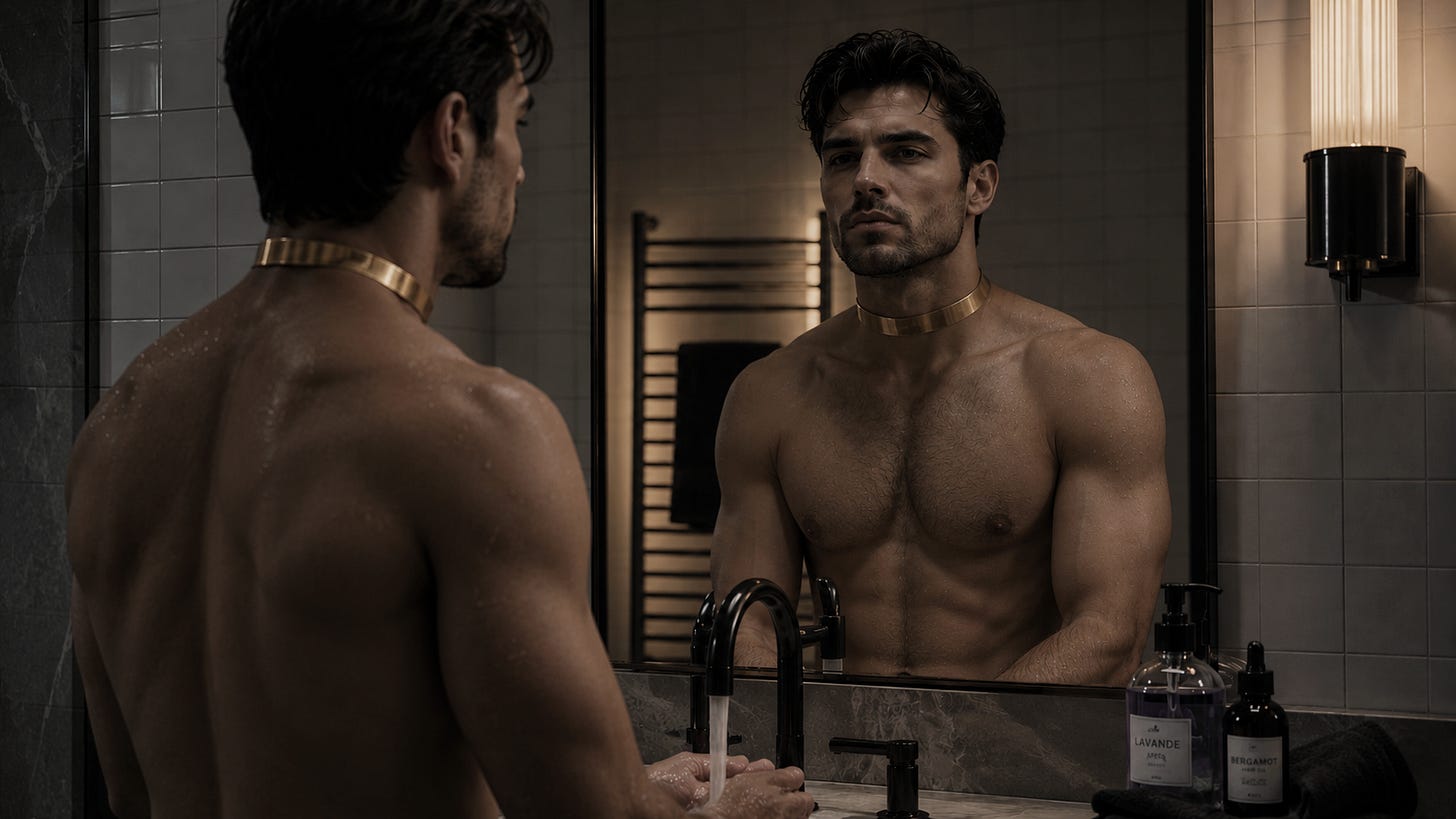
The person looking back was continuous with me. That was the thing I needed to confirm. The skin was mine, the eyes were mine, the mouth that had answered Deschamps’s questions with the precision I’d been trained to bring to rooms full of people who wanted something from me, all of it was mine. The collar was new. The body was the same.
I didn’t look unrecognizable. I looked legible. The person in the mirror was someone who’d been assembled for a purpose, and the purpose was visible in every line of him. The sheen of whatever they’d worked into my skin, the way my hair fell now, the weight of gold at my throat. I knew exactly what he was for.
I turned off the water and dried my hands on a towel that was warm from a heated rack I hadn’t noticed until that moment. The small luxury of it, the Chalice’s institutional commitment to comfort as a form of control, registered and was filed.
On the walk back to the preparation room, I thought about Margaux.
Hundreds of miles away, in a dorm room whose window faced a quadrangle I’d never visited, my sister was living her life. She didn’t know about tonight. She didn’t know about the auction, or the contract, or the collar. She knew I’d “figured something out,” that was the phrase I’d used the last time we’d spoken, and she’d trusted me enough not to push.
The trust was genuine. The information I’d given her wasn’t. I was protecting her by managing what she knew, and I understood, even then, that the management was also a form of control. Someday she’d challenge it. Someday she’d pull the thread and find out what I’d done and why, and the conversation that followed would be one of the hardest I’d ever have.
That was a problem for someday. Tonight was a problem for now.
I set the thought of her down carefully, the way you set down something fragile you intend to come back for, and I returned to the preparation room and let the staff finish what they’d started. They dressed me back with deliberate precision.
Deschamps appeared briefly in the doorway while the woman was adjusting the collar. He spoke to the man in a voice too low for me to catch, and the man nodded, and Deschamps left without looking at me. The institution as backdrop. Its indifference as protection.
I was aware that the bidding field would include people who already knew who I was. The Armenian youngest brother, maybe. Paul-Antoine’s people, if Paul-Antoine’s interests extended this far. Others whose names I might recognize and whose faces I might know. I didn’t know the specific parties. I was preparing to be recognized anyway.
The woman stepped back and studied me with the practiced eye of someone who’d prepared a hundred bodies for a hundred rooms like tonight’s. “You’re ready,” she said.
She wasn’t wrong.

The waiting space was narrow. More of a corridor, really, with a door at one end that led to the auction room and a door at the other that I’d come through. The walls were the same cream as the holding room, but here there was no window, no couch, no carafe of water. Just a chair I didn’t sit in and the stillness of a space designed to be passed through rather than occupied.
The door to the auction room was heavy wood, old enough that the grain had risen in places. Under it, a strip of light and the intermittent passage of shoes.
I built the room from pieces.
The first thing I registered was the quality of the footwear. Oxfords, mostly—expensive, well-maintained, the kind of shoes that communicated something about the people who’d chosen them. A pair of loafers in oxblood leather that stopped directly outside the door for a moment before moving on. The quiet pad of rubber soles that belonged to someone who worked here, someone whose job required them to move without drawing attention.
The voices came next. Not words, because the door was too thick for that, but cadence. The rhythm of men greeting each other in a room where business would be conducted. The rise and fall of social pleasantries that nobody meant. The lower register of serious conversation happening in pockets, voices pitched to carry only to the person they were meant for.
The Coordinator moved through the room in a pattern I could track by the way the voices shifted. When she passed, conversations paused and resumed. Not out of deference, precisely, but out of the recognition that she was the person who made things happen here, and what she was making happen tonight required a certain quality of attention.
I identified the proxy representative without being told.
The proxy representative arrived alone, which was the first thing. The second was that his footsteps stopped near the back of the room and didn’t move again. The third was the quality of the surrounding silence. He spoke to no one. No one spoke to him. He was here on behalf of someone who wasn’t, and his attention, I could feel it even through the door, was calibrated to the doors and exits, not the décor.
Someone absent had sent someone present. The someone present was here to observe rather than participate. Or to participate in a way that wasn’t visible yet. I logged it.
Marc’s arrival changed the room before I saw him.
It wasn’t sound. It wasn’t anything I could point to and say that’s what shifted. It was pressure, a change in the atmosphere of the space beyond the door, the way voices adjusted around a new weight. Conversations that had been easy became careful. Silences that had been comfortable became strategic. I had encountered this change many times in the past.
I didn’t look. The door didn’t have a window. But I knew he was there the way I’d known he was there in every room we’d ever shared, from the school cafeteria to the parties we’d both been invited to because our families occupied the same extended world. Marc had never entered a room quietly in his life. He wasn’t loud. He was simply present, and his presence demanded acknowledgment regardless of whether or not he ever asked for it.
The Coordinator’s voice rose briefly, a greeting, professionally warm, and then subsided. Footsteps. The creak of a chair taking weight.
I catalogued the other arrivals as they came. Paul-Antoine’s representative, recognizable by the quality of his shoes. They were Italian, newer than the others, chosen by someone who wanted the room to know he had money and wasn’t afraid to show it. The Armenian youngest brother, whose voice I recognized from parties years ago, a nasal quality that hadn’t changed. Levon Kazarian, whose arrival was marked by the way other people’s conversations paused when he spoke.
The Chalice’s staging was guessable even from here. The room beyond the door had been arranged for a specific kind of looking. Not a courtroom, not a theater, but some space less sacred between them. The chairs would be arranged in a loose arc facing a platform or a cleared space where the merchandise could be presented. The lighting would be precise. Bright enough to see, dim enough to feel private. The whole architecture of the space was designed to make the transaction feel like an event rather than a purchase, and the event feel like something the bidders were privileged to witness rather than responsible for creating.
The door opened.
The Coordinator stood in the gap. She was a woman in her early thirties with a face that had learned to be pleasant without being readable. Her dress was charcoal, her jewelry minimal, her smile the arrangement of muscles that hospitality professionals learn in their first year on the job.
“It’s time,” she said.
I stepped through the door into a room larger than I’d expected and smaller than it had sounded. Fifteen men, maybe twenty, arranged in a loose arc of chairs that faced a low platform at the front of the space. The lighting was exactly what I’d anticipated. Warm, precise, the kind of illumination that made skin look like something worth paying for.
I scanned the room without appearing to scan it. This was a skill I’d learned before I learned to drive. The training of someone raised from childhood to map power structures while his hands stayed still and his face stayed open. My father had called it “reading the room.” What he meant was know who matters, know who wants something, know who’s lying about what they want.
Deschamps stood at the room’s edge, near a door I hadn’t noticed. Professional, appropriate. He met my eyes for a fraction of a second and then looked away. Noted and set aside.
The proxy representative was exactly where I’d placed him, against the far wall, near an exit. He was older than I’d expected, or younger, or precisely the age that made him hard to place. His suit was good without being memorable, his posture upright without being rigid, his attention on the doors rather than on me. He was wearing a ring on his right hand. Not a wedding band, something older, a signet, the kind of piece that carried a family crest or the memory of one, and he touched it once, absently, as his eyes swept the room. He was the type of man you forgot you’d seen, which was the point. You forgot the man but remembered the ring.
The general bidding field was what I’d expected. Men in suits, mostly, with the sheen of money that had been present long enough to be taken for granted. A few younger faces. A few older ones. The quality of attention varied. Some were here to assess, clinically, the merchandise they might bid on. Others were here for something less transactional, something with more personal weight underneath it.
I found Marc before Marc’s gaze found me.
He was in the second row, not quite center, in a chair that looked too small for him even though it was the same size as all the others. His posture was the same as it had been in every room we’d ever shared, radiating the stillness of someone who didn’t need to demonstrate power because power was what he was. Solid, controlled, contained.
And then he looked at me.
His face was as I remembered it from adolescence. Lined with contempt, the barely concealed hostility, but there was something underneath it now that I hadn’t had language for then. Something that had surfaced in the years between the school cafeteria and this room, or maybe it had been there all along and was simply more visible now that the context had changed.
Possessive. The look was possessive, not exploratory. Marc didn’t want to look at me. Marc wanted to have me. These were different ambitions, and I’d just identified the distinction in the flesh, standing on a platform in a room full of men who were here to buy me.
The contempt was still there. But underneath it, the underneath I’d sensed for years without a name for it, was something hungrier. Something that had been waiting for this room, this configuration, this specific arrangement of power.
I stored it and moved on.
The Coordinator was speaking about the terms of the presentation, the order of events, the protocols for inspection. Her voice was smooth and practiced and I let it wash over me without attaching meaning to the words. I knew the protocols already. I’d read the contract.
Midway through my first walk, the slow circuit of the platform that was designed to give the bidders a complete view, I found Vincent. The sight of him stopped my breath.
The rupture was immediate and specific. Not panic. My composure didn’t break. I could not allow it to break, not here, not mid-step, not in a room where breaking composure was not an option. The rupture was internal. A very rapid, very complete reorganization of what I’d understood about who was in this room and why.
Vincent was here. In this room. Watching me.
He was in the back, near the wall, in a chair that he’d chosen for its sightlines rather than its prominence. His face was doing something I’d never seen it do before. Or rather, it was doing the inverse of something I’d always seen it do. When I walked into a room, Vincent’s face lightened. It was a specific softening, a particular release of tension around his eyes and mouth that I’d noticed years ago and never fully analyzed. It was just what his face did. What he did when I was there.
This was the opposite of that. This was something heavier occupying the space where the lightening usually lived. A face doing the work of containing something it couldn’t put down and couldn’t afford to show. Grief without the permission to grieve. Want without the permission to want. The compression of muscles that came from holding something in because letting it out would cost more than holding it would.
How long had he known? How long had he known I was here, that I’d signed, that tonight was happening? He’d known the auction was tonight. That much was clear from the fact that he was here at all. But had he known before? Had he known when it mattered, when knowing might have changed something, when . . . .
I looked away. I completed the walk. I did not give the room anything. My face stayed open, my hands stayed still, my body moved with the grace trained into it since childhood, when my father had first started teaching me that being seen was a skill, and the skill was in managing what the seeing produced.
The Coordinator spoke again. I heard the words without attending to them.
Then my clothes were removed. The staff approached from the sides of the platform, the same woman and man who’d prepared me, their faces still professionally neutral, their hands still efficient and impersonal. They unfastened what needed to be unfastened, lifted what needed to be lifted, and my clothes fell away with the soft sound of fabric against polished wood.
The room’s air touched my skin. It was cooler than the preparation room, cooler than my body, and my skin responded the way skin responds to temperature change. With a tightening, a slight rise of the surface, the awareness of being exposed that had nothing to do with modesty and everything to do with physics.
The golden collar was already around my throat. Now a fine gold chain that caught the light was attached to it as the Coordinator lifted it, and I understood in that moment what the next phase of the evening would look like.
I was led around the room.
The chain was light but the weight of what it meant was not. The Coordinator held it with the practiced grip of someone who’d done this before, who knew how much slack to give and when to pause and how to present the body at the end of the chain in a way that maximized visibility without quite tipping into display.
The bidders watched. Their attention was total and specific, the kind of looking that assessed and catalogued and valued. I walked past them one by one, and each face registered something different. Interest, calculation, hunger, indifference. I logged each expression in the part of my mind that was two calculations behind the rest of me.
The first calculation was Vincent. Vincent being here meant he’d known and come anyway, for a reason I didn’t yet have context for. Had he come to watch? To bid? To witness something he felt responsible for or something he wanted to be part of?
The second calculation was the unresolved night. It arrived uninvited, the way it always did when I wasn’t guarding against it. The memory of his hands, his mouth, the way he’d looked at me afterward with something I hadn’t been able to read at the time and had spent years not letting myself interpret. I suppressed it immediately, but the suppression itself was a tell. The effort required to set it aside told me more than I was prepared to know at that moment.
One of the bidders asked me a question. A man in the second row, gray haired, his face impassive. He wanted to know how I handled stress. The question was almost absurd in its ordinariness, a job interview question dropped into a room where I was naked and collared and on display.
I answered it. My voice was steady. “I organize things. Lists, mostly. I run cold water over my wrists. It helps me reset.”
The gray-haired man nodded and made a note on a tablet. I watched him do it, the small, ordinary gesture of a man processing information. In another context, we might have been discussing a consulting contract or a policy proposal. Context was everything. Context was the room, the chain, the oil on my skin, the eyes of fifteen people cataloguing my body with the focused attention of appraisers.
The Coordinator stopped at the chairs in the front row, and I understood that we’d reached the inspection phase. The chain went slack, and I stood still while the nearest bidder, a man in his sixties with the pallor of old money and indoor living, leaned forward and looked at me with the detached assessment of someone who’d bought a lot of things in his life and expected this purchase to be like the others.
He didn’t touch me. Some of them did.
Kazarian was the third or fourth. He stood up when the Coordinator brought me to him. It was a gesture that the others hadn’t made, a physical acknowledgment that he wanted to be closer than the chair allowed. His face was the face I remembered from photographs in my father’s files. Levon Kazarian, mid-thirties, the kind of wealth that came from things nobody talked about at dinner parties. His eyes moved over my body with the diligence of someone taking inventory.
Then his hands followed.
He started at my shoulders—not the muscles, but the joints, the place where bone met bone under skin. His fingers were dry and cool and they pressed with the pressure of someone who knew what he was looking for and how to find it. He worked his way down my arms, palpating the biceps, the forearms, turning my hands over to look at the palms and then the backs. His touch was neither gentle nor rough. It was evaluative.
When he reached my torso, his hands spread flat against my chest and then moved down, over the ribcage, the stomach, the expanse of muscle below the navel. He was thorough. He was not ashamed. He cupped my genitals in one palm, feeling the heft of them, their particular weight, and then lifted my cock with the detachment of someone examining livestock, checking the length, the thickness, the way it hung when it wasn’t aroused.
I let him. My body was not mine to withhold in this room. That was the contract. That was the chain. That was the collar whose weight I felt now with every breath.
He turned me around, or told me to turn, I don’t remember which, and his hands mapped the landscape of my back, the dip of my spine, the curve of my ass. His fingers traced the crease between my cheeks with the same evaluative pressure, parting the flesh enough to look, to assess, to confirm what the documentation had described.
“Good,” he said. The word was for himself, not for me. He sat back down.
When the Coordinator brought me to Marc, the room’s attention shifted.
He didn’t stand. He stayed in his chair, his weight settled back, his legs slightly apart, his hands resting on his thighs. The posture was casual and wasn’t. It was the posture of a man who’d been waiting for something for a very long time and wanted to savor the moment it arrived.
His inspection was slow. Deliberate. He started at my feet and moved up, examining my ankles, calves, knees, thighs, all without touching me. His eyes traveled over my body like hands, and the restraint was itself a form of contact. When he reached my cock, he paused. Let the pause extend. Let the room see him looking.
Then his gaze continued upward to my stomach, chest, shoulders, throat, to the collar at my throat, and finally to my face.
His expression was full of something I recognized without having a clean name for. Satisfaction, yes. Triumph, certainly. But underneath both, something more specific. The gloating pleasure of a man who’d wanted something for a decade and was finally, definitively, about to have it.
“Turn,” he said.
I turned. I felt his eyes on my back, the weight of someone who’d been watching me for more than a decade and was now watching me from inches away. Then I turned back. I didn’t do these things quickly. I did them at the pace the room expected, the pace of someone who was performing cooperation because the performance was the only available dignity.
When I was facing him again, Marc leaned forward and spoke. His voice was quiet, pitched for my ears and no one else’s.

“Where are your guards now, Alex?”
The words landed and something in my chest turned over. A click I felt at the back of my throat.
The guards. I knew exactly what he meant. There had been two of them, Julien and Tomas, friends from the year above, boys whose fathers worked for my father. Marc had cornered me once in the corridor outside the science wing. I was fourteen. He’d had me against the lockers, his forearm across my throat, his face close enough that I could smell the wintergreen on his breath. I’d been afraid—genuinely afraid, the kind that turned your stomach to water—and then Julien had appeared at the end of the corridor. Tomas behind him. They hadn’t said a word. They hadn’t needed to. Marc had looked at them, then back at me, and something in his face had closed like a door slamming. He’d walked away. Since that day my friends had always stepped in between me and Marc. Like the gala party.
Until now. He’d been waiting ten odd years for the guards to be gone. And now they were. The protection was gone. The family was gone. I was standing naked in front of him with a gold collar around my neck, and nothing stood between us but the heat of his voice in my ear.
I didn’t answer. The question hadn’t been a question. It was a marker. Marc was telling me that he’d been waiting for this moment since we were fourteen years old, and I was receiving the information, and the information was part of the transaction.
He leaned back. The inspection was over. I was dismissed.
The Coordinator led me to the front of the room again and I stood on the platform while the bidders returned to their seats. Somewhere in the middle distance the machinery of the auction—the paddles, the numbers, the choreography of competitive bidding—was being assembled around me like a stage set for the final act.
I allowed myself one direct look at Vincent.
It was deliberate. Measured. The look of someone taking an accurate reading. What I saw was what I’d expected to see, or what I’d hoped to see, or what I’d dreaded seeing. I couldn’t separate those strands in the moment and I didn’t try.
Vincent was doing what I was doing. Holding himself together. Watching without appearing to watch. Managing the fact of this room with the same discipline I was using, the same active composure, the same deliberate stillness of hands and face.
His presence here was the most honest thing he’d done in years regarding me. It was also one of the worst. These were not in conflict.
I turned back to the front of the room. I had not given anyone here, not Marc, not the bidding field, not Vincent, the satisfaction of a visible response. The collar was gold and heavy around my throat. My body was bare and catalogued and assessed. And I was, in this moment, more specifically myself than I’d been since the raid.
The auction began.

The Coordinator had produced a gavel from somewhere. It was small, brass-headed, the kind of object that looked decorative until you heard it strike wood and understood that it was, in fact, the only thing in the room that mattered now.
“Opening bids,” she said. “The floor recognizes qualified bidders.”
The numbers started low and climbed fast, the way they always did in rooms where the stakes were understood by everyone present. Three serious parties here locally. I tracked them by the way they raised their paddles, the rhythm of their increments. Three more were bidding remotely, their offers relayed by an assistant at a small desk near the back of the room whose voice was the flattest thing in the space.
I read the room’s financial temperature the way I’d been trained to read political rooms. Who was performing seriousness and who had actual reserves. The man in the front row who raised his paddle with a flourish every time, he was out at seven figures, I could see it in the way his hand hesitated before the next bid. The woman representing a consortium whose name I didn’t recognize was calculating, not emoting, and her ceiling was higher than her first few bids suggested.
Marc and Vincent were in a separate category. I tracked them apart from the rest.
Marc hadn’t bid yet. He was sitting in his chair with the stillness of someone who knew the early rounds were theater and was waiting for the actual performance to begin. His eyes moved around the room the way a predator’s might. Not looking for threats, because there were no threats here, but cataloguing the other bidders with the detached interest of someone who planned to outlast all of them.
Vincent was also waiting. His posture was the same as it had been when I first saw him. Contained, composed, the arrangement of his limbs communicated calm without quite being calm. He was watching the bidding with the attention of someone who understood numbers better than people, which he did.
The proxy representative entered the bidding early and precisely. Not aggressive but methodical. He raised his paddle at predictable intervals, matching the increments without exceeding them, the way someone does who’s been given a number and told to execute against it. Whoever had sent him had prepared for this auction. Had calculated what they were willing to spend and had sent someone to spend it.
I noted this without emphasis. The way I noted everything.
At two million, the man with the flourish dropped out. At three and a half, the young one in the back row who’d been bidding by increments of twenty-five thousand put his paddle down and didn’t pick it up again. The field was narrowing, and the narrowing was revealing who was serious and who’d been hoping the serious people wouldn’t show up.
Kazarian bid aggressively. No hesitation, no incremental testing, just the paddle going up every time the Coordinator called for higher numbers. He’d inspected me with his hands and now he was bidding with the same thoroughness, the same refusal to be outworked. His face showed nothing except the intensity of a man who was used to getting what he wanted.
At five million, Vincent began to bid.
His paddle went up for the first time, and the room registered it with a slight shift of attention, the way heads turned slightly toward the back of the room. Vincent didn’t look at anyone except the Coordinator. His voice was steady. The number he called out eliminated three more bidders.
I watched his face across the room and understood something I hadn’t been sure of until that moment. Whatever Vincent was doing in this room, whatever had brought him here after years of knowing me and doing nothing with it, the bidding itself was honest in a way that almost nothing else about our history had been. There was nothing strategic about bidding on a person you’d already lost. He couldn’t protect me by winning, and he knew that. But the paddle went up anyway.
The unresolved night surfaced. I put it back down.
Marc’s escalation changed the register of the room.
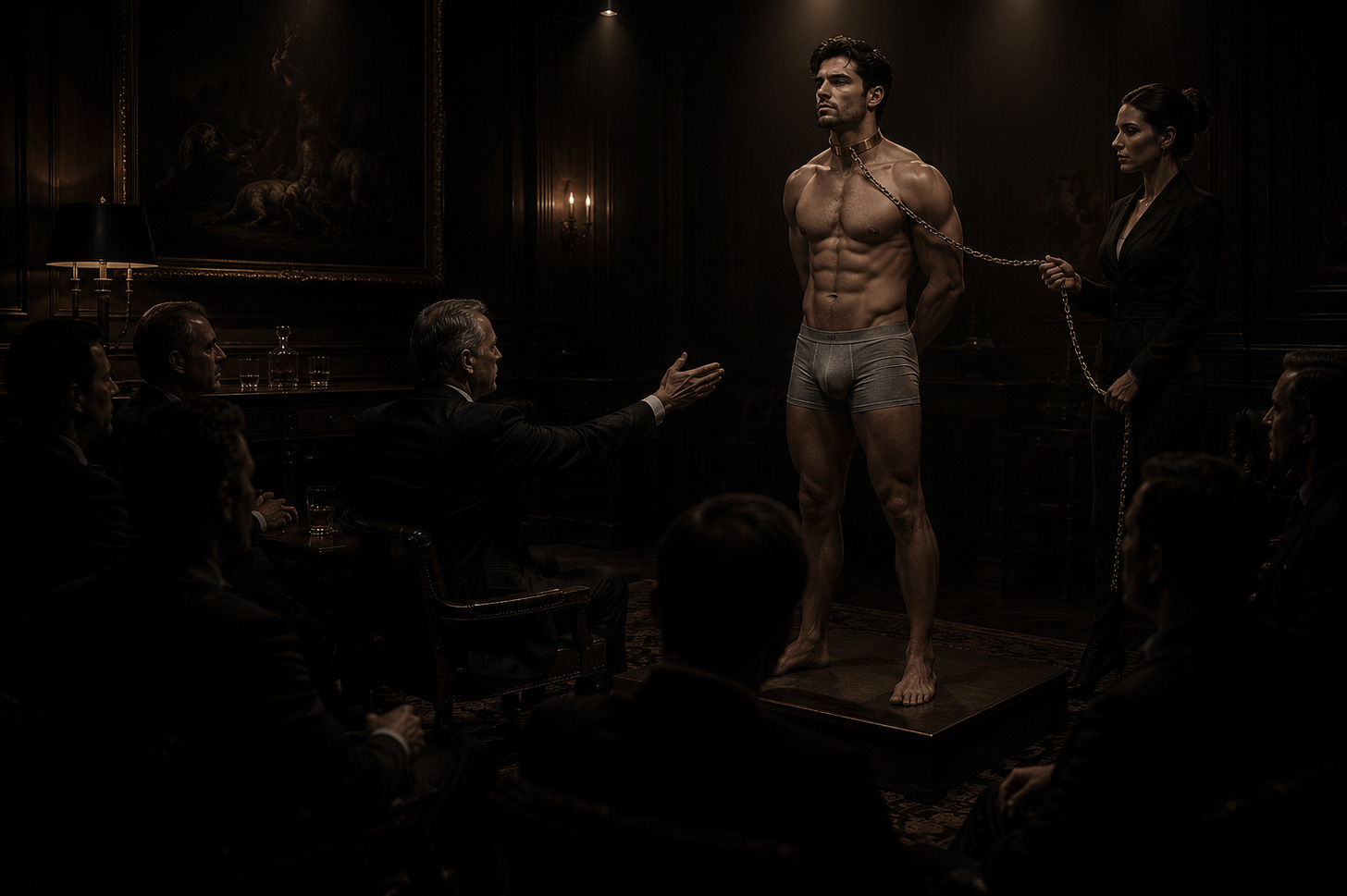
His first bid was just high enough to signal that he wasn’t playing the same game as everyone else. The increment was wrong. Too large, too casual, the kind of bid that communicated I can do this all night without saying it aloud. A few of the remaining bidders looked at each other. One of them put his paddle down.
Marc wasn’t bidding against Vincent. That was the thing I noticed. He was bidding as if Vincent wasn’t a relevant party, as if Vincent’s numbers were background noise, irrelevant data, the kind of thing you filtered out while you waited for the real opponent to reveal themselves.
It was a more specific kind of aggression than direct competition would have been.
The proxy representative matched twice. Three times. His increments were precise, consistent, the work of someone executing an algorithm. At six million, his paddle went up for what would be the last time.
I caught it before anyone else did.
A micro expression on his face, not defeat, but something more calculating. A shift in the set of his mouth, the briefest relaxation of his shoulders. He was done. Six million was the ceiling, and the ceiling had been reached, and whoever had authorized this number had decided in advance, in some room I’d never see, that this outcome was acceptable.
Why was a question for later. The fact of it was all I had in the moment. I set it beside the other facts I couldn’t assemble yet. Someone had sent a representative to bid on me. That someone had set a limit. That limit had been reached, and the representative was not distressed by reaching it. He was relieved? Satisfied? Simply done with a job he’d been given?
Kazarian paused. His paddle stayed on his lap for a beat, two beats, while the Coordinator scanned the room. Then he raised it again.
“Six point two five.”
The room was quiet now. Everything before had been preamble.
Vincent bid $7 million.
The number was higher than anything the casual field had approached. Higher than what I’d calculated as the likely ceiling based on the Chalice’s documentation and Gabriel’s research and my own understanding of what a body was worth in a market I was only beginning to comprehend. Vincent had gone past the rational number. He’d gone past the number that made financial sense for someone whose family was transitioning out of organized crime into legitimacy, whose resources were substantial but not infinite, whose bid was being watched by people who would draw conclusions from it.
He’d gone to the number that told me, more clearly than anything he’d ever said, that he wanted me not as an acquisition but as a person. And the number told me something else, too. It told me he knew he was going to lose.
Marc didn’t look at Vincent. Didn’t look at Kazarian. Didn’t look at the Coordinator. He looked at me. It was a brief glance, the kind that communicated something I couldn’t read and didn’t try to. Then he raised his paddle.
“Fifteen million.”
The room’s collective gasp was audible. A soft rush of indrawn breath, the sound of people who had thought they understood the stakes and had just discovered they’d been wrong. Fifteen million dollars was not a bid. It was a statement. It was the kind of number that made everything before it look like children playing with money they didn’t understand.
No one spoke.
I found Vincent’s face across the room and held it. What I read there was not surprise. Vincent had suspected before he bid, before he’d even entered the room that this was how it would end. He’d known Marc’s number, or guessed it, or simply understood that Marc had been waiting too long to be outbid by anyone in this room.
He’d bid anyway.
That was the thing. Vincent had sat in this room and raised his paddle and called out numbers he knew would be insufficient, because not bidding would have required an honesty about his own stake that he wasn’t prepared to perform in public. The bidding was the performance. The losing was inevitable. And he’d done it anyway, knowing that the person he was bidding on was watching, that the man he was losing to was the man who had been circling me since adolescence, that the whole architecture of the evening was a monument to his own failure to act when acting might still have mattered.
The Coordinator’s gavel was rising. I could see it in the periphery of my vision, the small brass head catching the light, the wood handle in her steady grip.
“Going once.”
The room held its breath.
“Going twice.”
Marc’s face was calm. The calm of someone who’d never doubted the outcome.
“Sold. To Monsieur Ricci, for fifteen million dollars.”

The gavel fell.
The sound was smaller than I’d expected. A sharp crack that died almost immediately, swallowed by the room’s acoustics. The room held still. Fifteen men adjusting to the new shape of the world.
I belonged to Marc now.
The horror and the consolation arrived simultaneously. I felt them both in my body before I could name either. The collar had changed weight around my throat. It was Marc’s collar now and my skin knew the difference before my mind did. My hands, still at my sides, had gone cold. I could feel my pulse in my temples, a steady count I couldn’t slow. The room was the same room with the same chairs, same lighting, same Coordinator gathering her papers, but the air had thickened, or I had, and every breath required permission I hadn’t needed five minutes ago.
I let the horror be real for approximately ten seconds. Long enough. Then I put it away.
Margaux’s tuition. Paid in full, guaranteed, untouchable by anyone in this room. The separate account, seeded and waiting for her twenty-first birthday. Larger now than I had ever dreamed possible. The institutional protections Deschamps had described in his measured voice. I recited the facts the way I’d recited the contract terms to myself in the holding room, and the recitation was a form of breathing. I had chosen this. I would not revise the choice. The horror didn’t erase the calculation. The calculation didn’t soften the horror. They sat beside each other in my chest like two stones I’d agreed to carry.
Then I found Vincent’s eyes across the room.
The rest of the room was too occupied to notice. People were standing, gathering their things. The Coordinator was conferring with her assistant about the paperwork. Kazarian was leaving with the angry stiffness of someone who’d lost and didn’t want to show it. The room was returning to itself, the way rooms do after the thing they’ve been arranged for has concluded.
Vincent and I looked at each other.
It was a held moment—deliberate, specific, the first direct acknowledgment between us that I’d chosen to give since I’d stepped onto the platform and found him watching me. The look wasn’t consolation. It wasn’t forgiveness, which would have been too soft, or farewell, which would have been too final.
It was closer to you are a witness to this and I am choosing to let you be that.
I saw you clearly in this room. I saw what you did and what you didn’t do. And I’m not going to use it against you. Not tonight, not yet, maybe not ever, but I want you to know that I saw.
Vincent received the look without flinching. His face didn’t change, but something behind it shifted, a recognition, maybe, or an acknowledgment of his own. He’d bid knowing he’d lose. He’d stayed in the room after the gavel fell. He was still here, and the fact of his presence was its own kind of statement.
I looked away first. Not because I was done looking, but because I’d communicated what I needed to communicate and the rest would have to wait for a different room, a different configuration of power, a different version of whatever existed between us.
The room looked the same as it had five minutes ago. But something had changed, and the change was in me. The weight of a door closing on one version of my life and opening on another.
The amber light from the sconces caught the edge of the Coordinator’s gavel where it rested on the table. The world unchanged. The person in it different.

The formalities of buying a person took less time than I’d expected.
Deschamps appeared with the paperwork in the same leather folder, the same measured presence, and I stood naked at the front of the room while signatures were collected and verified. The chain was still attached to my collar. The Coordinator held it with the same practiced grip, as if letting go before the transfer was complete would violate some protocol I hadn’t read.
“The contract has been executed,” Deschamps said. His voice was the same as it had been in the holding room. Professional, not unkind, the voice of someone who’d done this many times and had stopped counting. “Possession transfers to Monsieur Ricci effective immediately. All terms, guarantees, and institutional protections remain in force.”
Marc took the chain the way he’d taken everything else tonight, without theatrics. He took it from the Coordinator’s hand with the ease of someone who’d been born to hold it, and he didn’t look at me when he did. The restraint wasn’t kindness. It was control. He’d won. He didn’t need to perform the winning.
“Come,” he said.
The word was quiet. Not a request.
I followed him out of the auction room and into the corridor. The chain was short enough that I had to stay close, close enough to smell the scent of him, which was something woody and clean, close enough to feel the heat of his body in the cool air of the hallway. We walked side by side through the Chalice’s corridors, past the preparation room, past the holding room, past the bathroom where I’d run cold water over my wrists what felt like hours ago.
He didn’t touch me. He didn’t speak. The silence between us was the kind that had weight and texture, that said more than words would have said. He was keeping me for somewhere else. The walk through the Chalice was just transit. Just the necessary passage between the room where he’d bought me and the place where he would do whatever he’d spent fifteen million dollars to do.
The walk outside was the first time I felt the cold.
It was April in Montréal and the night had the particular bite of a city that knew winter was leaving and wasn’t going to pretend otherwise. Marc led me through a side entrance, not the main doors, nothing that would attract attention, and into a parking area where a black car was waiting with its engine running and its headlights off.
I was still naked. Still collared. Still on the chain.
Marc offered me no clothing, no coat. He didn’t even pause as he led me into the cold. His stride was the same as it had been inside. Measured, unhurried, the pace of someone who didn’t need to rush because rushing would imply he cared about something other than his own convenience. The chain was short in his hand, and I followed because following was what the chain required.
The cold hit my skin and my body answered, every surface tightening, the ache of nipples contracting, the involuntary shiver that ran from my shoulders to my thighs. Marc didn’t acknowledge it. He opened the rear door of the car and gestured for me to get in, and so I did, bending into the warm, dark interior while the chain trailed behind me like a golden tail.
He got in beside me. The driver was a man I didn’t recognize, whose face I couldn’t see from the back seat, and he pulled out of the parking area and into the street without being told.
The car was warm. The seats were leather, soft and expensive, and my bare skin stuck to them slightly with the tackiness of cold flesh meeting heated surfaces. Marc didn’t speak at first. He turned the chain over in his hand, the gold links catching the passing streetlights, his thumb moving across the metal the way someone might touch a thing they’d waited a long time to hold. The city slid past the windows in a blur of streetlights and closed storefronts and the emptiness of Montréal after midnight.
“Welcome to your new life, Alexandre.”
He didn’t look at me when he said it. His voice was subdued, almost conversational, the tone of someone remarking on the weather. I didn’t answer. There was nothing to say.
I was reading him. Filing what I observed. The restraint was not kindness. I’d been right about that. It was something more like patience, or the performance of patience, or the knowledge that whatever he’d been waiting for was finally his and there was no hurry anymore. He’d spent fifteen million dollars and fourteen years to get here. The rest of the night could take as long as it needed to. I would be handled somewhere else, somewhere that belonged to him, somewhere the transaction could be completed in private.
I thought about Vincent. The look we’d exchanged. The one I’d chosen to give him, deliberate and measured, in front of a room that wasn’t watching. I thought about what it meant that I’d chosen it at all. That in the moment of my transfer, between the gavel’s fall and Marc’s hand on the chain, the person I’d wanted to acknowledge was not my sister or my father or any of the people I’d been protecting. It was Vincent. The man who’d come to the auction knowing he’d lose and bid anyway. The man whose attention produced a response in my body I couldn’t manage into invisibility.

Vincent’s Point of View
The room emptied around me and I didn’t leave.
I didn’t plan to stay. I simply didn’t stand when the others stood, didn’t gather my things because I had no things to gather, didn’t walk toward the door because walking toward the door would have required a decision I wasn’t prepared to make yet. The Coordinator’s assistants were already clearing chairs, stacking them in neat rows against the far wall. One of them glanced at me and then looked away.
I stood at the edge of the space where the bidding had happened and did the accounting.
I failed him. Again.
The bidding itself I’d known I would lose. I had come here knowing that and I’d raised my paddle anyway, and the raising of it had been a different kind of act. Not an attempt to win. A refusal to pretend I didn’t want to. The knowledge hadn’t stopped me. It had simply clarified what the gesture was for.
What I’d failed to do was a longer list. I didn’t go through it in full.
The unresolved night surfaced and I let it. The club a thousand miles from home where we’d found each other by accident. The hotel room the kind of place you booked when you didn’t want to be found. There was a beach below the deck. I remembered the sound of the waves while Alex slept, the way the light came through the shutters and striped his back in the morning. The way his body had felt under my hands, different from any body I’d touched before or since, responsive in a way that had nothing to do with technique and everything to do with honesty. The morning after, when I’d looked at him across the rumpled sheets and known something I’d spent the intervening years trying not to name.
The silence that followed. Years of silence. Years of watching him at parties and receptions, watching his face lighten when he saw me, knowing what my own face was doing in response and doing nothing about it. Years of telling myself the silence was protection. That I was waiting for the right moment. That when his father’s situation stabilized, when the political world settled, when the circumstances were clean, I’d say something.
His father was dead. The political world had collapsed. The circumstances would never be clean.
The unresolved night was not unresolved because circumstances had intervened. It was unresolved because I’d chosen, repeatedly, not to resolve it. Silence over honesty. Distance over risk. The careful management of my own feelings over the vulnerable act of naming them. I’d let Alex walk through the years without ever telling him. And now he belonged to Marc. The silence was permanent. Or might as well be.
The room was nearly empty now. Two staff members were folding the cloth that had covered the Coordinator’s table. One of them was speaking quietly into a headset.
I walked out of the auction room and into the corridor. The Chalice’s hallways were muted now, the stillness of a building whose business had been conducted and whose occupants had gone home. The sconces on the walls cast the same amber light they’d cast when I’d arrived, and the floor under my feet was the same polished wood.
Deschamps was waiting near the end of the corridor. He’d positioned himself so that I’d have to pass him to reach the exit, and it was deliberate in a way that told me he’d been waiting for the staff to be dismissed before he approached.
“Monsieur Lefebvre.”
I stopped. He didn’t offer his hand and I didn’t offer mine.
“The contract is clean,” he said. “The guarantees are in place. Welfare checks are standard. The Chalice monitors all executed contracts for compliance. Monsieur Bélanger’s sister’s tuition is secured. She will be protected. The separate account is beyond the reach of any contracting party.”
He was giving me nothing except the facts, and he was giving them to me because he knew something, or suspected something, that made the giving appropriate. I didn’t ask what he knew. I didn’t ask why he was telling me.
I nodded. Of course Alex had done this for his sister. But why hadn’t he come to me first?
I knew the answer. I had spent years making myself unavailable for exactly this kind of asking. The silence that I’d told myself was protection had been, from his side, a closed door. I set the question aside and walked.
Deschamps watched me for a moment longer, and then he stepped aside. Not quite a dismissal. Not quite permission. Just the small space he’d created for me to walk through.
I walked through it. Down the corridor, past the preparation room with its door closed, past the holding room with its door also closed, through the main entrance and into the raw April night where my car was waiting in the lot.
The city was the same as it had been when I’d arrived. The same streetlights. The same darkness. The same Montréal skyline against the same black sky.

End of Chapter 4.