MM Fiction, Slow-Burn Romance, Mutual Pining, Wager, Oblivious Protagonists
Leo and Marcus pour their final shifts at Holloway, the subterranean sanctuary where they fell in love, and say goodbye to the stage that made them stars. Their last night behind the bar becomes a private ritual, a claiming of the space that held four years of secrets, before they walk out into the rain together. Six months later, the doors of Vance & Cole open for the first time, and the night begins again.

Leo’s Point of View
The office smelled of stale smoke and the boss’s peppermint tea. She’d been drinking the same tea for as long as I’d worked here. The mug was chipped on the rim. I had noticed it a hundred times and said nothing.
Marcus sat beside me. His posture was perfect. His tie was dead center. He’d dressed for a firing the way other people dressed for a funeral.
Madeline, she’d told us to call her Maddie years ago but it never stuck, sat behind her desk with her hands folded on a leather blotter. The blotter was cracked at the corners. She’d had it since the bar opened. Her face was harder than I’d ever seen it, and I’d seen her fire three line cooks, a barback who’d been skimming tips, and a server who’d made the mistake of telling her the Old-Fashioned recipe was “outdated.”
“So,” she said. “Vance and Cole.”
It wasn’t a question. She let the name sit there like a bad oyster.
“Who told you?” Marcus asked.
“Does it matter?”
“I’d like to know.”
“Chloe’s Instagram. Your new business partner tagged her in a concept sketch. She reposted it.” Maddie’s mouth twisted. “The algorithm is faster than the rumor mill. Congratulations. You’ve been outed by metadata.”
I closed my eyes. Rafael. The sketch he’d given me. The one I’d shown everyone at the celebration. Of course.
“We weren’t hiding it,” I said.
“You weren’t telling me either.”
“Because there was nothing to tell. We don’t have a lease. We don’t have a liquor license. We have a sketch and a space that’s still got a hole in the roof.”
“And an investor.”
“Two investors,” Marcus said quietly. “Adrian Hale and Rafael Costa.”
Maddie’s jaw tightened. She knew the names. Everyone in New York hospitality knew the names. Adrian had been Holloway’s most loyal regular for two years. Rafael had designed the mural in the private dining room. They weren’t just investors. They were family.
“You’re poaching my customers,” she said.
“We’re not poaching anything.”
“You’re poaching my best bartenders.”
“We’re standing right here,” I said. “We haven’t quit.”
“But you’re going to.”
The silence that followed wasn’t angry. It was worse. It was hurt.
Maddie leaned back in her chair. She looked older than she had five minutes ago. The lines around her mouth had deepened. The peppermint tea had stopped steaming.
“I built this place with my husband’s life insurance,” she said. “Did I ever tell you that? He died in 2015. Aneurysm. Forty-three years old. The only thing he left me was a policy I didn’t know he’d taken out and a note that said open the bar you always talked about. So I did. I found this basement. I hung that door. I put that neon sign up with my own hands because the contractor said it couldn’t be done.”
She stopped. Turned the mug in her hands. The chip caught the light.
“You remember your first Saturday?” She was looking at Marcus now. “That bachelorette party. Twelve women, all ordering cosmos. You made every single one with a different twist. Told them it was a ‘flight of self-discovery.’ They tipped forty percent and came back every month for a year.” She shook her head. “I knew right then. You weren’t just a bartender. You were an artist.”
Marcus didn’t say anything. His face was tight. He was filing the moment somewhere he’d keep it.
“And you.” She turned to me. “The night the health inspector came. You talked to him for twenty minutes about fly-fishing while I hid the vermouth I’d been infusing without a permit. He left without checking a single thing.” A ghost of a smile. “You’ve been covering for people since the day you walked in.”
She leaned forward. Her hands flattened on the blotter. The cracked corners. The years of use.
“I hired you when you were still swimming off a hangover, Leo. You couldn’t make a Negroni without checking the recipe. I hired you when your academic career had just imploded and your hands shook every time someone asked you a question, Marcus. I trained you. I promoted you. I gave you the best shifts, the best regulars, the best bar in the goddamn city.” Her voice cracked. She didn’t try to hide it. “And now you’re leaving me to open a competitor.”
“It’s not a competitor,” Marcus said. “It’s a neighborhood bar in the West Village. It’s half the size. It’s not the same clientele. We’re not trying to—”
“It’s a bar. In Manhattan. That makes it a competitor.”
“Maddie.”
She held up a hand. Stopped him.
“I’m not going to fight you. I’m too old and too tired and frankly too fond of you both to turn this into a war. But I need to know are you in or are you out? Because if you’re out, I need to hire replacements. I need to train them. I need to figure out what Holloway looks like without the two of you behind the bar.” She picked up her tea. Took a sip. Grimaced at the cold. “So. What’s it going to be?”
I looked at Marcus. He looked at me. The decision had been made weeks ago, months ago, maybe years ago. We’d just been waiting for someone to ask the question out loud.
“Two weeks,” I said. “We’ll stay two weeks. Train our replacements. Make sure the transition is clean. Then we’re out.”
Maddie nodded. Slow. The anger had drained out of her, and what was left was something closer to grief.
“You’re making a mistake,” she said. “This city eats new bars alive. For every one that makes it, twenty close in the first year. You’ve got good investors and a good concept and enough talent to fill three bars, and it still might not be enough. You know that, right?”
“We know,” Marcus said.
“And you’re doing it, anyway.”
“We have to try.”
She looked at us for a long time. Then she stood. Came around the desk. She was a small woman, five-two in heels, but she’d always had a presence that made rooms feel crowded.
“I’ll miss you,” she said. “Both of you. You’re the best bartenders I’ve ever had and the biggest pains in my ass I’ve ever employed. Try not to fail. It would reflect badly on me.”
She shook Marcus’s hand. Then mine. Her grip was fierce.
“Two weeks,” she said. “Don’t make me regret it.”

Marcus’s Point of View
We stepped out of the office and into the empty bar. The stools were still upside down on the bar top from the night before. The glassware was racked and gleaming. The well was clean. Everything in its place. Everything exactly as we’d left it.
I had spent four years cataloguing this room. The way the light hit the back bar at four in the afternoon. The unique squeak of the third stool from the left. The faint scorch mark on the wood where someone had left a cigarette burning in 2019, before the smoking ban, before I’d ever set foot in New York. I knew this room the way I knew my own hands. Every inch of it was memorized.
And we were leaving.
“Well,” Leo said. He was standing by the service well, one hand resting on the speed rail. The gesture was unconscious. Proprietary. “That went better than I expected.”
“We still have jobs.”
“We still have jobs for two weeks.”
“Two weeks is enough.”
“Enough for what?”
I didn’t have an answer. I walked to the back bar and ran my fingers along the bottles. Whiskey. Rye. Scotch. Gin. The Amari collection I’d built from seven labels to forty-three. The vermouth I’d convinced Maddie to let me order from a tiny distributor in Brooklyn who washed his bottles by hand. Every bottle was a decision I’d made. Every label was a conversation I’d had.
“I’m going to miss this,” I said.
“The booze?”
“The booze. The bar. The light.” I turned. Leo was watching me the way he always watched me. Head slightly tilted. Eyes narrowed. His body angled toward mine like a compass finding north. “The way you look behind the well. I’ve been watching you stand there for four years. I’m not sure I know how to look at you anywhere else.”
Leo crossed the room. Didn’t stop until he was close enough that I could smell the soap he used. It was cheap and sharp and so familiar it made my chest ache.
“You’ll figure it out,” he said. “You’re a fast learner.”
“My learning curve has been notably slow where you’re concerned.”
“Four years.”
“Four years of willful ignorance. A personal record.”
He kissed me. Soft. His hand came up to my jaw, thumb brushing the corner of my mouth. The gesture was so gentle, so unlike the way he’d kissed me three days ago against the wall of our apartment, that something behind my chest cracked open.
“I’m scared,” I said. It came out before I could stop it.
“I know.”
“I’m not supposed to be scared. I’m supposed to be the one with the plan. The protocols. The—”
“You’re supposed to be human.” His thumb traced the line of my cheekbone. “This is a big thing. Leaving. Building something new. It’s okay to be scared.”
“Are you?”
“Shitless,” he grinned. The grin was shaky at the edges. “But I’ve got you. You’ve got me. We’ve got Adrian and Rafael and a print shop with a hole in the roof. What else do we need?”
“A liquor license.”
“Minor detail.”
“A health inspection.”
“You’re ruining my pep talk.”
“I’m improving it. Pep talks should be accurate.”
He laughed. The sound bounced off the empty bar, filled the room, and faded. Outside, the city was waking up. A delivery truck rumbled past. A car horn. The distant shriek of a subway braking. None of it paused for us. None of it knew we’d just set a timer on the only lives we’d ever known.
“We should tell Adrian and Rafael,” I said.
“Chloe.”
“The regulars.”
He nodded. “And train the kids. And figure out what I’m wearing on the last shift.”
“You already know what you’re wearing.”
“I do,” I admitted. “I’ve known for weeks.”
“Of course you have.”

The next two weeks blurred.
I remember them in fragments. Not a narrative. A catalogue.
Monday. Chloe cried. Actually cried, mascara streaking, her perfectly curated composure dissolving into hiccups. She hugged Leo so hard he made a sound I’d never heard before. Something that occupied the horror between a laugh and a wheeze. She hugged me and whispered, “You better invite me to the opening or I will destroy you on Instagram. I have forty thousand followers. I can do it.” Then she pulled back, dabbed at her eyes with a napkin, and posted a photo of the three of us with the caption these idiots are abandoning me. It got eleven thousand likes before I finished my shift.
I believed her.
Wednesday. The regulars began to hear. A woman named Judith who’d been coming to Holloway since opening night took my hand and said, “You’re the only bartender who ever remembered I don’t like Campari.” She held on for a long time, her knuckles knobby against my palm. “My husband died three years ago,” she said. “I’ve been coming here every Thursday since. You always remembered to ask how my book club was going.” She squeezed once and let go. I had to turn around and reorganize the Amari for five minutes before I could speak again.
A man named David who always ordered a Sazerac and never took off his coat left a hundred-dollar tip on a forty-dollar tab. “Don’t spend it all on bitters,” he said. He still didn’t take off his coat. He never did.
Friday. Maddie introduced us to our replacements. A pair of kids who looked at us like we were rock stars. The boy was tall and nervous and kept dropping his bar spoon. The girl was short and fierce and asked Leo if it was true he’d once made a Last Word while blindfolded. “Two Last Words,” Leo said. “At the same time.” “Bullshit.” “Ask Marcus.” “It’s true,” I said. “I was the blindfold.” The girl’s eyes went wide. The boy dropped his spoon again. We stayed late that night, walking them through the closing checklist. The boy had finally stopped dropping things. The girl had started correcting Leo on his measurements. He was delighted.
Monday, again. Adrian and Rafael took us to dinner at a place in Tribeca with no sign and no menu and a wine list that required a ladder. Adrian raised a glass. “To the architecture of us,” Rafael added, “To the best bartenders in New York. May your new bar be half as good as you are.” The wine was so old it tasted like dirt and honey. I catalogued it anyway. Filed it under last times.
Saturday. Our last Saturday. The bar was packed. Leo worked the well. I worked the pass. We didn’t speak. We didn’t need to. A shoulder tap meant behind you. A glance meant this one needs a heavy pour. A raised eyebrow meant are you seeing what I’m seeing. It was the language we’d built over four years, the silent choreography of two bodies moving in a space designed for one. It was the most beautiful thing I had ever been part of.
And it was ending.

Leo’s Point of View
The last night felt like any other night.
That was the strange part. The bar filled up like it always did. The ice machine made the same grinding noise it had made since 2019. The EST. 2017 sign hummed its same amber hum. I made Negronis and Old-Fashioneds and the occasional Last Word for people who wanted to watch me show off. Marcus worked the pass with his usual terrifying precision, his hands moving like they were reading a language only he could see.
The difference was underneath. A low hum of awareness. A countdown.
This is the last time I’ll reach for this bottle.
The last time I’ll hear that stool squeak.
The last time I’ll see Marcus’s face in this light.
The regulars came in waves. Judith hugged me across the bar and left a card. David took off his coat—actually took it off, for the first time in three years—and stayed for two Sazeracs instead of one. Chloe posted a photo of us working and the caption read end of an era and she tagged us both and the post got three thousand likes before midnight.
Adrian and Rafael arrived at nine. They took the booth. Their booth. The one where Adrian had sat for two years, politely refusing every advance, watching us orbit each other with those quiet, knowing eyes.
I brought them their drinks without being asked. Old-Fashioned for Adrian. Amaro on the rocks for Rafael.
“On the house,” I said.
“Maddie will kill you,” Adrian said.
“Maddie’s not here tonight. She said her goodbyes this afternoon.”
Adrian’s expression flickered. Something almost like surprise. “She came in?”
“Stood right there.” I pointed to the end of the bar. “Same spot she hired me. Told me I was a ‘serviceable bartender’ and a ‘moderately adequate human being.’”
“That’s practically a love letter from Maddie.”
“I know. I almost cried.”
Rafael reached across the bar and squeezed my wrist. His fingers were warm. “You’re going to miss this place.”
“Yeah,” I looked around the room. The amber glow. The black leather. The faces I’d been serving for four years. Faces I might never see again. “But it’s not the place I’m going to miss. It’s the—”
“The stage,” Adrian said quietly. “I know.”
I left them to their drinks. The rush picked up. Nine-thirty to midnight was a blur of tickets and shakers and the rhythm of my own body doing what it had learned to do so well it didn’t need my brain anymore. My hands knew the bottles. My feet knew the floor. My mouth knew the small talk, the regulars’ names, the jokes that landed because I’d told them a hundred times before.
At midnight, the crowd began to thin. At twelve-thirty, we called last call. At one, the final customers paid their tabs and drifted out into the rain.
The door closed.
The bar was empty.
Marcus and I stood behind the well. The neon hummed. The ice machine cycled off with a final, rattling sigh.
“Well,” Marcus said. “That’s it.”
“Not quite.”
I walked to the door. Locked it. Turned the deadbolt. The sound of metal sliding into place was the loudest thing I’d heard all night.
When I turned back, Marcus was watching me. His tie was off center. A quarter-inch to the left. His eyes were doing that thing where they tracked my movements like I was a specimen he hadn’t finished cataloguing.
“Leo,” he said. “What are you doing?”
I didn’t answer with words. I crossed the room, put my hands on his waist, and lifted him onto the bar top.

Marcus’s Point of View
The wood was cool through my trousers.
I had been standing behind this bar for four years. I had mixed drinks on this bar top, wiped it down at the end of every shift, buffed out the water rings and the citrus stains and the ghost marks of a thousand glasses set down by a thousand hands. I had never sat on it.
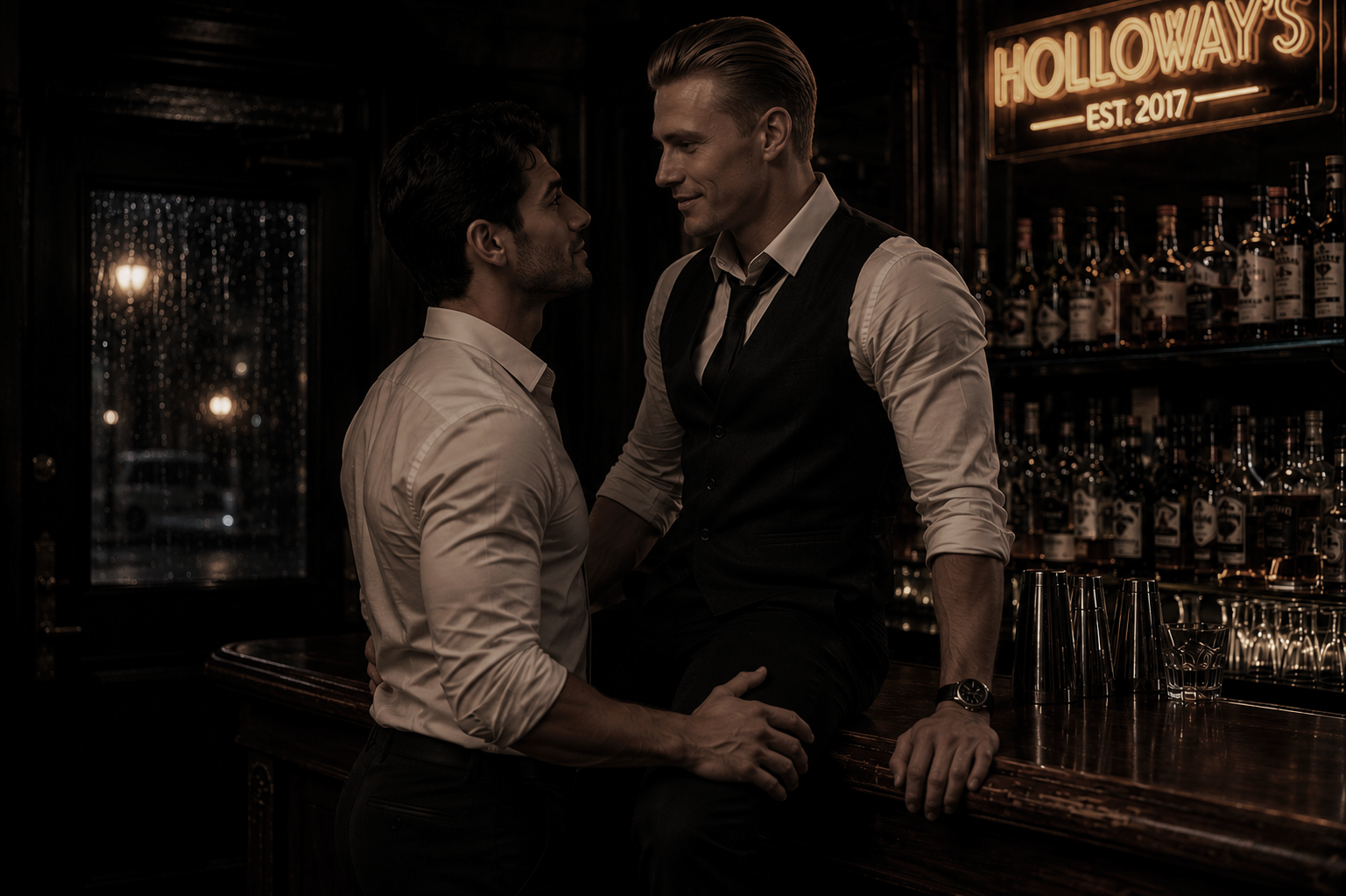
For a moment, the shift in perspective was disorienting. The room looked different from up here. Larger. The amber neon threw shadows I’d never noticed. The bottles on the back bar caught the light at angles I’d only ever seen from below. Leo’s face was level with mine.
“Four years,” he said. His hands were on my thighs. “Four years behind this bar and I’ve never done this.”
“You’ve never lifted a grown man onto a bar top in the middle of a shift?”
“We’re not in the middle of a shift.”
“We’re not?”
“It’s after close. Nobody’s here. Shift’s over.” His thumbs traced circles through the wool of my trousers. “This is our bar now. For the next few hours. Ours.”
The word landed in my chest and stayed there. Ours. Not Holloway’s. Not Maddie’s. For these few hours, after four years of tending someone else’s stage, it was ours.
“You’re sentimental,” I said.
“I’m romantic. There’s a difference.”
“You say that about everything.”
“Because it’s usually true.”
He kissed me. Not soft, not gentle, not the careful kiss of a man who was still learning the shape of my mouth. He kissed me like he’d been waiting four years to kiss me on this bar top. Like the last time was a rehearsal and this was the performance.
His tongue was heat and pressure. His hands moved from my thighs to my waist to the buttons of my shirt. He undid them one at a time, his mouth never leaving mine. The air in the bar was cool against my chest as the fabric fell open.
“Lie back,” he said.
“The bar top is—”
“Sanitized. I wiped it down myself. Lie back.”
I did. The wood was smooth and cold against my shoulder blades. Above me, the ceiling was higher than I’d realized. The track lighting cast long, distorted shadows. The EST. 2017 sign was a golden smear at the edge of my vision. And Leo was leaning over me, his body a warm weight, his face half in shadow and half in amber light.
“I’ve wanted to do this since the first week,” he said. “When you bent over to get the bitters from the bottom shelf and your shirt came untucked. Right there.” He touched the small of my back. “I thought, I want to have him right here. On this bar. In front of God and the health inspector.”
“That’s a health code violation.”
“I don’t care.”
“The health department would.”
“The health department isn’t here.”
His mouth found my throat. His teeth grazed the tendon. My back arched without permission, my hips pressing up into the weight of him, and the sound that came out of me was embarrassing and wholly accurate.
“Leo.”
“Yeah.”
“Lock the door.”
“It’s already locked.”
“The blinds.”
“There aren’t any blinds. We’re underground. The only window is the door and it looks out onto a stairwell.” His mouth moved lower. Collarbone. Sternum. “Nobody can see us. Nobody’s coming. It’s just us and the bar and the next four hours.”
“Four hours?”
“I told you. Ours.”

Leo’s Point of View
I undressed him on the bar top.
Not fast. Not like we’d torn at each other against the apartment wall, buttons flying, belt buckles clanking. This was different. This was a ritual. I pulled his shirt off his shoulders one sleeve at a time. I folded it. Set it on the stool behind me. His trousers came next, and I took my time with those too, working the belt loose from the buckle, tugging the fabric down over his hips, his thighs, his calves. His shoes I unlaced with the same care I’d use to measure a quarter-ounce of absinthe. His socks I peeled off last, running my thumb along the arch of his foot, the involuntary twitch of muscle under my thumb.
“You’re treating me like a cocktail,” he said. His voice was dry but his eyes were dark. His chest was flushed. “Measured. Precise. Methodical.”
“You’re better than a cocktail.”
“I should hope so.”
“You’re a whole goddamn bar.”
I stepped back. Looked at him.
He was naked on the bar top. The amber light pooled in the hollow of his throat, in the sharp lines of his clavicles, in the faint trail of hair that ran from his navel to the base of his cock. His cock was hard, curving up toward his stomach, the head already glistening. His legs were parted. His hands were at his sides, fingers curled against the wood. He was watching me with an expression I’d never seen before. Not control. Not surrender. Something in between. Something that looked a lot like trust.
“You’re beautiful,” I said.
“You say that every time.”
“Because it’s true every time.”
I bent over him. Kissed the center of his chest. The skin was warm and salty sweet and his heart beat under my lips, fast and stuttering, like a song in the wrong time signature. My tongue traced the line of his sternum. My teeth caught the edge of his lowest rib. He gasped.
“The bar—”
“Is fine. The bar is very clean. Stop worrying about the bar.”
“I’m not worrying about the bar. I’m cataloguing the bar. The grain of the wood. The temperature differential between the bar top and my skin. The way the light . . .”
I took his cock in my mouth.
The sentence died. His hand flew to the back of my head. His hips bucked. I pinned them with one arm, pressing him flat against the wood, and worked him slow. My tongue found the ridge under the head. My lips sealed around the shaft. I pulled back until my mouth was barely touching him, then took him deep again, all the way to the base, my throat opening around him the way it had learned to do.
“Christ,” he said. “Christ. Your mouth. Your goddamn . . .”
I hummed. The vibration made his whole body jerk.
I settled into a rhythm. Slow pulls, letting him feel every inch of my mouth. My tongue pressed flat against the underside of his shaft on the downstroke. On the upstroke, I flicked the tip against the ridge, that spot just under the head that made his thighs shake. His taste was salt and skin and masculine musk. Pre-cum leaked steadily now, slicking my lips. I swallowed around him and his hips bucked again, harder this time.
“Leo. Leo, I . . .”
I pulled back. Just the head in my mouth now. My tongue traced circles around it, slow and wet, while my hand worked the shaft. The contrast made him gasp. Made his fingers twist in my hair. I looked up without lifting my mouth and found his eyes locked on mine, his chest heaving, his mouth open around a sound he couldn’t finish.
“You okay up there?”
“Do not . . .” He swallowed. “Do not stop.”
I didn’t. I swallowed him deep again, all the way to the root, and this time I held it. Nose pressed to the dark hair at the base. Throat working around him. His whole body went rigid. A sound ripped out of him that wasn’t a word at all, just a raw collection of broken vowels.
I held until my lungs burned. Then I pulled off, a thin strand of spit connecting my bottom lip to the head of his cock, and wiped my mouth with the back of my hand.
This was the thing about Marcus. He talked. He catalogued. His brain never shut up. But if I got my mouth on him, if I worked him just right, the words started falling apart. First the big ones. Then the small ones. Then nothing but sounds.
I stroked him with my hand. Looked up.
“Talk to me.”
“I can’t.”
“Try.”
“You . . . the bar . . . the wood . . . my back is cold . . . your mouth is warm . . . the contrast is . . . I’m going to . . . ”
“Not yet.”
I stood. Unbuttoned my shirt. Let it fall. Unbuckled my belt. His eyes tracked every movement. I catalogued the cataloguer, watching his gaze move from my shoulders to my chest to my stomach to the waistband of my jeans. His lips parting. His hand reached for me without his permission, fingers brushing the trail of hair below my navel.
“I want to be inside you,” I said. “Right here. On this bar top where I’ve watched you mix drinks for four years. I want to fuck you in the same spot you taught me how to make a proper Sazerac.”
“That spot is . . . that’s not where you taught me—”
“I know where the spot is. I was there.”
“You were across the bar.”
“I was watching.”
I pulled my jeans down. My cock sprang free, hard and leaking, the head already slick. Marcus’s hand closed around it like it belonged there. Familiar. Proprietary. His thumb swept across the tip, spreading wetness, and I had to grab the edge of the bar top to stay upright.
“We need—”
“Lube’s in my bag. Behind the well.”
“You brought lube to our last shift?”
“I’m an optimist.”

Marcus’s Point of View
He prepped me with the same precision he’d used to undress me.
One finger. Slick. Circling. My body opened for him now in a way it had never opened for anyone else. Four years of guarding every entrance, literal and metaphorical, and Leo had talked his way past all of them with his thumbs and his grin and the way he said my name like it was a thing worth saving.
“Ready?” he asked.
“Ask me again.”
He added a second finger. Crooked it. Found the spot.
“Ready?”
“Ask me one more time.”
“Brat.”
But he was smiling. He added a third finger. The stretch. The burn. The familiar slide of my body yielding to his. My hand found his shoulder. My nails dug in. The bar top was hard under my spine and cold against my shoulders and the sensation of being stretched open in the same place I’d spent four years maintaining perfect composure was almost unbearable.
“Now,” I said. “Leo. Now.”
He positioned himself between my legs. The head of his cock pressed against me. The heat of him. The weight.
“Look at me,” he said.
I did.
He pushed in.
The first stroke was always the most. The tight clutch of my body around the head. The stretch. The burn blooming into something else, something deeper, something that felt like home. I had catalogued this sensation so many times that my body knew it before my brain did. The way the breath left my lungs. The way my back arched. The way my hand found the back of his neck and held on.
“There,” I said. “There. Don’t stop.”
“Wasn’t planning to.”
He moved. Slowly. The bar top was solid beneath me, the wood worn smooth by a decade of glasses and elbows and the occasional drunken forehead. The neon hummed its amber heartbeat. The rain had picked up outside, a distant drumroll against the stairwell door.
And Leo was inside me. Leo was fucking me on the bar where we’d met, where we’d fought, where we’d fallen in love without admitting it. His hips rolled in a rhythm that was older than both of us. His breath was hot against my throat. His hands were braced on either side of my shoulders, and the muscles in his arms were corded with the effort of holding back.
“Don’t,” I said.
“Don’t what?”
“Don’t hold back. Not tonight. Not here.”
His rhythm stuttered. Recovered. “You sure?”
“I’ve been cataloguing you for four years. I know your pace. I know your tells. I know you slow down when you think you might hurt me. I’m telling you now you won’t. Not tonight. Tonight I want you to fuck me like we’re the only two people in the world.”
His eyes went dark. His hands tightened on the wood. And he let go.
He pulled out to the tip. Held there. His eyes on mine, asking the question again without words. I answered with my heels, digging into his back, pulling him in.
He drove back into me. Slower than before. Deeper. The full length of him sinking home until his hips were flush against my ass. The bar top creaked. My breath caught in my throat.
The pace shifted. His hips drove into me with a force that pushed the air from my lungs. The bar top creaked again. A bottle rattled somewhere on the back bar. My legs wrapped around his waist and my heels dug into the small of his back and my hands found his shoulder blades and held on as he rutted into me with the full weight of his body.
“Yes,” I said. Or maybe I shouted it. The word was torn out of me raw and unedited. “Yes. There. Leo. Right there.”
“Marcus—”
“Don’t stop. Don’t you dare stop. I’m . . . I’m close. I’m so close. Your hand. Put your hand on me. Now.”
His hand wrapped around my cock. The friction was perfect. The rhythm was perfect. The weight of him inside me and the grip of his hand on me and the amber light and the rain and the creak of the bar top and the way he was looking at me like I was the only thing in the universe worth seeing.
“I love you,” I said. The words came out in a rush, breathless and broken. “I love you. I love this. I love . . . oh . . . oh, God . . .”
I came.
The orgasm tore through me in a pulse of heat that started somewhere behind my navel and spread outward until my fingers were tingling and my vision was a blur of gold and shadow. I clenched around him. His body shuddered in response. The hot flood of his release welled deep inside me and he groaned my name into the hollow of my throat.
We lay there on the bar top, tangled and breathing. His weight on top of me. His cock still buried inside me. The world slowly reassembling itself around us. The neon, the rain, the soft click of the ice machine cycling back on.
“I think we violated several health codes,” I said.
Leo laughed. The sound vibrated through his chest into mine. “Several. Possibly dozens.”
“Maddie would kill us.”
“Maddie will never know.”
“She’ll know. She knows everything. She’ll walk in tomorrow morning and the bar top will be—”
“Sterilized. I’ll sterilize it. Twice. Three times. I’ll buy a new bar top.”
“There’s nothing wrong with this one.”
“Exactly.”
He lifted his head. Looked at me. His face was flushed and his hair was a mess and his eyes were the blue of a swimming pool under summer sun.
“This is where I first saw you,” he said. “Right here. You were muddling mint and I forgot my own name.”
“You told me I looked like ‘sexy furniture.’ I wanted to die.”
“I wanted to live. Finally.”
He kissed me. It was gentle this time. Almost chaste. The kiss of a man who had just fucked his boyfriend on a bar top and was now feeling sentimental about it.
“We should clean up,” I said.
“In a minute.”
“The health department.”
“Can wait.”
“The bar—”
“Can wait.” He brushed a strand of hair from my forehead. “Everything can wait. Just let me have this. One more minute. Right here. In the place it all started.”
I stopped arguing. I lay there on the bar top with Leo’s weight on my chest and Leo’s cock slowly softening inside of me and Leo’s breath warm on my throat and the EST. 2017 sign humming its endless amber heartbeat above us. Outside, the rain fell harder. The city carried on. And I catalogued every detail. The temperature of the wood, the sound of the rain, the weight of the man I loved. I filed them all under a single heading.
This. Remember this.

Leo’s Point of View
We cleaned up. I sterilized the bar top twice, like I’d promised, and Marcus reorganized the back bar like he’d been itching to do all night, and by the time we were done the bar looked altogether like it had looked before we’d arrived four years ago. Ready for someone else.
I stood in the center of the room and waited. For the tightness in my throat. The weight in my stomach. Something. But my body was still humming from Marcus’s. The warmth in my chest where his head had rested. The faint ache in my shoulders from holding myself over him on the bar top. My body didn’t know we were saying goodbye. My body thought we were just getting started.
“Ready?” Marcus asked.
He was standing by the door, his bag over his shoulder. His tie was back on. Center. Perfect. The way he’d worn it every shift for four years. I wanted to reach out and pull it a quarter-inch to the left. Just to see him fix it.
“Yeah,” I said. “Ready.”
We walked to the door. I killed the lights. The neon stayed on. It always stayed on.
Outside the rain had softened to a drizzle. The street was empty. The black door swung shut behind us with a sound I’d heard a thousand times and never really listened to.
I stopped. Looked back.
The door was just a door. Black. Unmarked. The same door I’d walked through for my first shift in 2022, hungover and terrified, a former swimmer who’d never made a Sazerac in his life. The same door Marcus had walked through six months before that, his academic career in ashes, his hands shaking.
The same door where Adrian had stood two years ago, pausing on the threshold, the rain soaking his coat, before stepping inside and changing everything.
“Hey,” Marcus said. His hand found mine. “You okay?”
“Just saying goodbye.”
“You already said goodbye. You said goodbye to the regulars and the boss and the bar itself.”
“I’m not saying goodbye to Holloway.” I squeezed his hand. “I’m saying goodbye to the guy who walked through that door four years ago. The one who couldn’t say a goddamn thing he meant.”
“What words?”
“You know what words.”
“Say them anyway.”
I turned. His face was wet with drizzle. His tie was getting soaked. His eyes were doing that bright thing, the thing he did when he was feeling more than his protocols could handle.
“I love you,” I said. “I’ve loved you since the night you fixed my Old-Fashioned recipe and didn’t make me feel stupid about it. I’ve loved you through four years of pretending I didn’t. I’ve loved you through the bet and the fight and the walk-in fridge and Adrian’s penthouse and every single night I went home alone and wished I hadn’t. I love you, Marcus Cole. And I’m going to keep loving you through every bar we build and every fight we have and every single night of the next thirty years. Okay?”
He didn’t say anything for a long moment. The rain fell around us. The neon hummed behind the door.
“Okay,” he said.
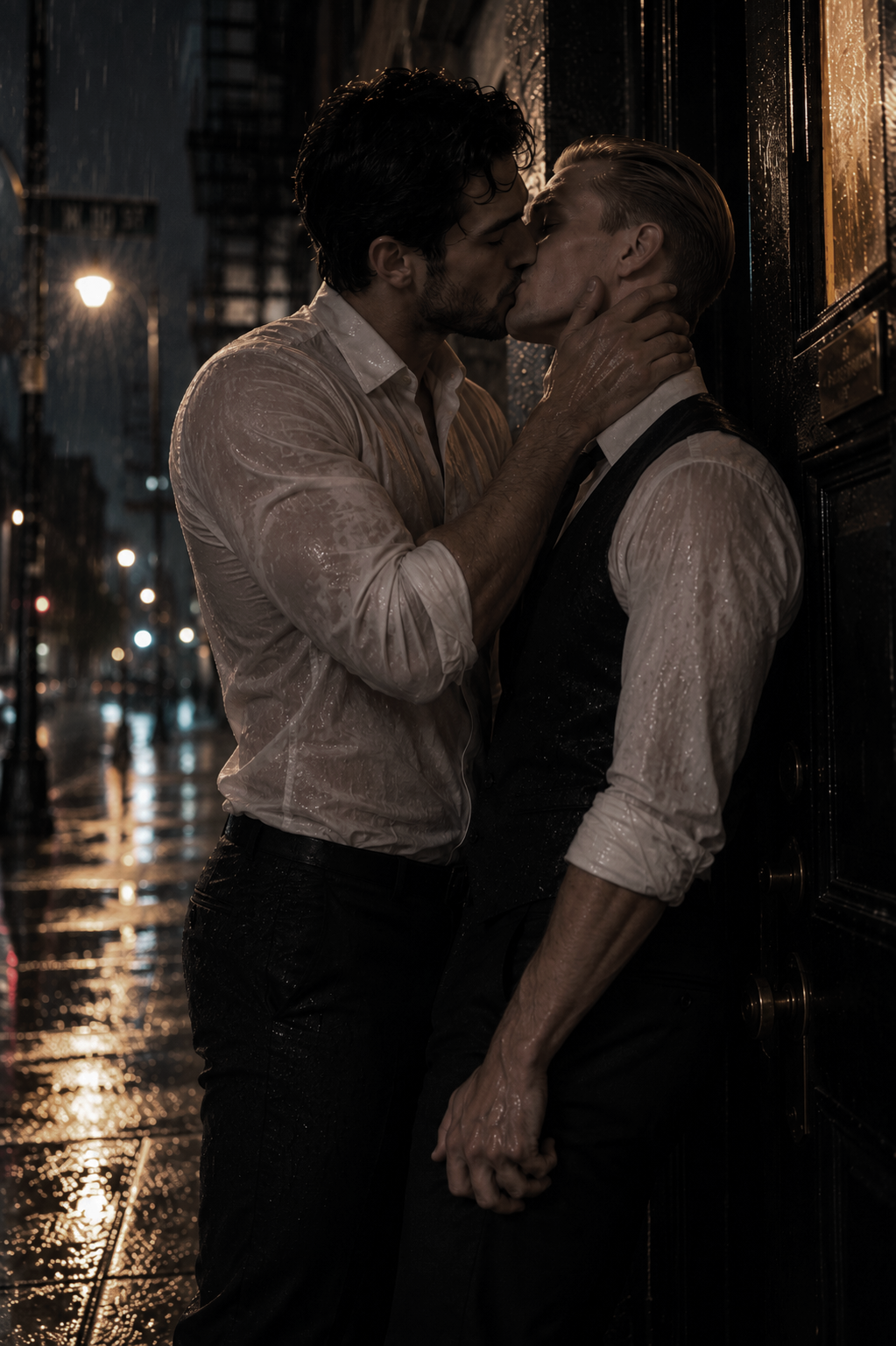
Then he kissed me. In the rain. Outside the bar. Where anyone could see.
His hand stayed in mine afterwards. We walked to the subway like that. I didn’t look back again. Didn’t need to. The door was closed. The neon was humming. And we were already somewhere else.

Marcus’s Point of View
Six months later, I stood behind the bar at Vance & Cole and waited for the doors to open.
The space was everything we’d fought about and everything we’d agreed on. The marble bar, a long peninsula open on three sides. The back bar was organized by category, alphabetized within each section, exactly the way I’d insisted. The mezzanine curving around the room like an arm. The skylight, finally unboarded, threw a column of October sun onto the exact spot where I’d be standing for the next thirty years.
Leo was at the other end of the bar, adjusting the speed rail. He’d already moved the Amari. I could see it from here. The Montenegro was next to the Averna instead of the Nonino. I would fix it later. I would fix it every night for the rest of our lives.
“You moved the Amari,” I said.
“I was testing you.”
“You were not. You forgot where the Montenegro goes.”
“It’s a brown liquid in a brown bottle. It looks exactly like the Nonino.”
“The Montenegro is forty percent lighter in color and has a distinctly different flavor profile. They are not remotely interchangeable.”
“I love you.”
“That’s not a defense.”
“It’s an explanation. I was thinking about you instead of the bottles.”
I tried to maintain my stern expression. Failed. “Acceptable.”
Adrian was on the mezzanine adjusting the track lighting. He’d been up there for an hour, muttering about sightlines and lux levels. Rafael was at the corner booth. Our corner booth, the one Leo had drawn on the back of an electric bill six months ago, and he was sipping an amaro and sketching on a napkin.
“Five minutes,” Leo said. He appeared at my elbow without making a sound. “You nervous?”
“I’ve never been nervous in my life.”
“Bullshit.”
“Complete and utter fabrication. My hands are shaking.”
I looked down at my hands. They were, in fact, shaking. Slightly. Only someone who’d been cataloguing me for four years would have noticed.
Leo covered my hand with his. Pressed it flat against the marble.
“We built this,” he said. “You and me. Adrian and Rafael. Every fight. Every sketch. Every compromise. It’s all here. It’s real. And in five minutes, the doors open and people walk in and we pour drinks and we do what we’ve been doing for four years. It’s the same thing. Just a different stage.”
“A different neon sign.”
“A better neon sign.”
I looked up. The sign glowed above the door: EST. 2026. White letters on black glass. Clean. New. Ours.
“Chloe’s here,” Leo said. “She’s been posting Instagram stories for an hour. Must have been working overtime. We have six hundred people on the waitlist.”
“Six hundred?”
“Chloe’s Instagram,” he said. “Terrifying.”
I laughed. The sound surprised me. The tension in my shoulders released a fraction of an inch.
“You know,” I said, “I never did cover your shifts.”
Leo’s thumb brushed the inside of my wrist. The gesture was old now, worn smooth by repetition, but it still sent a silent thrill up my arm. “You covered every shift with me. That’s the point.”
I turned my hand over. Laced my fingers through his.
“Ready?”
“Ready.”
We walked to the door. Past the bar. Past the mezzanine. Past the booth where Rafael raised his glass in salute and Adrian gave us a single, approving nod. Past the new neon sign and the black door and the threshold we’d crossed a hundred times in our heads but never in real life.
Leo unlocked the door.
The crowd outside was bigger than I’d expected. Faces. Phones. The low murmur of anticipation. Chloe was at the front, her phone raised, already filming. Behind her, a line that stretched down the block.
Leo looked at me. I looked at him.
“Welcome to Vance and Cole,” Leo said.
I was half a beat behind. “Vance and Cole. Welcome.”
We looked at each other. Leo’s mouth twitched. “We’re gonna have to practice that.”
“We have thirty years to get it right.”
Then we stepped aside, and the first customers walked through the door, and the bar we’d built together came to life.

The night was a flurry of tickets and bottles and the rhythm of two bodies orbiting in a space designed for two. Leo worked the well. I worked the pass. The language we’d built over four years at Holloway translated perfectly to the new stage. A shoulder tap. A glance. A raised eyebrow at a customer who’d had enough. We didn’t need words. We’d never needed words.
At midnight, Adrian appeared at the bar. He’d changed out of his work clothes into something darker. His eyes swept the room with an architect’s satisfaction.
“You’re out of the Montenegro,” he said.
“Already?”
“You underestimated demand. It happens. I’d recommend doubling your order for next week.”
“Noted.”
He hesitated. For Adrian, hesitation was practically a soliloquy.
“I’m proud of you,” he said. “Both of you. You built something beautiful.”
“We had good architects.”
“You had good bones.” He reached across the bar. Shook my hand. It was the first time he’d done that in two years. “Rafael and I will be in the booth. The usual.”
“I’ll bring it over.”
He disappeared into the crowd. I poured his Old-Fashioned. Rafael’s amaro. Delivered them myself.
By two in the morning, the crowd had thinned to a handful of diehards. Chloe was still there, her phone finally lowered, her mascara somehow still perfect. The new regulars—our regulars—were scattered at the bar and the booths. Judith had come. David had come. He’d taken off his coat.
At two-thirty, Leo called last call. At three o’clock , we locked the door.
We stood behind the bar. Our bar. The marble was streaked with water rings. The speed rail was a disaster. Someone had moved the Amari again and I hadn’t even noticed.
“Not bad for a first night,” Leo said.
“Not bad at all.”
“Six hundred on the waitlist.”
“Chloe’s Instagram is terrifying.”
“We should send her flowers.”
“We should send her a cocktail. The Vance. It’s basically an Old-Fashioned with better hair.”
Leo laughed. The sound filled the empty bar. The burgundy glow of the new neon caught the side of his face, throwing shadows under his cheekbones. His shoulders were slumping and his grin was too wide for his face and he was so beautiful it made my teeth ache.
“Come here,” I said.
He came.
We stood in the middle of the bar we’d built together, the marble cool under our hands, the skylight dark overhead, the city sleeping beyond the black door. I straightened his collar. He didn’t wear a tie. He never wore a tie. The absence was its own kind of signature.
“One night down,” he said. “Thirty years to go.”
“Thirty years. You really think we’ll make it that long?”
“I know we will.”
“You can’t know that.”
“I can.” He kissed my forehead. “Because I know myself. I spent four years trying not to love you and it didn’t work. Thirty years of trying to love you is going to be easy.”
“Okay,” I said.
“Okay?”
“Okay. Let’s do thirty years. Let’s do thirty more after that. Let’s do every shift together until we’re too old to lift a shaker and then we’ll hire someone else to do it and we’ll sit in the corner booth and critique their technique.”
“That’s a plan.”
“It’s a protocol.”
“Same thing.”
I kissed him. Once. A period at the end of a very long sentence. Then I stepped back and looked at the bar. Our bar. I let the quiet settle.
Outside it started to rain.
Inside we were warm.

Leo’s Point of View
The door opened.
A stranger walked in. Curious. Drawn by the light. He was maybe thirty, in a coat that had seen better days, his hair wet from the rain. He stopped just inside the threshold and looked around like he wasn’t sure he belonged here.
“Sorry,” he said. “I know you’re closed. I just . . . the sign. I saw the sign.”
I looked at Marcus. He looked at me.
“One more?” I said.
“One more.”
I turned to the stranger. Gestured to the bar. “Take a seat.”
He sat. The same stool the first customer had sat on six hours ago. The leather was still warm.
“What can I get you?”
“I don’t know. Something classic. Something that tastes like . . .” He trailed off. Shrugged. “Something that tastes like the beginning of something.”
I smiled. Reached for the rye. Reached for the bitters. Reached for the sugar.
“One Sazerac,” I said. “Coming up.”
Behind me, the neon hummed its steady amber heartbeat. The ice machine cycled on. Marcus adjusted the speed rail, his hands as precise as ever. The stranger watched us work with the look people got when they walked into a bar and realized they’d found somewhere worth staying.
And the night began.

End of Chapter Eight.