
When a mysterious stranger finds Michael closing up the café on a rainy Tuesday night, he brings an impossible claim: Michael’s real name is Breck, they’re engaged, and a devastating betrayal erased an entire life from his memory. As matching rings glint in the streetlight and body memory wars with amnesia, a story of heartbreak, searching, and the long road to earning back trust unfolds in one small apartment above an empty café.

Breck (Michael)
The cafe closes at nine on Tuesdays.
I like Tuesdays. They’re quiet in a way that feels intentional, not abandoned. The morning regulars have come and gone. Mr. Kowalski with his double espresso and his silence, the woman with the red scarf who always tips in coins, the young couple who share a croissant and never stop touching. The afternoon slump gave way to a trickle of evening customers, students for the most part, bent over laptops and textbooks, nursing the same latte for three hours until the foam goes cold and the milk separates into pale swirls. By eight-thirty, the place is empty except for Rosa in the back office doing inventory and me behind the counter, wiping down the espresso machine for the third time because I like the way the stainless steel gleams when it’s clean.
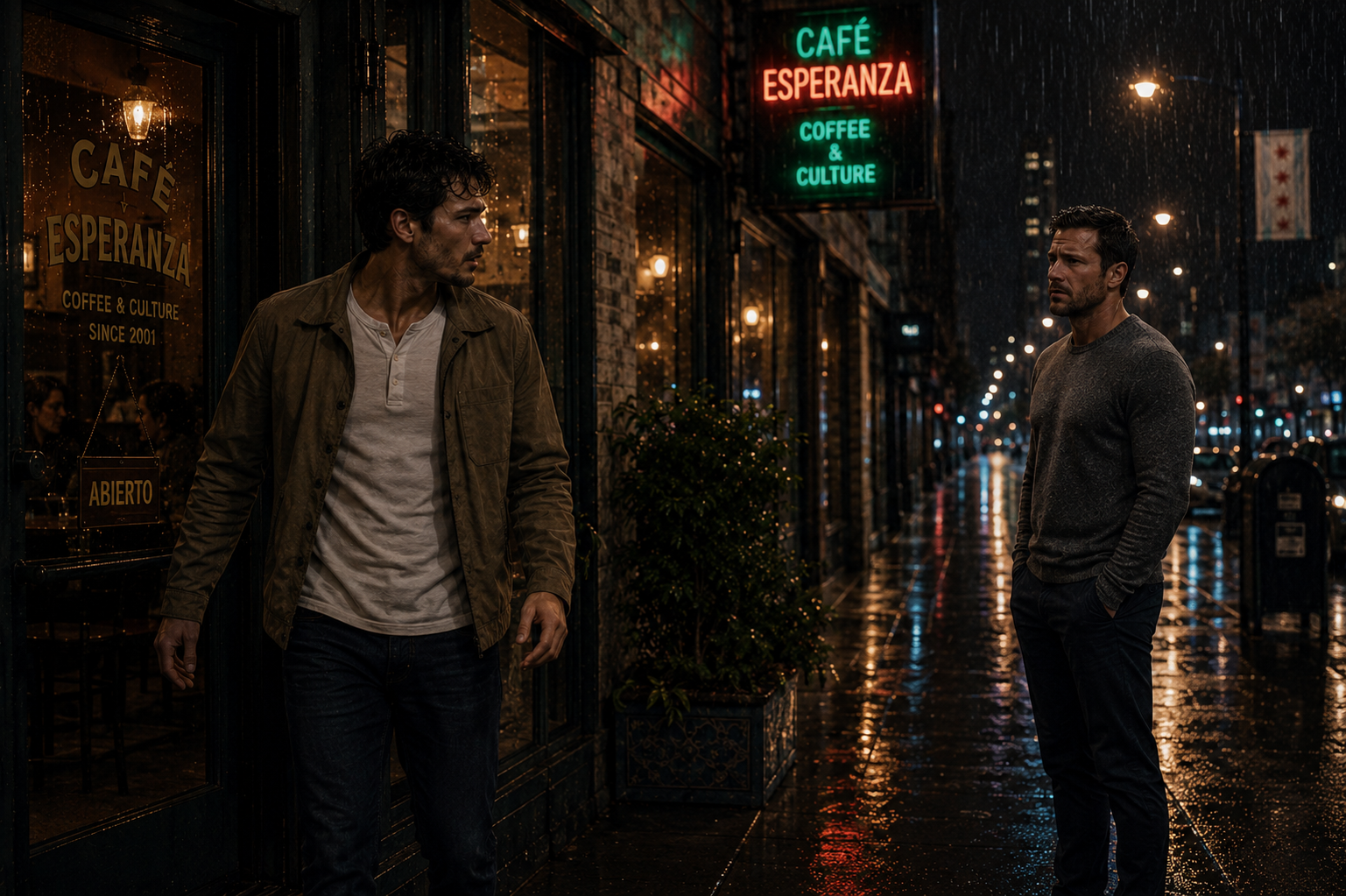
The rain started around seven. A soft, indecisive drizzle at first, a Chicago trademark. By eight it had settled into something steadier, a rhythm on the windows that makes the cafe smaller and warmer than it is. I’ve always liked the rain. Or at least, I’ve liked it for as long as I can remember, which is about a year.
The gray feeling is worse when it rains.
That’s what I call it. The gray feeling. Not sadness, exactly. Sadness has a shape, a reason, a story you can tell yourself about why your chest feels heavy. The gray feeling is unique. It’s directionless, a weather system that moves through me without asking permission, settling into my bones like damp. It comes most often at dusk, especially when the light outside matches the light inside and everything blurs at the edges. I’ll be fine all day, making coffee and remembering orders, and then the sun will start to go and something in me will dim with it.
Tonight it’s worse than usual. I’ve been off since I woke up, a low hum of unease I can’t trace to anything specific. I burned my first batch of espresso this morning, something I haven’t done in months. I forgot Mrs. Delgado’s oat milk until she reminded me twice. And I keep catching myself touching my ring. Turning it around my finger, feeling the weight of it, the smoothness of the metal where my thumb has worn it down over a year of the same unconscious motion.
I don’t know who gave me this ring. I don’t know why I still wear it. I’ve tried to take it off twice—once in the first month, when I was still trying to piece together a life from the fragments I had, and once around month six, when I decided I should stop clinging to a past I couldn’t remember. Both times, my hand refused. It wasn’t a decision. It was a revolt. My fingers wouldn’t close around the band. My chest tightened. I put it back on and the tightness eased, and I’ve never tried again.
The ring means something. Or meant something. Or belongs to someone who meant something. I touch it the way you touch a scar. Not because it hurts, but because it’s proof something happened.
“Michael.”
Rosa’s voice from the office doorway. I look up. She’s leaning against the frame, her reading glasses pushed up into her graying curls, a clipboard in one hand. Rosa is sixty-three and built like a woman who’s spent her life on her feet. She opened Cafe Esperanza twenty years ago after her husband died, and she runs it with the blunt, unsentimental warmth of someone who’s seen enough hardship to know when a person needs a job more than they need questions.
I needed a job more than I needed questions.
“The milk order’s short again,” she says. “I’m going to call the supplier tomorrow and give them hell. You want me to walk you through the order sheet so you know what to look for next time?”
“I’ve got it. You showed me last month.”
“Did I?” she squints at me. “You remember that?”
I shrug. “Apparently.”
What I don’t say: I remember everything from the last year. The twenty-eight years before that are the problem.
Rosa studies me for a moment. She has a way of looking at people that makes you feel like she’s reading the fine print. Then she nods, taps the clipboard against her hip, and says, “You’ve been quiet tonight.”
“Tuesdays are quiet.”
“Not the cafe. You.”
I wipe down the steam wand again, even though it’s already clean. “Just tired.”
“Mm.” She doesn’t believe me. She never believes me when I say I’m tired, which is fair, because I’m always tired in a way that sleep doesn’t fix. “You want to talk about it?”
“There’s nothing to talk about.”
“Michael.” Her voice gentles. “I’ve known you a year. You’re the best employee I’ve ever had, and I’m not just saying that because you remember the regulars’ orders better than I do. But you get this look sometimes. Like you’re waiting for something. Or someone.”
The word someone lands in my chest like a blow I didn’t see coming. I feel the ache settle in, but I can’t tell what threw it.
“I’m fine, Rosa. Really.”
She doesn’t push. That’s one thing I appreciate about her. She knows I have a past I can’t access, a life I walked away from—or was pushed out of, or fell out of, I still don’t know which—and she’s never demanded the story. She just keeps the cafe warm and the paychecks coming and doesn’t ask questions I can’t answer.
“All right.” She pushes off the door frame. “I’m heading out. You’re closing?”
“Yeah.”
“Lock up properly. Back door too. And don’t walk home in the rain without your coat again. You’ll catch your death.”
“I’ve got my coat.”
“You never have your coat.” She pulls her own jacket from the hook by the office, a battered green parka that’s seen better decades. “See you Thursday.”
“Night, Rosa.”
The bell over the door chimed as she left. Cold air gusts in, wet asphalt and fallen leaves on the wind, the aroma of autumn, and then the door swings shut and I’m alone.
I finish closing the cafe the way I always do. Wipe down the tables. Stack the chairs. Empty the pastry case and wrap the leftover croissants for the shelter down the street. Rosa’s policy was no food wasted, no person turned away hungry. I checked the back door twice, jiggling the handle to make sure it’s secure. Muscle memory. The ghost of a habit from a life I can’t remember.
Then I kill the lights and step outside.
The rain is steady now, a cold October rain that finds every gap in my jacket and seeps through my collar. I pull the door shut and fumble with the keys. Rosa’s keys, the set she gave me on my third day when she decided I was trustworthy, and the gesture still makes my throat tight when I think about it. I lock the glass door, check it once, check it twice. The street is empty. The amber streetlights make halos in the rain, blurred and soft, and the only sound is the hiss of tires on wet pavement somewhere in the distance.
I’m about to turn toward the apartment entrance when a voice says my name.
Not my name. Not the one I’ve been using for a year.
My name.
“Breck.”
I freeze.
Not at the word. At the voice. Something in it hits me at a level below language, a frequency my body recognizes before my mind has time to catch up. My shoulders square. My heart rate spikes. A flush of heat moves through me that makes no sense in the cold rain.
I turn.
The man standing in front of me is beautiful. That’s the first thing I register. The word surfaces from somewhere, unbidden, beautiful, and I don’t know why that’s the word my brain chooses when I look at a stranger in the rain. He’s tall, taller than me, with dark brown hair swept back from a face that looks like it’s been through something. Powerful jaw. Hazel eyes catch the streetlight and shift between green and amber. An expensive coat, the kind that costs more than my monthly rent, but looks like he’s been sleeping in it. And he’s crying.
Not sobbing. Not making a scene. Just tears running freely, mixing with rain, tracking down a face that’s trying very hard to hold itself together and not quite managing.
I know this man.
I don’t know this man.
Both things are true at the same time and the contradiction makes my chest ache in a way I can’t name.
“I’m sorry to approach you like this.” His voice is rough, scraped raw, the voice of someone who’s been talking to himself for a long time and only just found someone else to listen. “I’ve been looking for you for a long time.”
I don’t move. My hand is still on the cafe door, keys pressed against the cold metal. The rain is soaking through my collar. I should say something. Who are you? What do you want? Why are you crying? But my voice has gone somewhere I can’t reach.
He takes a step closer. The motion is careful, deliberate, like he’s approaching a frightened animal. The yellow streetlight catches his left hand and I see it.
A ring.
Platinum. Nothing flashy. But heavy enough to know it cost more than my entire wardrobe.
The same ring I’m wearing.
I look down at my own hand, still pressed against the door. The ring glimmers in the wet light. I look back at his hand. The match is exact. The same band, same width, same faint wear on the edges where a thumb has worried it smooth.
“This isn’t a coincidence,” I hear myself say. My voice comes out calm, the way it always does when I’m talking to a stranger in distress. Some part of me knows the rhythm, the tone, the right way to speak to someone who’s hurting. It’s a skill I didn’t learn in the last year. It’s older than that.
“No.” He almost laughs, a broken, nervous sound. “It’s not a coincidence.” He takes another step. We’re maybe six feet apart now, the rain falling between us, and I can smell him. Cedar and bergamot and something underneath, something warm and familiar that makes me want to step forward and run away in equal measure. “Your name is Breck Carson. You’re twenty-eight years old.” A pause. “Twenty-nine now. Your birthday was in April. You’re from Portland, Oregon. You’re a crisis counselor. You work at a suicide prevention hotline. You save people’s lives. You saved mine, even if you don’t remember it.”
The words strike like lightning. Crisis counselor. Suicide prevention. Portland. Nothing changes. The wall in my mind is still firmly in place and still silent, but behind it is a growing pressure. A weight. Something pushing.
“My name is Michael,” I say. It comes out weaker than I mean it to.
“No.” His voice is gentle, but there’s steel underneath. “Your name is Breck. You changed it because you had to. Because being Breck Carson was too painful, and your mind decided it was safer to be someone else.”
“How do you know that?”
“Because I’ve spent a year learning everything there is to know about dissociative fugue. Because I hired a specialist who explained it to me in clinical detail I didn’t want to hear. Because I’ve been looking for you for three hundred and sixty-four days, and I’ve been sitting outside this cafe for two weeks, trying to find the courage to say your name.”
Three hundred and sixty-four days. A year. Almost exactly a year.
The gray feeling is pressing in now, heavy and thick. My hand goes to my ring without permission, my thumb finding the familiar groove, turning it around and around. The man’s eyes drop to the motion and he makes a sound. A small, wounded noise that cuts through the rain.
“You’re still wearing it.”
“I don’t know who you are.”
“I know.” He takes a breath, visibly steadying himself. “I know you don’t. That’s not your fault. None of this is your fault.”
There’s something in the way he says it. None of this is your fault. My throat tightens. As if he’s been waiting a long time to say those words. As if they cost him something.
“What do you want?”
“To talk. Just talk.” He holds his hands up, palms open. The rain drips from his sleeves. “I know you don’t remember. I know this is terrifying. If you want me to leave, I’ll leave. I’ll leave and I won’t come back. But I owe you the truth. And I think . . .” He stops. Swallows. “I think part of you knows that.”
I look at his hands. At the ring. At the way his fingers are trembling slightly, not from cold, though it is cold, but from the effort of holding himself still. There’s a scar on his jawline, thin and white, mostly hidden by stubble. I don’t know why my eyes go there. I don’t know why I want to touch it.
“This is crazy,” I say. “I don’t know you.”
“Your body remembers me.” His voice drops, barely audible over the rain. “I know it does.”
The worst part is, he’s right.
I’ve been feeling something for months. Phantom sensations. The weight of a hand on my hip. The scent of cedar and bergamot in an empty room. The feeling when I wake at three in the morning that someone should be in the bed beside me. That the space on the left side is a presence, not an absence. I’ve been dreaming about hands. A specific pair of hands, with a ring on them, reaching for me. I never see the face.
Now the hands are here. The face is here. And the feeling in my chest is so big and so wordless and so terrifying that I don’t know whether to run toward it or away from it.
I look at the man, at this stranger who knows my name, who’s been searching for me for a year, who’s standing in the rain crying and trying not to show it and I make a decision I don’t understand.
“There’s a cafe.” I gesture at the locked door behind me. “It’s closed. But I have an apartment. Upstairs.”
His breath catches. “Okay.”
“What should I call you?”
“Trace.”
Trace. The name lands like a stone dropped into still water. I feel the ripples but I can’t see what caused them. Something in my chest shifts, one tectonic plate grinding against another, deep and slow and seismic.
“Okay, Trace.” I pull the keys from the door and gesture toward the side entrance, the one that leads to the apartment stairs. “Come on.”
He follows me without speaking. I can feel him behind me. The heat of his body, the weight of his gaze, the faint scent of cedar and rain. My heart is beating too fast. My hands are shaking, though I don’t know why. I unlock the apartment door and hold it open.
The stairs are narrow and poorly lit, the carpet worn thin in the center from decades of footsteps. I climb them every night without thinking about it. Tonight, every step feels like a decision.
At the top of the stairs, I unlocked the apartment door. It sticks in the frame, it always sticks, and I have to lean my shoulder into it. When it swings open the apartment is dark and quiet, the way I left it this morning. One room, essentially. A kitchenette along the back wall, a pull-out couch I’ve never folded back into a couch, a small table with two mismatched chairs. A window that faces the street, with rain streaking down the glass. The only personal touches are the books stacked on the floor. Paperbacks from the used bookstore down the street, their spines cracked and softened, and a potted plant on the windowsill that Rosa gave me when I moved in. “Every home needs something alive,” she’d said. The plant is still alive. Barely.
“It’s not much,” I say, and then I don’t know why I said it. Why I care what this stranger thinks of my apartment.
“It’s you,” Trace says quietly. He’s standing in the doorway, not quite inside yet, as if he’s waiting for permission. The rain has plastered his dark hair to his forehead. His coat is soaked through at the shoulders. “The books. The plant. The way you’ve made it feel like somewhere a person could rest.” He swallows. “It’s very you.”
“You keep saying that.” I pull off my wet jacket and hang it on the hook by the door. “You talk like you know me.”
“I do know you.” He steps inside, finally, and the door clicks shut behind him. The apartment feels smaller with him in it. Not in a bad way. In a way that makes me aware of my own body, the space it takes up, the space it wants to take up. “I know you better than I’ve ever known anyone. And I also . . .” He stops. Takes a breath. “I also know that the person I knew is not the person standing in front of me. I’m trying to hold both of those things at once.”
I don’t know what to say to that. I don’t know what to say to any of this. So I do what I always do when I don’t know what to do. I make tea.
The ritual is automatic. Fill the kettle. Set it on the stove. Turn the burner on. While the water heats, I pull down two mugs from the cabinet, the unchipped ones I save for when Rosa comes up after a long shift. I opened the tea tin. Chamomile-valerian blend, the one Rosa recommended when I told her I wasn’t sleeping. The fragrancof it rises, dry and floral and faintly medicinal, and something in my chest loosens a notch.
Trace is still standing by the door, watching me. I can feel his eyes on my back, tracking my movements. It should feel invasive. It doesn’t. It’s something settling into a groove I didn’t realize was there.
“You can sit down,” I say without turning around.
“I don’t want to assume—”
“If you’re going to be here, you might as well be comfortable.”
A pause. Then the scrape of a chair on the linoleum floor, the creak of wood as he sits. The kettle starts its slow climb toward boiling.
“What kind of tea?” he asks.
“Chamomile-valerian. I don’t have anything with caffeine. It keeps me up.”
“I know. You’ve always been sensitive to caffeine after four. You used to say it was because you were already too alert for your own good.”
I turn around. Trace is sitting at the small table, his hands folded in front of him like he’s in a meeting. He’s taken off his coat and hung it over the back of the chair, a gesture so natural, so domestic, that it makes my chest ache. The coat drips onto the linoleum. Neither of us moves to do anything about it.
“I don’t remember that,” I say.
“I know.”
The kettle whistles. I pour the water and watch the steam curl up from the mugs. I add oat milk to one, my hand reaches for the carton without conscious thought, and I leave the other black.
I set the mugs on the table. Trace looks at the one with oat milk. Then at me. His eyes are wet again, though he’s not quite crying.
“You remembered,” he says. “You didn’t know you remembered, but you did.”
“What?”
“Oat milk. You made it exactly the way I like it. Oat milk, no sugar. You didn’t ask. You just . . . did it.”
I look down at the mugs. He’s right. I didn’t think about it. My hands knew what to do.
“I don’t understand what’s happening,” I say. The words come out steadier than I feel. “I don’t know who you are. I don’t know who I am. But my body is doing things, saying things, that don’t make sense. And it’s scaring me.”
Trace’s expression shifts. The careful composure cracks, just for a second, and I see something raw underneath. Guilt. Grief. A tenderness so sharp it looks like it hurts.
“I’m sorry,” he says. “This is my fault. All of this is my fault. You’re scared because of something I did, and I’m standing here asking you to let me explain, which is probably the most selfish thing I’ve ever done, and I’ve done a lot of selfish things.”
“Then why are you here?”
“Because I owe you the truth.” He wraps his hands around the mug but doesn’t drink. “Because I’ve spent a year learning that love isn’t an emotion you get to have. It’s a verb you have to practice. And the first verb is honesty. Even when it’s ugly. Especially when it’s ugly.”
I sit down across from him. The chair is hard and the light from the bare bulb overhead is harsh and the apartment is so small that our knees are almost touching under the table. I should feel crowded. Trapped. Instead, I feel the opposite. A door I didn’t understand was locked has just been opened a crack.
“Then tell me,” I say. “Tell me the truth.”
And Trace, this stranger who knows my name, who wears my ring, who’s been searching for me for a year, takes a breath and begins.

He tells me about a night in October.
A crisis hotline. A caller named Marcus. My voice on the other end of the line, steady and calm, the voice of someone who knows how to talk people back from the edge. He tells me about the silence after the gunshot. About the way I came home, soaked and shattered, needing the one person I thought would catch me.
He tells me about the bedroom door swinging open. The light creeping across the bed. The man in our sheets. The wedding wine. The look on my face. He says he’ll never forget it, the way my eyes went blank, the way I went still in a way that scared him more than anger ever could.
He tells me about the rain. About the way I walked out without my coat, without my phone, without looking back. About the year he spent searching, about the detectives, the specialists, the dead-end leads and the false hopes. He tells me about my mother, Elaine, who said oh, honey, what did you do and made him cry for the first time in years. About my sister, Avery, who called him a piece of shit and meant it. About my father, David, who sent him a single email. When you find my son, I’ll want to talk. Until then, no calls.
He tells me about the man he used to be. The charming one. The generous one. The one who thought money could solve any problem, smooth any friction, buy his way out of any consequence. He tells me about the first time he cheated, early in our relationship, a secret he buried in shame. He tells me about the second time, the one I caught. About the fear of commitment, the restlessness, the way he sabotaged the best thing in his life because he didn’t know how to be happy without waiting for the other shoe to drop.
“The other shoe,” he says, “was me. I was the other shoe. I was always the other shoe.”
He tells me about the year that followed. The drinking. The therapy. The night he almost downloaded the app again and didn’t. The way he sat in the wreckage and let it hurt. The way he learned, slowly and painfully, that some debts take more than money to satisfy.
Through all of it, I listen.
I don’t interrupt. I don’t ask questions. I sit with my hands wrapped around my mug and my eyes on his face and I let the words wash over me. My crisis-worker brain—the part of me that’s older than the last year, the part that knows how to read micro-expressions and vocal patterns and signs of deception—catalogues everything. The way his voice shakes when he talks about the gunshot. The way his jaw tightens when he mentions the other man. The way his thumb moves unconsciously over his ring, the same motion I make, the same rhythm.
He’s telling the truth. I know it with a certainty I can’t explain. This man is telling me the truth, and the truth is terrible, and he’s not trying to soften it.
When he finally stops talking, the silence is enormous. The rain has softened outside, a gentle patter on the window instead of the earlier drumming. The tea has gone cold in my mug. I don’t know how long he’s been speaking. An hour, maybe. Maybe more.
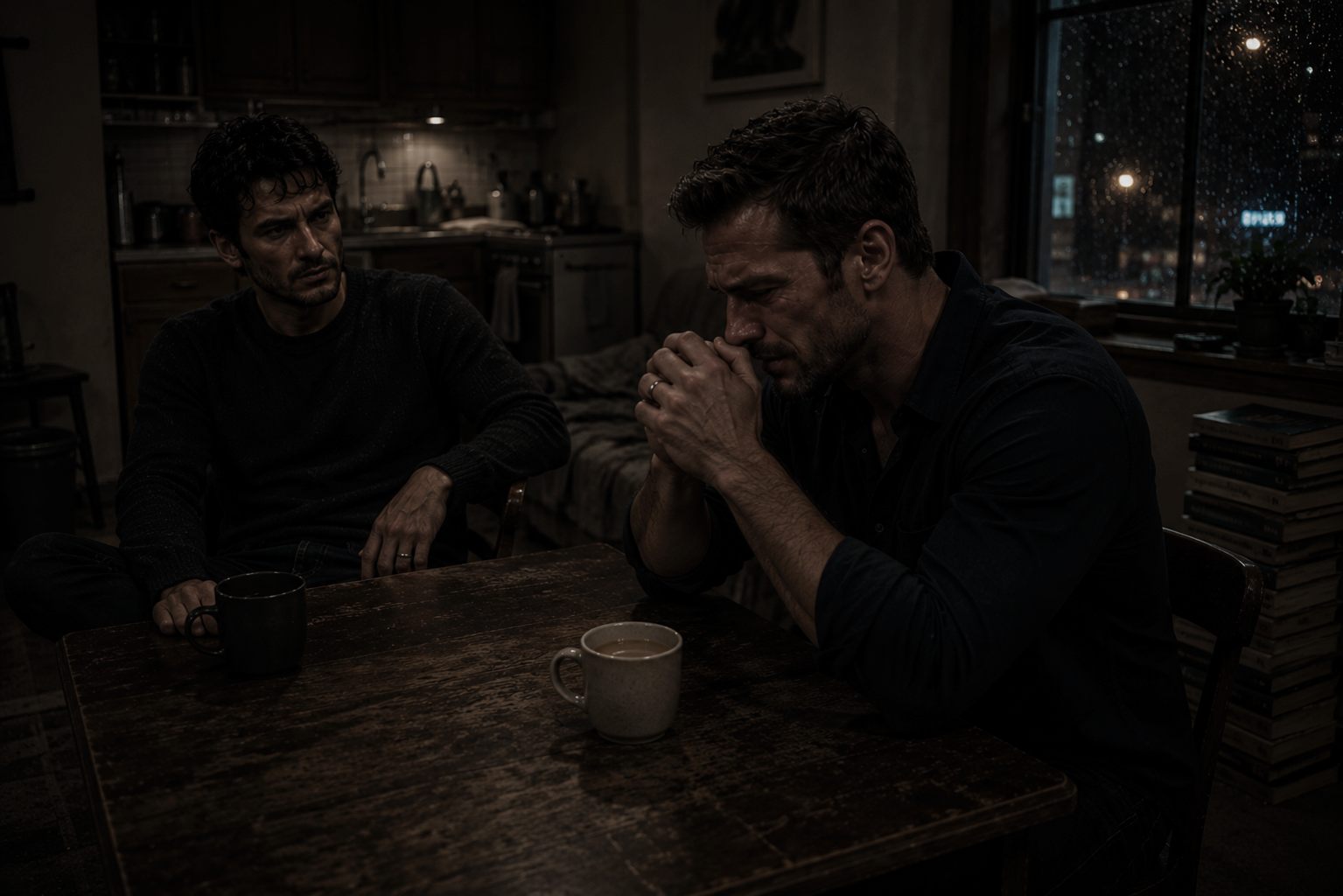
I look at him. At this man who broke me and searched for me and sat in the wreckage for a year. At his hands, still wrapped around his mug, the ring gleaming in the overhead light. At his jaw, the faint scar, the stubble he hasn’t shaved in a few days. At his eyes which are watching me with an expression I don’t have a name for.
“I believe you,” I say.
The words hit him like a blow. He exhales, a long shuddering breath, and his shoulders drop an inch. “You do?”
“I believe that you believe it. And I believe that it happened . . . to the person I used to be.” I set my mug down on the table. The ceramic clicks against the wood, a small, grounding sound. “But it doesn’t feel like my story. Is that strange?”
“No. That’s the fugue.” His voice is steadier now, the voice of someone who’s done his research. “Your mind walled off everything that was too painful to hold. The memories are still there, somewhere. But you can’t access them. For safety, your brain chose to become a different person.
“Michael.”
“Yeah. Michael.” He says the name gently, without judgment, as if he’s acknowledging a necessary fiction. “A psychiatrist I hired, Dr. Okami, she explained it to me. Dissociative fugue is a protective mechanism. A circuit breaker. Your psyche hit something it couldn’t process and it shut down your whole identity to keep you safe.”
“So I’m not crazy.”
“No. You’re not crazy. You’re the sanest person I’ve ever met. You just got hurt so badly your brain had to take the batteries out for a while. I did that to you.”
His voice doesn’t rise, doesn’t shift, but there it is again. The quiet knowing. The way he talks about my mind as if it’s a country he’s been studying for years. Not the clinical language of therapy. He’s not Dr. Okami, whoever she is, but he uses the language of someone who’s been paying very close attention.
I tread water in the silence, unable to look away from his hands around the mug. They’re good hands. Strong. Well kept. The kind of hands that have never done manual labor but have learned, recently, to do something harder than that.
“You said you’ve been sitting outside the cafe for two weeks.”
He nods. “I wanted to approach you the first night. I got out of the car. I walked halfway down the block. And then I stopped.”
“Why?”
“Because I was afraid.” He meets my eyes. “Not of you. Of what I’d done to you. Of seeing you up close and knowing, really knowing, that the person I loved most in the world didn’t remember me. Of making it worse. I’ve spent my whole life making things worse when I meant to make them better.”
“So what changed?”
“Honestly?” A ghost of a smile. “My sister called me a coward. Again. She’s been calling me a coward for a year. But this time she said, ‘You found him. If you don’t go to him, you’re not just a coward. You’re the man who found him and still couldn’t do the right thing.’” He shakes his head. “I couldn’t be that man. Not anymore.”
I lean back in my chair. The legs scrape against the linoleum. Trace’s eyes track the motion, not predatory, not even intentional. His body seems tuned to mine, tracking my movements as you track the weather. He reads my movements like a barometer reads pressure.
“I have questions,” I say.
“Ask me anything.”
“Did I love you?”
The question hangs in the air. Trace’s expression doesn’t change, but something behind his eyes does. A flicker, a crack, a door opening onto a room he’s kept locked for a long time.
“Yes,” he says. “I think you did. I know I didn’t deserve it, but yes. You loved me.”
“How do you know?”
“Because you told me. Every day. Not always with words, with the way you made my coffee, the way you kissed my forehead when I came home stressed, the way you laughed at my stupid jokes even when they weren’t funny.” His voice roughens. “You loved me the way you love everything. Thoroughly. Generously. Holding nothing back. I just didn’t know how to let myself be loved like that.”
I nod slowly. The words don’t unlock anything. The wall is still there, solid and silent, but they feel true. They feel like something I would have done.
“Why did you do it?” I ask. “The cheating. If you loved me, if I loved you, why did you—”
“Because I was terrified.” He doesn’t hesitate. It’s a practiced answer, maybe, a truth he’s said enough times to a therapist that it comes out clean. “Not of you. Of forever. Of being the kind of man someone like you deserves. You were—are—the best person I’ve ever known. And I thought if I broke things early, I’d save you from the slow disappointment of finding out I wasn’t good enough.”
“That doesn’t make sense.”
“I know. It wasn’t logic. It was fear dressed up as logic. It’s the same thing I’ve done my whole life. I sabotage the good things before someone can take them away from me. “I’m not making excuses. I’m trying to give you the truth, and the truth is ugly. I cheated because I was selfish and scared, and I didn’t know how to be happy. I cheated because I’d never had to face a consequence I couldn’t buy my way out of. None of that is your fault. None of it is about you.”
I consider this. The rain is still tapping at the window, a steady, rhythmic sound. The apartment feels very small and very quiet, like the whole world has shrunk down to this table, these two mugs of cold tea, these two matching rings.
“You’re still wearing it,” I say. “The ring.”
“I haven’t taken it off since you put it on my finger.” He looks down at his hand, at the platinum band. “I’m keeping this on until I put yours back on.”
“When did I take mine off?”
“You didn’t. You’re still wearing it.”
I look down at my hand. He’s right. The ring is still there, warm from my skin, the metal worn smooth where my thumb has worried it. “I tried to take it off. Twice. I couldn’t.”
“I know. Dr. Okami said that’s common. The body remembers what the mind can’t.”
“Your Dr. Okami sounds like she knows a lot.”
“She does. She also said something I think about every day.” Trace leans forward slightly, his elbows on the table. “She said that fugue recovery isn’t about finding a magic key. It’s about retracing the wound. The psyche lets memory back in when it feels safe enough to process the trauma. Not just physical safety. Emotional safety. A rewritten narrative. Evidence that you’re not a failure.”
“And you think you can give me that.”
“I don’t know.” His voice is so quiet I have to lean in to hear it. “I don’t know if I can give you anything. I don’t know if you’ll ever remember me, or if you’ll ever want to. All I know is that I’ve spent a year becoming someone who might be worth remembering. And I’m here. And I’m not leaving unless you tell me to leave.”
The word leave does something to my chest. A tightening. A pressure. Like a door slamming shut somewhere deep inside me, or a door opening, I can’t tell which.
“I don’t want you to leave,” I say. The words come out before I’ve decided to say them. “I don’t know why. I don’t know you. But I don’t want you to leave.”
Trace exhales. His shoulders drop another inch. His eyes are wet again, but he’s not crying. He’s holding it together with an effort I can see in the set of his jaw, the tremor in his hands. He looks like a man who’s been drowning for a year and just found a life preserver.
“Okay,” he says. “Okay.”

The clock on the stove reads 11:47.
We’ve been talking for almost three hours. At some point, I reheated the tea. At some point, Trace took off his wet socks and hung them over the radiator, a gesture so mundane and so intimate that I had to look away. Now we’re sitting across from each other at the small table, the mugs empty, the rain still falling outside, and I’m aware of something I wasn’t aware of before.
He’s beautiful.
Not just handsome. Beautiful. There’s a difference, and I’m noticing it now, in the tired hours after midnight when my defenses are down. His jaw is sharp enough to cut glass, but his mouth is soft, the kind of mouth that knows how to smile and has forgotten recently. His shoulders are broad under his sweater, a dark gray cashmere that looks like it cost more than my monthly tips. The collar is slightly stretched, as if someone—as if I—used to tug on it. His hands are still on the table, long fingered and well kept, and I keep catching myself staring at them. At the ring. At the way his thumb keeps moving over the metal in the same rhythm I use.
The pull is physical. I don’t know what else to call it. It’s not attraction in the way I understand attraction. I’ve felt attraction in the last year, mild flickers of interest in strangers at the cafe, easily dismissed and quickly forgotten. This is different. This is gravitational. My body wants to be closer to his body. My hand wants to reach across the table and touch his. My chest wants to press against his chest and feel his heartbeat. It’s absurd. It’s terrifying. I don’t know this man. I don’t know his name except what he’s told me, don’t know his history except what he’s confessed, don’t know if he’s kind or cruel or something in between. But my body is acting as if it knows him. Like it’s been waiting for him. Like the space beside me in bed at three in the morning has been his space all along.
He notices me noticing. Of course he does. He’s been reading my body language all night, tracking my micro-expressions, responding to shifts in my posture before I’m conscious of making them. His eyes meet mine across the table, and something flickers there. Recognition, heat, a wanting so carefully controlled it looks like pain.
“You’re looking at me differently,” he says.
“I’m looking at you the same way I’ve been looking at you.”
“No.” His voice is quiet, rougher than before. “You’re not.”
I should look away. I should deflect, joke, change the subject the way I deflected when Rosa asked if I was okay, the way I deflect whenever someone gets too close to the locked room in my mind. But I’m tired. Three hours of emotional honesty have worn down something in me, and the locked room feels closer now, the door less solid.
“What am I supposed to feel?” I ask. “I don’t know you. I don’t remember you. But my body is doing things I can’t explain. My hands want to touch you. My chest . . .” I stop. Press my palm flat against my sternum. “It’s like there’s a string tied to my ribcage and you’re pulling on it.”
Trace closes his eyes. When he opens them again, the wanting is still there, but it’s been pushed back, held at arm’s length. “I know,” he says. “I know exactly what you’re feeling.”
“Then explain it.”
“It’s the body memory. The somatic stuff. We were together for four years. Your body knows mine the way a musician knows their instrument. It doesn’t matter that your mind can’t access the files. Your body has its own archives.”
“So this is . . . muscle memory.”
“Something like that.” He pauses. “But also more than that. At least for me.”
The word me lands differently than it did an hour ago. It’s weighted now. Personal.
“You feel it too,” I say. It’s not a question.
“Breck.” He says my name, my real name, like it’s a word he’s been holding in his mouth for a year, waiting to let it out. “I spent a year looking for you. I spent two weeks watching you through a cafe window, too scared to approach. I’m sitting in your apartment at midnight, and you’re wearing my ring, and you just told me you don’t want me to leave, and every cell in my body wants to cross this table and . . . ” He stops. Breathes. Presses his palms flat against the wood. “And I’m not going to. Because that’s not why I’m here.”
“Why are you here?”
“To tell you the truth. To give you whatever you need, even if what you need is for me to go away.”
“That’s not what I said.”
“I know.” He meets my eyes. “But I’m trying very hard not to be the man I used to be. The one who took what he wanted and told himself it was okay because he could buy his way out of the consequences. This. You. You are not something I get to take. You’re something I have to earn.”
The word earn hangs in the air. He means it. I can see that he means it. Every line of his body is rigid with restraint, his hands flat on the table, his shoulders squared, his jaw tight. He’s a man holding himself back from something he wants very badly, and the wanting is written all over him, and he’s choosing not to act on it.
“Why?” I ask.
“Because I love you. And I’m learning that loving someone means putting their needs ahead of your own, even when it’s hard. Especially when it’s hard.”
“How do you know what my needs are?”
“I don’t. That’s why I’m not assuming.” He leans back slightly, giving me space. “You tell me. Whatever you need, Breck. Space. Time. For me to leave. For me to stay. It’s your choice.”
I look at him. At this man who broke me and searched for me and spent a year becoming someone who doesn’t take what he wants. At the ring on his finger, the one he hasn’t removed since I put it there. Since the person I used to be put it there. At his hands, still flat on the table, still shaking almost imperceptibly.
The pull is still there. The gravitational want. The string tied to my ribcage. But underneath it, something else is surfacing. Something quieter. Something that feels like safety.
“I need you to stay,” I say. “On the couch. Tonight. I don’t know why. I don’t know anything, apparently. But I don’t want to be alone right now.”
Trace nods slowly. “Okay.”
“And I need you to not . . . ” I gesture vaguely at the space between us. “Whatever this is. I’m not ready. I don’t know what I’m feeling or why I’m feeling it, and I can’t sort that out if you’re . . . if we’re . . .”
“I understand.” His voice is steady. “Nothing happens that you don’t initiate. Nothing.”
“Okay.”
“Okay.”
The word settles between us, small and solid. The rain has softened to a whisper on the window. The apartment is warm now, the radiator hissing softly in the corner. I stand up, my legs stiff from sitting so long, and pull a spare blanket from the closet. It’s thin and worn, the kind of blanket you buy at a drugstore when you’ve just moved into an apartment and don’t own anything. Trace takes it without comment.
“The bathroom’s through there.” I point at the door next to the kitchenette. “There are clean towels in the cabinet. I’ll leave a toothbrush on the sink.”
“You don’t have to—”
“You’ve been crying in the rain for half an hour. Your teeth need brushing.”
A sound escapes him, a half laugh, half exhale, the first thing approaching humor he’s made all night. “You always had a thing for dental hygiene.”
“I don’t remember that.”
“I know.” He stands up, the blanket draped over his arm. He’s taller than I thought, or maybe the apartment is just small. He fills the space in a way that should be oppressive but isn’t. “Goodnight, Breck.”
“Goodnight, Trace.”
He says my name like a question. I say his like an answer. Neither of us comments on it.

I lie in bed and listen to the rain.
The pull-out couch creaks when Trace moves. I hear him settle, the rustle of the thin blanket, the soft thump of a pillow being adjusted. The walls in this apartment are thin. I can hear everything. His breathing. The shift of his weight. The little sigh he makes when he finally stops moving.
I should feel trapped. I should feel afraid. A stranger is sleeping on my couch, a stranger who claims to be my fiancé, who admits to breaking me so badly my mind shut down to protect itself. A stranger who makes my body hum like a tuning fork just by being in the same room.
But I don’t feel trapped. I feel the opposite. I feel like something that’s been dislocated has just clicked back into place.
I touch my ring. Turn it around and around. The motion is automatic, worn smooth by a year of repetition. Trace’s ring is the same band with the same wear on the edges. He said he hadn’t taken it off since I put it there. He said it’s not coming off until he puts mine back on my hand.
My hand. My ring. My fiancé.
The words don’t fit yet. They’re too big, too strange, like clothes that belong to someone else. But they’re not altogether wrong either. They feel like something I might grow into.
On the other side of the thin wall, Trace’s breathing has slowed. He’s asleep or close to it. I wonder what he’s dreaming about. I wonder if he’s dreaming about me, about the me he knew, the Breck Carson who laughed and made coffee and kissed his forehead to cheer him up.
I don’t know that man. I may never know him. The wall in my mind is still there, solid and silent. But it has doors now. I can feel them. And standing on the other side of those doors, patient and waiting, is a stranger who knows my name.
I close my eyes. The rain keeps falling. The ring is warm against my thumb. And for the first time in a year, the gray feeling doesn’t come.

I wake at three in the morning to the sound of rain and the smell of cedar.
At first I think I’m dreaming. The scent is so familiar, so specific, that it pulls me out of sleep like a hand on my shoulder. I lie still in the dark, breathing it in, and my body does something it’s never done before. It relaxes. Completely. Every muscle, every tendon, every knot of tension I’ve been carrying for a year just . . . lets go.
Cedar and bergamot. He smells like a hug from a rich person.
The thought surfaces from nowhere. I don’t know where it came from. It doesn’t feel like a memory, not exactly. It feels like a piece of dialogue from a movie I saw once, a line so familiar I could recite it in my sleep.
The smell means Trace. Trace is in the next room.
I get out of bed. My feet are bare and the floor is cold and I don’t care. I walk to the doorway and look out at the living room. The pullout couch is a dark shape against the wall. Trace is lying on his side, the thin blanket pulled up to his chin, his dark hair mussed against the pillow. The streetlight through the window catches the edge of his jaw, the curve of his shoulder, the hand resting on the pillow next to his face.
The ring glints in the tawny light.
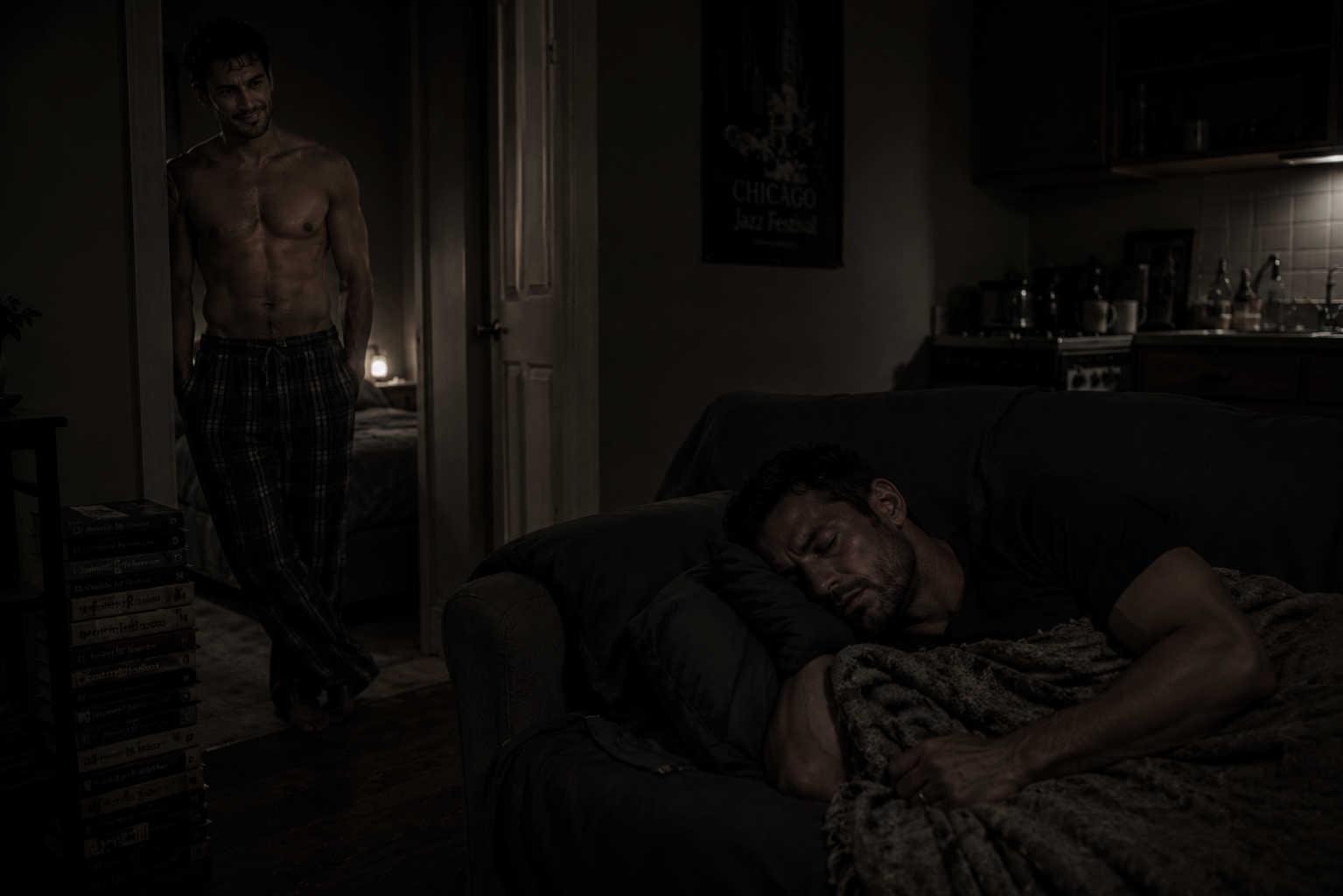
I stand in the doorway and watch him sleep. I don’t know why. I don’t know what I’m looking for. I just know that my body wants to be here, in this doorway, looking at this man, and I’ve learned over the last year to trust my body when my mind doesn’t have answers.
You’re still wearing it.
It’s not coming off until I put yours back on your hand.
I touch my ring. Turn it around. And somewhere deep in my chest, behind the wall where the memories are locked, something shifts. A door opens. Just a crack. Just enough to let a sliver of light through.
I don’t know what it means. I don’t know what comes next.
But I know his name now. I know his face. I know the smell of him and the sound of his breathing and the way his hand looks curled on the pillow.
It’s not everything. But it’s something.
I go back to bed. The rain keeps falling. Trace keeps breathing. And for the first time in a year, I fall asleep without the gray feeling pressing in.

End of Chapter Three