

In the raw, rain-soaked dark of 3 a.m., Breck finally unleashes the fury he’s been holding back. The compounded betrayal of Trace’s infidelity tangled with the echo of a stranger’s suicide in his ear. As Breck grapples with the terrifying uncertainty of what memories are real and which his mind has constructed, they forge a fragile but honest protocol. Trace will tell him the truth, even when it’s ugly. The anger tips into an explosive, teeth-baring kiss against the kitchen counter, then shifts into something quieter—an act of intimate service that isn’t about forgiveness or earning redemption, but about one man meeting the other’s raw, unspoken need in the wreckage of what they used to be.

Breck’s Point of View
The rain woke me at three in the morning. Well, not the rain, exactly. The rain had been falling for two days straight, a steady Chicago drumbeat that had become the background noise of everything. What woke me was the memory of rain. Rain on a different window. Rain on the night I came home early and found the bed I was supposed to be married in occupied by someone else.
I opened my eyes in the dark of my apartment. The ceiling was still there. Trace was still there, asleep on the pull-out couch where he had been sleeping since the all-night confession, since the careful kisses, since the slow, sacred re-consecration of our bodies in my bed. He was on his back, one arm flung above his head, the other hand resting on his chest where his ring caught the faint orange glow of the streetlight through the blinds. His lips were gently parted. He looked younger when he was sleeping. Less like the man who had detonated my life and more like the man I’d said yes to in the rain on the coast.
I hated him for that.
The fury came up from my stomach like sickness. It was hot and sudden and nothing like the clean anger I’d felt before. That anger had been useful, a door swinging open in my mind, a handhold in the fog. This was different. This was the compounded betrayal, the double wound, the thing I hadn’t let myself fully feel because I’d been so busy being grateful he’d found me, so busy being careful with us both.
I sat up. The pull-out couch creaked. Trace’s breathing hitched and then steadied.
I remembered the gunshot.
Then I remembered the silence after the gunshot. The kind of silence that isn’t empty but is full, full of the echo of what just happened, full of the absence where a voice had been. Marcus. His name was Marcus, and he’d called the hotline many times over the months, and I’d talked to him for most of those calls, and on the last one he’d said I’m tired, Breck, I’m so tired of being tired, and I’d said I know, buddy, I know, but you don’t have to do this, you can just stay on the phone with me, just stay on the phone, and then . . . .
The sound. Flat. Percussive. Final. Another sound that meant a body had fallen somewhere in a dark apartment in a city I didn’t know, and I was the only person on earth who heard it happen.
And I’d come home to Trace fucking a stranger in our bed.
The wedding wine we’d bought together. The Domaine Tempier Bandol Rosé, the one we’d joked about hiding from Trace’s father because it wasn’t expensive enough. Trace had opened that bottle for this stranger. I’d seen it on the nightstand. Our wine. Our bed. Our sheets that I had washed three days before, the ones with the thread count Trace had researched obsessively because he wanted everything to be perfect for me.
“Wake up.”
My voice came out steady. That surprised me. Inside, I was a rockslide. Outside, I was the calm I’d trained into myself for thousands of hours on the crisis line. The stillness Trace’s sister had told me scared people who knew me well.
Trace didn’t stir.
I reached over and put my hand on his chest. Not gently, but not violently either. Just pressure. The ring on my finger clicked against the ring on his.
“Trace. Wake up.”
His eyes opened. He was awake immediately, the way people wake when something’s already wrong. He blinked at the ceiling, then at me.
“What time . . .”
“You were in our bed.” My voice was still steady. Still calm. The floor was moving, but I was holding on. “You were in our bed. In our house. With our wedding wine on the nightstand. The wine we picked out for our wedding. While I was on the phone with a man who put a gun in his mouth.”
Trace’s face went slack. It was a particular kind of slack. The look of someone who’s been waiting for a hit and finally feels it land.
“Breck—”
“I listened to him die.” The steadiness cracked. I felt it go, a fault line opening up through my chest. “I heard the gunshot. I heard the silence. I sat there in my chair at the hotline with my hand over my mouth and I couldn’t make a sound because there were other calls coming in and I had to . . . I had to . . .”
I was standing now. I didn’t remember standing.

“And I came home to you. I came home to my fiancé, the person who was supposed to . . . you were supposed to be mt safe place. The one thing. The one goddamn thing in my life that couldn’t hurt me. And you were in our bed with some man I’d never seen before, drinking our wedding wine, and the sheets were . . . I washed those sheets. I washed them. Three days before. Did you know that?”
Trace sat up slowly, like he was moving through water. He didn’t reach for me. He didn’t speak.
“Did you know I washed those sheets?”
“No,” he said. His voice was rough with sleep, but his eyes were clear. Alert. Present in a way that made me angrier, not less angry, because where was that presence when he was bringing a stranger into our home? “I didn’t know.”
“His name was Marcus.” I was pacing now, three steps toward the kitchen, three steps back toward the couch. The apartment was too small for this. There wasn’t enough room for the size of what I was feeling. “He was twenty-three years old. He had a dog, a rescue greyhound named Lucy. He called the hotline when he felt himself slipping. He told me once that I was the only person who’d ever made him feel like his pain was real. And I heard him die, Trace. I heard the gun go off, and I heard the thump of his body hitting the floor, and I heard the dog start barking, and I couldn’t do anything. I couldn’t save him. I couldn’t call anyone. I couldn’t even hang up the phone because protocol says you stay on the line until emergency services arrive, and they took twelve minutes, and the whole time I could hear the dog losing her mind and Marcus wasn’t making any sound at all.”
I stopped pacing. I turned to face him. My hands were shaking.
“And I came home. To you. I needed you more than I have ever needed anyone in my entire life. And you were . . .”
The word caught in my throat. I couldn’t say it. I’d been using clinical language in my head for weeks. The infidelity, the betrayal, the incident. The clinical language had kept it at a distance, kept it manageable. But now it was three in the morning and the rain was hitting the window like tiny fists and the man I loved was looking at me with his whole heart in his face and I couldn’t use the clinical language anymore.
“There you lay, fucking someone else,” I said. “In our bed. While someone died in my ear.”
The sentence landed like a body hitting the floor.
Trace closed his eyes. When he opened them, they were wet.
“I know,” he said.
“That’s it? You know?”
“No, that’s not it. But I don’t know what else to say. There’s nothing I can say that makes it less true.” He swallowed. His hand was still on his chest, ring and all. “You’re right. About all of it. I was in our bed with someone else while you were going through the worst moment of your life. I didn’t know what was happening to you, but that doesn’t matter. I should have been there. I should have been the person you came home to. Instead, I was the reason you couldn’t come home at all.”
I wanted him to fight back. I wanted him to deflect, to make excuses, to give me something I could push against. That was his pattern. Negotiate, explain, minimize. That was the Trace I knew how to be angry with. But this Trace, the one who sat on my pull-out couch at three in the morning and absorbed every word without defending himself, I didn’t know what to do with this Trace.
“You’re not supposed to just take it,” I said. “You’re supposed to . . . you always have a reason. You always have a way to make it make sense.”
“I don’t have a reason. I had reasons before. I told myself stories about cold feet and self-sabotage and being terrified of the forever part. But those were explanations, not reasons. They don’t make it better. They don’t make it less of a choice I made, over and over, right up until the moment you opened the door.”
I sat down on the edge of the coffee table. The pull-out couch was too close to him, and too far away was the kitchen, and the coffee table was exactly in between.
“Did you even think about me?” My voice had gone quiet. The rockslide had passed. Now there was simply the debris. “When you brought him home. When you opened the wine. When you got into our bed. Did you think about me at all?”
Trace was silent for a long moment. I watched him decide between the easy answer and the true one.
“No,” he said. “I didn’t. I was thinking about myself. I was thinking about the wedding and what it meant and whether I was capable of being the person you deserved, and I . . . I let that thinking become a permission structure. I made your absence into a loophole. I turned off the part of myself that knew what I was doing.”
“You turned me off?”
“Yeah,” his voice cracked. “I turned you off.”
The rain had picked up. It was coming down hard now, a real Chicago downpour, the kind that flooded gutters and made the whole city smell like wet pavement and smoke. I listened to it for a while. Trace didn’t move.
“I don’t know how to forgive this,” I said.
“I’m not asking you to.”
“I know. That’s what’s making me so goddamn angry!” I practically screamed at him. I pressed the heels of my hands into my eyes. “You’re doing everything right. You found me. You stayed. You’ve been careful and patient, and you’ve told me the truth about things you could have kept hidden forever. You’re being the man I needed you to be a year ago, Trace. And I’m furious. Because where was this man? Where was he when I was washing our sheets and picking out wedding invitations and laughing with you about mushrooms in the pasta?”
“Mushrooms?”
I dropped my hands. “I remembered the last good night. A few days ago. We were addressing wedding invitations. And we were sitting on the floor and I laughed at you about something and you threw a mushroom at my head.”
Trace’s expression shifted into something so tender it hurt to look at. “I remember you telling me.”
“I don’t know if I’m remembering it right. I don’t know if I’m remembering any of it right. The mushrooms, the bathroom sink, the hospital lights from the surgery. I can’t tell what’s real and what’s my brain trying to fill in the gaps with things I want to be true.” My voice was rising again. “I don’t know if I’m remembering us or remembering what you’ve told me about us. And you . . . you know everything. You know the whole story. You caused this. You’re the reason my brain is so fucked up. And I have to just trust that what you’re telling me is real. I have to trust the man who lied to me for our entire relationship about who he was. I have to trust the man who cheated on me twice. And I’m doing it. I’m doing it. Because what else am I supposed to do?”
Trace sat forward. The blanket pooled around his waist. He was wearing an old t-shirt of mine. A soft gray cotton with a faded Portland State logo and the sight of it made my chest ache in a way that had nothing to do with anger.
“Can I say something?” he asked.
“You’re going to anyway.”
“I was going to ask permission first.”
That almost made me laugh. Almost. “Fine. Say something.”
He took a breath. When he spoke, his voice was different. More deliberate and less conversational. It took me a moment to recognize it as rehearsed, and another moment to realize that the rehearsal wasn’t a performance. It was a scaffold. Someone had taught him to build this.
“I betrayed you,” he said. “Not only with the cheating. I betrayed you every day I didn’t tell you the truth about who I was. I let you love a version of me that didn’t include the worst parts. That was strategic. I wanted to be the man you thought I was, and I thought if I pretended long enough, I would become him. I didn’t. I became someone who could look at the ring on his finger, think about the man who put it there, and still make the choice I made. That’s not a mistake. It’s not a moment of weakness. It’s a pattern. I have a pattern of sabotaging the things I love when they get too real, and I’ve never done the work to break it.”
He paused. His hand moved to his jaw. A gesture I’d catalogued weeks ago, a tell I didn’t know I remembered. Then he dropped it.
“I’m doing the work now. Sloane, my sister, she’s been pushing me. I’m in therapy. I’m trying to learn how to be honest when honesty costs me something. I’m trying to learn how to sit with discomfort instead of buying my way out of it.” He met my eyes. “I’m not asking for forgiveness, Breck. I’m not asking you to trust me. I’m telling you what I’m doing so you can decide if it matters.”
The rain filled the silence.
“Who taught you to say that?” I asked.
“My therapist. Sloane coached me on the delivery.” A ghost of his old smirk, there and gone. “She said I needed to stop improvising. I’m bad at improvising when I’m scared.”
“You’re bad at improvising always.”
“Fair.”
I stood up. The kitchen was three steps away and I needed water or coffee or something to do with my hands that wasn’t hitting him or holding him. I couldn’t decide which impulse was stronger. I filled a glass from the tap and drank it standing at the counter, my back to the room.
“I’m still angry,” I said.
“I know.”
“I’m going to be angry for a while.”
“I know that, too.”
“And I don’t know what’s real. Some of what I remember . . . I don’t know if it happened or if I made it up because I want it to have happened. I can’t tell if I’m remembering us or remembering something you’ve told me about us. It scares me.”
I turned around. Trace was still on the couch, watching me with an expression I couldn’t read. Grief and hope tangled together, the same look I’d caught on his face a dozen times since he’d found me.
“I need you to tell me when I get something wrong,” I said. “When I remember something that didn’t happen, or I’m putting pieces together wrong, I need you to tell me.”
“Okay.”
“And when you don’t know? When you can’t tell if something was real or not? I need you to tell me that too.”
Trace nodded slowly. “I can do that.”
“I need to be able to trust what you say. Even when it’s not what I want to hear. Especially when it’s not what you think I want to hear.”
“I understand.”
“We had a fight once,” I said. “About dishes. You did something with the sponge that drove me insane.”
Trace’s mouth twitched. “We had approximately eight thousand fights about dishes. But the sponge thing . . . I don’t remember that one. It might be a composite.”
“So tell me that. Tell me when you don’t remember too.”
“Then I’m telling you now. I don’t remember the sponge. But the dishes were a whole thing. You thought I was passive aggressive about the way I loaded the dishwasher. You were right.”
I finished the water and set the glass in the sink. My hands had stopped shaking.
“If I ask you something about the past and you don’t want to answer because the answer will hurt me—”
“Ask anyway,” Trace said. “I’ll answer anyway. That’s the deal.”
“That’s the deal.” I leaned against the counter. The anger was still there, but it had settled into something quieter, a low-grade fever instead of a flash fire. “Okay. I’m still furious. I don’t forgive you. But I believe you when you say you’re trying.”
“That’s more than I deserve.”
“Probably.”
Trace winced, but it was a clean wince with no deflection, no charm. Just a man taking a hit he’d earned.
“I need to talk to my family,” I said. “I need to call my mom. I need to hear her voice. I’ve been . . . I don’t know how long it’s been since I talked to her. I don’t remember the last time.”
“I can make that happen. Whenever you’re ready.”
“Tomorrow. Or today. Later today. When it’s not three in the morning.”
“Okay.”
Trace started to lie back down and stopped. “Breck?”
“What?”
“Thank you. For waking me up. For telling me all of it.”
I didn’t say you’re welcome. I said nothing. I walked back to my bed and got under the covers and lay there in the dark listening to the rain and the sound of Trace’s breathing evening out on the pull-out couch. The ring on my finger was warm from my thumb, from the constant touching I couldn’t seem to stop, and I turned it around and around in the dark and thought about Marcus and Lucy the greyhound and the wedding wine and the sound of a gunshot that would never, ever leave me.
I didn’t sleep.
But I didn’t leave either.

Trace’s Point of View
She’d said, When he comes at you, and he will come at you, don’t defend. Don’t explain. Don’t negotiate. Just take it. You’ve been dodging this hit for a year. Let it land.
Sloane had been right. She was always right. It was infuriating.
I lay on the pull-out couch in the gray pre-dawn light, still feeling the aftershock of Breck’s fury vibrating in my chest. The things he’d said—you were fucking someone else while someone died in my ear—those words were going to live in me for the rest of my life. I deserved them. I’d earned every syllable. But knowing that didn’t make them hurt less, and there was a part of me—the old part, the part I was trying to starve to death—that wanted to argue. I didn’t know about the caller. I didn’t know what you were going through. It wasn’t calculated, it wasn’t malicious, it was just stupid and selfish and scared.
But that was the old Trace talking. The Trace who could turn any confession into a negotiation. Who could apologize for cheating while somehow making the apology about his own pain. Who’d spent thirty years learning that charm and money could buy his way out of anything, including accountability.
That Trace was the reason Breck had walked out into a rainstorm with no memory and no wallet and no idea who he was.
That Trace needed to die.
I sat up slowly. My back ached. The pull-out couch was a medieval torture device disguised as furniture, and my eyes felt like they’d been packed in sand. I’d slept maybe an hour after Breck went back to bed. Every time I closed my eyes, I saw his face in the kitchen doorway, the way he’d said I heard him die with that terrible, steady calm, the stillness Sloane had warned me about.
When Breck goes still, that’s when you should be scared. That’s not peace. That’s the lid blowing off.
I pulled on my jeans and padded to the kitchen. The espresso machine Breck had bought at a thrift store for thirty dollars sat on the counter next to a bag of beans from Café Esperanza. I’d been practicing with it badly, but practicing. The first time I had tried to make him coffee, I’d produced something that tasted like burnt rubber and shame. He’d drunk it anyway. That was Breck. He’d always drunk the terrible coffee I made him because he knew I was trying.
I measured the grounds carefully this time. Tamped them the way Rosa had shown me when she’d caught me struggling with the machine at the café. You’re overthinking it, she’d said. Coffee doesn’t need you to be perfect. It just needs you to pay attention.
Rosa. She’d hated me on sight. I couldn’t blame her. She’d found Breck when he was nobody, with no name, no past, no tether to the world. She had watched him build himself back from nothing. Then I’d shown up with my expensive watch and my desperate eyes and my story about how I’d shattered him, and she’d looked at me like I was a cockroach she was deciding whether to crush.
I don’t know you, but I know him, she’d said. He came in here a year ago with nothing. No wallet, no name, no past. He built himself back from air. You don’t get to undo that because you’re sorry.
I’d said You’re right. I don’t get to. And I’d meant it.
She’d studied me for a long moment, looking for the tell, looking for the charm, looking for the deflection. Whatever she was looking for, she didn’t find it. Or she found something else. She’d stepped aside. But she was still watching. I knew she was still watching.
The espresso machine hissed. The shot that came out was darker than my previous attempts, with a thin layer of crema on top. Not perfect. But better.
I heard Breck stirring in the bedroom. The floorboards creaked, then the bathroom door closed, then the sound of water running. By the time he emerged with his hair damp, his eyes bruised with exhaustion, wearing the same hoodie he’d been living in for days, I had two cups ready.
He looked at the cup. Then at me.
“You made espresso.”
“I’m learning.”
“Rosa teach you?”
“She took pity on me. Said I was embarrassing the café.”
Breck’s mouth did something that wasn’t quite a smile. “She’s protective.”
“She should be.”
He took the cup and drank. Didn’t compliment the coffee. Didn’t complain either. Just drank it standing at the counter, looking out the small window at the rain.
The silence between us wasn’t comfortable, but it wasn’t hostile either. It was the silence of two people who’d said the worst things they needed to say and were still standing in the same room.
I cleared my throat. “There’s something I should tell you. About earlier.”
Breck turned. “What?”
“When you were . . . when you were saying all of it. The wine, the sheets, Marcus. I started to deflect.” I made myself say it plainly with no softening. “In my head. I started to tell myself that I didn’t know about the caller, that it wasn’t as calculated as you made it sound. That was an old habit. That was me trying to make myself feel less like a monster. And I caught it, and I stopped it. But I wanted you to know that it happened. Because the deal is I tell you the truth, even about the things that make me look worse.”
Breck studied me over the rim of his cup. The look was unreadable. Not the exploding stillness, but something adjacent to it. Assessment, maybe.
“You could have kept that to yourself.”
“Yeah. But that’s the point. I’m trying not to do that anymore.”
“Okay.” He took another sip of espresso. “This is actually drinkable.”
“High praise.”
“Don’t get used to it.”

The day passed in fragments.
Breck called in sick to the café. Rosa texted him back immediately. I saw the notification light up his phone, a string of concerned emojis, and he typed something reassuring and put the phone face down on the counter. We moved around each other in the small apartment like two planets in unstable orbit, sometimes pulling close, sometimes swinging wide. He made toast and ate it standing up. I did the dishes from the night before. He sat on the pull-out couch and stared at the window. I pretended to read a book and actually watched him out of the corner of my eye.
Around noon, the silence broke.
“What was his name?”
I looked up. Breck was still on the couch, knees drawn up, hood pulled over his head. He looked both twenty years old and a hundred years old at the same time.
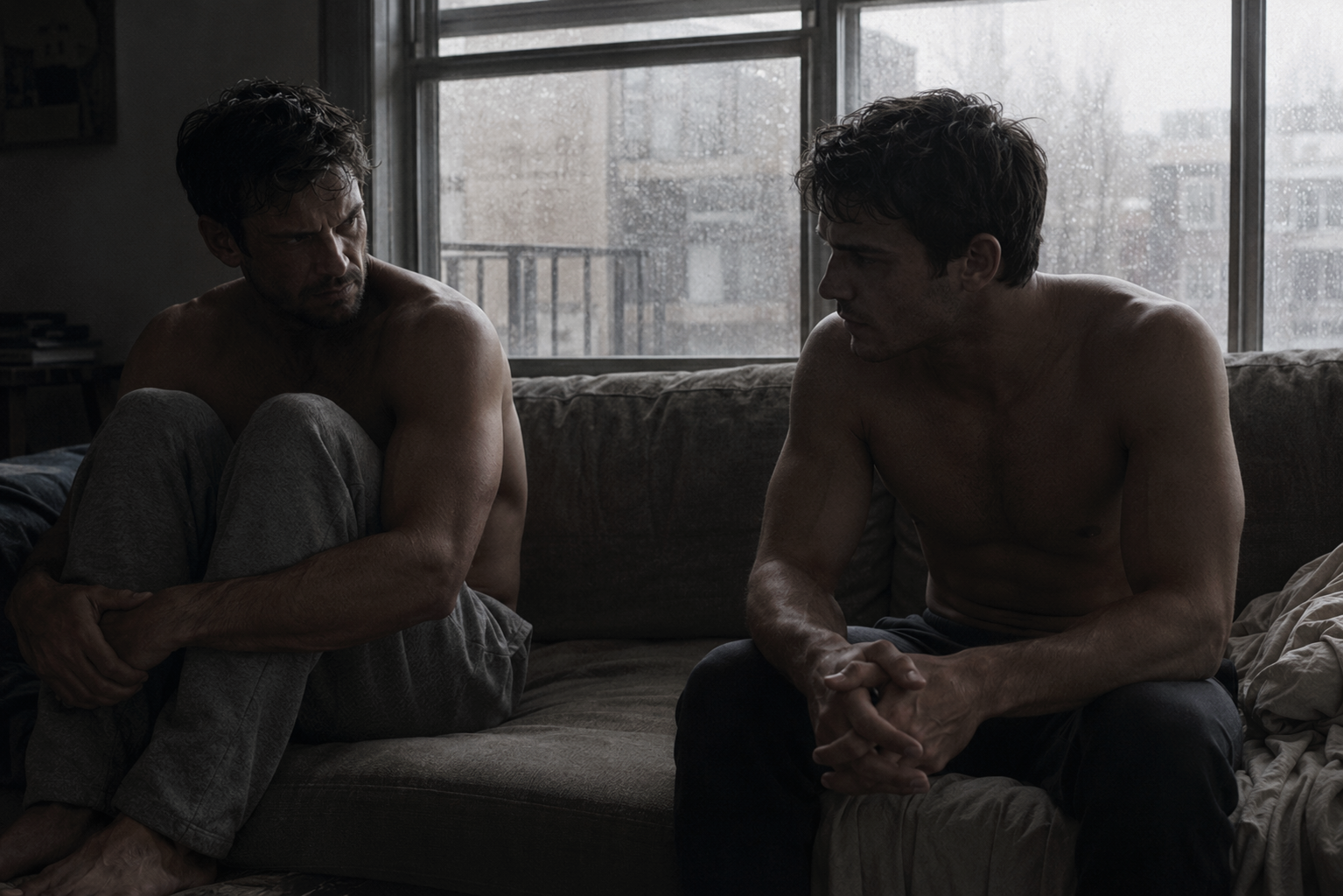
“The man you were with. What was his name?”
“Rob.” I closed the book. No point pretending. “He was a trainer at my gym. It wasn’t . . . it wasn’t an affair. It was a one-night thing. He didn’t know about you. I told him I was single.”
“You brought a stranger into our bed.”
“I know.”
“You put him in the sheets I washed. You gave him our wine. Our wedding wine”
“I know.”
Breck’s jaw tightened. “I keep thinking about the logistics. Did you take off your ring? Or did you leave it on? Did he see it on the nightstand? Did you even think to hide it?”
I made myself answer. “I took it off. Put it in the drawer. I didn’t want to see it while I was . . . I didn’t want it looking at me.”
“While you were fucking him.”
“Yeah.”
Breck nodded slowly. He didn’t look at me. “At least you had the decency to feel guilty while you were doing it.”
“That’s not decency. That’s cowardice. I felt guilty and I did it anyway.”
He was quiet for a moment. “I keep trying to picture it. The scene. You and him in our bed. The wine. The ring in the drawer. I keep trying to make it make sense. But it doesn’t. It’s like I’m looking at a photograph of someone else’s life.”
“It was my life. My poor choices. You didn’t do anything wrong.”
“I know I didn’t do anything wrong.” His voice sharpened. “I know that intellectually. But there’s this part of my brain that keeps asking what I could have done differently. If I’d been home more. If I’d been more . . . I don’t know. Available. If I’d paid more attention to the cracks. You wouldn’t have needed a Rob.”
“There weren’t cracks. Not the kind you could see. I was very good at hiding them.”
“You hid them from me for four years.”
“I hid them from myself for longer than that.”
Breck stood up. He crossed to the kitchen, then stopped, then turned around like he’d forgotten why he’d gotten up. His hands flexed at his sides.
“I want to hit you,” he said. “I’ve never wanted to hit anyone in my life. I talk people out of hurting themselves for a living. And right now I want to punch you in the face.”
“Okay.”
“Don’t say okay like . . .” He made a sound of frustration. “I’m not going to do it. I’m telling you I want to.”
“I believe you.”
“Stop being so goddamn understanding. It’s making it worse.”
I almost smiled. Caught it. “What do you want me to be?”
“I don’t know. Defensive. Angry. Something I can push against.” He raked his hands through his hair. “You’re doing everything right. You’re saying all the right things. And I hate it. Because it means you could have been this person the whole time. You just chose not to be. Because I can’t yell and scream and be angry at a man who’s being calm and reasonable. I don’t get to be mad. I don’t get to vent. You stole that from me, too.”
The words landed exactly where he meant them to.
I didn’t have a response to that. There wasn’t one.
“I’m going for a walk,” Breck said.
“It’s raining.”
“I know.”
He grabbed his jacket from the hook by the door, the same jacket he’d probably been wearing the night he disappeared, worn canvas with a tear in the left pocket, and he was gone before I could say anything else. The door snapped shut. His footsteps faded down the hallway.
I stood in the empty apartment and listened to the rain.
I’d spent a year not knowing where he was. A year of private investigators and hospital calls and sleepless nights staring at the ceiling of a townhouse that felt like a mausoleum. A year of wearing a ring that had become an accusation. And now he was here, and he was furious, and he’d walked out into the rain again, and every instinct I had was screaming at me to follow him, to find him, to fix it.
But I couldn’t fix it. That was the whole point. That was what Sloane had been trying to beat into my head for months. You can’t buy your way out of this. You can’t charm your way out of this. You can’t manage the narrative. You have to let him be angry. You have to let him walk away. You have to trust that he’ll come back, and if he doesn’t, you have to live with that too.
I sat down on the pull-out couch and put my head in my hands.
The ring was cold against my forehead.

He came back an hour later, soaked and shivering and smelling like wet wool and winter.
I didn’t say I was worried. I didn’t say Thank God you’re okay. I just handed him a towel and a dry sweatshirt and headed back to the kitchen to make more espresso.
“I walked to the river,” he said from behind me. “Didn’t jump in, in case you were wondering.”
“I wasn’t.”
“Liar.”
“That one was a lie, yeah.”
I heard him towel drying his hair. When I turned around, he was wearing the dry sweatshirt, this one with a hole in the cuff, and his face was flushed from the cold.
“I thought about calling my mom,” he said. “While I was walking. I had my phone. I could have done it. But I . . .” He stopped. Swallowed. “I don’t know what to say to her. I don’t know what I remember. I don’t know if the memories I have of her are real or if I’m just constructing a mother from what a mother should be.”
“She’s real. Elaine. She teaches elementary school. She’s been retired for two years. She called you every Sunday. When you went missing, she didn’t sleep for a week. She and your dad, David, they drove around Chicago every night looking for you. They put up flyers.”
Breck’s face went through something complicated. “Flyers.”
“With your picture. And my phone number. David said if you saw your own face somewhere, it might trigger something.”
“The flyer had my picture and your phone number?”
“Yeah.”
“So you were . . . the whole time I was gone, you were the person people called?”
“I was the person who needed to be called. I was the reason you were gone.” I handed him a fresh cup of espresso. “Your family knows, Breck. About the cheating. About what I did. I told them. It was the second-worst conversation of my life. The worst was telling you.”
He took the cup. His fingers were still cold. “How did they react?”
“Your mom cried. Your dad didn’t say anything for a long time, and then he said, ‘You find him. You find him and you bring him home, and then we’ll talk about the rest.’ Your sister told me if you were dead she’d make sure I never forgot it.”
“Avery.” His voice cracked on the name. “She always said you were too smooth. She didn’t trust you.”
“She was right.”
“She’s going to be insufferable about that.”
I almost laughed. It caught in my throat. “Yeah. She probably will be.”
Breck set the espresso down on the counter. He was standing close to me. Closer than he had been since the kiss on the couch, the desperate grinding, the just this for now. Close enough that I could smell the rain in his hair and the faint spearmint of the gum he chewed constantly on shift and the clean, simple scent of his skin.
“I’m still angry,” he said.
“I know.”
“And I’m still not sure I can forgive you.”
“I know.”
“But I’m still here.” He reached up and put his hand on my chest, palm flat over my heart, the same way he’d done when I was inside him and he wanted me to feel his heartbeat. “I’m still here, and I don’t want to leave. I don’t know if that’s strength or weakness. I don’t know if I’m staying because I love you or because I’m too tired to go. But I’m still here.”
I covered his hand with mine. The rings clicked together.
“Whatever the reason,” I said, “I’ll take it.”
“It’s not forgiveness.”
“I’m not asking for forgiveness.”
“Then what are you asking for?”
The question hung between us. I thought about Sloane, about the therapy sessions, about the structured apology I’d rehearsed until it stopped feeling like a script and started feeling like the truth.
“I’m not asking for anything,” I said. “I’m offering. Whatever you need. Whatever pace you need to set. Whatever version of me you can stand to be around. I’m here for it. No conditions.”
Breck’s hand was still on my chest. The warmth of it seeped through my shirt and into my skin.
“I need you to touch me,” he said. “And I need it to be about me. Not about earning forgiveness or proving something. Just about what I need.”
“Okay.”
“And I need you to know that it doesn’t fix anything. It’s not a reward for good behavior. It’s just my body needing something my brain can’t sort out yet.”
“I understand.”
“Do you?” His eyes were very blue in the gray light. “Because I need you to really understand that. I need you to know that me wanting you doesn’t mean I’m okay. It doesn’t mean we’re okay.”
“I know we’re not okay.” I turned my hand over and let his fingers lace through mine. “I know this is . . . this is you reaching for something physical because the emotional is too much. I know it’s not a fix. I know we have a long way to go.” I brought his hand up to my mouth and kissed his knuckles. “And I’m still here. Whatever you need.”
Something shifted in his face. The anger was still there, I could see it banked behind his eyes, but something else was there too. Something older. Something that had survived the fugue and the rain and the year of not knowing his own name.
“Then touch me,” he said.
I kissed him.
Not the desperate, frantic kiss of the pull-out couch, the clothes grinding and the breathless just this for now. Not the slow, sacred kiss of the scar tour, the sacred rediscovery of our bodies in his bed. This was something else. Something harder. A fight kiss, if that was a thing. A kiss that had teeth in it.
He kissed me back in the same way. His hands came up to my shoulders and pushed, and I let myself be pushed, my back hitting the kitchen counter with a thud that rattled the espresso cups. His mouth was hot and demanding, his body pinning me against the laminate edge, and the anger in him was translating into pressure, into force, into something his body knew how to do with this much adrenaline.
“I want to fuck you,” he said against my mouth. “But I also still want to hit you, and I don’t know which one I mean.”
“Both. Probably.”
“Don’t therapize me.”
“I’m not. I’m agreeing with you.”
He pulled back enough to look at me. His eyes were wide and his breath was coming fast. “You’d let me. If I wanted to hit you. You’d let me do it.”
“Yeah.”
“That’s not healthy.”
“Probably not. But it’s honest.”
He made a sound that was somewhere between a laugh and a growl. “You’re impossible.”
“I know.”
He kissed me again. It was less violent this time. Still hard, still hungry, but the edge had shifted from I want to hurt you to I want to feel something that isn’t pain. His hands were in my hair, then on my neck, then sliding down my chest to the hem of my shirt. He pulled it up, and I raised my arms, and the shirt came off and landed somewhere on the floor.
His mouth found my collarbone. My jaw. The scar on my jaw that he’d touched with such tenderness after the first time we’d made love in his bed, the scar that was just a scar now. A boy falling off a fence, a man trying to be honest. He bit it. Not hard enough to break skin, but hard enough that I felt it, hard enough that it would leave a mark.
“You kissed him here,” Breck said, his voice muffled against my throat. “The other man. Rob. You let him kiss your scar.”
“I don’t remember.”
“You don’t remember if he did, or you don’t remember letting him?”
“I don’t remember him kissing it. But he might have. I wasn’t paying attention to . . . I wasn’t present. I was somewhere else in my head the whole time.”
Breck pulled back. His face was flushed, his lips red. “You dissociated while you were fucking him?”
It wasn’t a question. I nodded anyway.
“That’s . . .” He stopped. Shook his head. “That’s not better. That’s almost worse.”
“I know. I know it is.”
He pressed his forehead against my chest. His breath was on my skin, hot and uneven. “I don’t know how to be angry at someone who was hurting themselves as much as they were hurting me.”
“I hurt you worse.”
“That’s not the point.”
“It’s a little bit the point.”
He lifted his head. “Shut up. Stop being right about things.”
“Okay.”
His hands shifted to my belt. “I need this. I need to feel something that makes sense. And you . . .” He unbuckled the belt, pulled it free, dropped it on the floor. “You make sense. The way we fit. That hasn’t changed. Even with everything else. That’s still—”
“The same,” I said. “Yeah. It’s still the same.”
He undid the button on my jeans. The zipper. I was already hard. I had been since the moment his mouth hit my throat, and when his hand closed around me through the fabric of my boxer-briefs I made a sound I didn’t recognize.
“I need you to do something for me,” he said.
“Anything.”
“I need you on your knees.”
The words coursed through me like a current. I didn’t ask if he was sure. I didn’t check in. I just dropped, the kitchen floor cold against my knees through the thin layer of jeans still bunched around my thighs.
He looked down at me. His chest was rising and falling fast, his hands braced on the counter on either side of my head. “This isn’t—it’s not a punishment. It’s not me trying to put you in your place. I need you to understand that.”
“I understand.”
“I’m not trying to degrade you. I’m not trying to . . . I just need—”
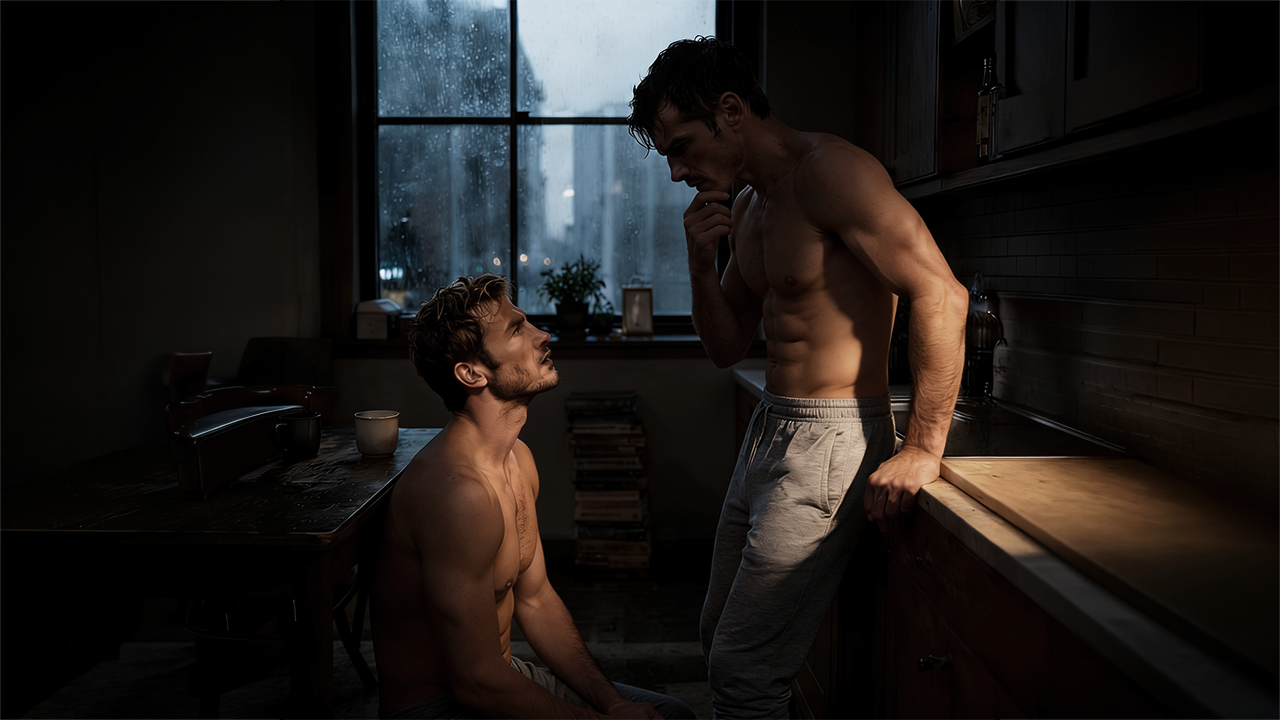
“I know what you need.” I put my hands on his hips, thumbs hooking into the waistband of his sweatpants. “You need to not think for a while. You need someone else to take care of it. Take care of you.”
His eyes closed. “Yeah.”
“I can do that.” I pulled the sweatpants down, slow enough that he could stop me if he wanted to. He didn’t. “Is this what you need?”
“Yes.”
He was hard already too. The sight of him—the flushed head, the slight curve, the way his stomach tensed as I leaned in—sent a jolt of heat straight through me. I’d done this a hundred times. A thousand. I knew his body the way I knew my own. I knew the sounds he made, the way his breath caught, the way his hand always came to rest on the back of my head. But this was different. This wasn’t foreplay or routine or the easy intimacy of two people who knew precisely how to get each other off. This was something he was asking for because he couldn’t ask for the bigger thing, and my job was to give it to him without making it mean anything he didn’t want it to mean.
I kissed the inside of his thigh. The crease where his leg met his hip. The base of his cock. He shuddered, his hand finding the back of my head, not pushing, just resting there.
“I’m still angry,” he said.
“I know.”
“This doesn’t change that.”
“I know that, too.”
Then I took him in my mouth, and he stopped talking.
I went slow. That was what he needed. Not the frantic, desperate rhythm of the pull-out couch, not the raw survival sex of the night the car backfired and the gunshot memory slammed back. Breck needed service. He needed care. He needed me on my knees on a cold kitchen floor, using my mouth to tell him something my words couldn’t.
You’re allowed to need things.
You’re allowed to be angry and still want this.
You’re allowed to take without giving back.
You’re allowed to be the one who gets held.
I worked him with my tongue, with my lips, with the steady pressure I knew he liked. His hand tightened on the back of my head. His hips moved in small, involuntary thrusts that he was trying to control and couldn’t. The sounds he made—the caught breaths, the low moans, the way my name came out strangled and broken—those sounds were a language I’d missed for a year. A language I thought I might never hear again.
“Trace,” his voice was rough. “Trace, I’m—”
I pulled back just enough to speak. “Let go. I’ve got you.”
He came with a sound that was almost a sob, his whole body going taut, his hand fisting in my hair. I stayed with him through it, swallowing everything his body unleashed, my hands steady on his hips, holding him up when his knees buckled.
When it was over, I stayed where I was. Let him lean against the counter. Let him breathe.
After a long moment, he reached down and pulled me up. His hands cupped my face, and he kissed me. Soft this time. So soft it ached.
“I’m still angry,” he said against my mouth.
“I know.”
“But I’m still here.” He kissed me again. “And I’m glad you’re here too.”
“Me too.”
He looked down at the obvious evidence of my own arousal, still straining against my boxers. “We should—”
“Not right now.” I pulled my jeans up awkwardly, leaving the button undone. “This wasn’t about me.”
“It can be. If you want.”
“Later. Maybe. Right now, I just want to . . . can I hold you? Is that okay?”
He nodded. I pulled him into my arms, right there in the kitchen, my back still against the counter, his face buried in my neck. He was shaking a little. I couldn’t tell if it was the aftermath of the orgasm or the aftermath of everything else.
“Thank you,” he said, muffled against my skin. “For not making it weird.”
“I tried very hard not to make it weird.”
“You succeeded.”
“Thank God.”
He laughed and it was a real laugh, surprised and startled, like he’d forgotten he could make that sound. “We’re a mess.”
“The biggest mess.”
“The absolute worst.”
“World historic levels of mess.”
He pulled back, still smiling a little, still with the banked anger behind his eyes. “I need to call my mom.”
“Okay.”
“Will you . . . will you be there? When I do it?”
“If you want me there.”
“I don’t know if I want you there. But I think I need you there.”
“Then I’ll be there.”
He nodded. Wiped his eyes with the back of his hand. When had he started crying? I hadn’t noticed. “Okay. Tomorrow. Or maybe the day after. I need to . . . I don’t know what I’m going to say to her.”
“You’ll figure it out. You’re good at that. The talking thing.”
“I’m good at talking other people through things. Not so good at being the one who needs talking through.”
“That’s okay. You’re learning.”
He looked at me for a long moment. “So are you.”
“Yeah.”
He stepped back, pulling up his sweatpants, running a hand through his disheveled hair. “I’m going to take a shower. A hot one. And then I’m going to sleep for twelve hours.”
“That sounds like a good plan.”
“You should sleep too. You look terrible.”
“Thanks.”
“You’re welcome.” He paused at the bathroom door. “Trace?”
“Yeah?”
“That thing you said. About the deal. About telling me when I get things wrong.”
“Yeah?”
“It helps. Knowing you’ll tell me the truth even when it’s ugly.”
“It’s the least I can do.”
“No,” he said. “The least you could do is nothing. This is more. I don’t know if it’s enough, but it’s more than nothing.” He opened the bathroom door. “I’ll see you in the morning.”
He closed the door behind him. A moment later, I heard the water start.
I stood in the kitchen shirtless, jeans undone, the taste of him still on my tongue, and listened to the rain and the shower and the sounds of the man I loved starting to put himself back together.
I didn’t know if we’d make it. I didn’t know if the forgiveness would ever come. But he was still here. He was still fighting. And for now, that was more than I’d ever thought I’d get.

End of Chapter Seven.