

When Alex Bélanger’s financier father dies in disgrace, the family empire collapses, leaving Alex with nothing but a sister to protect and a debt to organized crime no bank will solve. Desperate and out of options, he turns to the Chalice, an elite underground institution that auctions companionship to the world’s most powerful buyers. But as he subjects himself to the Chalice’s intimate and exacting assessment process, Alex discovers that the greatest revelation isn’t the price he will command. It’s the unnerving, undeniable truth about what his own body and soul are willing to surrender.

The story to date in EPUB format can be downloaded HERE if you prefer to read longer material on your Kindle or other book reading device.

Alex’s Point of View
No matter which way I turned, the pull-out couch had a bar that pressed into the small of my back. By the third night, I had learned to sleep around it, positioning my body at a slight diagonal with my feet hanging off the edge where the mattress was thinnest. Gabriel’s apartment smelled of laundry detergent and the rosemary plant on his kitchen windowsill. His cat, a gray tabby named Proust who had regarded me with suspicion the first two days, had taken to sleeping on my chest around four in the morning.
I didn’t suggest the bedroom. He didn’t offer. The arrangement was clear without being discussed. I was here. I was safe. And the couch was mine for as long as I needed it. Gabriel’s steady presence in the adjoining room was the first thing that had felt solid since the arrest.
On the second morning, the news broke. Gabriel had gone to the bakery on Mont-Royal and come back with croissants still warm in the paper bag. He set them on the kitchen counter, then paused, looking at his phone.
“Alex.”
I was at his laptop, working through the list of my father’s contacts, crossing off names as each call died unanswered. The morning light gave his figure a warm glow in the kitchen. I smelled the butter in the croissants before I registered his tone.
“What?”
He held out the phone. I didn’t take it. I read the headline from where I sat, my hands still on the keyboard. Philippe Bélanger Dies in Custody, Aged 59. Below the fold, heart attack in smaller type, as though the cause were a footnote to the main event.
I noticed Proust winding between my ankles under the table. The coffee I had made an hour earlier that had gone cold in the mug beside the laptop. I could see a faint ring of residue on the ceramic where the liquid had settled. I thought I’ll have to clean that before the coffee stains.

“There will be an inquest,” Gabriel said. He’d put the phone down on the counter, screen up, with the headline still visible. “It’ll delay things. The arrangements.”
The arrangements. My father’s body, somewhere in a coroner’s facility, waiting for the state to determine what was already a public fact. The funeral couldn’t happen until the inquest released him. Weeks, maybe. Margaux would have to fly home, sit through it. Fly back. She would call me when she saw the news. I needed to have something to tell her that wasn’t the truth about why he’d been in custody at all.
“Heart attack,” I said.
Gabriel didn’t answer. He opened the paper bag, took out a croissant, and put it on a plate in front of me. He didn’t say eat or I’m sorry or are you okay. He just set the plate down, poured fresh coffee into my cold mug, and moved to the window to open it for Proust, who was scratching at the screen.
That was Gabriel. He understood when presence was enough and when words would make things worse. I’d forgotten what that felt like until I was back in it.

The week organized itself around small rituals. I woke at six-thirty because I’d always woken at six-thirty. Gabriel’s apartment was quiet, the light still gray, Proust curled in the armchair by the bookshelf. I made coffee without asking. Gabriel took it black with a half teaspoon of sugar, something I had learned on the second morning and applied every morning since. I left his cup outside his bedroom door at seven-fifteen. By seven-thirty the cup was empty and returned to the kitchen. We didn’t discuss this either.
The laptop was Gabriel’s old one, a MacBook with a sticky space bar and a battery that gave out after three hours unplugged. I used it to call the lawyer first, then the family accountant, then the political contacts my father had cultivated over three decades. Most didn’t answer. Some answered and then remembered they had another call. My notepad, a spiral-bound thing Gabriel had found in his desk drawer, was filled with lines through names.
On the third evening, I stood in the kitchen doorway while Gabriel cooked. He was making a risotto, stirring with a wooden spoon as the steam rose past his face. He had put on music from his phone. Something with a piano that embodied quiet and repetitive. Proust was circling his ankles hoping for dropped parmesan.
“De Santis is making noise,” Gabriel said, not looking up from the pot. “Through professional channels. My supervisor got a call.”
I leaned against the doorframe. The risotto smelled of white wine and something earthy, mushrooms probably. The apartment was warm. He kept the thermostat higher than I would have, but I’d stopped noticing after the first day.
“What kind of noise?”
“The kind that suggests patience isn’t his primary virtue.” Gabriel added stock to the pot in a thin stream, still stirring. “Nothing actionable yet. Just pressure. He wants to know where you are.”
“And your supervisor?”
“Told him she hadn’t seen you since the arrest and hung up.” He glanced at me then quickly with a flicker of amusement. “She doesn’t like being told who to ask about.”
I filed the information without drama. De Santis was a known quantity. Patient only when patience served him, and I had nothing left that served him. The investigation into my father’s finances had frozen everything. I was legally broke and legally untouchable, a combination that should have protected me but instead made me a vacuum. De Santis hated vacuums. De Santis would fill this vacuum with whatever pressure was necessary to get what the families owed. Blood from my family, somehow. My father’s treachery could not go unpunished, even if the only people left to punish were wholly innocent.
Gabriel ladled the risotto into two bowls without ceremony, handed me one, and sat at the kitchen table. I sat across from him. We ate without talking. The piano music cycled to something in a minor key. Proust gave up on parmesan and jumped onto the windowsill, becoming a gray silhouette against the darkening sky.
This was the texture of the week. Gabriel’s cooking, the cat’s gradual acceptance, the notepad of crossed-out names, the coffee I left outside his door. Normalcy as a form of care. Presence without pressure.
On the fifth morning, I called the lawyer again.
He answered on the fourth ring, and his voice carried what I already knew. He’d been dreading this call. His name was Moreau, mid-fifties, and he had handled my father’s legitimate accounts for years. He’d been as blindsided by the federal investigation as I was, but unlike me, he’d managed to keep his practice intact. Barely.
“I’ve been calling the family contacts,” I said. “What’s left of them. No one’s answering.”
Moreau sighed into the phone, and it traveled through the line like a door closing. “I’m not surprised. Your father’s situation has made everyone cautious. The investigation is public. Anyone who helps you now is signaling something they don’t want signaled.”
“How long to challenge the seizure legally?”
“Alex.”
“How long?”
A pause. I heard him shift in his chair, the creak of leather, the faint buzz of traffic beyond his office window. “With the federal case proceeding? Twelve months minimum. Likely eighteen. And that’s assuming we find grounds for challenge, which, given what the investigation has already uncovered, is not a given. Your father’s estate was leveraged against obligations that predate your birth. Legally speaking, you’re not a creditor. You’re a bystander.”
A bystander. I looked at the notepad on the table in front of me. Twenty-three names, twenty-three lines through them.
“Thank you,” I said. “For the honesty.”
“It’s not the kind of honesty I wanted to give you.”
“No,” I said. “But I appreciate it anyway.”
I ended the call and sat with the notepad. Outside, the first real warmth of spring was sharpening the air. The cat had followed a sunbeam to the floor and lay in a patch of warmth, one paw stretched out as though reaching for something.
I made fresh coffee. I left a cup outside Gabriel’s door. Then I sat back down at the table and looked at my notepad, and I drew the last line through the last name, and I closed the cover.

That evening, Gabriel sat down across from me at the kitchen table.
He didn’t do it casually. I had been on the couch reading an old copy of Le Devoir that had been sitting on his coffee table for a week, and he came out of his bedroom and sat in the chair opposite me with a deliberateness that made me set the paper down. His face had the look it got when he had been holding something for a while and had decided it was time to let it go.
“I want to tell you about something,” he said. “An option. I’ve been thinking about it for a few days, and I want you to hear it from me before you hear it from anyone else.”
I folded the newspaper. Proust was in the armchair watching us both with the unreadable expression cats deploy when they sense a shift in household rhythm.
“I’m listening.”
Gabriel leaned back in his chair. He had the same habit I remembered from high school. When he was about to say something difficult, he’d press his fingertips together, a little steeple of thought. Something that had made me trust him then, and it made me trust him now.
“Have you heard of the Chalice?”
The word landed with a weight I couldn’t place. Something liturgical about it, something old. “No,” I said.
“It’s a private global institution. They’ve been operating in Montréal for around forty years. Their business is . . .” He paused, recalibrating his voice. “They offer companions to people who can afford them. High-quality companions, for lack of a better phrase. They operate an underground auction system with contracts to legally bind the parties. What can’t be put in a contract gets enforced the old-fashioned way.”
“Companions,” I said.
“People. The contracts specify the terms, and the organization holds leverage over everyone involved. It’s not . . .” He stopped and pressed his fingertips together harder. “It’s not trafficking, Alex. The people who enter these contracts do it voluntarily. There’s a trust fund structure. The money from the auction goes into a protected vehicle for a designated beneficiary. The contract holder can’t touch it. The institution can’t touch it. It’s irrevocable.”
I was still. The newspaper rustled under my hand. I’d been gripping the edge without noticing and the paper had wrinkled where my thumb pressed down.
“Go on,” I said.
“The financial arrangements can be substantial. The contracts typically run from three months to three years, though they can be longer. The organization has protected its contracts from external pressure for four decades. That includes criminal pressure.” He met my eyes. “A Chalice contract would stop De Santis. He couldn’t touch you. He couldn’t touch Margaux. The organization’s leverage works in both directions, and they have forty years of the most intimate dirt on everyone important.”
Margaux. He’d said her name deliberately and I knew it, and I knew that he knew I knew it. She was the fixed point in every calculation I’d been making since the night of the arrest, the one variable I couldn’t move and wouldn’t negotiate. The last time I’d seen her in person, three months ago before everything broke, had been the two of us at a cafe on Saint-Denis. She laughed at something stupid I’d said about her philosophy professor and the thought rose in my memory and settled there.
“How much?” I said. “In a trust fund.”
Gabriel named a number. It was more than enough. It was, in fact, almost exactly enough. The amount that would keep Margaux at her university for the remaining three years of her degree, cover her living expenses, pay off the last of the family debts that had fallen to her, and leave her with something to start from. The precision of it made my stomach tighten.
“The beneficiary doesn’t have to be the contract holder,” Gabriel added. “Most people designate family. Siblings. Parents. Their own children. The trust is structured so that even if the contract is terminated early, the designated beneficiary is protected.”
“How do you know this?”
He was quiet for a moment. “I know someone who went through the process. About five years ago. It’s not something people talk about publicly, for obvious reasons, but he was . . . it worked out. The contract ran its course and he came out the other side with what he needed. He’s in Vancouver now. Married. Happy, as far as I can tell.”
“And his beneficiary?”
“A younger brother. College fund, plus enough for a down payment on a house.”
I glanced at the notepad on the coffee table. Twenty-three names. Twenty-three lines. The lawyer’s voice in my ear, twelve months minimum, likely eighteen. De Santis’s thinning patience. Margaux’s voice on the phone last week, deliberately bright with the effort she was making not to ask me how bad things really were.
“No,” I said.
Gabriel nodded. “Okay.” He didn’t push, didn’t ask if I was sure, did nothing with his face but accept the answer. He stood, walked to the kitchen, and filled the kettle for tea.
We didn’t discuss it again that night. But the not discussing was its own kind of processing. He put on another record, something with strings, and I sat on the couch with Le Devoir open to a page I wasn’t reading. Proust abandoned the armchair and settled into the space beside my thigh, purring with the low, steady vibration of a small motor. The kettle boiled. Gabriel made tea for both of us without asking, and set the mug on the coffee table in front of me. Chamomile. The same tea he’d made the night I showed up at his door, soaked through and shaking. The steam curled upward in the lamplight, and I watched it until it disappeared.
That night, I lay on the pull-out couch and I couldn’t sleep.
Margaux’s part-time job at the university library. The way she’d mentioned it casually, as though it were an interesting experience rather than a necessity. The hours she was working. I had done the math in my head while she talked, adding up shifts, subtracting from her course load. She was pulling twenty hours a week on top of a full course load, and the brightness in her voice had been a lie she was telling for my benefit.
The lawyer’s timeline. Eighteen months before I could even begin to challenge the seizure. Eighteen months of De Santis waiting, or not waiting. Eighteen months of Margaux trying to hold things together on a library job and whatever scraps of the family finances she could access.
The Chalice. Gabriel’s voice, level and careful, presenting the option without minimizing what it was. The number he’d named. The trust fund structure. Irrevocable. The word turned over in my mind like a stone I’d picked up from a riverbed, smooth and cold and heavier than it looked.
I examined why “no” did not feel final. It had seemed final when I had said it. The word had left my mouth with the weight of a door closing but now, in the dark, with Gabriel’s breathing steady in the next room and the streetlight marking the ceiling like a question, I could feel the door shifting. The latch hadn’t caught. I hadn’t let it.
Because I’d been thinking about the Chalice since Gabriel named it. Because the number he’d given me had already settled into my calculations like a piece I’d been missing without knowing it. Because somewhere beneath the immediate recoil, beneath the instinctive no that had risen before I could examine it, I was already working through the logic. The body. The contract. The time. The money. Margaux, safe. Margaux, done with the library job she hadn’t wanted me to know about. Margaux, finishing her degree without the fear underneath her carefully bright voice, the thin note of strain she couldn’t quite hide.
I stared at the ceiling. The orange rectangle didn’t move. Somewhere in the apartment a pipe creaked, the building settling into the chill of the night.
In the morning, I made coffee. I left Gabriel’s cup outside his door at seven-fifteen. When he came out at seven-thirty with the cup in his hand and his hair still messy from sleep, I was sitting at the kitchen table with the lavender notepad open to a fresh page.
“Tell me more,” I said.
Gabriel looked at me for a long moment. Then he nodded once and reached for his phone.

The two days between Gabriel’s call and the Chalice consultation were a systematic hunt for any door that wasn’t the Chalice.
I started with employment. Called three professional contacts from the policy world, two former colleagues, and a director at the think tank where I’d interned during undergrad. The pattern was identical each time. Initial warmth, recognition, a tone of genuine pleasure at hearing from me. Then the shift, a slight hesitation, a carefulness that crept into the voice like frost forming on a window. The timing is difficult. Given the current associations. Six months from now, perhaps. De Santis wouldn’t wait six months. I’d be lucky if he waited six weeks.
Financial institutions were worse. I called four private lenders. Without assets, without income, without an untainted co-signer, I was toxic. The last call ended with a junior loan officer who could not have been older than twenty-five apologizing for being unable to help. He actually apologized. I thanked him and hung up before he could apologize again.
International options came next. A professor at the Université libre de Bruxelles had been a mentor during my policy degree. We’d stayed in occasional contact and his letters had always been warm. He answered my call with genuine enthusiasm, asked how I was, expressed sorrow about my father. But when I raised the possibility of a research position, any position, his voice changed. “The institute’s government relationships,” he said. “It would be impossible now. A year from now, maybe, when things have settled.” A year from now. The same timeline Moreau had given me, and just as useless.
The political contacts were the shortest calls. Two mid-level officials who’d been at my father’s fundraisers, who’d shaken my hand and told me they were looking forward to watching my career. Both told me, in different language, that the investigation had made me radioactive in any timeline that mattered.
The last call was to a friend. Michel had family money. Not the kind of obscene wealth that made the papers, but the quiet, generational kind that sat in trusts and investments and occasionally manifested as a new car or a vacation property in the Laurentians. We’d been close in university. He’d always said, half-joking, that if I ever needed anything, I should call.
He answered on the first ring.
“Alex. God, I’ve been wondering when you’d reach out. How are you? No, stupid question. What do you need?”
The readiness in his voice was almost physically painful. I gave him the number. I heard him stop breathing for a beat.
“I can do half,” he said.
“Michel—”
“Half, Alex. I wish I could do more, but my trust doesn’t release the principal until I’m thirty, and the quarterly disbursement just went through last month. Half is what I have liquid. It’s yours. I can transfer it today.”
Half. Half of what Margaux needed. Half was a different kind of nothing.
“I appreciate it,” I said. “More than I can say. But half won’t help her.”
Silence on the line. He swallowed.
“I’m sorry,” he said.
“It’s not your fault.”
“Still. I’m sorry.”
I put the phone down and sat at Gabriel’s kitchen table. The notepad was open to the page I’d started two days ago. Employment, four lines through four names. Financial, four lines. International, one line. Political, two lines. Friends, one name, Michel, with a question mark beside it I had hoped would become a solution and instead became a line like all the others.
Eleven names. Eleven lines.
I drew a line through Michel’s name, closed the notepad, and walked to Gabriel’s bedroom door.
“What time is the consultation tomorrow?”
Gabriel looked up from his book. The cat was sprawled across his lap, purring audibly. “One-thirty. Old Montréal. I’ll text you the address.”
“Thank you.”
I walked back to the couch and sat down. The notepad was still in my hand. I’d been carrying it without noticing.
I didn’t open it again.

Mat Deschamps’s Point of View
The consultation request landed on Mat Deschamps’s desk at 3:47 p.m. on a Thursday. It had come through the standard intake channel. The one Mat reviewed personally, a practice he’d instituted eight years ago when he had realized that the junior administrators were declining requests according to a pattern he found both predictable and wasteful. The pattern was simple. Anything flagged for high exposure got kicked before anyone with judgment saw it. Mat had opinions about that.
This particular intake had three flags. Familial exposure to a federal investigation. Financial collapse of the applicant’s estate. Potential attention from what the intake form described, in the careful language of institutional liability, as “Montréal-based private financial interests,” which Mat translated accurately as organized crime.
The junior administrator who’d processed the intake was a woman named Savard. Competent but rule bound, the type of person who considered the flagging system a protection rather than a limitation. She attached a note recommending that they decline the request. Exposure risk above standard threshold.
Mat read the intake twice. The first time he saw the liability columns. Philippe Bélanger’s investigation, the asset seizure, the organized crime shadow, the media profile of the family name. The second time he saw the applicant. Age 26. Policy background. Groomed for legitimate political life. A father who’d spent three decades building a financial architecture that had collapsed into a federal investigation and an organized crime betrayal that was still unfolding in the news cycle like a slow-motion bomb.
Beneath the liability columns, this intake was about something Mat had been watching for from a certain direction. He’d been in the Chalice for twelve years. He knew what the institution’s long memory looked like, and he knew certain intakes were not coincidences.
He overrode the flag.
“Sir,” Savard said when he told her, “the exposure—”
“I’ve read the exposure assessment. Process the intake. Standard processing, but I want Caron assigned as the senior evaluator. Not the rotation.”
“Élodie Caron is—”
“I’m aware. She’s the best evaluator we have for this kind of intake. Assign her.”
Savard hesitated. Mat watched her process the override, her face moving through the sequence of emotions that always accompanied a procedural violation. Confusion, recalculation, a sort of resigned acceptance. She was good at her job and she knew Mat’s overrides were never arbitrary. She just didn’t know his reasoning and Mat would not give it to her.
“I’ll process the intake,” she said.
She left his office. Mat sat for a moment with the file open on his desk. In the hallway, the Coordinator, Élodie, passed his door. Their eyes met briefly. Her expression didn’t change, but a question passed between them in the fraction of a second their gazes held. Mat gave her the smallest possible nod, the kind that promised a later explanation without being visible to anyone else.
She continued down the hall. Mat turned back to the file and made a notation in the margin: Flagged for institutional interest. Deschamps review at 30-day.
The institutional interest was genuine. What Mat hadn’t told Savard, what he hadn’t told anyone, was that Philippe Bélanger’s name had appeared in the Chalice’s records before. Not as a client. As something else. Something Mat had spent the last three years tracing through the institution’s archives with the patience of someone who knew that understanding an architecture required understanding the foundations first.
This intake was a door. Mat didn’t know yet where it led. But he knew enough to leave it open.
He closed the file and went back to the rest of his afternoon. Outside his office, the Chalice’s corridors hummed with the muted efficient sound of an institution that had been doing its work for forty years and expected to do it for forty more. The stone walls held their coolness against the late March afternoon. Mat made a note on his calendar. Thirty days. By then, he’d know more.

Alex’s Point of View
The address was in Old Montréal. A street I’d walked a dozen times without noticing the building. Heritage stone, three stories, a brass plate beside the door with a number and nothing else. No signage. No sign of what happened inside. I stood on the sidewalk for perhaps thirty seconds, the March air sharp against my face, the stone of the building the color of old bread. The windows on the upper floors were tall and narrow, the glass dark, the curtains drawn. It looked like a private residence that had been closed for the season.
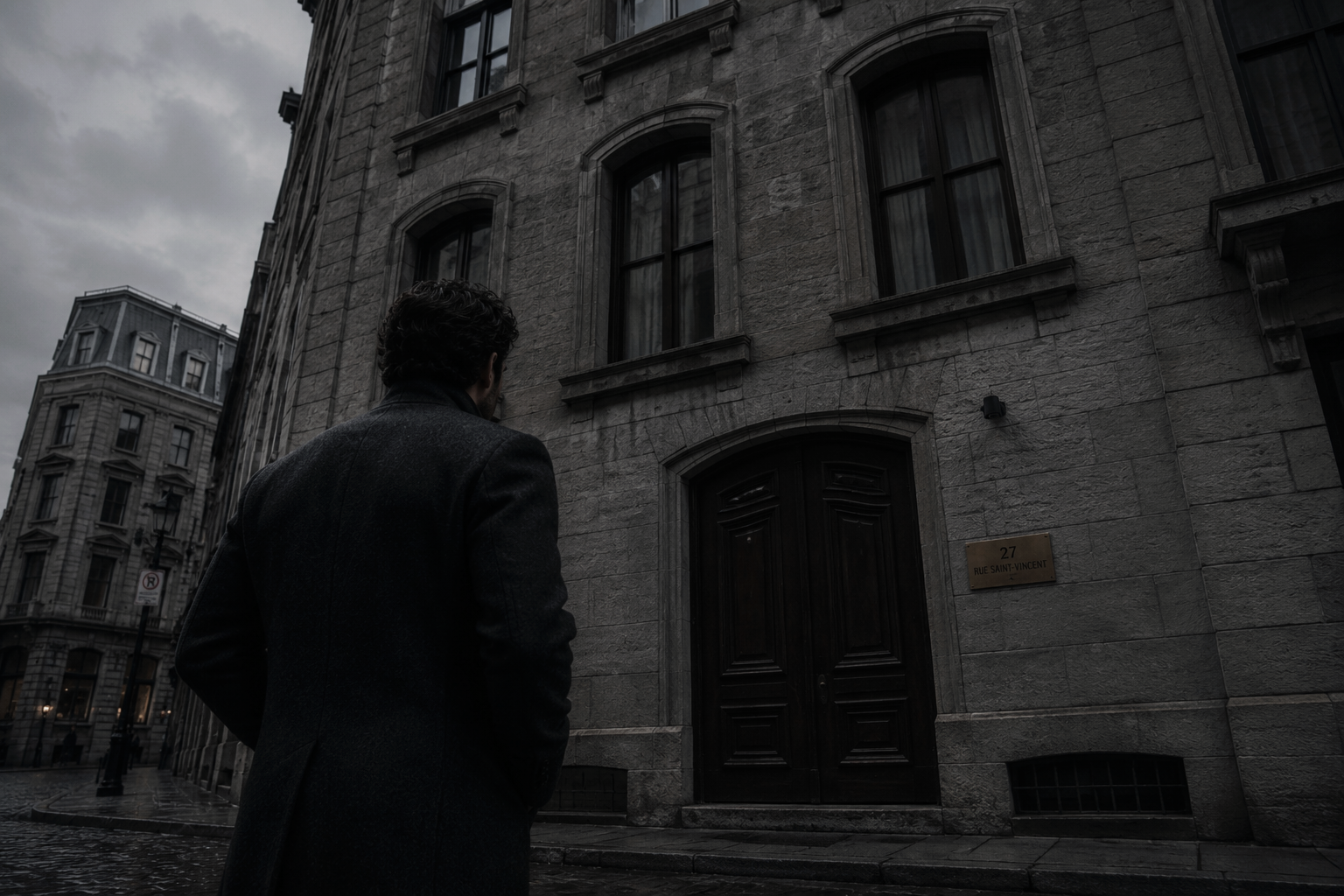
I rang the bell.
The door opened immediately. The woman who answered was perhaps fifty, dressed in a dark blouse and wool trousers, and utterly composed. She didn’t ask who I was. “Mr. Bélanger. We’ve been expecting you. Please come in.”
The entrance hall did not try to impress. Stone floors that decades of footsteps had worn smooth. A vase of fresh flowers on a console table. White lilies, the kind that smell like memory. A single chair beside a window that looked onto an interior courtyard. The light in the hall was the color of weak tea, filtered through the glass with the March sky providing a soft, diffuse illumination. Comfortable chairs in the reception area, the upholstery a quiet gray. A table of current magazines. Water on a tray, glasses already poured, the condensation beading on the crystal.
Wealth was present but not performed. The building had the understated confidence of old money that didn’t need to announce itself. The art on the walls was original but unsigned. The rugs were Persian but worn at the edges. The silver coffee service on the sideboard had been polished by someone who did it daily and not just before visitors arrived.
The receptionist, at least I assumed she was a receptionist though she hadn’t introduced herself that way, offered me water and gestured toward the seating area. “Someone will be with you shortly.”
Shortly. The word was precise and deliberate, a reassurance wrapped in professional vagueness.
I didn’t sit. I moved to the window that looked onto the courtyard and stood with my back to the room, my hands in the pockets of my coat. The courtyard was small and meticulously kept. Boxwood hedges, a stone bench, a single birch whose leaves were coming out. Someone had raked the gravel that morning. The lines were still visible, concentric circles that radiated from the bench like ripples in a pond.
A man on the other side of the reception area was reading something on a tablet, his posture suggesting he’d been here before and understood the rhythms. A woman near the coffee service was speaking easily with a staff member about something that made her laugh. She let out a quiet laugh, the kind that suits a space where volume is carefully controlled. I inventoried them without staring. The man’s shoes were Italian, expensive but not ostentatious. The woman tucked her small leather handbag, which cost more than my monthly rent, beside her chair.
The skill of reading a room without appearing to read it I had learned in childhood, at my father’s fundraisers, where the ability to assess who mattered and who didn’t was a survival mechanism. I’d gotten good at it. Too good, probably. It resisted turning off.
At the far end of the hall, a figure passed—efficient, contained, a briefcase in hand—and glanced at me professionally. Our eyes met for perhaps half a second. Hers were the color of dark honey and they revealed nothing. The Coordinator, I assumed, though no one had said so. She disappeared through a doorway without breaking stride.
I turned back to the courtyard. I’d been here for eight minutes, and the institution had already told me everything I needed. It was older than it looked, privately funded at a level that made the understatement possible, and staffed by people who were utterly unfazed by whatever walked through the door.
That morning I had dressed carefully. Gabriel had offered to come with me but I’d declined. This was something I needed to do alone. The clothes I’d chosen were my own. The last suit I’d bought before the seizure, a dark gray wool that fit well and didn’t call attention to itself. I’d shaved. I’d run cold water over my wrists in Gabriel’s bathroom, the ritual that always helped me reset before things I couldn’t control.
“Mr. Bélanger?”
I turned. The woman who’d spoken was perhaps thirty, her face composed into an expression of professional warmth that was precise without being cold. She wore a navy dress and low heels, and she carried a tablet in the crook of her arm as if it were part of her body.
“I’m your Assessment Coordinator. I’ll be guiding you through today’s process.” She paused, a beat of assessment that was so subtle I almost missed it. “The full assessment takes three to four hours. It includes a physical component, a psychological evaluation, and a consultation on parameters. Do you have any questions before we begin?”
Three to four hours. I’d cleared the day.
“No,” I said. “No questions.”
“Then we’ll begin.”
She turned and I followed her down the corridor.

The corridor was long and quiet, lined with doors that were all closed. A runner covered the stone floor. Wool, dark red, the sort of thing that muffled footsteps and made the space feel older than it was. Sconces on the walls provided a light that was warm without being bright, the bulbs behind frosted glass casting soft circles on the stone. I counted the doors as we passed. Four on the left, three on the right. The eighth door was open.
The room we entered was honest about its purpose. An adjustable examination table with a paper covering that crinkled when I stepped close. A rack of instruments on the wall. I recognized a blood pressure cuff, an ophthalmoscope, things that belonged in any medical setting. A camera system hung mounted on the ceiling, currently inactive, its lens aimed at the table. The room’s lighting was adjustable and the Coordinator adjusted it as we entered, bringing it up to a clinical brightness that erased shadows.
“The physical assessment takes approximately ninety minutes,” the Coordinator said. “Dr. Laurent will conduct the examination. I’ll be present for documentation. The camera will document a portion of the assessment and it will take photographs for the confidential file. We will not release anything without your signed consent, and we will not share anything beyond the highest tier of approved bidders.”
She paused, watching me. I kept my face still.
“Do you have any questions about this part of the process?”
“No.”
Dr. Laurent entered without ceremony. He was perhaps sixty and balding, with hands that looked clean and capable. He introduced himself with three words and began the examination promptly, before I had time to think about what was happening. That was deliberate, I understood later. The clinical busyness was a form of management, keeping me moving through the process without giving me room to stop and assess what the process meant.
He asked me to undress. I did. He didn’t watch me do it. He was calibrating something on the wall, his back turned, giving me the privacy of being temporarily unseen. The Coordinator had opened her tablet and was entering data, her attention fixed on the screen.
Then he turned and the examination began.
He worked with total professional blankness. His hands moved over my body without hesitation, without lingering, without any hint that suggested he was examining anything other than a specimen. Height, weight, and the calipers that measured muscle mass and body fat. Cardiovascular baselines. I lay on the table while the blood pressure cuff tightened around my arm, while cold gel touched my chest and the ultrasound wand mapped the chambers of my heart. Skin, checked with a dermatoscope. Teeth, counted and noted. Hair and nails. Vision and hearing. Reflexes.
The thoroughness was almost philosophical. He was cataloging me the way a naturalist might catalog a new species. I found myself cooperating with him, holding still for the measurements, answering questions about my medical history in a voice that sounded, to my own ears, entirely calm. The Coordinator made notes without expression. At one point, she asked me to turn. I turned. She asked me to stand. I stood. The compliance was automatic, and I watched myself comply from a slight distance, as though the man being measured and the man observing the measurement were two different people.
Then the camera activated.

The Coordinator explained the documentation. A series of images from multiple angles, standard for the institution’s records. She adjusted the lighting again, this time to a softer register, something that would photograph well. Dr. Laurent stepped back, and I stood in the center of the room, the camera lens a dark eye aimed at my body.
“Face forward, please. Arms at your sides.”
I faced forward.
“Turn slightly to the left. Now the right.”
I turned.
“Face the wall, please.”
I faced the wall.
The shutter clicked, making a soft sound that was almost apologetic. The Coordinator moved around the room, adjusting angles, asking me to shift my weight, to raise my arms, to turn my head. The process took perhaps fifteen minutes. By the end of it, I had stopped being a person and had become a file. A set of images that would be scrolled through on tablets in hotel rooms in London and Dubai and Hong Kong, viewers assessing my body the way they might assess a property or an investment.
I had expected to find this dehumanizing. What I felt was something more complicated.
The final portion of the physical assessment was the part I’d known was coming. The Coordinator explained it in the same tone she’d used for everything else. Clinical, precise, a procedure like any other. A demonstration of certain physical responses. The ones in which people bidding on a companion were most interested. The body’s autonomic functions, documented for the file.
My compliance was complete and professional.
My body’s response was not.
I stood in that bright room with the camera’s indicator light glowing green and felt my body answer the situation in a way I had not approved. The impersonal touch, the directed attention, the complete absence of apology in the proceedings. My body understood something my mind was still processing, and it responded with an honesty I couldn’t override. It performed through all its various states, to be measured and photographed and catalogued through each of them. Down to the quantity and quality of my ejaculate.
The examiner noted it without a shift in expression. He’d seen this before. It was data.
But something happened in that clinical room, under those professional hands, that I hadn’t anticipated. My body’s response—the rise of heat, the quickening of breath, the involuntary evidence of arousal—wasn’t caused by the clinical context. The examination table, the paper covering, the doctor’s gloved hands, the Coordinator’s dispassionate observation. None of that was erotic. What was erotic was the directed attention. The unapologetic physical contact. The fact of being examined, assessed, documented, seen in a way that left no room for concealment. My compliance, which I had understood as a form of management, was also a form of submission. The Chalice created a context that allowed them to handle my body without apology, and my body responded with a truth I hadn’t authorized it to reveal.
I would think about this later. For now, I sat on a paper-covered exam table in a room with no windows, my body visibly aroused, and the Coordinator asked if I needed a moment before continuing.
“No,” I said. My voice was steady. I could feel the steadiness in my throat, the way the words came out level and controlled. “I’m fine.”
She nodded. Dr. Laurent removed his gloves. I dressed with hands that didn’t shake.
The Coordinator led me out of the room and down the corridor to a different door. This one opened onto a smaller space. Two chairs, a small table between them, and a window that looked onto the courtyard I’d seen from the reception area. The light through the glass was the color of amber. A conversation space. The type of room where people said things they had not planned to say.
“Please,” the Coordinator said, gesturing to a chair. “Sit. This portion of the assessment is less structured.”
I sat. She sat across from me. The table between us held nothing but a glass of water, already poured, still cold, the condensation beading on the crystal the way it had in reception.

The Coordinator’s attention shifted. In the physical assessment, she had been documenting a body. Now she was looking at a person and the difference was palpable. Her posture was the same. Composed, professional, warm without being personal, but her eyes had changed. She was no longer cataloging. She was listening.
“We’ll begin with some background,” she said. “Your education, your professional experience, your social world. Some of this was in your intake, but I’d like to hear it from you.”
I gave her the surface. The policy degree, the political grooming, the think tank internship, the careful trajectory my father had mapped out before it all collapsed. She asked follow-up questions that suggested she’d done her homework. Not interrogating. Just following the thread, her attention steady and undemanding.
Then the questions changed texture.
“How would you describe your relationship with your father?”
I paused. The courtyard outside the window was quiet.
“Complicated,” I said.
“That’s often the case. Can you tell me more?”
I looked at the glass of water on the table. The condensation had formed a small pool at the base.
“He was proud of me. Genuinely, I think. He wanted me to have the life he’d built, the legitimate one. The politics, the public service, the respectability. He kept me insulated from the rest of it. I didn’t know about the finances until the raid. He thought he was protecting me.” I paused. “He was protecting me. But it was a protection that depended on my ignorance, and when it failed, the ignorance became a liability.”
“Did you love him?”
“Yes.”
“And now?”
I looked at her. Her face was open, interested, free of judgment. She was asking because the answer mattered, not because she was curious.
“I’m still trying to figure out what I feel,” I said. “It changes. Sometimes it’s grief. Sometimes it’s anger. Sometimes it’s neither. He made choices that destroyed everything he had built, and I’m still sorting through the wreckage. It’s hard to mourn someone when you’re also furious at them.”
She nodded and made a note on her tablet. Not recording my words, she wasn’t transcribing, but noting something about the content, the shape of it.
“How do you typically manage stress?”
“Badly,” I said. Then, because she was waiting, “I organize things. Lists. Systems. I run cold water over my wrists when I need to reset. I make coffee for people. It gives me something to do with my hands while I’m thinking.”
“That’s unusually specific.”
“I’ve had time to notice.”
She smiled briefly. The first genuine smile I’d seen from her. It changed her face, made her younger, more present. “I’d like to ask about your relational history. Past partners. What brought them together and what ended them. Take your time.”
I told her about Michael. The year and a half of warmth that I’d mistaken for something simpler than it was. The way he’d ended it within hours of the asset seizure, his exit prepared in advance, his directness so clean it had to have been rehearsed. I heard myself say things I hadn’t said aloud before. That the warmth had been real, and the calculation had been real, and the coexistence of those two truths had felt comfortable at the time.
“Which I now understand,” I added, “was a warning.”
“How so?”
“Comfortable shouldn’t mean convenient. It shouldn’t mean the absence of friction. A relationship that’s comfortable in the way Michael and I were comfortable is one where someone isn’t being entirely honest. I don’t think he was capable of the kind of honesty that costs something.”
The Coordinator waited. I recognized the technique. She was giving me space to fill, trusting that I would. And I did.
“I was convenient for him,” I said. “The political connections, the family name, the future he could see attaching himself to. When that future disappeared, so did he. It wasn’t a betrayal in the sense that he’d promised something and broken it. It was a betrayal in the sense that I’d mistaken something transactional for something genuine.”
“That’s a difficult distinction to make in the moment.”
“It’s easier in retrospect.”
Another small smile. “Most things are.” She shifted slightly in her chair, recrossing her ankles. The movement was professional but unhurried. She was settling in, not preparing to leave. “I want to shift the conversation now. We’ve been talking about what you’ve experienced and how you’ve managed it. I understand the context that brought you here. What I need to understand now is what you want.”
“I don’t know yet how much of what I want is legible to me,” I said.
The Coordinator didn’t react with surprise or sympathy, or any of the responses I might have expected. She nodded, as though I’d given her precisely the answer she was looking for.
“That’s honest,” she said. “I appreciate honesty. Most people who sit in that chair give me a version of what they think I want to hear. You’ve given me the truth, which is that you’re still assembling it.” She paused. “I’d like to help you with that assembly, if you’re willing. We’re going to work through some categories of experience and desire. You’ll tell me yes or no or conditional to each. There are no wrong answers. There are only accurate ones and inaccurate ones. I’m asking for accurate.”
She began the systematic survey. The categories moved from simple to complex, from the physical to the psychological, from the easy to name to the things that required me to pause and find the words. I answered with more precision than I’d expected to have. The room, the Coordinator’s calm presence, the specific formality of the process, all of it combined to create an environment in which honesty felt possible. Not easy. But possible.
By the time we’d been talking for fifty minutes, I’d learned things about myself I hadn’t fully known. The shape of my wanting, which I’d always experienced as something diffuse and unexamined, was becoming legible. I could see its outlines, the way you can see the shape of a landscape from a height. Not every detail, but the contours. The things I’d told myself I wanted. The things I’d wanted but not allowed myself to name. The things I was still unwilling to name, even now, even to this woman whose entire professional function was to receive such answers without reaction.
She didn’t push. She noted the absences. I could see her noting them, the slight pause of her stylus on the tablet, but she didn’t press. The three conspicuous absences, the places where my answers stopped short of “no” without committing to “yes,” were left where they were. She’d seen them. I knew she’d seen them. And she let them sit.
“Let’s take a break,” she said. “Five minutes. There’s water on the table, and the washroom is down the hall to your left. I’ll be back.”
She left. The door closed with a soft click.
I sat alone in the quiet room, the light shifting toward evening, the birch in the courtyard beginning to blur as the sun dropped behind the building. I drank the water. I breathed. I held the things I’d learned about myself carefully, the way you hold something fragile that you’re not yet ready to scrutinize.
The five minutes passed. The door opened. The Coordinator returned, and with her came a shift in the atmosphere. A subtle change, the sense that we were arriving at the territory the whole day had been building toward.
“Now,” she said, sitting down across from me, “we’re going to talk about limits.”

“The purpose of this conversation,” the Coordinator said, “is to establish your contract parameters. What you will do, what you won’t do, and what you’ll do under specific conditions. Every restriction we record will reduce the pool of eligible bidders, which will reduce the auction payout. That’s not a threat. It’s information. We’re not asking you to agree to anything you’re genuinely unwilling to do. We’re asking you to be precise about where your limits actually are, not where you assume we want them to be.”
She set the tablet on the table between us, screen angled so I could see the categories she’d be working through. The list was long, organized by type. Physical. Relational. Psychological. Public and private. Permanent and temporary.
“Take your time with each answer. A ‘no’ doesn’t require explanation. A ‘yes’ doesn’t require enthusiasm. A ‘conditional’ requires the condition, nothing more. Do you have questions before we begin?”
“No.”
She began with the simple categories. The ones that required no thought, only recognition. I said no to things I’d always known I’d say no to, and the words left my mouth without effort. The Coordinator noted each one without comment, her stylus moving across the tablet screen in small, precise strokes.
We moved into the middle territory. Control. The question wasn’t do you want control, that wasn’t how she framed it. She asked me how much control I was prepared to cede, and under what circumstances, and for how long. I had to think about it. Not because I didn’t know the answer, but because voicing it required me to acknowledge something about myself I’d never said aloud.
I gave her the answer. It was considered and specific, and it cost me something to voice evenly. The Coordinator noted it without reaction.
“Good,” she said. “That’s helpful.”
Helpful. The word was so ordinary, so professional, that for a moment I forgot the content of what I’d just told her. The clinical framing was itself a form of protection. By treating my answers as data, she made it possible for me to give them.
We moved through the categories I’d expected. I said yes to things I’d known I’d say yes to. I said no to things I’d known I’d say no to. Both passed without incident. The Coordinator’s face remained steady, gracious, the same expression she’d worn since we sat down. She’d heard these answers before. She’d heard answers more extreme and more restrictive. Nothing I said surprised her.
Then we reached the troublesome part.
She asked me about things I’d wanted but not allowed myself to have. She framed it carefully, the way she’d framed everything. A question about what a benefactor might offer, what I might ask for if the asking had no consequences.
I paused longer than I’d paused for any of the previous questions.
I knew the honest answer. I’d known it since the hotel room the night of the gala. The ghost of rougher hands on my body, the memory I’d been avoiding because avoiding it was easier than examining it. I’d known it in the Chalice’s physical assessment room, standing on the paper-covered table while my body demonstrated truths my mind hadn’t authorized. I’d known it on Gabriel’s pull-out couch at four in the morning, staring at the orange rectangle of streetlight on the ceiling.
The Coordinator waited. The silence was comfortable, undemanding. She’d given me space before, and she gave it again.
I told her. The words came out specific and unqualified, without apology. I named what I wanted in language that left no room for misinterpretation, and when I was done, I didn’t look away from her face.
She noted it. Her stylus moved across the tablet. Then she looked up.
“Thank you,” she said. “That’s precisely the kind of clarity that makes these contracts functional.”
We continued through the remaining categories. I answered with the same precision, but something had shifted. The hardest thing was out of the room now, named and noted and, in the naming, somehow less terrifying than it had been when it was only a thought I carried alone.
By the end, I’d spoken more honestly about my wants than I’d spoken to anyone I knew. Not to Gabriel, who’d held me through a week of grief and asked nothing. Not to Michael, who’d been in my bed for eighteen months without ever knowing what I kept hidden. Not to Margaux, who loved me without complication but who I protected by managing what I showed her.
The Coordinator had no stake in managing what she perceived. Her job was to see me clearly, and she’d done it.
She reviewed her notes on the tablet, scrolling through the categories we’d covered. The light outside had dimmed further. The courtyard was in shadow now, the birch almost invisible against the dark gravel.
“This is a strong profile,” she said. “Something we haven’t been able to offer in this configuration before.” She paused, and when she looked at me her expression held something that wasn’t quite professional warmth. It was recognition. “Including the things you didn’t name.”
“I assumed,” I said.
“You assumed correctly. The conspicuous absences are part of the profile. They tell us almost as much as what you said directly.”
“Almost.”
She smiled, that brief, genuine expression I’d seen earlier. “Almost. We’ll have a formal response for you within forty-eight hours, assuming the background checks produce nothing unexpected. But I can tell you now that the preliminary assessment is positive in every category.”
She stood. I stood with her. The interview was over, but she didn’t lead me toward the door.
“Before we conclude,” she said, “there’s one more room.”

The third room was unique. I felt it the moment the door opened. The lighting was warmer, adjusted to something softer than the clinical brightness of the exam room or the conversation light of the consultation space. The materials had changed. The floor was wood, not stone. The walls were a pale cream. The furniture was sparse but deliberate. A large window on the far wall looked onto the courtyard, but the angle was different, the birch visible through a wider pane. The effect was that of a private space, a room meant for something more intimate than the institutional functions of the rest of the building.
A man was waiting inside. Older than the Coordinator, perhaps fifty-five, with a face that had seen everything and reacted to nothing. He sat in an armchair near the window, and he stood up when we entered.
“This is our senior evaluator,” the Coordinator said. “He’ll be observing this portion of the assessment.”
The senior evaluator nodded, a single economical movement, and said nothing. His presence was calm, utterly professional, and somehow more unnerving than the Coordinator’s structured warmth had been. She was reading me with permission. He was reading me because it was his function, and permission wasn’t part of the equation.
The Coordinator gestured to the center of the room, where a blue and cream Persian rug, old enough to have been walked on by people who’d died before I was born, created a kind of stage.

“What we’re asking for in this portion is presence,” she said. “The ability to occupy space, to be looked at, to remain legible as yourself while having no formal power. Only the highest tier of bidders can access the documentation from this room.”
I understood. The physical assessment had documented my body. The psychological evaluation had documented my desires. This room was about something harder to quantify. The quality of being present, of being seen, of holding myself in a way that communicated something specific about who I was and what I could offer. It was, in its way, the most intimate part of the process.
“Stand here,” she said, indicating the center of the rug.
I stood.
The senior evaluator didn’t move from his chair, but his attention shifted. I felt it the way you feel a change in temperature, a pressure that wasn’t physical but was unmistakable. He was looking at me, and the looking was a kind of touch.
I followed the instructions. Facing forward. A slight turn. Arms relaxed at my sides. The Coordinator gave instructions in her calm, professional voice, and I followed them. The instructions were simple. Adjust your weight, lift your chin, look toward the window, but the simplicity was deceptive. Every adjustment changed something. Every instruction was a test of how I occupied my body under observation.
My body cooperated. More than cooperated. There was an ease to it that surprised me, a willingness I had not expected. The Coordinator’s voice was a steady presence in the room, and I responded to it not as instruction but as invitation. A guidance toward something I was discovering I knew how to do. Being looked at. Being read. Being present in a way that left me visible, legible, and somehow still myself.
Midway through, something shifted.
I felt it before I could name it. A divergence between my composure, which was intact, my face steady, my breathing even, and my body’s response, which had registered the attention in a way that was visible. The warmth in my skin, the slight quickening of my pulse, the physical evidence of arousal that no amount of management could suppress.
The Coordinator noticed. The senior evaluator noticed. I couldn’t correct it, and after a moment, I didn’t try.
She asked me to demonstrate something more specific. A physical response, in the way I’d been asked during the medical examination, but this time without the medical examiner’s clinical hands. This time I was to do it myself, on instruction, while they watched.
I did it. The room was warm and the light was amber and my body answered the instruction before my mind had finished processing what I’d been asked to do. There was a tremor in my thighs I hadn’t approved. My breath became shallow in a way that had nothing to do with exertion. I held myself in the center of the lamplight, exposed and aroused and unable to pretend otherwise, and something in the quality of that exposure, of being seen in a state I hadn’t chosen and couldn’t manage, produced its own additional response. My body had stopped consulting me.
The senior evaluator spoke for the first time. His voice was mild and measured, the voice of someone who did not need to raise it because he’d learned long ago that quietness commanded more attention than volume.
“The way he holds himself,” he said, addressing the Coordinator. “There’s a specific quality. Stillness that communicates cooperation without surrender. That’s distinct. Useful.”
The demonstration ended perhaps twenty minutes after it began. The Coordinator announced that the final documentation was complete. The senior evaluator rose from his chair and left the room without ceremony, his footsteps muted on the wooden floor.
“We’re finished,” the Coordinator said. “I’ll escort you a room you can wait in.”
She opened the door into the corridor. I followed her, my body still carrying the warmth of the room and the residue of being seen.
The heavy door closed behind us.

I stood alone in the quiet room. The Coordinator had left me here while she prepared the preliminary results. “A few minutes,” she’d said, and closed the door with the same soft click I’d heard at the end of the psychological evaluation. The room was the third one, the warmer room. The one with the Persian rug and the window onto the courtyard. The lighting had been left as it was. The armchair where the senior evaluator had sat was empty.
I walked to the nearest chair, not the senior evaluator’s armchair but a smaller one, upholstered in something gray, and I sat down. Not a collapse. I lowered myself into the seat with intention, feeling my weight settle, the chair’s frame creaking under me. My body was still warm from the demonstration. The arousal hadn’t entirely faded. I could feel it at the edges of my awareness. A low hum that was both inconvenient and revealing.
I breathed.
The hard limits conversation replayed itself in my mind. The things I’d named yes and no. The three things I’d left conspicuously unnamed. The absences the Coordinator had noted without comment, the spaces where my answers had curved away from a definitive answer like a river finding its way around an obstacle. I examined them now, alone, without the pressure of her attention. They were accurate. I hadn’t been evasive. I’d been precise, and the precision had required leaving some doors unopened. The absences were information I now held. They required no apology.
I cataloged my prior life the way I’d cataloged the notepad names. The study in my walk-up apartment, where I’d written policy briefs for organizations that had stopped returning my calls. The research offer from Brussels, a year away and useless. The political future my father had built for me, now a smoking ruin in a federal investigation file. The grief existed. It was real, and it was heavy, and this room was not its place. The grief could wait.
The realization wasn’t sudden. It had been building since the nights on the pull-out couch, since the morning I’d said “tell me more,” since every door I’d tried to open had swung shut in my face. I had not come here to discover whether I would do this. I’d come here to become certain of a decision I had already made. The certainty was here now, sitting in the silence with me, as solid as the chair under my body, as undeniable as the warmth still humming around the borders of awareness.
I stood. Straightened the front of my shirt, which had wrinkled during the demonstration. The clothes were mine. The dark gray wool suit I’d put on that morning in Gabriel’s apartment, borrowed space in a borrowed life, but the person wearing it was not borrowed. He was completely himself. He was about to sign a contract that would sell his body to the highest bidder, and he was more precisely himself than he’d been in years.
The knowledge sat in my chest like something I’d picked up and decided to carry.
The door opened. The Coordinator had returned, her tablet in her hand, her expression composed.
“We have the preliminary results,” she said.
She reviewed the assessment outcomes in the reception area, standing near the window where I’d watched the birch and the gravel three and a half hours earlier. The light had changed entirely. The courtyard was dark now, the courtyard lights casting small circles of gold on the gravel. The reception area’s ceiling fixtures had dimmed to evening levels.
“Positive in every category,” the Coordinator said. “Your physical assessment exceeded baseline markers across the board. Your psychological evaluation demonstrated self awareness and honesty at a level we rarely see. Your consultation on parameters produced a profile that the senior evaluator has flagged as unusually strong.” She paused, scrolling through something on her tablet. “The senior evaluator expects formal acceptance within forty-eight hours, barring anything unexpected from the background check. I don’t expect issues.”
I asked about the contract structure. She answered thoroughly with the same precision she’d brought to every other part of the assessment.
The trust fund mechanism was irrevocable. Once the auction proceeds were transferred into the fund, the money was untouchable by me, by the purchaser, by the institution, by anyone. The designated beneficiary was the sole recipient, and the designation was locked at the time of contract signing. No modifications without the beneficiary’s consent.
The contract duration was negotiable, but typically ranged from three months to three years. Given the sum I’d specified, the number Gabriel had named, the number that covered Margaux’s tuition and living expenses and the debts and a buffer, she recommended five years. “Longer contracts command higher total sums,” she said, “and the trust fund payout is structured accordingly.”
The obligations were what I’d expected. The auctionee provided “cooperative companionship” within the boundaries established in the hard limits consultation. The purchaser ensured health and welfare, a lifestyle commensurate with the contract’s terms, and no physical harm beyond what the contract permitted. The language was formal but clear, and I recognized the careful balance it struck. Body and company in exchange for a secure, upscale life and the irrevocable protection of my sister.
I asked clarifying questions. She answered them without hesitation. The institution had been doing this for forty years. The questions I was asking were questions they’d answered thousands of times, and the answers were polished to a high, smooth finish. Every contingency had been anticipated. Every edge case had a provision.
As we were concluding, she added something that hadn’t been in the standard briefing.
“There’s been advance interest from a proxy client,” she said. “Someone has already flagged your profile before the auction’s formal announcement.”
I felt the information land and settle. “Who do they represent?”
“The proxy channel is confidential until the client identifies themself. But the interest level suggests a serious bidder. Someone became aware of your profile as soon as it became available.”
Someone who’d been watching the channel. Someone who’d known, or suspected, that I would end up here. The implication sat in my stomach like a hot coal.
I filed the information carefully. It was not yet a threat. It was a piece of the puzzle I hadn’t known was missing, and its shape suggested other pieces I still couldn’t see. I would hold it until I had more.
“Thank you,” I said to the Coordinator. “For your thoroughness.”
She shook my hand, the first physical contact we’d had that wasn’t procedural, and her grip was warm and professional and precisely as long as it needed to be.
“I’ll be in touch within two days,” she said. “The formal acceptance will come with a contract package for review. Take your time with it. Ask questions. We’d rather have you understand what you’re signing than have to fix it later.”
She escorted me to the heavy front door. The receptionist nodded as I passed. The woman with the expensive handbag was gone. The man with the Italian shoes was gone. The Chalice’s corridors were quiet, the building settling into evening, the stone walls holding their accumulated coolness against the dark.
The door opened. The street was quiet, the heritage buildings lining both sides glowing amber in the streetlights. The air had sharpened since I’d arrived and the cold had teeth now, the last bite of the disappearing winter. I stood on the threshold for a moment with the Chalice at my back, the city in front of me and then the door closed with the heavy, final sound of old wood meeting old stone.
I began walking toward the metro.

End of Chapter Three.