

Alex Bélanger’s meticulously planned future vanishes in a single afternoon when a federal investigation seizes his family’s assets, leaving him with nothing but the clothes on his back and a phone full of dead-end contacts. As his political network, his home, and even his ex-lover abandon him to a newly hostile city, he must navigate a world where his name is a curse. With nowhere else to turn, he calls Gabriel, a face from his past who offers not just refuge, but a raw, undeniable physical connection that reignites a long-buried need and becomes his only anchor in the wreckage.

The story to date in EPUB format can be downloaded HERE if you prefer to read longer material on your Kindle or other device.

Alex’s Point of View
The municipal water infrastructure paper sat open on the library table, twenty-three pages with my advisor’s notes in green ink. Genuinely promising, she’d written at the top, and two weeks later the words still produced a small, private warmth when I looked at them. The study room smelled of old paper and someone’s abandoned coffee, and through the interior window I could watch the undergraduate stacks doing their late-morning business. A girl re-shelving books with earbuds in, a boy staring at his laptop with the vacant look of someone who’d been there since the night before.
My phone was face down on the table. I hadn’t checked it in two hours.
The footnote I was reconstructing concerned the 2008 water main failures in Notre-Dame-de-Grâce, and I’d found a council report that contradicted the standard narrative. My advisor had written follow this with two underlines. Beyond the paper, there was the parliamentary committee review she’d mentioned in passing last week. A summer research assistantship that would put my name on published policy work before I turned twenty-seven. My father had called it the long game when we’d discussed it at Christmas, his pride in me genuine and his vision for my trajectory clear. An ordinary Tuesday with a future taking shape.
A knock on the door glass. I looked up.
My classmate Delphine stood in the doorway with her laptop clutched to her chest like a textbook from grade school. “Sorry to interrupt. You have a minute?”
I did. I always did for Delphine, who’d once explained regression analysis to me over three coffees and refused to let me buy any of them. She was referencing a primary source I’d already tracked down, and I walked her through the citation while she typed with one hand, her other still holding the laptop. She thanked me with the slight envy she’d never quite hidden. My ease with the material, the advisor’s green-ink praise she’d glimpsed once, the sense that things came to me without struggle.
I didn’t tell her about the hours. No one ever wanted to hear about the hours.
“Any time,” I said, and meant it.
She left. I returned to the footnote. Through the glass wall, I watched my advisor, Professor Côté, emerge from the faculty stairwell and scan the study room. She spotted me through the glass and beckoned with two fingers. I saved the document and stepped into the hallway.
Professor Côté was sixty-three and had the energy of someone who’d decided at forty that slowing down was a personal failure. She told me about the parliamentary committee in the hallway’s fluorescent hum. The committee had requested her for a policy review, she’d recommended me as a research assistant for the summer term, the funding was already allocated, and she needed my answer by Friday but was hoping for it now.
“Yes,” I said. “Immediately. Absolutely.”
She smiled the distinct smile of someone who’d expected this answer and was pleased anyway. “Good. I’ll send the paperwork tonight. Don’t let the footnotes eat you alive.”
I went back into the study room with the lightness of a door opening onto a corridor I’d been walking toward for years. The paper. The assistantship. The trajectory my father had mapped from the first time I’d come home from a policy debate with a hunger I hadn’t known how to name. All of it lined up in the ordinary fluorescence of an ordinary Tuesday.
I checked my phone.
Three missed calls from my father’s lawyer. Two from a number I didn’t recognize. One from my father.
He never called me at school. Our communication was scheduled, organized, managed through his assistant or mine or the shared calendar we maintained. An unscheduled call from him during a weekday meant crisis, meant illness, meant something I couldn’t yet name and was already beginning to feel in my stomach.
I was calling him back when the study room door opened again.
This time it wasn’t Delphine.

Two agents. The man was older and carried a leather folder that had seen use. The woman was younger and stood with the stillness of someone trained to wait. They introduced themselves with bureaucratic courtesy. Special Agent Caron, Special Agent Lefrançois. The courtesy was the first thing that frightened me, because it meant the situation required no aggression. They weren’t arresting me. They were requesting my cooperation with an active federal investigation. I was free to call an attorney. I was free to decline.
I called the attorney from the hallway while they waited at a respectful distance. The phone rang six times, then voicemail. I called my father’s backup. The senior partner at the firm who’d handled our family’s legal affairs for fifteen years. The receptionist put me on hold and came back with a voice that had been carefully emptied of everything except professional neutrality.
“I’m sorry, Mr. Bélanger. No one is currently available.”
I understood, in the space between currently and available, that the word meant something it had never meant before.
I agreed to cooperate. What else was there? They walked me through the library, down the main stairwell, and out the glass doors onto the campus walkway. It was late March, the air still cold enough to bite, the last gray snow piled in dirty heaps at the edges of the quad. The walk from the library to the parking circle took four minutes, and in those four minutes a dozen people who knew me saw me. A graduate student from my methodology seminar who looked at the agents and then at me and then away. A professor from the political science department who nodded at me and I nodded back, casual, unhurried, as though this were a normal Tuesday and these were normal companions and nothing at all was being taken apart piece by piece. The composure was practical. It was also a form of dignity I hadn’t known I possessed until I needed it.
The agents didn’t speak in the car. The silence confirmed what their courtesy had obscured. This was serious, and it had been in motion longer than I’d been aware of it. I watched the campus recede through the window and thought about my father’s missed call, forty-five minutes old now. What he’d been trying to tell me. What room he’d been in when he’d dialed. Whether he’d known, in the moment before the call went to voicemail, that I wouldn’t pick up in time.
My phone buzzed. A notification from my banking app. My primary credit card had been declined on a recurring charge, the monthly storage unit in Mile End where I kept my off-season wardrobe and my mother’s remaining things. Thirty-seven dollars.
I stared at the screen. The agent in the passenger seat adjusted the side mirror. The car turned onto the expressway.
I put the phone in my pocket.

The room was smaller than I’d expected but just as cold as I’d imagined. Fluorescent lights, concrete walls painted institutional beige, a metal table bolted to the floor. Four chairs. A camera in the corner with a red light that blinked at irregular intervals. The air smelled of old coffee and something that was probably anxiety, absorbed into the paint over years of interrogations.
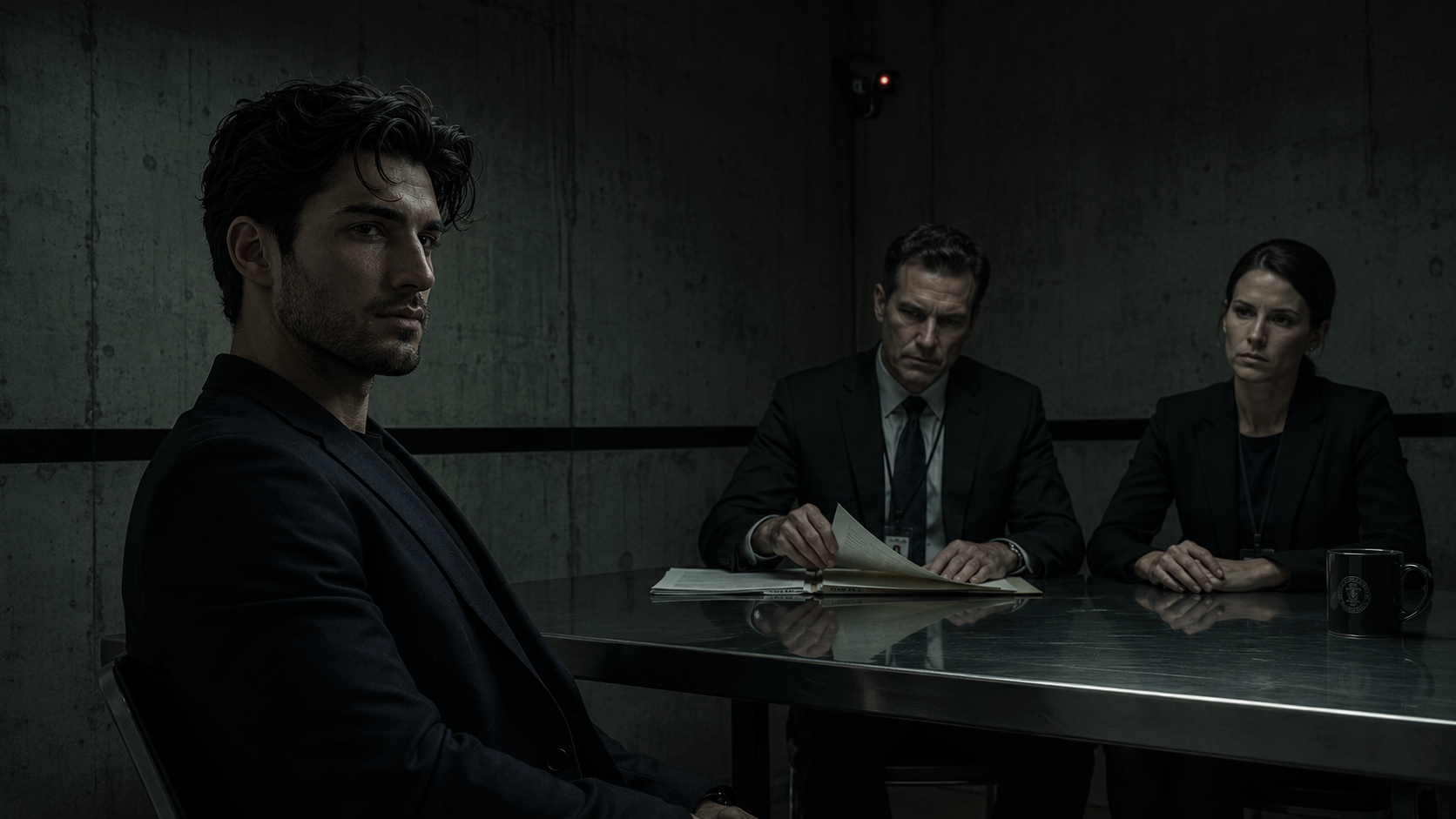
The senior agent, Caron, had a file that was two inches thick and clearly years in the making. He set it on the table with the weight of someone who knows exactly what’s inside and exactly how long it’s taken to compile.
They began with my father’s legitimate businesses. Holding companies. Real estate portfolios. Investment vehicles I’d heard mentioned at dinner but never discussed in detail. I answered what I could, which was substantially less than the file suggested I should know. The agents’ expressions didn’t change. They already knew what I didn’t know. The questions were mapping the boundaries of my ignorance rather than seeking information I possessed.
“Did your father ever discuss the Rue Saint-Hubert properties with you?”
“No.”
“Did you have signatory authority on any family accounts?”
“No.”
“Were you aware of the Cayman-registered investment fund listed under your father’s holding company?”
“No.”
Three hours. They covered my entire life. Schools, friends, internships, political connections, every name on every document they’d recovered from four years of surveillance. The questions came in waves, benign for stretches, then suddenly specific, probing at something I didn’t recognize. They weren’t trying to catch me in a lie. They were building a comprehensive record of someone who might be useful later. A witness, a bargaining chip, a person whose ignorance was itself a kind of evidence. Both parties in the room understood this.
At the ninety-minute mark, I asked for the bathroom. The junior agent Lefrançois escorted me down the corridor and waited outside the door.
I ran cold water over both wrists in the white porcelain sink. The reset ritual, honed through years of debate preparation and political dinners and the performance of being Philippe Bélanger’s son. The cold bit at the thin skin of my inner wrists, and I breathed into the sensation. I looked in the mirror. I looked fine. Composed, neutral, the face of someone cooperating voluntarily with a federal inquiry. The face I’d been trained to wear.
I dried my hands on brown paper towels and went back.
Near the three-hour mark, Agent Caron slid a photograph across the metal table. A man I didn’t recognize, middle aged, dark suit, seated at a restaurant table with someone whose face had been cropped out. The background suggested somewhere in Old Montreal. The date stamp was from eighteen months ago.
“Do you know this man?”
“No.”
“Have you ever seen him before?”
“Never.”
The agent’s expression didn’t change. He took the photograph back and returned it to the file without comment.
The junior agent Lefrançois took over for a stretch. Her questions were different. They were not about what I knew but about what I felt. She probed the nature of my relationship with my father with the careful neutrality of someone looking for cracks. Was there estrangement? Resentment? Had he withheld affection? Had I ever felt used?
I answered with patient accuracy. My relationship with my father had been warm and distant. Warmth because he loved me genuinely, distance because he’d protected me by withholding. I had never felt used because I had never known there was anything to be used for. I loved him, and I knew very little about his life. Both of these things were true.
She made a note I couldn’t read.
At four hours, Caron closed the file. “Thank you for your cooperation, Mr. Bélanger. You’re free to go.”
The courtesy hadn’t changed. It was the most unsettling thing about them.
I stood. My legs worked normally. I walked to the door they’d opened and down the corridor toward the elevator bank, and before the elevators I stopped and put my hand flat against the wall for five seconds. The paint was cool and a bit tacky, and under my palm the concrete was solid and didn’t ask me anything. I breathed once, twice. Then I continued.

The notifications had accumulated over four hours. I read them standing on the sidewalk outside the federal building, the late-afternoon light cold and flat across the concrete plaza.
The credit card decline was already known. Car insurance policy suspended. Banking app frozen, checking account, then savings account, then the joint account connected to my father’s estate. A message from a student loan administrator requesting immediate contact regarding my father’s cosignatory status. A formal notice from my landlord in Montreal. Federal seizure documentation had been filed for my condo, and my tenancy was under review.
I read all of this standing on the sidewalk in good clothes I’d put on that morning for the study room and a scheduled gala follow-up meeting. The wind came up from the river and cut through my jacket. I didn’t shiver.
I called the attorney again. The same receptionist answered with the same managed voice, and this time I didn’t bother leaving a message.
The campus parking structure was miles away. I walked there because walking was something I could do, and the walk gave me a shape to hold while the inside of me rearranged itself into an unrecognizable geography.
My space was empty.
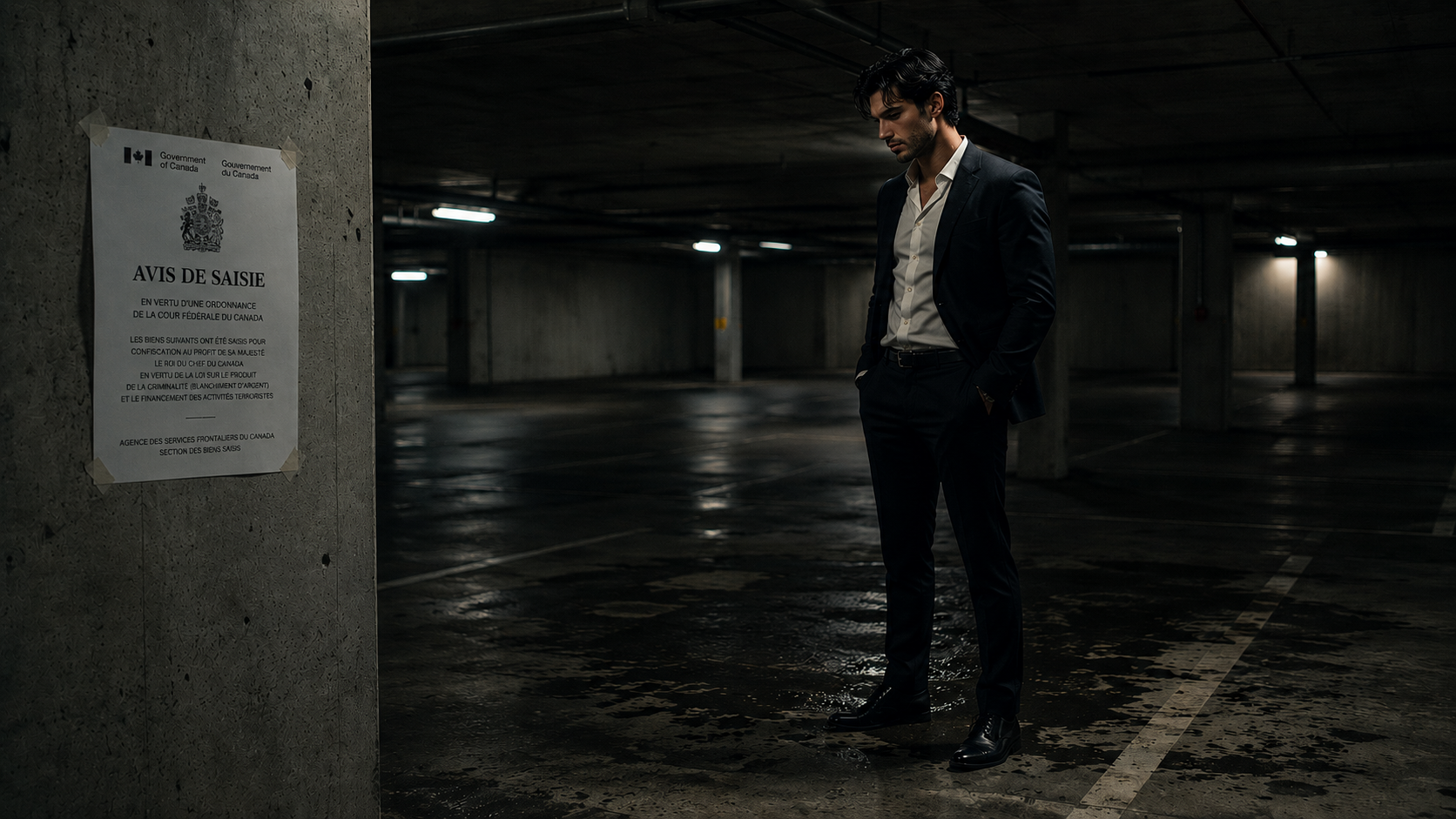
The pillar where I’d parked my car at eight-fifteen that morning had a federal seizure notice taped to the concrete. The paper was crisp and official, the seal embossed, the language precise. The car, a three-year-old Audi I’d bought with money from the trust fund my father had established when I turned twenty-one, had been removed during the four hours I’d spent answering questions I couldn’t answer.
I stood in the empty space. Oil from someone else’s vehicle stained the concrete floor. I stood there for longer than was useful, and then I walked out.
On the sidewalk, I took stock. My phone was on a family plan whose autopay card was now frozen. I had until the end of the billing cycle before that stopped working. My wallet had two hundred and forty dollars in cash, the frozen cards, my driver’s license, a student ID, a coffee receipt from this morning. The clothes I was wearing, which were good and would last if I were careful. The shoes on my feet.
I had a meeting this afternoon with a political contact I’d cultivated for six months, a deputy minister’s chief of staff who’d been warming to my attention. I called. It went to voicemail. I left a message already knowing it wouldn’t be returned, because the world I was calling into no longer existed.

Over the next two hours, I made calls while walking.
The political contacts went first. I worked through them in descending order of hope. The ones I thought might answer, the ones I hoped might answer, the ones I knew wouldn’t answer but called anyway because not calling felt like surrender. The first went to voicemail and didn’t call back. The second picked up, heard my name, and was suddenly in a meeting with a specificity that meant never. The third expressed shocked sympathy for forty-five seconds, then explained with genuine discomfort that being seen contacting anyone associated with the investigation was professionally impossible. The fourth hung up without speaking. The fifth, a woman I’d considered a genuine ally, someone who’d mentored me through my first policy role said, with the softness of someone inflicting a wound they’d rather not, “I’m sorry. I really am. But you understand.”
I said I did.
“Take care of yourself,” she said. The goodbye was final.
The calls to my father’s world were different. They answered. The people whose world ran on codes and consequences answered their phones and they were brief and honest in a way that was almost a relief after the political evasions. “You know what your father did.” A version of this from four people in forty-five minutes. “You know what that means. It isn’t personal.” The honesty was brutal and clean, and I appreciated it in the way you appreciate a surgeon who doesn’t pretend the procedure won’t hurt.
One call was worse than the rest. A man who’d known my father for thirty years, who’d come to my high school graduation and sent a Christmas gift every December of my life. He answered with warmth that was genuine and devastated and already preparing to withdraw, and he told me things I could hear him not wanting to say.
“You’re toxic right now, Alex. And I’m sorry that’s the word for it, but it’s the accurate one. There are people furious about what your father did, and they are not distinguishing between him and you. You need to find somewhere safe and very quiet, and I can’t tell you where that is.”
A pause. Through the phone, I could hear him breathing.
“What your father did would horrify your mother. He was playing the feds against us and us against the feds. There’s no forgiving that. De Santis wants blood.”
He hung up. I stood on the sidewalk with my phone against my ear long after the line went dead, and then I continued walking. De Santis was the de facto head of the Italian crime families in Montreal. Being on his bad side was not good for one’s life expectancy.
I stopped at my condo. The building was the same as it had been that morning. The glass doors, the lobby with its tasteful minimalism, the elevator I’d ridden down at seven forty-five with my laptop bag and my paper notes and the ordinary expectation of returning. But the door to my unit had a federal seal across the frame. White paper, embossed lettering, the weight of the state made visible. A neighbor from two floors up, a woman whose cat I’d fed once when she was away, came out of the stairwell and saw me standing there. She made a visible decision not to acknowledge me, then reversed it at the last moment.
“I’m sorry,” she said in passing, without stopping.
I looked at the seal but didn’t touch it. Touching it would have meant something I wasn’t ready to accept. I went back downstairs.

Michael picked up on the third ring with the sound of someone who had been waiting for this call and had prepared for it.
“Alex.”
I explained in a few precise, undramatic sentences. The federal seizure. The interrogation. The scope of what had been taken. The condo, the car, the accounts, the future I’d been walking toward this morning. I needed accommodation for tonight. I needed help navigating the next twenty-four hours.
Michael listened without interrupting. When I finished, there was a pause, and in the pause I understood what he was going to say before he said it.
“Alex.” His voice had the efficiency of someone who has decided honesty is the kindest available form, which was self-serving and not entirely wrong. “Our arrangement was based on conditions that no longer exist. I’m sorry. Genuinely. But you have to understand the landscape has changed entirely.”
“Be specific.”
He was. My value, the political future, the family connections, the positioning of our relationship within the network he was building was gone, not damaged. Gone. He had a life and a career to protect, and being associated with the son of a federal criminal defendant was something he could not afford. He said he was sorry once, and it sounded like he meant it, which was almost worse.
I was sitting on a park bench. I hadn’t noticed when I’d sat down. The park was the small one on Avenue Laurier with the fountain that wasn’t running yet, the trees still bare, a woman passing with a golden retriever that pulled toward a pigeon and was gently corrected.
“All right,” I said.
“You’re going to be okay.” Michael’s voice shifted into something meant to be reassurance. A tone I recognized now as the one he used when he’d already exited a situation and wanted to feel good about the exit. “You’re smart and you’re capable and people will eventually—”
“Thank you.”
I ended the call.
Montreal continued around me. Students with paper coffee cups. A delivery truck double-parked outside the bakery. None of it required anything from me, and that absence of requirement was the first quiet thing I’d felt in hours. I looked at my hands on my knees. They were still, deliberate, the hands of someone who’d been trained to maintain control under observation. The same hands that had held a coffee this morning in a life that no longer existed.
I thought about the hotel room two nights ago. Michael’s attention, which I’d read as affection and now understood as an investment return on a portfolio. How good he’d been at it. The practiced precision, the hands that knew exactly what they were doing, the warmth that had felt genuine because in the moment it was. The phone placed face down on the nightstand. I’d noticed it and noted it and filed it somewhere I hadn’t examined, and now I examined it. The first quiet signal. The thing I’d seen and chosen not to see.
Comfortable was a warning, I thought.
I didn’t cry. Not on a park bench in the middle of the day, with the delivery driver unloading bread and the students laughing at something on a phone screen. It wasn’t composure as performance. I simply had things to do, and crying didn’t advance any of them.
I called Margaux.

She answered on the first ring, already talking.
“Alex? I just saw. There’s a news alert about Dad, it said federal investigation, it said assets, I don’t understand what’s happening. Is Dad okay? Are you okay? What’s going on?”
Margaux talked when she was scared. She filled the uneasy space because my voice wasn’t doing what it normally did, and the filling was a signal of its own. She already knew something was wrong, and the knowing was gnawing at her composure. Five hundred miles away in her dorm room with its tapestries and her roommate’s abandoned coffee cups, she’d seen a headline, and the world had lurched.
I decided in the first ten seconds. Margaux got the true but incomplete version, calibrated to what she could do with the information, which was nothing because she was five hundred miles away at an Ivy League campus I’d promised to protect.
“Dad is in very serious trouble with the government.” I kept my voice steady, the older-brother tone I’d used since she was nine and afraid of thunderstorms. “All the family assets are seized. You’re not in legal trouble, nothing is directed at you. Your tuition is complicated, but I’m going to take care of it.”
“How?”
“I’m figuring it out.”
“What does that mean?”
“It means I’m figuring it out, and you don’t need to worry about that part. I need you to stay at school and stay safe and answer when I call. Can you do that?”
She was quiet. Margaux was good natured and largely oblivious by design. I’d kept her that way, protected her from the full picture because I loved her and that was the form love took. But she was also smarter than the available information had allowed her to be, and I knew she could hear the omissions in what I wasn’t saying.
“Yes,” she said finally, in the voice of someone not fully satisfied but accepting provisionally. “I can do that.”
“I love you. Everything will be manageable.”
I ended the call and sat with the word manageable. I’d said it so many times today it felt like a technical term rather than an actual condition. I wasn’t certain that it was accurate. I was certain it had been the right word for my sister.
My phone battery was at nineteen percent. Roughly fifteen useful minutes of calls remained.
I scrolled through my contacts.

Alex Martin’s Point of View
The young federal agent, his name was Alex Martin, a plain name, easy to miss and designed to be, carried a file to his supervisor’s desk.
“I found something in the seizure documentation.”
His supervisor was a man named Matticks and he was tired in the way of someone who’d been doing this work for twenty years and had learned, at cost, which things were safe to notice. He looked at Martin with the wariness of someone who knew he noticed more than was good for him.
The flag was a routing instruction attached to the morning’s seizure. Specific files from the Bélanger estate were being directed to a sub-processing unit Martin had never seen on any organizational chart. He’d checked and the unit existed, was extremely small, and reported through a channel bypassing his supervisor entirely.
Matticks read the file. His face didn’t change.
“Let it go.”
“Is there a reason?”
“Let it go.” The tone was final. Not anger, not evasion, but the flatness of someone who had encountered this before and learned to let it go.
Martin took the file back to his desk. He sat. He opened a personal encrypted drive on his own machine, established months ago for things he didn’t know what to do with yet, and he copied the relevant information. The routing number. The unit designation. The timestamp.
He closed the drive. Stared at his screen. Then he opened his email and composed a message to an address he’d used twice before. Three lines, no attachments. The reformist police chief who’d been patiently building a case against something Martin didn’t yet have a name for.
He sent the email and went back to his work.

Alex’s Point of View
The phone rang twice before he answered.
“Hey.”
Gabriel’s voice. Like it was a regular Tuesday. Like he’d been expecting a call from someone else and got me instead and didn’t miss a beat. The warmth of it hit me in the chest. A physical sensation, the first warmth I’d felt all day that wasn’t being withdrawn before it could settle.
“Gabriel. I need help.”
I said it plainly, without preamble. My battery was at fifteen percent and preamble was no longer available.
He didn’t ask what kind of help or what had happened. He said “Where are you?” I told him. Avenue Laurier, the park with the fountain. “There’s a metro line two blocks from you. Take it to Rosemont-La Petite-Patrie. I’ll be there in twenty minutes.” A pause. “Do you have metro fare?”
I checked my wallet. Two hundred and forty dollars in cash. “Yes.”
“Okay. Twenty minutes.”
He hung up.
I stood on the sidewalk with my phone in my hand. Something happened in me that wasn’t quite relief. The situation hadn’t changed, the condo still had a federal seal on the door, my father was still in a room somewhere answering questions I couldn’t imagine. But the warmth of Gabriel’s voice, the unhesitating where are you, the twenty minutes he’d promised without asking what it would cost him, it was a door opening when I’d stopped expecting doors to open.
I found the metro. Paid fare with cash. Sat on the orange plastic seat watching Montreal’s underground slide past in the dark. The familiar station names, the graffiti on the tunnel walls, the acrid smell of the metro that I’d known since childhood and had never thought about until today, when everything familiar had become strange. I was learning something new about the city I’d lived in my entire life. It was entirely possible to be stranded inside a familiar place. The geography hadn’t changed. The street names were the same. But the city that had been mine this morning—the car, the condo, the political future, the name that opened doors—was gone, and the city that remained was one in which I had two hundred and forty dollars and a phone that would die by evening.
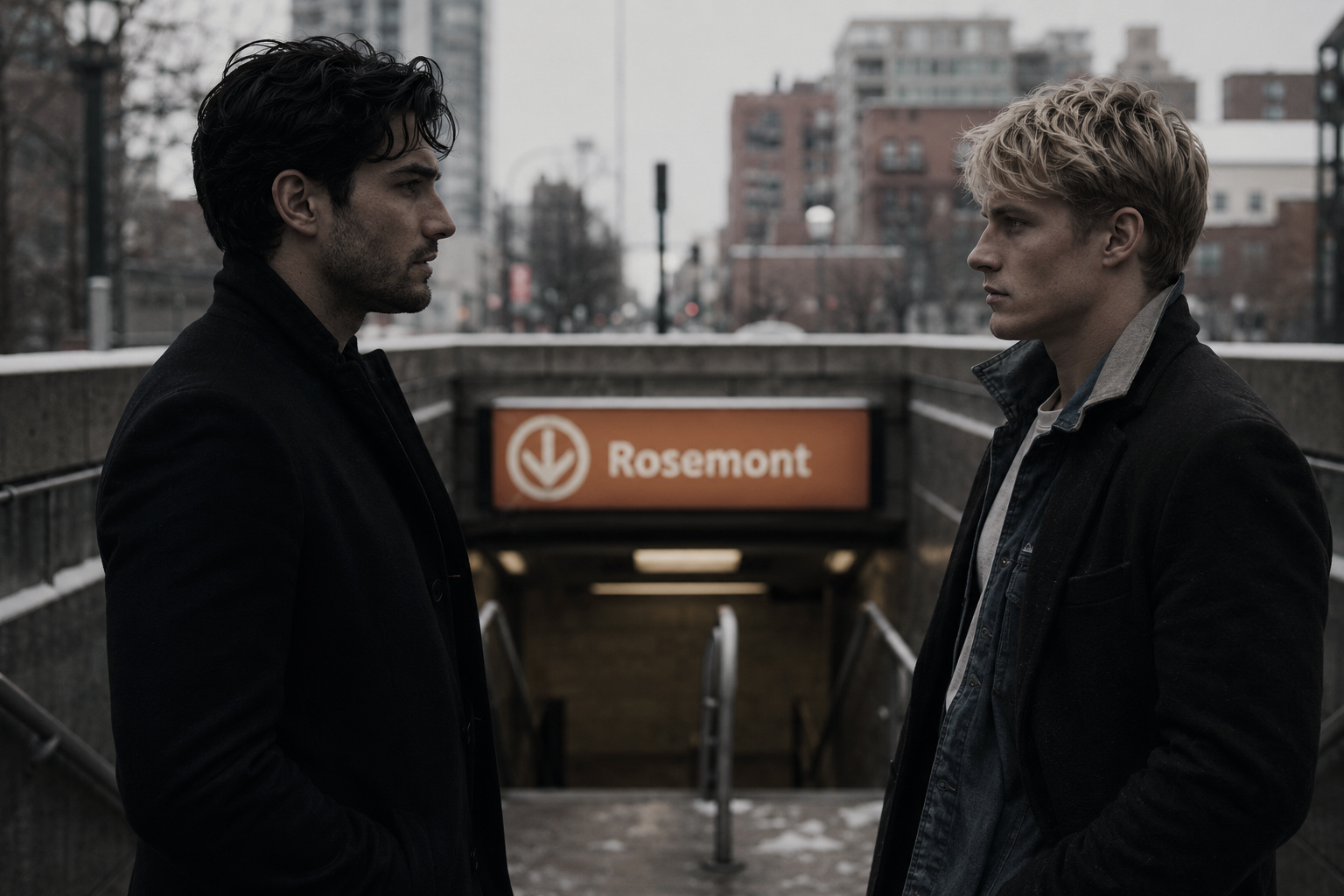
The train pulled into Rosemont-La Petite-Patrie. I climbed the stairs into the late-afternoon light, and Gabriel was there.
He was standing at the top of the stairs in a jacket he’d clearly grabbed without thinking. It didn’t match and the collar was half turned up. He’d come as fast as he could, and he was trying not to show alarm. The trying was visible because I’d known him since we were seventeen and still learning how to manage what we showed each other.
He assessed me for a long moment. Face, posture, the good clothes I’d dressed in this morning for a different life.
“You look like shit,” he said.
His tone was warm. The warmest thing anyone had said to me all day.
“That’s about right,” I said.
We walked to his car.

The apartment belonged to someone making a life without a net. Not precarious, Gabriel was too careful for precarious, but he built it by hand, piece by piece, imbuing it with the character of a space he assembled rather than purchased. The kitchen had things in it, a garlic keeper shaped like a rooster, mismatched mugs on open shelving, a cookbook propped against the backsplash with a tomato sauce stain on the spine. The living room had stacked books on the floor because the bookcase was full, and two plants that someone had tended with attention, noticing when they needed water.
Gabriel made pasta with the efficiency of someone who knows practical acts of care matter more than statements about them. He didn’t ask me what I needed. He put water on to boil and told me the shower worked better if you turned the handle left first, and towels could be found in the bathroom closet.
The shower was the first thing in twelve hours that required nothing from me. I stood under the hot water longer than necessary. The physical normalcy of it, the steam filling the small bathroom, the water pressure on my shoulders, the soap that smelled like cedar and something herbal, was relief so intense it unmoored me. I leaned my forehead against the tile and didn’t think about anything at all. The tile was cool and uneven, and the grout had a small crack in one corner I probably wouldn’t have noticed on any other day.
I emerged in borrowed clothes. Gabriel was close enough in size that the sweatpants and sweater fit, and we ate at the kitchen table. He’d made pesto from a jar his mother had sent, and the pasta was slightly overcooked in the way of someone who’d been distracted by the person he was feeding. It was the best thing I’d tasted all day.
Gabriel asked, for the first time, what happened.
I told him the complete version. He’d earned it by answering the phone, by saying twenty minutes without hesitation, by making pasta while I stood in his shower and remembered what it felt like to be in a body that wasn’t being assessed. He listened without interrupting, with the full presence I’d always associated with him. When I was young and didn’t yet know what I was allowed to want, Gabriel had been the first person who’d made me feel like wanting was permitted.
When I finished, he was quiet. Then he spoke.
“Your father played a long game and lost it, and you got left in the wreckage. That’s about the size of it.”
Not harsh. Accurate. Gabriel had always said the accurate thing without making it a weapon.
“What do you need most right now?”
I considered. I let myself genuinely consider what I actually needed, which was a muscle I hadn’t exercised all day. “To not make any decisions for about six hours.”
“I can do that.”
We cleared the table. I charged my dead phone in the corner by the window and messages came in as it powered back on. Several were expected. The student loan administrator again, an automated notice from my insurance provider, a news alert about the seizure with my father’s name in the headline. Two were not expected, neither requiring immediate response. I read them all and put the phone down.
The apartment was quiet. Not silent because the refrigerator hummed, and traffic passed occasionally on the street below, and the radiator clicked the way of things in old buildings. But quiet in the way of a space where someone lived actually, not performatively. I hadn’t been in this kind of quiet all day.

Gabriel’s Point of View
It began without a decision.
We were on the couch in the low light of early evening. I had turned on one lamp and left the rest of the apartment in shadow, and we’d been sitting close for a while. The way you sit with someone you’ve known since before you knew how to manage yourself. The gravity had always been there between us. It had been there at seventeen, when we’d learned each other’s bodies with the clumsy tenderness of boys who didn’t know yet what they could want. It had been there when we’d ended things not because it wasn’t working, but because we were heading in different directions, and we’d both known it, and the ending had been clean and sad and kind.
Now the gravity was still there. Doing what gravity does when resistance stops.
The kiss was a question I’d been asking all night, and Alex’s mouth was the answer, finally given. My hands acted on a memory of their own, skating the worn flannel of his shirt, charting the dip of his lower back, the hard shelf of his shoulder blades. The fabric was soft from a thousand washes, a little frayed at the cuff. It smelled like detergent and under that, him. I pulled him into me, and the solid fact of his body knocked a thought loose. *This is happening.
I took control of the kiss not because I planned to, but because I couldn’t resist. My hand found the back of his head, my fingers threading into the dense, dark thicket of his hair just above the nape, cradling the weight of his skull. I felt the slight give of his body, a surrender that wasn’t weakness but permission. He wrapped his arms around my neck, linking his wrists, and the simple, trusting form of the gesture did something to my chest. A tightness I’d been carrying for months relaxed all at once. I couldn’t name the feeling. I just felt my rib cage expand an inch.
His mouth opened, a soft parting of his lips that was as much a sigh as an invitation, and my tongue swept in. The taste of him was a shock of clarity. Dark coffee and something sweeter underneath, something private. A soft, guttural sound vibrated in his chest, and I swallowed it. I was already hard. The pressure in my jeans was a blunt, urgent fact, a purely physical demand. His hips recognized the shift in the conversation before my brain did. He started to move, a slow, searching gyration against my thigh that sent a white-hot wire of need straight to the base of my spine.
We were grinding our cocks together through two layers of denim, a clumsy, perfect rhythm that felt like a language we were inventing on the spot. He was finding his groove, a fluid roll of his hips that was both sweet and filthy. My lust, which had felt like a slow, banked fire, went up in a sheet of gasoline. My hand in his hair tightened, my tongue pushed deeper, my whole body turning into a single, driving engine. I wanted to consume him. He must have felt it, the sudden shift in pressure, the edge of aggression. And he didn’t just match it. He beat me at my own game.
His hips started rolling faster, a focused, expert pivot that dragged his cock along the full, aching length of mine and pushed a grunt out of my lungs and into his mouth. “Fuck.”
He pulled back just enough to break the seal of our lips. The sound it made, a wet, intimate click, was obscenely beautiful. I opened my eyes, my lids heavy, and his face was a study in my own destruction. His pupils were dark, the warm brown of his irises reduced to a thin, dark ring. His lips were parted, slick and swollen, glazed with my spit. I could see a thin string of it connecting his bottom lip to mine for a second before it snapped. It was the single most arousing thing I’d ever seen. A primal, possessive thought surfaced. I did that. He’s wet because of me.
He dropped. There was no transition, no graceful descent. He just folded, his knees hitting the cheap rug with a soft, muffled thud. I watched him fumble for my belt, his usually deft fingers all thumbs, clawing at the leather, at the brass buckle. My cock was a second heartbeat trapped behind the zipper, and I was no help. I just sat there, holding his jaw in one hand, kissing the top of his head, breathing in the scent of his shampoo. The waistband of his briefs, dark blue, was peeking over the top of his jeans, a single damp spot spreading at the tip. I was soaking him without even touching him.
He finally won the battle with my belt, yanking it free of the loops and flinging it. The brass buckle chimed against the leg of the couch. He looked up at me, his eyes wide and waiting.
“Suck me,” I said, or the thing that was driving my body said. My voice was low, scraping bottom, a command with no preamble.
He nearly tore the button fly apart. He yanked my jeans and boxer-briefs down to mid thigh in one rough pull. My cock sprang up, liberated, heavy and rigid, slapping my stomach just above the navel with a wet, fleshy sound. I had half a second to feel the cool air of the room on the slick head before his mouth was on me, a wet, tight, enveloping heat that made my knees threaten to buckle. A long, broken groan clawed its way out of my chest.
“That’s it,” I heard myself say, my fingers stroking his hair, my thighs falling open wider to give his working shoulders more room. “Suck that big cock.”
He took me deep, so deep I felt the head of my cock bump the back of his throat and start to slip past. I heard him gag, a wet, constricted, desperate sound that shook his whole body, but he didn’t pull off. He just breathed hard through his nose and pushed his limits, making a gorgeous, sloppy mess. He was painting my groin with his own spit. I felt a string of it break and trail, cooling, down the inside of my thigh. His tongue was a separate creature, a wild, curious animal, tracing the thick vein on the underside, lapping at the sensitive divot just beneath the head.
He paused, my cock still filling his cheek, and his eyes rolled up to meet mine. They were already going red-rimmed and glassy. “Look at me,” I whispered, my thumb tracing the stretched corner of his lips. “I want to see you.” He hummed a low note of agreement. I felt the vibration in my balls. It was a promise. And then he smiled, as much as a man with seven inches of cock in his mouth can smile, and the sight of it, that little secret smile around a mouthful of me, was a blessing.
“Jesus,” I breathed out. “It’s been . . . it’s been a while.”
I started to fuck his mouth. I couldn’t help it. The sight of him on his knees, taking it, asking for it, broke something loose. I held his head, my thumbs solid above his ears, my fingers laced at the back, and I started to rock my hips, a slow, deep, balls-deep glide. A growl built in my chest. “Your eyes are so fucking red,” I grunted, my gaze locked on his. “All that water pouring down your face. You’re a wreck.”
He pulled off just far enough to speak, the tip of my cock resting on his lower lip. “Thank you.” His voice was a ruined rasp. Then he ducked his head and started lapping at my shaft again, a series of long, loving, open-mouthed kisses.
“I’m going to come,” I said, the words dragged out of me. “But not in your throat. Not yet. I asked if you wanted that, but . . .”
“You can put your cock anywhere, Gabriel,” he said, his voice muffled against my skin.
I pulled him up by his hair, not hard, just enough to direct. “I want your ass, Alex. I want to fuck your ass. Let me?”
He swallowed hard, his Adam’s apple bobbing. His eyes were dazed but certain. “Yeah,” he breathed. “Yes.”
“I’ve imagined this since the second I saw you today,” I confessed, the words coming out in a rush, hot against his mouth. “A do-over for high school.”
“Lube,” he said, and it was an awkward, practical word in the charged air, but it was also the sexiest word I’d ever heard. “Where . . . where is it?”
“Bedroom,” I said, jerking my head. “Nightstand drawer.”
He scrambled up, took one step, and immediately spun the wrong way, a perfect, 360-degree pirouette of pure, horny disorientation. His face flushed, his hair was a riot, and his cock was a solid, leaking bar in his briefs.
“Through there,” I said, laughing softly, pointing at the door right behind him. “Nightstand. Can’t miss it.”
He was gone and back in a blur of time. I kicked off my jeans and sprawled on the couch, naked, with one arm behind my head and the other loosely stroking my own wet cock. I saw him stop dead in the doorway, the small, utilitarian bottle of off-brand lube clutched in his hand. He was staring at me. I could see his heart slamming against the wall of his chest, see his breath go shallow. This was for him. All of this hungry, naked want was for him. I saw the thought hit him, felt him accept it, and the shift in his posture was a gorgeous thing.
“Strip,” I commanded, and it was a direct, pointed word. I saw a wave of dizziness pass over his face. His eyes fluttered shut for a second.
He laughed, a short, nervous, joyful exhalation. “Okay.” He pulled his sweater over his head, shucked his sweats and briefs in one clumsy movement, and stood there, fully hard, his cock a beautiful, flushed, up-tilted curve that mirrored mine.
“Damn, you’re a pretty man,” I said, letting my eyes roam from his solid feet to his strong thighs to the flat expanse of his stomach. “Turn around.”
He did. The muscles of his back shifted, his ass a twin curve of solid, pale muscle.
“Damn beautiful,” I corrected myself. The tops of his ears burned pink.
“Look at you,” Alex said over his shoulder. His gaze raked me, the raw appreciation in it a physical caress.
“Yeah?” I smirked. “You like what you see?” I gestured with my chin toward his jutting cock. “I can tell.”
“Well, that’s . . . horrifyingly clear, I guess. Yeah.” He was awkward, charmingly so.
“Come here,” I said, my voice softening, the command dropping into an invitation. “Come let me mount you.”
He didn’t just walk, he rushed, crossing the room in three strides and landing right in my lap, straddling me, his solid thighs gripping my hips. My mouth found his again, and a deeper conversation ensued, full of gratitude and relief and a pure, unrelenting hunger. He reached between us, his big, warm hand wrapping around both of our cocks at once. I felt the slickness of pre-cum smear between us. He stroked. I grabbed the lube from his other hand, fumbled the cap open with my teeth, and squeezed a cold, viscous drizzle over his knuckles. The scent was a flat, chemical, vaguely floral nothing of cheap lube, the kind you buy at a corner store. It didn’t matter. The wet sound it made in his hand as he started gliding his fist up and down our shafts was the only music I needed. His cockhead butted against mine, a clumsy rub of two too-sensitive, too-swollen, velvet-skinned things.
I bit his lower lip, pulling on it before releasing it. “I need to be in you. Now.”
He shuffled up, his thighs tensing, and his slick hand guided me to his entrance. He sank down. Slow. So goddamn slow. I watched his face, the way his mouth fell open in a silent, perfect ‘O’ of delicate pain, his brows knitting together. I felt the ring of tight, searing muscle stretch around my invading crown, the fluttering clutch of his body trying to decide if I was a threat or a promise. My hands found his waist, gripping the hard bone of his pelvis.
“Better than I ever thought,” I whispered against his lips, my voice shaking. It was true. The fiction of my imagination was a pale, watery thing compared to this dense, hot, impossibly tight reality. I kissed him, soft, feather light, as he took the next inch, the kiss both an apology and a plea. His face was a careful mask, his jaw tight. He was powering through it, I could tell, fucking himself on me to get to the other side of the glass.
“Ride me,” I told him, my voice finding its command again. “Let it happen.”
He let his hips answer. He started slowly, a cautious, rocking motion, a gentle slide that dragged me out of him just an inch before pulling me back in. The friction was a maddening, liquid fire pleasure. My head fell back. I was just a knot of sensation, anchored by the tight grip of his body. He found his confidence, his rhythm switching gears. His pace started to build, the cautious glide turning into a full-fledged ride. He was bouncing on my cock now, a wild, untamed, bucking-bronco ride, his ass slapping down on my thighs with a flat, sharp sound.
“Yes,” I snarled, my hands living on his hips, guiding the force but not controlling it. “Ride that cock. Use it.”
He swiveled, a hip gyration that was all instinct and zero self consciousness, and I felt the head of my cock nudge against a distinct, swollen little mound deep inside him. He screamed. Not a moan, not a whimper. A genuine, thin, high scream of pure bliss. His whole body clenched around me. I was happy to just be inside him, to be the tool for his bliss, to watch. I let him take the lead, my hands resting on his thighs, feeling the powerful ripple of his quadriceps as he worked himself on my length. I felt my cock swell inside him, that final, unstoppable prelude to orgasm. My grip on his hips tightened, my fingers digging into the flesh hard enough to leave marks.
“My turn,” I growled.
I locked my arms around his back and stood up in one fluid motion. I impaled him on my cock, his full weight sinking him down to the root. He gasped, his arms and legs scrambling to hold on.
“Wrap your legs,” I commanded, and his ankles locked behind my lower back. I was standing, feet planted wide, holding all of him with nothing but my arms and my cock. I thrust up, a deep, solid, pile-driver stroke that punched the air out of his lungs in a ‘hoo’ sound. His ass was a perfect tight, hot weight in my hands. I hooked my fingers in the split of him and spread his cheeks wide, opening him for a deeper entry, trying to get another inch when I had no more to give. I was determined to fuck him into next week. I thought of my cockhead kissing the base of his lungs and I laughed into the sweat-slick skin of his neck.
“What?” he gasped.
“Nothing. I’m just . . . deep.”
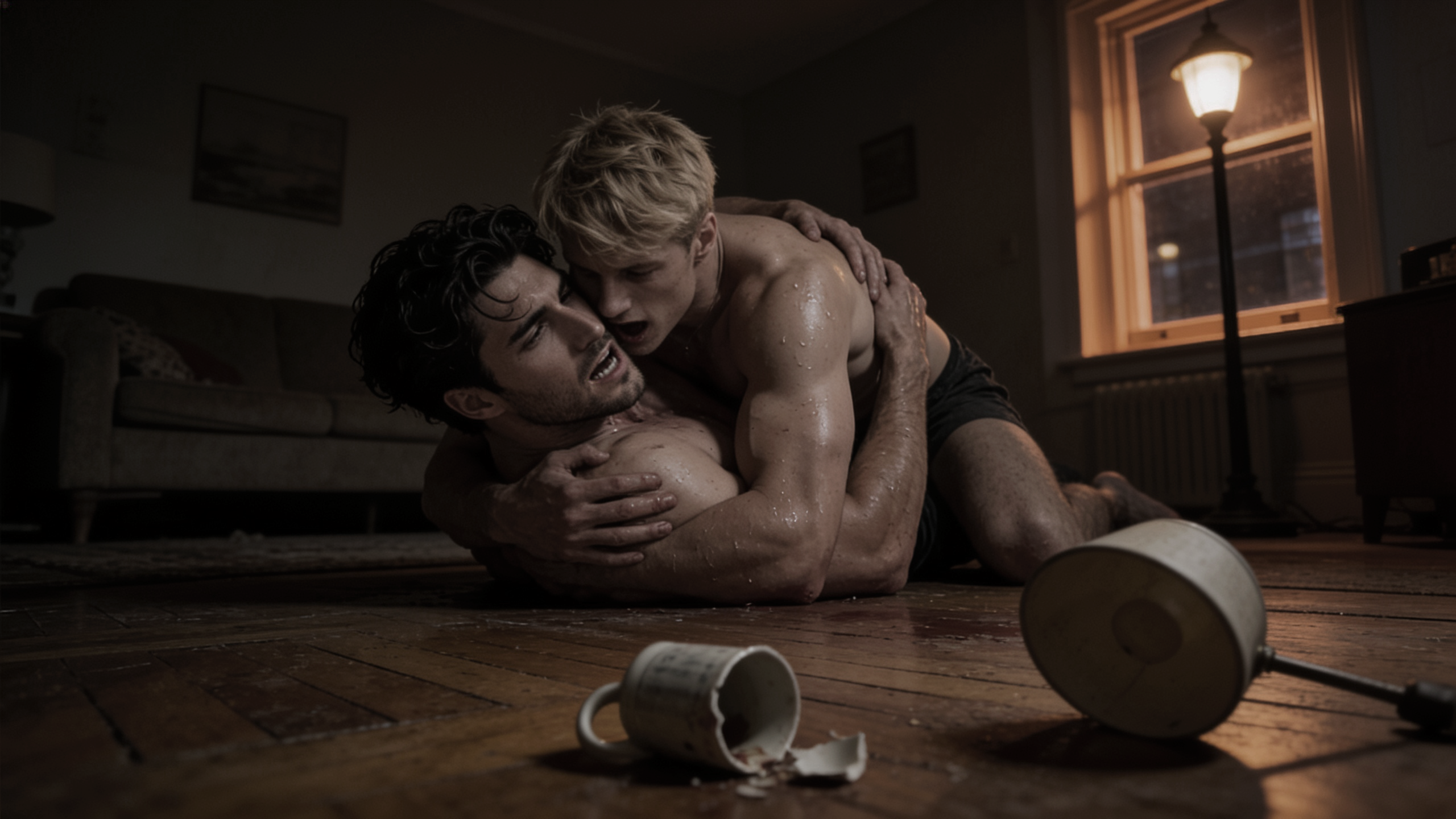
He laughed with me, a breathless, crazy sound. I needed to change the angle. The couch was too soft. I walked us the four steps to the heavy oak table near the window. Without a word, I swept my arm across the surface, sending a lamp and a half-empty mug of cold tea crashing to the floor. The ceramic shattered. Neither of us looked. I laid him down on the cool, hard wood, his sweat-damp back squeaking against the polished grain. I took his ankles and hoisted them onto my shoulders. He was bent in half, folded and presented, his hole a wet, red, worked-over little mouth, begging me.
I railed him. I fell into a pure, animalistic, no-thought-no-future rhythm, my hips a metronome from hell, slamming my dick into him as deep and as hard as the structure of our bodies would allow. The wet, slapping sound was obscene, the smell of sweat and cheap lube and raw sex thick enough to swim through. Alex’s face was a canvas of obliteration. His eyes rolled back, the whites showing.
“God, yes, look at you. Ruin me, Gabriel. Please.” His words were a garble, a prayer.
“You like it this rough?” I didn’t even know my own voice.
“I don’t know. Just go. Just do it.”
I felt a grin split my face, a ferocious baring of teeth. “I’m not even going half as hard as I want to.”
I unleashed it. A torrent of piston-fucking, jackhammering his prostate with the blunt, insistent head of my cock, making him whine like a wounded animal. I kissed him, forcing my tongue into his mouth to swallow the sound, to give him something to do with his teeth. “Take my cock,” I groaned into his mouth. “Just fucking take it. That’s it. Good boy.”
He was gone, his body a conduit for this brutal, beautiful rhythm. I lifted him from the table again, his legs clamped around my waist, and we slid to the floor in a pile of tangled limbs. The hardwood was cold and unforgiving against my knees, a hard, grounding fact. He wrapped his arms and legs around me, and we were just one knot of flesh and frantic motion on my floor, kissing with desperate, uncoordinated hunger as I fucked him into the ground.
I felt the heat pooling at the base of my spine, the tightening in my balls that signaled the end.
“Inside,” I grunted, my face buried in his neck. “Can I? Alex?”
“God, yes,” he begged, his voice cracking. “Please, Gabriel. Fill me up.”
The permission was all I needed. With a deep, guttural, animal roar that I felt tear from my diaphragm, I came. The ecstasy was a white-hot detonation at the tip of my cock, pumping rope after thick, hot rope of cum deep into his clenching insides. I felt my pulse in my eyelids. I felt my face go slack, all the tension draining out with the jets of my release. I collapsed, a dead weight, my body a blanket over his, my cock still pulsing, still kicking, buried inside him.
He was content. I could feel it in the limp, satisfied weight of his body beneath mine. My load was inside him, a warm, liquid secret that marked him as mine. I lifted my heavy head and kissed him with a slow, deep, grateful kiss.
“That was amazing,” I whispered against his mouth.
But I wasn’t done. I was still inside him. “Your turn,” I said. “I want to feel you come. With me still in you.”
Alex’s Point of View
My brain was offline. Gabriel’s kisses had knocked it offline faster than anything Michael had ever done. It was a smooth, warm, static-hum of bliss. I was a receptacle for his commands. His voice, low and still ragged from his own release, told me what I needed. He was still inside me, a thick, softening, living plug, and he pulled my hips closer against his. A pure, electric shot of greed fired through my belly.
My hand found my cock, so hard it was an agony, so slick with my pre-cum it was practically weeping. I grabbed my balls with my other hand, pulling them tight up against the root of my shaft. I was slick and desperate, my fist a blur. I looked at him. His face was hovering just above mine, his lips parted, his eyes heavy lidded but sharp, watching my hand with a predator’s focus. The dim light carved the muscles of his shoulders and chest, glazed in a patina of our shared sweat. He was the most beautiful thing I’d ever seen in that moment. A warm, syrupy feeling, a mix of gratitude and pure, aching worship, flooded my chest.
The orgasm wasn’t a climb. It was an ambush. One second I was watching him, my fist flying, and the next, my vision failed. I felt the first hot, thick spurt hit my stomach just below the navel. A second volley landed on my chest, a thick, white rivulet catching in the shallow valley between my pectoral muscles. The rest was a pulsing, throbbing, draining satisfaction, a hot splash spreading across my abs. I was making a mess all over myself while his cock still buried itself inside me, and the thought was the peak of the pleasure.
Gabriel watched, his expression a mask of dark fascination, and then he leaned down and kissed me, a soft seal on the whole, sacred act. “Good boy,” he murmured.
I felt him withdraw. The slow, slick, sucking sound of it was both a loss and a profound relief. I felt an unfamiliar, foreign emptiness, a space he’d just left. And then a slow, warm trickle started to leak out of me. His load. I smiled, a stupid, lazy, fucked-out smile.
Gabriel collapsed onto the floor beside me in a long, boneless sprawl. Our shoulders were touching.
“I’m not going to be able to sit down for a week,” I said to the ceiling. “Best. Thing. Ever.”
He let out a breathy, exhausted laugh. “I don’t think I’ve ever fucked anyone . . . that hard. Like that.”
I turned my head, the bare wood floor cool against my cheek. I looked at his profile, the Roman nose, the soft lips. “No one has ever fucked me that hard,” I said, the truth of it solid and new.
Happy. The word was too small, a pale, pastel thing for this. I felt like the air after a thunderstorm, washed clean, humming with a low, satisfied electricity. I closed my eyes, feeling the mess cooling on my stomach, the deep ache deep inside, and the solid, warm presence of the man beside me.
Afterward, we were both on the floor in low light. Neither of us spoke for a while. The ceiling was white and slightly cracked in one corner, and the streetlight outside cast a pale orange rectangle across the far wall. My body felt like my own. A small miracle after a day of being a problem to be solved.
Gabriel spoke first. His voice was careful, present, and honest in a way that he had prepared while I wasn’t looking.
“Alex.”
I waited.
“I need to tell you something before you start thinking about next week.” A pause. “You can stay here. For now. A few days. Maybe a week.” Another pause, longer this time. “But I can’t protect you from the kind of attention you’re about to have. I’m not in a position to do that. I have people I’d be putting in a bad situation.”
He stopped. “I should have said this before. It probably should have been the first thing I said, and it wasn’t, and I’m sorry for that.”
I looked at the ceiling. The crack ran from the corner of the room to the light fixture, a thin dark line I could barely make out in the dimness.
“No,” I said. “It was right.”
“It wasn’t.”
“It was what I needed. And it was right. Those aren’t in conflict.”
I meant it. Gabriel heard it. Some weight I couldn’t name came off his face. A guilt he’d been holding that I hadn’t known was there to release.
“I’ll help you figure out the next step,” he said. “I have some people I can call. There might be options you haven’t considered yet.”
He didn’t specify. He would later, when the option had a name and a price and a shape I couldn’t yet imagine.
We lay in the dark. My phone was charging in the other room, its screen dark, its notifications waiting. I’d decided not to look at it until morning. The only decision I’d made all day that was exclusively about myself.
Gabriel said, near sleep, in the quiet voice of someone who believes what they’re saying and means you to believe it too, “You’re going to be okay. Not soon. But eventually.”
I didn’t answer. I wasn’t certain it was true. Everything I’d lost in the last twelve hours was still lost, and the shape of whatever was coming next was a shape I couldn’t yet see. But the words carried genuine belief, and genuine belief, in this borrowed apartment in this city that had abruptly become unnavigable, was not nothing.
I closed my eyes.

End of Chapter Two.