
Two bartenders make a bet to seduce the same enigmatic stranger, but the real game is the years of simmering tension between them that neither has dared to name. As their strategies force them to drop their armor, the scholar revealing his heart, the charmer admitting his loneliness, every brush of shoulders behind the bar becomes a confession. Who you really want may have been standing beside you all along.

Marcus
The black door on Mercer Street doesn’t have a sign. It doesn’t need one. The people who find Holloway are the people who are supposed to find it—a self-selecting clientele of beautiful neurotics and successful insomniacs who understand that a door without a name is a promise, not a barrier.
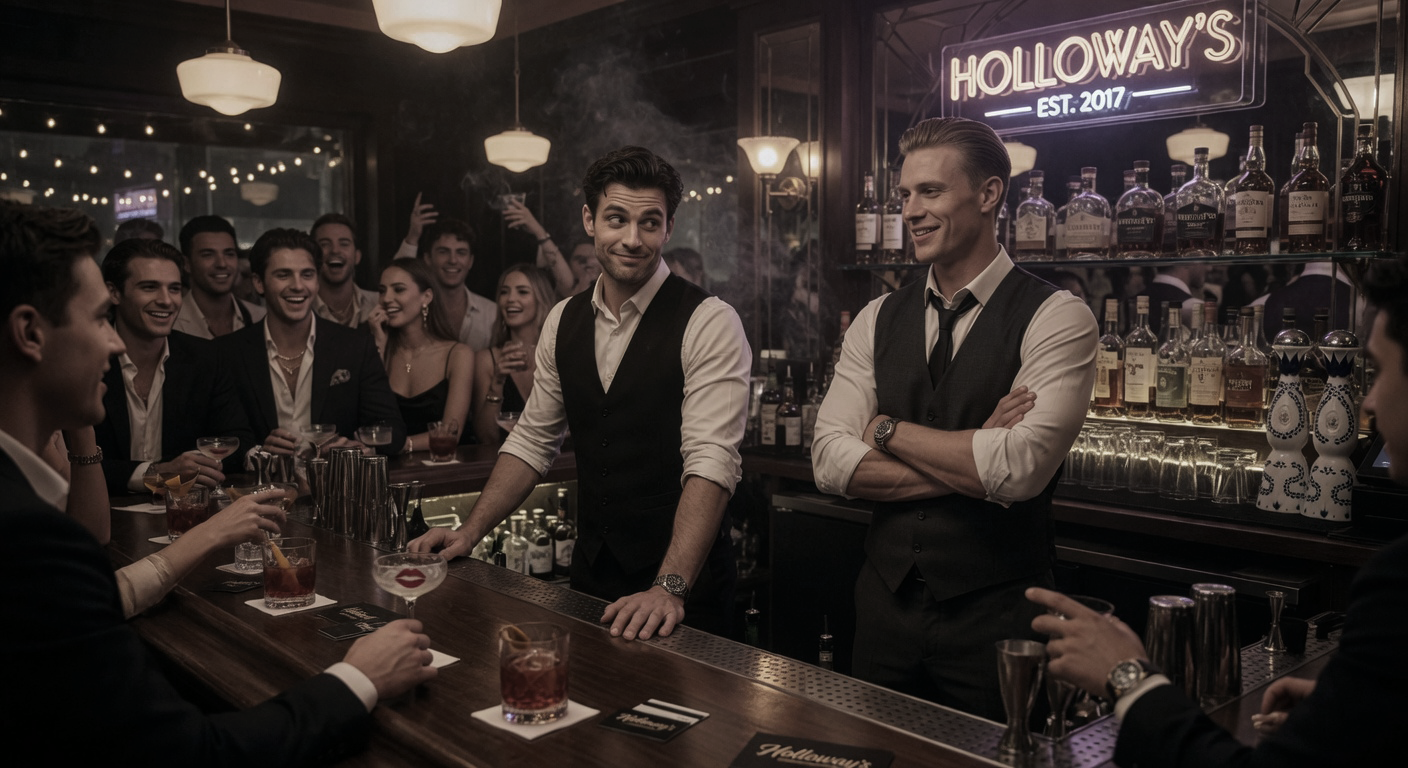
I pushed through at seven-fifteen on a Friday, nodded at the hostess, and felt the familiar shift in my ears before anything else. Holloway lives underground, a former speakeasy renovated to within an inch of its life. Exposed brick, velvet banquettes the color of dried blood, a backlit bar of black marble that seems to float on its own reflection. The neon EST. 2017 sign hummed above the liquor shelves, a low, amber thrum that settled into my chest the way the first note of a familiar song does. I have spent more of my adult life inside this room than in my apartment. The fact had never once struck me as depressing. That, I recognized, should probably have struck me as something.
Leo was already behind the bar, polishing glassware. He got there early on Fridays. He said it was to warm up. I thought he just liked the quiet before the noise started. The way the empty room held the light differently, softer, like a theatre before the house opens.
“Cole.” He didn’t look up. “You’re wearing the navy suit.”
“I always wear the navy suit.”
“On Fridays you wear the charcoal.” He set a highball glass on the rack. The click was soft, precise, the sound of a man who had done this ten thousand times and still cared. “Don’t think I don’t notice.”
I slid my bag under the well and began rolling my sleeves. “You’re unsettlingly observant for a man who can’t remember which mezcal we stock.”
“Del Maguey Chichicapa. Top shelf left, two bottles back.” He looked at me then, and the full wattage of his smile hit me with its usual disorienting force. “I remember the important things.”
A committee with a very specific agenda seemed to have designed Leo Vance. Broad shoulders, a swimmer’s back, thick dark hair that never quite stayed out of his eyes, and a mouth that defaulted to a smirk. My polar opposite in every physical particular, which was why our regulars found us such an amusing set. The scholar and the athlete. The tie and the rolled sleeves. I had made my peace with being the before in a before-and-after photograph.
“You look tired,” I said.
“I look gorgeous. But also tired.” He rubbed the back of his neck, a familiar gesture I had catalogued years ago and never quite stopped cataloguing. “Late night.”
“Anyone I know?”
“Just me and my thoughts. Terrible company, both of us.”
I didn’t press. Four years beside him had taught me which doors were locked and which were merely closed. This one was deadbolted. Leo’s late nights alone were a subject he deflected with the same reflexive grace he used to catch a falling bottle. A small pivot, a flash of the smile, and the conversation was elsewhere before you noticed it had moved.
The first guests trickled in around eight. Holloway doesn’t serve food beyond a few minimalist small plates. Olives, charcuterie, a cheese board that costs more than a tank of gas, so people arrive late and stay late. Leo and I fell into our rhythm without discussion, the way we always do. He worked the well. I worked the service tickets. We orbited each other in the narrow galley behind the bar, passing bottles and towels with the wordless choreography of a long partnership. A shoulder tap meant behind you. A glance at a half-empty glass meant refresh in two minutes. A raised eyebrow meant this one’s trouble. It was a language built on years of shared crisis and shared victory, and it was, I sometimes thought, the most functional relationship of my life.
Someone took the photograph around ten.
I was muddling mint for a Southside when I felt Leo go still beside me. Not a pause. A stillness. The difference was something you learned to read, like the change in air pressure before a storm. He was staring out at the bar with an expression I couldn’t name. Wistful, perhaps, or tired in a way that went deeper than sleep. The light caught the line of his jaw, the slight furrow between his brows, and the glass in my hand felt suddenly heavier.
I opened my mouth to ask if he was all right.
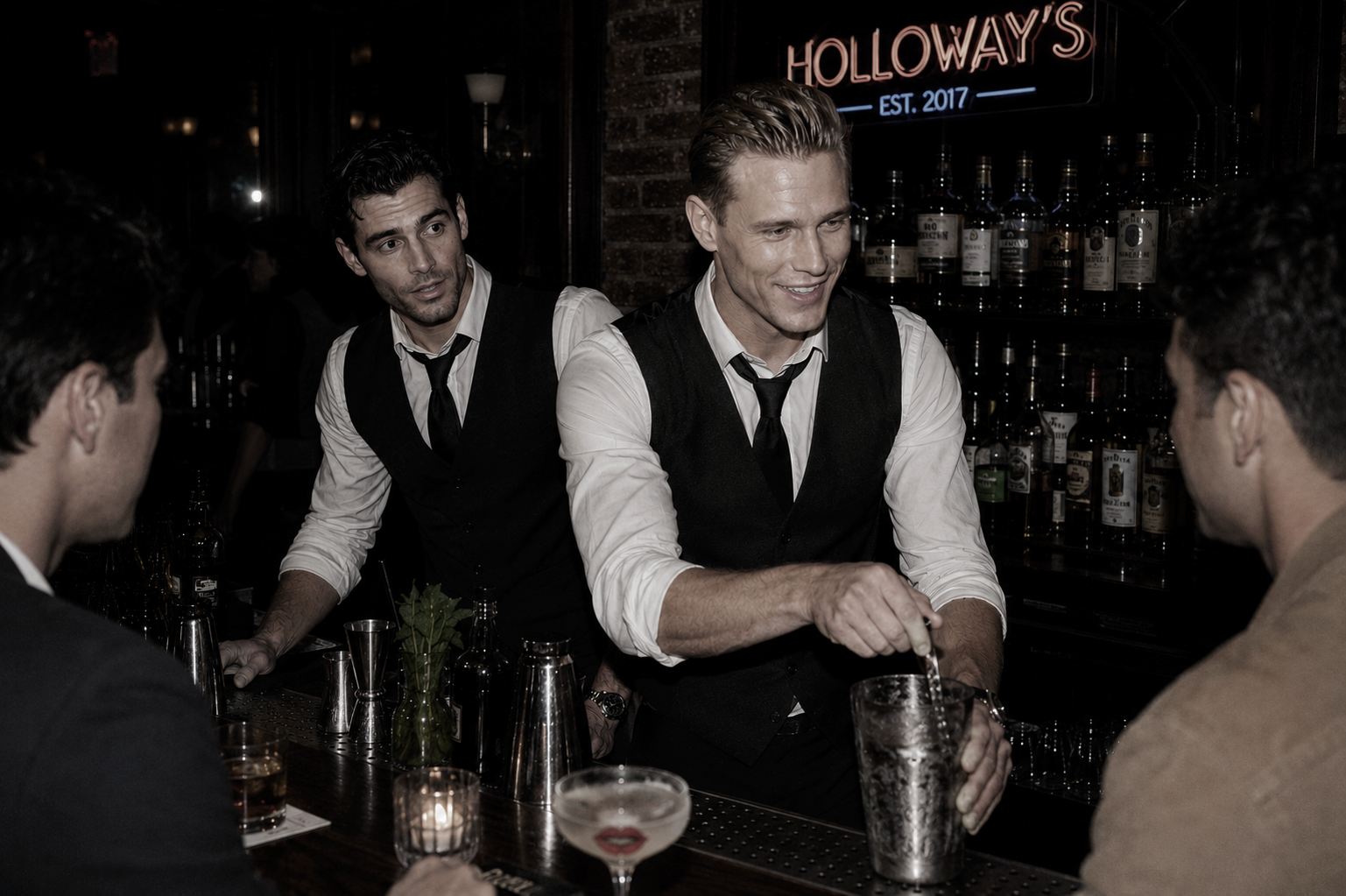
A flash exploded from one of the booths.
Leo blinked. “Did someone just take our picture?”
“A regular, probably. You know how they are.” I returned to my mint, but my hands were a little unsteady, and I couldn’t have said why. “We’re part of the ambience. We’re essentially furniture.”
“Sexy furniture.”
“Please never say that again.”
But the moment lingered, the way certain unremarkable moments do, for reasons that only become clear later. I filed it away.
I file everything away. It’s what I do.

Leo
So here’s the thing about working with Marcus Cole. You get used to it.
You get used to the way he stays three moves ahead, playing chess while the rest of us play checkers. You get used to the dry little comments he drops under his breath, the ones only you can hear, because he trusts you to catch them. The way he stands, spine straight and shoulders back as if about to receive a medal, and the precise, almost surgical movements of his hands. No wasted gestures, no idle fidgeting. You get used to the quiet he carries, the way he can stand right next to you and still feel like he’s observing the room from a distance.
You get used to it, and then some Friday night you look over at him and a stranger’s camera flash goes off and you realize you’ve been staring at his profile for entirely too long. The line of his jaw in the amber light. The concentration in his hands.
And you have no idea why.
The Southside was fine. Marcus always makes perfect cocktails. He could muddle mint in his sleep and produce something balanced and chilled and aesthetically impeccable. It’s infuriating.
I slipped back to pouring. That’s my job on Fridays. I handle the bar guests, the ones who want to watch their drinks being made and flirt a little with the bartender. Marcus does the service tickets because he’s faster and more organized and, if we’re being honest, above the messy business of flirting. Not that he can’t flirt. I’ve seen him do it. It’s terrifying. He doesn’t use charm the way I do, heat and a well-timed compliment, the suggestion of possibility. He uses attention. The kind that makes you feel like the only person in the room. He remembers your name, your drink, the thing you mentioned three weeks ago about your mother’s hip surgery, and he folds it into the conversation so smoothly you’re halfway in love before you realize what’s happening.
I’ve never seen him use it to actually take anyone home, though. That’s the thing about Marcus. All precision and no follow through. Like a surgeon who loses interest after the incision.
Around eleven, a woman at the bar asked for something smoky but not aggressive. I made her a Mezcal Negroni and talked her through the build. She leaned in, touched my wrist, and laughed at something I said. Standard stuff. I let her touch my wrist. I’m good at letting people touch my wrist.
Out of the corner of my eye, I saw Marcus watching. Just for a second. Then his attention snapped back to the ticket rail.
I felt a sharp, unidentifiable pang. I decided it was hunger. I hadn’t eaten dinner.
That was probably it.

Marcus
The photograph appeared on Instagram the next day. Chloe, a fashion publicist who spends more on cocktails than I spend on rent, had tagged us both. The dream team, she’d captioned it. Holloway’s finest doing what they do best.
The image was good in an accidental sort of way. Leo and I caught mid-glance, the bar’s amber glow cutting our faces in half, light and shadow. There was something conspiratorial in the angle, a suggestion of shared secrets. I stared at it for longer than was reasonable. My coffee went cold in my hand.
“You’re mooning over the thirst trap,” Leo said, appearing over my shoulder. He was wearing a t-shirt that had seen better decades, his hair still wet from the shower. He smelled of cedar soap and something I refused to name.
“I’m not mooning. I’m assessing.”
“What’s the verdict?”
“That you should get a haircut.”
He laughed, that unguarded bark of his that always caught me off guard. “You’re such a liar, Cole. You love my hair.”
“I tolerate it. There’s a difference.”
I saved the photograph to my phone anyway. For the archives. I’m a cataloguer.
It’s what I do.

Leo
The slow Tuesday was Marcus’s fault, or maybe mine, depending on how you look at it.
Tuesdays in late January are always dead. The holidays are a distant memory, the resolutions still technically in effect, and nobody wants to be seen drinking alone on a weeknight in the dead of winter. Outside, the cold had turned Mercer Street into a wind tunnel, and the few people who passed the door had their collars up and their hands jammed in their pockets. Inside, the bar felt suspended, out of time.
Marcus and I were polishing glassware, there wasn’t even a bar guest to ignore, and entertaining ourselves with a meandering argument about whether shaking a martini was ever a good idea.
“Chemically indefensible,” Marcus said for the third time. He was holding a coupe glass up to the light, inspecting it for water spots with the intensity of a man reading a contract. “Shaking aerates the gin and bruises the botanicals. You’re mutilating the spirit for the sake of temperature.”
“Sometimes you want a little mutilation.” I held up a highball, buffed out a smudge. “Sometimes the rules are boring.”
“Spoken like a man who’s never taken a chemistry class.”
“Spoken like a man who’s never had fun.”
Marcus opened his mouth to retort, but the black door swung open and Adrian Hale walked in.
We both forgot what we were arguing about.
Adrian Hale. The Architect. I’d been at Holloway for four years and he’d been a regular for at least two. Always alone. He took the corner booth beneath the EST. 2017 sign and ordered Old Fashioneds with no ice and no cherry. Thirty percent tips, rain or shine. He was handsome in a way that made me feel like I’d missed a lesson somewhere, a kind of elegance I couldn’t replicate or disarm. Silver at the temples, dark eyes that held the light without reflecting it back, a stillness that made you want to lean closer just to check if he was real.
He was also, famously, impossible.
I’d seen people try. God, I’d seen people try. Beautiful women, beautiful men, people who were very accustomed to getting what they wanted. They’d approach his booth with some pretext. A compliment on his watch, a question about the building, and he’d receive them with flawless courtesy and an absolutely unbreachable boundary. They’d retreat a few minutes later, confused and faintly aroused, and he’d return to whatever he was sketching in his notebook as if they’d never existed.
“Look at him,” I said, watching Adrian settle into his booth with the usual ritual. Jacket off, cuffs adjusted, notebook open, the small, economical signal to the server. “What do you think it would take?”
Marcus followed my gaze. “To do what, exactly?”
“To crack him. Get past the walls. Be the one person he actually looks at.”
Marcus was quiet for a moment. He was looking at Adrian with the expression he gets when he’s solving a problem, turning it over in his mind like a puzzle box. “It would take something genuine, I suspect. Something that isn’t a performance.”
“Everything’s a performance.”
“Not to him.” Marcus set down his glass and turned to face me fully. “That’s the interesting thing. He refuses to take part. He’s the only honest person in the room.”
A prickle ran down the back of my neck. Marcus was looking at me with a strange intensity, the way you look at a crack in the ceiling and wonder if it’s new or if you’ve just never noticed it before.
“What if we made it a bet,” I said.
“A bet.”
“Which one of us can get Adrian Hale into bed first. Loser covers the winner’s shifts for a month. Permanent bragging rights.”
Marcus’s expression didn’t change, but something flickered behind his eyes. Alarm, maybe, or interest. With Marcus, it’s always hard to tell. “That’s a terrible idea.”
“That’s not a no.”
He stared at me for a long moment. Then the corner of his mouth lifted, the dry, private smile he reserves for moments when he’s about to do something he knows he shouldn’t. “You’re proposing we seduce a stranger for sport. Isn’t that a bit predatory?”
“We’re not predators. We’re enthusiasts.”
“You’re an enthusiast. I’m a connoisseur.”
“Same thing. Better branding.”
He laughed, a short exhale that wasn’t quite surrender but was leaning in that direction. “A month of shifts. That’s a significant stake.”
“Scared?”
The word landed. I saw it land. Marcus’s jaw tightened, just a fraction, and I knew in that moment that I’d won. Not the bet. The argument.
“You’re on,” he said.
We shook on it. His grip was firm and dry, exactly as long as a professional handshake should be, and yet I felt it in my chest, a low thrum like a bass note through the floorboards.
Something is starting, I thought. Something is starting and I haven’t thought it through.
I never think things through. It’s my defining flaw.

Marcus
I agreed to the bet because I am an idiot.
No, that’s not fair. I agreed because Leo was looking at me with that blend of challenge and delight that always made me a little irrational, and because the alternative—admitting that the idea made me deeply, inexplicably uncomfortable—would have required an explanation I didn’t have. Easier to play along. Easier to treat it as a game.
I am exceptional at games. I spent six years in academia learning to play them at the highest level. I can close-read a text, deconstruct an argument, spot the fatal weakness in the first paragraph. How different could a person be?
I found out three days later.
Adrian returned on Friday, as he always does, and I made my first move. I had a plan.
I always have a plan.
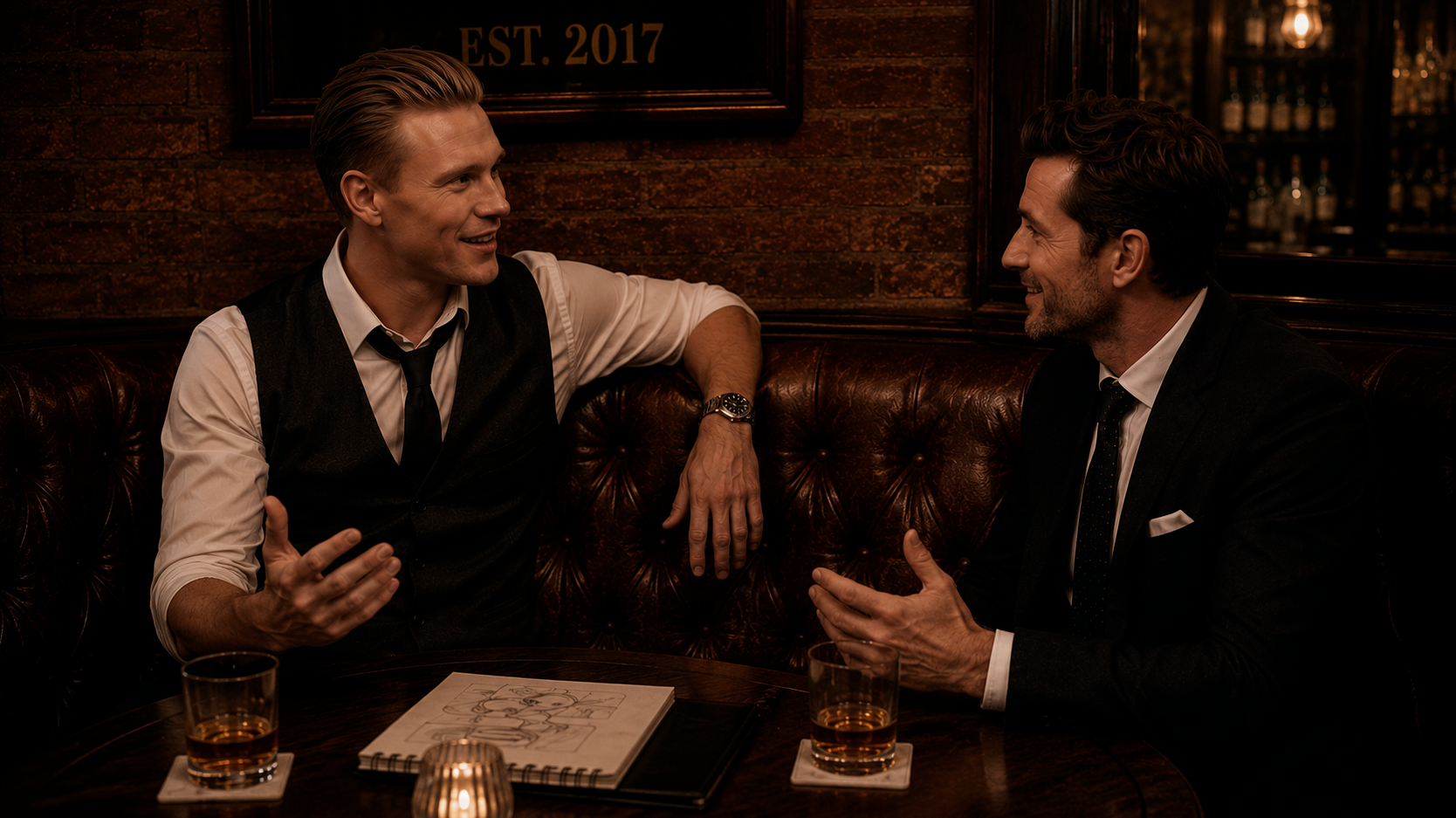
I waited until his Old Fashioned was half empty, the optimal refresh window, and approached the booth myself rather than sending the server. “Mr. Hale. How’s the drink?”
He looked up from his sketchbook. A glass pen, I realized, not a ballpoint. An inkwell on the table. The sight of it did something small and complicated to my chest. “Excellent, as always. Please thank the bar.”
“I will. I’m the bar.” I allowed myself a small, self-deprecating smile. “Do you mind if I ask you a question? About the building.”
A flicker. “You’re curious about the architecture?”
“The bones of it, yes. I was reading about Tadao Ando’s use of concrete and light, and I noticed some similarities. The way the space seems excavated rather than constructed. The relationship to shadow.”
I had, in fact, spent the previous evening researching Tadao Ando. Two documentaries. An interview in Architectural Digest. I sat on my couch with a legal pad and took notes. This is who I am. This is what I do.
I prepare.
Adrian set down his pen. “That’s an astute observation. Most people don’t register the Ando influence. The architect who designed this space was a student of his, actually. Do you have an interest in architecture?”
“Only casually. I was an English scholar, so my background is more in the structure of argument than the structure of buildings. But I find the parallels compelling.”
We talked for perhaps ten minutes. It was, by any objective measure, a successful conversation. Adrian was engaged, even animated. He gestured at the ceiling, traced lines in the air with his finger, asked me questions about my academic background. I felt the familiar satisfaction of a job well done, the quiet pleasure of interesting an interesting person.
And then he thanked me, said he had a call to make, and returned to his sketchbook with the same smooth, impenetrable finality with which a door closes.
I walked back to the bar. Hollow.
“Ten minutes,” Leo said, his voice carefully neutral. “That’s more than most people get.”
“He dismissed me.”
“He thanked you.”
“He dismissed me politely. It’s worse, somehow.”
Leo didn’t argue. He slid a fresh towel across the bar to me. Our version of a condolence card, and I caught his hand before I could stop myself. Just a brief contact, my fingers over his knuckles. The towel was warm from the sanitizer. His skin was cool. He stilled.
“We’ll crack him,” Leo said. “Patience.”
I pulled my hand back. “Since when are you the patient one?”
“Since I realized I was going to lose otherwise.”
I couldn’t tell if he was joking. With Leo, it’s always hard to tell.

Leo
I made my move two nights later.
Marcus’s failure had rattled me more than I wanted to admit. If he couldn’t get traction with his prep and his precision and his uncanny ability to make anyone believe they were the most fascinating person in the room, what chance did I have? I was muscle and a smile. No references. No research. All I had was instinct, and instinct was starting to feel like a very flimsy tool.
But instinct was all I possessed. So I used it.
Adrian was in his booth, nursing what looked like a whiskey neat. He’d branched out. I walked over without a drink, without a pretext, just me and my insufficient toolkit.
“Mind if I sit?”
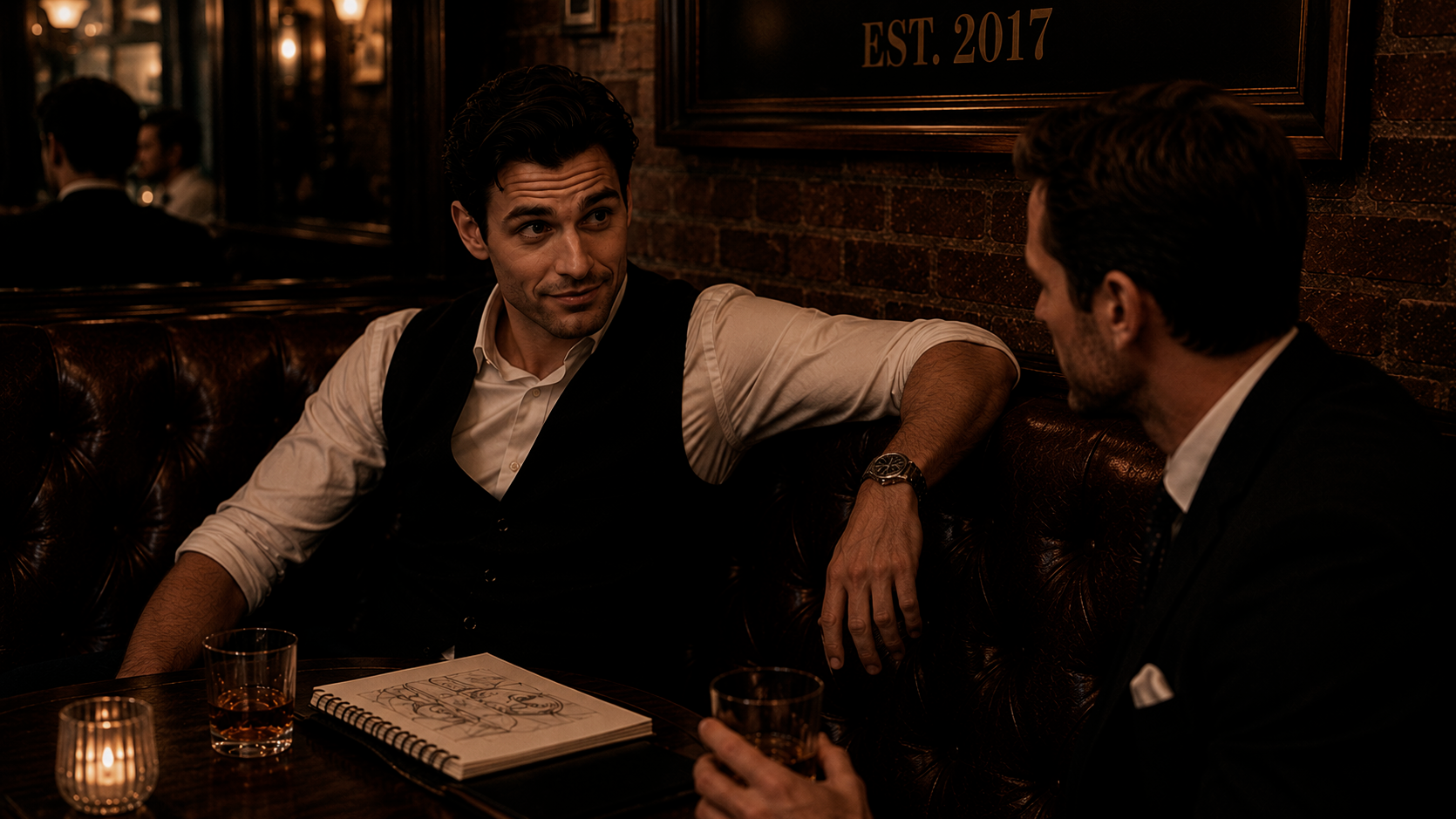
He looked up. The gaze wasn’t unfriendly, but it was clinical, like he was measuring me for a suit I wasn’t sure I wanted to wear. “For a moment.”
I slid into the booth across from him. Up close, he was more unsettling. The kind of handsomeness that made you aware of your own mess. I felt like a golden retriever that had wandered into a museum and was trying very hard not to knock anything over with its tail.
“Can I ask you something?”
“You may.”
“Why do you always sit alone?”
A blunt question. Probably a stupid question. But I’d been thinking about it for two years, and my strategy, such as it was, was honesty.
Adrian considered me for a long moment. The light from the EST. 2017 sign caught the silver at his temples. “Loneliness is often the most honest form of company. Don’t you find?”
“No,” I said. “I don’t.”
“Why not?”
“Because I hate being alone.” The words were out before I’d vetted them. I felt the heat rise in my face but I didn’t look away. “I mean . . . I’m good at it. I’ve had a lot of practice. But I hate it.”
Something shifted behind his eyes. A crack, perhaps. A flicker of light through a curtain. “That’s a very honest answer.”
“I’m trying out honesty. My partner says I should do more of it.”
“Your partner?”
“My work partner. Marcus. The other bartender.” I gestured vaguely toward the bar. “The one with the tie. You talked to him the other night.”
“I remember Marcus.” Adrian’s mouth curved slightly. “He’s quite intelligent.”
“He’s a genius. It’s annoying.” I leaned back in the booth, forcing myself to relax. The leather creaked under me. “He thinks I rely too much on charm. He’s probably right.”
“And what do you think you’re relying on now?”
“I don’t know.” I met his eyes. “I’m just talking. Is it working?”
Adrian laughed. A quiet sound, almost surprised. I flushed with something that might have been triumph or might have been something else entirely. “I haven’t decided,” he said.
He didn’t dismiss me. We talked for another fifteen minutes about the bar, about his work, about nothing in particular, and when I finally stood to return to my post he said, “Thank you for the conversation, Leo. It was unexpectedly genuine.”
Unexpectedly genuine. I turned the phrase over in my mind all the way back to the well. I still wasn’t sure whether to be flattered or insulted.
I told Marcus everything after the last guest left. He listened with an expression I couldn’t read, his hands busy restocking the speed rail.
“You were vulnerable,” he said when I’d finished.
“I guess?”
“Genuine vulnerability. That’s your strategy.”
“I don’t have a strategy. I told you, I’m just—”
“Talking.” He nodded slowly. “Yes. You are.”
For a moment he looked deeply unsettled, the way someone looks when they’ve found a door they didn’t know existed in a house they’ve lived in for years.
I didn’t understand why.

Marcus
Leo was doing something I couldn’t replicate.
He was being himself. Or a version of himself stripped of bravado, stripped of performance, stripped of the relentless charm that functioned as his armor. And it was working. Adrian had laughed. Adrian had called him genuine.
I had spent hours on Tadao Ando. Leo had walked over and blurted out his loneliness like a confession.
Leo was winning.
That was the problem, I told myself. The competition. I don’t enjoy losing. It’s a character flaw, one I’ve never managed to excise despite years of awareness. A poor loser, a sore one. Watching Leo’s incremental success while my own carefully constructed approach had failed was galling in a way that felt almost physical. A low, acidic heat in my stomach.
But that wasn’t the whole problem. I knew it.
Leo had told Adrian something he’d never told me. All the jokes about late nights and poor company, all the deflection and swagger and performance, and beneath it he’d been what? Lonely. The word didn’t fit my mental image of Leo Vance. My mental image, I realized, was incomplete.
We debriefed after closing, as we always did now. It had become a ritual, the third thing in our week, alongside shifts and sleep.
“He’s not a fortress,” Leo said, sliding onto a bar stool with a beer. The overheads had been dimmed and the room was all shadows and amber. “He’s a mirror. Whatever you give him, he reflects back. I gave him honesty and he gave me . . . I don’t know. Interest. Maybe.”
“You gave him vulnerability,” I said. “I gave him an interview.”
“You gave him an excellent interview. Very well researched.”
“Thank you.”
“You’re welcome.” He tipped his beer toward me in a mock toast. “We’ll figure him out. Both of us. We’re a team, right?”
“Are we?”
The question came out sharper than I’d intended. Leo’s face flickered—hurt, quickly masked—and I felt the heat of shame rise up my neck.
“Of course we are,” I said, quieter. “We’re the dream team. It says so on Instagram.”
Leo didn’t smile. He was looking at me with an odd intensity, his beer forgotten. “You know, for someone so smart, you’re terrible at the stuff that matters.”
“What does that mean?”
“It means you’re great at information and terrible at connection. You know everything about Adrian and nothing about him. You know everything about me and . . .” He stopped. Shook his head. “Forget it.”
“No.” I set my glass down. “Finish the sentence.”
He was quiet for a long moment. The neon hummed in the silence. When he spoke again, his voice was rougher, stripped of its usual music. “You know everything about me and nothing about me. Because I don’t let you. Because I’m . . .” He made a vague, frustrated gesture at himself. “I’m all surface. That’s the problem, isn’t it? I’m good at the start and useless at the rest.”
I stared at him. The confession was so unexpected, so un-Leo, that I felt the floor shift under me. “You’re not useless.”
“I’ve never been in love,” he said. “Not really. Not the kind that lasts. What if that’s the whole problem? What if I’m just . . . temporary? A good time. A warm body. Not the thing people keep.”
His eyes were dark, tired. I realized, with a small, sharp ache behind my sternum, that I was seeing something I’d never seen before. Leo without the armor. Leo without the performance, sitting on a bar stool in the dim light, his hands still around his beer bottle.
I reached out and touched his wrist. I don’t know why. I didn’t plan the gesture. I didn’t analyze it. It was just my hand on his skin, his pulse beneath my fingers, steady and warm.
“His loss,” I said. “Whoever didn’t keep you. His loss.”
Leo looked at my hand. Looked at me. His expression was unreadable. “You’re doing it again.”
“Doing what?”
“Being genuine. It’s weird. Are you feeling alright?”
I pulled my hand back. The absence of contact was a small bereavement. “I’m fine.”
“You’re not.” He stood, gathering his jacket from the hook. “But you will be. We both will.” He paused by the door, his hand resting on the frame, and for a moment he looked back at me. “Marcus?”
“Yes?”
“I’m glad we’re doing this. The bet, I mean. Whatever happens. I’m glad.”
He was gone before I could reply.
I sat alone in the empty bar, the EST. 2017 humming above me, and tried to name the feeling in my chest. It was like opening a door you’d always assumed was locked and finding it had never been locked at all. The moment before a fall. The particular silence after a note you didn’t know you’d been waiting for.
The beginning of a colossal mistake.

Leo
I couldn’t sleep.
I lay in my apartment, a studio in the East Village I’d never decorated because decorating implies staying, and replayed the conversation on a loop. The way he’d touched my wrist. His loss. The way his voice had gone rough, just for a moment, like the words cost him something he hadn’t budgeted for.
I’d told him the truth. I tell no one the truth. It was supposed to be part of the bet, my new strategy of vulnerability, but it hadn’t felt like strategy. It had felt like standing naked in a room and realizing you didn’t mind being seen.
This is a problem, I thought, staring at the ceiling. The streetlight outside cast a faint yellow stripe across the plaster. This is a very specific kind of problem that I don’t have the tools to solve.
The next shift, I arrived early. Marcus was already there, of course, setting up the well with his usual meticulous precision. He was wearing the navy suit, even though it was Friday. I didn’t comment.
We worked in a strange, suspended silence. The rhythm of our partnership had shifted into something more careful, more deliberate. Every brush of shoulders was significant. Every exchanged glance was a question neither of us knew how to ask. The bar felt smaller than it had the week before.
And then, at ten o’clock, the black door swung open and Adrian Hale walked in.
He was not alone.
Beside him was a man I’d never seen before. Dark haired, olive skinned, dressed in an impeccably cut blazer and an air of casual possession. He was the kind of beautiful that made you want to apologize for looking. His hand rested lightly on Adrian’s lower back, and the gesture was so easy, so practiced, that it told you everything you needed to know.
I froze. Across the bar, Marcus froze too.
Adrian caught my eye. He smiled that same quiet, knowing smile and led his companion to the corner booth.
“Holy shit,” I breathed.
Marcus appeared at my elbow. His face was pale, but his eyes were bright. “Is that—”
“I think so.”
“Are they—”
“I think so.”
We stood shoulder to shoulder, staring at the booth where everything we thought we knew was being rewritten.
“Well,” Marcus said after a long, frozen moment. “The bet just became miles more complicated.”
I looked at him. He looked at me. And despite everything—the confusion, the panic, the strange and terrible tenderness that had taken up residence in my chest—I laughed.
“So what do we do now?”
Marcus didn’t answer. His hand found my elbow. Just a second of pressure, brief and grounding. Something clicked into place. It had nothing to do with Adrian Hale and everything to do with the man beside me, the warmth of his fingers through my sleeve, the way he didn’t pull back quite as quickly as he might have a week ago.
“I don’t know,” he said. “But I suspect we’re about to find out.”

End of Chapter One.