
When a forty-one-year-old man decides to wait patiently for a guarded twenty-one-year-old art history student, neither expects the waiting to become the point—or for the reward to be so deliberate. But after gallery exhibitions, lake days, and a quiet battle of restraint, Jesse flips the script in a way that leaves Wade undone, even as the shadows of Wade’s past circle closer. This slow-burn age-gap romance is a masterclass in longing, patience, and the quiet power of being seen.

Wade
Monday passed without a call. Tuesday, the same. I kept my phone on the kitchen island while I dealt with a maintenance issue at the dog park I co-owned with Jake, and I checked it more than the situation required, and I noticed I was checking it and did nothing about it.
The dog park business was a side investment that had turned into a proper income stream. Jake handled the day-to-day management, I handled the capital and the strategic decisions, and between the two of us we’d built something profitable that also happened to be the only reason Mercer hadn’t destroyed my house from sheer under-stimulated spite. Tuesday’s problem was a backed-up drain in the washing station that would cost twelve hundred dollars to fix and take three days. I signed off on the estimate and made two other calls and looked at my phone again.
Jake, who had been on-site all morning and had watched me check my phone six times, said nothing until we were in the truck heading back to the house.
“Jesse hasn’t called,” he said.
“I noticed,” I said.
“You’re waiting.”
“I’m not waiting. I’m living my life. My life currently involves looking at my phone. It’s a feature of modern adulthood.”
Jake made a sound that was not quite a laugh and not quite a dismissal. “What’s the plan when he does call?”
“He’s not going to call,” I said. “He’s twenty-one and he just broke up with someone and he’s got a double major and a job and my house made him uncomfortable. He spent the whole lake day being careful around me. He’s not going to call.”
“You sound very certain.”
“I’m very certain.”
“Then why are you checking your phone?”
I looked out the passenger window at the strip malls going by. “I’m not,” I said.
Jake made the sound again.
“You know,” he said, pulling into my driveway and cutting the engine, “you could call him.”
“I’m not calling him.” I got out of the truck and closed the door harder than necessary. “He said he’d check his schedule. I told him to let me know. Chasing him now looks like the exact thing I said I would not do.”
“So you’re just going to wait.”
“I’m going to let him come to me when he’s ready,” I said. “If he’s ever ready. That’s not waiting. That’s giving him space.”
Jake walked around the front of the truck and stopped at the bottom of the porch steps. “You gave Luke space. You gave Marcus space. You gave that guy from the gym space. You know what they did with the space you gave them? Nothing. Because they weren’t looking for space. They were looking for someone who’d actually show up.”
I paused with my hand on the porch railing. “That’s different.”
“How.”
“Luke was a setup. Marcus was a mistake. The gym guy was just . . .” I waved a hand. “Jesse is different.”
“Why?”
I thought about the cove. The painting conversation. The way he’d said, you feel the rightness of it before you can say why. The way he’d looked at me across the dinner table and looked away. The sound of him laughing at something Milo said, full and unguarded, the laugh that changed his entire face. My thumb on his wrist, his pulse jumping. The fact that he’d spent an entire day watching Kip watch me and hadn’t said a word about it. The fact that he knew what Kip and David had done with Luke and was still planning to come back next weekend.
“He’s just different,” I said.
Jake looked at me for a long moment. Then he nodded once, a small nod that acknowledged something he would not push on, and we went inside.

Jesse
I called on Wednesday.
It was late afternoon, the light through my apartment window the flat, diffuse white of Texas summer reflecting off the parking lot. I had just finished a shift at the hardware store. A pickup shift I’d taken because the restaurant didn’t need me on Wednesday nights and the extra cash kept my electric bill paid, my back and shoulders aching pleasantly from stocking and customer service and hauling bags of concrete mix for people who couldn’t be bothered. I was sitting at my kitchen counter with a glass of water and my phone and Wade Mitchell’s contact information.
I could call. I could not call. The choice was simple.
I tapped the screen.
Jake answered.
I said, “Hey, it’s Jesse. Is Wade around?”
“Hang on.” Jake’s voice was neutral in a way that suggested he was making it neutral on purpose. There was a pause, the muffled sound of a hand covering the speaker, and then something that might have been a door closing or might have been a palm moving over the receiver, and then Wade’s voice.
“Jesse.” Not a question. A statement.
“Hi,” I said. “I don’t have your direct number.”
There was a brief pause. “I should’ve given it to you.”
“You gave me a ride to the lake,” I said. “I think that covers it for a few weeks.”
“Let’s not drag it out.” He sounded different on the phone. Not guarded, exactly, but attentive in a way I recognized. “What’s up?”
I told him about the exhibition. A private collection of Texas landscape paintings on loan to the university gallery, including two by Frank Reaugh that I’d only seen in reproductions. I was going Thursday evening. I asked if he wanted to come see what one of his paintings was supposed to look like. I said it lightly, the way I said things I wasn’t sure would land, and they had the right kind of light in them. Pastoral Texas before air conditioning. Reaugh had figured out how to paint heat, the way it changes the look of a landscape, the soft distortions, the way the sky goes pale white at the edges. It was worth seeing.
There was a pause, not long, but the specific length of a pause that meant the person on the other end was deciding about how to respond.
“Thursday,” Wade said.
“Thursday. There’s a reception with complimentary wine, or we can go earlier before it gets crowded.”
“I’ll meet you there,” he said. “Text me the time and the building.”
“Will do.”
Another pause. I could hear something in the background, the indistinct sound of Jake’s voice, the click of what might have been a door, and then the sound went muffled again, like Wade had shifted his grip on the phone. The quiet that followed had a different quality, a small deliberation. When he spoke again the extra edge I’d heard, the man performing ease, had gone.
“Thanks for asking me.” His voice was lower. “I was hoping you would.”
“I said I’d let you know,” I said.
“You did.” He didn’t embellish. “Thursday, then.”
I hung up.
I set the phone on the counter and looked at it for a moment. The light through the window was softer now, the late-afternoon gold that came before the heat broke, and I sat there and thought about the way he’d said my name when he picked up the phone. Jesse. Not a question. A statement. The way he’d said I was hoping you would like it was just information, something true he wasn’t working to hide. I didn’t know what to do with any of it yet, but I noticed it, and I filed it, and I went to make dinner.

Wade
Thursday evening, and I was in the parking lot of a university art gallery standing next to my truck and reminding myself that this was not a date. Jesse had asked me to see some paintings. I was looking at some paintings. The fact that I’d changed shirts twice and spent ten minutes deciding whether cologne was too much for a university gallery reception—I’d gone without, Jake had talked me down from the ledge—was not evidence of a date. It was evidence of appropriate grooming.
What I wanted, if I was honest, was something that felt less like a transaction and more like an invitation. Other people had framed every previous interaction. David hosted the pool party, Kip maneuvered the situation, and David also initiated and invited everyone to the lake day. This was Jesse asking me to do something he’d found. Something he wanted to share. It was the first thing that belonged entirely to him, and I wanted to show up for it correctly.
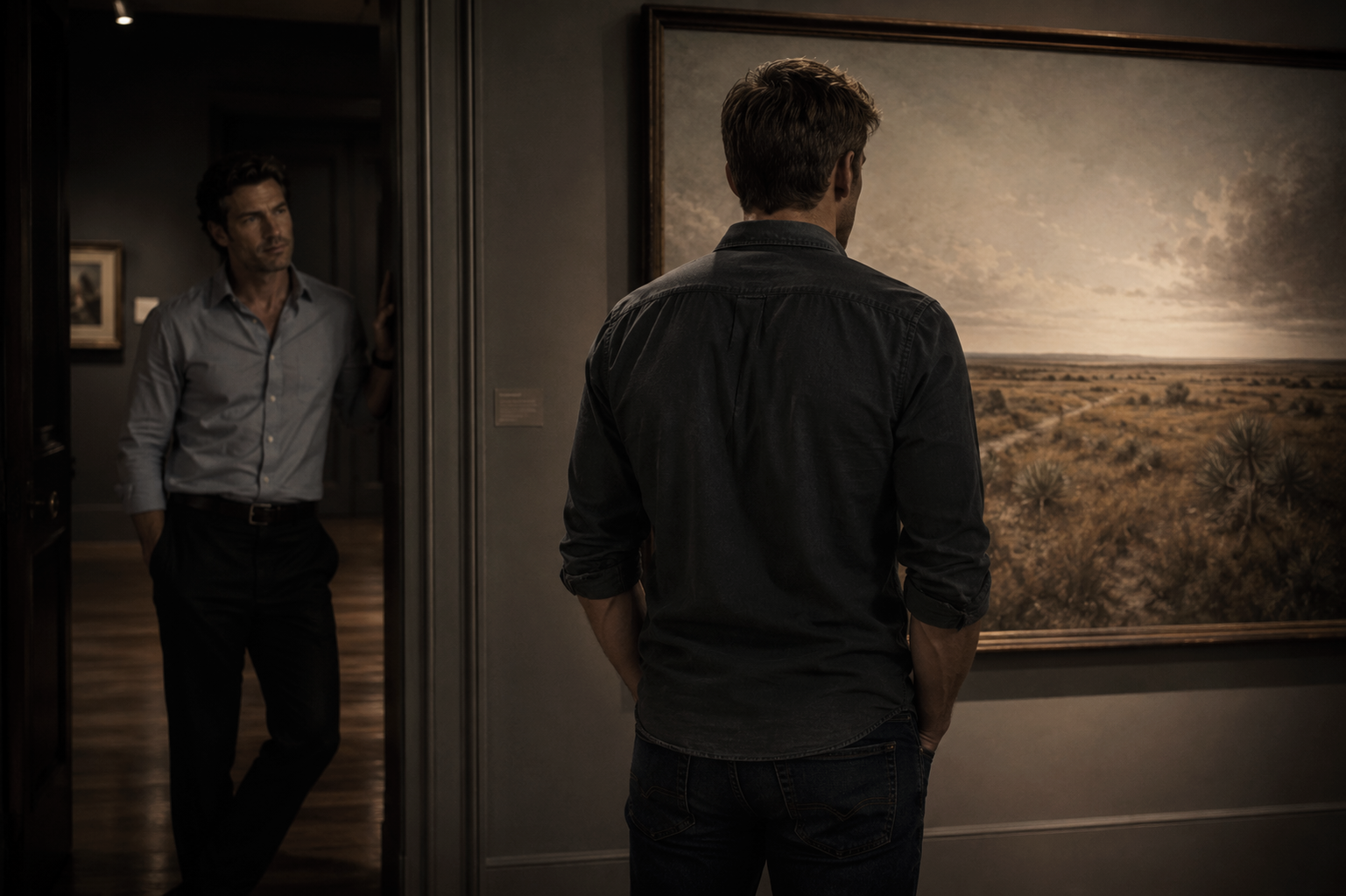
The gallery was a modest building at the edge of campus, brick and glass and the particular brand of institutional architecture that said we spent the budget on the collection. I found Jesse in the main hall, studying a painting near the entrance. Not reading the plaque, not checking his phone, just standing in front of it with that complete stillness I’d seen in my hallway, the rest of the room around him apparently not there. He was wearing dark jeans and a button-down shirt that fit him well, the sleeves rolled to mid-forearm. The light from the track lighting above the painting caught the line of his jaw and the serious set of his mouth. I stopped in the doorway for a moment and watched him, because watching him look at a painting was its own category of good thing, and I was old enough to recognize when something needed to be appreciated before it was interrupted.
Then I walked over.
“That serious face is going to give me a complex,” I said.
He turned his head just enough to acknowledge me without actually moving his body, a gesture so deliberately calm it was almost a provocation. “You’re early.”
“I’m on time. You’re the one who’s been here long enough to decide you’re early.”
He smiled without showing teeth, which was apparently all the smile I was going to get, and then he tilted his head slightly—the left side toward me, I noticed, as though he were offering me his better ear. I filed it without thinking. Then he gestured at the painting. “This is a Reaugh.”
It was a large canvas, maybe four feet wide, showing a stretch of West Texas prairie under a sky that took up two-thirds of the composition. The palette was muted. Ochre, sage, the pale bleached blue of a summer sky pressed thin by heat. But there was something in the way the light moved across the grass that made the whole thing feel alive.
“There’s a second one in the next room,” he said. “I wanted to see this one first.”
I stood beside him and looked at it. The quiet of the gallery settled around us. There were a few other people in the building. Students mostly, a couple of older patrons moving slowly through the exhibits, but the room we were in was empty except for the two of us, the painting, and the particular quality of attention Jesse brought to things.
“What am I supposed to be seeing?” I asked.
He considered the question with the same deliberateness he’d brought to the painting in my hallway. “You’re supposed to be seeing whatever you see. That’s how this works. I’m not going to tell you what to look at.”
“That’s different from last time.”
“Last time you asked me a specific question about a specific painting and I answered it. This time there’s no question yet. There’s just the painting.” He glanced at me. “What do you see?”
I looked at the prairie, the sky, the soft haze at the horizon line. “It looks like Texas in August. When the heat’s been going so long you forget it was ever different. The kind of day where the light is the weather.”
“Good,” he said, and there was something in his voice that was not quite surprise, but was adjacent to it. “That’s exactly what he was trying to do. Reaugh thought light was the subject matter. More than the landscape. He said—” He stopped, half smiled. “I’m lecturing.”
“I asked you to.”
“That’s true.” He looked back at the painting. “He said atmosphere was the true subject of landscape painting. Not the trees or the grass or the mountains. The light. The way it changes everything it touches.”
I looked at the painting and tried to see what he was seeing. The specific quality of the light, the way it moved across the prairie. And I thought, without meaning to, of the way the light had moved across Jesse’s back and shoulders in the cove. The way it had caught the water on his skin. The way I’d studied the bluffs and tried not to study him and failed at both.
“You really love this,” I said.
“Yes,” Jesse said without hesitation. “This is the one thing I do for no other reason than I want to.”
We moved through the exhibition at a relaxed pace. There were twelve paintings in total, mostly Texas landscapes from the late nineteenth and early twentieth centuries, and Jesse knew something about every one of them. Not in the way people who wanted to impress you knew things, he wasn’t performing. He was just talking about something he loved, and the talking was the same as the listening, full attention, no part of it elsewhere.
In the stillness of the gallery, with the track lighting warm on his face and his voice low and serious and occasionally, when a painting genuinely delighted him, rising to something close to eagerness, I let myself want him without managing it. For ten minutes. For the length of the second room. I let myself imagine what it would be like to take him home from something like this, to cook for him, to have him sit at my kitchen island and tell me about paintings while I made dinner and Mercer waited for scraps at his feet. To have him stay. Not in the guest room. In my room. In my bed. The want was specific and detailed and I let it be specific and detailed, because wanting him this way—quiet, private, respectful of the space between what I wanted and what he was ready for—was the only version of wanting him I was going to allow myself yet.
At the end of the exhibition, in front of a small canvas showing a creek bed at dusk, I asked him how he ended up with the double major.
“Pragmatism,” he said.
“Art history isn’t pragmatic?”
“Art history is what I love. Business administration gets me a job.” He didn’t sound bitter about it. Just factual, the way he sounded about most things. “My parents wanted me to be a doctor or an engineer. Maybe a lawyer if I insisted on being difficult. Art history wasn’t on the list. It wasn’t in the same universe as the list.” He paused, looking at the creek bed. “I told them I was doing business administration. I am. I’m just also doing the other thing.”
“And they don’t know.”
“They know I’m taking art history courses as electives. They don’t know it’s my second major. They wouldn’t understand the point of it, and I don’t have the energy to explain the point of it every time we talk, so I let them believe it’s a side interest.” He looked at me. “That sounds worse than it is. We’re not close. They love me, but they love the version of me that made sense to them when I was twelve. I’ve been a different person for a while now, and it’s easier to let them keep the twelve-year-old than to update them.”
I thought about my father, who had drifted away when I was twenty-five and had never understood what I was building or why I was building it. “The update is hard,” I said. “Sometimes it’s not worth the cost.”
“Yes,” Jesse said, and something in his face shifted, a small recognition. “That’s exactly it.”
We stood there for another minute, the creek bed glowing softly under the track lights, and then Jesse said, “I should probably let you go. You drove all the way up here for a forty-minute exhibition.”
“I drove all the way up here because I wanted to see the exhibition,” I said. “And because you asked.”
He looked at me for a moment longer than was strictly necessary. “I’m glad you came.”
“Me too.”
We walked out of the gallery together into the warm evening air, the sky going pink at the edges, the campus quiet with the particular emptiness of summer term.
“This weekend,” I said. “Lake day. You still in?”
“I’m still in.”
“Good. We’ll do dinner again. If you want.”
“I want.”
I nodded. He nodded. The conversation ended with the ease of two people who had figured out how to end conversations without making them awkward, and I watched him walk toward his car, a beat-up Honda with a parking sticker on the back window, and I got in my truck and sat there for a moment with the engine running and the radio off.
This was going to be a problem.
I was going to let it be a problem.

Jesse
The lake days became the shape of my Saturdays. Not all of them. Every other weekend belonged to the restaurant, and some Saturdays I couldn’t afford the gas, but more of them than I’d planned. The first one after the gallery, I packed my own sunscreen in my bag because accepting Wade’s felt like making a concession I hadn’t agreed to yet. He noticed. He didn’t comment on it, but I saw him see it, the small bottle of drugstore SPF 50 on the towel beside my bag, and something in his expression did a thing I couldn’t name.
After the third Saturday, Wade started finding reasons for us to eat dinner afterward, just the two of us, not the whole marina crowd. A barbecue place in Lewisville with picnic tables and a line out the door and brisket that made you stop talking mid sentence. A Mexican place in Frisco where the salsa was hot enough to make your eyes water and Wade apologized for not warning me and then laughed at my face. Each time, the check arrived and Wade signed it without looking at the total, tipping well past twenty percent with the absent ease of someone for whom money was not a thing that required attention. Each time, I ordered the second-cheapest thing on the menu and didn’t draw attention to the fact that I was doing it. Wade noticed that too.
“You don’t have to do that,” he said, the third time, after I’d ordered chicken enchiladas that were eleven dollars while he had the thirty-dollar steak.
“Do what.”
“Order like you’re on a budget.”
“I am on a budget,” I said.
He looked at me for a moment, and something in his expression shifted. “I’m not—” He stopped. “I’m not trying to make a point with the money. It’s just dinner.”
“I know,” I said. “I’m not making a point either. I’m just ordering what I’d order if I were paying.”
He nodded. He didn’t push it. After that, the checks kept coming and he kept paying them, and I kept ordering what I’d order if I were paying, and neither of us acknowledged that this was a negotiation we were both losing on purpose.

Wade
By the fourth Saturday, Jesse had stopped bringing his own sunscreen.
I noticed because I noticed everything to do with him by then. The way he took his coffee, the way he folded his towel before he got in the water, the way he talked with his hands when he got excited about a painting and then caught himself and stopped. The sunscreen was a small thing, but it was the first small thing he’d conceded, and I filed it under progress and didn’t mention it.
Jake, of course, noticed me noticing.
“You’re staring again,” he said, from his usual spot at the helm.
“I’m looking at the water.”
“You’re looking at Jesse, who is in the water. That’s staring with an excuse.”
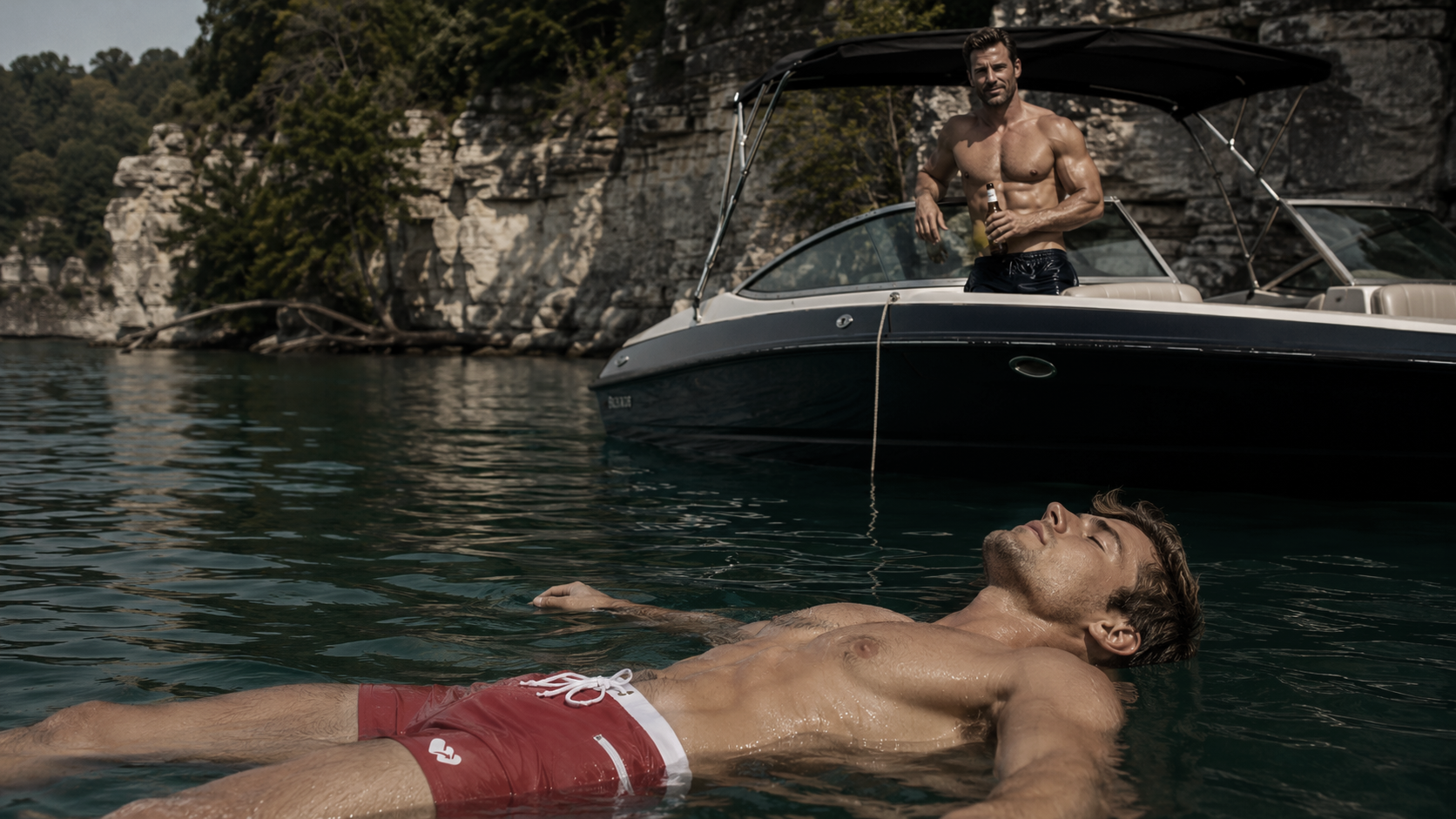
I didn’t dignify this with a response. Jesse was swimming laps across the cove, the same strong, clean stroke I’d watched the first time, and the light was doing the thing it always did on his shoulders, and I was, yes, staring. I was doing ridiculous amounts of staring. I had been staring for four weekends and a gallery exhibition and three dinners, and I had touched him precisely once. On the wrist during the jetski tutorial, a moment I replayed with embarrassing frequency. I was losing my mind.
“He’s still not going to sleep with you,” Jake said, in the conversational tone of someone discussing the weather.
“I know.”
“Do you?”
“I know he’s not going to sleep with me tonight. I know he’s probably not going to sleep with me next week or the week after that. I know he might never sleep with me. I am aware of the situation.”
“And yet.”
“And yet,” I agreed.
Jake looked at the water, where Jesse had stopped swimming and was floating on his back, his face turned up to the sun, the definition of his chest visible even from this distance. “You’ve never waited this long for anyone.”
“No.”
“Does it bother you?”
I considered the question fairly. “No,” I said. “It should. But it doesn’t.”
Jake said nothing. When I looked at him, he was smiling in the small, private way he smiled when something had confirmed a suspicion he’d been holding quietly.
“What?” I said.
“Nothing,” Jake said. “Just thinking.”
“About what?”
“About how the man who told me three weeks ago he was going to bury himself in something tight before the weekend is now telling me he’s happy to wait indefinitely for someone who might never put out.” He picked up his beer. “It’s interesting.”
“I’m not happy about it.”
“You’re something,” Jake said. “You’re definitely something.”

Jesse
David noticed the absences. He’d been noticing for weeks, but he said nothing directly until the fifth Saturday, when I texted to cancel a thing he’d wanted to do in Deep Ellum that night because I was still in Plano and had no way to make it back in time.
You’re always in Plano now, he wrote. Three dots. Then: Do you even live in Denton anymore?
I live in Denton, I wrote back. I’m in Plano on Saturdays. It’s one day a week.
It’s every Saturday.
It’s not every Saturday. It’s most Saturdays. There’s a difference.
He didn’t respond for a while. When he did, the text was careful in a way David’s texts were rarely careful. Are you and Wade a thing now? Because you said you weren’t interested in options and now you’re spending every weekend at his house.
I looked at my phone. Mercer was at my feet under Wade’s kitchen table, his head on my shoe. Wade was at the counter making coffee even though it was nearly nine at night because he’d said he wanted decaf and I’d said nothing and he was making it anyway. The house was quiet, the living room lights low, the pool filter humming outside.
We’re not a thing, I typed. We’re just spending time together. I don’t know what we are yet.
Okay, David said. Just checking. Then: Kip says Wade never waits for anyone. Just so you know.
I put my phone face down on the table and didn’t answer. Wade set a mug of decaf in front of me and sat down across the table, and I thought about what David had said. Wade never waits for anyone. And about the fact that he had been waiting, patiently, without pushing, for five weeks now. The sunscreen. The dinners. The gallery. The way he’d put his hand on my wrist and pulled back when I didn’t move toward him. The way he’d said I was hoping you would on the phone and I’m glad you came at the gallery and I’ll wait on the boat, all of it flat and unadorned, none of it a performance.
He wasn’t waiting the way other people waited. He was waiting the way he did everything else. With the ease of someone who had decided what he wanted and was comfortable with the timeline. It should have made me nervous. It didn’t.
“What are you thinking about?” Wade asked.
“David,” I said. “He thinks we’re a thing.”
Wade’s expression didn’t change. “What do you think?”
“I think we’re figuring it out.”
He nodded. “That’s fair.” He drank his decaf. “Take your time.”

Wade
The fifth week, Uncle Paul appeared at the marina again.
This time, Jake saw him coming before he reached Jesse and intercepted him with the quiet, immovable efficiency of someone who had been trained to block approaches and had never forgotten how. Their conversation was brief and conducted in tones too low for me to hear from the boat, but Paul’s smile flickered and Jake’s expression didn’t, and by the time Paul moved on, Jesse was still sitting on the swim platform talking to Milo about something that made him laugh, entirely unaware that an intervention had occurred.
Jake walked back to the boat and didn’t mention it. I didn’t mention it either. Some things were understood.

Jesse
By the sixth Saturday, I’d stopped counting how many lake days I’d been to. I knew it was six because Wade mentioned it casually, in passing, the way he mentioned things that mattered to him without making a production of them and I realized I’d been keeping track without meaning to.
The lake was the same. The heat was the same. The water was the same. But something had shifted in the way I moved through it, a quality of ease I hadn’t noticed arriving. I knew where the towels were kept. I knew which cooler had the water and which had the beer. I knew the rhythm of the day. Morning on the water, afternoon in the cove, dinner at the marina. I knew that at some point during each of those stages, Wade would find a way to be near me, and I would find a way to let him, and neither of us would acknowledge that this was a pattern we were both maintaining.
We talked about Luke that afternoon. Not in the oblique, circling way we’d been talking around it for weeks, but directly. Wade had brought the jetskis back to the dock and I was helping him tie them off, and somewhere in the quiet of the empty marina, with the sun going gold and the water slapping gently against the hulls, I said, “I figured out what Kip and David were doing.”
Wade didn’t look up from the cleat. “I know.”
“You knew the whole time.”
“I knew they’d introduced Luke to both of us. I didn’t know they’d done it back to back like that until the night you told me.” He straightened. “It’s not an excuse.”
“I didn’t think it was.”
He looked at me then, and his expression was the serious one I didn’t see often, the one that replaced the easy charm with something quieter and more attentive. “I’m sorry they did that to you. Whether or not I knew, it happened in my circle. It happened with people who are supposed to be my friends.”
I finished the knot I was tying and stood. “It happened to you too. You were the first one they handed him to. I was second.”
“Yes.”
“So we’re both . . .” I stopped. “I don’t know what we are.”
“Neither do I,” Wade said. “But I want to find out.”
We stood there for a moment, the dock creaking under us, the late-afternoon light doing its golden thing on the water. And then Wade said, “Dinner again tonight? Just us?”
“Yes,” I said. “Just us.”

Wade
We went back to the house after dinner because neither of us wanted the night to end and because the house was closer than Denton and because Mercer was there, and Jesse had made it clear over the past six weeks that spending time with Mercer was a significant factor in his willingness to drive to Plano.
Jake had gone out with someone he’d met at the marina, a story that involved a jetski and a misunderstanding about a cooler, and we had the place to ourselves. Mercer was at the door, tail swinging, and he came to Jesse first. Jesse knelt and let Mercer press his head against his knee and I thought, not for the first time, that this dog had decided something about Jesse that I hadn’t decided about myself yet.
I said something about getting the lights, and Jesse stood up and looked out the back windows at the pool. The water was still, the surface flat and dark, the underwater lights making small shifting patterns against the patio. The night was warm and quiet, and somewhere in the house a clock was ticking, and I moved through the living room turning on lamps with the practiced, absent ease of someone who had done it a thousand times.
“You don’t need to stand on ceremony,” I called from the living room. “Kitchen, pool, whatever.”
He went to the studio at the back of the house. The painting was still there. The mystery landscape, the anonymous canvas that had made him stop in the hallway the first night he’d been here. That moment had been on my mind for six weeks. The way he’d stood with his hands in his pockets and his weight slightly forward, the way Mercer had been at his knee, the way I’d watched him from the doorway and understood, for the first time, that I was in trouble.
The trouble had a name. That name was Jesse.
I found him in the studio, studying the canvas with the same absorbed attention he’d brought to the Reaugh at the gallery. The track lighting was off, just the ambient light from the hallway catching the surface, and he was standing near it, his arms crossed, his head tilted.
“I did some research,” he said without turning around.
“On my painting?”
“On your painting.” He stepped back and folded his arms with what I recognized now as his thinking posture. “The style isn’t a perfect match for Reaugh, but something about the signature treatment of the light—”
“Signature treatment of the light,” I repeated.
“I’m serious.”
“You’re very serious.”
“The palette is slightly cooler than Reaugh’s mature work—”
“The palette.”
“Are you going to repeat everything I say?”
“Just the words that sound like you’re writing a paper about my painting instead of telling me what you actually think.”
He turned toward me. The conversation shifted, the way conversations shift when they’ve been circling something and finally decide to land. “What did you mean on the boat?” His voice was softer now, all the performance gone from it. “When you said the thing about the rightness you feel before you can say why.”
I moved further into the room.
“I meant that when you bought this painting, you weren’t looking for a Reaugh. You were looking for light that made you feel something. And you found it. The fact that it turned out to be worth considerably more than you paid for it is just the universe having a sense of humor.”
“What else do you know,” I said, stepping closer, close enough to touch, “about things I bought because they made me feel something?”
“You,” he said tenderly, “are standing very close.”
I didn’t move away. “I know.”
“If you are waiting for me to step back,” Jesse said, “I’m not going to.”
“Good.”
My hand came up slowly, giving him time to move, to stop me, to do whatever he needed to do, and then my fingers touched the side of his face. His palm was warm and dry and slightly rough, and my thumb traced along his jaw with the deliberate gentleness of someone who knew exactly how much strength he had and exactly how much to use.
“This is a bad idea,” I said.
“Probably,” he said.
His eyes searched mine, and whatever I found there made me smile. Not the easy, charming smile I used on everyone else, but something smaller and more specific, a smile that was just for him.
“I am trying very hard,” I said, “to do the right thing here.”
“And what is the right thing?”
I closed my eyes. My hand was still on his face. “The right thing is not to kiss you when you’ve had three drinks and could still conceivably claim you’re not thinking clearly.”
“I’m thinking clearly.”
“The jury’s out on that.” I opened my eyes. “But I will not have you wake up tomorrow and wonder if I took advantage of a situation. So.” I dropped my hand slowly, and stepped back.
He didn’t move. For a long moment he simply looked at me, his chest rising and falling with a breath that was deeper than it needed to be. Then his eyes met mine, and something in them I hadn’t seen before—a quiet, deliberate heat—made my pulse stutter.
“Okay,” he said.
“Okay,” I said.
I didn’t see the decision happen. I only saw its result. Jesse stepped forward. One step, then another, his body language shifting from still to purposeful in the space of a heartbeat. I backed up half a step before the wall met my shoulders. I wasn’t trapped. I could have stopped him. I didn’t want to.
He dropped to his knees.
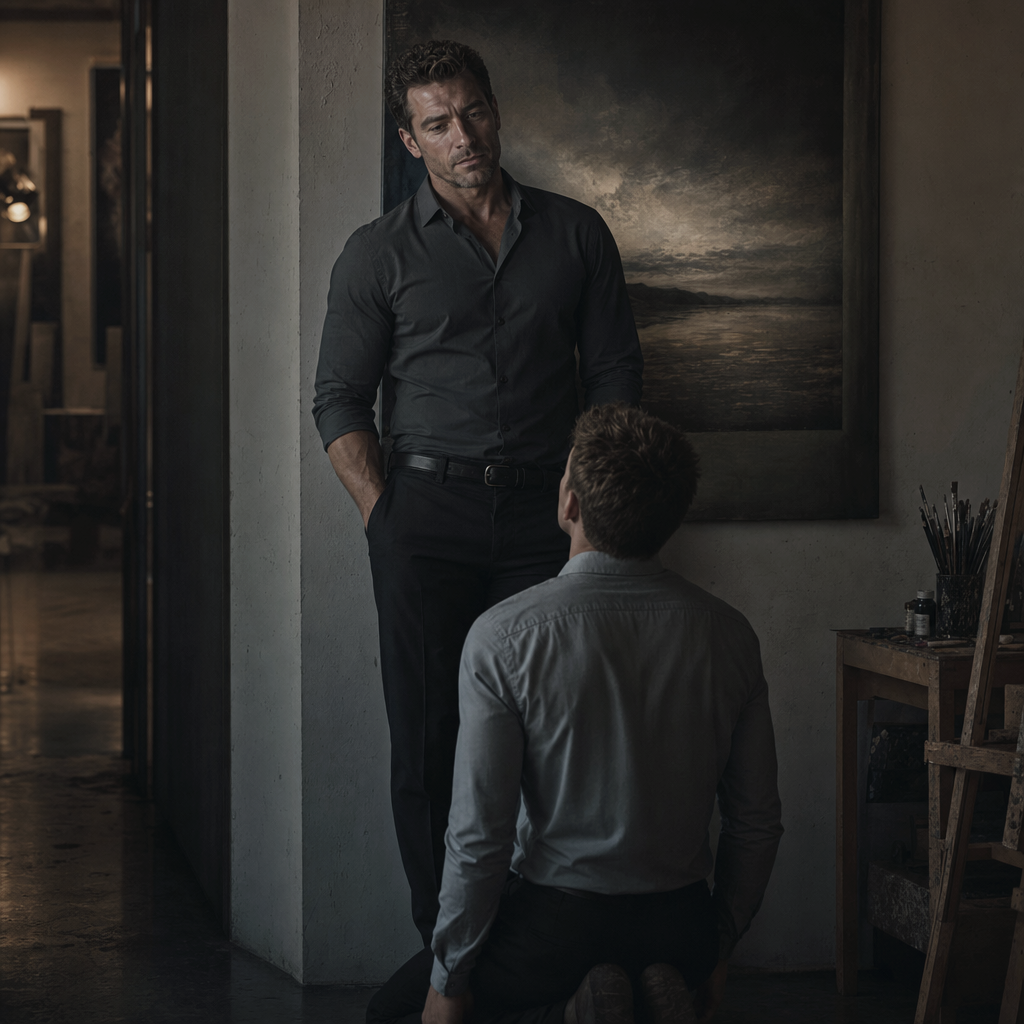
The motion was fluid, unhurried, as though he’d been planning it for longer than I realized and was now choosing his moment. My brain produced a series of disconnected observations in rapid succession. The serious set of his mouth, the pale gold of his hair under the dim light, the way his hands went to my belt before I could think to help them. I reached downward once, instinct or an offer, and he batted my hand away without looking up, a single, gentle deflection that said this is mine to do. I let my hands fall to my sides.
He worked the button free, then the zipper, drawing it down deliberately enough that each click of the teeth separating was a discrete, insignificant event. My underwear followed, his knuckles grazing the hypersensitive skin beneath, and then he was drawing me out, gently, with a care that bordered on ceremonial. I was fully hard, had been racing toward hard since the moment he’d said you are standing very close and his eyes had gone dark.
He took me into his mouth without hesitation.
It was . . . I lost the ability to form sentences for a stretch of time. His tongue knew things. His mouth was warm and wet and as methodical as the rest of him, as though he’d studied this the way he studied paintings, with full attention and no wasted motion. He worked me with a slow, building rhythm that wasn’t rushed and wasn’t tentative, and when his hand came up to cradle the base of my shaft, the other hand pressing lightly against my hip to keep me pinned to the wall, I heard myself make a sound I didn’t recognize. My palms were flat against the drywall behind me, and my hips were fighting the urge to move, and he was looking up at me once—just once, his eyes finding mine above my waist—and the expression in them was not submission. It was something closer to generosity. A gift. A reward.
The orgasm built with a speed that embarrassed me. Weeks of wanting, of waiting, of staring at his back and shoulders in the cove and his mouth across the dinner table and his hands folded around a coffee mug. All of it condensed into a pressure at the base of my spine that he dismantled with a skill I hadn’t known he possessed. When I came, it was with a groan I couldn’t swallow, my head falling back against the wall, his name tangled somewhere in the noise. He didn’t pull away. He swallowed, calmly, deliberately, and then, before I could catch my breath, his tongue was moving again, cleaning me with small, thorough strokes until there was nothing left, the sensation so sharp it was bordering pain and so good I couldn’t form a word to tell him to stop.
He folded me back into my underwear with the same care he’d used to free me. Rezipped. Rebuttoned. His movements were precise and unhurried, and when he was finished, he rose to his feet and stood before me without comment, his chin lifted, the faintest flush high on his cheekbones the only evidence of what he’d just done.
I was still against the wall, breathing as though I’d run a mile, my brain struggling to reboot. He looked at me with that same steady, serious expression, and there was a small smile at the corner of his mouth. Not a grin, not a performance, just a private, inward thing that said he was pleased with himself and didn’t intend to explain why.
“I’m going to look for the dog,” he said.
“What was that for?” I asked, and my voice came out rougher than I intended, half air and half gravel.
“For being patient.” His smile deepened by a hair, the serious face cracking open just enough to let the light through. “And for being a decent human being.”
“The dog is in the hallway,” I managed.
“Then I’m going to the hallway.”
I watched him go. Watched the line of his back disappear through the door, the easy, unbothered stride of a man who had just dismantled me and I stayed against the wall for another full minute because my legs hadn’t yet confirmed they would hold me.
When I finally pushed off the drywall, I went to the kitchen and made decaf, because I’d said I was going to make decaf, and because I needed something to do with my hands that wasn’t reliving the previous five minutes in graphic detail, which I was going to do anyway. The coffee maker hissed, the kitchen lights hummed, and I stood at the island with my palms flat on the cool granite and tried to process what had just happened.
It wasn’t the act itself, though the act itself had been extraordinary, easily one of the top ten I’d ever received, and I’d been receiving them for a long time. It was the deliberateness of it. The choice. He’d decided, and the decision had been to give me something, and he’d given it without asking for anything in return and without leaving room for interpretation. For being patient. And for being a decent human being. I’d known men who gave blowjobs as currency, and men who gave them as an apology, and men who gave them because they didn’t know what else to offer. Jesse had given me one as a thank-you note. That was new. That was, like everything else about him, unprecedented.
I thought about his eyes looking up at me from his knees. The way his hand had pressed my hip against the wall, a small but absolute statement of control. The way he’d swallowed without flinching. The way he’d tucked me back into my pants like he was closing a book he’d finished reading.
This, I thought, is either the beginning of something or the most elaborate goodbye I’ve ever received. I wasn’t sure which terrified me more.
The coffee maker beeped. I poured two mugs.

Jesse
We were sitting in the living room when the doorbell rang.
The front door was unlocked. The doorbell was a formality. I looked at Wade over the rim of my coffee cup, and he looked at the door, and the door opened and Paul Strayer walked into the house as if he owned it.
He was wearing the same expensive sunglasses from the lake days, pushed up into his hair, and a linen shirt that likely cost more than my monthly rent. His smile was full wattage, the charm dialed up to its highest setting, and behind him, in the driveway, I could see the taillights of a car that was not his truck. Someone was waiting. Someone young, by the shape of the silhouette. The companion from the marina, maybe, or a new one. Paul collected them like some men collected watches.
“Wade,” Paul said, spreading his hands as if he were arriving at a surprise party he’d thrown for himself. “I was in the neighborhood.”
“You live in Dallas,” Wade said.
“Broadly speaking.” He stepped into the living room and saw me, and the wattage of his smile increased by a degree that I recognized now as predatory. “And the young art historian. Still here. Fascinating.”
I met his gaze with the flat, unimpressed stillness I’d deployed at the marina. “Evening.”
“I was just telling Wade—” Paul began.
“You were telling me you were in the neighborhood,” Wade said. “You weren’t. What do you want?”
“I want to borrow a bottle of something good and some company.” He gestured at the room, at me, at Wade. “This is company. And you always have something good.”
Wade didn’t move. “It’s late, Paul.”
“It’s ten-thirty. That’s not late. That’s early for you.” He moved further into the room, and I saw his attention settle on me with the particular focus he used on anyone he’d decided was a target. “You’ve been spending a lot of time here. David says you’ve been at the lake every weekend. That’s practically a regular.”
“I like the lake,” I said.
“You like the lake,” Paul repeated. “Or you like the company. Wade’s an excellent host. Very generous. Very . . .” He paused, and the pause was deliberate, a small cruelty dressed up as a conversational beat. “. . . welcoming.”
“I’m going to ask you to leave,” Wade said.
“I haven’t done anything.”
“You’re doing it now.” Wade stepped forward, putting himself between me and Paul without making it obvious. “You don’t get to come into my house and talk to him like that.”
Paul’s expression flickered, the smile still in place but something underneath it shifting. “I’m just being friendly.”
“You’re not being friendly. You’re being Paul. And whatever you’re shopping for, it’s not here.”
“That’s not very generous of you, Wade. Sharing is—”
“Don’t.” Wade’s voice was low and flat, and I was aware of him in front of me, the solid wall of him between me and Paul, the way his shoulders had squared. “Don’t finish that sentence.”
Paul held up his hands in a gesture of mock surrender. “Fine. I’ll find my company elsewhere. But you might want to consider . . .” He looked past Wade at me, and his smile turned sharp. “. . . that when you keep a pretty thing all to yourself, it looks like you’re afraid someone’s going to steal it.”
Wade moved before I thought about moving. One step, then two, and he was close enough to Paul that Paul had to look up to meet his eyes. Paul was tall, but Wade was taller, and Wade had forty pounds on him and a decade of carrying those pounds in useful ways.
“Get out of my house,” Wade said.
Paul held Wade’s gaze for a moment longer than was comfortable. Then he shrugged, the easy, liquid shrug of someone who’d learned to make defeat look like indifference, and turned toward the door.
At the threshold he stopped and looked at Wade over his shoulder. “Don’t be so territorial, Wade,” he said. “It doesn’t suit you.”
Mercer, who had been lying in the hallway and had watched the entire exchange with the muted attention of a dog who understood more than he let on, stood up and walked to the front door and sat down in the opening. He didn’t growl. He didn’t need to. He was a large dog, and he was in the way, and his stillness was the stillness of something that might become movement very quickly.
Paul looked at the dog. Looked at Wade. Looked at me, who had risen from my seat and was standing now at the back of the room, my posture relaxed and watchful.
“I’m outnumbered,” Paul said. “Good night, Wade. Enjoy your . . .” He gestured vaguely at me. “. . . guest.”
He walked out. The door closed. Mercer lay back down.
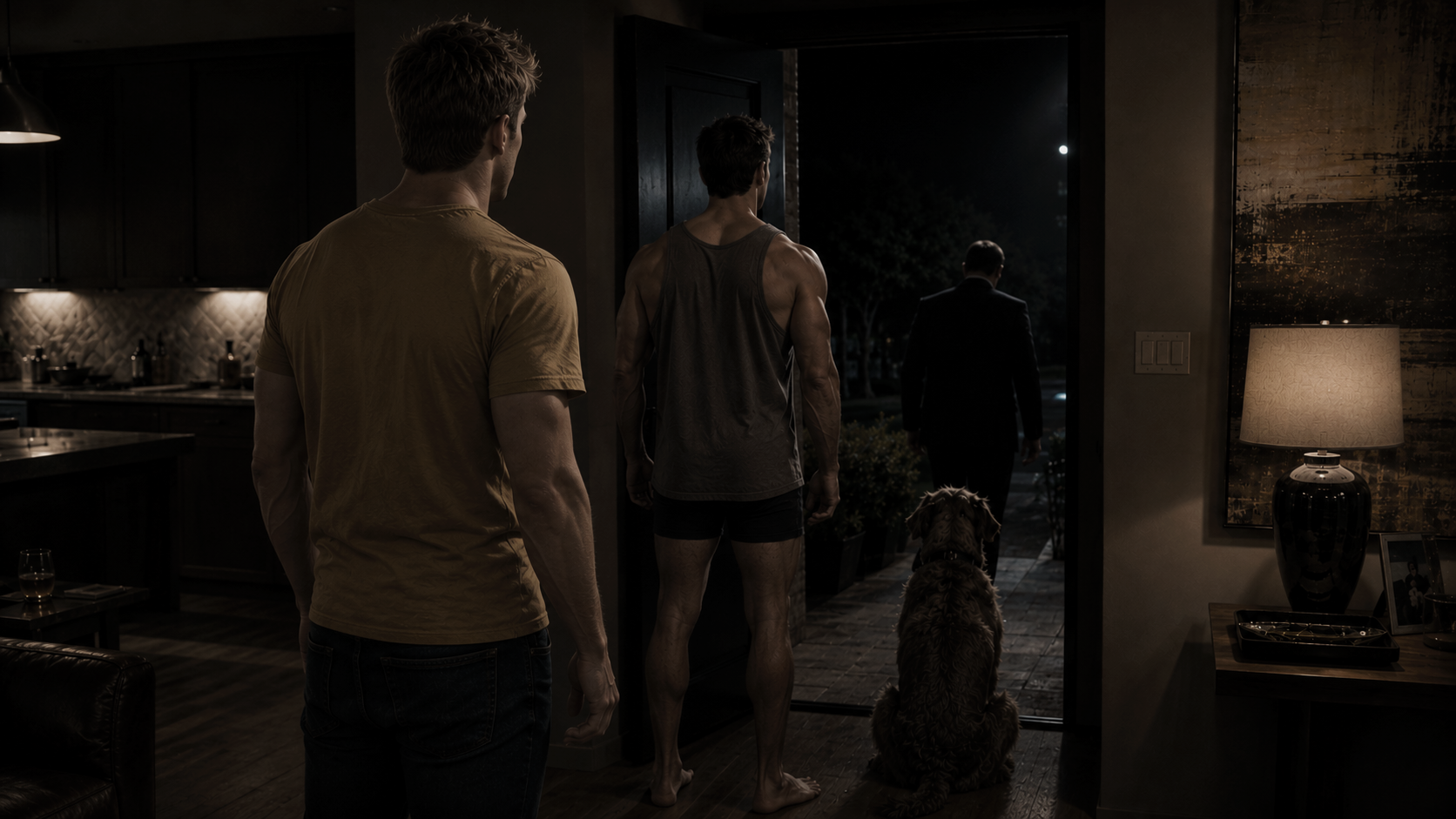
The room was soundless.
Wade stood where he was for a moment, breathing, the adrenaline still moving through him in waves. Then he turned around and looked at me. My expression was unreadable, which meant I was processing.
“I’m sorry,” he said.
“For what?”
“That. Him. He’s . . . he’s been like that for fifteen years and I keep thinking he’ll grow out of it and he never does.”
“I know what he is,” I said. “I knew at the marina. You didn’t need to—” I stopped.
“I did,” he said. “I did need to.”
I looked at him for a long moment. “I can handle Paul.”
“I know you can. You handled him at the marina. You’d handle him anywhere. But you shouldn’t have to.” He crossed to the wet bar and poured himself two fingers of whiskey, neat, because he needed something to do with his hands. “He doesn’t get to come into my house and talk to you like you’re something I picked up at a bar.”
“Is that what he thinks I am?”
“He thinks everyone is something someone picked up at a bar. That’s how Paul sees the world.” He drank. “He’s wrong.”
“I know,” I said. And then, very quietly, “I know what I am.”
It was the kind of sentence that meant more than it said. He didn’t press on it. He just stood there, the whiskey warm in his throat, the room settling back into quiet, and let me decide what came next.
After a minute, I walked to the front door and opened it. I heard myself call something into the night air, and then Kip’s voice answered—sharp, surprised—and I realized Kip had been outside. He’d arrived with Paul, or after Paul, and he’d been standing on the porch while Paul left.
I came back inside with Kip following. He looked at Wade, at me, at the whiskey in Wade’s hand. I didn’t have the bandwidth to parse his complicated expression.
“Paul’s gone,” Wade said.
“I saw,” Kip said.
“He shouldn’t have been here.”
“No,” Kip agreed. “He shouldn’t.” He looked at me with an expression I couldn’t read. “Are you all right?”
“I’m fine,” I said. “He’s not the first person to look at me like that, and he won’t be the last.”
Kip was quiet for a moment. Then he said to Wade, “I told him not to come.”
“You came with him.”
“I drove separately. I was trying to . . .” He stopped. “It doesn’t matter. He’s gone. I just wanted to make sure . . .” He looked at me again, and this time his expression was something closer to the thing I’d seen on his face at the lake, the quiet, watchful quality. “He shouldn’t have talked to you like that.”
“No,” I said. “He shouldn’t.”
“If he does it again—”
“He won’t,” Wade said. “He knows better now.”
Kip looked at Wade for a long moment. Whatever he was thinking, he didn’t say it. He just nodded once, a small, tight nod, and then turned and walked back out to his car.
The door closed. The house was quiet again.
Wade finished his whiskey. Set the glass down.
“Stay,” he said. “You’ve had coffee, and it’s late. Guest room’s still made up.”
I looked at him. “You’re sure?”
“I’m sure.”
I nodded once, and then I went to the hallway where Mercer was lying on the rug, and Wade went to lock the front door, and the night settled around us like something tired and steady.

Jesse
In the guest room, the light off, the house quiet, I lay on my back and looked at the ceiling. The whiskey Wade had poured and I hadn’t drunk was a warmth in my chest. The evening replayed itself in order. The gallery, the drive, the lake conversation, the painting, the kneeling on the studio floor, Paul. The way Wade had stepped in front of me without making it a performance. The way his voice had gone low and flat when he told Paul to get out. And before that, before the intrusion, the way he’d dropped his hand from my face. The way he’d said I’m not going to have you wake up tomorrow and wonder if I took advantage of a situation. The way he’d stepped back even when I’d told him I was thinking clearly.
He’d taken the high road. He’d been patient for six weeks, and then, when the moment came, he’d stepped back rather than risk my regret. No one had ever done that for me before. No one had ever wanted me and then chosen not to take because taking might have cost me something.
So I’d decided to give him something instead.
I had little experience. The two relationships before Luke were gentle things, unremarkable, neither of them lasting long enough for me to learn much. They had left me with a basic vocabulary and not much fluency. But I’d watched. I’d listened. I’d paid attention in the way I paid attention to everything, and I’d known, in a theoretical way, how to make a man fall apart with his back against a wall. Tonight I’d discovered that the theoretical version translated fairly well into practice.
The taste of him was still faintly on my tongue. The weight of him, the heat, the way his breathing had gone ragged above me while I worked. I hadn’t known it would feel like that. Like power, but not the kind that diminishes anyone. Like gratitude, but with teeth. I’d looked up at him once, his eyes dark and his mouth open and his back arched against the wall, and the sound he’d made when he came was something I wanted to hear again. Often. Regularly. Under circumstances I was only beginning to allow myself to imagine.
He was a problem. Forty-one years old, broad and warm and confident in a way that wasn’t arrogance, and he’d put his hand on my face like I was something precious and pulled back like I was something he was afraid to break. I’d wanted to show him that I wasn’t breakable. That he didn’t have to treat me like glass. That the careful, deliberate version of himself he’d been offering me for six weeks was appreciated, genuinely, and that appreciation could take forms he hadn’t expected.
The look on his face afterward—bewildered, wrecked, grateful—had been worth the risk. Every second of it.
I closed my eyes. Mercer’s weight shifted at the foot of the bed, a warm, solid pressure.
I didn’t have intentions. But I’d just made one very clear, and the making of it had changed something. I didn’t yet know what it had changed into. But I was going to find out.

Wade
Jake came in around midnight. I was still in the kitchen, the decaf long cold, the whiskey bottle back in its cabinet, the house dark except for the light over the stove. He closed the front door quietly and walked through the living room and stopped when he saw me.
“You’re still up.”
“Couldn’t sleep.”
He looked at my face for a moment, reading it the way he read everything. “What happened?”
I told him. Paul, the intrusion, the thrown-out exit. Kip showing up afterwards. Jesse staying in the guest room. And before that, the studio, the painting, the hand on his face, the decision to step back, and what Jesse had done in response.
Jake listened without interrupting, his expression moving through several distinct phases. When I got to the part where Jesse dropped to his knees, his eyebrows rose a fraction of an inch, the Jake equivalent of a dropped jaw, and stayed there until I finished.
“He blew you,” Jake said flatly.
“Yes.”
“As a reward. For being patient.”
“And for being a decent human being.”
Jake stared at me. Then he went to the refrigerator, got two beers, and set one in front of me with the deliberateness of a man who needed a prop for the conversation that was about to happen.
“You’ve been a gentleman for six weeks,” he said, “and he thanked you by dropping to his knees in your studio and giving you a top-ten blowjob.”
“That’s accurate.”
“And you didn’t stop him.”
“He batted my hand away when I tried to help. He was very clear about what he wanted.” I twisted the cap off the beer. “Who am I to argue with a man who knows what he wants?”
Jake looked at me for a long moment. Then he shook his head, the small, incredulous shake of someone who had been prepared for one set of problems and had encountered a different set altogether. “I’ve been telling you for weeks he’s not like the others. I did not expect him to prove it by blowing you in your own hallway.”
“Studio.”
“Studio. Fine.” He opened his own beer. “What did you do after?”
“I made decaf. Then Paul showed up.” I paused. “I’m still processing it. The act itself was . . . extraordinary. But the deliberateness of it. The choice. He’d been thinking about it. He’d decided. I don’t know what it means.”
“It means he likes you,” Jake said. “It means he’s grateful that you’ve been patient and that you stepped back when you could have pushed. And it means he’s bolder than any of us gave him credit for. That’s all good. That’s all very good.”
“He’s twenty-one.”
“We’ve had this conversation.”
“I know. I just . . . he’s twenty-one, and he just gave me one of the best blowjobs of my life, and I’m forty-one and I felt like I was the one out of my depth. That’s new. That’s never happened before.”
Jake took a long pull of his beer. “Good. It should feel new. Everything about him is new. That’s the point.”
We sat in silence for a moment. The refrigerator hummed.
“All right,” Jake said finally, leaning back in his chair. “Here’s what I think. You’ve got it bad. You’ve been a gentleman for six weeks, and it’s very impressive, and I’m proud of you. You also just got your brains blown out by a twenty-one-year-old art history major who did it because you didn’t kiss him when you could have. That’s going to live in your head rent free for the foreseeable future. Tomorrow, you’re going to let me make you breakfast, and you’re going to be normal around him, and you will not spend the whole meal thinking about his mouth.”
“I’m absolutely going to spend the whole meal thinking about his mouth.”
“I know. That’s why I’m making breakfast. So I can distract you.” He raised his beer. “You’ve been waiting six weeks. You just got proof that the waiting is working. Now keep waiting. He’ll let you know when he’s ready for the next thing.”
“You’re very wise tonight.”
“I’m always wise. You just don’t always listen.” He stood up, taking his beer with him. “Don’t overthink it. He gave you a gift. Accept it. Don’t make it weird.”
“I will not make it weird.”
“You made it weird by telling me about it.”
“You asked what happened.”
“I asked what happened with Paul.”
“Paul was after,” I said. “Context matters.”
Jake looked at me for a moment. Then he laughed. A low, genuine laugh, the kind he reserved for things that had truly surprised him. “You’re something else, Wade.”
He went to bed. I stayed in the kitchen for a while longer, drinking slowly, letting the night settle. Somewhere in the guest room, Jesse was asleep with Mercer at the foot of the bed, and I was in the kitchen wanting him, and the wanting was different now. Sharper. More specific. I had a new memory to add to the collection. The weight of him on his knees, the heat of his mouth, the way he’d looked up at me with those serious eyes and given me something no one had ever thought to give me before.
I finished my beer and went to bed. In the morning, Jesse would be in my kitchen. I’d make coffee. I’d be normal.
I’d wait.

End of Chapter Three.