

The party turns devastating when a drug-fueled comparison to an ex-lover shatters Jesse in front of everyone, only for the night to break open further with a locked-door betrayal. As Jesse quietly packs his life into a single duffel bag, the house settles into a fragile quiet where alliances are tested, long-hidden machinations are exposed, and everyone must confront the wreckage left behind. This chapter delivers a exploration of public humiliation and private heartbreak, leaving every character to hold the pieces of a night they won’t easily survive.

You can download the EPUB version of this story to date HERE if you prefer to read on your Kindle or other device.

[Tonight, the house continues to burn down. Tomorrow they will wake and stand in its smoldering wreckage and try to decide if anything is salvageable. I think Chapter 8 is the most emotional chapter I’ve ever written. Paid subscribers will get an early release on Tuesday.]
Jesse’s Point of View
The party had changed temperature. I felt it the way you feel a draft from a window someone opened in another room. Not visible, not obvious, but present in the way people adjusted their bodies around me. Conversations shifted when I walked past. Eyes found other things to look at. The space around me had become careful, as if I were carrying something fragile and everyone had agreed, without speaking, not to jostle it.
I had been standing at the wall for what felt like a long time. My back was straight. My hands were at my sides. The wall behind me was smooth and cool through my shirt, and the nail hole where the painting used to hang was a small, dark interruption in the plaster that my fingers kept finding, kept tracing, kept leaving.
Forty minutes. That was the estimate I gave myself. Forty minutes of circulating, of performing normalcy, of being the version of myself that could smile at the right moments and excuse himself to get another drink and not let anyone see that something had been gutted.
David found me near the fire pit. His face was flushed with drink and concern, the particular combination that made him sloppy and sincere in equal measure.
“You okay?” he asked.
The question was too large. I took the piece of it I could answer.
“I’m fine.”
“Because that was . . .” He stopped, seeming to realize that finishing the sentence would require him to say out loud what had happened, and that saying it out loud might make it worse. “Wade was really drunk.”
“Yes.”
“You’re not okay.”
“David.” I kept my voice level, the way I’d been keeping everything level since the couch. “I’m managing. Let me manage.”
He looked at me for a moment longer, his drunk face trying to find the right expression and not quite landing on it. Then he nodded, squeezed my arm with a clumsy affection that was meant to be comforting, and wandered back toward the bar.
Paul put a hand on my shoulder as he passed. His palm was damp, the pressure too heavy, the contact lasting half a second longer than it should have.
“Good party,” he said.
The words were weighted with something I didn’t want to examine. I didn’t answer. He moved on, and the space where his hand had been stayed warm on my shoulder, a residue I couldn’t shake off.
The living room scene was still replaying. I couldn’t stop it. The graphic comparison to Andrew, that tight little hole just swallowing my cock, surfaced and resurfaced, each time with the same sick drop in my stomach, the same flush of heat that was not embarrassment but something closer to disbelief. The drug suggestion. The way he’d framed my body as a problem to be solved. The way he’d offered to pay for the solution, as if my non-negotiable condition were a negotiation he’d simply been waiting to resume.
And Andrew. Andrew was here. Andrew had heard every word.
I looked around the patio, cataloguing who was still there. The crowd had thinned. The earlier fullness of the party reduced to the hardcore remnants, the ones who would stay until the fire pit burned down or the host passed out. Michael and Milo were at one of the patio tables, not speaking, the distance between them more visible now than it had been earlier. Paul was at the bar, refilling his glass. Kip was somewhere inside. Andrew . . . I didn’t see Andrew. I didn’t see Wade either.
The host was missing.
I went inside.

The hallway was quieter than the patio, the music from the outdoor speakers reduced to a muffled bass line that vibrated through the walls. The framed photograph was still there. The one I’d studied my first night, the one that had told me something about Wade before I knew I was looking for it. I didn’t stop. The house felt different now, the way a room feels different after someone has said something that can’t be unsaid. The art was still on the walls. The furniture was still arranged the same way. But something in the air had changed, a charge that hadn’t been there before.
Jake was standing outside the master bedroom door.
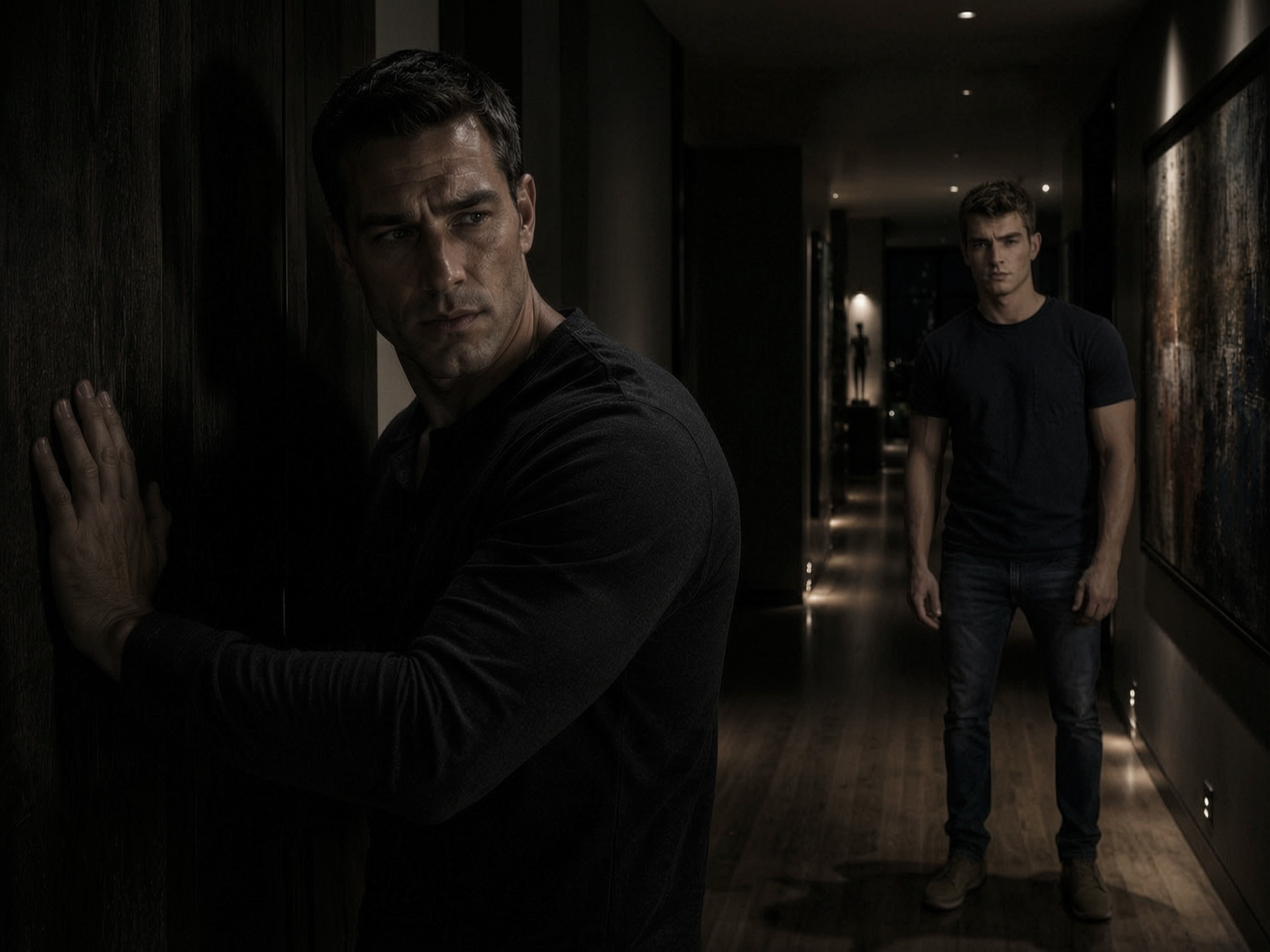
He wasn’t knocking. His hand was flat against the wood, palm pressed to the surface, as if he were trying to feel something through it. His jaw was tight. His shoulders were set in the form of someone who had made a decision and was waiting for the right moment to act on it.
He heard me approach and turned. His face, when he saw me, did something complicated. The quick, involuntary flicker of someone who had been hoping I wouldn’t come down this hallway and was now recalibrating.
“Jesse,” Jake said. His voice was low, careful, and in the tone of someone who was trying to control the impact of something uncontrollable. “Just . . . listen for a second.”
“Don’t,” I said.
“He’s not . . . whatever he took, it’s not just the drinks. He doesn’t know what he’s doing right now.”
“He knew what he was saying in the living room.” My voice came out flat, which was a victory of a certain kind. “He was very clear about what he was saying.”
“That was the drugs. That was whatever Jaegen left on the table.”
“That was the drugs removing the filter.” I looked at Jake’s hand, still flat against the door. “That’s how it works, Jake. It doesn’t invent things. It just removes what was keeping them in.”
Jake was quiet. He had the expression of a man who knew I wasn’t wrong and wasn’t going to pretend otherwise. The fact that he didn’t try to argue was, in its own way, worse than if he had.
“Is Andrew in there with him?” I asked.
The pause was the answer. It landed in the space between us with the weight of something physical.
“Jesse . . .”
“Is Andrew in there with him?”
Jake’s jaw moved. One small, involuntary tightening, and then he controlled it again. The Marine in him, the part that had been trained to deliver bad news with precision and without flinching, was doing its work. “I’ve been standing here for ten minutes trying to talk him out. I don’t think he can hear me over . . .” He stopped. Tried again. “I am going to go in there and deal with it. Okay? That’s what’s going to happen. But I wanted you to hear it from me. Not from . . . I didn’t want you to find out from walking past the door.”
I looked at him for a long moment. Jake, who had been decent to me from the first night when decency was not the default. Jake, who had said I don’t bet on people with the particular flatness that meant it was a principle. Jake, whose hand was still against the door like he was holding something back.
“Jake,” I said. I knew tears were showing and I did my best to pretend that I did not.
He stopped.
“I’ll handle it,” Jake said. “Go back to the party. Let me handle it.”
“You’ll handle it?”
“Yes.”
I looked at the door. The wood was solid. The lock was engaged. On the other side of it, Wade was . . . I stopped the thought before it could finish. Some things didn’t need to be imagined in detail.
“I heard you,” I said. “I know you’re trying. But I don’t think there’s a party to go back to anymore.”
Then I turned and walked back down the hallway, past the photograph, past the living room, past the wall where the painting had been, and out to the patio, where the fire pit was still burning and the party was still happening and everything was exactly the same except that it wasn’t.

Wade’s Point of View
The bedroom was very bright and then it was very dark and then it was very bright again, and somewhere in the space between the bright and the dark I understood that I was lying on the bed, and that I was not alone.
The drug was still doing its thing. The warm, electrical hum that had been running under my skin since the bar, the sense that everything was sharper and softer at the same time, that the edges of things were both more distinct and less important. I could feel the sheets under my back and the weight of another body beside me, and the wanting was still there, the bright urgent wanting that the drugs had unlocked and that alcohol had never quite managed on its own.
Andrew’s mouth was on my neck. I knew it was Andrew because Andrew’s mouth had been on my neck approximately four hundred times in the thirty months we’d been doing this, off and on, and my body remembered the shape of it the way it remembered the shape of my own teeth. His hand was on my chest, working the buttons of my shirt with the practiced ease of someone who had done this exact thing in this exact room more times than I could count.
“You’re still so fucking hot,” I heard myself say. My voice was thick and slow, the words arriving a half second after I thought them. “You know that? You’re still the best. The best I ever had. Nobody fucks like you.”
Andrew made a sound against my throat. It might have been a laugh. “You’re high.”
“I’m celebrating.” I reached for him, my hands clumsy, finding his hips, the familiar architecture of his body. “Sixteen weeks. Can you believe it? Sixteen weeks with the kid and he still won’t let me . . .” I laughed, the loose, unguarded laugh of a man whose filter was gone. “He’s so fucking tight, man. Not in the good way. In the way where he can’t relax. I’ve been waiting four months to get inside that ass and every time I try he goes all . . .” I gestured vaguely, my hand losing its place, finding Andrew’s thigh instead. “But you. You. You could take anything. Remember that time in the hotel in Austin? I had you on your hands and knees for like an hour and you just . . . you just let me go. You loved it. You were begging for it.”
“I remember,” Andrew said. His voice was amused, unhurried, the voice of a man who had been in this situation before and knew exactly how it was going to end.
“That’s what I need,” I said. The words were coming faster now, the drugs pushing them out before I could stop them. “I need someone who can take it. Jesse’s . . . Jesse’s amazing, he’s so good in every other way, but he’s not . . . he’s never going to be that. And I thought I could be patient, I thought I could wait, but four months, man. Four months and I’m still . . .” I pulled Andrew closer, my mouth finding his ear. “I want to fuck you until you can’t walk. I want to do all the things I can’t do with him. He’s too fragile. Too in his head about it. But you, you’re a fucking professional.”
Andrew’s laugh was low and warm, the laugh of someone who was being given exactly what they wanted and didn’t have to pretend otherwise. “You’re going to regret this in the morning.”
The room was warm and dark and flickering at the edges, and somewhere in the back of my mind a voice was saying stop, this is wrong, Jesse is here, you just humiliated him in front of everyone and now you’re . . . but the voice was very far away, and the warmth was very close, and Andrew’s body was familiar in the way of something easy, something that didn’t require work, something that didn’t ask me to be better than I was.
“Fuck the morning,” I said. “This is tonight.”
And then the room tilted, and the bright went dark, and the dark stayed dark, and the last thing I was aware of before the drug pulled me under was Andrew’s hand on my belt and the sound of my own breathing, heavy and slow, and somewhere very far away, a door that wouldn’t open.

Jesse’s Point of View
The guest room was exactly as I’d left it.
The bed was made. The spare blankets were folded on the chair in the corner. The glass of water I’d poured that morning—was it only that morning?—was still on the nightstand. The surface of it caught the light from the hallway, a small, still circle that I stared at for a long moment before I moved.
I had come to this room my first night here. I had looked at this ceiling and thought about a breakup, a fist against a doorframe, and the strange fact that the man whose guest room I was sleeping in had dated the same person I had. The ceiling was the same ceiling. The room was the same room. But the person standing in it now was not the same person who had stood in it then.
My things were where I’d left them. The duffel bag in the closet. The book on the nightstand. The jacket hung over the back of the chair. Sixteen weeks of accumulated domestic knowledge, where the extra towels were, how the shower tap worked, which drawer held the spare phone chargers, and I was cataloguing it all with the cold, precise attention of someone who was about to leave and wanted to make sure nothing was forgotten.
My hands were steady. Not calm. I was not calm. It was the steadiness of a body that had decided to delay collapse until the logistics were handled. I folded the jacket. Put it in the duffel. Retrieved the phone charger from the drawer. The book went into the bag last, its spine cracked at the place I’d stopped reading the night before, a marker of a timeline that had already fractured.
The glass of water was still on the nightstand. I didn’t drink it. I didn’t move it. I left it there, a small, deliberate omission, and walked out of the room with my bag in my hand and my life reduced to what I could carry.

The driveway was cold. The October night had finally arrived. The temperature dropped, the wind picking up from the north, the smell of cedar and chlorine and the faint, sweet smoke of the fire pit still burning on the patio. My car was where I’d parked it six hours ago at the edge of the circular drive, the Honda that Wade had once looked at and said nothing about, because we both knew the gap between our lives was too large to comment on.
I was at the driver’s side door when Jake caught up to me.
“Jesse.”
I didn’t turn around. “I’m fine to drive. I stopped drinking an hour ago.”
“That’s not . . .” He was breathing hard, as if he’d run. “You can’t drive right now. You’re . . . you’re not in a state to drive.”
I turned then. The motion was slower than I intended, weighted with something I couldn’t name. Jake’s face was sharp in the porch light. The tight jaw, the eyes that were trying to read me, the particular urgency of someone who had been running damage control all night and was running out of things to control.
“I’m not drunk,” I said. “I’m not going to crash. I’m going to get in my car and drive to Denton and that’s the end of it.”
“That’s not the end of it.” He took a step closer. “What happened in the living room—”
“Was not an accident.” My voice came out harder now, the levelness cracking at the edges. “He compared me to Andrew. In front of everyone. In front of Andrew. He offered to pay for drugs to ‘fix’ me. And now he’s in his bedroom with the door locked and Andrew is in there with him, and you’re standing here telling me not to drive.”
The words landed in the cold air and stayed there. Jake didn’t flinch. He absorbed them, the way he absorbed everything. Steadily, without deflection, without trying to make them smaller than they were.
“You’re right,” he said. “All of that. You’re right about all of it. But you’re still not driving.”
“I don’t—”
“Stay in the guest room tonight. I’ll stay too. We’ll figure out the rest tomorrow.”
I looked at him. The porch light was behind him, casting his face into half shadow, but his expression was clear. The steady, uncomplicated decency that had been there since the first night, since the moment he’d told Wade I wasn’t like the others and meant it as a warning.
“There’s something else,” Jake said. “Something you should know.”
“Jake, I can’t take any more.”
“Before tonight—before the party—Wade told me he wanted to make it permanent. The actual word. Permanent.” He paused. “I’m not telling you that to change your mind about anything. I’m telling you because you should have all the information.”
Permanent. The word landed somewhere in my chest and didn’t move. I didn’t know what to do with it. I didn’t know if it made things better or worse. I filed it, the way I filed everything, in the place where I kept things I wasn’t ready to process yet.
“Sounds like permanent lasted less than twenty-four hours,” I said.
“Jesse . . .” Jake looked at me.
“The guest room?” I said.
“Yeah.”
“I’m not talking to him tonight.”
“You won’t have to. He’s passed out. He won’t be waking up for hours.”
I looked at my car. The duffel bag was still in my hand. The night was cold and dark and full of the distant sound of the party I had left behind.
“Okay,” I said. “Tonight. But I’m not promising I’ll talk to him tomorrow, either.”
“I can’t blame you.”

I didn’t go back until Jake had dragged Andrew out.
I watched from the kitchen. The patio door was open a few inches, and the cold air came through it in thin, sharp currents that carried the smell of the dying fire. Andrew came out of the hallway in a state of undress. Shoes in one hand, shirt in the other, belt undone, not meeting anyone’s eyes. His face was not embarrassed. It was the face of someone who had been caught and didn’t consider the catching to be the worst part.
Jake was behind him, one hand on Andrew’s shoulder, propelling him forward with a force that was not violent but was not gentle either. His voice was low and cold, the timbre of someone who had been pushed past patience and into something more dangerous.
“I don’t know what you thought you were doing tonight,” Jake said. “But you knew. You’ve known for sixteen weeks exactly what this is and what it means to him. You came to this party knowing that.”
Andrew said something I couldn’t hear. A murmur, low and defensive.
“I don’t want to hear it,” Jake said. “I don’t want an explanation. I want you to understand, clearly and completely, that you are not going to be in this house again. Not while Jesse is here. And if you have any interest in staying in this social circle which you might not, after tonight, and that would be a reasonable outcome, you are going to stay as far out of this relationship as it is possible to stay.” A pause, absolute and final. “Are we clear?”
Andrew said something again, still too low to carry, but the tone was capitulation. The tone was I know.
“Good,” Jake said.
The patio door slid open. Cold air flooded the kitchen. Andrew walked through it, out to the driveway, where a rideshare was already waiting. Summoned by Jake, I realized, while I’d been in the guest room. The car door opened and closed. Headlights swept across the front of the house. Then the car was gone, and the driveway was empty, and Jake was standing in the kitchen with his hands braced on the counter, breathing like he’d just finished something exhausting.
“Thank you,” I said.
He looked up. His face was tired in a way I hadn’t seen before. The exhaustion of a man who had been managing other people’s disasters all night and hadn’t had a chance to manage his own.
“He’s still passed out. He won’t be waking soon.” Jake straightened, ran a hand through his hair. “Get some sleep. If you can.”
“I’ll try.”
I went back to the guest room. The duffel bag was on the bed. The glass of water remained on the nightstand. I closed the door and sat down on the edge of the mattress, and the night stretched out in front of me, long and quiet and full of things I wasn’t going to sleep through.

The guest room ceiling was the same as it had been the first night.
I lay on the bed with the lights off and the door cracked open and the October wind moving through the cedars outside the window. The sound was a low, constant rush. Not white noise, something more specific, the particular frequency of wind through needle leaves that I’d learned to recognize over sixteen weeks of sleeping in this house.
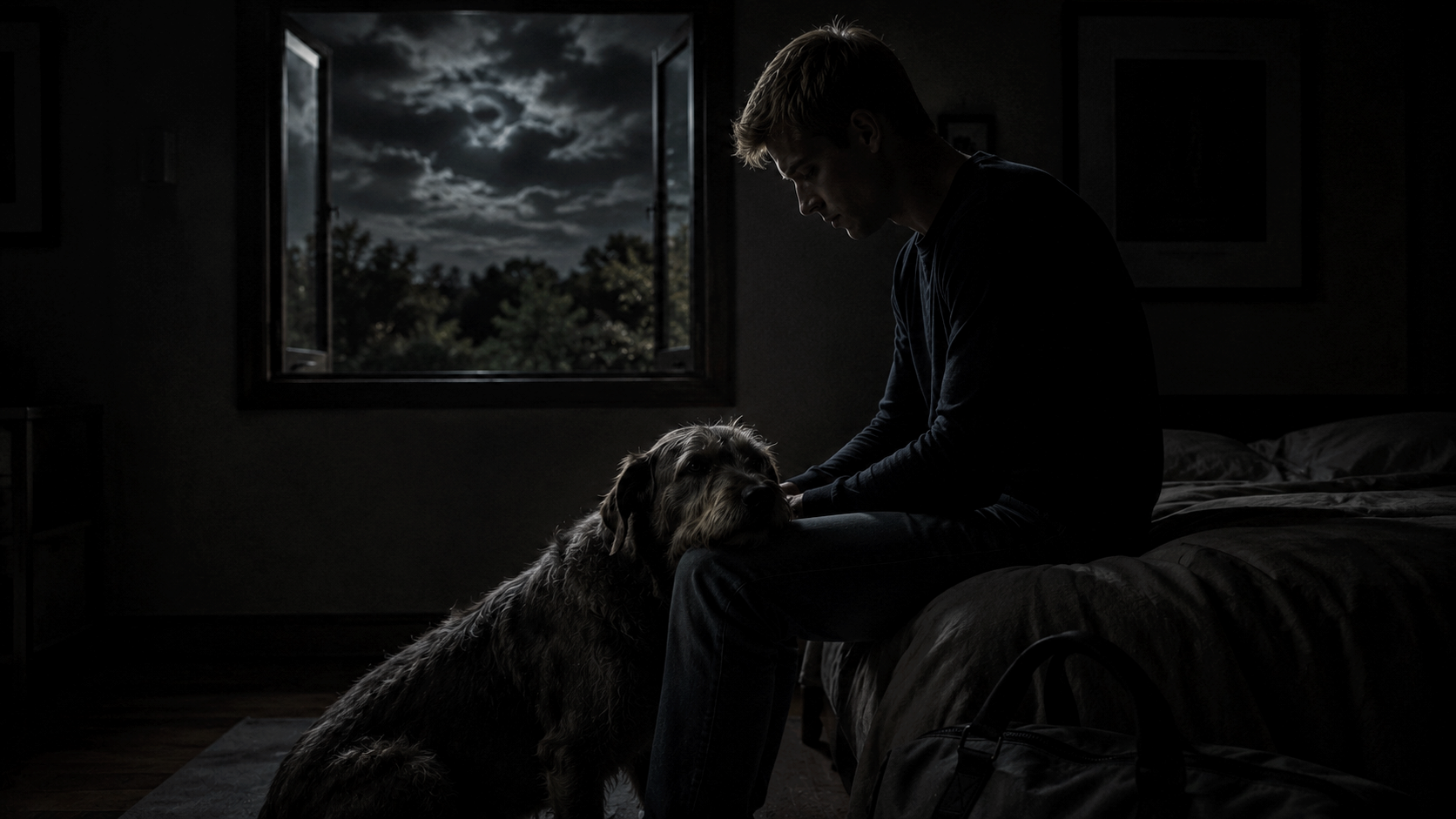
Mercer arrived at some point. I didn’t hear him come in. My good ear was toward the window, and the wind was covering the small sounds, but I felt the weight of his head on my knee, the familiar pressure of a dog who had decided, without asking, that I needed company. His fur was coarse against my palm. His breathing was slow and even, the rhythm of an old dog who had seen enough human drama to know that it usually passed.
I sat there in the dark with my hand on his head and let the night do what it was going to do.
The living room scene replayed. The graphic comparison. Andrew could take anything I gave him. The words were more real now, sharper, the way they’d sounded in the room with everyone watching. The drug suggestion. The way he’d beamed at me afterward, satisfied, as if he’d solved something.
And then the locked door. Andrew inside. The same Andrew he’d just publicly compared me to. The same Andrew I’d asked about the other morning. Your party. Your list. And he’d let me let it drop, and now Andrew was in his bedroom, and whatever had happened in there had happened while I was standing in the living room holding myself together.
Permanent. The word Jake had given me. Wade had said permanent. He’d meant it, or Jake believed he’d meant it, and Jake was not someone who was easy to fool. The same man who had humiliated me in front of everyone, who had offered to drug me, who had locked the door with Andrew . . . that man had also, at some point, told his best friend he wanted to make this last.
I held both things at once. I didn’t try to reconcile them. They sat side by side in the dark, two facts that should have canceled each other out and didn’t.
Mercer exhaled a long dog sigh and shifted his weight against my leg. Outside, the wind kept moving through the cedars. The house was quiet. The party was over. Somewhere down the hall, Wade was unconscious, the chemical residue still in his system.
I didn’t sleep. But I breathed. I breathed, and I kept my hand on the dog’s head, and I waited for the gray light to come back.

Jake’s Point of View
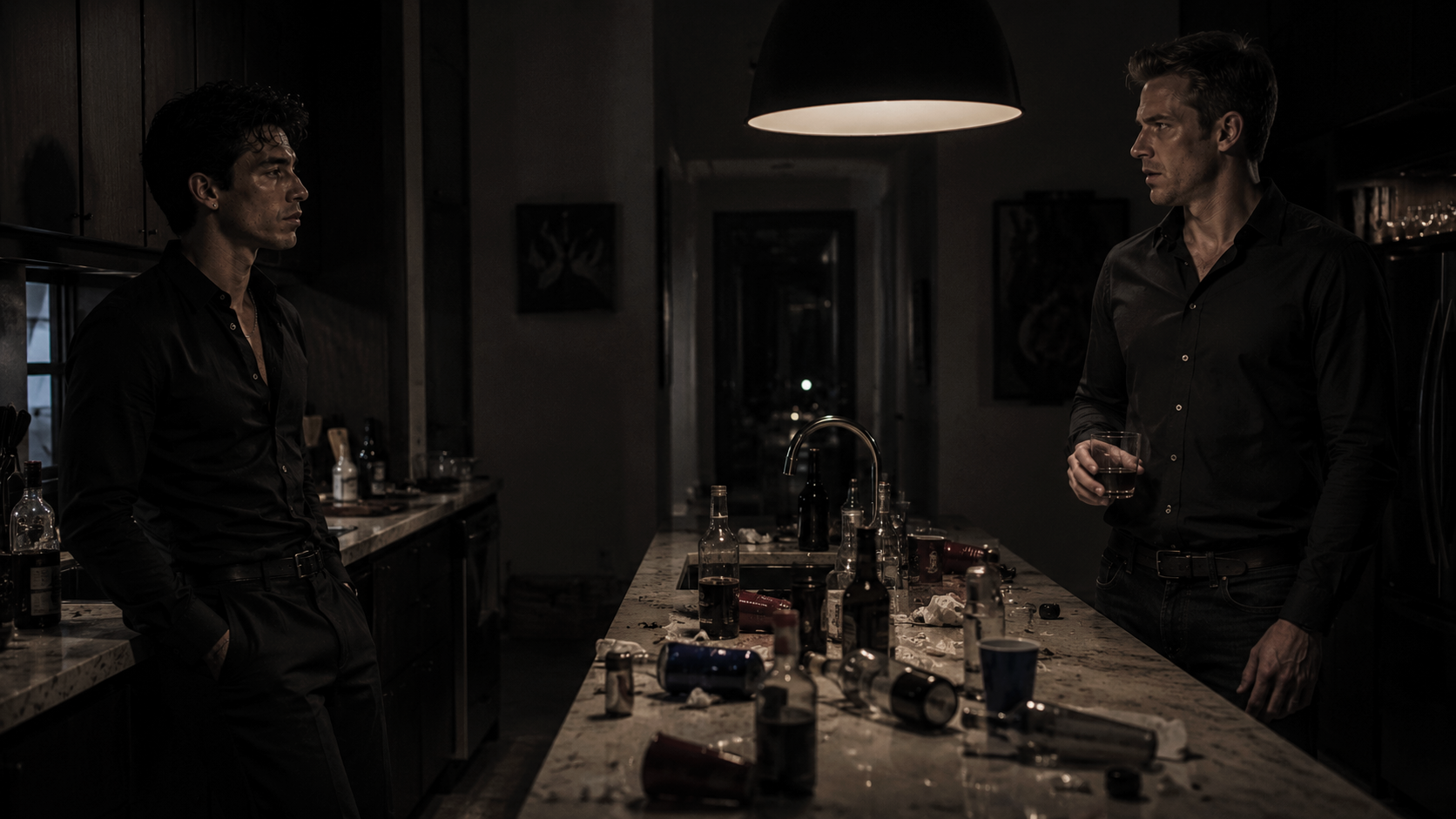
The kitchen was a wreck.
I hadn’t noticed it while I was ejecting Andrew, while I was talking to Jesse in the driveway, while I was doing the hundred small things that had to be done to keep a disaster from becoming a catastrophe. But now, with Jesse in the guest room and Wade unconscious and the last of the guests finally gone, the kitchen was simply a wreck.
Cups everywhere. Bottles. A platter of something that had been left out too long and was starting to smell. The serving trays Jesse had found without looking, stacked neatly by the sink, the only organized thing in the room.
I started cleaning because cleaning was something I could do. I loaded the dishwasher. I threw out the food. I wiped down the counters with a rag I found under the sink, the familiar domestic motions settling something in my chest that had been unsettled since the living room scene.
Kip was still there.
He was at the kitchen island, nursing a drink he’d been nursing for an hour, his expression carefully neutral in the way that meant he was feeling something he didn’t want to show. I’d known him long enough to read the signs. The slight tension around his mouth, the way his eyes tracked me as I moved through the kitchen, the particular stillness of someone who was waiting for a conversation to start.
“Wade’s going to have a hell of a morning,” Kip said.
“Yeah.”
“Is Jesse still here?”
“Guest room.”
Kip nodded slowly. “That’s probably for the best. He shouldn’t be driving tonight.”
I put the rag down. Turned to face him. The kitchen was between us, the island, the dirty glasses, the last remnants of a party that had gone very wrong.
“When did you and David introduce Luke to Jesse?”
The question landed in the quiet. Kip’s expression flickered with a small, almost imperceptible shift, the micro-expression of someone who had been expecting this question and was still not prepared for it.
“What does Luke have to do with—”
“Luke Carrillo. Wade dated him for three weeks in April. Ended it because he was too intense. The same week, you and David introduced Luke to Jesse.” I kept my voice level. “I’ve been putting the timeline together. I want to know when.”
Kip was silent for a long moment. The drink in his hand didn’t move. His face had gone very still, the way it did when he was running a calculation behind his eyes.
“Early April,” he said finally. “After Wade ended it. David and I thought—”
“You thought Luke would distract Jesse. Keep him occupied. Keep him away from Wade.”
“I didn’t—”
“You were at the pool party. You knew Jesse was coming. You knew Wade was interested. And you’d already introduced Jesse to Luke, hoping Luke would be enough of a distraction that Jesse wouldn’t . . . what? Notice Wade? Connect with Wade? Become a problem for you?”
Kip’s composure cracked. Just for a moment burned a flash of something raw underneath the careful surface. “It wasn’t like that.”
“It was exactly like that.” I leaned back against the counter. “You’ve been in love with Wade for two years. Since before we got together. I’ve known it. I’ve been pretending not to know it because acknowledging it would have meant having a conversation I didn’t want to have. But the Luke thing—you used Luke. You used him to block a rival, and you didn’t care what it cost Jesse.”
The silence that followed was complete. Kip’s eyes were on his drink. His hand was steady, but the rest of him had gone very still.
“He doesn’t see you that way,” I said. “He never has. And I don’t think that’s going to change.”
Kip’s voice, when it came, was barely audible. “I know.”
We stood there in the kitchen, the wreckage of the party around us, and the thing that had been unspoken for two years sat in the air between us, finally named.
“I’m not going to yell,” I said. “I’ve been thinking about this for weeks. Since the Luke thing, since the way you talk about Jesse, since the way you position yourself near Wade every time he’s in a room. I’ve been watching versions of this for two years, and I told myself it wasn’t a problem because Wade never responded. But it was a problem. It’s been a problem the whole time.”
“I should . . .” Kip put his drink down. His hand was still steady, but something in his face had collapsed. “I should go. Get a ride.”
“Yeah.”
He left the kitchen. The front door opened and closed. The house settled into quiet.
I finished cleaning. The counters were wiped. The dishwasher was running. The last of the party debris was bagged and waiting by the back door. Outside, the wind was still moving through the cedars, and the fire pit was a dark, cold circle on the patio.
I checked on Jesse before I settled onto the couch. The guest room door was cracked open, and through it I could see him. He was still awake, sitting against the headboard, Mercer’s head on his knee. His face was unreadable in the dim light.
“I’m okay,” he said, before I could ask. The words were not true, but they were also not a lie. They were the words someone said when they were managing.
“Jake,” he added, as I turned to go. “Thank you.”
I nodded. Didn’t say anything. Went back to the couch and lay down in the dark.
Morning was going to be hard. There was no version of this where the morning wasn’t going to be hard. But the house was quiet, and Jesse was still here, and that was something. Not enough, but something. A minor miracle in itself.
I closed my eyes. The wind kept moving through the cedars. The dishwasher hummed its cycle. And somewhere in the back of my mind, the thing I’d been avoiding looking at directly was finally, unavoidably, there. The feeling I’d had since the first night, since the moment David had described Jesse to me and I’d told Wade what I would do if I weren’t with Kip. It hadn’t been a hypothetical. It had been a warning to Wade and to myself.
Jesse was in the guest room. Wade was unconscious in the master bedroom. Kip was gone. And I was on the couch, in the dark, with a feeling I wasn’t going to act on and wasn’t going to be able to ignore.
One thing at a time. Tonight, everyone was still breathing. Tomorrow, the reckoning.
Morning is going to be hard, I thought again, and let the thought sit where it was, and didn’t try to solve it. Some things couldn’t be solved. They could only be survived.

End of Chapter Seven.