
From the humble intimacy of takeout pho eaten cross-legged on a cramped apartment floor to the quiet sting of being introduced as a “roommate” to a business associate, this chapter deepens the quiet architecture of Wade and Jesse’s relationship—a love built on remembered details and unguarded Tuesday afternoons. But when a dinner party brings old flames, fracturing couples, and a friend whose warm questions feel more like reconnaissance, the pressure to closet their connection intensifies, forcing Wade toward a reckoning between the man he’s curated for the world and the version that exists with Jesse in the morning light.

[This is the second half of Chapter 5. If you missed it, there is an EPUB attached to the top of Chapter 5.1 with the entire Chapter if you’d rather read on your Kindle or other ebook device.]
Jesse’s Point of View
I came out of class on a Tuesday in early September and found Wade Mitchell standing in the student parking lot next to his truck with a bag of Vietnamese takeout and an expression that was trying very hard to be casual.
“You drove forty-five minutes,” I said. “On a Tuesday.”
“It’s Tuesday?”
“You know it’s Tuesday.”
“I had a meeting in Denton.”
“You don’t have meetings in Denton.”
He held up the bag. “I brought pho. And spring rolls. The good ones. From the place you mentioned.”
I’d mentioned the place precisely once. Three months ago. On a dock. With my feet in the water and Wade beside me and the afternoon light doing something complicated with the surface of the lake.
“You wrote that down too,” I said.
“I write everything down.”
I didn’t know what to do with that. I was standing in a parking lot in the September heat with my backpack full of textbooks, and my shift at the restaurant starting in two hours. Wade had driven forty-five minutes for pho and spring rolls and a Tuesday.
“My apartment is small,” I said.
“I’m aware.”
“And messy.”
“I assumed.”
“And I have to leave for work at twelve-forty-five.”
“I’ll be gone by twelve-forty.”
I looked at him for a moment. He was wearing a polo shirt and shorts, and his face was doing the thing it does when he’s trying not to show how much he wants something. The bag of pho was getting condensation on the outside.
“Okay,” I said. “Follow me.”

My apartment was a one bedroom in a complex full of other students. The carpet was old and the walls were thin and the kitchen smelled like whatever the neighbors were cooking. I’d lived there for two years, and I’d never had anyone over except David.
Wade sat on my floor. Not the couch but the floor, with his back against the wall and his knees up, and his forty-one-year-old joints already complaining. I didn’t have a dining table. I ate most of my meals standing at the kitchen counter or on the couch with a textbook in my lap.
We ate pho on the floor. The broth was still hot. The spring rolls were the good ones, the ones with the peanut sauce that wasn’t too sweet. Wade asked about my classes and I told him about my art history seminar and my architecture studio and the paper I was writing on Reaugh. He listened. He really listened, asking questions that showed he’d been paying attention to all the other conversations we’d had about art, about school, about what I wanted to do with the rest of my life.
He stayed for three hours. His knee was clearly bothering him. I saw him shift position twice, the way you do when something hurts and you’re trying not to draw attention to it but he didn’t mention it. He just sat on my floor with his back against the wall and his bad knee and let me talk about things that mattered to me.
At some point, I looked around the apartment and realized what he was seeing. The two mugs in the dish rack. The jacket not hung up. The reading list on the counter, annotated in my handwriting. The single pillow on the bed. The complete absence of anything that suggested another person lived here or visited regularly.
Of all of it, I thought, this is the one I’ll keep. The theater tickets had been grand, and the skydiving had been unforgettable, and the lake days had been something out of a different life. But this, sitting on my floor on a Tuesday afternoon eating pho he’d driven forty-five minutes to bring me. This was the thing I was going to hold on to when the other things felt too big to trust.
“You should go,” I said. “Before it gets later.”
Wade looked at his phone. “It’s already later.”
“I have to be at work.”
“I know.”
He stood up. His knee made a sound I pretended not to notice. He gathered the takeout containers and put them in the trash and then stood in my doorway with his hand on the frame.
“You could,” he said. “Come back to Plano. After your shift. If you wanted.”
It was the most careful invitation he’d ever made. He didn’t push. Didn’t list reasons. Didn’t do the Wade thing where he filled the silence with logistics and enthusiasm and reasons why his idea was the best idea.
“You could,” I said. “That’s the pitch?”
“That’s the pitch.”
I looked at him in the doorway of my apartment with his bad knee and his polo shirt and the expression of a man who had driven forty-five minutes for no reason he could defend in a business context and was trying very hard not to ask for more than I was willing to give.
“Goodnight, Wade,” I said.
I meant it affectionately. He understood I meant it affectionately. He smiled, not the big Wade smile, the one he uses at parties, but the smaller one, the one I was starting to realize was the real one.
“Goodnight, Jesse.”
He left. I stood in my apartment and looked at the space on the floor where he’d been sitting and thought about the way he’d said you could like he was offering me something he was afraid I’d refuse.
I didn’t refuse. Not permanently. But that Tuesday, in that doorway, I said goodnight and let him drive back to Plano alone. Some things need time. Some things need to be held at a distance before you can trust them up close.

Wade’s Point of View
I drove north on Interstate 35 at noon on a Tuesday for no reason I could defend in a business context.
There was no meeting in Denton. There had never been a meeting in Denton. I’d woken up that morning and looked at the note on my phone, the one with the pho place, the one Jesse had mentioned on the dock in June, and then I’d gotten in my truck and driven forty-five minutes to a restaurant I’d never been to and ordered pho and spring rolls and then driven to a university parking lot to wait for a twenty-one-year-old who was probably going to tell me I was insane.
He didn’t tell me I was insane. He said my name in the parking lot with the exact tone of someone who knew there was no meeting in Denton and had decided not to call me on it.
His apartment was small. Smaller than I expected. The carpet was the color of institutional compromise, and the kitchen smelled like the neighbors’ cooking, and the whole place was maybe six hundred square feet. Jesse Tretiak lived in six hundred square feet and worked forty hours a week and attended school full time and still found time to swim every night and read books about art and architecture and write papers about Frank Reaugh.
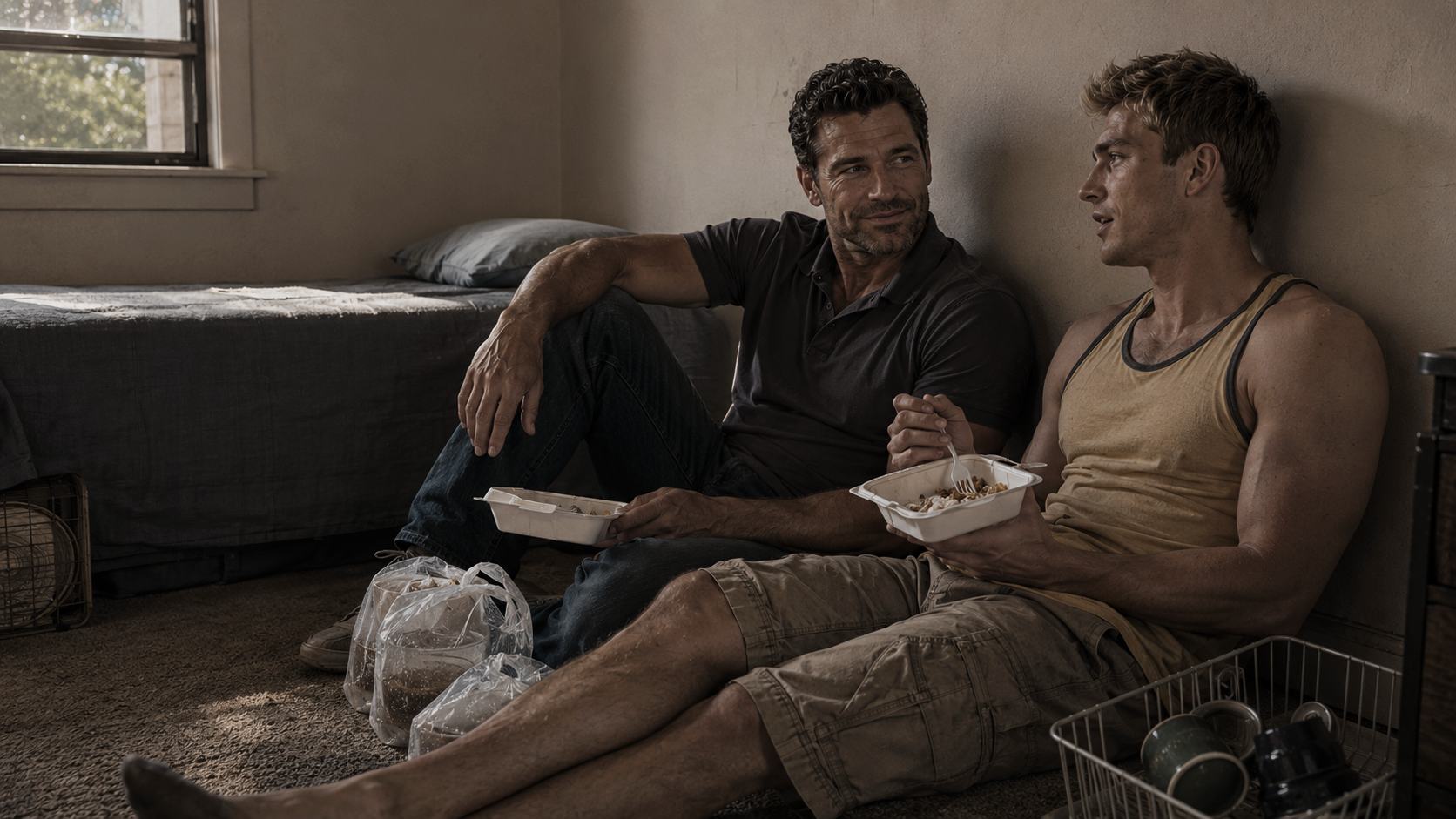
I sat on his floor. The floor because he didn’t have a dining table. I sat on the floor with my back against the wall and my knee started protesting about twenty minutes in and I didn’t mention it because complaining about my knee while sitting on the floor of a twenty-one-year-old’s apartment after driving forty-five minutes to bring him pho seemed like exactly the wrong move.
I studied his apartment while he ate. Not obviously. I was listening to him talk about his architecture studio. Something about load-bearing walls and the way light moves through a space. I was also cataloguing the evidence of his actual daily life. The reading list on the counter, marked up in handwriting that was small and precise. The two mugs in the dish rack, both chipped. The jacket not hung up, draped over a chair that looked like it had come from a thrift store. The single pillow on the bed. There was a total lack of evidence that another person resided here or was a regular visitor.
He’d been alone for a long time. I’d known that. He’d told me about Luke, about the breakup, about the way he’d been on his own since he was eighteen, but seeing it was different. Seeing the single pillow and the two chipped mugs and the jacket that didn’t have a hook to go on made something in my chest go tight and hot.
He told me I should go. I stood up and my knee made a sound I pretended wasn’t audible and I said you could and he said goodnight and I meant it the way I’d meant everything else I’d done for the past two months. Carefully, intentionally, with the full knowledge that I was in over my head and didn’t want to get out.
I drove back to Plano and thought about the moment a thing stops being what you’re doing and becomes who you are. I’d been doing this for two months. The tickets, the lake days, the skydiving, the pho on a Tuesday, and somewhere in there, probably in the parking lot when Jesse said my name knowing there was no meeting in Denton, it had stopped being a pursuit and started being just who I was now.
Someone who drove forty-five minutes for pho because Jesse mentioned it once.
Someone who sat on floors with bad knees because Jesse didn’t have a dining table.
Someone who said you could instead of come home with me because Jesse needed the question to be a question.
I pulled into my driveway and sat in the truck for a minute with the engine off. The house was big and silent and full of art I’d bought at auctions without knowing what I was looking at. In six hundred square feet with two chipped mugs and a single pillow, Jesse Tretiak had more than I’d ever managed to accumulate in forty-one years of trying.
I walked inside. Mercer met me at the door. I fed him and then I stood in my kitchen and added another line to the note on my phone. Floor. No dining table. Two mugs. Single pillow. And then, because I couldn’t stop myself, I’m going to marry him.

Jesse’s Point of View
It was a Saturday morning in late September. The doorbell rang at nine and when I opened it there was a man in a polo shirt with a clipboard who looked at me with the expression of someone who had been told to expect someone else.
“I’m Greg,” he said. “I’m here to see Wade.”
“He’s in the kitchen.”
Greg looked past me into the house. Then back at me. I was wearing a t-shirt and jeans and my hair was wet from the shower. I’d been in this house every weekend since August and some weeknights when my shift ended early enough to justify the drive. I knew where the coffee was and where Wade kept the good towels and exactly how long Mercer needed to be walked before he’d settle down for the morning.
This was the first time I’d opened the door to one of Wade’s business associates.
Wade came up behind me. Put his hand on my shoulder in a way that was meant to be casual and landed somewhere closer to possessive.
“Greg,” he said. “This is Jesse. He’s renting the other room.”
I froze.
The word landed in my chest and sat there. Roommate. Wade had said roommate. He’d said it easily, without hesitation, the way you say something you’ve practiced. The way you say something you’ve been saying for years about other people, about the men who’d stayed in the guest room before me. I was not a guest. I was not renting the other room. I was sleeping in his bed and eating breakfast at his counter and walking his dog in the mornings before he woke up. I was something that didn’t have a word in the language he used with people like Greg.
I processed it in real time. The cost. The specific cost of being introduced as a roommate to a man who clearly didn’t know Wade was gay, who clearly worked in an industry where that information would change things, who clearly inhabited a world where people like me were invisible by design.
Greg shook my hand. I shook his. We did the things people do when they’re meeting someone who doesn’t matter.
Wade took Greg out to the patio to look at whatever they were looking at. I stayed in the kitchen and made coffee and thought about the word roommate and what it cost me to hear it and what it would cost me to let it go.
When Greg left, Wade came back inside. He stood in the kitchen doorway with his hands in his pockets and his shoulders slightly hunched, the way he stands when he knows he’s done something wrong.
“I know,” he said.
I didn’t turn around. I was looking at the coffee pot. The coffee was done. It had been done for five minutes.
“Do you?” I said.
Not a question. A statement. I wasn’t asking if he knew. I was asking if he understood what it meant that he knew and did it anyway.
“Jesse.”
“I’ll give it time,” I said. “I understand why you did it. I’m not happy about it, but I understand.”
“It’s the business. The builders. The people I work with —”
“I know who it is. I was in the room.”
Wade was quiet. I turned around. He was looking at me with the expression of a man who had been handed something he didn’t know how to hold.
“I’m not going to be your roommate forever,” I said. “At some point you’re going to have to choose.”
“I know.”
“I’ll give it time. But I’m not going to forget what it feels like to be introduced as something I’m not.”
Wade crossed the kitchen. Put his hand on the back of my neck. Brief, steady, the way he did when he didn’t have words for what he was feeling.
“I know,” he said again.
I let the hand stay where it was. I didn’t lean into it. I didn’t pull away. I just stood there with the weight of his palm on my neck and the word roommate still settling in my chest and the knowledge that I’d just agreed to carry something I hadn’t asked to carry.
Some costs are invisible until you’re paying them. Some costs you pay because the alternative is worse.

Wade’s Point of View
I lay awake that night long after Jesse’s breathing had evened out beside me.
I wanted to explain. I wanted to tell him about my father in Tulsa who watched Fox News and referred to gay people as “that lifestyle” at Thanksgiving dinner. I wanted to tell him about the clients who would pull their money if they knew, the builders who’d stop returning my calls, the twenty years of professional relationships I’d built on a version of myself that didn’t include this part. I wanted to tell him it wasn’t about shame. It was about survival, about the practical reality of being a gay man in an industry that was still, in a lot of ways, stuck in 1985.
But that was the version I’d give him if I were making my case. The clean version. The one where it wasn’t about me.
The other version. The one I sat with while Jesse’s breathing evened out in the dark was harder to look at. I’d written I’m going to marry him in a note on my phone three weeks ago, and then this afternoon I’d looked a man in the eye and called him my roommate. Two truths, and the space between them was pure cowardice.
It wasn’t just the business. It wasn’t just my father, though I could still hear him, that lifestyle, in the frequency of contempt that made you feel frivolous and unclean. I’d spent forty-one years building a self that was the opposite of everything he meant. I was disciplined. I was successful. I threw parties and people came. I solved problems. I was taken seriously. And the whole structure depended on people not knowing the one thing. If I told them, I knew exactly what they’d see. Not the house. Not the business. Not the forty-one years of architecture I’d built around the secret. They’d see a middle-aged man in love with a twenty-one-year-old. That’s the first thought. That’s the joke. What’s wrong with him? Can’t find someone his own age? Midlife crisis with a pool.
I could handle losing money. I could handle losing clients. I couldn’t handle being a punchline I couldn’t control. My father would get to say I told you so without opening his mouth, and strangers would get to look at Jesse and me and write a story I didn’t get to edit.
That was the real reason. Not survival. Vanity.
But Jesse had said I’ll give it time in a tone I recognized as a choice rather than acceptance. He wasn’t okay with it. He was choosing to live with it, which was different. Which was bigger. Which meant he was handing me something I hadn’t asked for and trusting me not to drop it.
I lay in the dark and understood the burden of being given something without consent.
Jesse stirred beside me. Shifted in his sleep. His hand found my arm and stayed there, a warm pressure in the dark. He didn’t know he’d done it. His breathing didn’t change.
I didn’t move. I stayed exactly where I was with his hand on my arm and the word roommate still echoing in my head and the knowledge that eventually I was going to have to choose between the version of myself I’d built for the world and the version that existed in this house.
Not tonight. But eventually.

Early October. Eleven people at a steakhouse in Uptown. Private room, white tablecloths, a wine list that required its own binder.
I’d organized the dinner as a kind of introduction. Jesse was officially living with me now and the friend group needed to see us together in a context that wasn’t a lake day or a pool party. Something adult. Something that said this is real without actually saying the words.
I seated Jesse on my left. His good ear toward the table. I’d been doing it for so long it was automatic. I’d stopped thinking about the hearing and started just positioning him where he could hear. He’d stopped remarking on it. Some accommodations become invisible when you do them long enough.
The table filled in around us. Jake and Kip arrived first. Kip in something expensive, Jake in something comfortable, the distance between them visible if you knew where to look. Milo and Michael came next, Michael already telling a story about something that had happened at Whole Foods, Milo following with the patient expression of a man who’d heard seventeen versions of this story and was bracing for the eighteenth. Uncle Paul arrived in a blazer that was too young for him and scouted the table for the most attractive person under twenty-five. David and Ben and Baker came in together, a knot of younger energy that made the room feel briefly like a college bar.
Andrew arrived late. He worked the room with practiced ease. He hugged Kip, shook Jake’s hand, and said something to Michael that made him laugh. When he got to me, he gave me the easy smile of someone who’d seen me naked and wasn’t going to forget it.
“Jesse,” he said. “Good to see you again.”
The warmth was technically friendly. Entirely uninvested. Jesse clocked it. I saw the slight shift in his jaw, the way he catalogued the interaction and filed it somewhere, but he just nodded and said something polite and turned back to his menu.
Andrew caught Jesse looking at him later in the evening and gave him a small, cool smile. Jesse looked away first, but not like he’d lost. Like he’d gotten what he needed.
Michael and Milo’s fracture was visible if you knew what to look for. They sat next to each other but not quite together. A two-inch gap between their chairs that used to be zero inches. Michael made a joke about something, and Milo didn’t laugh. Milo said something dry about nostalgia, and Michael turned it into a bit instead of hearing what it actually was.
“I didn’t know we had a script,” Milo said at one point, and Michael laughed as if it were a joke and Milo didn’t correct him.
I filed it. I’d been filing things all evening. Andrew’s smile, Michael’s deflection, the way Kip kept finding reasons to be near me. I hadn’t yet assembled them into a pattern.
Jaegen arrived at nine with a bottle of Patrón Añejo and pre-arranged shot glasses. He poured three shots without asking. Handed them to Jesse.
“For the new official roommate,” he said, and the word roommate landed on the table like a boulder. I saw Jesse’s face go still. He took the shot. Drank it. Took the second one Jaegen poured.
Jaegen was warm. Solicitous. He asked Jesse a lot of questions about school, about work, about how things were going with us. Jesse answered politely. Kept his own counsel. Drank two of the three shots and left the third untouched.
I watched Jaegen work the table. Watched him refill Jesse’s glass. Watched the way his attention stayed on Jesse longer than it stayed on anyone else.
I filed it. Separately from the other things.

Jesse’s Point of View
Jaegen was warm. That was the first thing I noticed. He was warm in the way people are warm when they want you to like them, which differs from the warmth of people who just naturally like everyone. I couldn’t tell which one he was.
He asked a lot of questions. I answered them. I was on my third drink by then, someone kept refilling my wine glass, and the alcohol was doing its thing, the thing where my shoulders dropped and my sentences got longer and I stopped monitoring every expression that crossed my face.
“Wade says you’re studying art and business,” Jaegen said. He was sitting next to me, his chair angled toward mine, his attention full and focused. “That’s impressive. How’s the program?”
“Demanding. I like it.”
“And you’re working at the same time? Restaurant work, right?”
“Yeah.”
“That’s a lot. Wade mentioned you support yourself. That’s genuinely impressive. Most people couldn’t manage that at your age.”
I didn’t know what to do with the compliment. It was specific. It was appropriate. It felt like something he’d been thinking about before he said it.
“How are things with Wade?” he asked. “Really. He tells me things are good, but Wade tells everyone things are good.”
“They’re good,” I said.
“Good. I’m glad.” He refilled my glass. “He seems different with you. More settled. Less like he’s performing all the time. I think you’re good for him.”
I found myself liking Jaegen. He was easy to talk to. He asked real questions and listened to the answers and didn’t seem to be working an angle. By the end of the dinner I’d decided he was probably just a friendly person who was genuinely interested in his friend’s new relationship.
On the drive home, something nagged at me.
“Jaegen asks a lot of questions,” I said.
Wade was driving. The streetlights slid across his face at regular intervals. “That’s Jaegen. He’s always been like that.”
“He bought me three shots. Without asking.”
“He does that too.”
I didn’t say anything else. Wade didn’t push. The night was warm through the open window, and the Dallas skyline was doing its thing in the rearview mirror, and I was tired and full and trying to figure out why Jaegen’s attention had felt less like friendship and more like research.
At home, I stood in the bathroom doorway while Wade brushed his teeth. I almost said something, it felt like he was taking notes, like he was collecting information, like every question had a purpose I couldn’t see, and then didn’t.
“What?” Wade said around the toothbrush.
“Nothing. Just tired.”
I got into bed. Mercer was already at the foot of it, a warm weight against my ankles. Wade finished in the bathroom and got in beside me and turned off the light. The house settled into its nighttime quiet.
I lay awake processing. Andrew’s smile, cool and unbothered, the smile of someone who’d seen the inside of this bedroom and expected to see it again. Jaegen’s watchful attention, the way he’d refilled my glass without being asked, the way his questions had felt like a survey. Being introduced as a roommate, the third time in a month, the word settling into the space where my actual life was supposed to be.
The dog at the foot of the bed.
Wade’s hand found mine in the dark.
“Wade,” I said. Very quietly. I meant to say something else and then didn’t know what it was.
His thumb moved across my knuckles. “I know. Me too.”
I didn’t say it back. I didn’t need to. Whatever it was, it was there in the dark between us, unnamed and understood.

Wade’s Point of View
I woke before Jesse in gray October light.
The shutters were doing their thing. Thin lines of pale gold across the ceiling, across the bedspread, across Jesse’s shoulder where the sheet had slipped down. He was still asleep. His breathing was slow and even. His face was relaxed in a way it almost never was when he was awake.
I lay there and laid out the receipts in my mind.
The builder. He’s renting the other room. The way Jesse’s shoulders had gone tight and then deliberately loose. The way he’d said I’ll give it time like he was handing me a loan he expected to be repaid.
The group dinner. Andrew’s cool smile, the way he’d worked the room like he still belonged in it. Jaegen’s arrival with the Patrón and the pre-arranged shot glasses and the attention that had stayed on Jesse like a heat lamp. The way Jaegen had asked how are things with Wade like he was collecting information for later use. The shots Jesse had drunk without protest. The ones I’d let him drink because I hadn’t yet assembled any of this into a pattern.
Michael and Milo, sitting two inches apart. Kip, finding reasons to be near me. David, watching Jesse with the expression of someone who’d lost something and wasn’t sure when he’d lost it.
The choices I’d already made. The choices I was going to have to make. The version of myself I’d built for the world. The straight-presenting entrepreneur, the guy who introduced his boyfriends as roommates, the man who’d spent forty-one years being the most important person in his own life. And the version that existed in this house, in this bed, with this man beside me and this dog at our feet and this life we were building in the spaces between the lies.
I would have to have to choose eventually between the version of myself I curated for the world and the version that existed in this house. The builder was one thing. The family dinner I was going to have to sit through someday, watching my father’s face, that was another. Strangers on a patio, doing the math on our ages, making me the punchline of a joke I didn’t write, that was the thing I was actually afraid of. And Jesse had said I’ll give it time anyway.
I lay there and felt the weight of being handed something I hadn’t been asked to hold. A clock I didn’t know how to read, ticking toward a moment I wasn’t ready for. I wasn’t ready. I knew I wasn’t ready. But Jesse had said I’ll give it time and what he meant was I’ll give you time to become someone who doesn’t need it anymore and I was going to have to earn that.
He stirred beside me. Opened his eyes. Found me already awake.
“Hey,” he said.
“Hey.”
“You’re thinking.”
“I’m always thinking.”
“You’re thinking about something you don’t want to tell me.”
I turned my head on the pillow. Looked at him. “I was thinking about how many times I’m going to have to introduce you as my roommate before I figure out how to stop.”
Jesse was quiet for a moment. “That’s honest.”
“Was it the wrong thing to say?”
“No. It was the right thing. I just wasn’t expecting it.”
He sat up. The sheet pooled around his waist. The growing gray light filled the room with the October morning, making everything look washed clean.
“I’m going to make coffee,” he said.
“I’ll be there in a minute.”
He got up. Pulled on a pair of sweatpants that were mine, actually, and a t-shirt that was also probably mine. Mercer lifted his head, assessed the situation, and followed Jesse out of the room. The dog had made his choice months ago.
I lay in bed for another minute. Looked at the ceiling. Thought about the things I was going to have to do and the person I was going to have to become.
Then I got up and made my way to the kitchen.
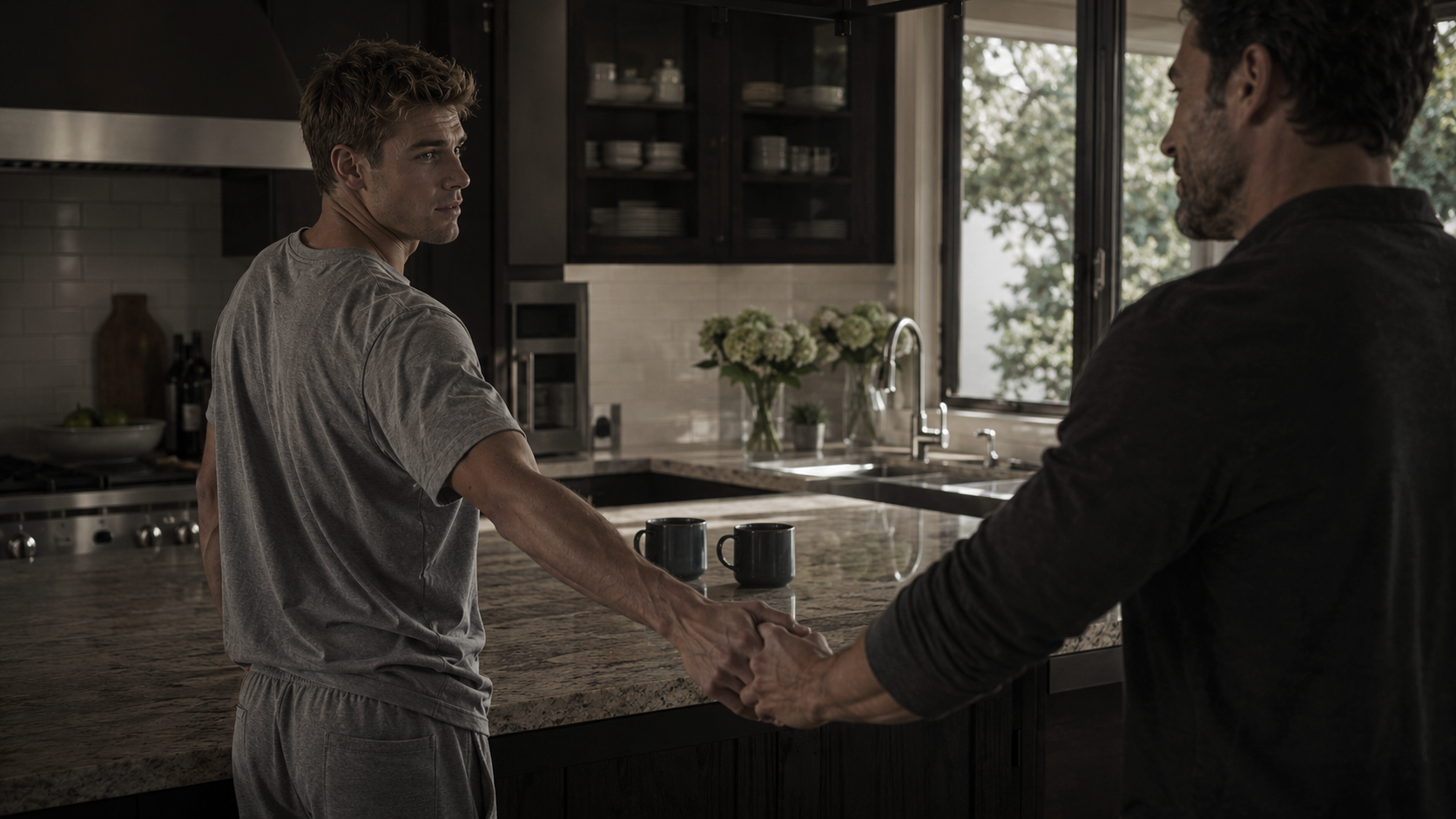
Jesse was at the counter with the coffee pot. His back was to me. The morning light was coming through the window over the sink and catching the edges of his hair. He’d set out two mugs. The good ones, the ones I’d bought at some artisan market in Austin and never used because no one had ever been here long enough to know where the good mugs were.
He reached across the counter and took my hand.
“I’m glad you’re here,” I said.
Jesse looked at me. His face did the thing it does when he’s feeling something he doesn’t have words for. The stillness, the slight jaw tightening, the direct gaze that never quite gives up what it’s carrying.
“I know,” he said. “I’m glad I’m here too.”

End of Chapter 5.2.